
Colorado Statewide Digital Trunked Radio System DTRS Training


- Slides: 52
Colorado Statewide Digital Trunked Radio System (DTRS) Training Prepared by: CCNC, Inc. Training Sub-Committee
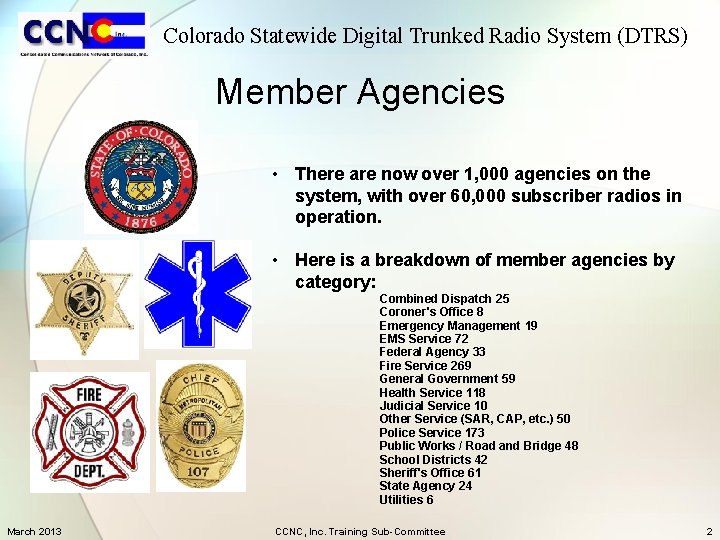
Colorado Statewide Digital Trunked Radio System (DTRS) Member Agencies • There are now over 1, 000 agencies on the system, with over 60, 000 subscriber radios in operation. • Here is a breakdown of member agencies by category: Combined Dispatch 25 Coroner's Office 8 Emergency Management 19 EMS Service 72 Federal Agency 33 Fire Service 269 General Government 59 Health Service 118 Judicial Service 10 Other Service (SAR, CAP, etc. ) 50 Police Service 173 Public Works / Road and Bridge 48 School Districts 42 Sheriff's Office 61 State Agency 24 Utilities 6 March 2013 CCNC, Inc. Training Sub-Committee 2
Colorado Statewide Digital Trunked Radio System (DTRS) CCNC, Inc. • CCNC, Inc. provides an organized user group made of participating government & public safety users. • The group meets monthly as a full body of members. • Various boards and committees meet generally monthly to provide specialized guidance and insight as it relates to system performance and operational guidelines. March 2013 CCNC, Inc. Training Sub-Committee 3
Colorado Statewide Digital Trunked Radio System (DTRS) Basic Radio System Information ( “Radio 101” ) Please check out additional training offered at www. co. train. org March 2013 CCNC, Inc. Training Sub-Committee 4
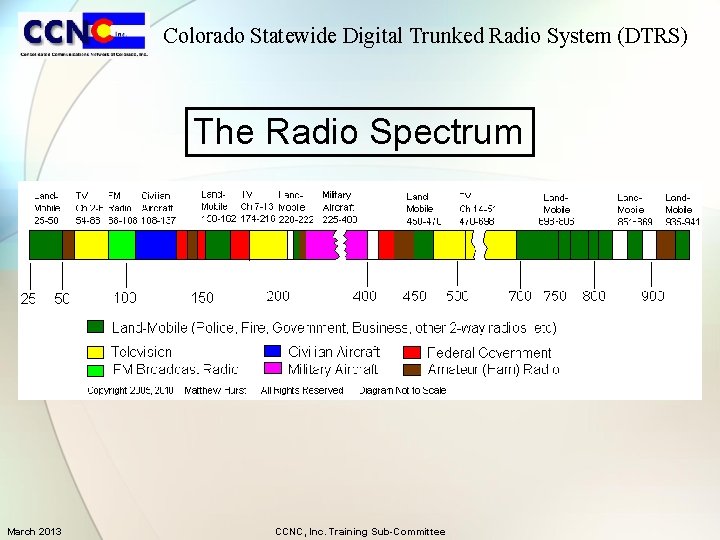
Colorado Statewide Digital Trunked Radio System (DTRS) The Radio Spectrum March 2013 CCNC, Inc. Training Sub-Committee
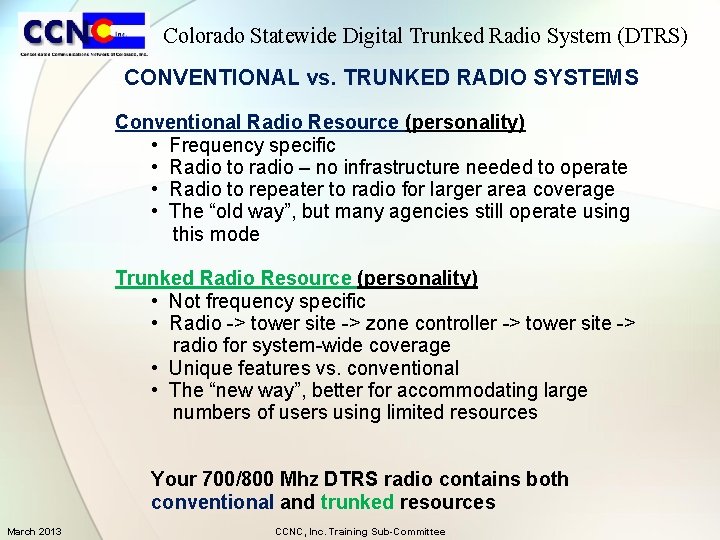
Colorado Statewide Digital Trunked Radio System (DTRS) CONVENTIONAL vs. TRUNKED RADIO SYSTEMS Conventional Radio Resource (personality) • Frequency specific • Radio to radio – no infrastructure needed to operate • Radio to repeater to radio for larger area coverage • The “old way”, but many agencies still operate using this mode Trunked Radio Resource (personality) • Not frequency specific • Radio -> tower site -> zone controller -> tower site -> radio for system-wide coverage • Unique features vs. conventional • The “new way”, better for accommodating large numbers of users using limited resources Your 700/800 Mhz DTRS radio contains both conventional and trunked resources March 2013 CCNC, Inc. Training Sub-Committee
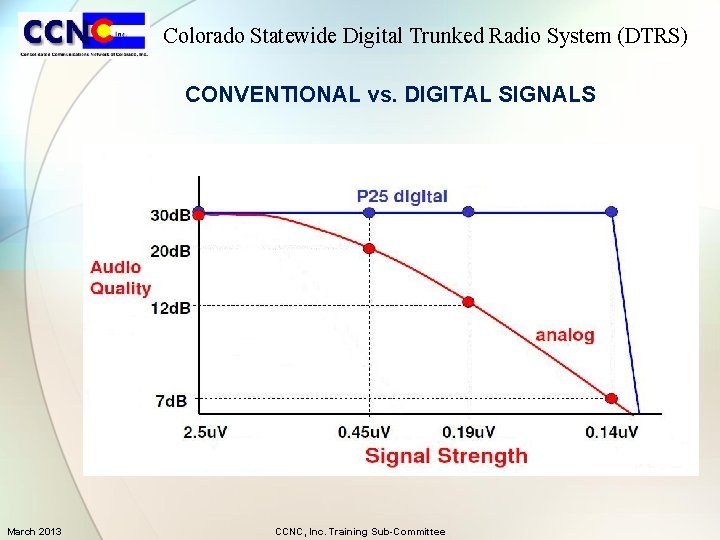
Colorado Statewide Digital Trunked Radio System (DTRS) CONVENTIONAL vs. DIGITAL SIGNALS March 2013 CCNC, Inc. Training Sub-Committee
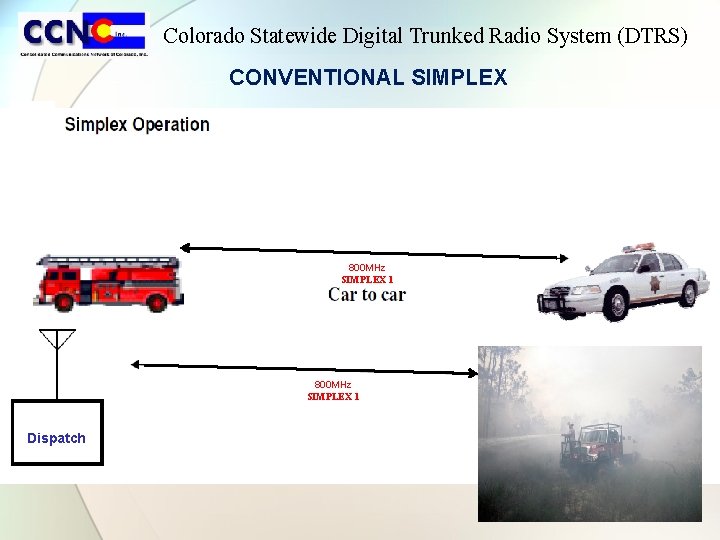
Colorado Statewide Digital Trunked Radio System (DTRS) CONVENTIONAL SIMPLEX 800 MHz SIMPLEX 1 Dispatch to Car Dispatch
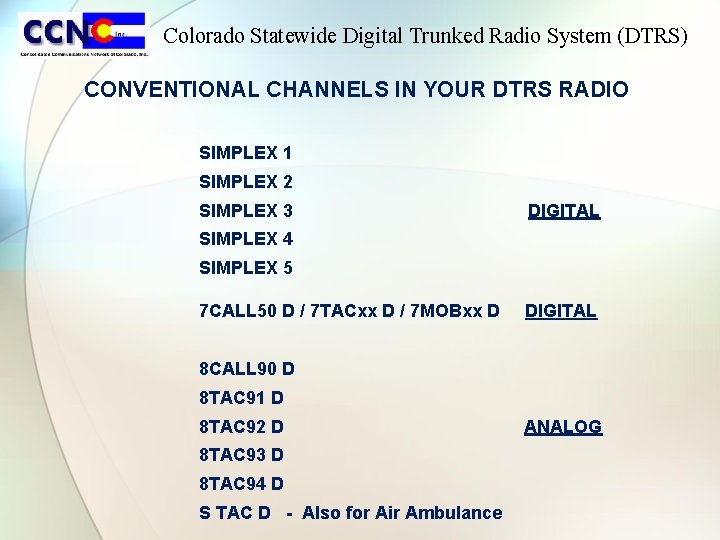
Colorado Statewide Digital Trunked Radio System (DTRS) CONVENTIONAL CHANNELS IN YOUR DTRS RADIO SIMPLEX 1 SIMPLEX 2 SIMPLEX 3 DIGITAL SIMPLEX 4 SIMPLEX 5 7 CALL 50 D / 7 TACxx D / 7 MOBxx D DIGITAL 8 CALL 90 D 8 TAC 91 D 8 TAC 92 D 8 TAC 93 D 8 TAC 94 D S TAC D - Also for Air Ambulance ANALOG
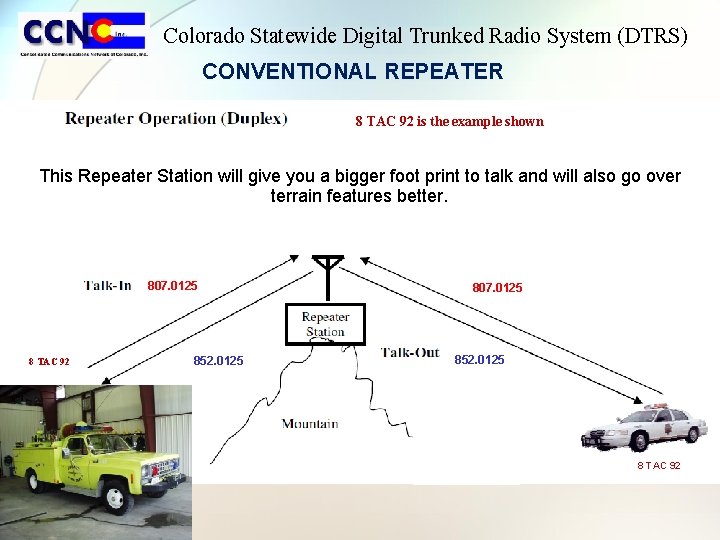
Colorado Statewide Digital Trunked Radio System (DTRS) CONVENTIONAL REPEATER 8 TAC 92 is the example shown This Repeater Station will give you a bigger foot print to talk and will also go over terrain features better. HORSETOOTH 8 TAC 92 807. 0125 8 TAC 92 852. 0125 807. 0125 852. 0125 VHF LCSO 1 COM VAN 8 TAC 92
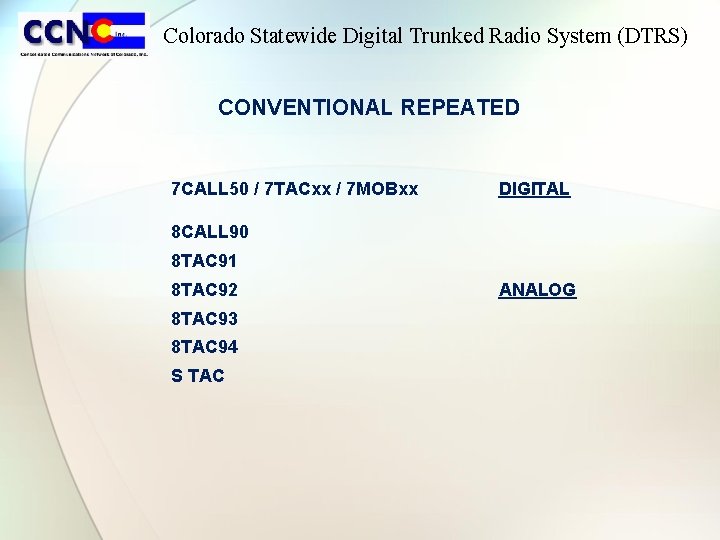
Colorado Statewide Digital Trunked Radio System (DTRS) CONVENTIONAL REPEATED 7 CALL 50 / 7 TACxx / 7 MOBxx DIGITAL 8 CALL 90 8 TAC 91 8 TAC 92 8 TAC 93 8 TAC 94 S TAC ANALOG
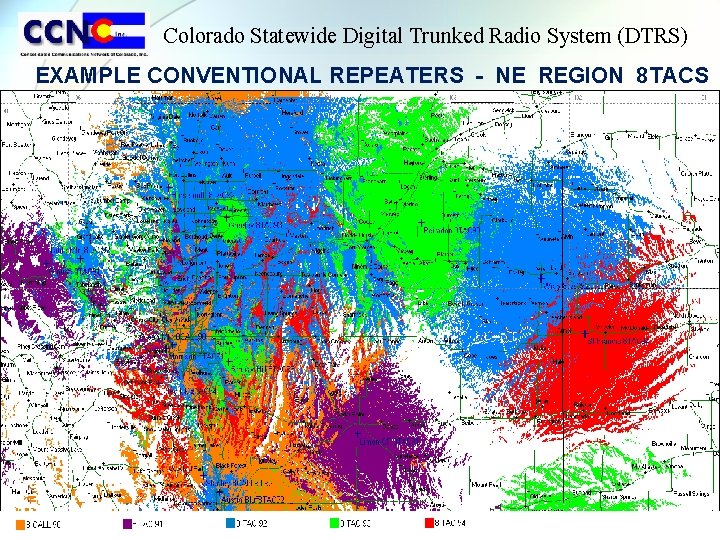
Colorado Statewide Digital Trunked Radio System (DTRS) EXAMPLE CONVENTIONAL REPEATERS - NE REGION 8 TACS
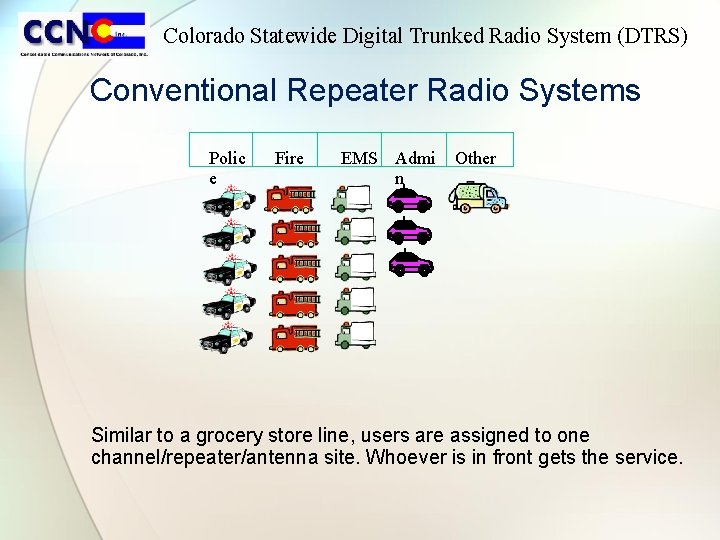
Colorado Statewide Digital Trunked Radio System (DTRS) Conventional Repeater Radio Systems Polic e Fire EMS Admi n Other Similar to a grocery store line, users are assigned to one channel/repeater/antenna site. Whoever is in front gets the service.
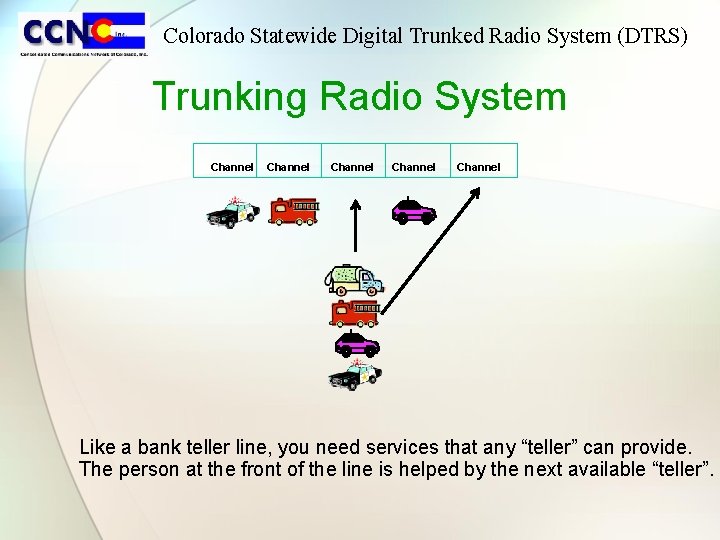
Colorado Statewide Digital Trunked Radio System (DTRS) Trunking Radio System Channel Channel Like a bank teller line, you need services that any “teller” can provide. The person at the front of the line is helped by the next available “teller”.
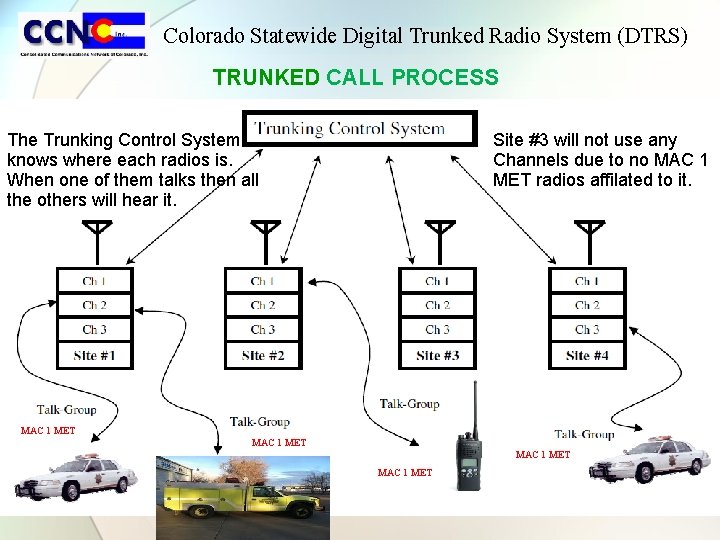
Colorado Statewide Digital Trunked Radio System (DTRS) TRUNKED CALL PROCESS The Trunking Control System knows where each radios is. When one of them talks then all the others will hear it. Site #3 will not use any Channels due to no MAC 1 MET radios affilated to it. MAC 1 MET COM VAN MAC 1 MET
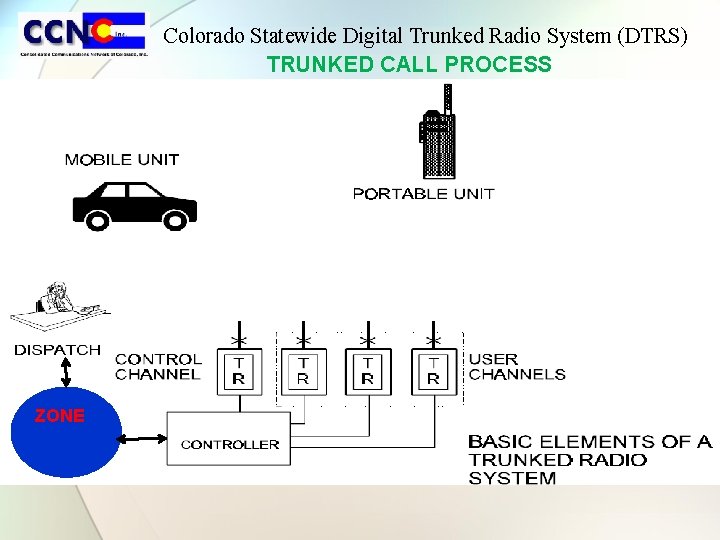
Colorado Statewide Digital Trunked Radio System (DTRS) TRUNKED CALL PROCESS BASE SITE ZONE SITE
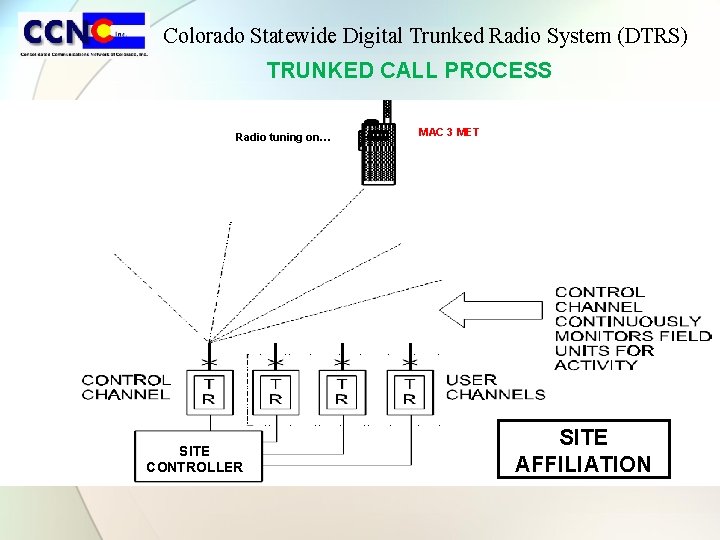
Colorado Statewide Digital Trunked Radio System (DTRS) TRUNKED CALL PROCESS Radio tuning on… MAC 3 MET LC DISP LC FIRE LC DISP SITE CONTROLLER SITE AFFILIATION
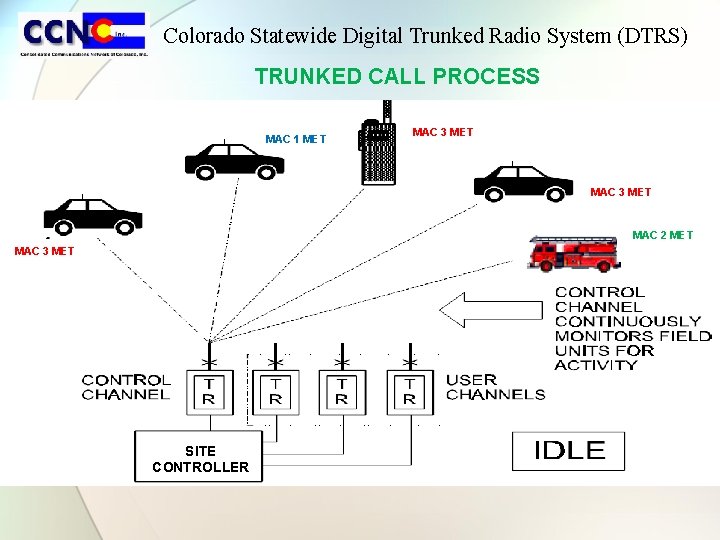
Colorado Statewide Digital Trunked Radio System (DTRS) TRUNKED CALL PROCESS MAC 1 MET MAC 3 MET MAC 2 MET MAC 3 MET SITE CONTROLLER
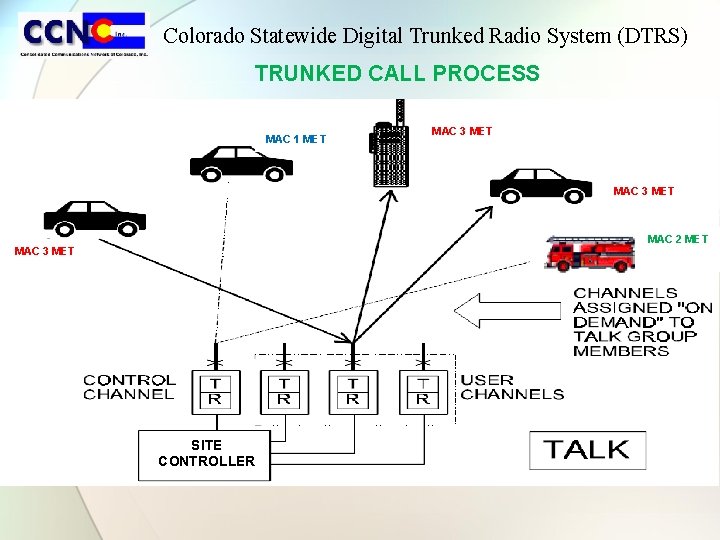
Colorado Statewide Digital Trunked Radio System (DTRS) TRUNKED CALL PROCESS MAC 1 MET MAC 3 MET MAC 2 MET MAC 3 MET SITE CONTROLLER
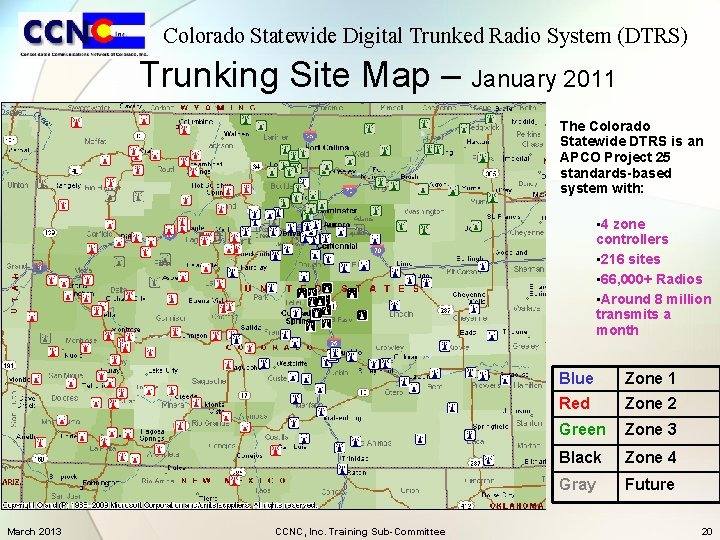
Colorado Statewide Digital Trunked Radio System (DTRS) Trunking Site Map – January 2011 The Colorado Statewide DTRS is an APCO Project 25 standards-based system with: • 4 zone controllers • 216 sites • 66, 000+ Radios • Around 8 million transmits a month March 2013 CCNC, Inc. Training Sub-Committee Blue Zone 1 Red Zone 2 Green Zone 3 Black Zone 4 Gray Future 20
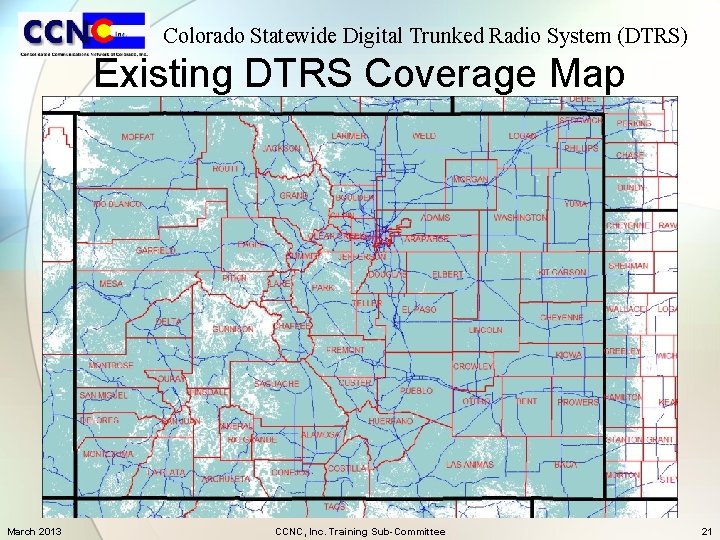
Colorado Statewide Digital Trunked Radio System (DTRS) Existing DTRS Coverage Map March 2013 CCNC, Inc. Training Sub-Committee 21
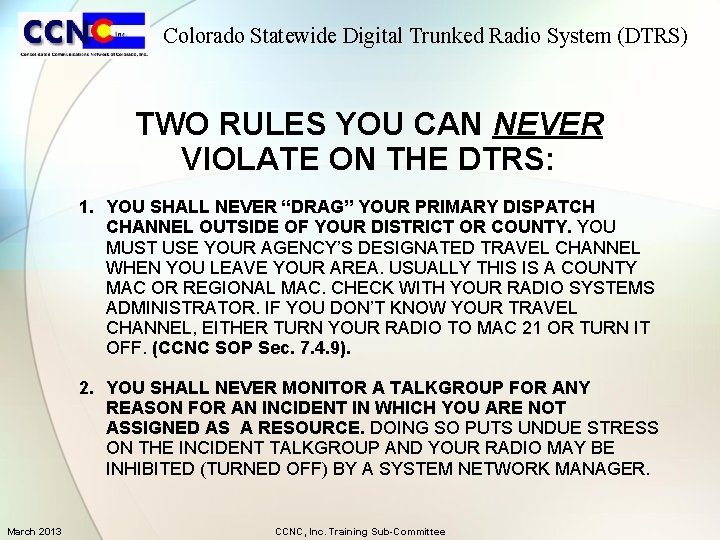
Colorado Statewide Digital Trunked Radio System (DTRS) TWO RULES YOU CAN NEVER VIOLATE ON THE DTRS: 1. YOU SHALL NEVER “DRAG” YOUR PRIMARY DISPATCH CHANNEL OUTSIDE OF YOUR DISTRICT OR COUNTY. YOU MUST USE YOUR AGENCY’S DESIGNATED TRAVEL CHANNEL WHEN YOU LEAVE YOUR AREA. USUALLY THIS IS A COUNTY MAC OR REGIONAL MAC. CHECK WITH YOUR RADIO SYSTEMS ADMINISTRATOR. IF YOU DON’T KNOW YOUR TRAVEL CHANNEL, EITHER TURN YOUR RADIO TO MAC 21 OR TURN IT OFF. (CCNC SOP Sec. 7. 4. 9). 2. YOU SHALL NEVER MONITOR A TALKGROUP FOR ANY REASON FOR AN INCIDENT IN WHICH YOU ARE NOT ASSIGNED AS A RESOURCE. DOING SO PUTS UNDUE STRESS ON THE INCIDENT TALKGROUP AND YOUR RADIO MAY BE INHIBITED (TURNED OFF) BY A SYSTEM NETWORK MANAGER. March 2013 CCNC, Inc. Training Sub-Committee
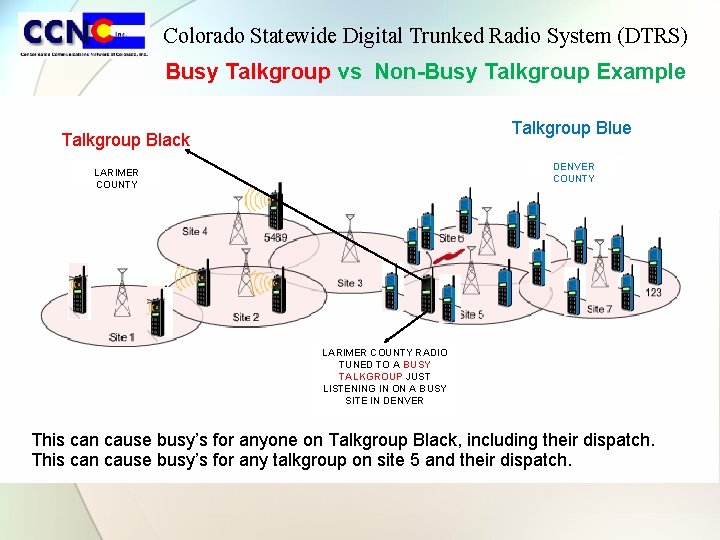
Colorado Statewide Digital Trunked Radio System (DTRS) Busy Talkgroup vs Non-Busy Talkgroup Example Talkgroup Blue Talkgroup Black DENVER COUNTY LARIMER COUNTY RADIO TUNED TO A BUSY TALKGROUP JUST LISTENING IN ON A BUSY SITE IN DENVER This can cause busy’s for anyone on Talkgroup Black, including their dispatch. This can cause busy’s for any talkgroup on site 5 and their dispatch.
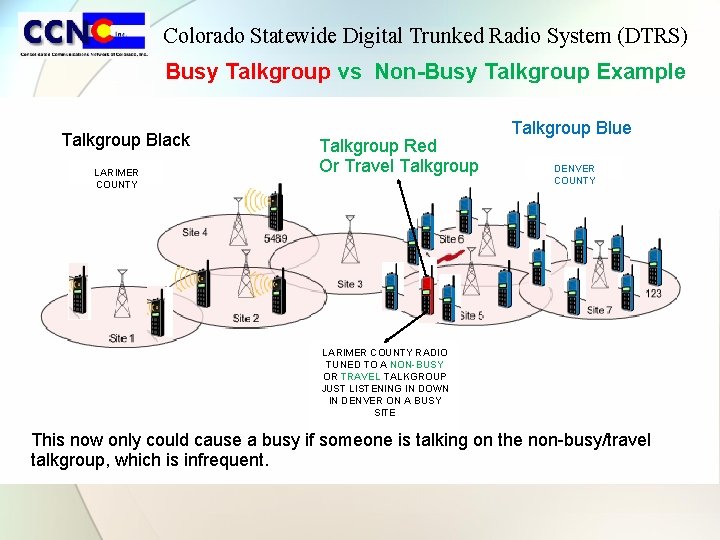
Colorado Statewide Digital Trunked Radio System (DTRS) Busy Talkgroup vs Non-Busy Talkgroup Example Talkgroup Black LARIMER COUNTY Talkgroup Red Or Travel Talkgroup Blue DENVER COUNTY LARIMER COUNTY RADIO TUNED TO A NON-BUSY OR TRAVEL TALKGROUP JUST LISTENING IN DOWN IN DENVER ON A BUSY SITE This now only could cause a busy if someone is talking on the non-busy/travel talkgroup, which is infrequent.
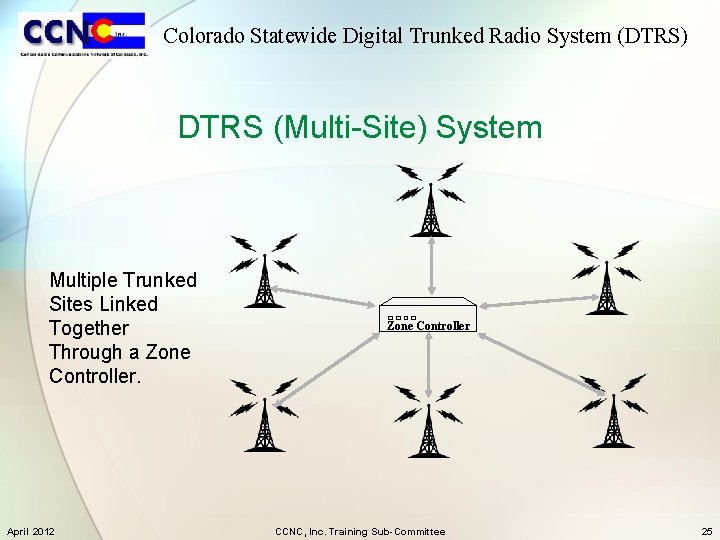
Colorado Statewide Digital Trunked Radio System (DTRS) DTRS (Multi-Site) System Multiple Trunked Sites Linked Together Through a Zone Controller. April 2012 Zone Controller CCNC, Inc. Training Sub-Committee 25
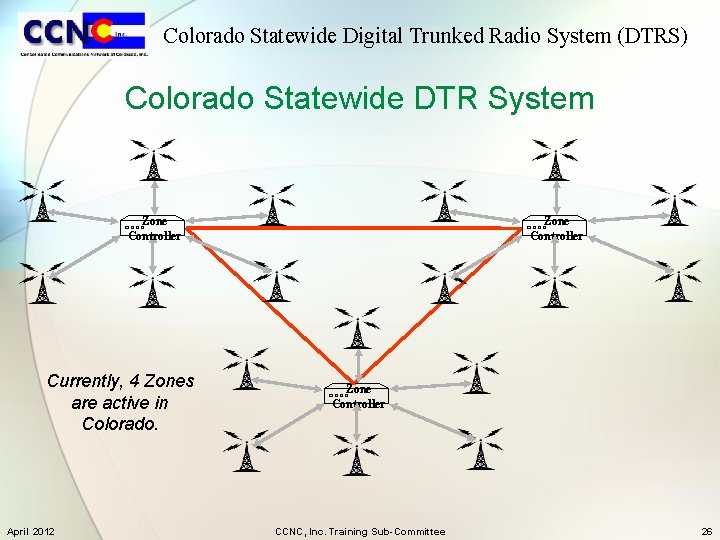
Colorado Statewide Digital Trunked Radio System (DTRS) Colorado Statewide DTR System Zone Controller Currently, 4 Zones are active in Colorado. April 2012 Zone Controller CCNC, Inc. Training Sub-Committee 26
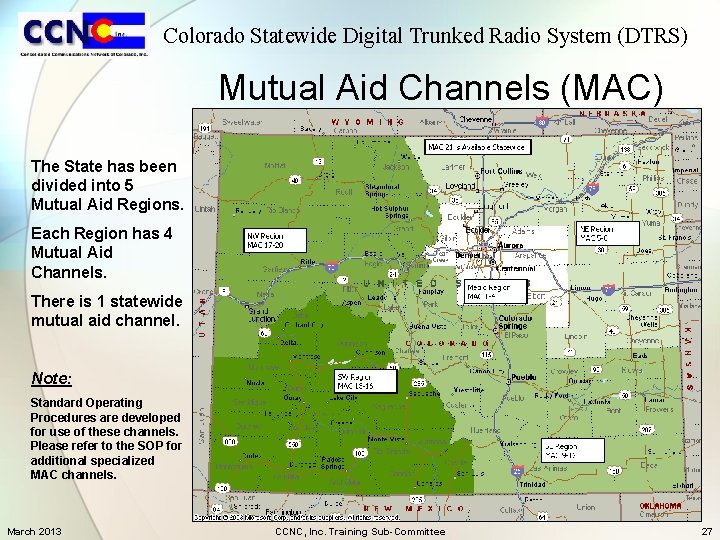
Colorado Statewide Digital Trunked Radio System (DTRS) Mutual Aid Channels (MAC) The State has been divided into 5 Mutual Aid Regions. Each Region has 4 Mutual Aid Channels. There is 1 statewide mutual aid channel. Note: Standard Operating Procedures are developed for use of these channels. Please refer to the SOP for additional specialized MAC channels. March 2013 CCNC, Inc. Training Sub-Committee 27
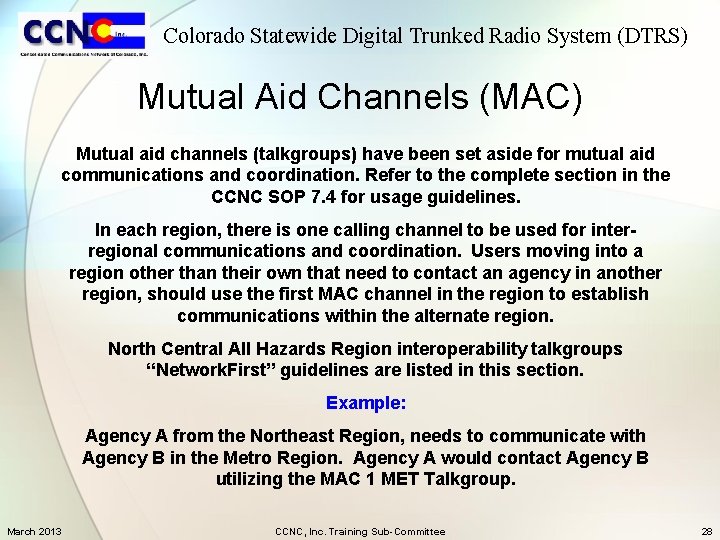
Colorado Statewide Digital Trunked Radio System (DTRS) Mutual Aid Channels (MAC) Mutual aid channels (talkgroups) have been set aside for mutual aid communications and coordination. Refer to the complete section in the CCNC SOP 7. 4 for usage guidelines. In each region, there is one calling channel to be used for interregional communications and coordination. Users moving into a region other than their own that need to contact an agency in another region, should use the first MAC channel in the region to establish communications within the alternate region. North Central All Hazards Region interoperability talkgroups “Network. First” guidelines are listed in this section. Example: Agency A from the Northeast Region, needs to communicate with Agency B in the Metro Region. Agency A would contact Agency B utilizing the MAC 1 MET Talkgroup. March 2013 CCNC, Inc. Training Sub-Committee 28
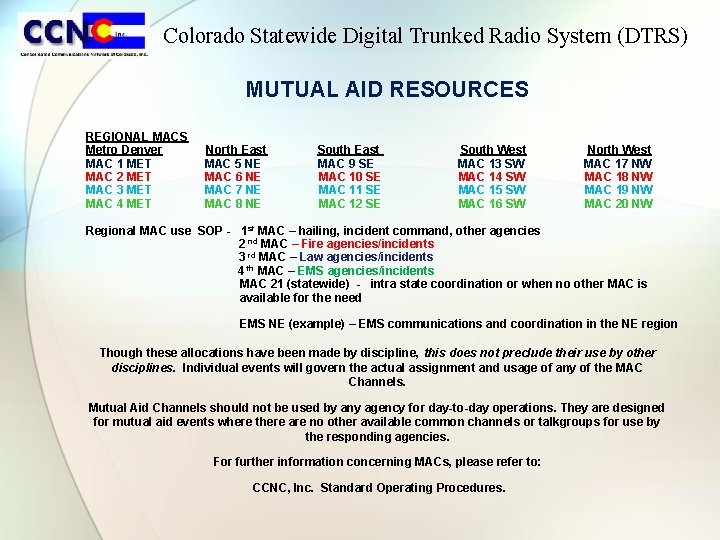
Colorado Statewide Digital Trunked Radio System (DTRS) MUTUAL AID RESOURCES REGIONAL MACS Metro Denver MAC 1 MET MAC 2 MET MAC 3 MET MAC 4 MET North East MAC 5 NE MAC 6 NE MAC 7 NE MAC 8 NE South East MAC 9 SE MAC 10 SE MAC 11 SE MAC 12 SE South West MAC 13 SW MAC 14 SW MAC 15 SW MAC 16 SW North West MAC 17 NW MAC 18 NW MAC 19 NW MAC 20 NW Regional MAC use SOP - 1 st MAC – hailing, incident command, other agencies 2 nd MAC – Fire agencies/incidents 3 rd MAC – Law agencies/incidents 4 th MAC – EMS agencies/incidents MAC 21 (statewide) - intra state coordination or when no other MAC is available for the need EMS NE (example) – EMS communications and coordination in the NE region Though these allocations have been made by discipline, this does not preclude their use by other disciplines. Individual events will govern the actual assignment and usage of any of the MAC Channels. Mutual Aid Channels should not be used by any agency for day-to-day operations. They are designed for mutual aid events where there are no other available common channels or talkgroups for use by the responding agencies. For further information concerning MACs, please refer to: CCNC, Inc. Standard Operating Procedures.
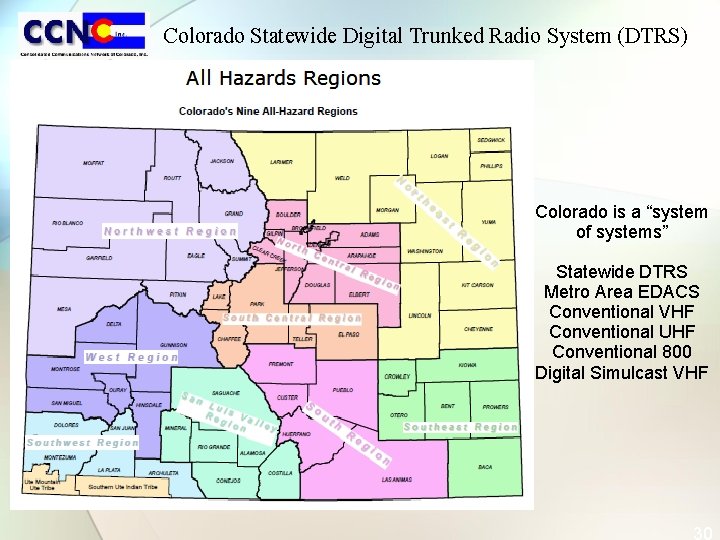
Colorado Statewide Digital Trunked Radio System (DTRS) Colorado is a “system of systems” Statewide DTRS Metro Area EDACS Conventional VHF Conventional UHF Conventional 800 Digital Simulcast VHF 30
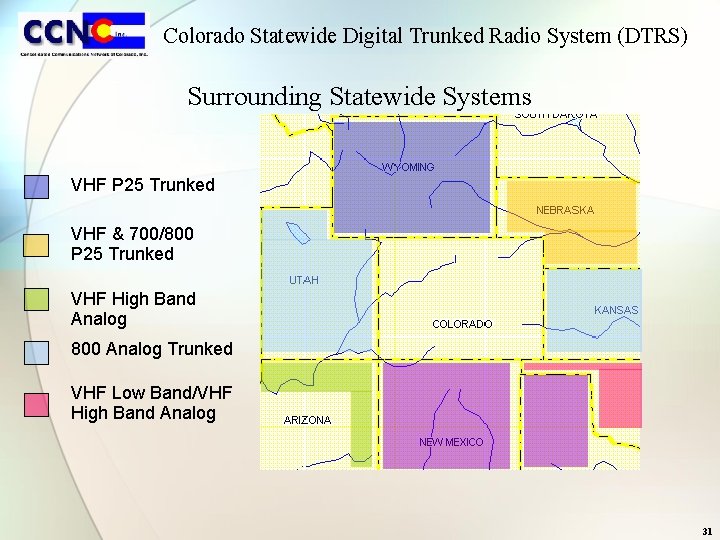
Colorado Statewide Digital Trunked Radio System (DTRS) Surrounding Statewide Systems VHF P 25 Trunked VHF & 700/800 P 25 Trunked VHF High Band Analog 800 Analog Trunked VHF Low Band/VHF High Band Analog 31
Colorado Statewide Digital Trunked Radio System (DTRS) Scanning Other Talkgroups April 2012 CCNC, Inc. Training Sub-Committee 32
Colorado Statewide Digital Trunked Radio System (DTRS) Scanning • Scanning of other talkgroups: • Is not a Best Practice • Does not support Mission Critical Communications Users may miss communications on their primary talkgroup as well as on the talkgroups that are being scanned. April 2012 CCNC, Inc. Training Sub-Committee 33
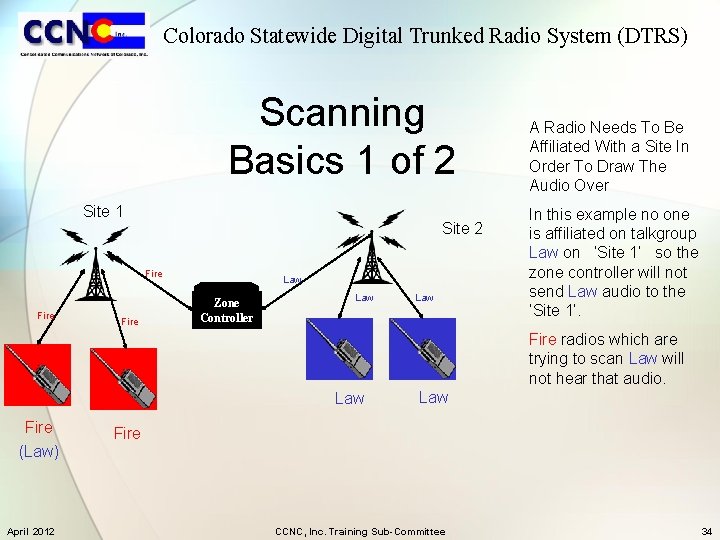
Colorado Statewide Digital Trunked Radio System (DTRS) Scanning Basics 1 of 2 Site 1 Site 2 Fire Law Zone Controller Law A Radio Needs To Be Affiliated With a Site In Order To Draw The Audio Over In this example no one is affiliated on talkgroup Law on ‘Site 1’ so the zone controller will not send Law audio to the ‘Site 1’. Fire radios which are trying to scan Law will not hear that audio. Law Fire (Law) April 2012 Law Fire CCNC, Inc. Training Sub-Committee 34
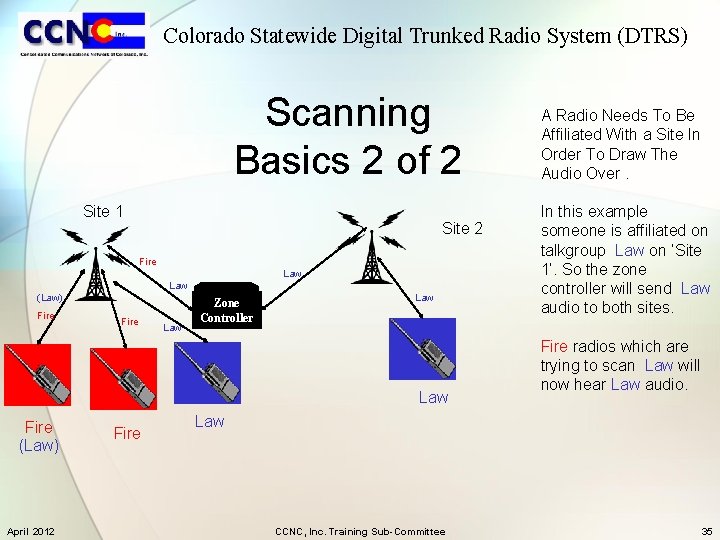
Colorado Statewide Digital Trunked Radio System (DTRS) Scanning Basics 2 of 2 Site 1 Site 2 Fire Law (Law) Fire Law Zone Controller Law Fire (Law) April 2012 Fire A Radio Needs To Be Affiliated With a Site In Order To Draw The Audio Over. In this example someone is affiliated on talkgroup Law on ‘Site 1’. So the zone controller will send Law audio to both sites. Fire radios which are trying to scan Law will now hear Law audio. Law CCNC, Inc. Training Sub-Committee 35
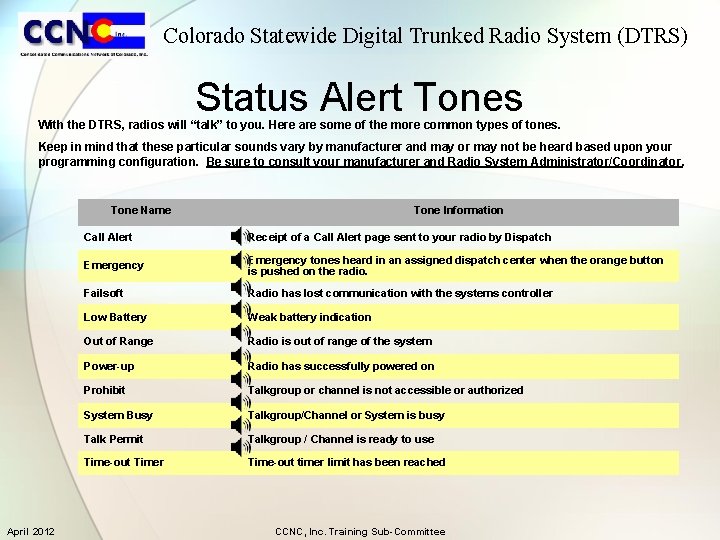
Colorado Statewide Digital Trunked Radio System (DTRS) Status Alert Tones* *Please note: There are five suppliers currently approved to provide radios to DTRS users, including Motorola, Tait, Harris, Kenwood and EF Johnson. Please get with your vendor or systems administrator for more accurate information regarding tones, programming information and radio usage. April 2012 CCNC, Inc. Training Sub-Committee 36
Colorado Statewide Digital Trunked Radio System (DTRS) Status Alert Tones With the DTRS, radios will “talk” to you. Here are some of the more common types of tones. Keep in mind that these particular sounds vary by manufacturer and may or may not be heard based upon your programming configuration. Be sure to consult your manufacturer and Radio System Administrator/Coordinator. Tone Name April 2012 Tone Information Call Alert Receipt of a Call Alert page sent to your radio by Dispatch Emergency tones heard in an assigned dispatch center when the orange button is pushed on the radio. Failsoft Radio has lost communication with the systems controller Low Battery Weak battery indication Out of Range Radio is out of range of the system Power-up Radio has successfully powered on Prohibit Talkgroup or channel is not accessible or authorized System Busy Talkgroup/Channel or System is busy Talk Permit Talkgroup / Channel is ready to use Time-out Timer Time-out timer limit has been reached CCNC, Inc. Training Sub-Committee
Colorado Statewide Digital Trunked Radio System (DTRS) Emergency Button April 2012 CCNC, Inc. Training Sub-Committee 38
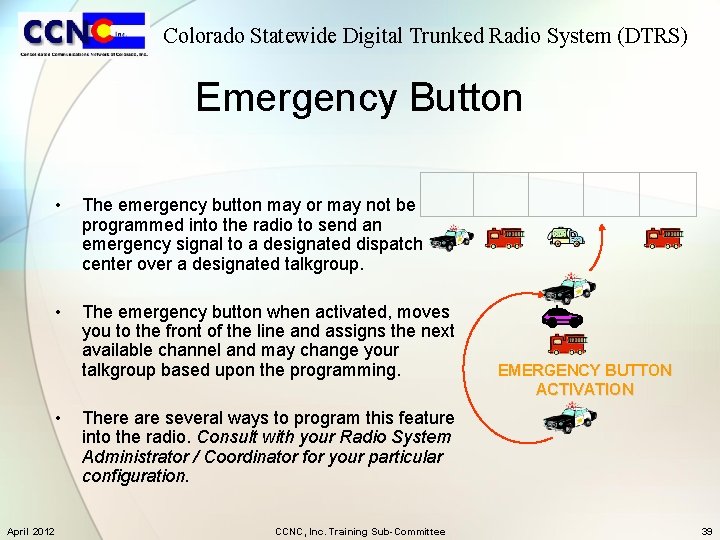
Colorado Statewide Digital Trunked Radio System (DTRS) Emergency Button • The emergency button may or may not be programmed into the radio to send an emergency signal to a designated dispatch center over a designated talkgroup. • The emergency button when activated, moves you to the front of the line and assigns the next available channel and may change your talkgroup based upon the programming. • April 2012 EMERGENCY BUTTON ACTIVATION There are several ways to program this feature into the radio. Consult with your Radio System Administrator / Coordinator for your particular configuration. CCNC, Inc. Training Sub-Committee 39
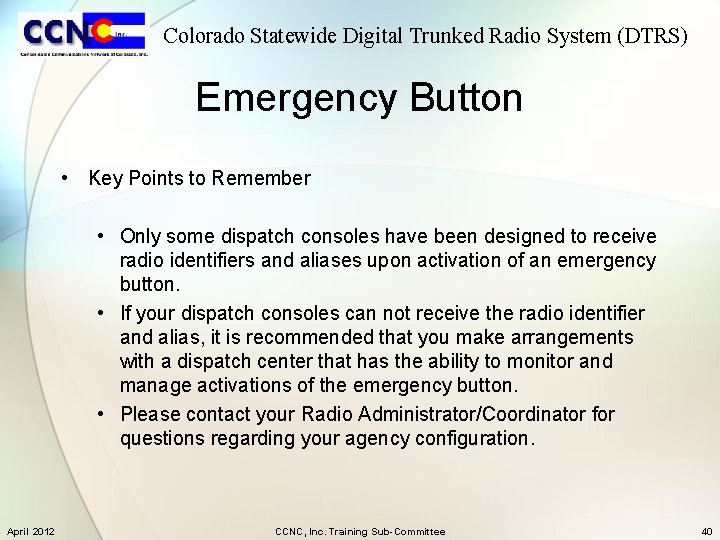
Colorado Statewide Digital Trunked Radio System (DTRS) Emergency Button • Key Points to Remember • Only some dispatch consoles have been designed to receive radio identifiers and aliases upon activation of an emergency button. • If your dispatch consoles can not receive the radio identifier and alias, it is recommended that you make arrangements with a dispatch center that has the ability to monitor and manage activations of the emergency button. • Please contact your Radio Administrator/Coordinator for questions regarding your agency configuration. April 2012 CCNC, Inc. Training Sub-Committee 40
Colorado Statewide Digital Trunked Radio System (DTRS) Emergency Button • Key Points to Remember • Should a user activate the emergency button, remember to “clear” the emergency at the conclusion of the activation. • For information on clearing the activation, refer to your radio manufacturers operational / programming information. • An activation takes priority on the talkgroup (channel) as well as on the antenna site. It ties up resources until the activation is cleared. April 2012 CCNC, Inc. Training Sub-Committee 41
Colorado Statewide Digital Trunked Radio System (DTRS) System Busy April 2012 CCNC, Inc. Training Sub-Committee 42
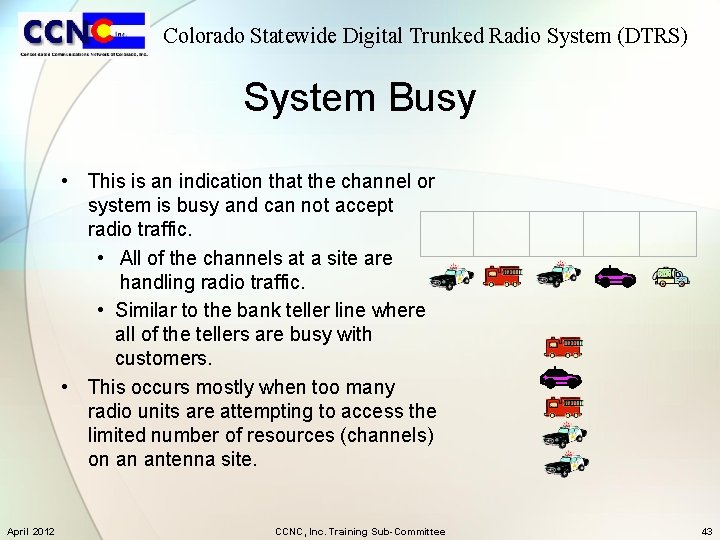
Colorado Statewide Digital Trunked Radio System (DTRS) System Busy • This is an indication that the channel or system is busy and can not accept radio traffic. • All of the channels at a site are handling radio traffic. • Similar to the bank teller line where all of the tellers are busy with customers. • This occurs mostly when too many radio units are attempting to access the limited number of resources (channels) on an antenna site. April 2012 CCNC, Inc. Training Sub-Committee 43
Colorado Statewide Digital Trunked Radio System (DTRS) System Busy • System busy eliminates the days of talking over each other as was the case in older conventional systems. • The system is designed, that should you receive a system busy, you are placed into a queue for the next available channel. Do not continue to hold down or re -key the push to talk (PTT) button. • Once you get the “bonk”, let go of the PTT and wait for the system to send you the talk permit tone when it’s ready. Then you are given a short window to key up and talk. If you don’t, then next guy in line gets the permission to talk. April 2012 CCNC, Inc. Training Sub-Committee 44
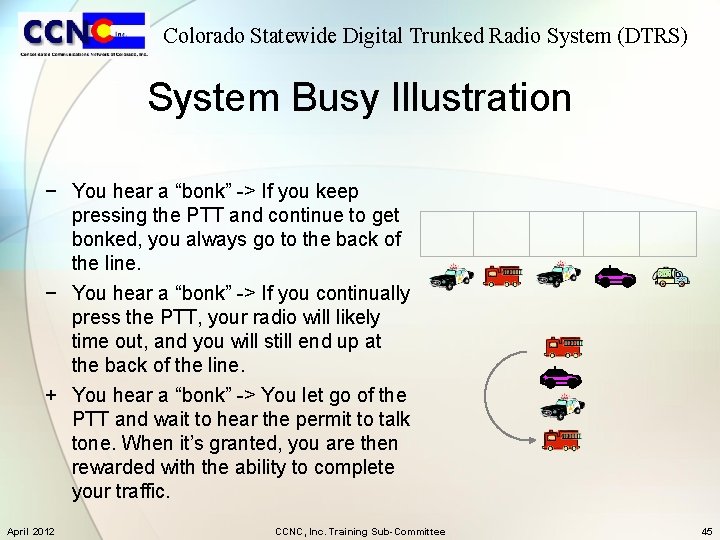
Colorado Statewide Digital Trunked Radio System (DTRS) System Busy Illustration − You hear a “bonk” -> If you keep pressing the PTT and continue to get bonked, you always go to the back of the line. − You hear a “bonk” -> If you continually press the PTT, your radio will likely time out, and you will still end up at the back of the line. + You hear a “bonk” -> You let go of the PTT and wait to hear the permit to talk tone. When it’s granted, you are then rewarded with the ability to complete your traffic. April 2012 CCNC, Inc. Training Sub-Committee 45
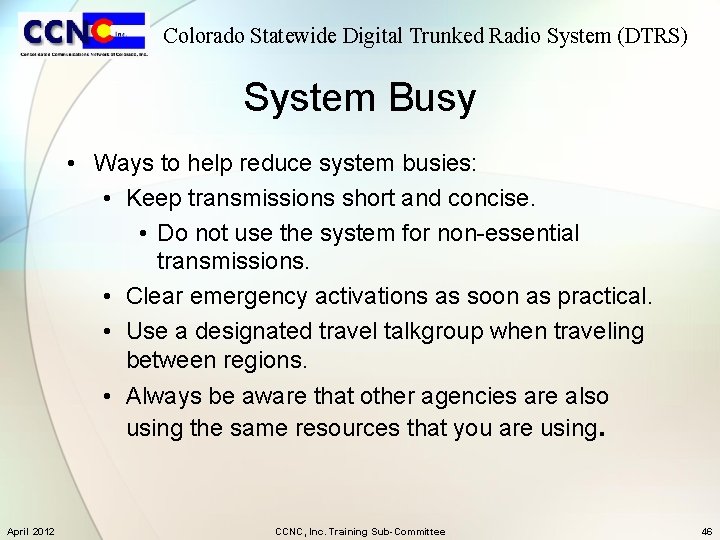
Colorado Statewide Digital Trunked Radio System (DTRS) System Busy • Ways to help reduce system busies: • Keep transmissions short and concise. • Do not use the system for non-essential transmissions. • Clear emergency activations as soon as practical. • Use a designated travel talkgroup when traveling between regions. • Always be aware that other agencies are also using the same resources that you are using. April 2012 CCNC, Inc. Training Sub-Committee 46
Colorado Statewide Digital Trunked Radio System (DTRS) Out of Range April 2012 CCNC, Inc. Training Sub-Committee 47
Colorado Statewide Digital Trunked Radio System (DTRS) Out-of-Range If you go out of the range of the system and can no longer lock onto a control channel: You will not have trunked radio communications (simplex and/or other conventional channels may be used based upon local policies). Your radio remains in this out-of-range condition until it locks onto a control channel, or it is turned off. This condition may be represented by a tone and/or a display on the radio. Consult with your Radio System Administrator/Coordinator. April 2012 CCNC, Inc. Training Sub-Committee 48
Colorado Statewide Digital Trunked Radio System (DTRS) Site Trunking April 2012 CCNC, Inc. Training Sub-Committee 49
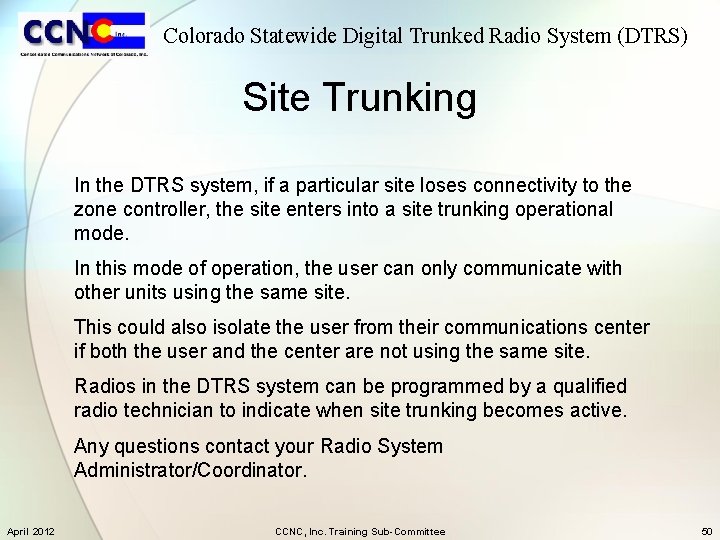
Colorado Statewide Digital Trunked Radio System (DTRS) Site Trunking In the DTRS system, if a particular site loses connectivity to the zone controller, the site enters into a site trunking operational mode. In this mode of operation, the user can only communicate with other units using the same site. This could also isolate the user from their communications center if both the user and the center are not using the same site. Radios in the DTRS system can be programmed by a qualified radio technician to indicate when site trunking becomes active. Any questions contact your Radio System Administrator/Coordinator. April 2012 CCNC, Inc. Training Sub-Committee 50
Colorado Statewide Digital Trunked Radio System (DTRS) Additional Information Interoperable Radio Communications Training www. co. train. org Radio Specific Information Contact Your Radio System Administrator/Coordinator for Agency Directed Training (ADT) materials CCNC, Inc. Standard Operating Procedures Resource Documents DTRS System Information Visit our website at System Information Visit Colorado’s website at Communication Services Meeting Information Calendar CCNC April 2012 CCNC, Inc. Training Sub-Committee 51
Colorado Statewide Digital Trunked Radio System (DTRS) Thank You For Your Interest and Participation April 2012 CCNC, Inc. Training Sub-Committee 52