
Colorado Regulation 7 Upstreams LDAR Future Standards Certification
- Slides: 21
Colorado Regulation 7 Upstream’s LDAR Future Standards Certification Education & Training Publishing Conferences & Exhibits Jay Christopher Business Unit Manager, Air & Process Services Trihydro Corporation Denver, Colorado
Jay Christopher Business Unit Manager, Air & Process Services • Based in Colorado, and was a testifying expert during the Colorado Regulation 7 hearings • Over 35 years of petroleum industry environmental experience, the last 25 focused on air issues • Prior to joining Trihydro, was a refinery environmental manager, and has also implemented air programs, including LDAR, at a variety of petroleum facilities 2
Presentation Objectives • Why Colorado’s Regulation 7 requirements are important to the upstream industry • The impact of a hydrocarbon rule that includes methane, versus a volatile organic compound (VOC) rule • A high-level overview of the Regulation 7 program elements 3
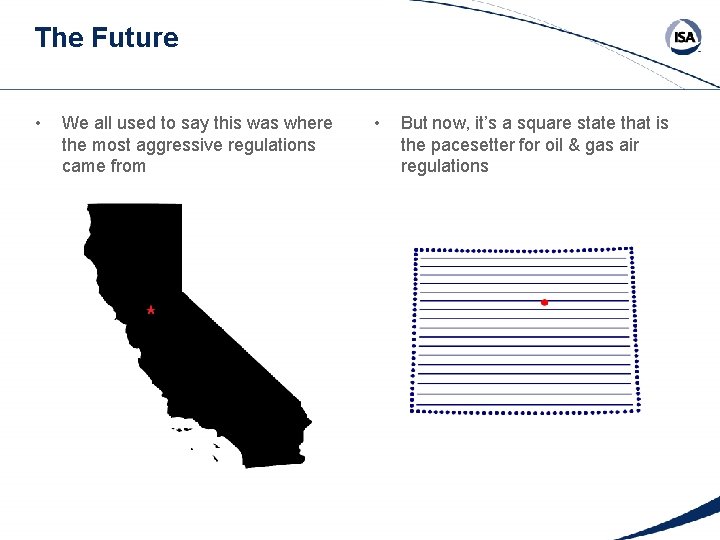
The Future • We all used to say this was where the most aggressive regulations came from • But now, it’s a square state that is the pacesetter for oil & gas air regulations
Why is it Important? • Several states are already looking at Colorado’s regulations as a model for their regulatory programs. • The January 14, 2015 White House announcement regarding oil & gas methane controls infers future regulations that will look very similar to Colorado’s. • “Quad O 2. 0” will likely include significant parts of Colorado Regulation 7.
Colorado Regulation No. 7 • Regulation 7 has historically been Colorado’s VOC regulation. • Major changes to the rule affecting oil & gas operations were approved by the Colorado Air Quality Control Commission on February 23, 2014, effective April 14, 2014. • Although there was a stakeholder process, the principal negotiations for this regulation took place between the three largest oil & gas operators in Colorado, the Environmental Defense Fund, and the Colorado Department of Public Health and Environment.
Reg. 7 Highlights • For the oil & gas sector, Reg. 7 is now a hydrocarbon rule (i. e. , it includes methane) • Reg. 7 applies statewide, not just the ozone non-attainment area; and covers new and existing sources • Reg. 7 covers oil & gas exploration and production • Well production facilities • Natural gas compression (between wellhead and natural gas plants) • Natural gas processing plants • Equipment such as glycol dehydrators, pneumatics, and storage tanks
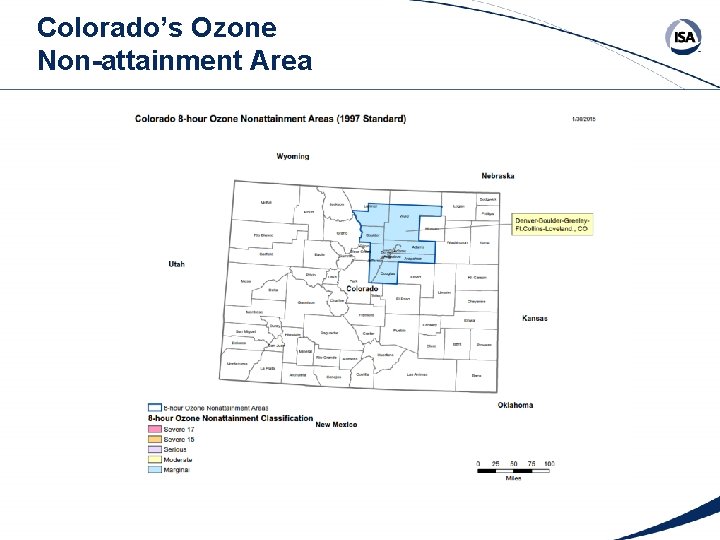
Colorado’s Ozone Non-attainment Area 8
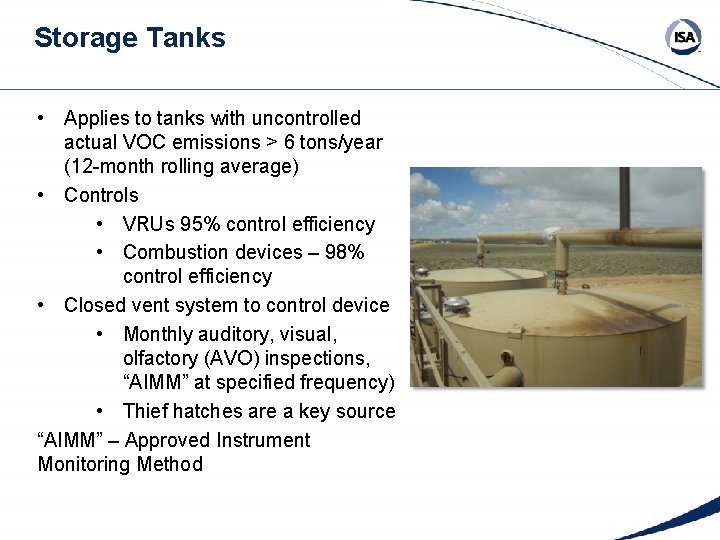
Storage Tanks • Applies to tanks with uncontrolled actual VOC emissions > 6 tons/year (12 -month rolling average) • Controls • VRUs 95% control efficiency • Combustion devices – 98% control efficiency • Closed vent system to control device • Monthly auditory, visual, olfactory (AVO) inspections, “AIMM” at specified frequency) • Thief hatches are a key source “AIMM” – Approved Instrument Monitoring Method
STEM Plans • STEM – Storage Tank Emissions Management system (demonstrate that the tank can operate without venting) • Selected control technologies • Monitoring practices • Operational practices • Procedures for evaluating ongoing emission capture performance • Approved instrument monitoring methods • Certification by owner or operator
Storage Tank Examples • • • Company A constructed a new condensate storage tank on March 15, 2014 and commenced operation on May 1, 2014. Uncontrolled actual VOC emissions are 10 tons per year (TPY), and Company A is controlling emissions with a combustion device. What is Company A required to do per Colorado Regulation Number 7? Install enclosed combustion device by May 1, 2015. Must include autoignition system. Must have manufacturer’s specifications and design on file, and document that the device will meet 98% destruction efficiency. Must start conducting AVO inspections of tank and associated equipment by May 1, 2015 – this includes the combustion device. Must have written STEM plan by May 1, 2015. Must conduct initial instrument monitoring within 90 days of January 1, 2016 and then annually.
Natural Gas Pneumatics • Installed after May 1, 2014 – no bleed if on-site electrical grid power available; or low-bleed (less than 6 standard cubic feet per hour (scfh) of natural gas) • High-bleed in service before May 1, 2014 – replace/retrofit to low-bleed by May 1, 2015 (written safety/process exemption allowed) • Remaining high-bleeds – tagged and inspected starting May 1, 2015, with enhanced maintenance Sounds a lot like Quad O, but this includes existing!
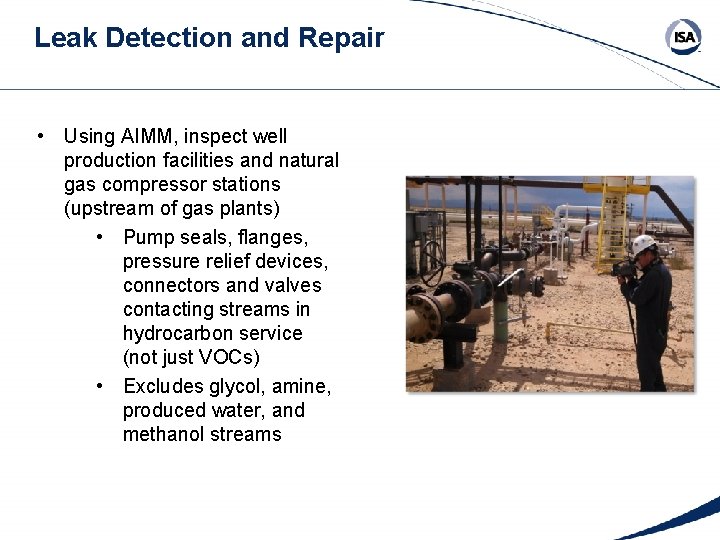
Leak Detection and Repair • Using AIMM, inspect well production facilities and natural gas compressor stations (upstream of gas plants) • Pump seals, flanges, pressure relief devices, connectors and valves contacting streams in hydrocarbon service (not just VOCs) • Excludes glycol, amine, produced water, and methanol streams
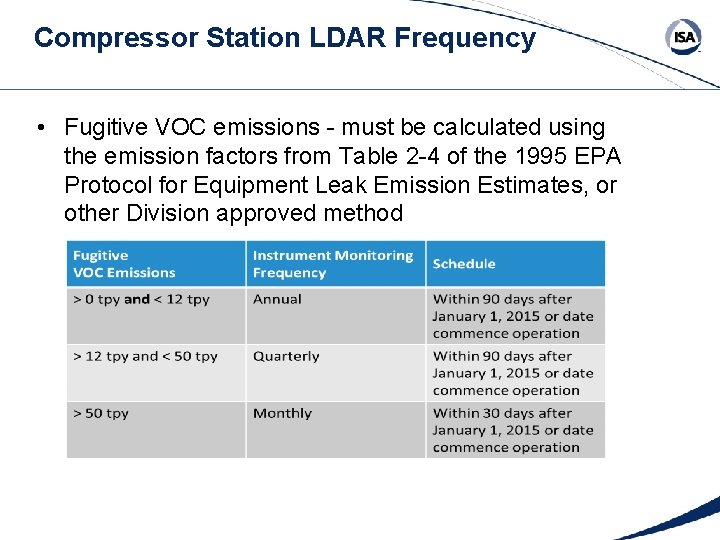
Compressor Station LDAR Frequency • Fugitive VOC emissions - must be calculated using the emission factors from Table 2 -4 of the 1995 EPA Protocol for Equipment Leak Emission Estimates, or other Division approved method
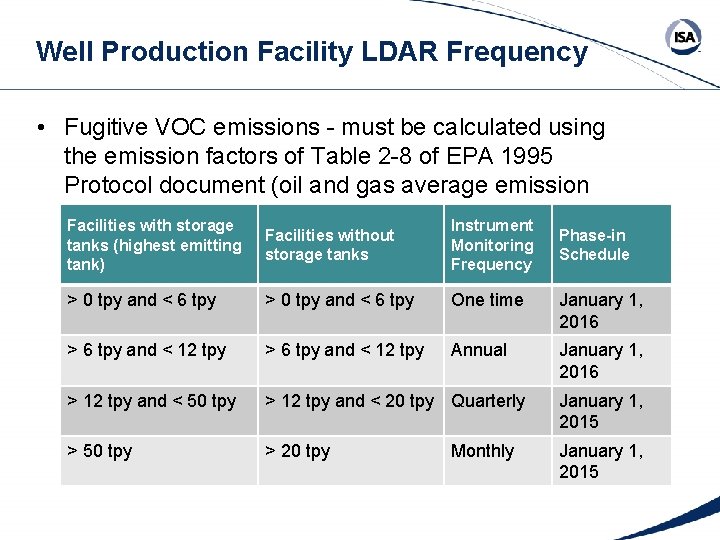
Well Production Facility LDAR Frequency • Fugitive VOC emissions - must be calculated using the emission factors of Table 2 -8 of EPA 1995 Protocol document (oil and gas average emission factors) Facilities with storage Instrument tanks (highest emitting tank) Facilities without storage tanks Monitoring Frequency Phase-in Schedule > 0 tpy and < 6 tpy One time January 1, 2016 > 6 tpy and < 12 tpy Annual January 1, 2016 > 12 tpy and < 50 tpy > 12 tpy and < 20 tpy Quarterly January 1, 2015 > 50 tpy > 20 tpy January 1, 2015 Monthly
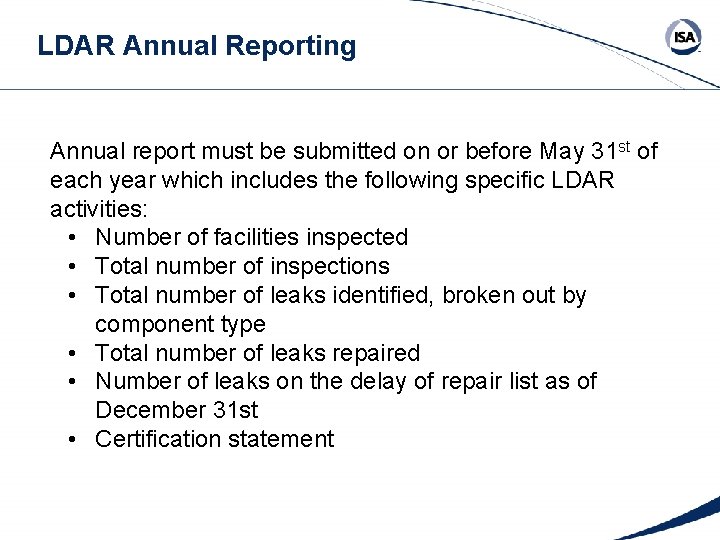
LDAR Annual Reporting Annual report must be submitted on or before May 31 st of each year which includes the following specific LDAR activities: • Number of facilities inspected • Total number of inspections • Total number of leaks identified, broken out by component type • Total number of leaks repaired • Number of leaks on the delay of repair list as of December 31 st • Certification statement
LDAR - OELs Well production facilities and natural gas compressors Open-ended line (OEL) controls required as of January 1, 2015 • Seal the open end of all open-ended valves or lines (except during operations requiring process fluid flow through the open-ended valve or line); OR • Treat as a “component” and monitor under the LDAR program
Compressors Centrifugal • 95% control on wet seal degassing systems Reciprocating • Replace rod packing every 26, 000 operating hours or every 36 months Does not apply if subject to New Source Performance Standards Subpart Quad O on or after January 1, 2015
Glycol Dehydrators • 95% control if using condenser or other air pollution control equipment • 98% control if using combustion • Existing dehydrators (after May 15, 2015) • Uncontrolled actual VOC > 6 TPY; or • Uncontrolled actual VOC > 2 TPY and located within 1, 320 feet of a building unit or designated outside activity area
Combustion Devices • Must be enclosed, exhibit no visible emissions during normal operations, and must be designed so that an observer can determine whether or not it is lit • Auto-igniters on combustion devices • New combustion device installed on or after May 1, 2014 – installed upon installation • Combustion device installed prior to May 1, 2014 – installed by May 1, 2016 or after next planned shutdown (whichever comes first)
If you ask me anything I don’t know, I’m not going to answer. -Yogi Berra Jay Christopher Business Unit Manager, Air & Process Services jchristopher@trihydro. com 303 -815 -9583