
Color Vision 1 Color Frdo Durand Barb Cutler
Color Vision 1
Color Frédo Durand Barb Cutler MIT- EECS Many slides courtesy of Victor Ostromoukhov and Leonard Mc. Millan
Admin • Final project due this Friday – If you aren’t well advanced yet, time to freak out • Don’t forget the final report (~1000 words) • Submit code, executable, instructions (we want to copy-paste command lines) Color Vision 3
Review of assignments • • Ray-casting spheres, planes, triangles Shadow rays, reflection, refraction Phong shading, solid textures Grid acceleration Supersampling and filtering Spline editing, surfaces of revolution, patches Particle systems Color Vision 4
How to optimize your ray tracer • Grid insertion: be smart about bbox! – Don’t check all voxels! • Precompute values used by intersection – E. g. inverse of matrix, square of radius – If a value does not change between iterations, cache it! • Passing parameters as pointers/refs, not value – Otherwise you spend a lot of time calling constructors and allocating memory • In general, avoid memory allocation in inner loops • But remember, optimization should come last and not at the price of readability • Trust the compiler for low-level optimizations Color Vision 5
Industrial-strength ray tracer • Usually, one single primitive (triangles) • Heavily optimize ray-triangle and spatial data structure (recursive grid or kd-tree) – Watch memory footprint • • Pluggable shaders (same as your shader class) High-quality supersampling (same as you) Distribution ray-tracing (soft shadows, glossy, Do. F) Global illumination (Irradiance caching, photon maps, but only recently used) Texture mapping, bump mapping Fancy light sources (shaders as well) Volumetric effects (fog, dust) Data management (although not always done well) Color Vision 6
Today: color Disclaimer: • Color is both quite simple and quite complex • There are two options to teach color: – pretend it all makes sense and it’s all simple – Expose the complexity and arbitrary choices • Unfortunately I have chosen the latter – Too bad if you believe ignorance is bliss Color Vision 7
Plan • • • What is color Cones and spectral response Color blindness and metamers Fundamental difficulty with colors Colorimetry and color spaces • Next time: More perception Gamma Color Vision 8
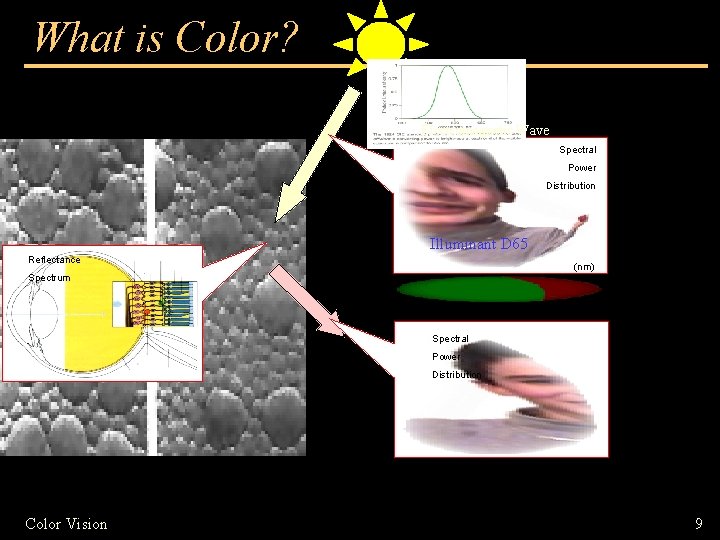
What is Color? Electromagnetic Wave Spectral Power Distribution Illuminant D 65 Reflectance (nm) Spectrum Spectral Power Distribution Color Vision 9
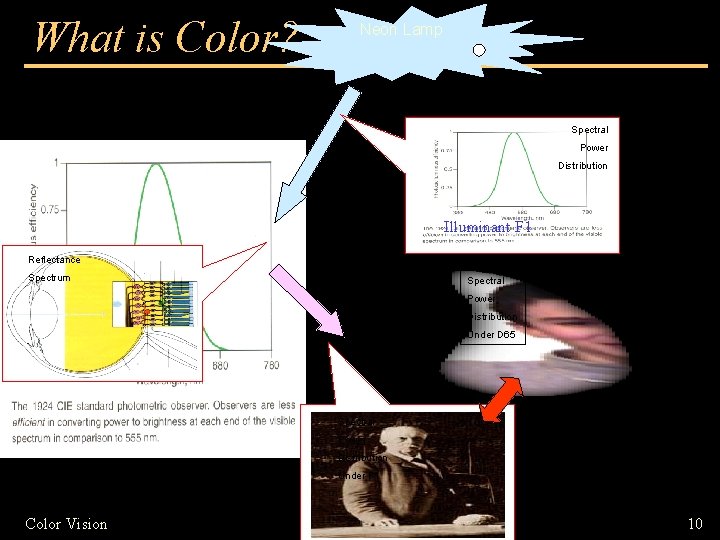
What is Color? Neon Lamp Spectral Power Distribution Illuminant F 1 Reflectance Spectrum Spectral Power Distribution Under D 65 Spectral Power Distribution Under F 1 Color Vision 10
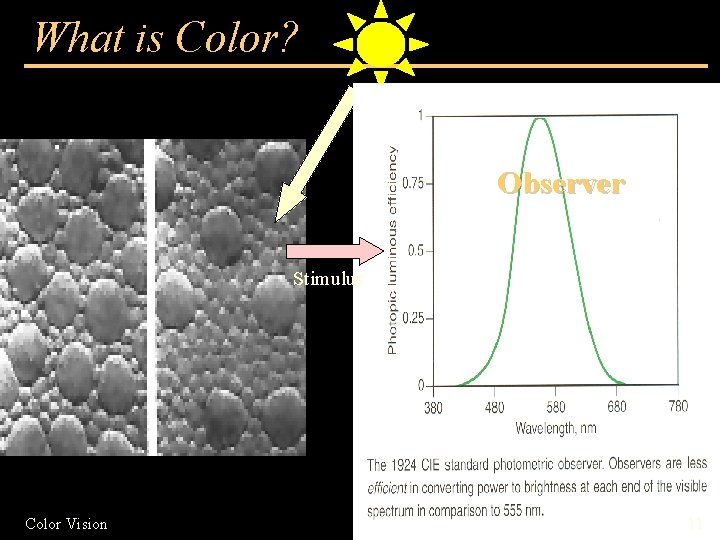
What is Color? Observer Stimulus Color Vision 11
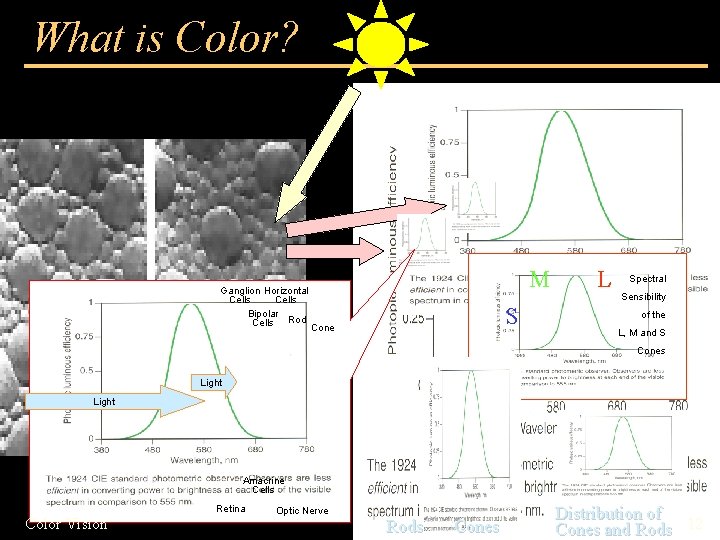
What is Color? M Ganglion Horizontal Cells Bipolar Cells Rod Cone S L Spectral Sensibility of the L, M and S Cones Light Amacrine Cells Retina Color Vision Optic Nerve Rods Cones Distribution of Cones and Rods 12
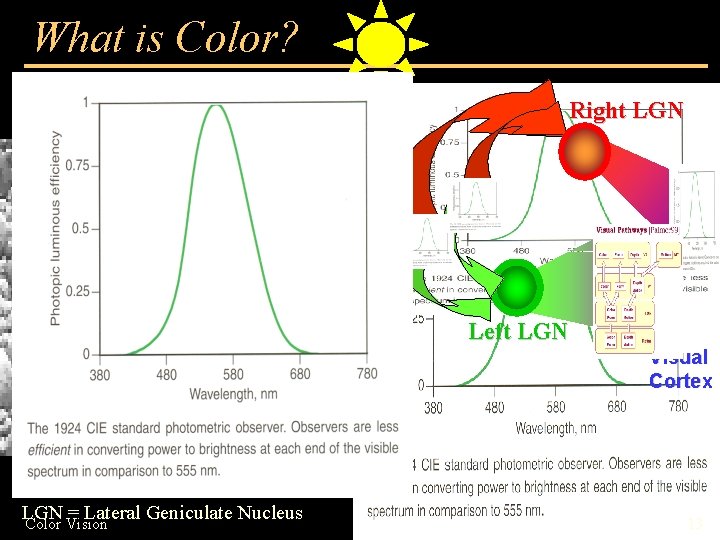
What is Color? Right LGN Left LGN Visual Cortex LGN = Lateral Geniculate Nucleus Color Vision 13

Questions? Color Vision 14
Plan • • • What is color Cones and spectral response Color blindness and metamers Fundamental difficulty with colors Colorimetry and color spaces • Next time: More perception Gamma Color Vision 15
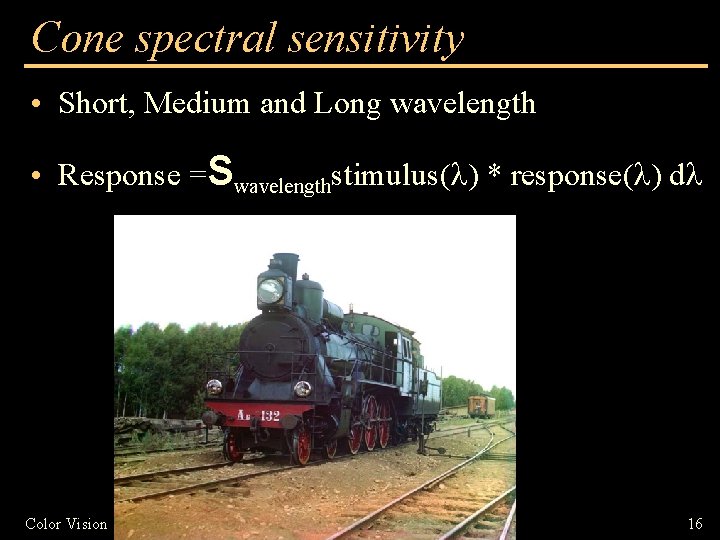
Cone spectral sensitivity • Short, Medium and Long wavelength • Response = Color Vision s wavelengthstimulus( ) * response( ) d 16
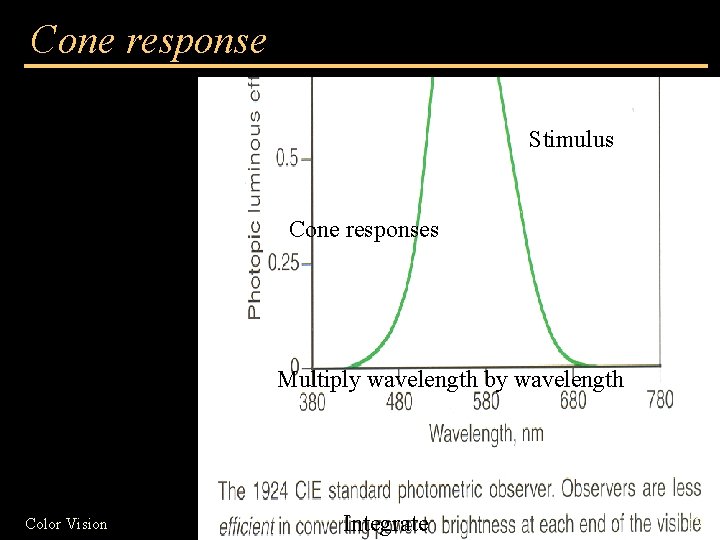
Cone response Stimulus Cone responses Multiply wavelength by wavelength Color Vision Integrate 17
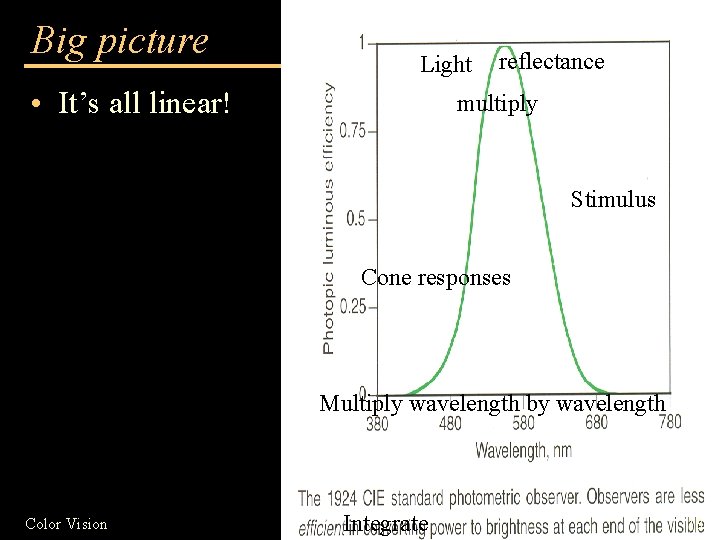
Big picture Light • It’s all linear! reflectance multiply Stimulus Cone responses Multiply wavelength by wavelength Color Vision Integrate 18
Cones do not “see” colors • Different wavelength, different intensity • Same response Color Vision 19
Response comparison • Different wavelength, different intensity • But different response for different cones Color Vision 20
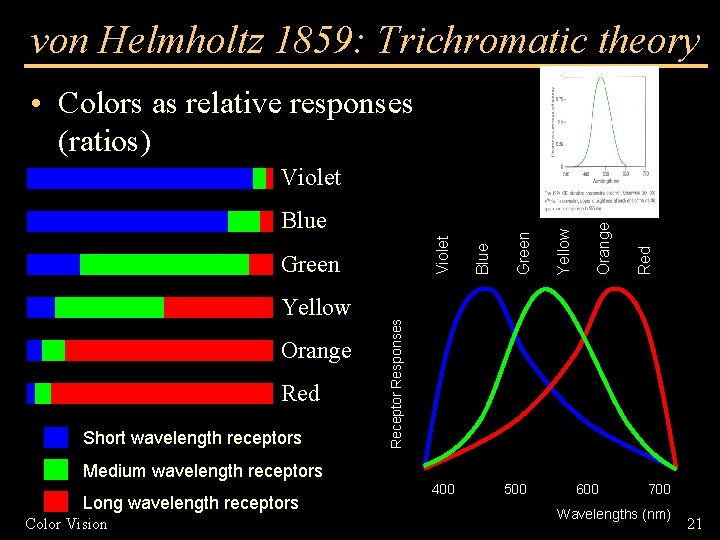
von Helmholtz 1859: Trichromatic theory • Colors as relative responses (ratios) Yellow Orange Red Short wavelength receptors Red Orange Yellow Receptor Responses Green Blue Violet Blue Green Violet Medium wavelength receptors Long wavelength receptors Color Vision 400 500 600 700 Wavelengths (nm) 21
Questions? Color Vision 22
Plan • • • What is color Cones and spectral response Color blindness and metamers Fundamental difficulty with colors Colorimetry and color spaces • Next time: More perception Gamma Color Vision 23
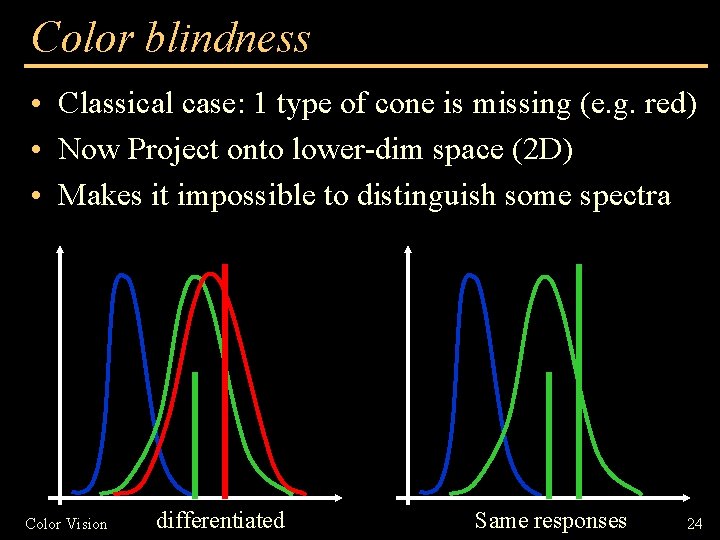
Color blindness • Classical case: 1 type of cone is missing (e. g. red) • Now Project onto lower-dim space (2 D) • Makes it impossible to distinguish some spectra Color Vision differentiated Same responses 24
Color blindness – more general • • Dalton 8% male, 0. 6% female Genetic Dichromate (2% male) – One type of cone missing – L (protanope), M (deuteranope), S (tritanope) • Anomalous trichromat – Shifted sensitivity Color Vision 25
Color blindness test Color Vision 26
Color blindness test • Maze in subtle intensity contrast • Visible only to color blinds • Color contrast overrides intensity otherwise Color Vision 27
Metamers • • We are all color blind! Different spectrum Same response Essentially, we have projected from an infinite-dimensional spectrum to a 3 D space: we loose information Color Vision 28
Metamers allows for color matching • Reproduce the color of any test lamp with the addition of 3 given primary lights • Essentially exploit metamers Color Vision 29
Metamerism & light source • Metamers under a given light source • May not be metamers under a different lamp Color Vision 30
Questions? Meryon (a colorblind painter), Le Vaisseau Fantôme Color Vision 31
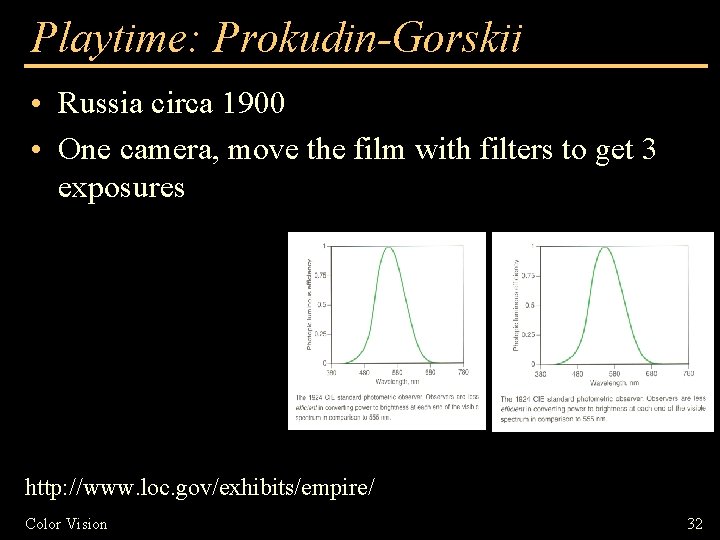
Playtime: Prokudin-Gorskii • Russia circa 1900 • One camera, move the film with filters to get 3 exposures http: //www. loc. gov/exhibits/empire/ Color Vision 32
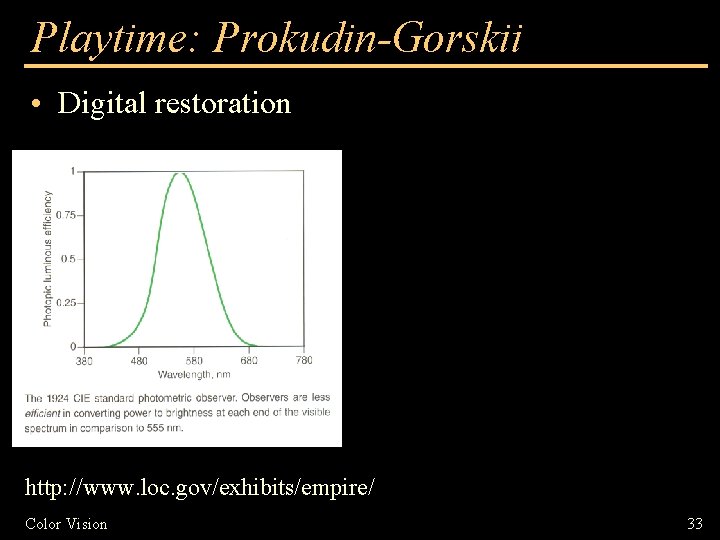
Playtime: Prokudin-Gorskii • Digital restoration http: //www. loc. gov/exhibits/empire/ Color Vision 33
Playtime: Prokudin-Gorskii Color Vision 34
Playtime: Prokudin-Gorskii Color Vision 35
Playtime: Prokudin-Gorskii Color Vision 36
Plan • • • What is color Cones and spectral response Color blindness and metamers Fundamental difficulty with colors Colorimetry and color spaces • Next time: More perception Gamma Color Vision 37
Warning Tricky thing with spectra & color: • Spectrum for the stimulus / synthesis – Light, monitor, reflectance • Response curve for receptor /analysis – Cones, camera, scanner They are usually not the same There are good reasons for this Color Vision 38
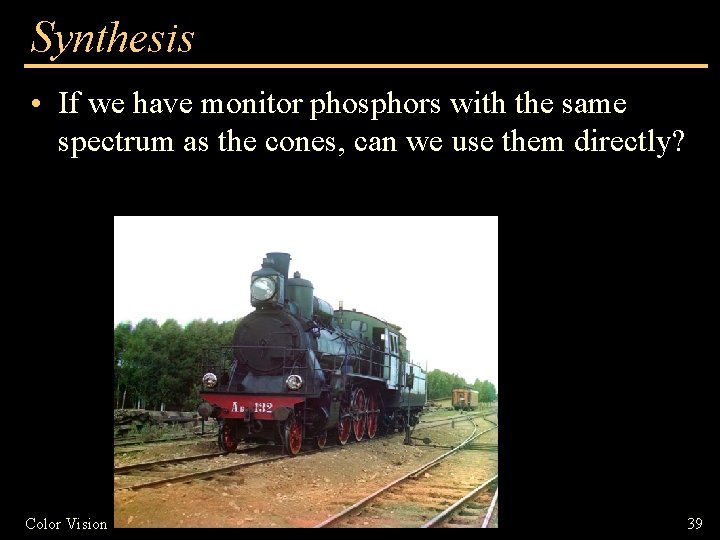
Synthesis • If we have monitor phosphors with the same spectrum as the cones, can we use them directly? Color Vision 39
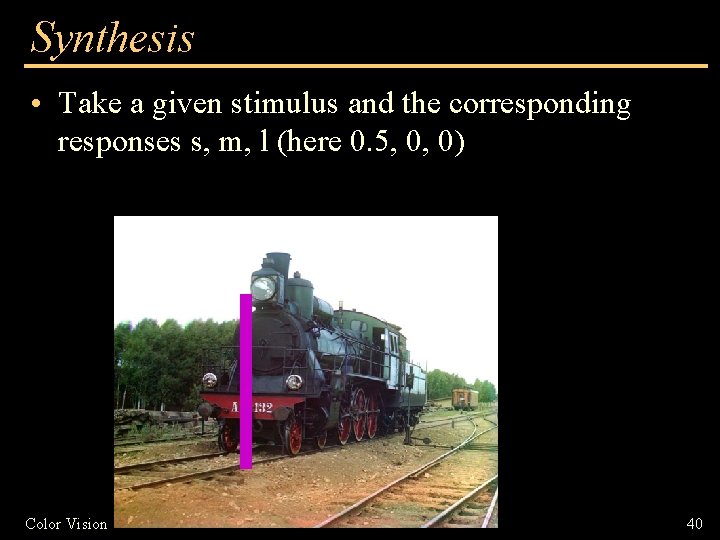
Synthesis • Take a given stimulus and the corresponding responses s, m, l (here 0. 5, 0, 0) Color Vision 40
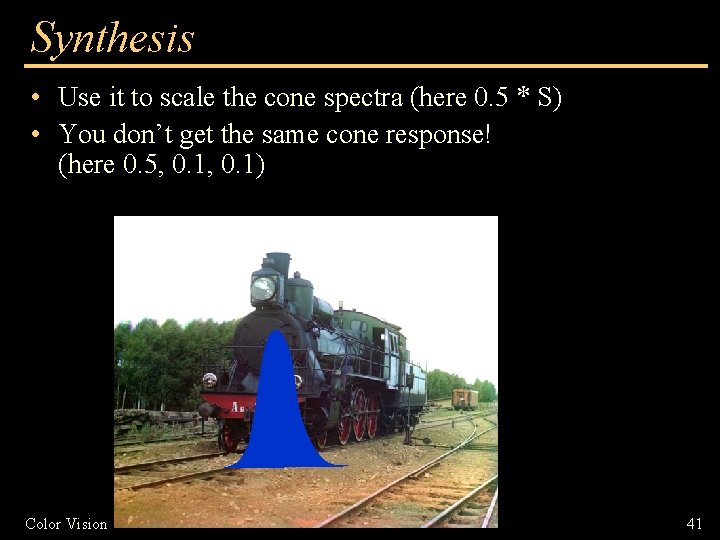
Synthesis • Use it to scale the cone spectra (here 0. 5 * S) • You don’t get the same cone response! (here 0. 5, 0. 1) Color Vision 41
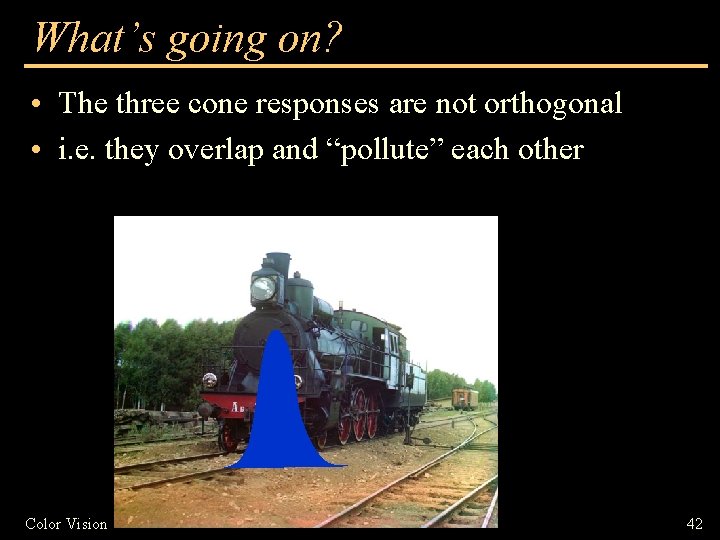
What’s going on? • The three cone responses are not orthogonal • i. e. they overlap and “pollute” each other Color Vision 42

Questions? Color Vision 43
Plan • • • What is color Cones and spectral response Color blindness and metamers Fundamental difficulty with colors Colorimetry and color spaces • Next time: More perception Gamma Color Vision 44
Standard color spaces • Colorimetry: science of color measurement • Quantitative measurements of colors are crucial in many industries – Television, computers, print, paint, luminaires • So far, we have used some vague notion of RGB • Unfortunately, RGB is not precisely defined, and depending on your monitor, you might get something different • We need a principled color space Color Vision 45
Standard color spaces • We need a principled color space • Many possible definition – Including cone response (LMS) – Unfortunately not really used • The good news is that color vision is linear and 3 -dimensional, so any color space based on color matching can be obtained using 3 x 3 matrix • But there are non-linear color spaces (e. g. Hue Saturation Value, Lab) Color Vision 46
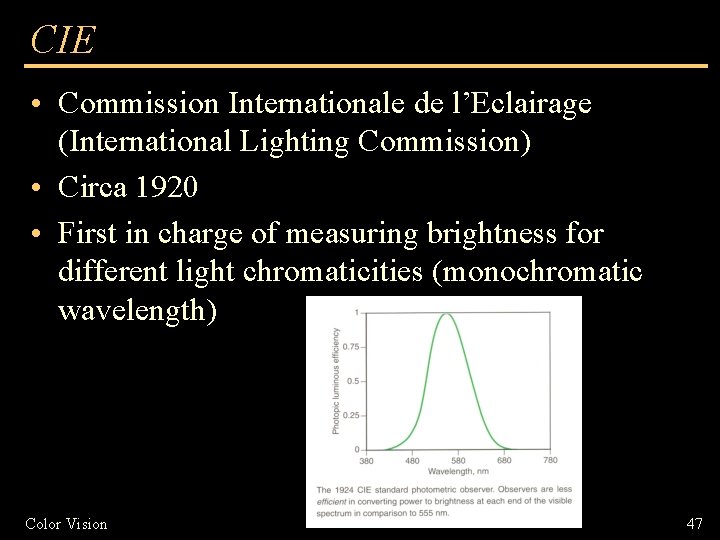
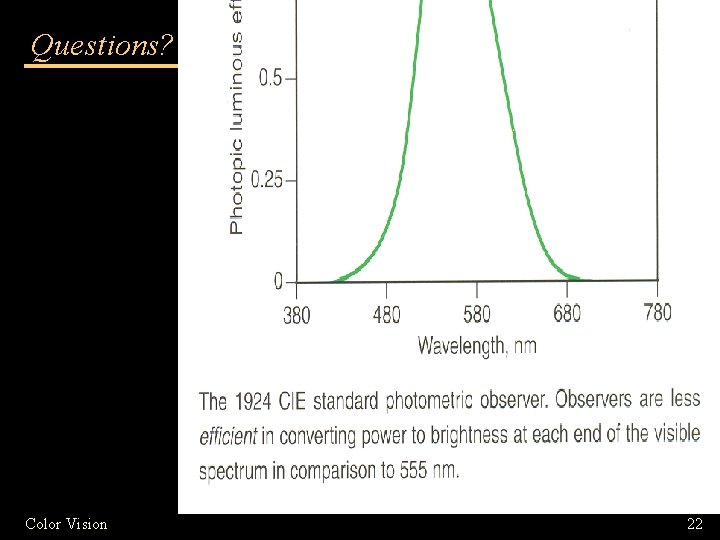
CIE • Commission Internationale de l’Eclairage (International Lighting Commission) • Circa 1920 • First in charge of measuring brightness for different light chromaticities (monochromatic wavelength) Color Vision 47
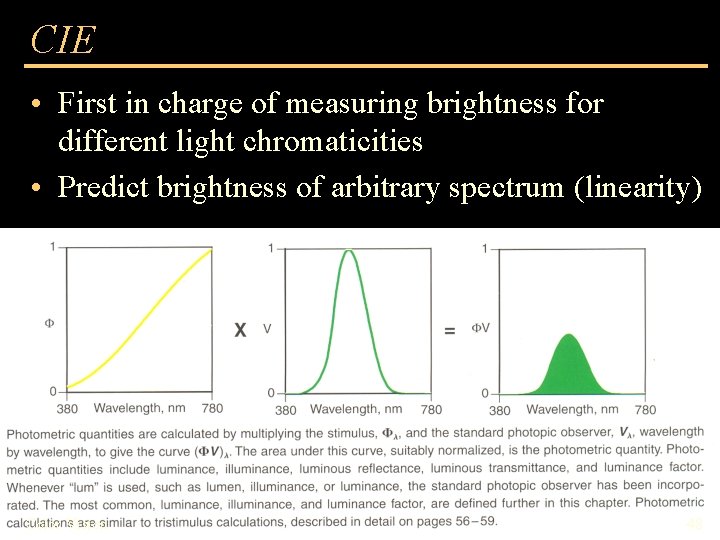
CIE • First in charge of measuring brightness for different light chromaticities • Predict brightness of arbitrary spectrum (linearity) Color Vision 48

Questions? Color Vision 49
- Slides: 49