
COLOR Some Interesting Facts about Color Facts About
COLOR

Some Interesting Facts about Color Facts About Color is a powerful tool. Many good artists and designers recognize it’s power and use it to manipulate to their benefit. Here are some interesting facts about color. Use this information wisely, as it will allow you the ability to subtly manipulate your audience.
Color Can Affect You Physically Did you know that the color in a drawing, painting, or object can effect the way you feel about it? In fact, simply the color of an object can affect your mood and feeling. There is actually research that suggests that the light of colors can affect the center of emotions found in the hypothalamus. This region of the brain, in turn affects the pituitary gland, which controls the endocrine system. The endocrine system, in turn controls the thyroid and sex glands, which control hormone levels. Hormone levels control mood and emotion. It may be a long trip, but color does physically affect our body through our mood and emotion.

Color Can Affect You Psychologically (Although it’s Hard to Prove) I think that all of us can agree that color does affect our psyche. It is quite hard to prove this however, if you are the scientific type. Despite this, there have been several attempts over the years to prove the connection between color and psychology. Neuropsychologist, Kurt Goldstein experimented with the affects of color on one’s psyche in the 1930’s. These experiments yielded some interesting results on how color affects us. For example, the experiments showed that objects seen in red light appear bigger or heavier. In contrast, objects that were viewed in the opposite color, green, appeared smaller and lighter.

Here a few more ways color is thought to have had an impact on psychology… Fact 1 – A factory in the United States changed the color of the bathrooms to an unpleasant green and saw production increase by 8%. Fact 2 – Customers of a coffee house constantly complained about the cool temperature in the room. At that time, the walls were painted a light blue. After changing the color to orange, there were no more complaints. Fact 3 – The color yellow can cause nausea, so it is avoided in airplanes. Fact 4 – Black boxes seemed heavier to workmen than green boxes filled with the same material. Fact 5 – Red can make you hungry, while the opposite color, green, suppresses it. Fact 6 – The color red can also increase your muscle reaction, make you want to gamble more, and raise your blood pressure. Blue has the opposite effect. Fact 7 – Blue street lighting resulted in lower crime rates in Glascow in 2000. Fact 8 – Blue conveys trust and reliability. Fact 9 – Green is believed to increase concentration.

Color Theory-The Elements of Art-Color is the element of art that refers to reflected light. Color theory is defined as a theory because it cannot be proved. Theories are generally accepted, despite the fact that they cannot be proven. Laws are accepted because they can be proven. There are volumes and volumes of information available about color. It is an exciting, ever-changing science. Color has an affect over how we feel about objects, how we behave, and how our bodies react to circumstances.

What is color theory? If color theory is simplified, it can be broken down into 3 parts- The color wheel, color value, and color schemes. Each part of color theory builds on the previous. Understanding each section of color theory fully, will help you better understand its importance in the creation of art.
COLOR WHEEL

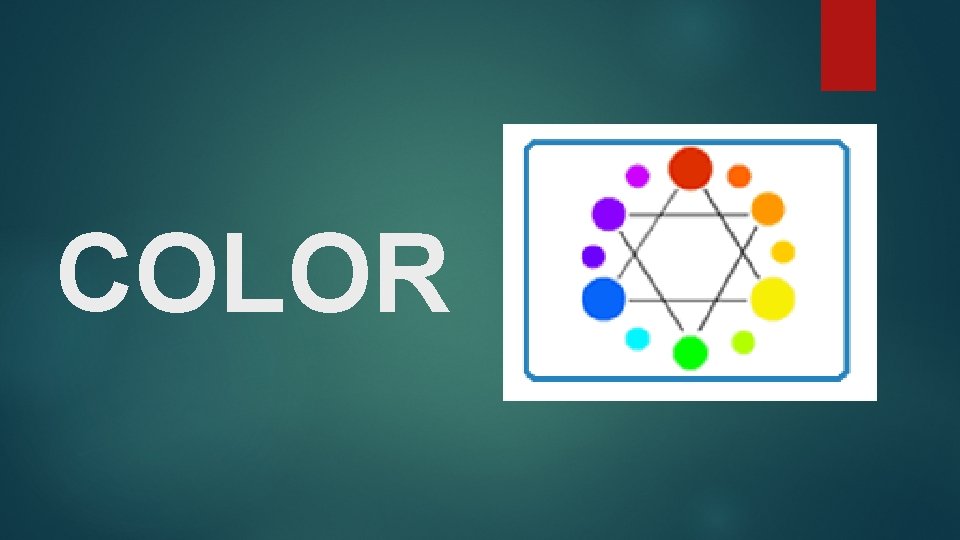
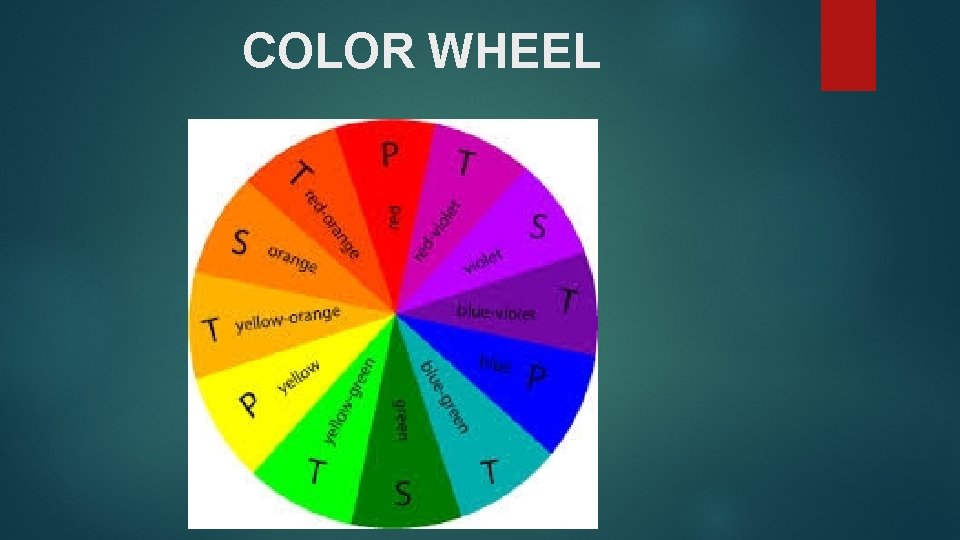
COLOR WHEEL The color wheel was developed by Sir Isaac Newton by taking the color spectrum and bending it into a circle. If you follow around the color wheel, you will find the same order of the color spectrum- red, orange, yellow, green, blue, indigo(blue-violet), and violet. Some remember it by the acronym ROY G. BIV. The color wheel is made up of three different types of colors - Primary, Secondary, and Tertiary. The primary colors are red, yellow, and blue. They are called primary for a couple of reasons. First, no two colors can be mixed to create a primary color. In other words, primary colors can only be created through the use of natural pigments. Secondly, all other colors found on the color wheel can be created by mixing primary colors together. The secondary colors are orange, green, and purple. Secondary colors are created by mixing equal parts of any two primary colors. Yellow and blue will give you green. Red and blue will create purple(violet). Red and yellow will give you orange. Tertiary colors are created by mixing equal parts of a secondary color and a primary color together. There are six tertiary colors- red-purple, red-orange, blue-green, yellow-green, blue-purple, and yelloworange. Notice that the proper way to refer to tertiary colors is by listing the primary color first and the secondary color, second.

COLOR VALUE The second part of color theory deals with color values. Value is the darkness or lightness of a color. When dealing with pure color (hue), value can be affected by adding white or black to a color.
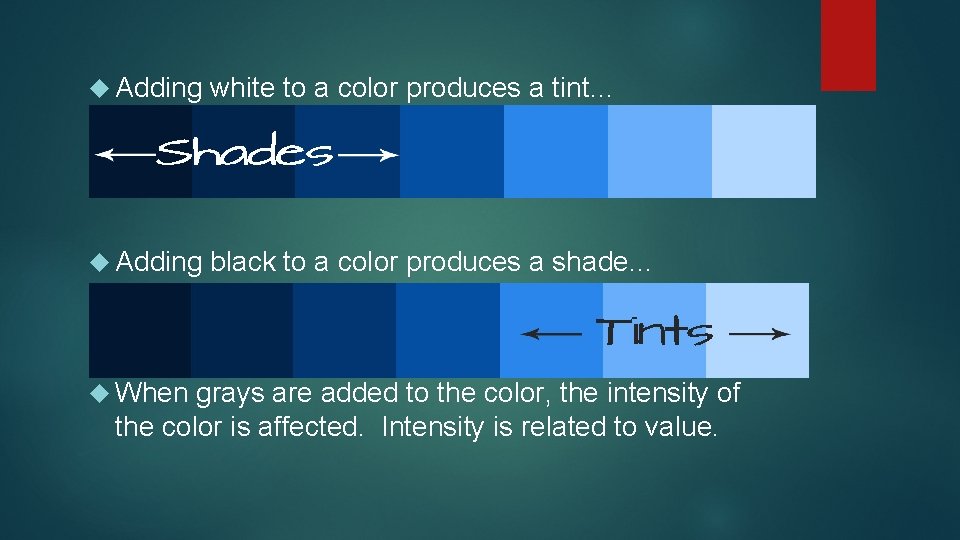
Adding white to a color produces a tint. . . Adding black to a color produces a shade. . . When grays are added to the color, the intensity of the color is affected. Intensity is related to value.

COLOR SCHEMES In color theory, a color scheme is a choice of colors used in design for a wide range of media to create style and appeal, or for aesthetic effects such as in building design, fashion, etc. Sometimes color schemes are used for purely practical reasons such as those used in camouflage.
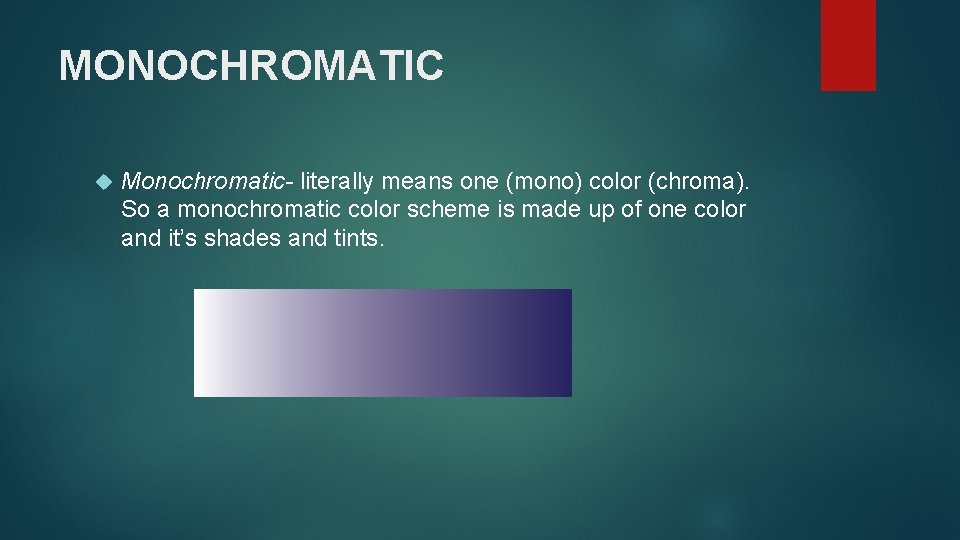
MONOCHROMATIC Monochromatic- literally means one (mono) color (chroma). So a monochromatic color scheme is made up of one color and it’s shades and tints.
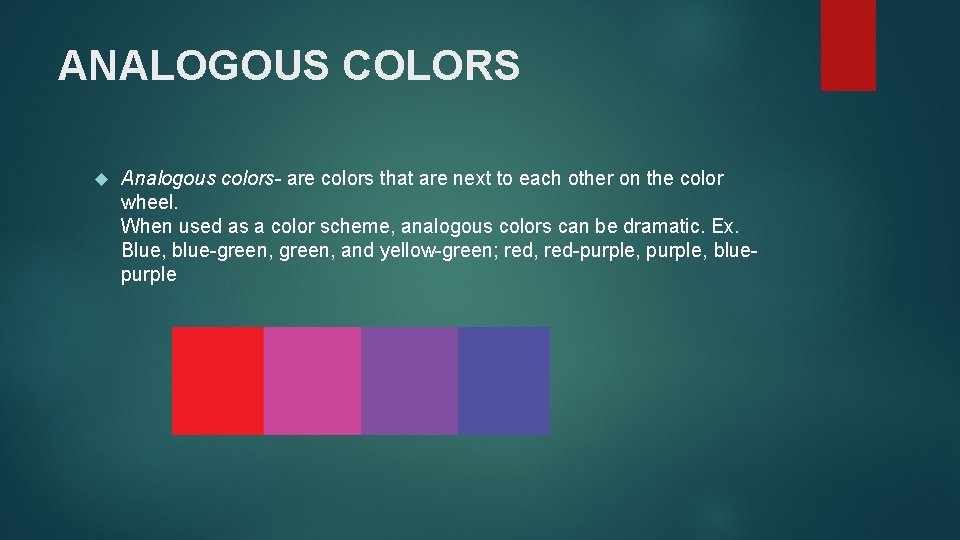
ANALOGOUS COLORS Analogous colors- are colors that are next to each other on the color wheel. When used as a color scheme, analogous colors can be dramatic. Ex. Blue, blue-green, and yellow-green; red, red-purple, bluepurple
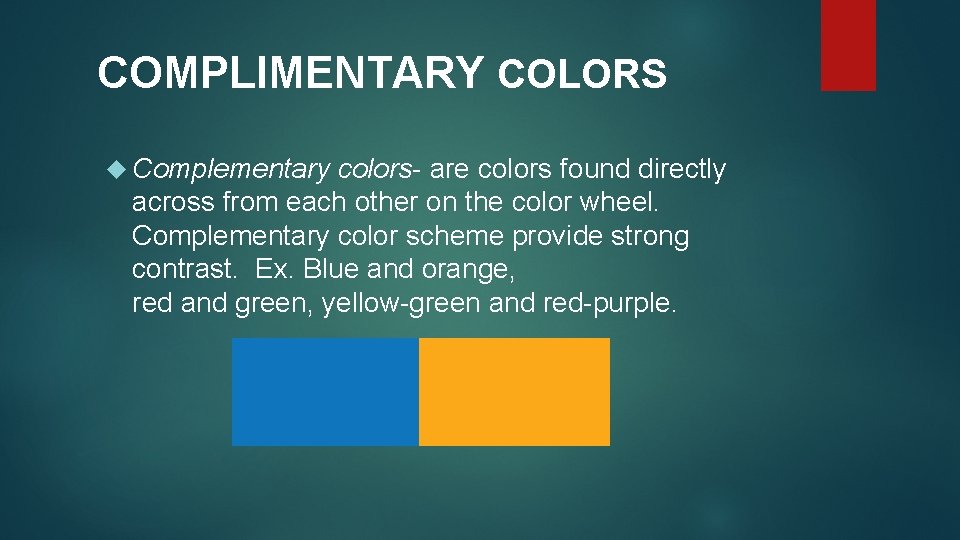
COMPLIMENTARY COLORS Complementary colors- are colors found directly across from each other on the color wheel. Complementary color scheme provide strong contrast. Ex. Blue and orange, red and green, yellow-green and red-purple.
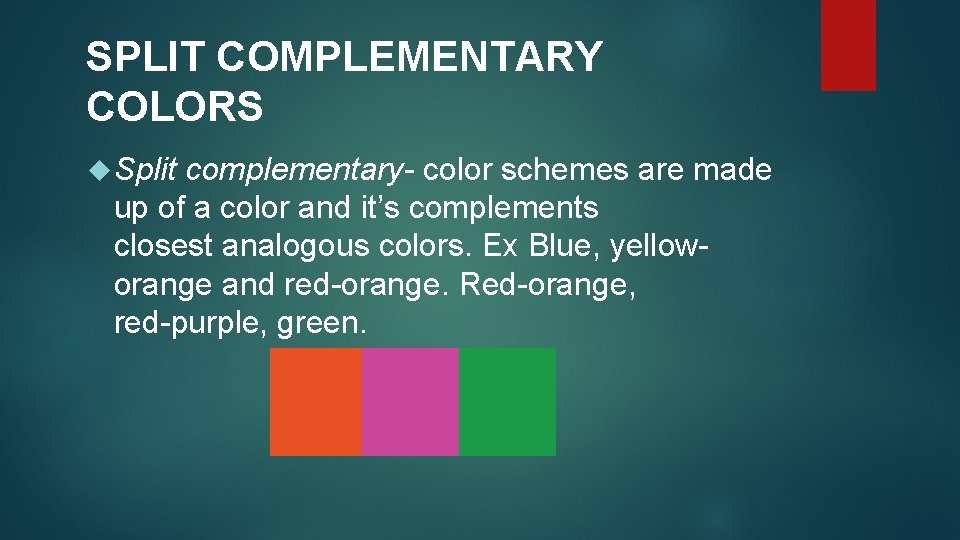
SPLIT COMPLEMENTARY COLORS Split complementary- color schemes are made up of a color and it’s complements closest analogous colors. Ex Blue, yelloworange and red-orange. Red-orange, red-purple, green.

Warm colors- colors that are usually associated with warm things. Ex. Red, yellow, orange
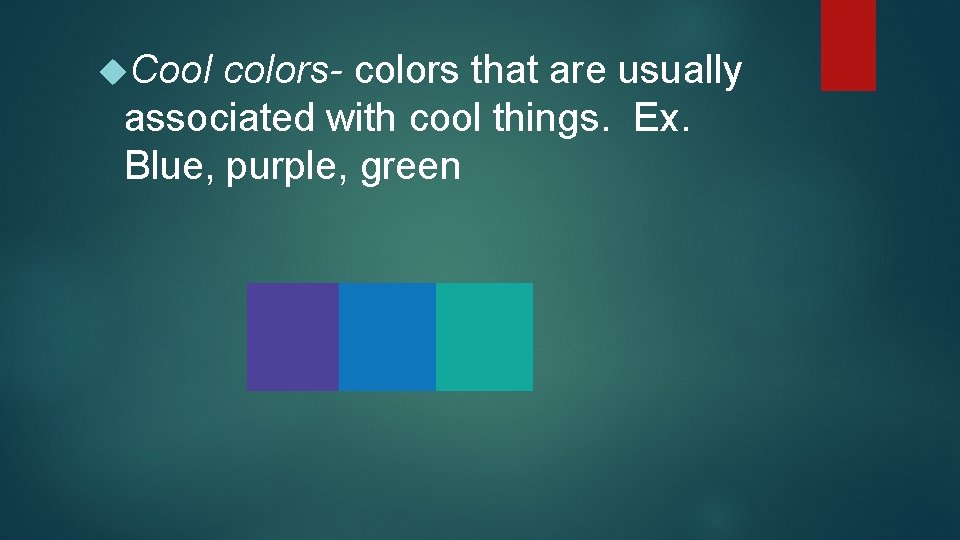
Cool colors- colors that are usually associated with cool things. Ex. Blue, purple, green

COLOR THEORY TERMS AND DEFINITIONS Color- Element of art derived from reflected light. We see color because light waves are reflected from objects to your eyes. Color wheel- color spectrum bent into a circle. Primary colors- The most basic colors on the color wheel, red, yellow and blue. These colors cannot be made by mixing Secondary colors- colors that are made by mixing two primary colors together. Orange, green and violet (purple) Tertiary colors- colors that are made by mixing a primary color with a secondary color Hue- the name of the color Intensity- the brightness or dullness of a color. DO NOT CONFUSE INTENSITY WITH VALUE. Color value- the darkness or lightness of a color. Ex pink is a tint of red Tints- are created by adding white to a color Shades- are created by adding black to a color Optical color- color that people actually perceive- also called local color.
Click the link below to go to the Interactive Color Wheel: Interactive Color Wheel
CREDITS www. thevirtualinstructor. com www. wikipedia. org
- Slides: 21