
COLOR PROCESSIN G COLOR PROCESSING The characteristics of

- Slides: 18
COLOR PROCESSIN G
COLOR PROCESSING Ø The characteristics of color image are distinguished by its properties brightness, hue and saturation. Ø simplifies object extraction and identification. 1. Motivation to use color 2. Brightness 3. Hue
Motivation to use color: Ø Powerful descriptor that often simplifies object identification and extraction from a scene Ø Humans can discern thousands of color shades and intensities, compared to about only two dozen shades of gray. Brightness: Ø Intensity Ø Perceived luminance Ø Depends on surrounding luminance
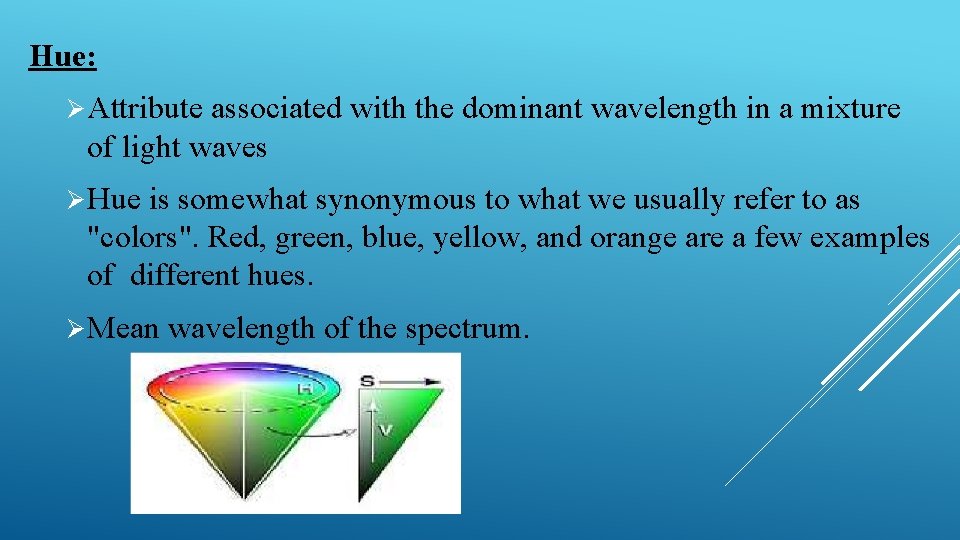
Hue: Ø Attribute associated with the dominant wavelength in a mixture of light waves Ø Hue is somewhat synonymous to what we usually refer to as "colors". Red, green, blue, yellow, and orange are a few examples of different hues. Ø Mean wavelength of the spectrum.
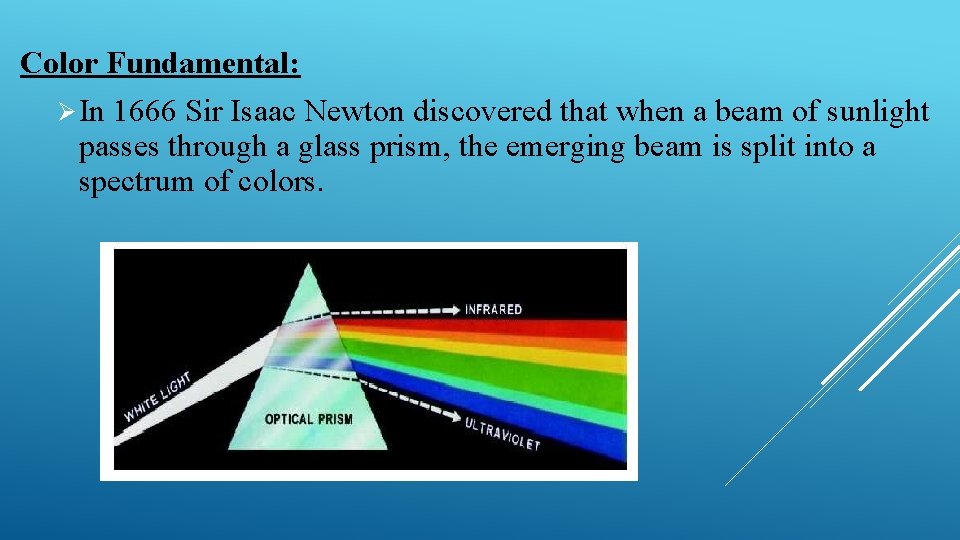
Color Fundamental: Ø In 1666 Sir Isaac Newton discovered that when a beam of sunlight passes through a glass prism, the emerging beam is split into a spectrum of colors.
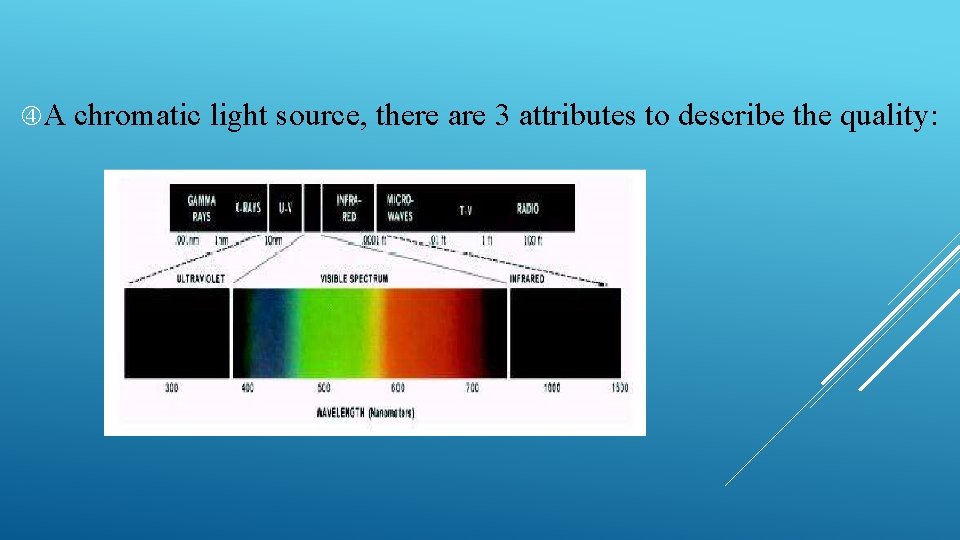
A chromatic light source, there are 3 attributes to describe the quality:
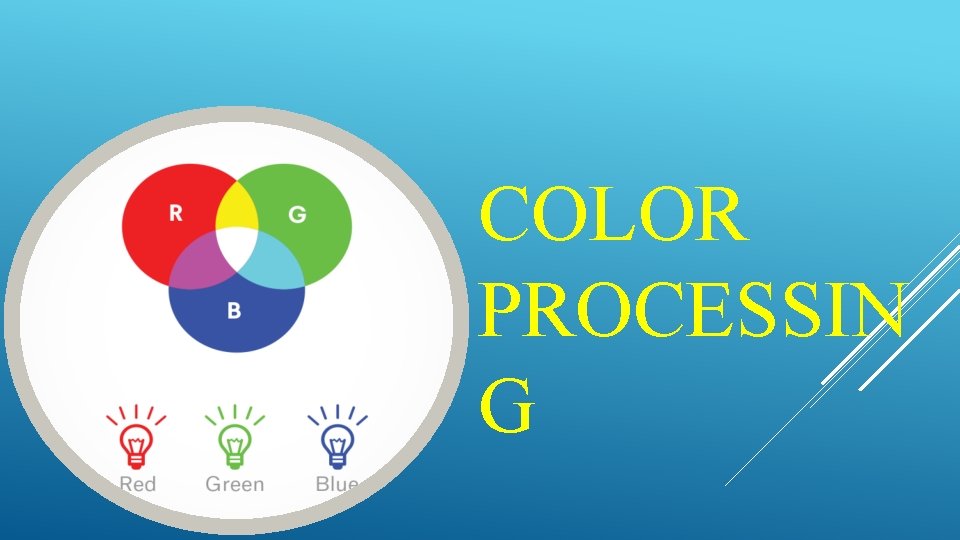
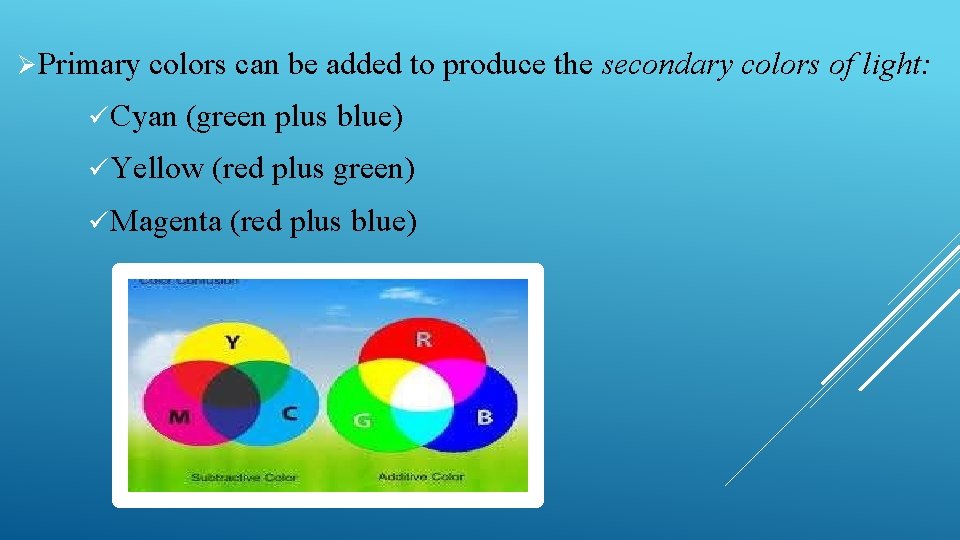
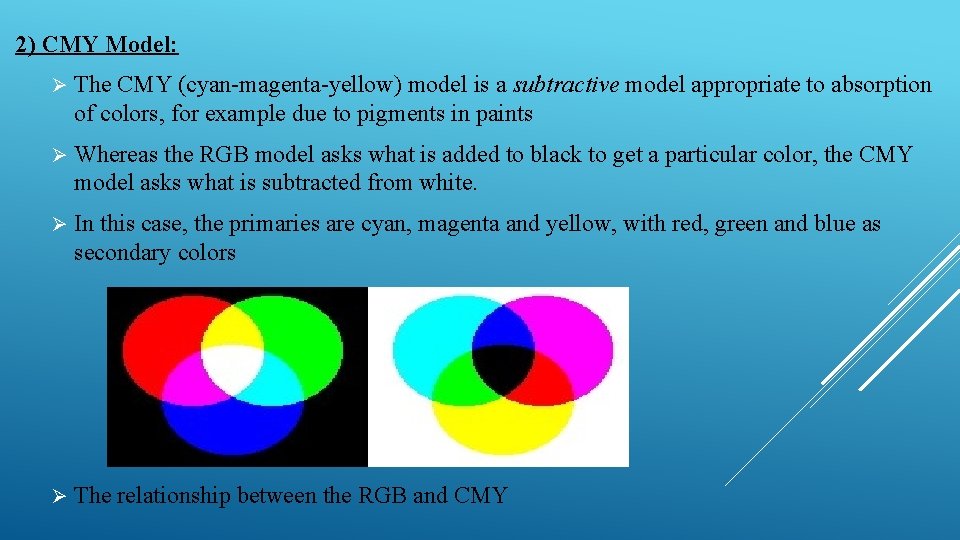
Ø Primary colors can be added to produce the secondary colors of light: ü Cyan (green plus blue) ü Yellow (red plus green) ü Magenta (red plus blue)
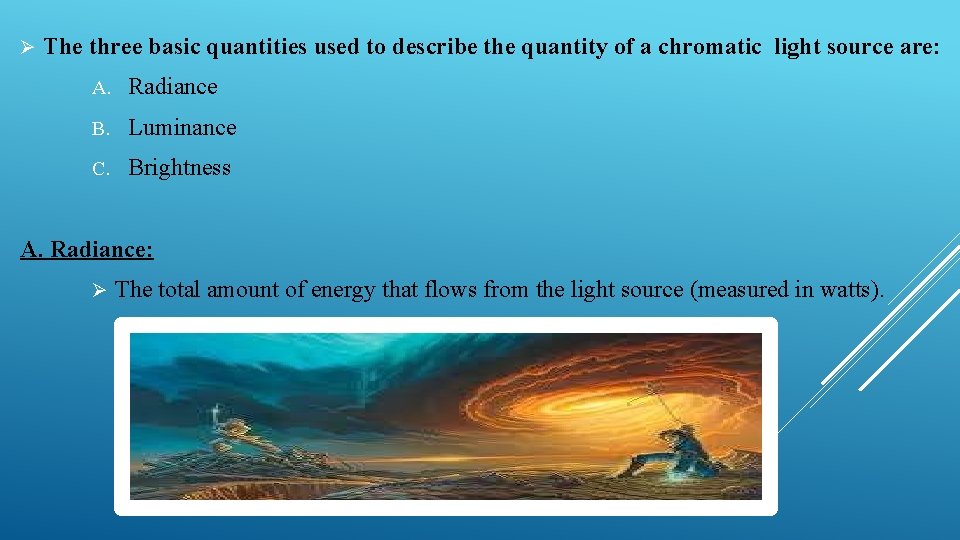
Ø The three basic quantities used to describe the quantity of a chromatic light source are: A. Radiance B. Luminance C. Brightness A. Radiance: Ø The total amount of energy that flows from the light source (measured in watts).
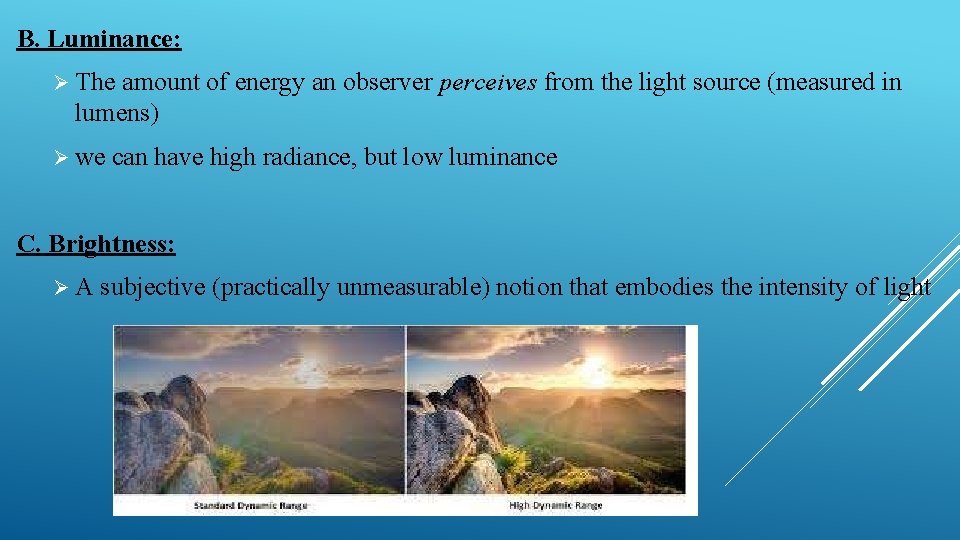
B. Luminance: Ø The amount of energy an observer perceives from the light source (measured in lumens) Ø we can have high radiance, but low luminance C. Brightness: ØA subjective (practically unmeasurable) notion that embodies the intensity of light
Color Model : Ø Color, by defining a 3 D coordinate system, and a subspace that contains all constructible colors within a particular model. ØA color model is an abstract mathematical model describing the way colors can be represented as tuples of numbers, typically as three or four values or color components. Ø Each color model is oriented towards either specific hardware is ( RGB, CMY, YIQ), or image processing applications (HSI ). Ø Any color that can be specified using a model will correspond to a single point within the subspace it defines.
TYPES OF COLOR MODELS: 1) RGB Model 2) CMY Model 3) HSI Model 4) YIQ Model 1) RGB Model: Ø Color monitor, color video cameras Ø In the RGB model, an image consists of three independent image planes, one in each of the primary colors: red, green and blue. Ø Specifying a particular color is by specifying the amount of each of the primary components present.
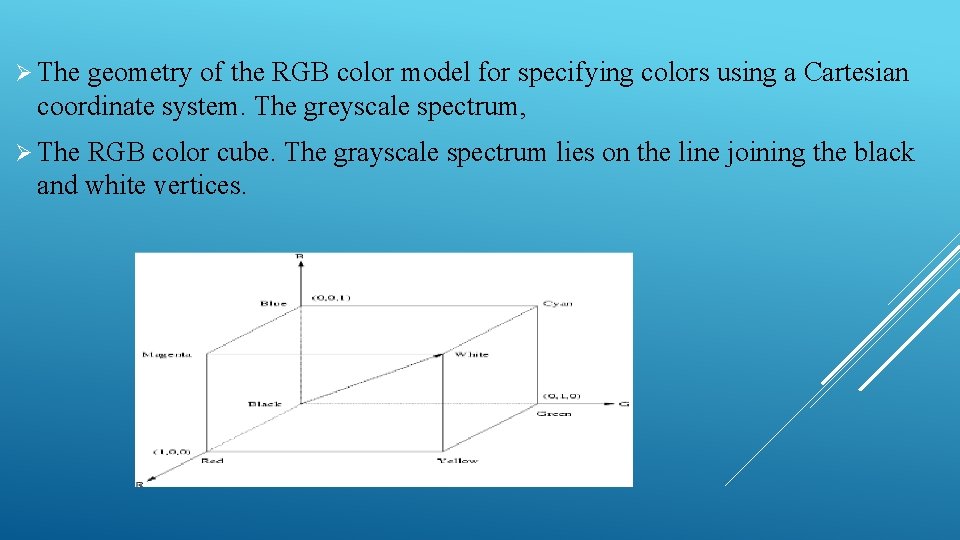
Ø The geometry of the RGB color model for specifying colors using a Cartesian coordinate system. The greyscale spectrum, Ø The RGB color cube. The grayscale spectrum lies on the line joining the black and white vertices.
2) CMY Model: Ø The CMY (cyan-magenta-yellow) model is a subtractive model appropriate to absorption of colors, for example due to pigments in paints Ø Whereas the RGB model asks what is added to black to get a particular color, the CMY model asks what is subtracted from white. Ø In this case, the primaries are cyan, magenta and yellow, with red, green and blue as secondary colors Ø The relationship between the RGB and CMY
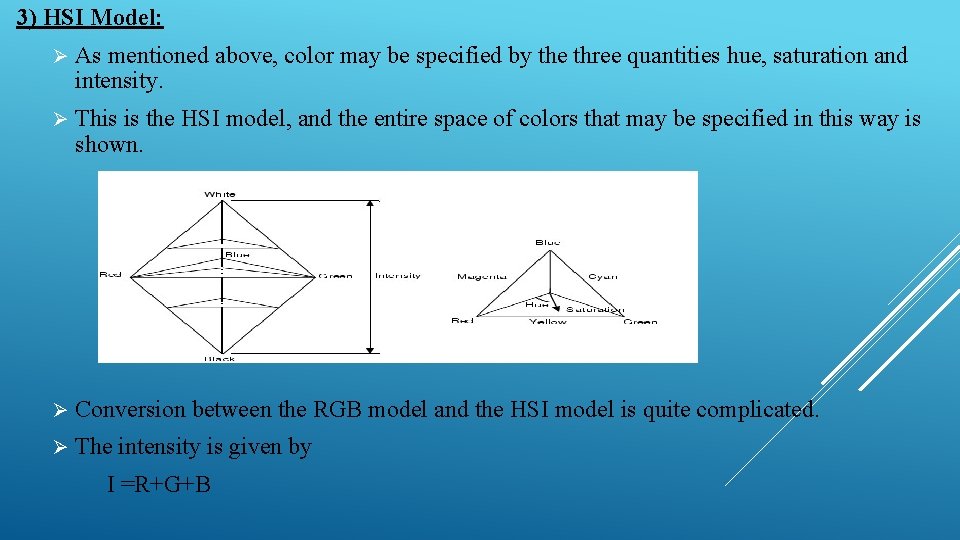
3) HSI Model: Ø As mentioned above, color may be specified by the three quantities hue, saturation and intensity. Ø This is the HSI model, and the entire space of colors that may be specified in this way is shown. Ø Conversion between the RGB model and the HSI model is quite complicated. Ø The intensity is given by I =R+G+B
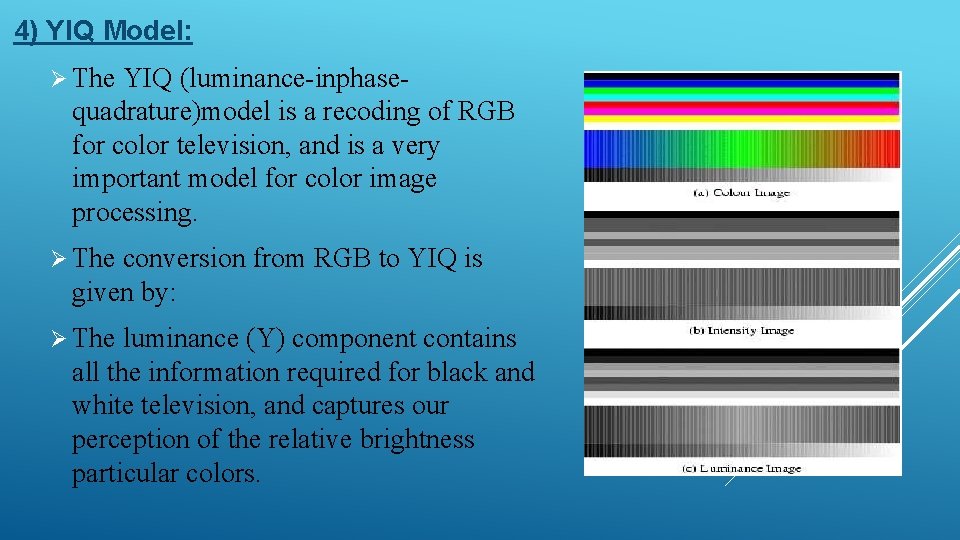
4) YIQ Model: Ø The YIQ (luminance-inphasequadrature)model is a recoding of RGB for color television, and is a very important model for color image processing. Ø The conversion from RGB to YIQ is given by: Ø The luminance (Y) component contains all the information required for black and white television, and captures our perception of the relative brightness particular colors.
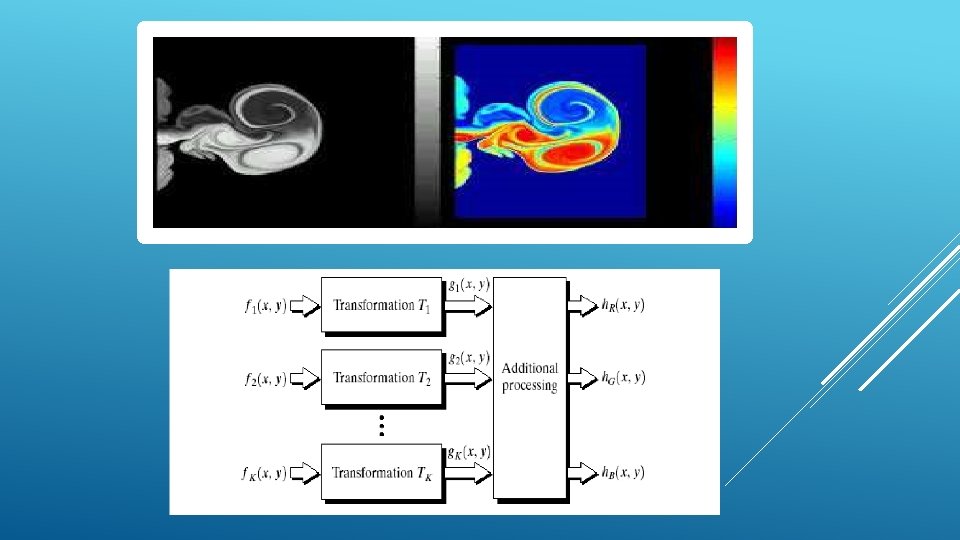
Pseudo color Processing : Ø Pseudo color image processing consists of assigning colors to grey values based on a specific criterion Ø The principle use of pseudo color image processing is for human visualization Ø Intensity slicing and color coding is one of the simplest kinds of pseudo color image processing. Ø Grey level color assignments can then be made according to the relation Ø where ck is the color associated with the kth intensity level Vk defined by the partitioning planes at l = k – 1 and l = k
THANK YOU !!!