
Color Polarization Color What does the word color




- Slides: 23
Color & Polarization
Color • What does the word color mean or describe?
Additive Primary Color • White light is comprised of all colors of the visible spectrum • Primary Colors = Red, Green, & Blue • Complementary Colors = Cyan, Magenta, & Yellow
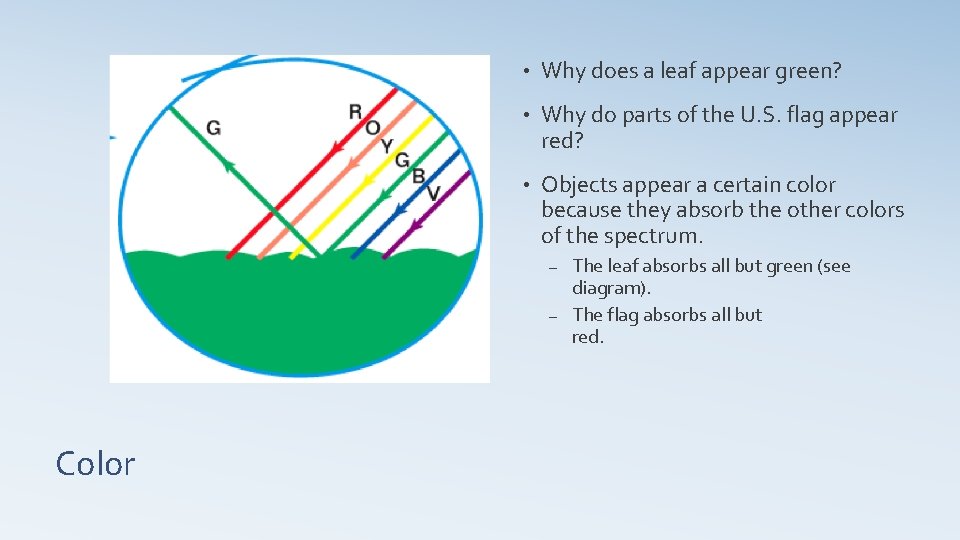
• Why does a leaf appear green? • Why do parts of the U. S. flag appear red? • Objects appear a certain color because they absorb the other colors of the spectrum. The leaf absorbs all but green (see diagram). – The flag absorbs all but red. – Color
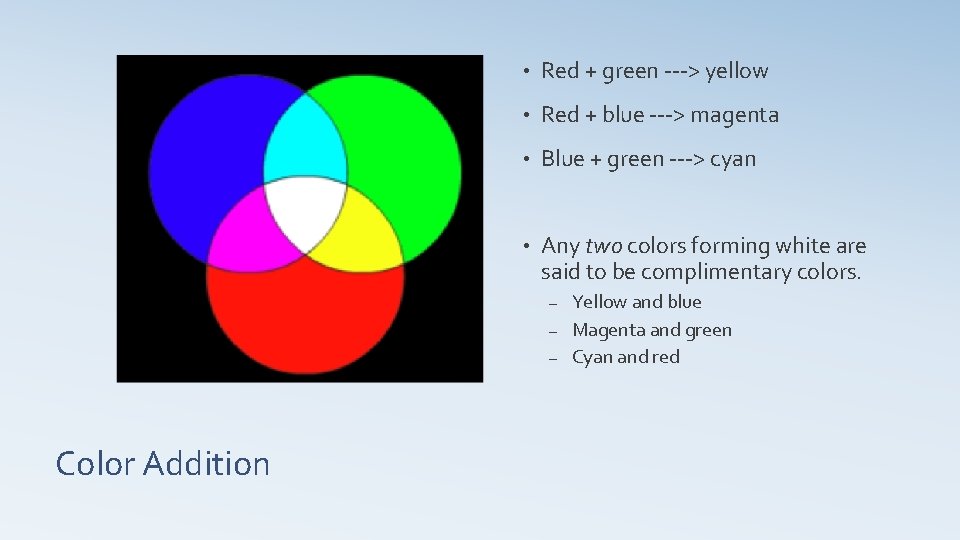
• Red + green ---> yellow • Red + blue ---> magenta • Blue + green ---> cyan • Any two colors forming white are said to be complimentary colors. Yellow and blue – Magenta and green – Cyan and red – Color Addition
Additive Primary Color Examples: • Pixels • Cone Cells
Click below to watch the Visual Concept Additive Color Mixing
Primary Colors • Why does this not work with paint?
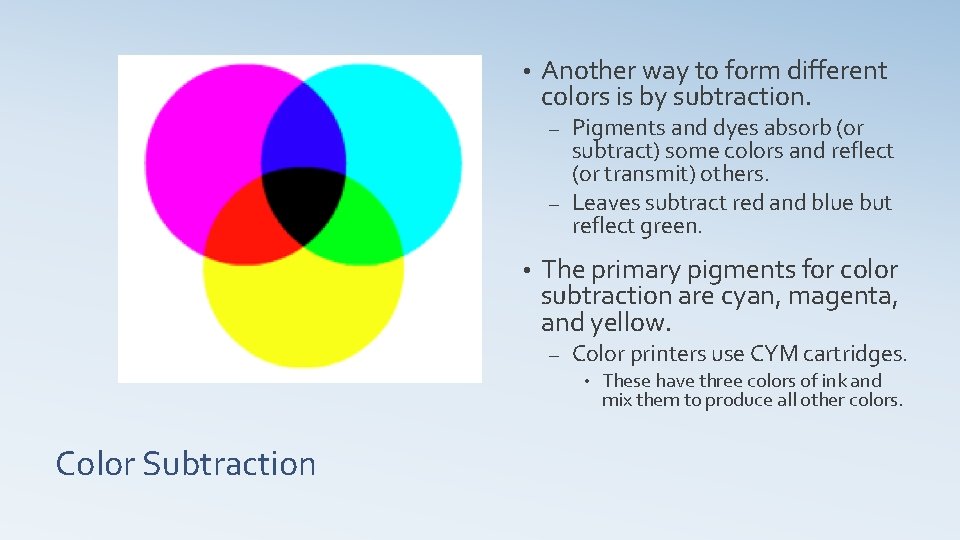
Subtractive Colors • Difference is that pigments rely on colors of light that are absorbed or subtracted. • When pigments mix, they subtract a certain color from white light
Subtractive Primary Colors • Cyan, Magenta, & Yellow • Mix the primary colors together and one should get black
• Another way to form different colors is by subtraction. Pigments and dyes absorb (or subtract) some colors and reflect (or transmit) others. – Leaves subtract red and blue but reflect green. – • The primary pigments for color subtraction are cyan, magenta, and yellow. – Color printers use CYM cartridges. • Color Subtraction These have three colors of ink and mix them to produce all other colors.
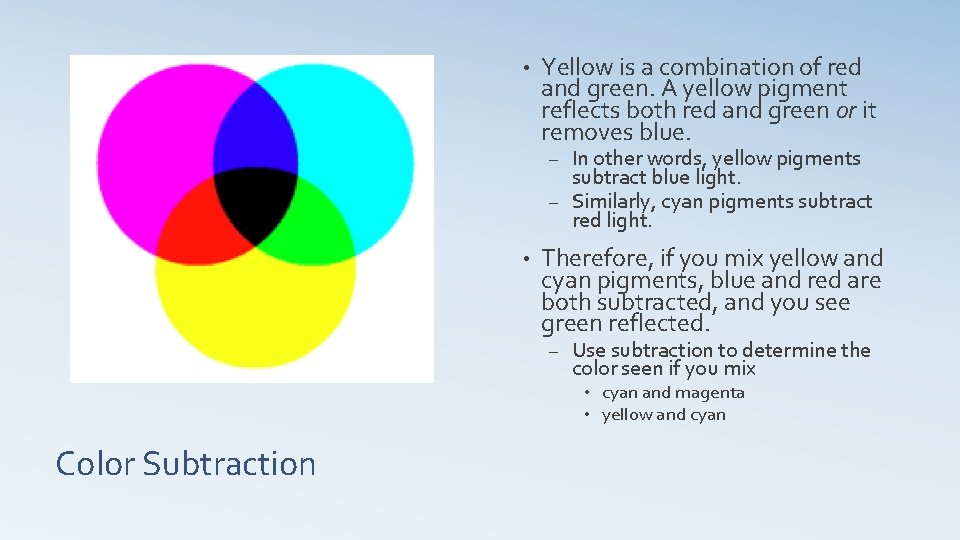
• Yellow is a combination of red and green. A yellow pigment reflects both red and green or it removes blue. In other words, yellow pigments subtract blue light. – Similarly, cyan pigments subtract red light. – • Therefore, if you mix yellow and cyan pigments, blue and red are both subtracted, and you see green reflected. – Use subtraction to determine the color seen if you mix • • Color Subtraction cyan and magenta yellow and cyan
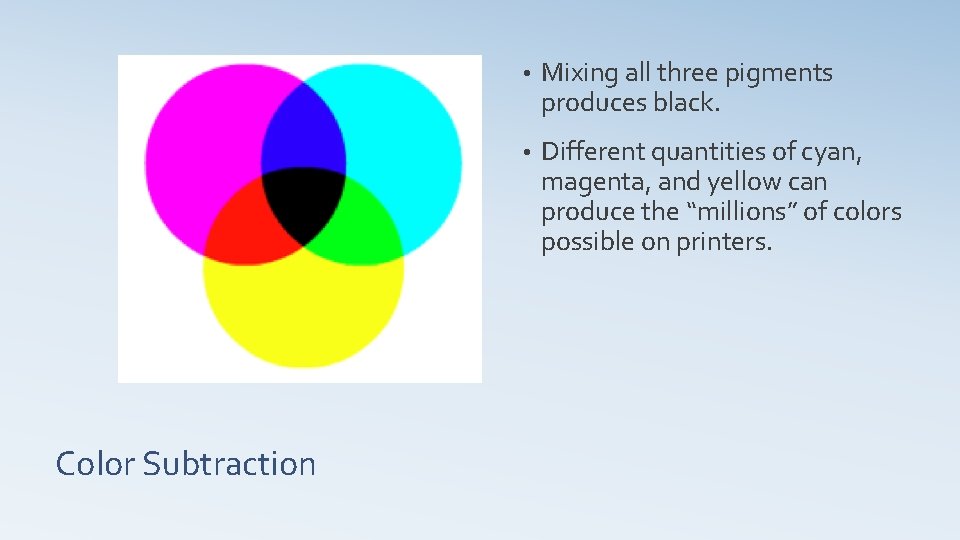
Color Subtraction • Mixing all three pigments produces black. • Different quantities of cyan, magenta, and yellow can produce the “millions” of colors possible on printers.
Subtractive Color Mixing Click below to watch the Visual Concept
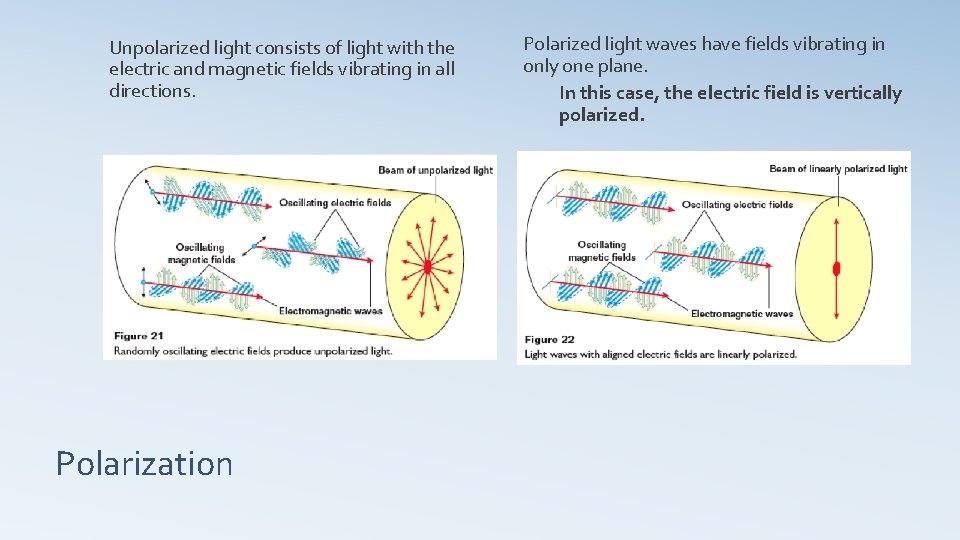
Polarization • Remember electric fields travel at a right angle to both the magnetic field and direction of propagation • This is unpolarized light
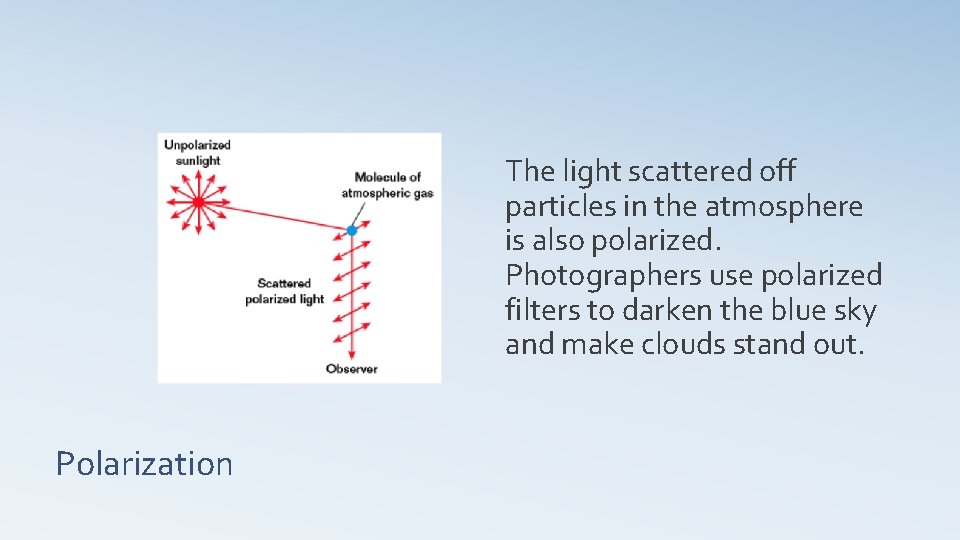
Polarization • Light can be polarized by transmission, scattering, and reflection.
Polarization • Certain processes can separate waves in the vertical and horizontal directions • This is linear polarization
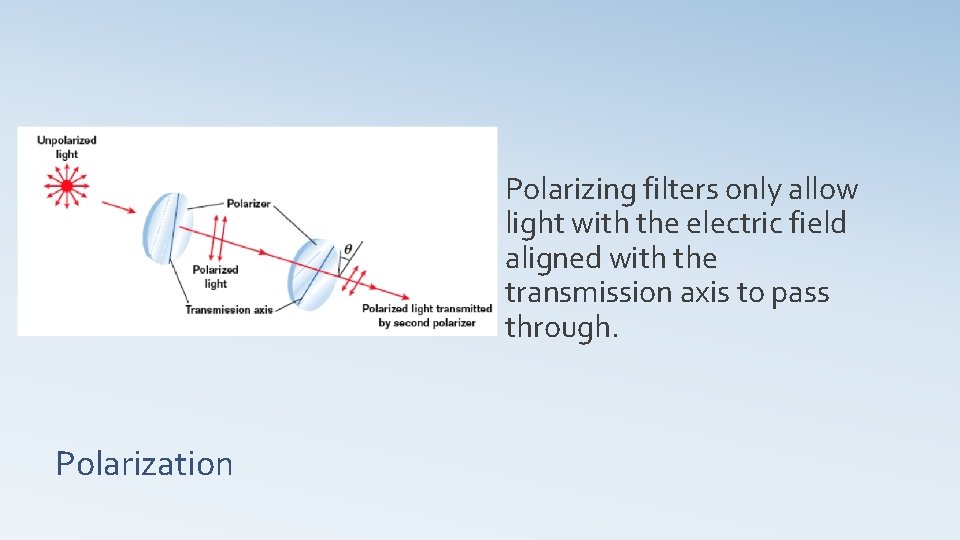
Polarization • Transmission axis – the line along which light is polarized • Like a picket fence
Polarization • Light can also be polarized by reflection and scattering • If the surface is parallel to the ground the light is polarized horizontally (glare)
Unpolarized light consists of light with the electric and magnetic fields vibrating in all directions. Polarization Polarized light waves have fields vibrating in only one plane. In this case, the electric field is vertically polarized.
Polarizing filters only allow light with the electric field aligned with the transmission axis to pass through. Polarization
The light scattered off particles in the atmosphere is also polarized. Photographers use polarized filters to darken the blue sky and make clouds stand out. Polarization
Click below to watch the Visual Concept Polarization by Reflecting and Scattering