
Color Lecture Set 25 CS 5540 HCI Rich

- Slides: 44
Color Lecture Set 25 CS 5540 HCI Rich Riesenfeld Fall 2011 1
Color Issues • Physical nature of color • Eye mechanism of color – Rods, Cones, tri-stimulus model • Brain mechanism of color • Color spaces • Aesthetic and physiological 2
Color • Color is complicated! – Highly nonlinear – No singular model to explain all • Many simplistic models, explanations • Many myths • Much new knowledge 3
Color • Many phenomena to explain – High light / low light – Illusions – Color blindness – Metamers 4
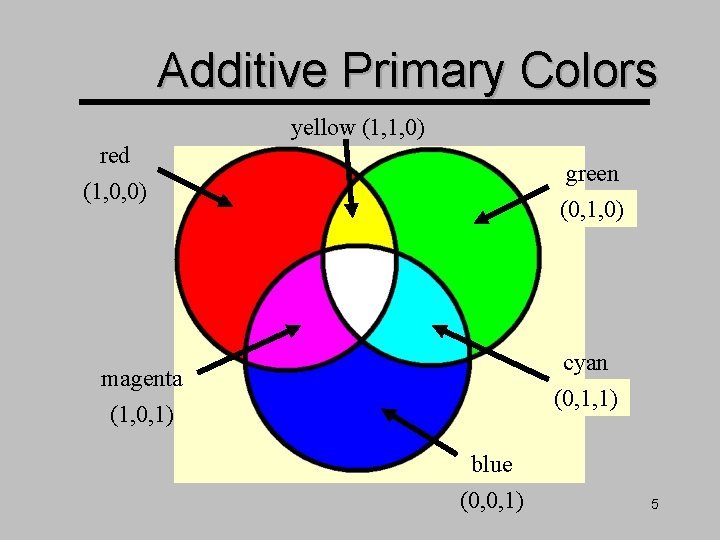
Additive Primary Colors yellow (1, 1, 0) red (1, 0, 0) green (0, 1, 0) cyan (0, 1, 1) magenta (1, 0, 1) blue (0, 0, 1) 5
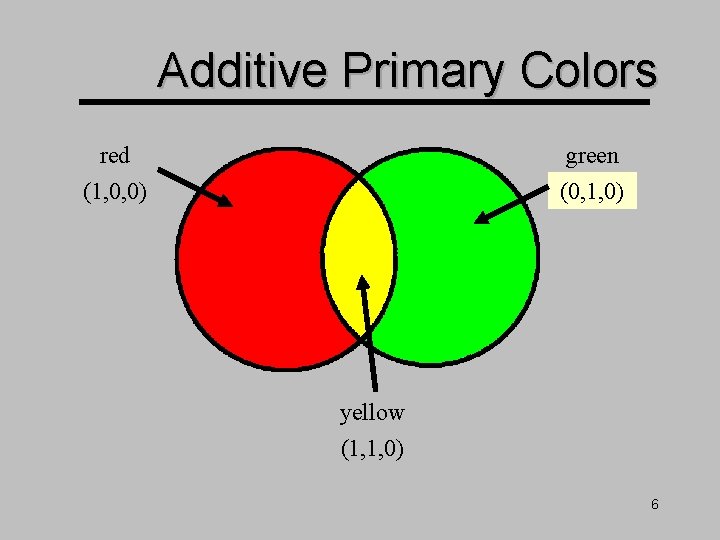
Additive Primary Colors red (1, 0, 0) green (0, 1, 0) yellow (1, 1, 0) 6
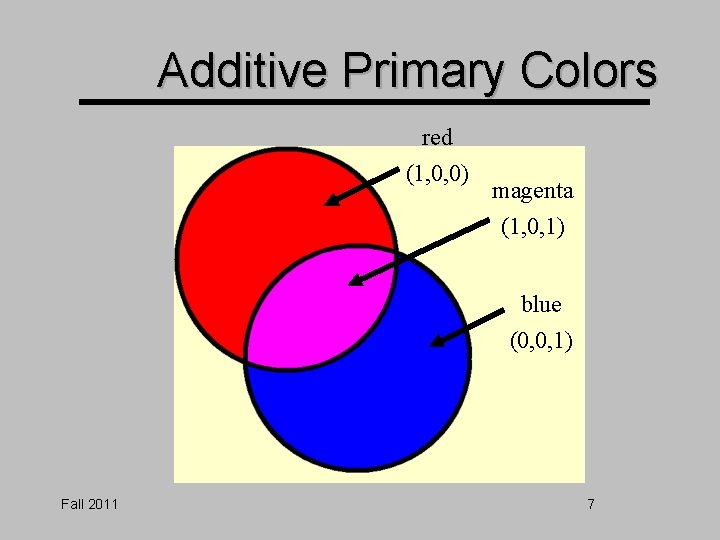
Additive Primary Colors red (1, 0, 0) magenta (1, 0, 1) blue (0, 0, 1) Fall 2011 7
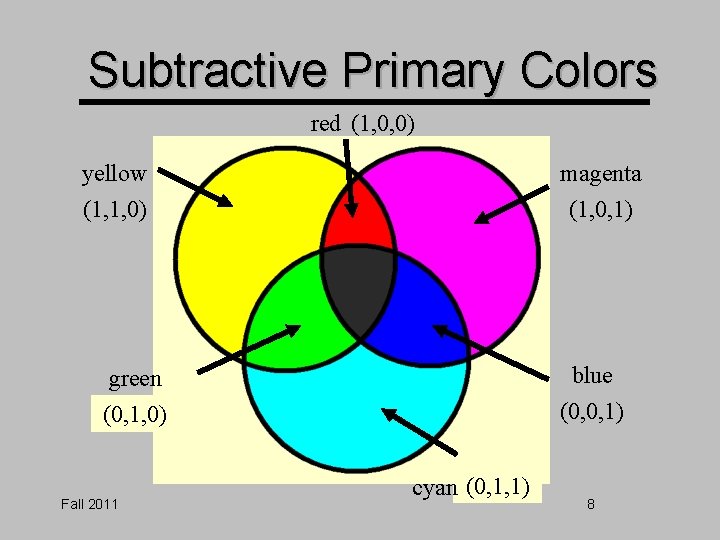
Subtractive Primary Colors red (1, 0, 0) yellow (1, 1, 0) magenta (1, 0, 1) blue (0, 0, 1) green (0, 1, 0) Fall 2011 cyan (0, 1, 1) 8
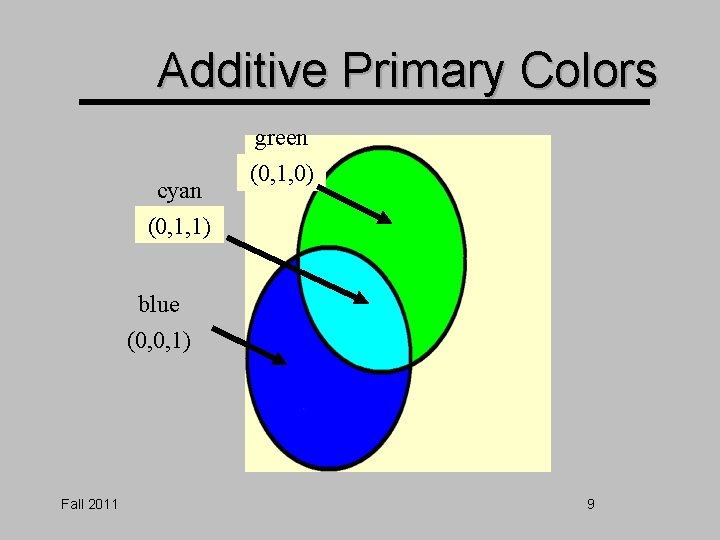
Additive Primary Colors green cyan (0, 1, 1) (0, 1, 0) blue (0, 0, 1) Fall 2011 9
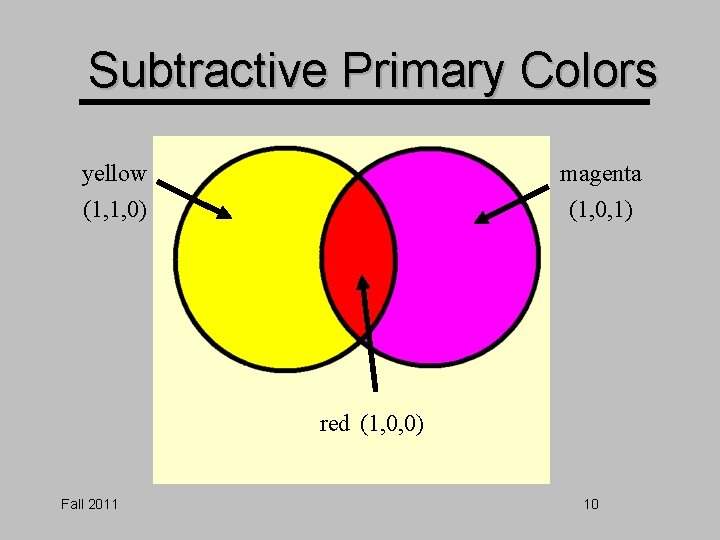
Subtractive Primary Colors yellow (1, 1, 0) magenta (1, 0, 1) red (1, 0, 0) Fall 2011 10
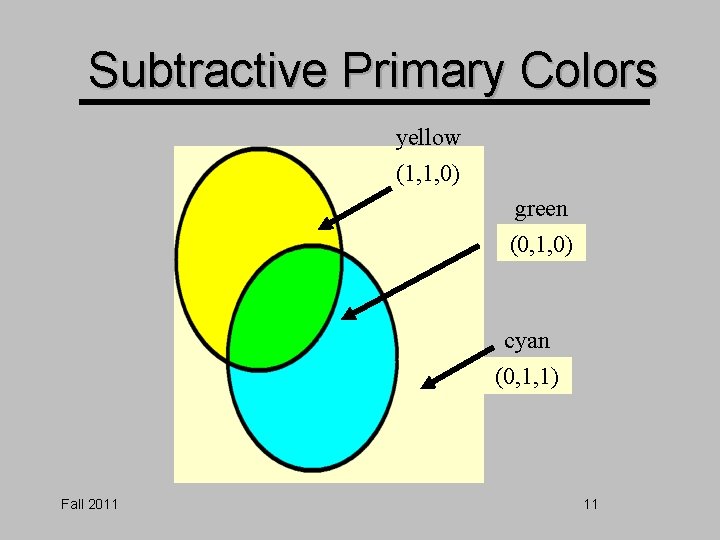
Subtractive Primary Colors yellow (1, 1, 0) green (0, 1, 0) cyan (0, 1, 1) Fall 2011 11
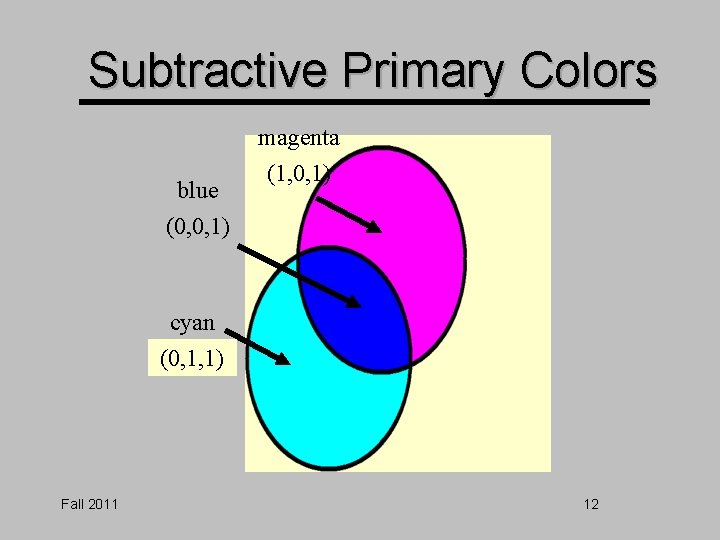
Subtractive Primary Colors magenta blue (0, 0, 1) (1, 0, 1) cyan (0, 1, 1) Fall 2011 12
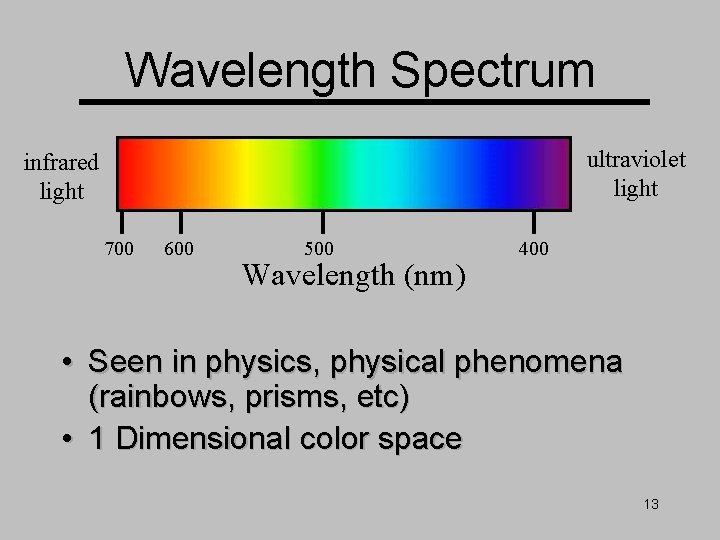
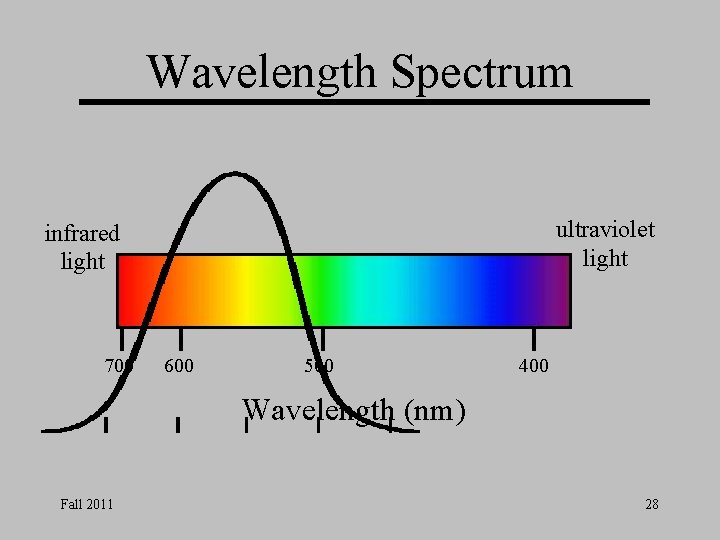
Wavelength Spectrum ultraviolet light infrared light 700 600 500 400 Wavelength (nm) • Seen in physics, physical phenomena (rainbows, prisms, etc) • 1 Dimensional color space 13
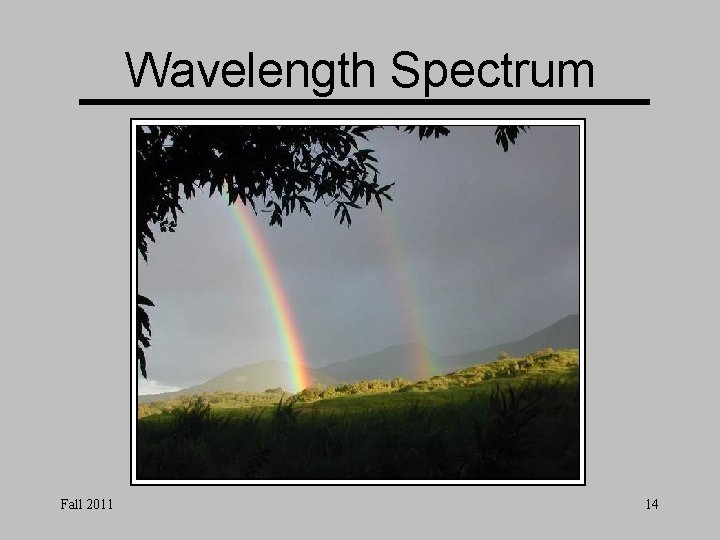
Wavelength Spectrum Fall 2011 14
Color Space • “Navigating, ” moving around in a color space, is tricky • Many representations (spaces) for all colors • Can you get to a nearby color? Can you predictably adjust a color? 15
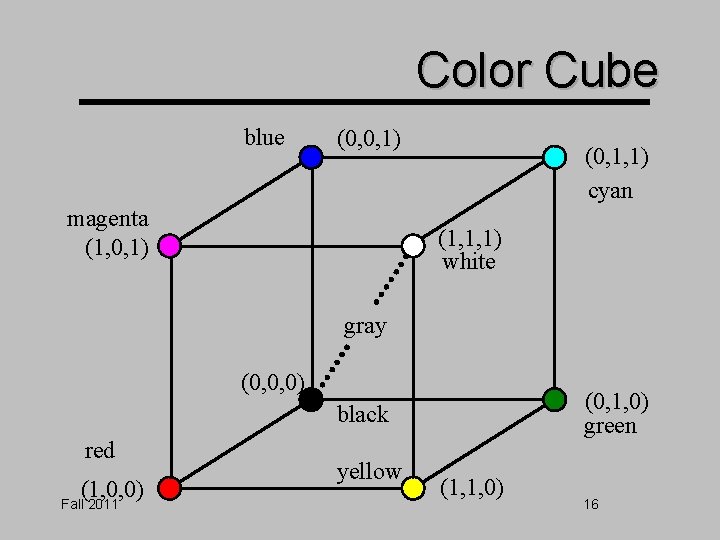
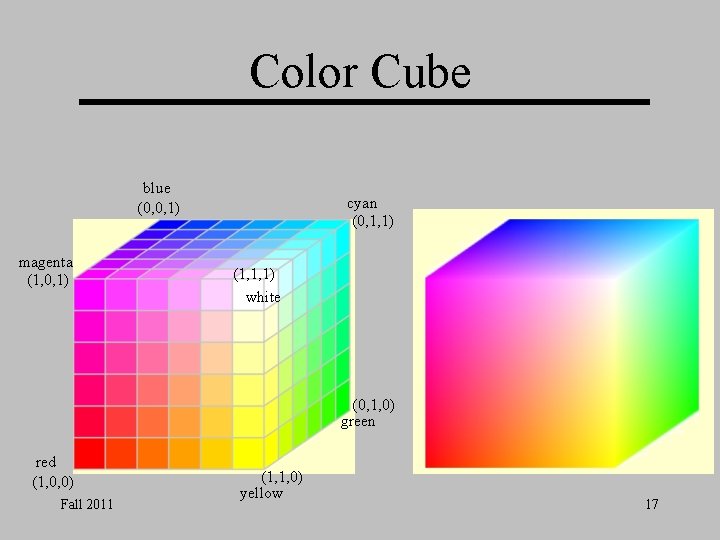
Color Cube blue (0, 0, 1) magenta (1, 0, 1) (0, 1, 1) cyan (1, 1, 1) white gray (0, 0, 0) (0, 1, 0) green black red (1, 0, 0) Fall 2011 yellow (1, 1, 0) 16
Color Cube blue (0, 0, 1) magenta (1, 0, 1) cyan (0, 1, 1) (1, 1, 1) white (0, 1, 0) green red (1, 0, 0) Fall 2011 (1, 1, 0) yellow 17
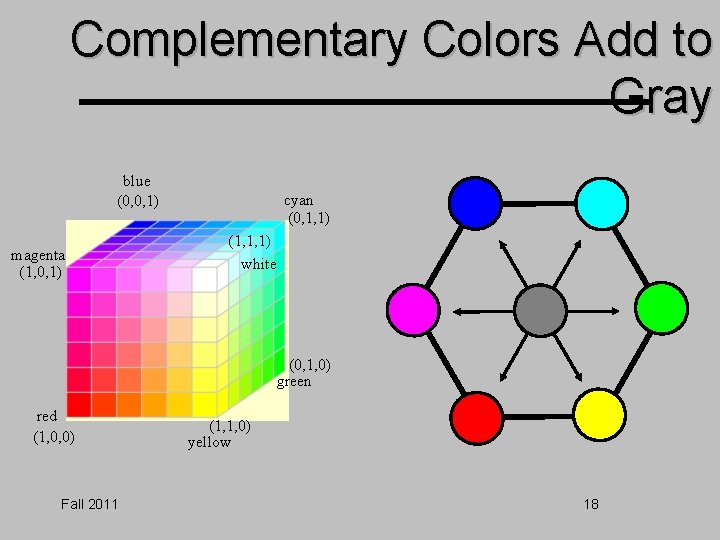
Complementary Colors Add to Gray blue (0, 0, 1) magenta (1, 0, 1) cyan (0, 1, 1) (1, 1, 1) white (0, 1, 0) green red (1, 0, 0) Fall 2011 (1, 1, 0) yellow 18
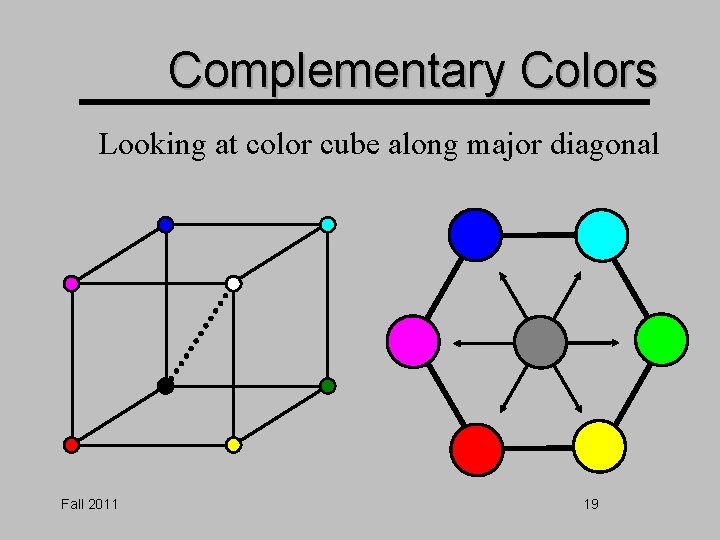
Complementary Colors Looking at color cube along major diagonal Fall 2011 19
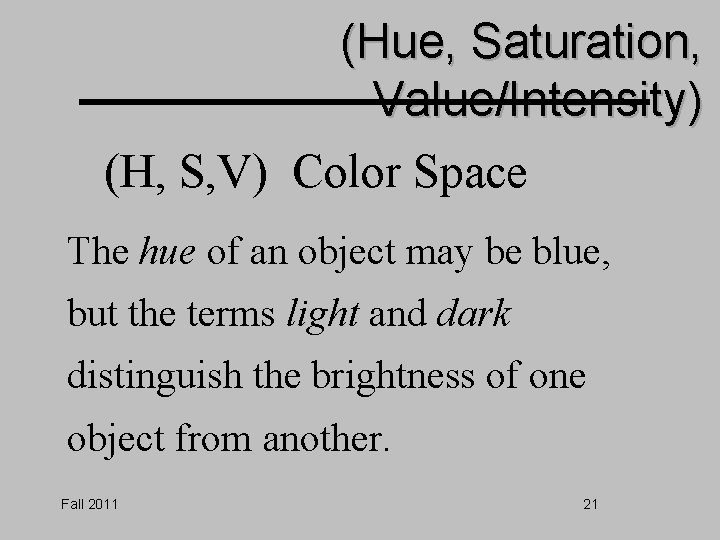
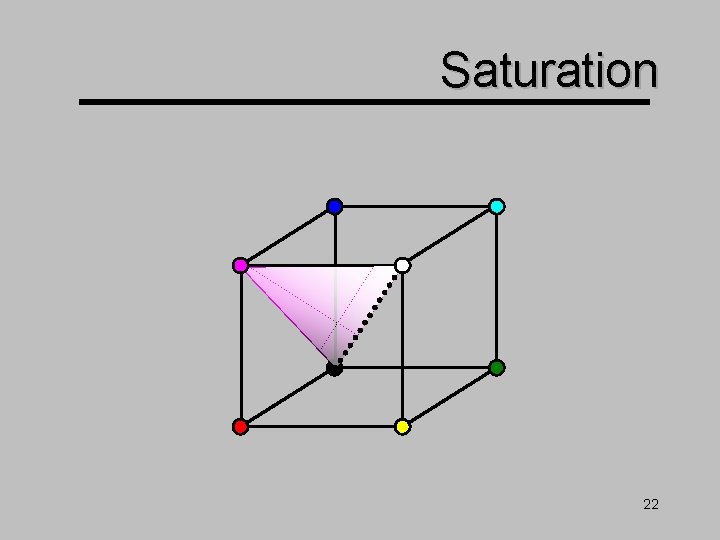
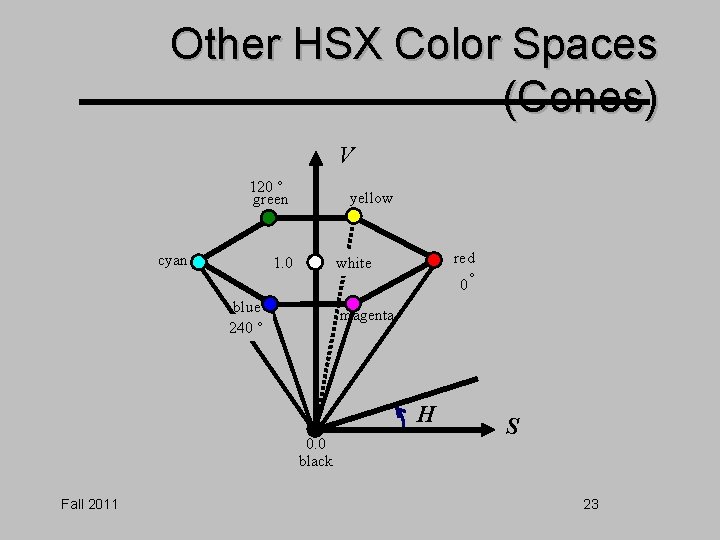
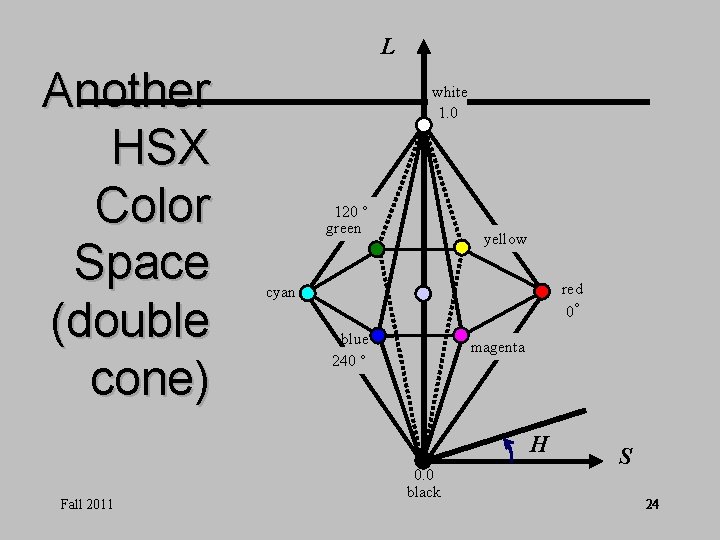
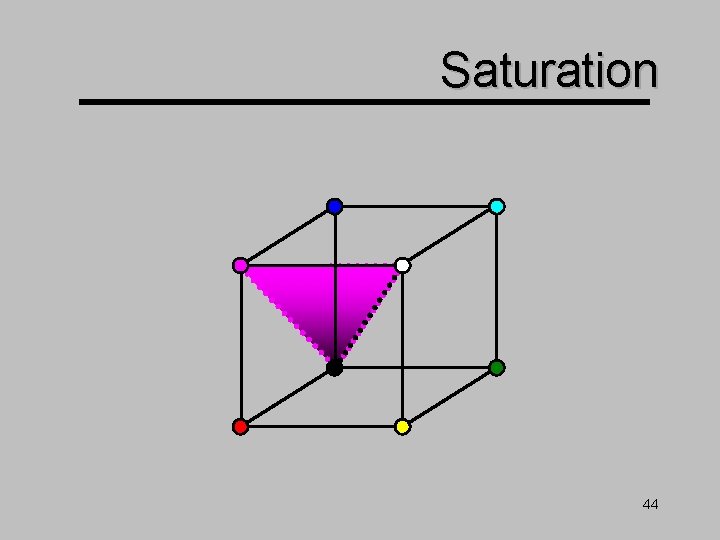
(H, S, V) Color Space • Hue: Color – Chroma • Saturation: Strength of a color – Neutral gray has 0 saturation • Brightness/Value: Intensity of light emanating from image 20
(Hue, Saturation, Value/Intensity) (H, S, V) Color Space The hue of an object may be blue, but the terms light and dark distinguish the brightness of one object from another. Fall 2011 21
Saturation 22
Other HSX Color Spaces (Cones) V 120 ˚ green cyan yellow 1. 0 red white blue 240 ˚ 0˚ magenta H 0. 0 black Fall 2011 S 23
L Another HSX Color Space (double cone) white 1. 0 120 ˚ green yellow red 0˚ cyan blue 240 ˚ magenta H Fall 2011 0. 0 black S 24
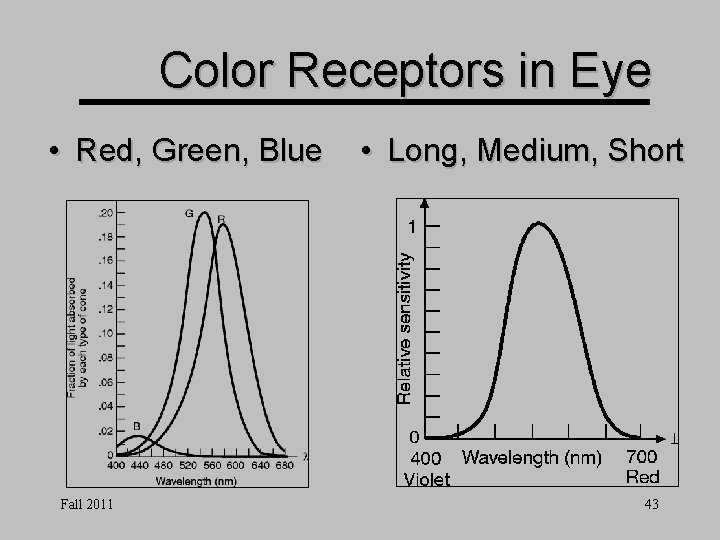
Tristimulus Color Theory • Any color can be “matched” by a mixture of three fixed base colors (primaries) • Eye has three kinds of color receptors called cones • Eye also has rods (low light receptors) 25
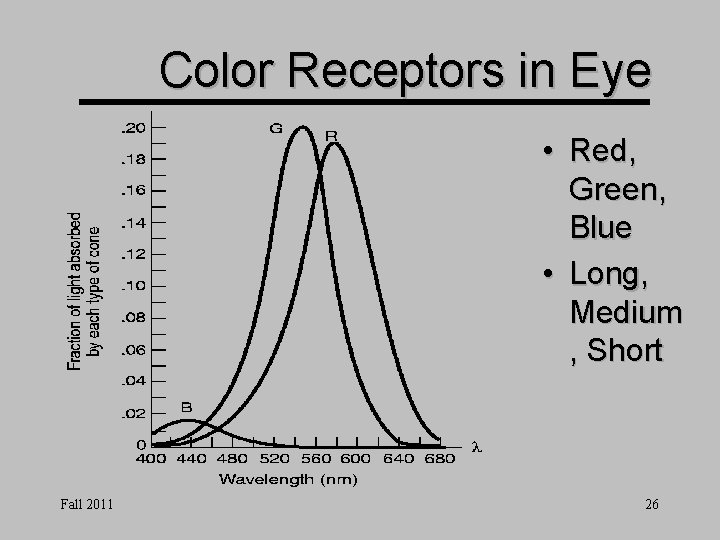
Color Receptors in Eye • Red, Green, Blue • Long, Medium , Short Fall 2011 26
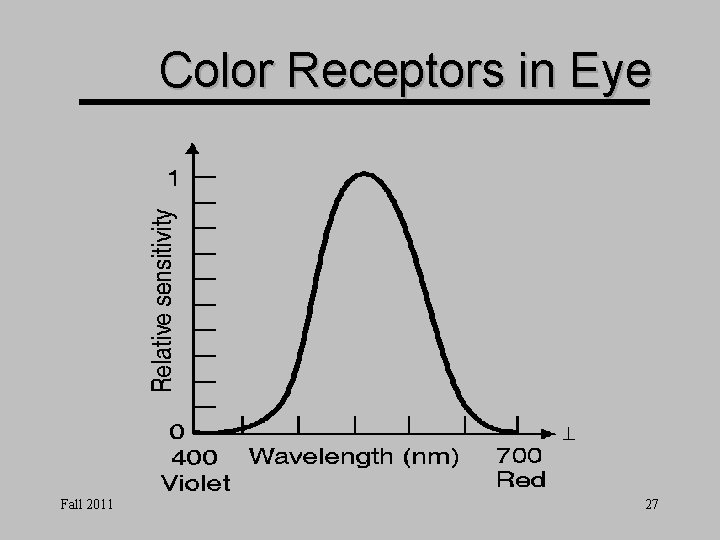
Color Receptors in Eye Fall 2011 27
Wavelength Spectrum ultraviolet light infrared light 700 600 500 400 Wavelength (nm) Fall 2011 28
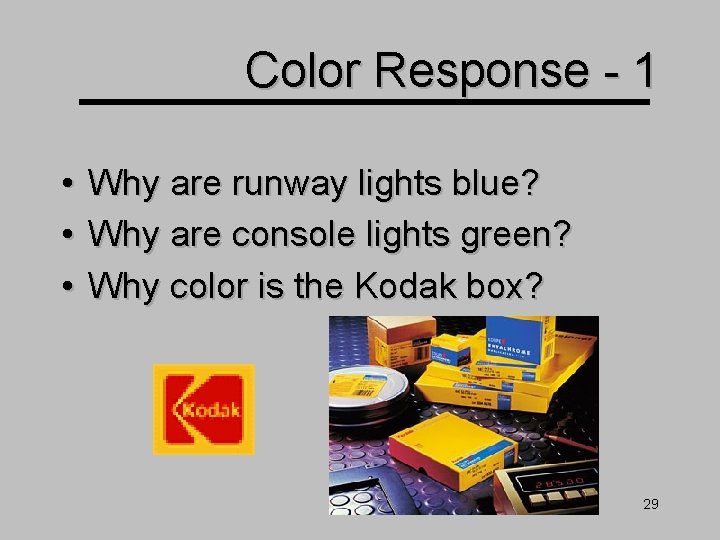
Color Response - 1 • • • Why are runway lights blue? Why are console lights green? Why color is the Kodak box? 29
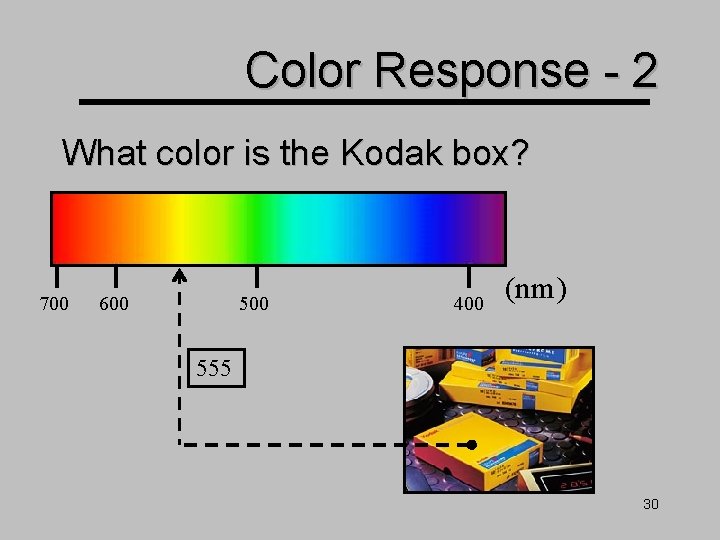
Color Response - 2 What color is the Kodak box? 700 600 500 400 (nm) 555 30
Color Matching Experiments • Given a reference color, try to match it identically • What does “negative red, ” or “negative color” mean? ? 31
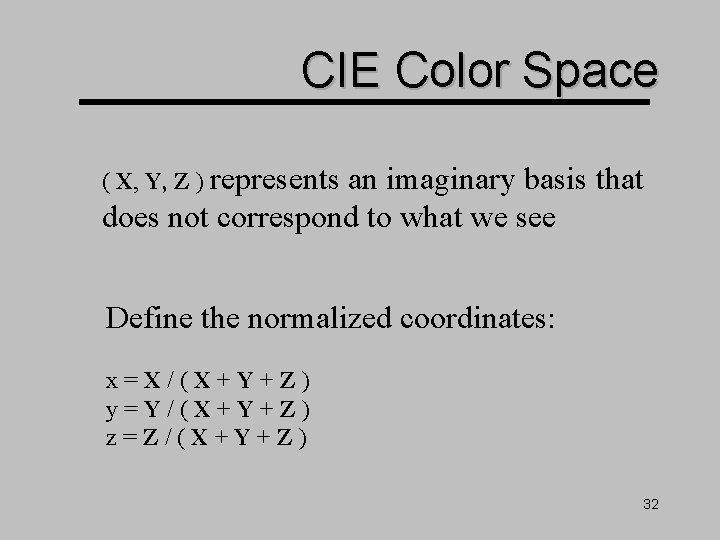
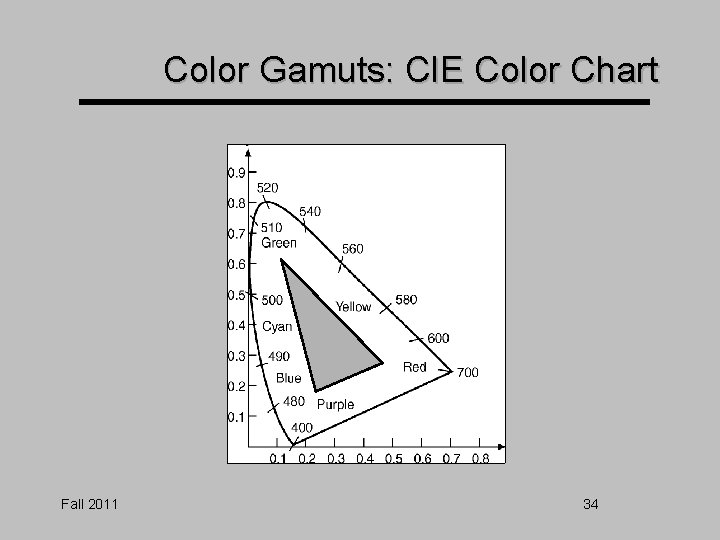
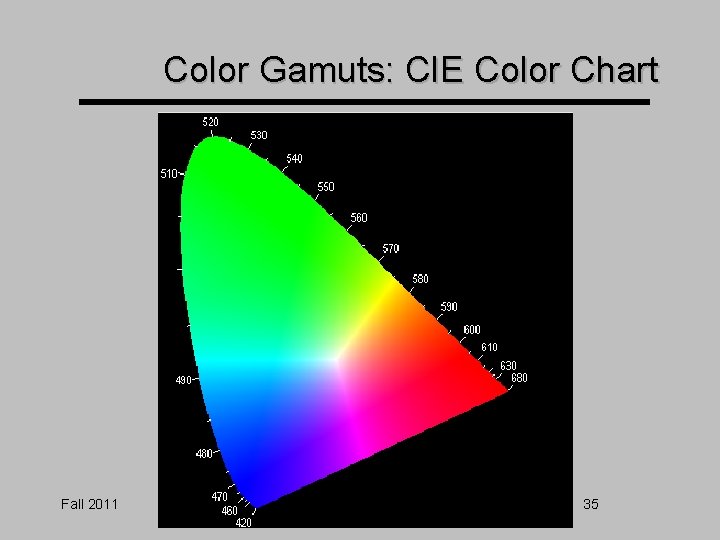
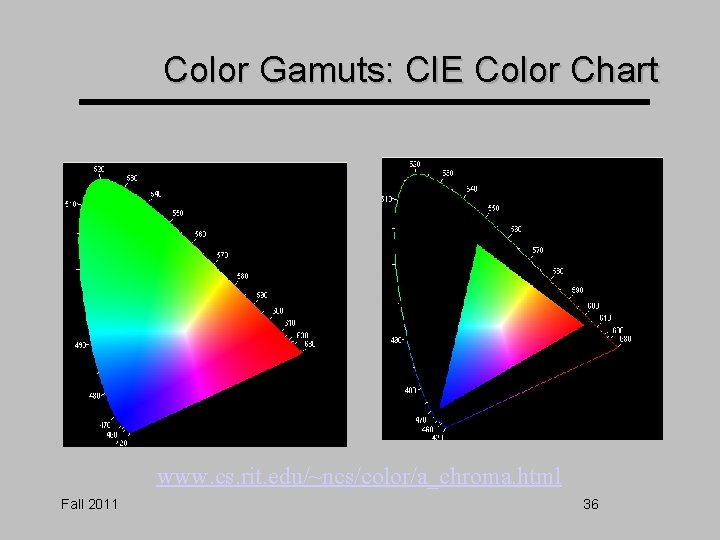
CIE Color Space ( X, Y, Z ) represents an imaginary basis that does not correspond to what we see Define the normalized coordinates: x = X / ( X + Y + Z ) y = Y / ( X + Y + Z ) z = Z / ( X + Y + Z ) 32
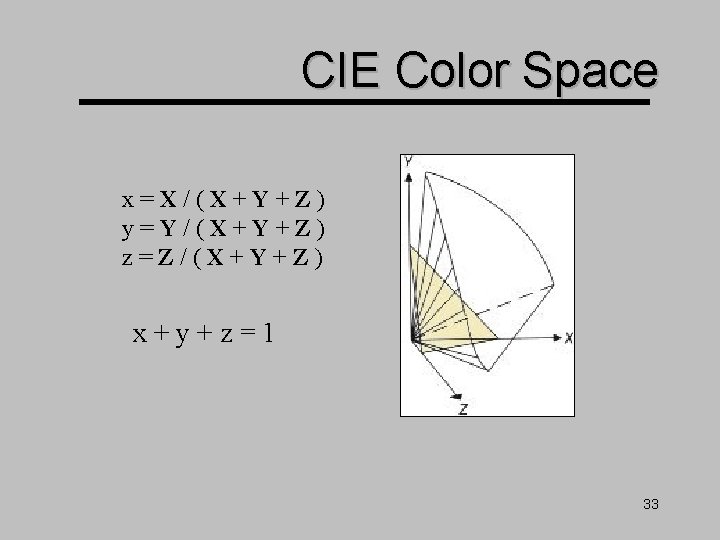
CIE Color Space x = X / ( X + Y + Z ) y = Y / ( X + Y + Z ) z = Z / ( X + Y + Z ) x + y + z = 1 33
Color Gamuts: CIE Color Chart Fall 2011 34
Color Gamuts: CIE Color Chart Fall 2011 35
Color Gamuts: CIE Color Chart www. cs. rit. edu/~ncs/color/a_chroma. html Fall 2011 36
Color Applets www. cs. brown. edu/exploratories/free. Software/repository/ edu/brown/cs/exploratories/applets/combined. Color. Mixing /combined_color_mixing_java_browser. html http: //www. cs. brown. edu/exploratories/free. Software /repository/edu/brown/cs/exploratories/applets/com bined. Color. Mixing/combined_color_mixing_java_pl ugin. html 37
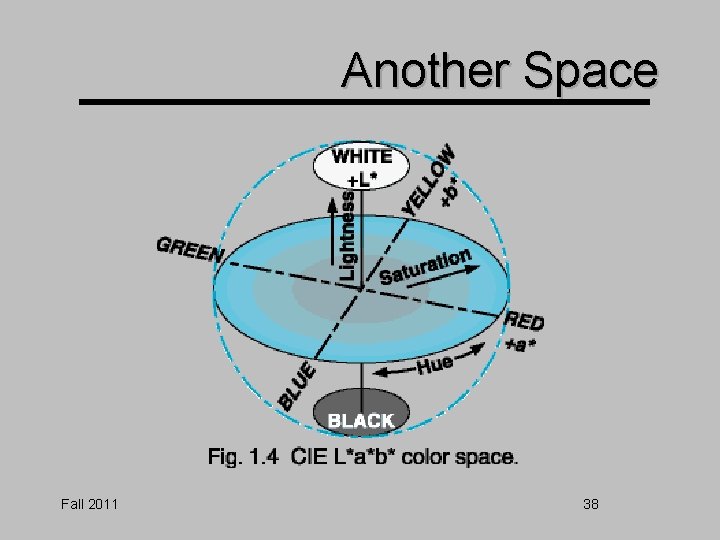
Another Space Fall 2011 38
Important Concepts • Adaptation – Slow process • Constancy – Immediate process 39
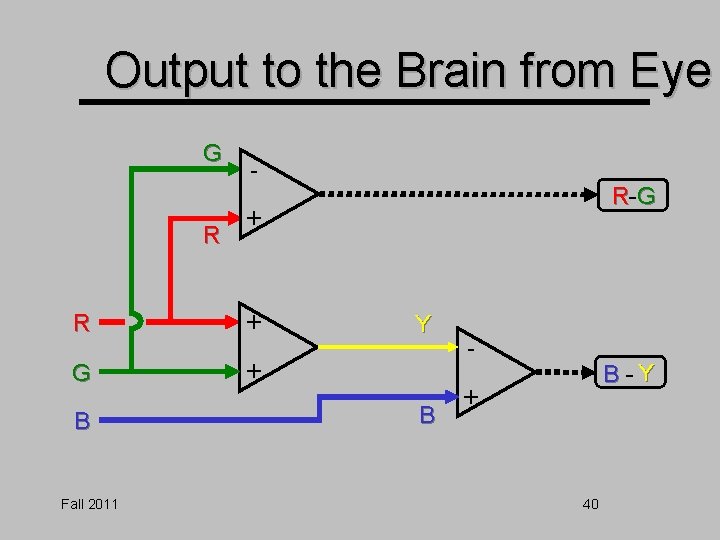
Output to the Brain from Eye G R + G + B Fall 2011 R -G Y B -Y + 40
Fall 2011 42 Lecture Set 25
Color Receptors in Eye • Red, Green, Blue Fall 2011 • Long, Medium, Short 43
Saturation 44