
Color CS 543 ECE 549 Saurabh Gupta Spring
Color CS 543 / ECE 549 – Saurabh Gupta Spring 2020, UIUC http: //saurabhg. web. illinois. edu/teaching/ece 549/sp 2020/ Many slides adapted from S. Seitz, L. Lazebnik, J. Hayes
What is color? • Color is the result of interaction between physical light in the environment and our visual system • Color is a psychological property of our visual experiences when we look at objects and lights, not a physical property of those objects or lights (S. Palmer, Vision Science: Photons to Phenomenology) Slide by L. Lazebnik
Outline • • • Physical origin of color Spectra of sources and surfaces Physiology of color vision Trichromatic color theory Color spaces Color constancy, white balance
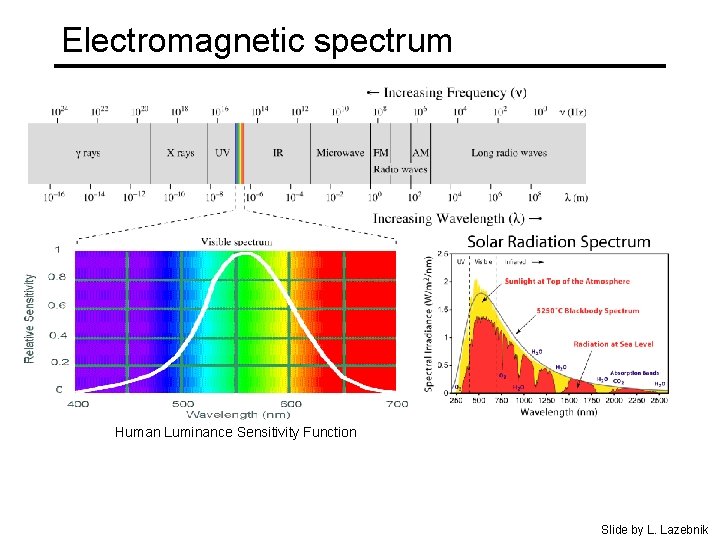
Electromagnetic spectrum Human Luminance Sensitivity Function Slide by L. Lazebnik
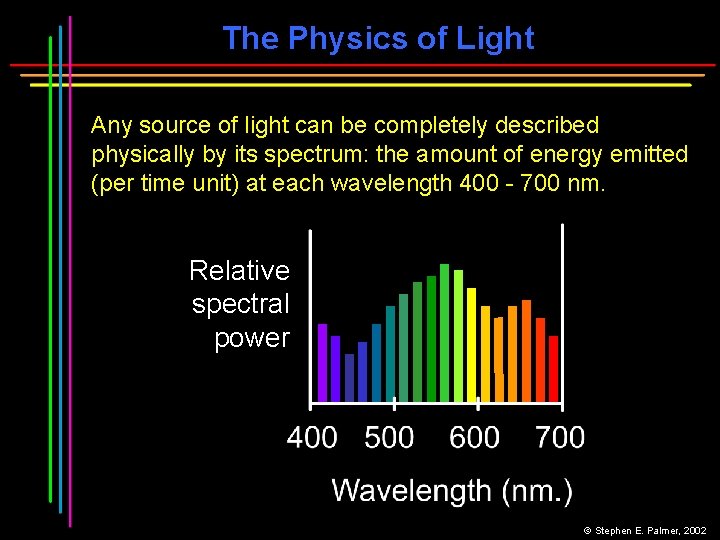
The Physics of Light Any source of light can be completely described physically by its spectrum: the amount of energy emitted (per time unit) at each wavelength 400 - 700 nm. Relative spectral power © Stephen E. Palmer, 2002
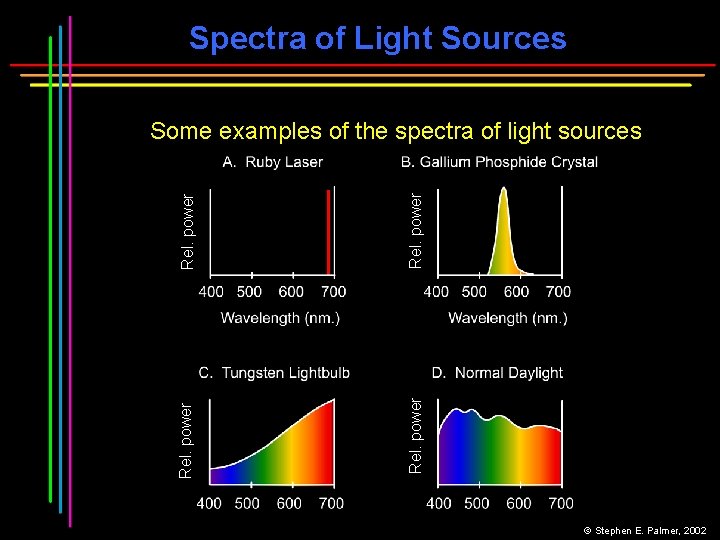
Spectra of Light Sources Rel. power Some examples of the spectra of light sources © Stephen E. Palmer, 2002
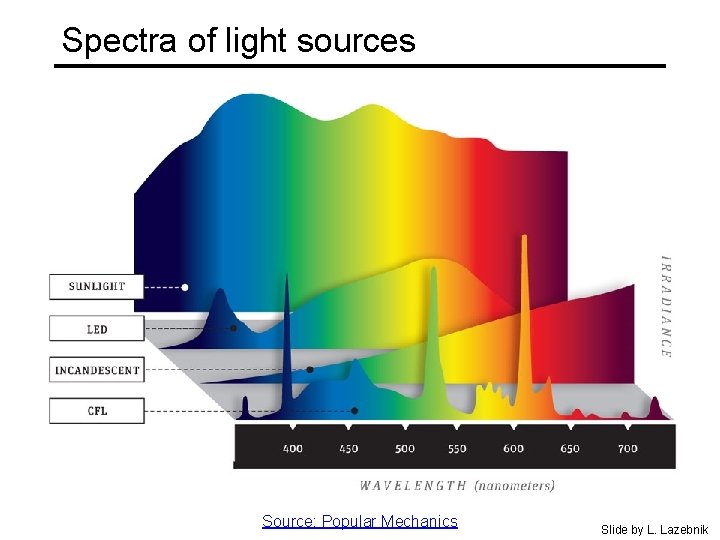
Spectra of light sources Source: Popular Mechanics Slide by L. Lazebnik
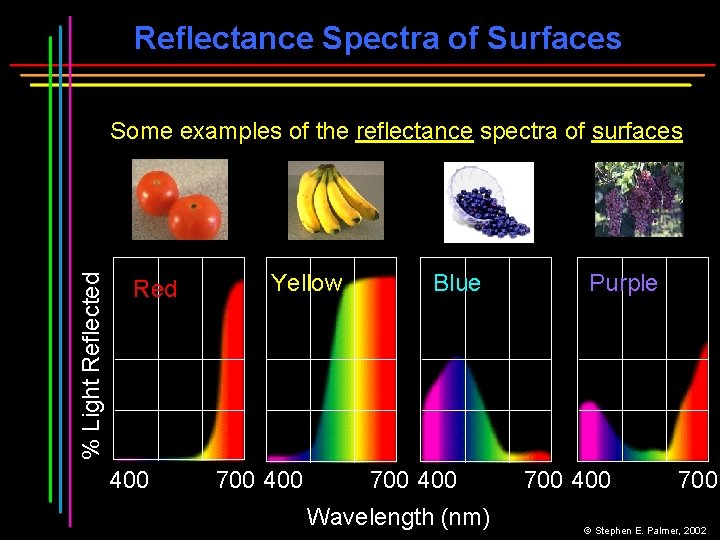
Reflectance Spectra of Surfaces % Light Reflected Some examples of the reflectance spectra of surfaces Red 400 Yellow 700 400 Blue 700 400 Wavelength (nm) Purple 700 400 700 © Stephen E. Palmer, 2002
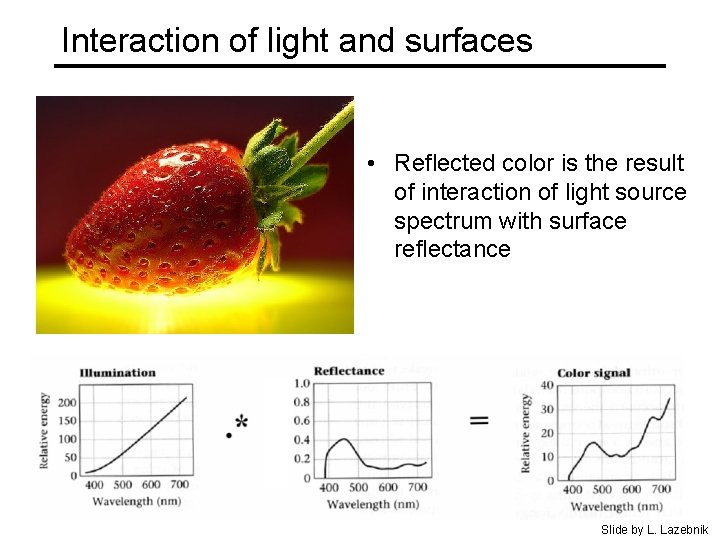
Interaction of light and surfaces • Reflected color is the result of interaction of light source spectrum with surface reflectance Slide by L. Lazebnik
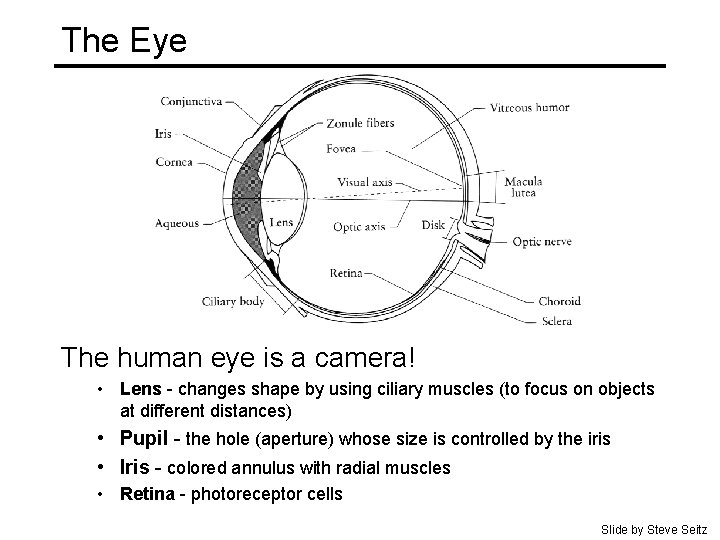
The Eye The human eye is a camera! • Lens - changes shape by using ciliary muscles (to focus on objects at different distances) • Pupil - the hole (aperture) whose size is controlled by the iris • Iris - colored annulus with radial muscles • Retina - photoreceptor cells Slide by Steve Seitz
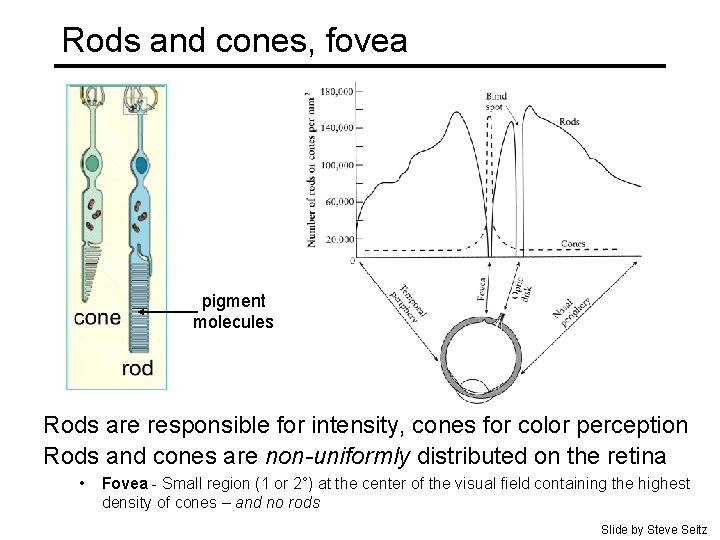
Rods and cones, fovea pigment molecules Rods are responsible for intensity, cones for color perception Rods and cones are non-uniformly distributed on the retina • Fovea - Small region (1 or 2°) at the center of the visual field containing the highest density of cones – and no rods Slide by Steve Seitz
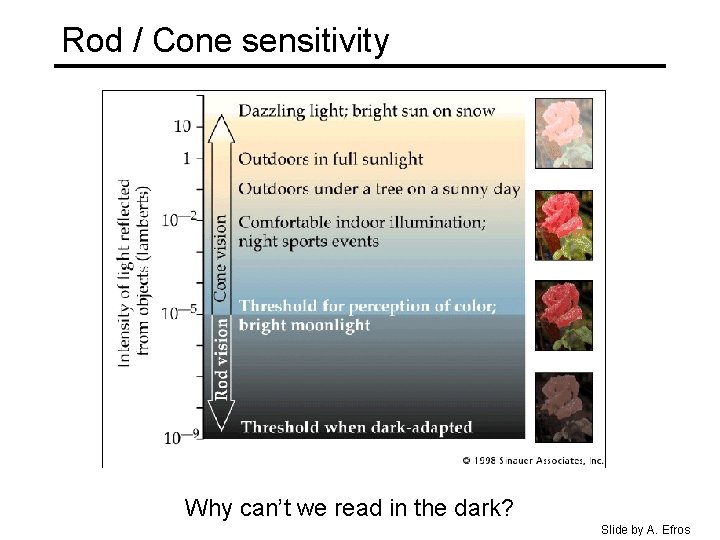
Rod / Cone sensitivity Why can’t we read in the dark? Slide by A. Efros
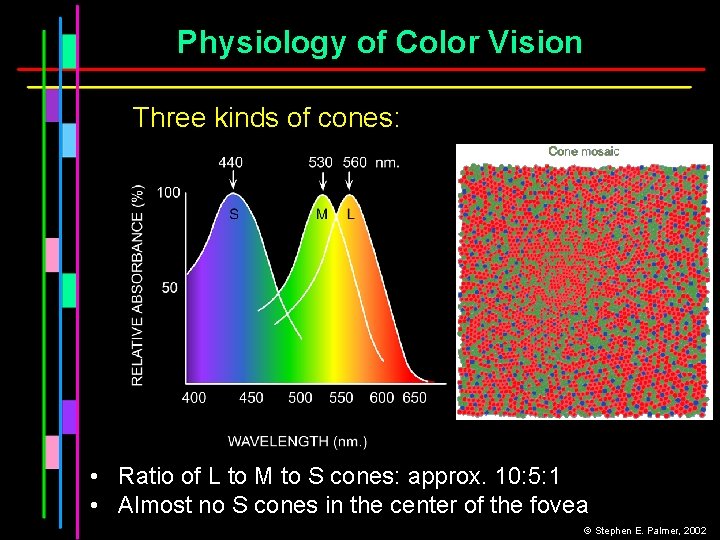
Physiology of Color Vision Three kinds of cones: • Ratio of L to M to S cones: approx. 10: 5: 1 • Almost no S cones in the center of the fovea © Stephen E. Palmer, 2002
Physiology of Color Vision: Fun facts • “M” and “L” pigments are encoded on the X-chromosome • That’s why men are more likely to be color blind • “L” gene has high variation, so some women may be tetrachromatic • Some animals have one (night animals), two (e. g. , dogs), four (fish, birds), five (pigeons, some reptiles/amphibians), or even 12 (mantis shrimp) types of cones http: //ngm. nationalgeographic. com/2016/02/evolution-of-eyes-text http: //en. wikipedia. org/wiki/Color_vision Slide by D. Hoiem
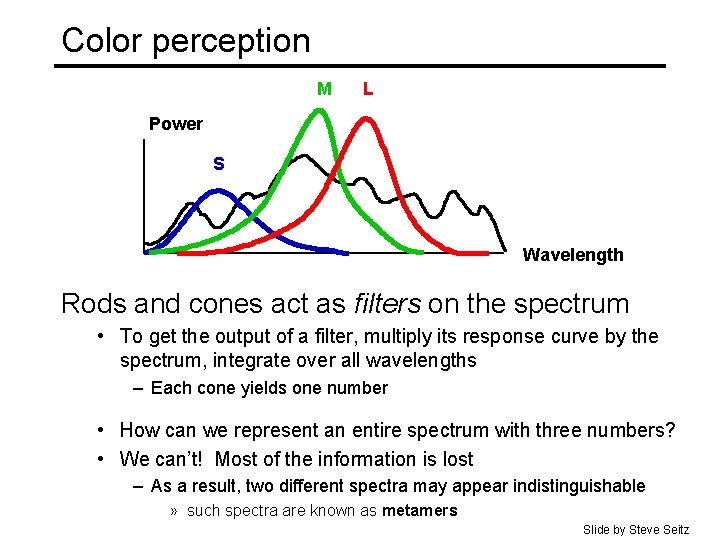
Color perception M L Power S Wavelength Rods and cones act as filters on the spectrum • To get the output of a filter, multiply its response curve by the spectrum, integrate over all wavelengths – Each cone yields one number • How can we represent an entire spectrum with three numbers? • We can’t! Most of the information is lost – As a result, two different spectra may appear indistinguishable » such spectra are known as metamers Slide by Steve Seitz
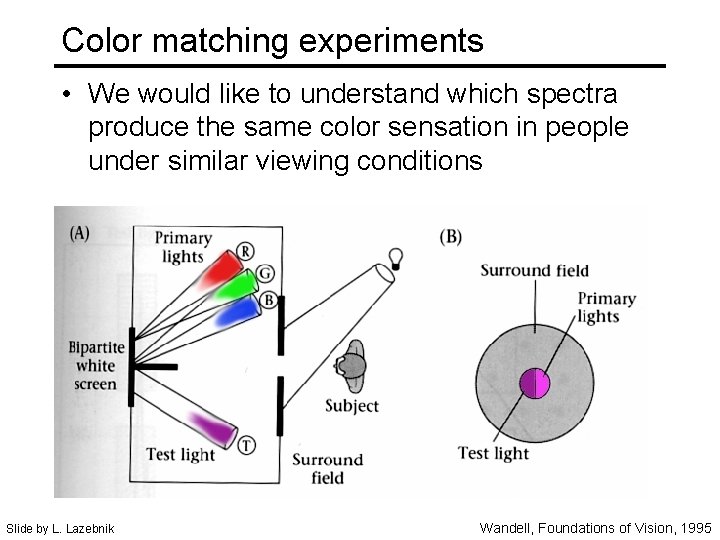
Color matching experiments • We would like to understand which spectra produce the same color sensation in people under similar viewing conditions Slide by L. Lazebnik Wandell, Foundations of Vision, 1995
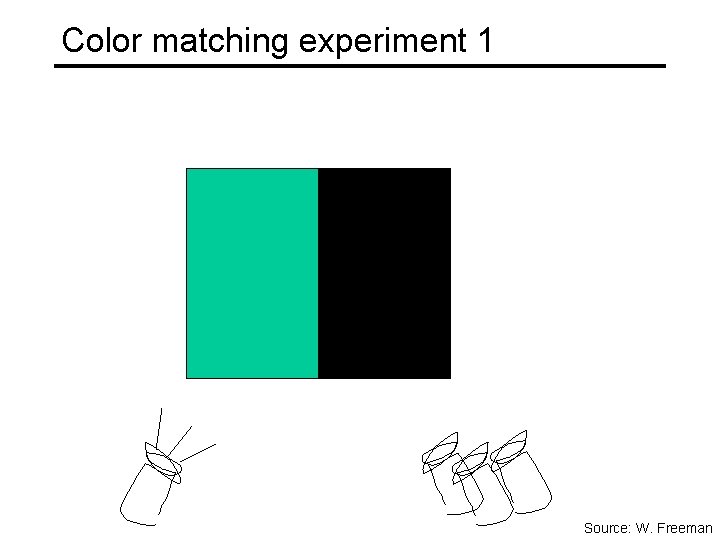
Color matching experiment 1 Source: W. Freeman
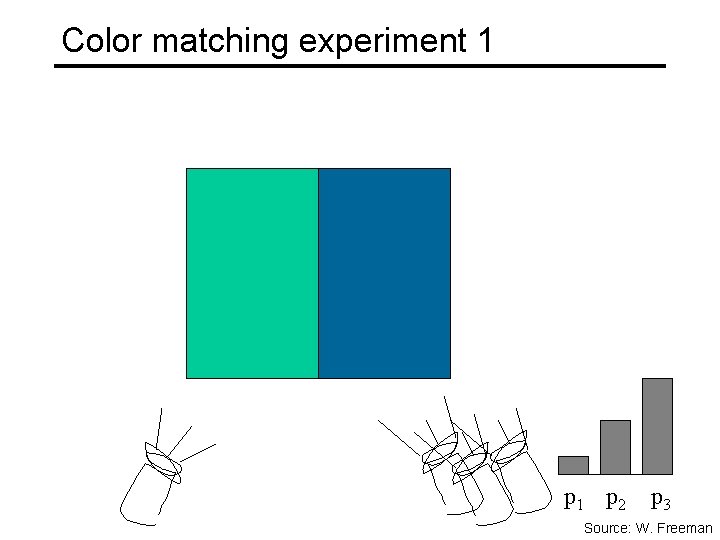
Color matching experiment 1 p 2 p 3 Source: W. Freeman
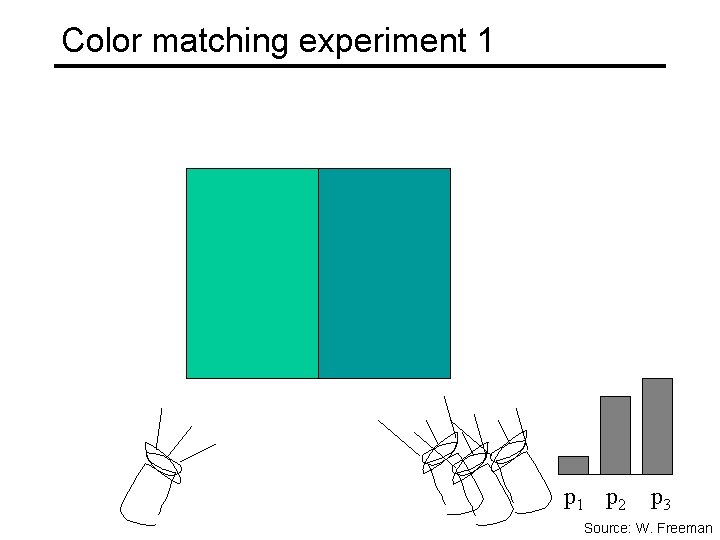
Color matching experiment 1 p 2 p 3 Source: W. Freeman
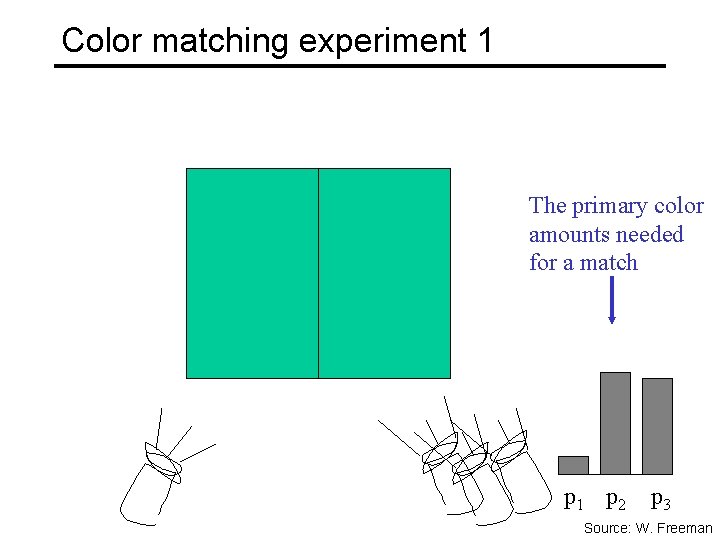
Color matching experiment 1 The primary color amounts needed for a match p 1 p 2 p 3 Source: W. Freeman
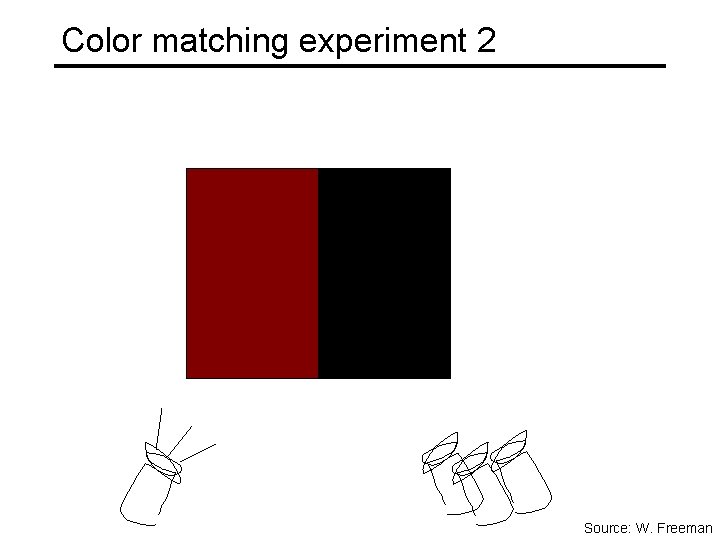
Color matching experiment 2 Source: W. Freeman
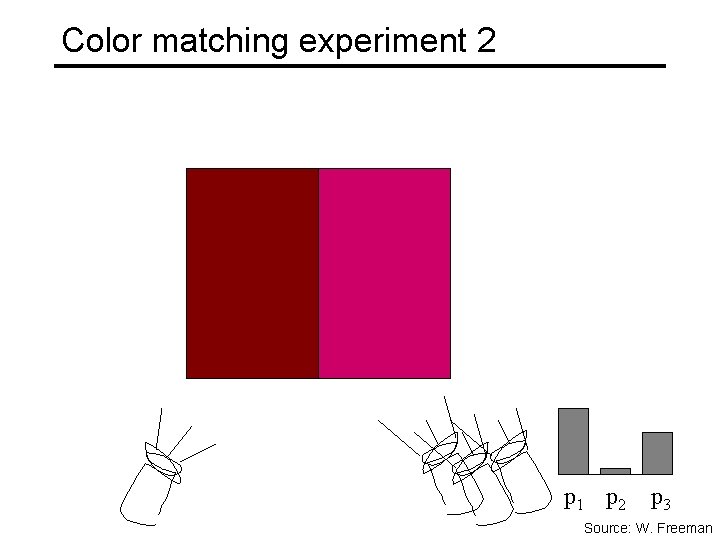
Color matching experiment 2 p 1 p 2 p 3 Source: W. Freeman
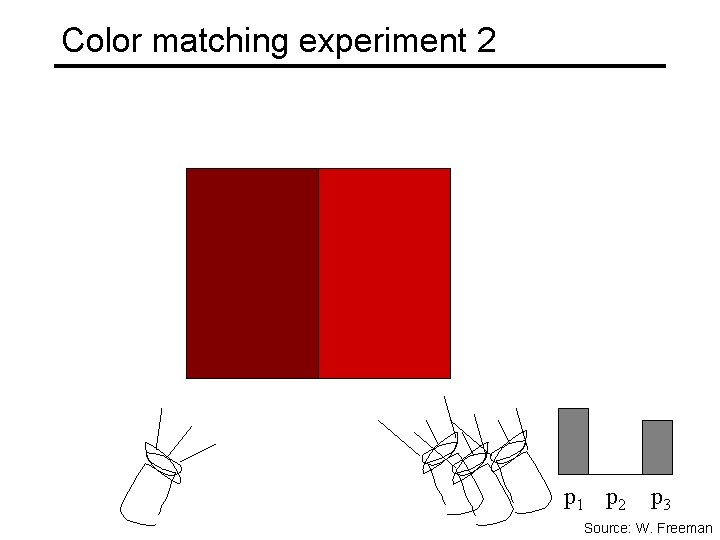
Color matching experiment 2 p 1 p 2 p 3 Source: W. Freeman
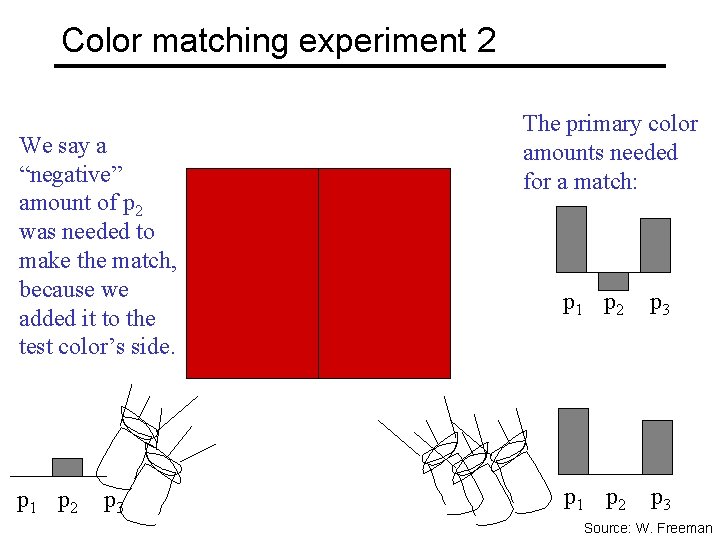
Color matching experiment 2 We say a “negative” amount of p 2 was needed to make the match, because we added it to the test color’s side. p 1 p 2 p 3 The primary color amounts needed for a match: p 1 p 2 p 3 Source: W. Freeman
Trichromacy • In color matching experiments, most people can match any given light with three primaries • Primaries must be independent • For the same light and same primaries, most people select the same weights • Exception: color blindness • Trichromatic color theory • Three numbers seem to be sufficient for encoding color • Dates back to 18 th century (Thomas Young) https: //en. wikipedia. org/wiki/Young_Helmholtz_theory Slide by L. Lazebnik
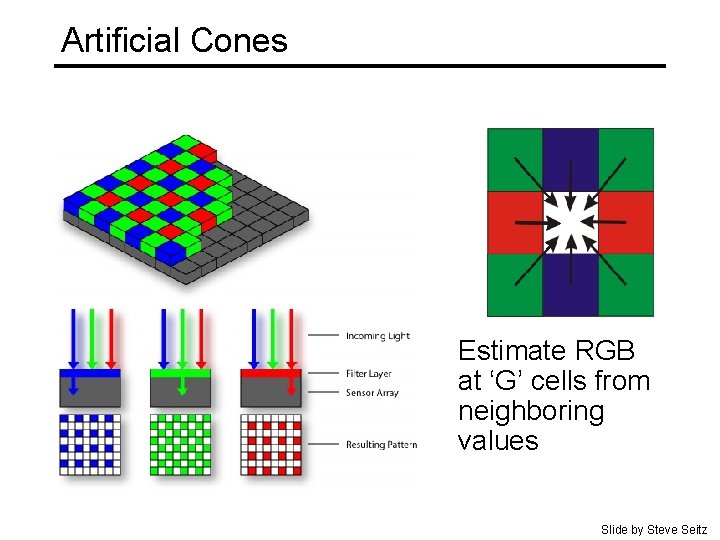
Artificial Cones Estimate RGB at ‘G’ cells from neighboring values Slide by Steve Seitz
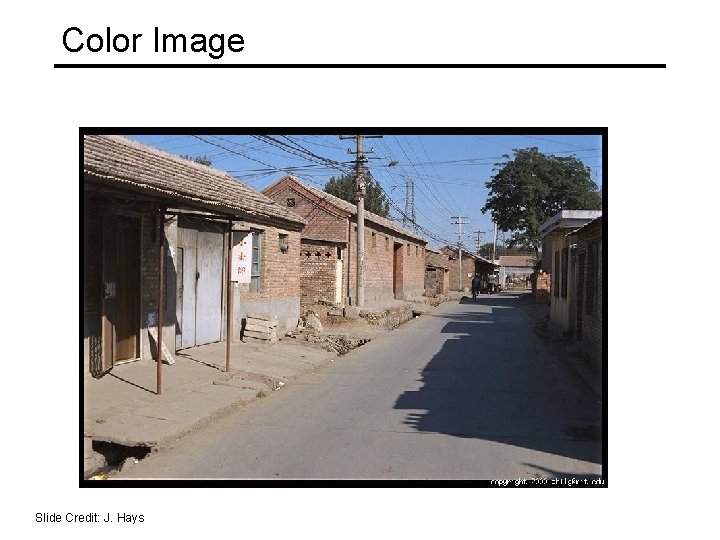
Color Image Slide Credit: J. Hays
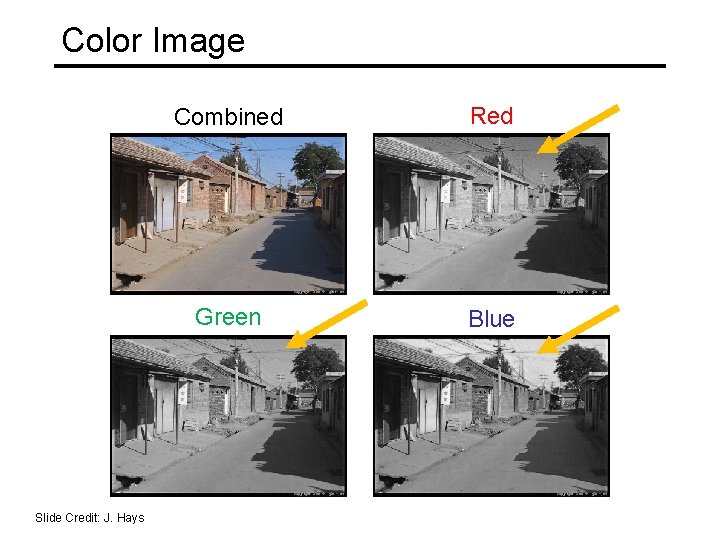
Color Image Slide Credit: J. Hays Combined Red Green Blue
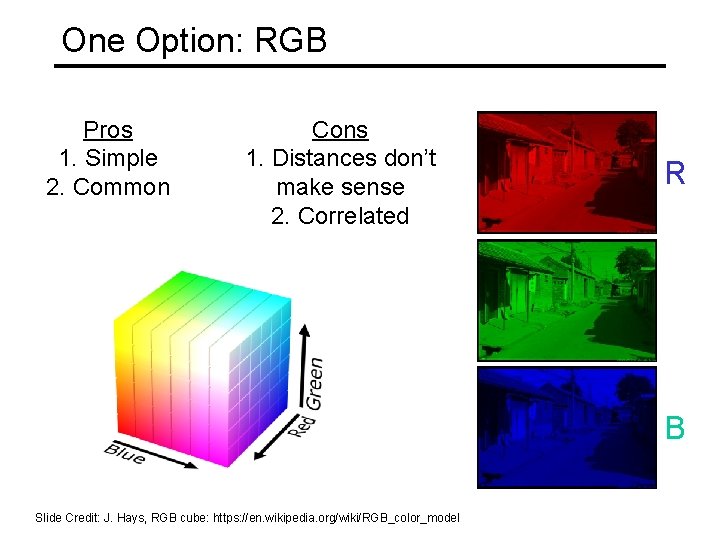
One Option: RGB Pros 1. Simple 2. Common Cons 1. Distances don’t make sense 2. Correlated R G B Slide Credit: J. Hays, RGB cube: https: //en. wikipedia. org/wiki/RGB_color_model
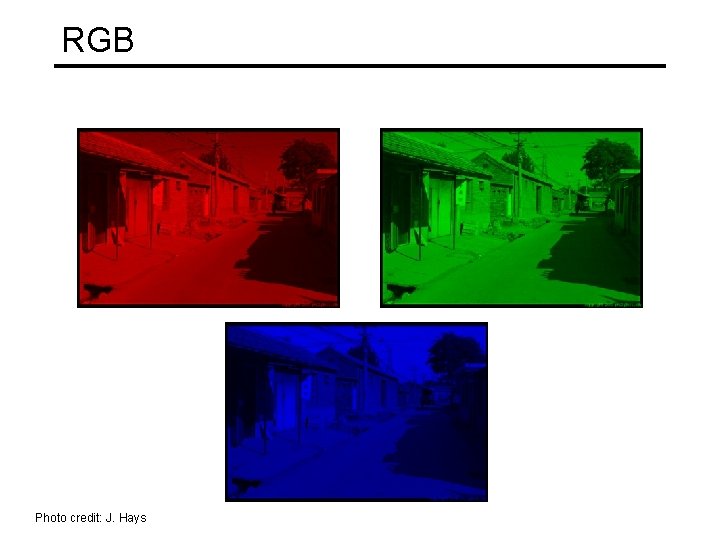
RGB Photo credit: J. Hays
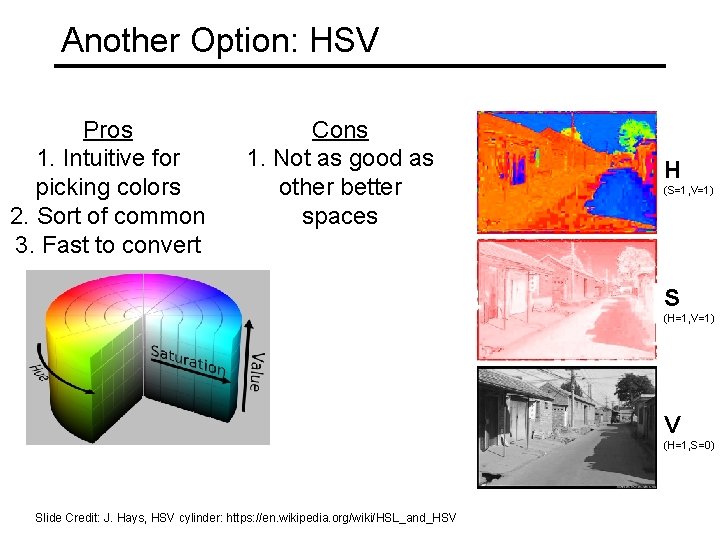
Another Option: HSV Pros 1. Intuitive for picking colors 2. Sort of common 3. Fast to convert Cons 1. Not as good as other better spaces H (S=1, V=1) S (H=1, V=1) V (H=1, S=0) Slide Credit: J. Hays, HSV cylinder: https: //en. wikipedia. org/wiki/HSL_and_HSV
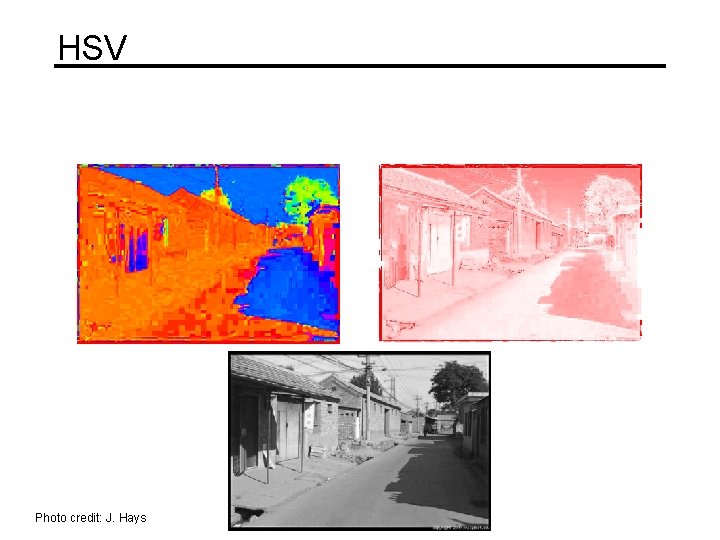
HSV Photo credit: J. Hays
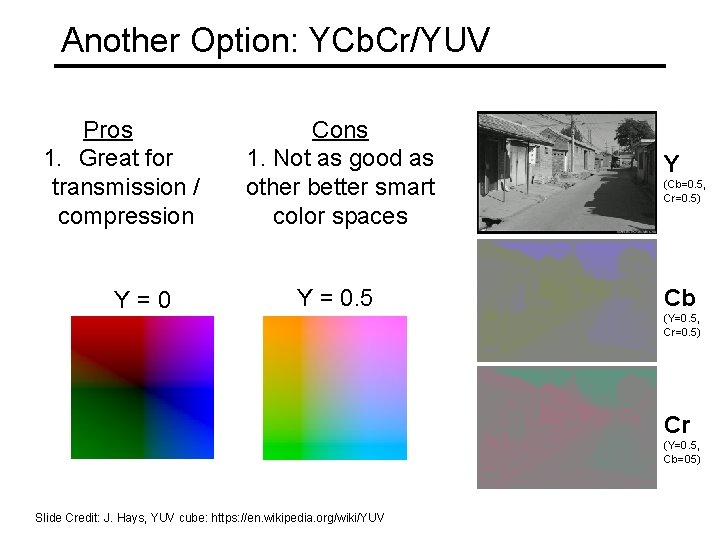
Another Option: YCb. Cr/YUV Pros 1. Great for transmission / compression Y=0 Cons 1. Not as good as other better smart color spaces Y = 0. 5 Y (Cb=0. 5, Cr=0. 5) Cb (Y=0. 5, Cr=0. 5) Cr (Y=0. 5, Cb=05) Slide Credit: J. Hays, YUV cube: https: //en. wikipedia. org/wiki/YUV
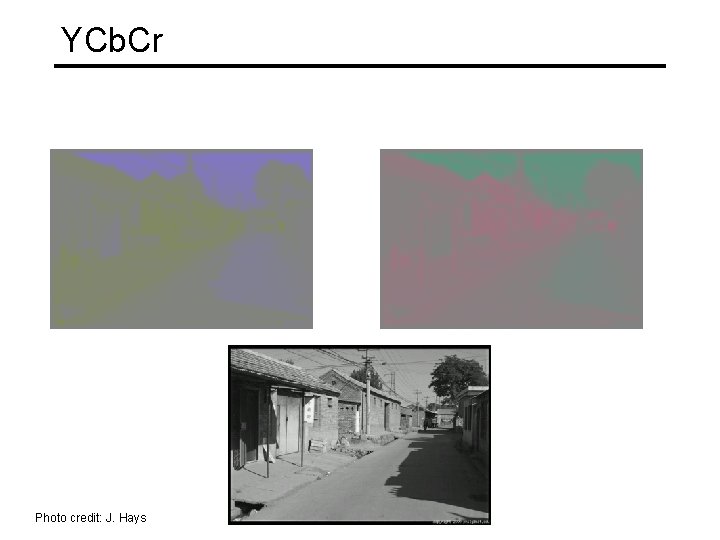
YCb. Cr Photo credit: J. Hays
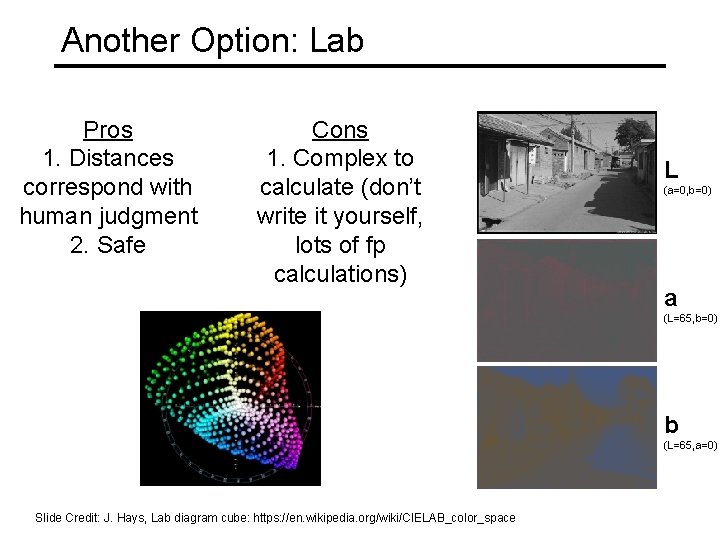
Another Option: Lab Pros 1. Distances correspond with human judgment 2. Safe Cons 1. Complex to calculate (don’t write it yourself, lots of fp calculations) L (a=0, b=0) a (L=65, b=0) b (L=65, a=0) Slide Credit: J. Hays, Lab diagram cube: https: //en. wikipedia. org/wiki/CIELAB_color_space
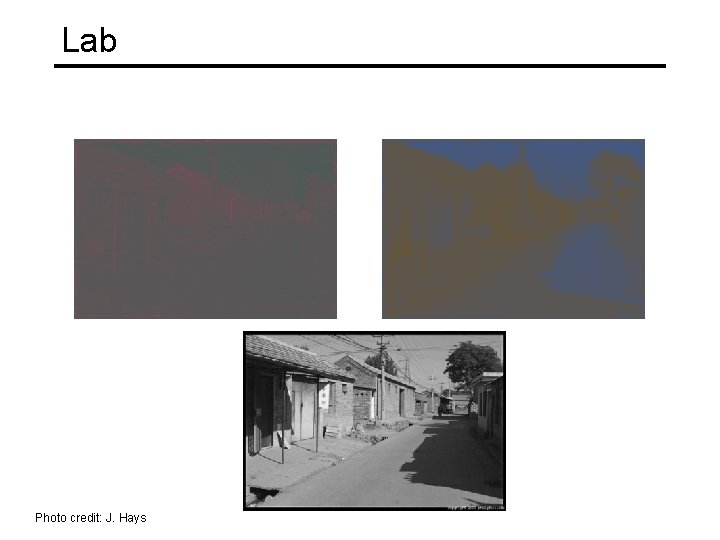
Lab Photo credit: J. Hays
Why Are There So Many? • Each serves different functions • • RGB: sort of intuitive, standard, everywhere HSV: good for picking, fast to compute YCb. Cr/YUV: fast to compute, compresses well Lab: the right(? ) thing to do, but “slow” to compute • Pick based on what you need and don’t sweat it: color really isn’t crucial
Color perception • Color/lightness constancy • The ability of the human visual system to perceive the intrinsic reflectance properties of the surfaces despite changes in illumination conditions Slide by L. Lazebnik
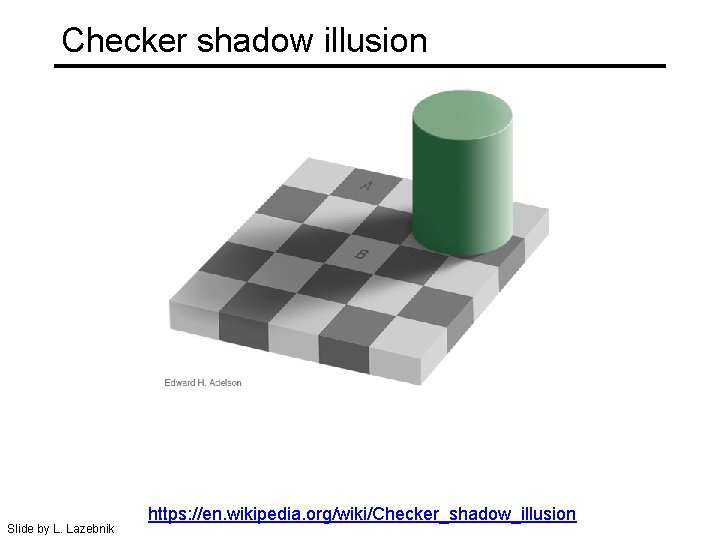
Checker shadow illusion Slide by L. Lazebnik https: //en. wikipedia. org/wiki/Checker_shadow_illusion
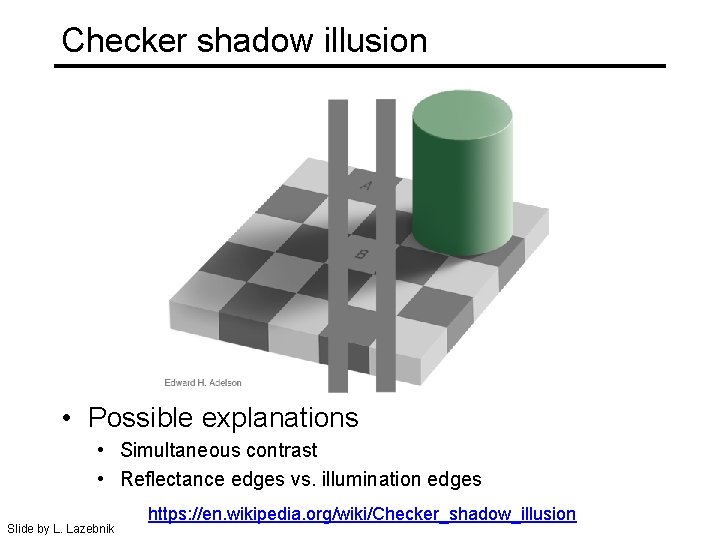
Checker shadow illusion • Possible explanations • Simultaneous contrast • Reflectance edges vs. illumination edges Slide by L. Lazebnik https: //en. wikipedia. org/wiki/Checker_shadow_illusion
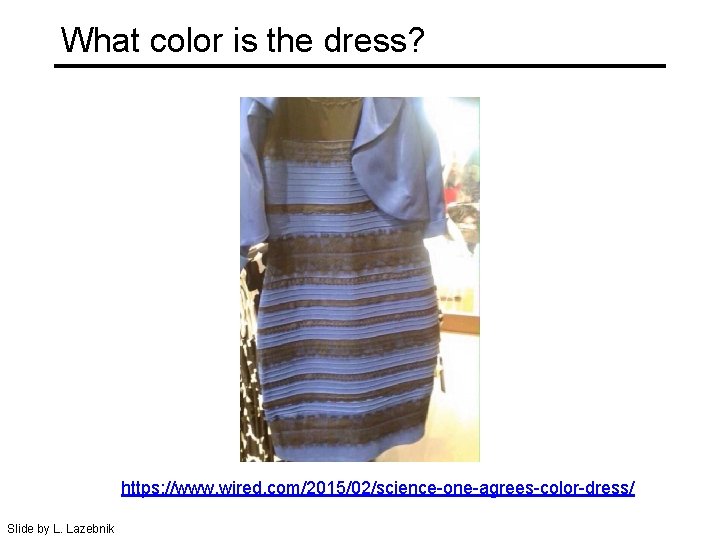
What color is the dress? https: //www. wired. com/2015/02/science-one-agrees-color-dress/ Slide by L. Lazebnik
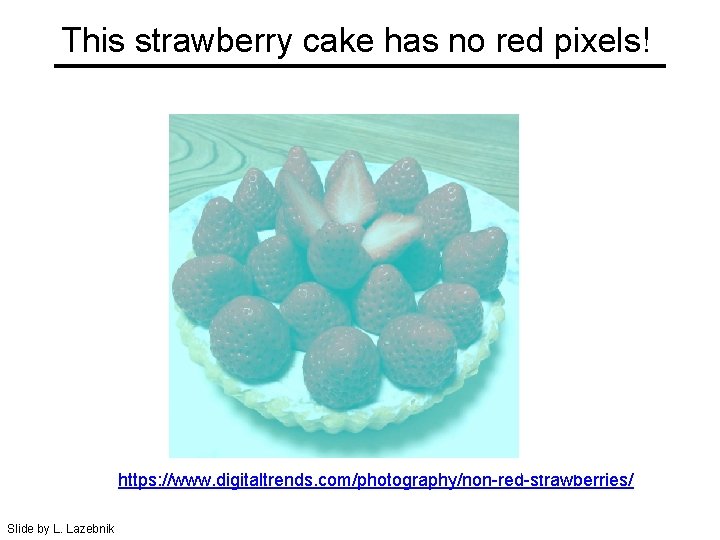
This strawberry cake has no red pixels! https: //www. digitaltrends. com/photography/non-red-strawberries/ Slide by L. Lazebnik
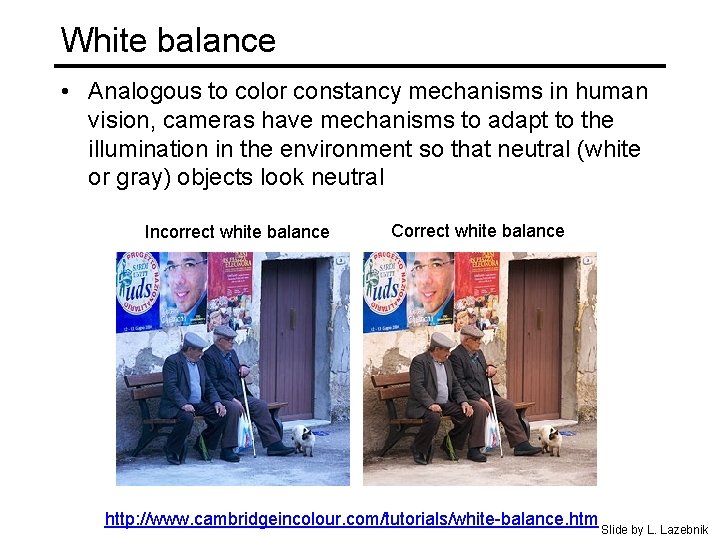
White balance • Analogous to color constancy mechanisms in human vision, cameras have mechanisms to adapt to the illumination in the environment so that neutral (white or gray) objects look neutral Incorrect white balance Correct white balance http: //www. cambridgeincolour. com/tutorials/white-balance. htm Slide by L. Lazebnik
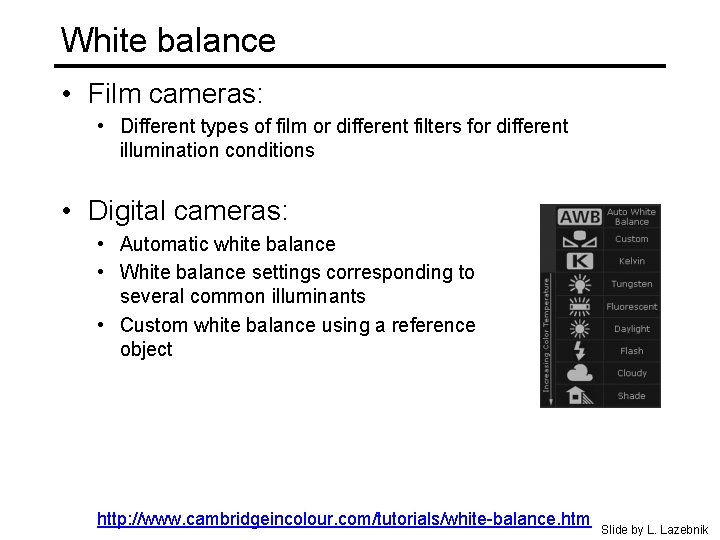
White balance • Film cameras: • Different types of film or different filters for different illumination conditions • Digital cameras: • Automatic white balance • White balance settings corresponding to several common illuminants • Custom white balance using a reference object http: //www. cambridgeincolour. com/tutorials/white-balance. htm Slide by L. Lazebnik
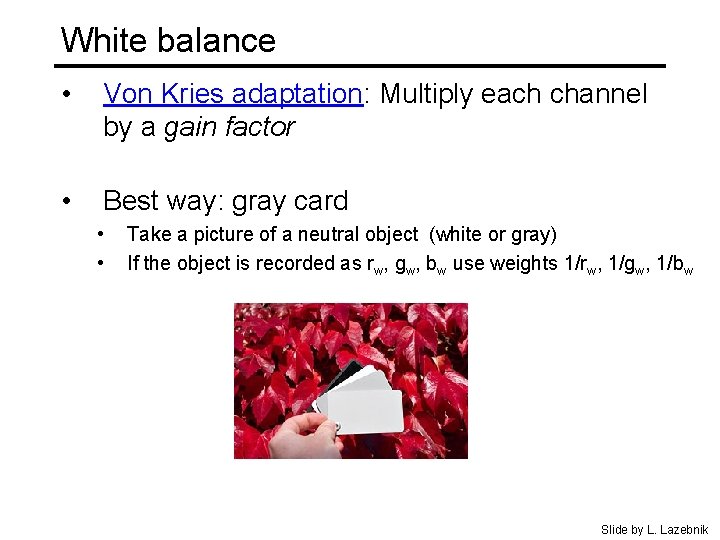
White balance • Von Kries adaptation: Multiply each channel by a gain factor • Best way: gray card • • Take a picture of a neutral object (white or gray) If the object is recorded as rw, gw, bw use weights 1/rw, 1/gw, 1/bw Slide by L. Lazebnik
White balance • Without gray cards: we need to “guess” which pixels correspond to white objects • Gray world assumption • The image average rave, gave, bave is gray • Use weights 1/rave, 1/gave, 1/bave • Brightest pixel assumption • Highlights usually have the color of the light source • Use weights inversely proportional to the values of the brightest pixels • Gamut mapping • Gamut: convex hull of all pixel colors in an image • Find the transformation that matches the gamut of the image to the gamut of a “typical” image under white light • Use image statistics, learning techniques Slide by L. Lazebnik
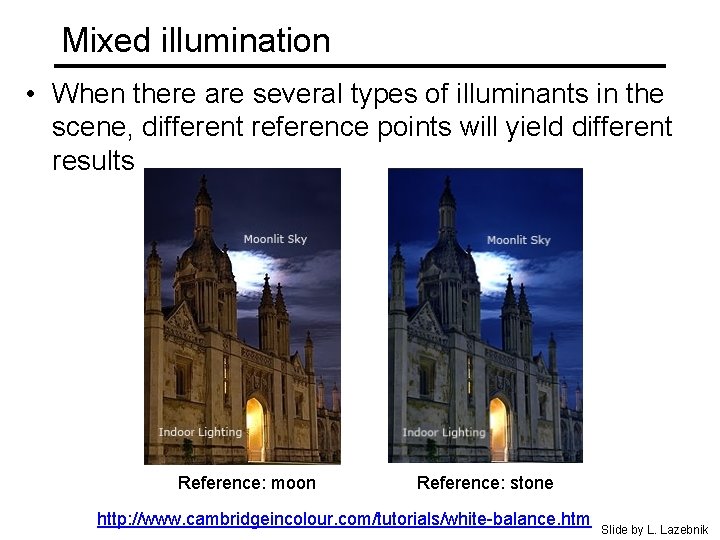
Mixed illumination • When there are several types of illuminants in the scene, different reference points will yield different results Reference: moon Reference: stone http: //www. cambridgeincolour. com/tutorials/white-balance. htm Slide by L. Lazebnik
- Slides: 47