
Color Blindness or Dyschromatopsia By Gabriella Lee Color
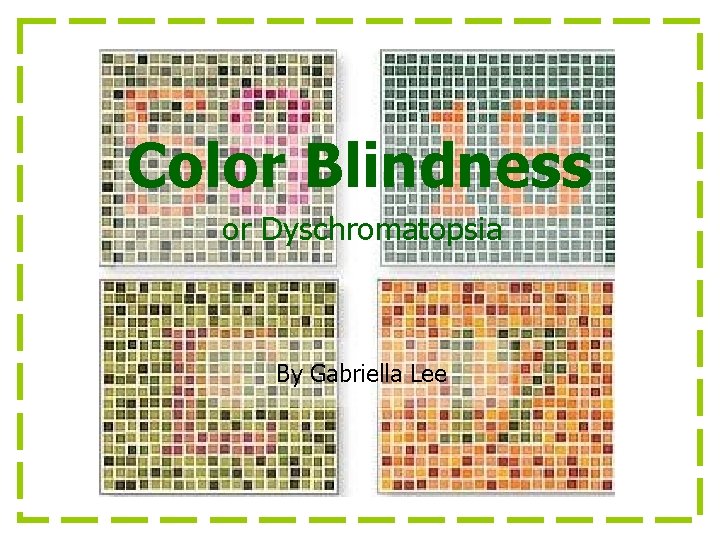
Color Blindness or Dyschromatopsia By Gabriella Lee
Color Blindness - Inability to perceive one or more colors.
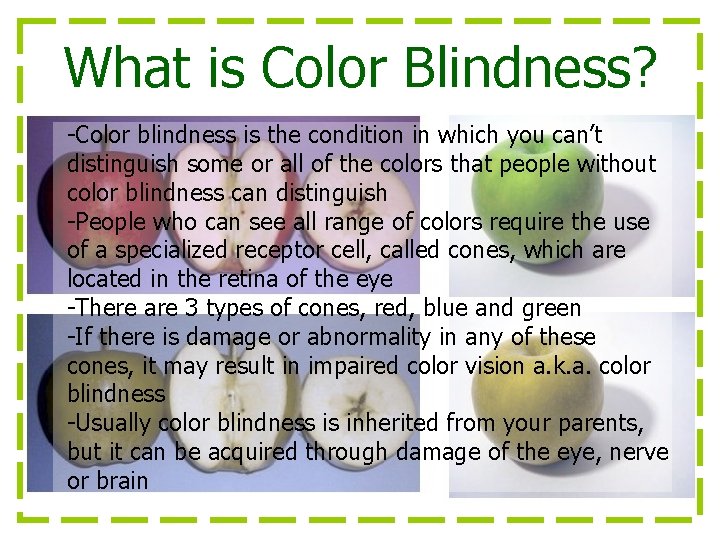
What is Color Blindness? -Color blindness is the condition in which you can’t distinguish some or all of the colors that people without color blindness can distinguish -People who can see all range of colors require the use of a specialized receptor cell, called cones, which are located in the retina of the eye -There are 3 types of cones, red, blue and green -If there is damage or abnormality in any of these cones, it may result in impaired color vision a. k. a. color blindness -Usually color blindness is inherited from your parents, but it can be acquired through damage of the eye, nerve or brain
Types of color blindness -There are many types of color blindness A few include - Monochromacy, which is complete color blindness - Dichromacy, which is when you can’t recognize one of the 3 basic colors (red, blue, green) -Protanopia, a color blindness which is caused by the loss of the red color -Deuteranopia, a color blindness which is caused by the loss of the green color -Tritanopia, a color blindness which is caused by the loss of the blue color - Anomalous Trichromacy, this is when one of the 3 basic colors is impaired but not lost
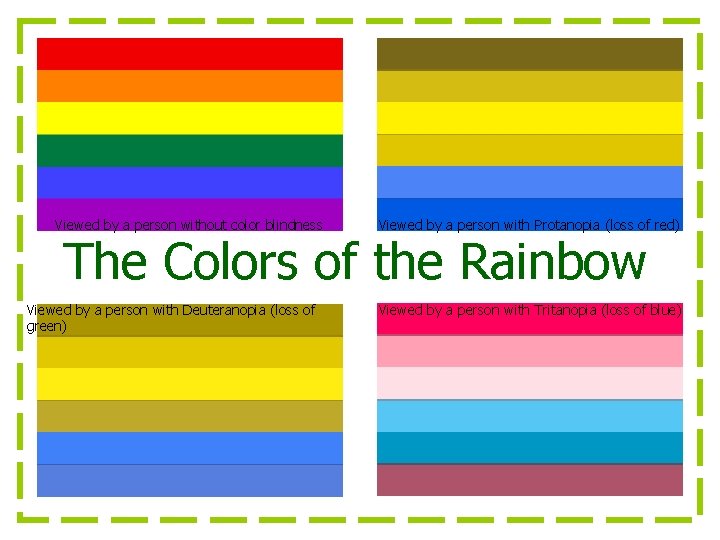
Viewed by a person without color blindness Viewed by a person with Protanopia (loss of red) The Colors of the Rainbow Viewed by a person with Deuteranopia (loss of green) Viewed by a person with Tritanopia (loss of blue)
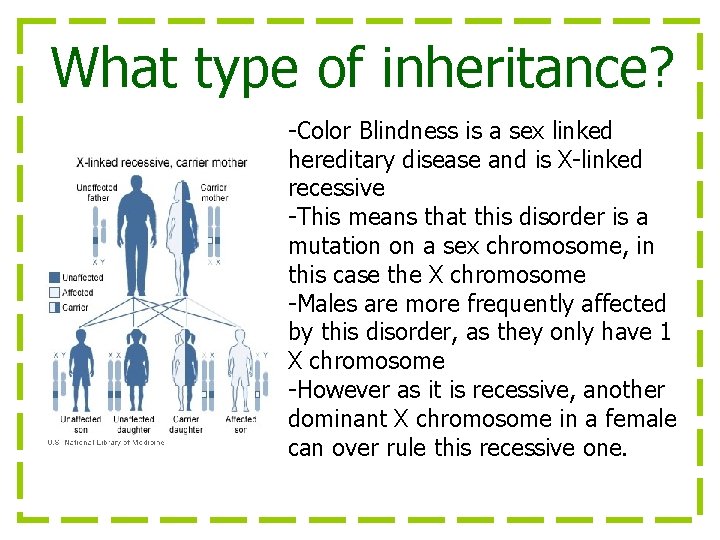
What type of inheritance? -Color Blindness is a sex linked hereditary disease and is X-linked recessive -This means that this disorder is a mutation on a sex chromosome, in this case the X chromosome -Males are more frequently affected by this disorder, as they only have 1 X chromosome -However as it is recessive, another dominant X chromosome in a female can over rule this recessive one.
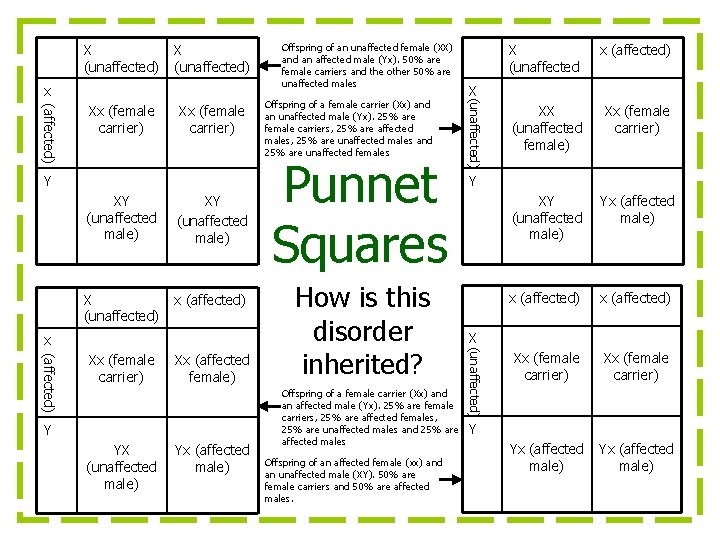
X (unaffected) (affected) Xx (female carrier) Y XY (unaffected male) X (unaffected) x (affected) Xx (female carrier) Xx (affected female) Y YX (unaffected male) Yx (affected male) Punnet Squares How is this disorder inherited? Offspring of a female carrier (Xx) and an affected male (Yx). 25% are female carriers, 25% are affected females, 25% are unaffected males and 25% are affected males Offspring of an affected female (xx) and an unaffected male (XY). 50% are female carriers and 50% are affected males. X (unaffected x (affected) XX (unaffected female) Xx (female carrier) XY (unaffected male) Yx (affected male) x (affected) Xx (female carrier) Yx (affected male) X Y X (unaffected) x Offspring of a female carrier (Xx) and an unaffected male (Yx). 25% are female carriers, 25% are affected males, 25% are unaffected males and 25% are unaffected females (unaffected) x Offspring of an unaffected female (XX) and an affected male (Yx). 50% are female carriers and the other 50% are unaffected males Y
Bibliography "Color Blindness. " Answers. Com. 19 Oct. 2007 <http: //www. answers. com/topic/color-blindness>. "Color Blindness. " St. Lukes. Eye. Com. St. Lukes Cataract and Laser Institute. 19 Oct. 2007 <http: //www. stlukeseye. com/Conditions/Color. Blindness. asp>. "Color Blindness. " Wikipedia. Hong Kong. 17 Oct. 2007. Keyword: Color Blindness. "Colors for the Color Blind. " 19 Oct. 2007 <http: //www. toledobend. com/colorblind/about. CB. html>. "Genetic Disorder. " Wikipedia. Hong Kong. 18 Oct. 2007. Keyword: Genetic Disorders. Pictures: http: //www. answers. com/topic/sex-linkage http: //damninteresting. com/? p=473 http: //answers. com/topic/color-blindness http: //en. wikipedia. org/wiki/Color_Blindness
- Slides: 8