
Color and Radiometry Digital Image Synthesis YungYu Chuang
![Conversion between XYZ and RGB float Spectrum: : XWeight[COLOR_SAMPLES] = 0. 412453 f, 0.](https://slidetodoc.com/presentation_image/defe5b706b67cd8d29f06be0a1b8972b/image-23.jpg "Conversion between XYZ and RGB float Spectrum: : XWeight[COLOR_SAMPLES] = 0. 412453 f, 0.")
- Slides: 38
Color and Radiometry Digital Image Synthesis Yung-Yu Chuang 10/22/2009 with slides by Pat Hanrahan and Matt Pharr
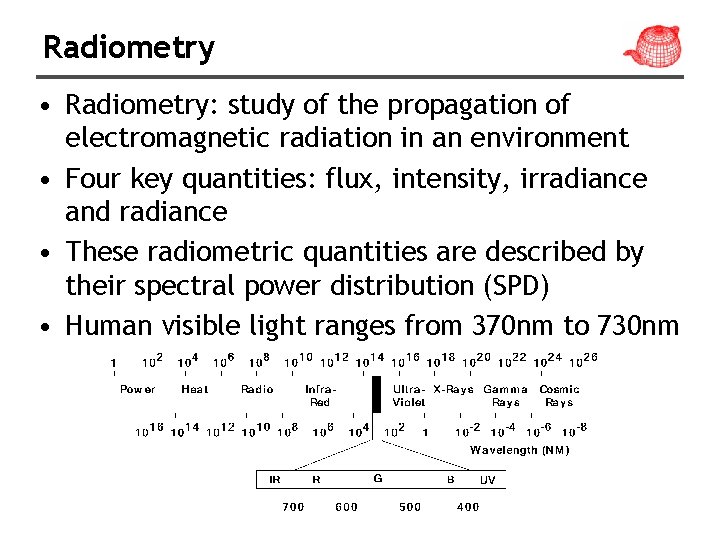
Radiometry • Radiometry: study of the propagation of electromagnetic radiation in an environment • Four key quantities: flux, intensity, irradiance and radiance • These radiometric quantities are described by their spectral power distribution (SPD) • Human visible light ranges from 370 nm to 730 nm
Basic radiometry • pbrt is based on radiative transfer: study of the transfer of radiant energy based on radiometric principles and operates at the geometric optics level (light interacts with objects much larger than the light’s wavelength) • It is based on the particle model. Hence, diffraction and interference can’t be easily accounted for.
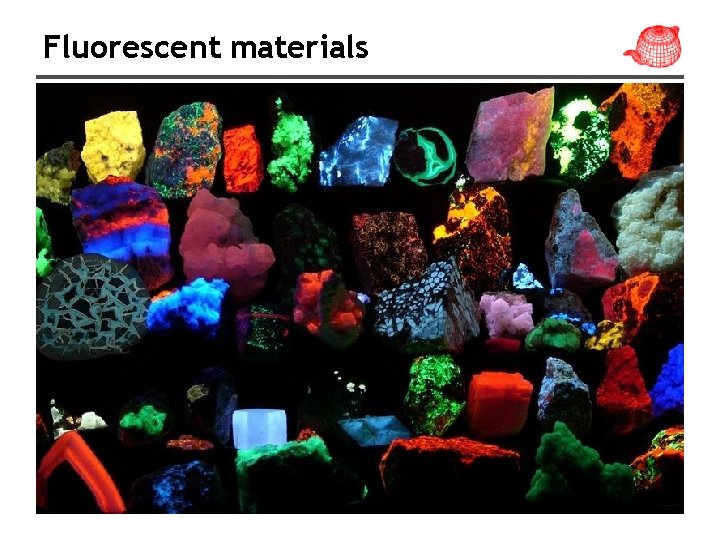
Basic assumptions about light behavior • Linearity: the combined effect of two inputs is equal to the sum of effects • Energy conservation: scattering event can’t produce more energy than they started with • Steady state: light is assumed to have reached equilibrium, so its radiance distribution isn’t changing over time. • No polarization: we only care the frequency of light but not other properties (such as phases) • No fluorescence or phosphorescence: behavior of light at a wavelength or time doesn’t affect the behavior of light at other wavelengths or time
Fluorescent materials
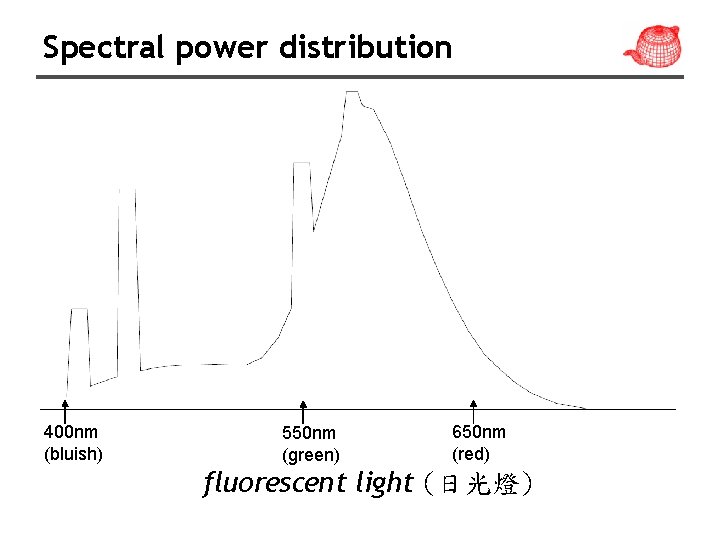
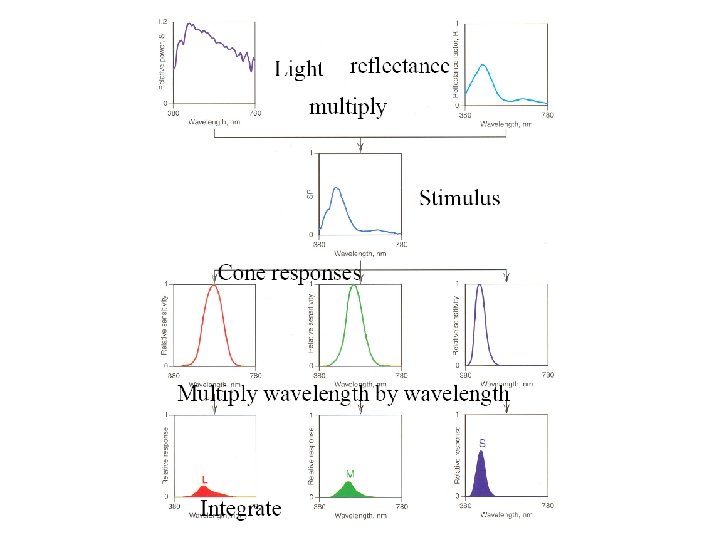
Spectral power distribution 400 nm (bluish) 550 nm (green) 650 nm (red) fluorescent light (日光燈)
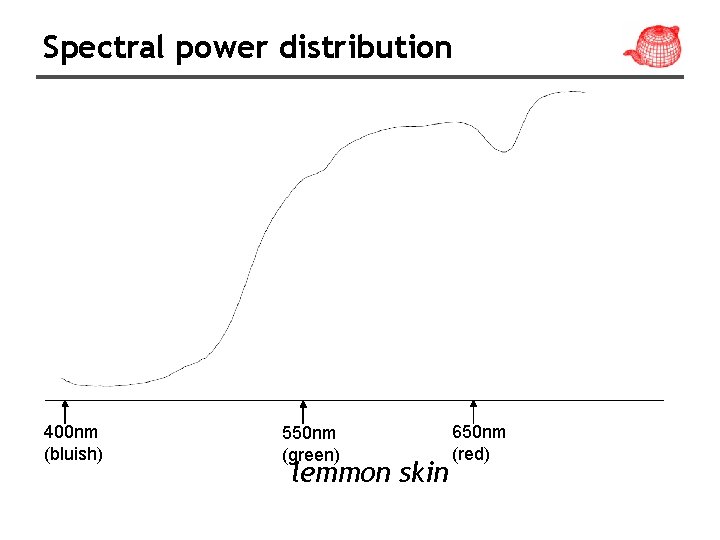
Spectral power distribution 400 nm (bluish) 550 nm (green) lemmon skin 650 nm (red)
Color • Need a compact, efficient and accurate way to represent functions like these • Find proper basis functions to map the infinitedimensional space of all possible SPD functions to a low-dimensional space of coefficients • For example, B(λ)=1 is a trivial but bad approximation
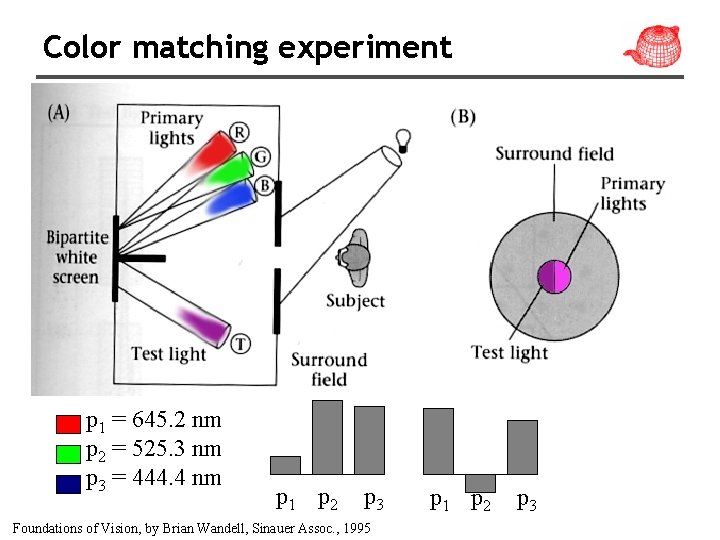
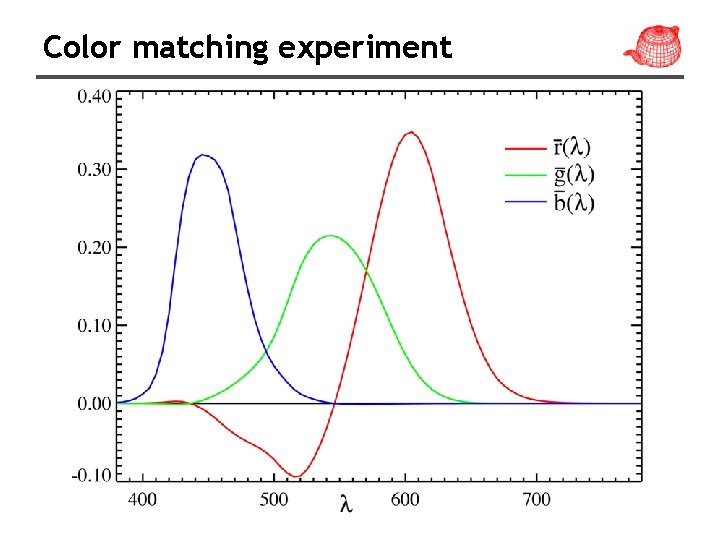
Color matching experiment p 1 = 645. 2 nm p 2 = 525. 3 nm p 3 = 444. 4 nm p 1 p 2 p 3 Foundations of Vision, by Brian Wandell, Sinauer Assoc. , 1995 p 1 p 2 p 3
Color matching experiment
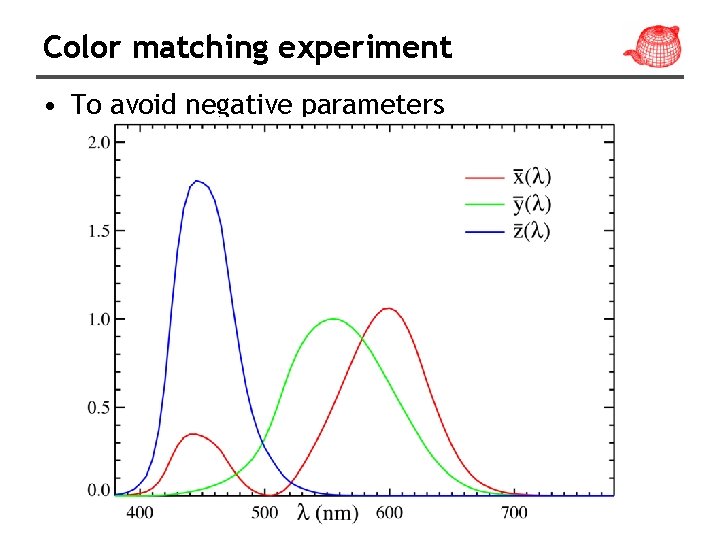
Color matching experiment • To avoid negative parameters
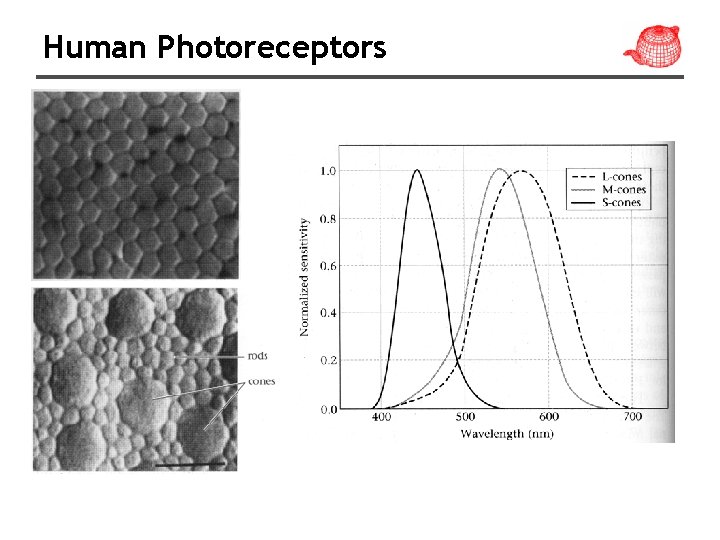
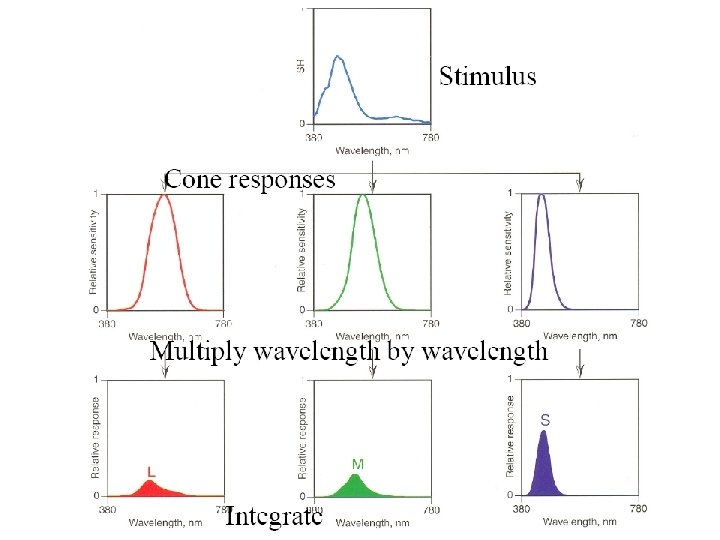
Human Photoreceptors
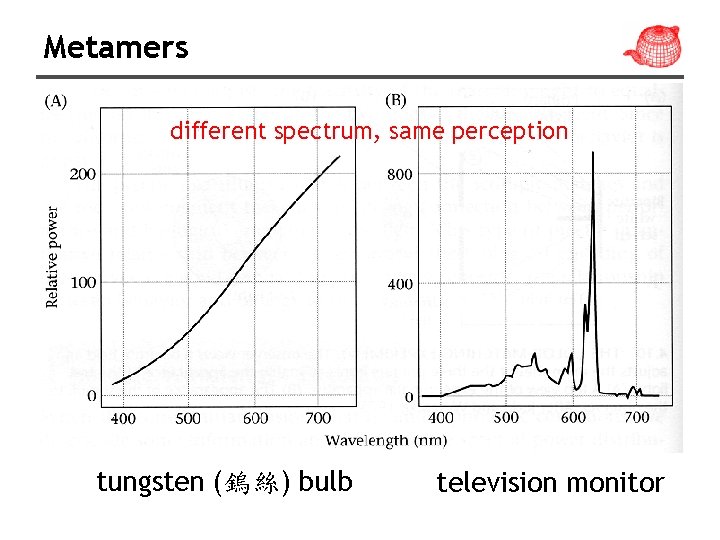
Metamers different spectrum, same perception tungsten (鎢絲) bulb television monitor
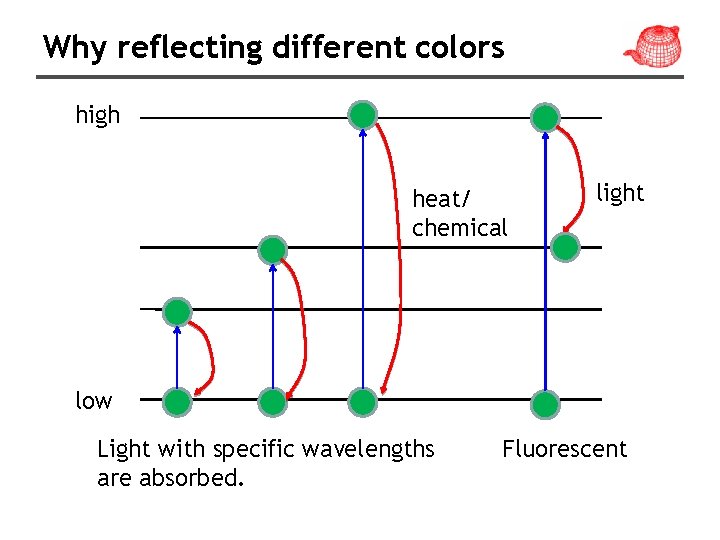
Why reflecting different colors high heat/ chemical light low Light with specific wavelengths are absorbed. Fluorescent
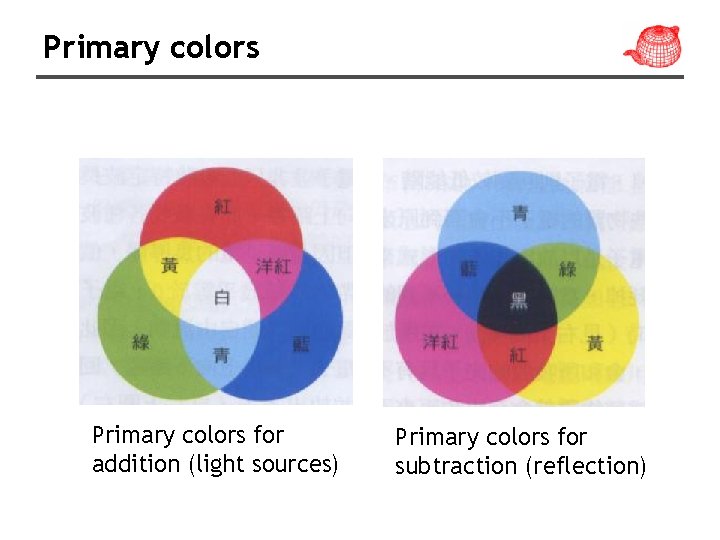
Primary colors for addition (light sources) Primary colors for subtraction (reflection)
Heat generates light • Vibration of atoms or electrons due to heat generates electromagnetic radiation as well. If its wavelength is within visible light (>1000 K), it generates color as well. • Color only depends on temperature, but not property of the object. • Human body radiates IR light under room temperature. • 2400 -2900 K: color temperature of incandescent light bulb
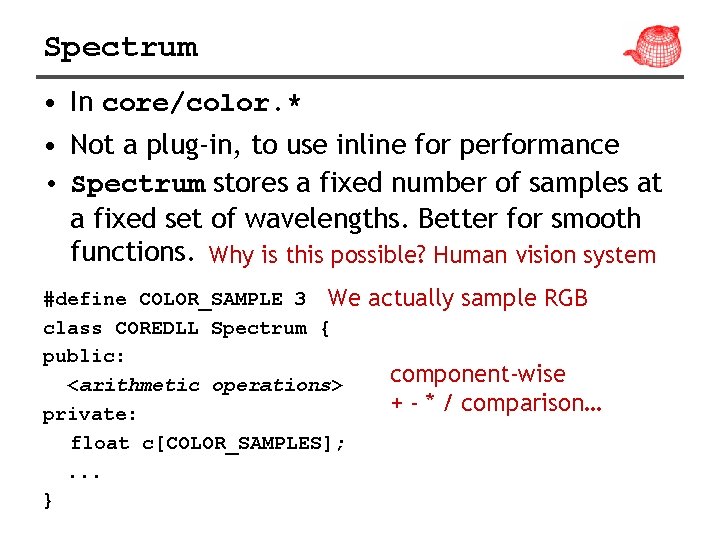
Spectrum • In core/color. * • Not a plug-in, to use inline for performance • Spectrum stores a fixed number of samples at a fixed set of wavelengths. Better for smooth functions. Why is this possible? Human vision system #define COLOR_SAMPLE 3 We class COREDLL Spectrum { public: <arithmetic operations> private: float c[COLOR_SAMPLES]; . . . } actually sample RGB component-wise + - * / comparison…
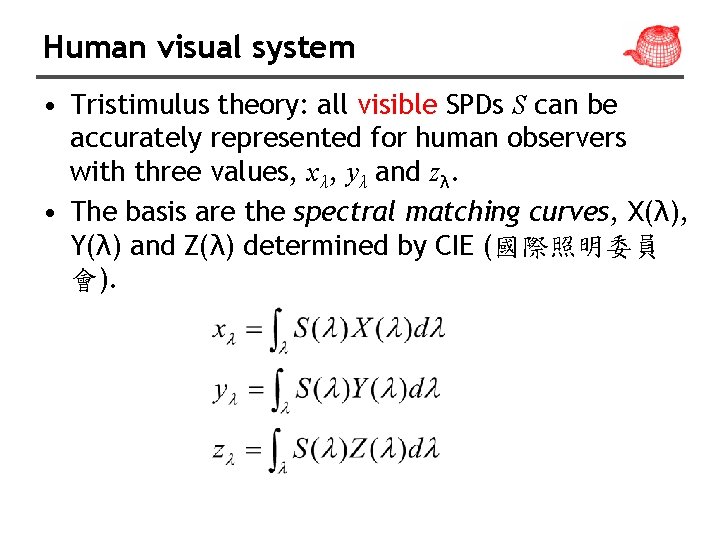
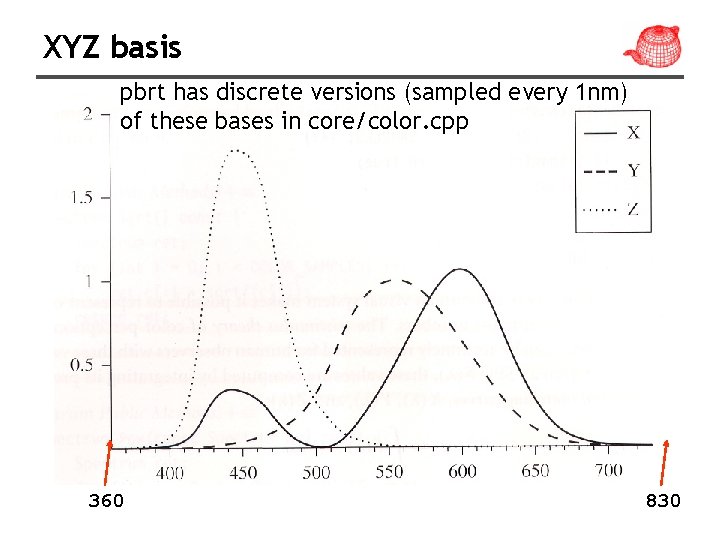
Human visual system • Tristimulus theory: all visible SPDs S can be accurately represented for human observers with three values, xλ, yλ and zλ. • The basis are the spectral matching curves, X(λ), Y(λ) and Z(λ) determined by CIE (國際照明委員 會).
XYZ basis pbrt has discrete versions (sampled every 1 nm) of these bases in core/color. cpp 360 830
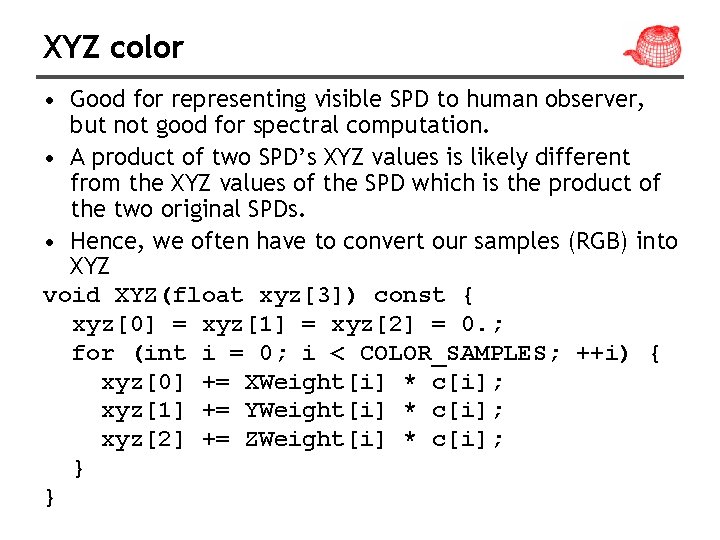
XYZ color • Good for representing visible SPD to human observer, but not good for spectral computation. • A product of two SPD’s XYZ values is likely different from the XYZ values of the SPD which is the product of the two original SPDs. • Hence, we often have to convert our samples (RGB) into XYZ void XYZ(float xyz[3]) const { xyz[0] = xyz[1] = xyz[2] = 0. ; for (int i = 0; i < COLOR_SAMPLES; ++i) { xyz[0] += XWeight[i] * c[i]; xyz[1] += YWeight[i] * c[i]; xyz[2] += ZWeight[i] * c[i]; } }
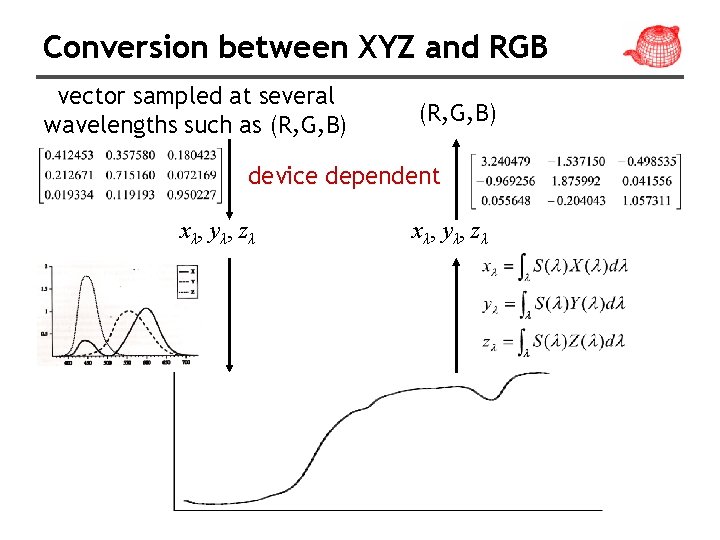
Conversion between XYZ and RGB float Spectrum: : XWeight[COLOR_SAMPLES] = 0. 412453 f, 0. 357580 f, 0. 180423 f }; float Spectrum: : YWeight[COLOR_SAMPLES] = 0. 212671 f, 0. 715160 f, 0. 072169 f }; float Spectrum: : ZWeight[COLOR_SAMPLES] = 0. 019334 f, 0. 119193 f, 0. 950227 f }; Spectrum From. XYZ(float x, float y, float c[3]; c[0] = 3. 240479 f * x + -1. 537150 f * y 0. 498535 f * z; c[1] = -0. 969256 f * x + 1. 875991 f * y 0. 041556 f * z; c[2] = 0. 055648 f * x + -0. 204043 f * y 1. 057311 f * z; return Spectrum(c); } { { { z) { + + +
Conversion between XYZ and RGB vector sampled at several wavelengths such as (R, G, B) device dependent x λ, y λ, z λ
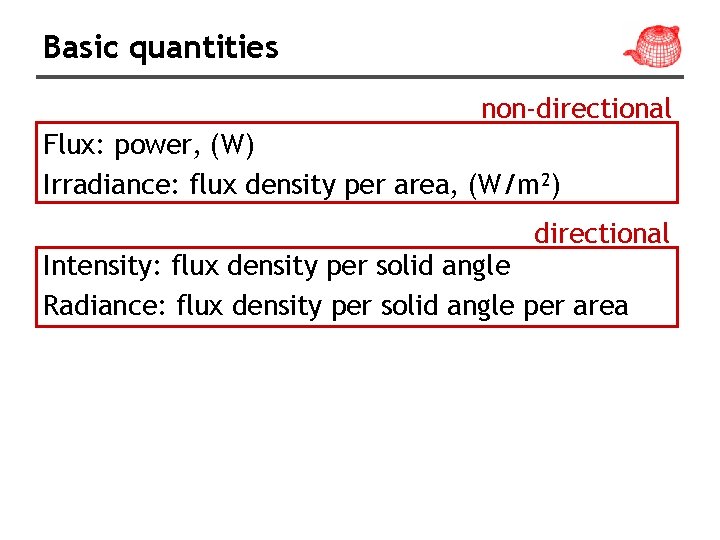
Basic quantities non-directional Flux: power, (W) Irradiance: flux density per area, (W/m 2) directional Intensity: flux density per solid angle Radiance: flux density per solid angle per area
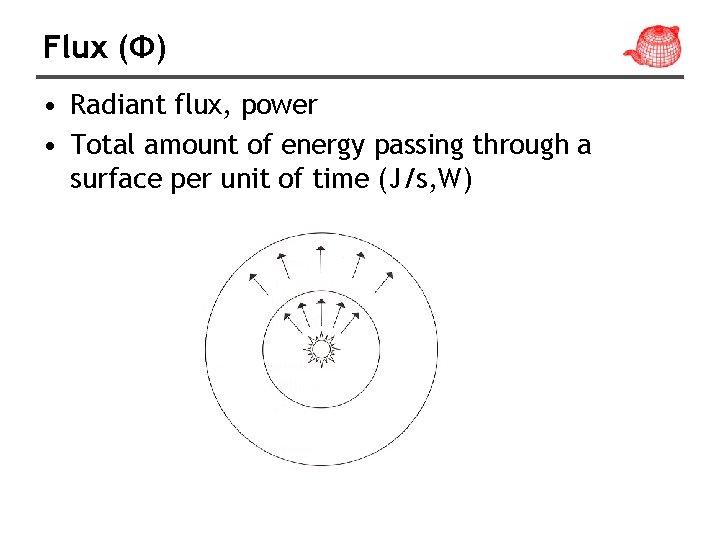
Flux (Φ) • Radiant flux, power • Total amount of energy passing through a surface per unit of time (J/s, W)
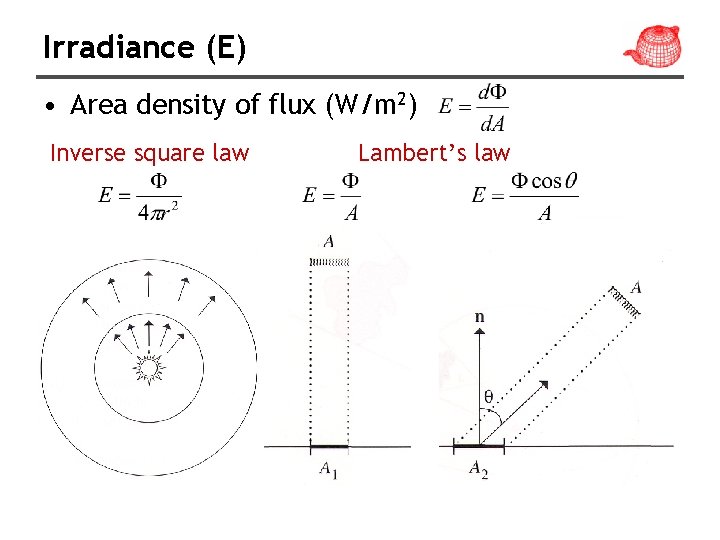
Irradiance (E) • Area density of flux (W/m 2) Inverse square law Lambert’s law
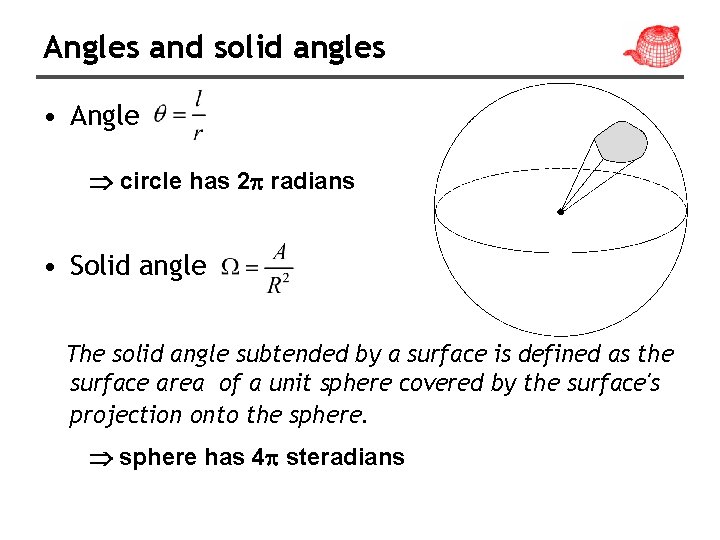
Angles and solid angles • Angle Þ circle has 2 p radians • Solid angle The solid angle subtended by a surface is defined as the surface area of a unit sphere covered by the surface's projection onto the sphere. Þ sphere has 4 p steradians
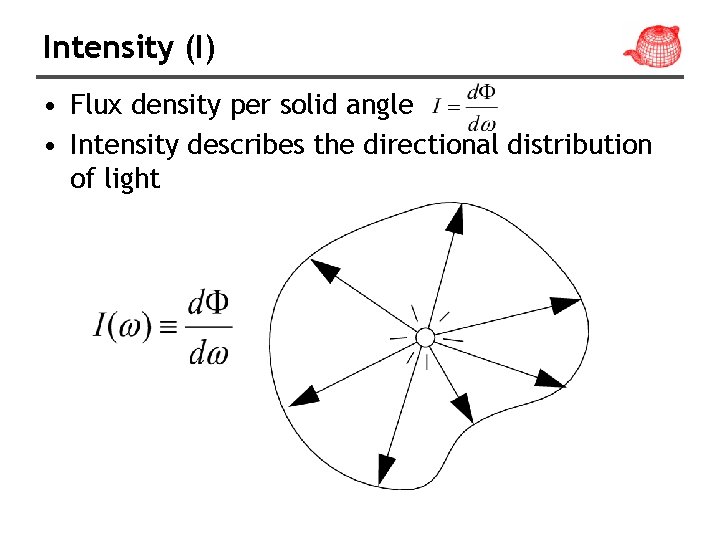
Intensity (I) • Flux density per solid angle • Intensity describes the directional distribution of light
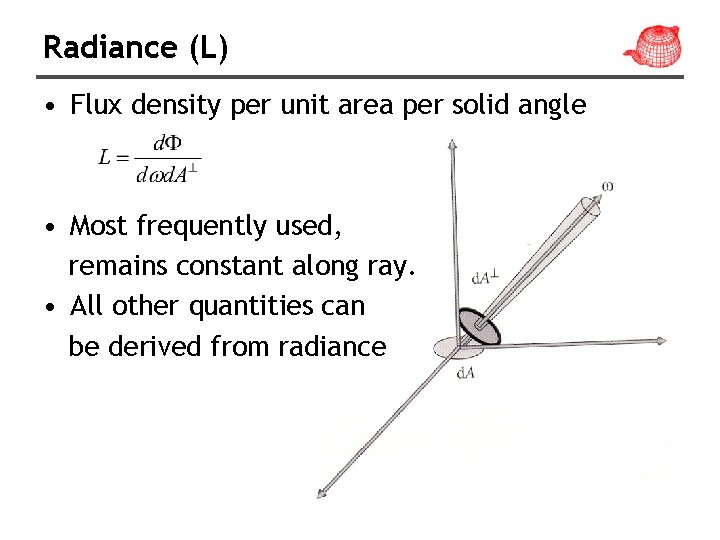
Radiance (L) • Flux density per unit area per solid angle • Most frequently used, remains constant along ray. • All other quantities can be derived from radiance
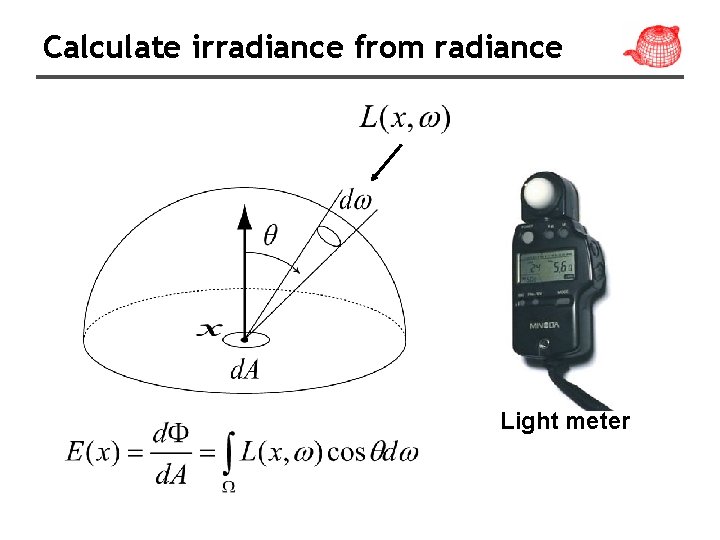
Calculate irradiance from radiance Light meter
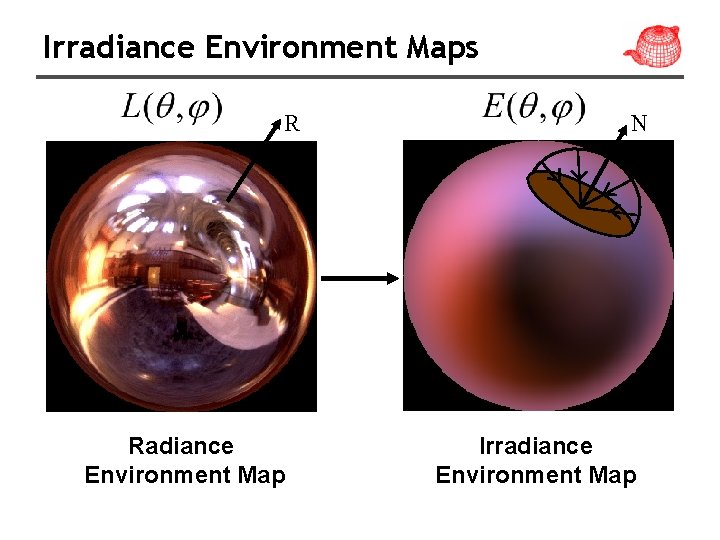
Irradiance Environment Maps R Radiance Environment Map N Irradiance Environment Map
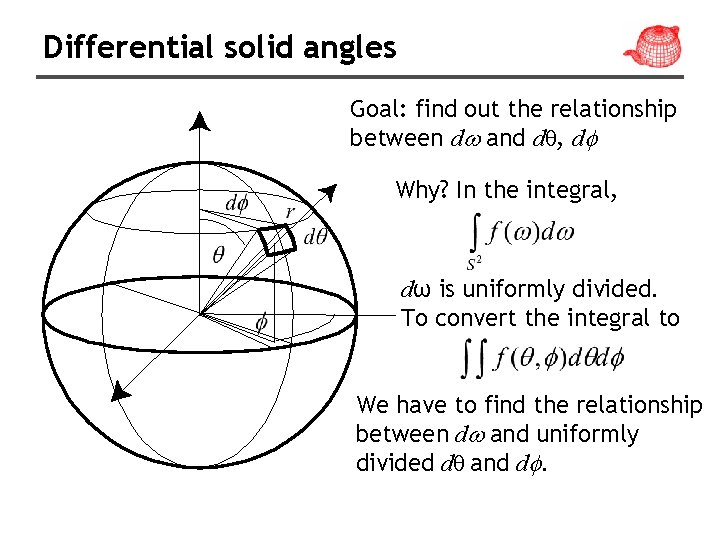
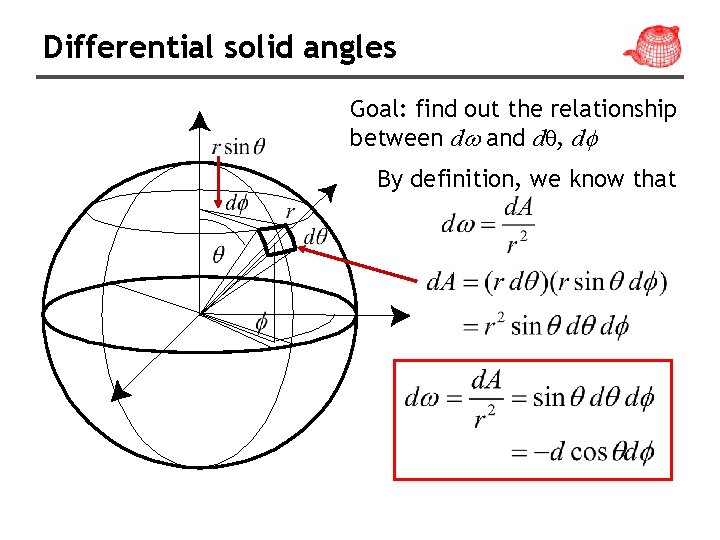
Differential solid angles Goal: find out the relationship between d and dθ, d Why? In the integral, dω is uniformly divided. To convert the integral to We have to find the relationship between d and uniformly divided dθ and d.
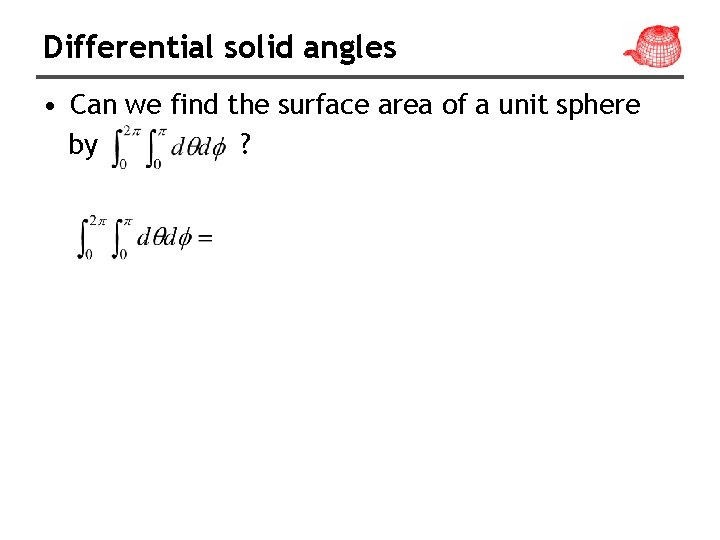
Differential solid angles • Can we find the surface area of a unit sphere by ?
Differential solid angles Goal: find out the relationship between d and dθ, d By definition, we know that
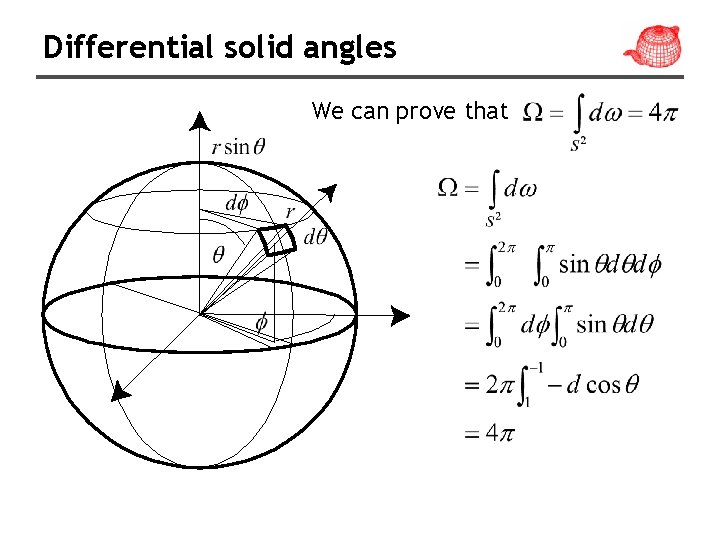
Differential solid angles We can prove that
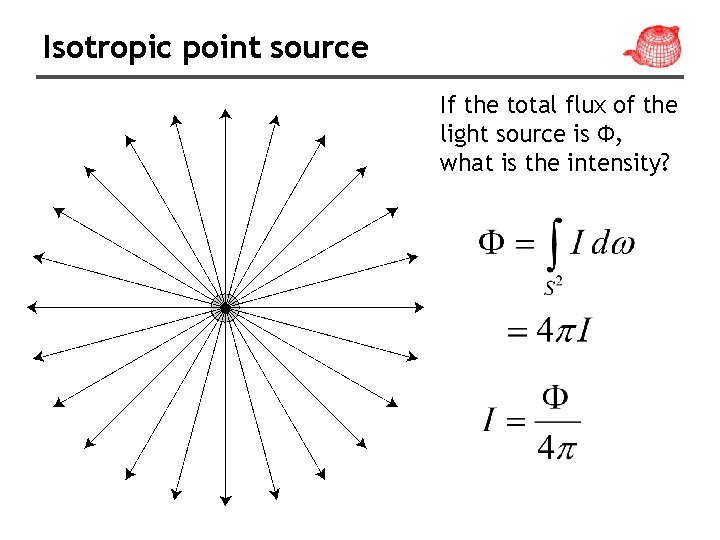
Isotropic point source If the total flux of the light source is Φ, what is the intensity?
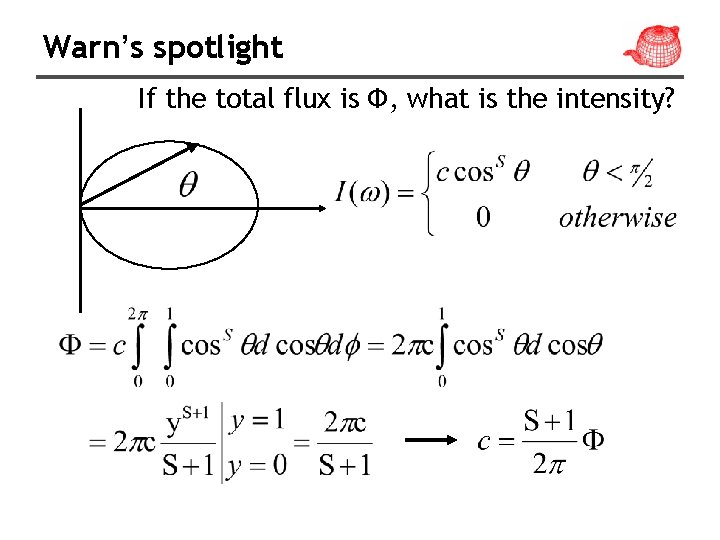
Warn’s spotlight If the total flux is Φ, what is the intensity?