
colons and semicolons within sentences For use with


- Slides: 18
colons : : : : : and semicolons ; ; ; within sentences For use with Technical Editing, 3 rd ed. 1
• This presentation distinguishes colons from semicolons so that you can use them accurately in sentences. • The presentation reviews both grammatical and stylistic reasons for choosing colons or semicolons. 2
A basic principle of comprehension • In order to comprehend, readers need to see relationships. When punctuation separates parts that readers must comprehend as related, the punctuation interferes with comprehension. 3
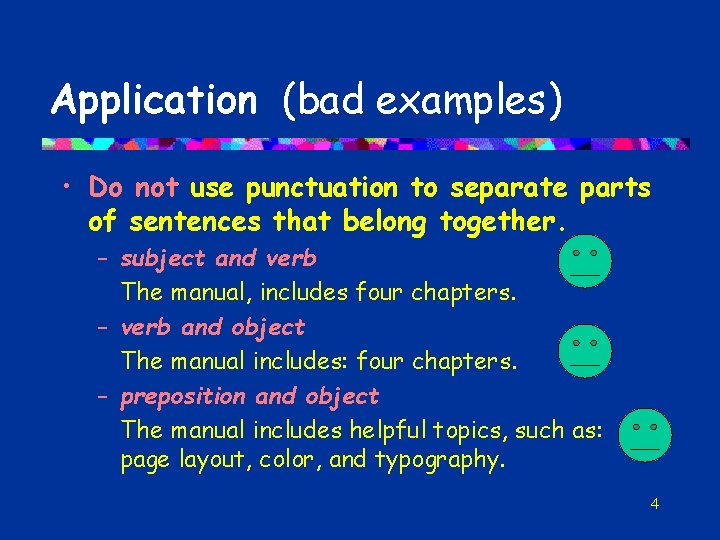
Application (bad examples) • Do not use punctuation to separate parts of sentences that belong together. – subject and verb The manual, includes four chapters. – verb and object The manual includes: four chapters. – preposition and object The manual includes helpful topics, such as: page layout, color, and typography. 4
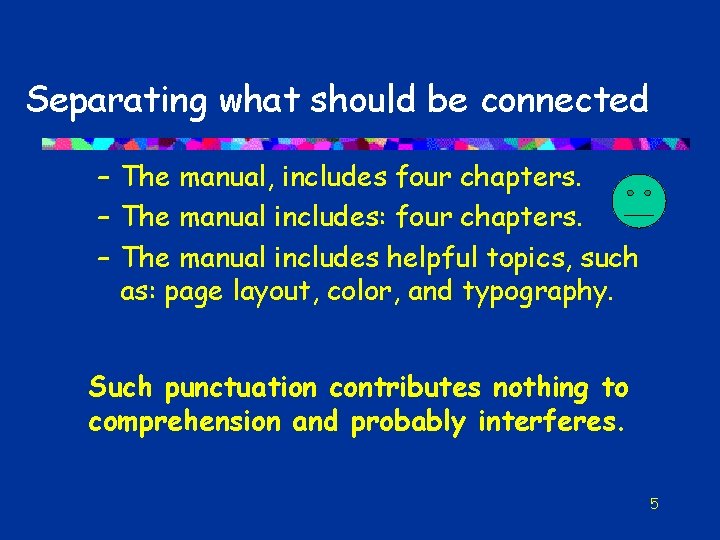
Separating what should be connected – The manual, includes four chapters. – The manual includes: four chapters. – The manual includes helpful topics, such as: page layout, color, and typography. Such punctuation contributes nothing to comprehension and probably interferes. 5
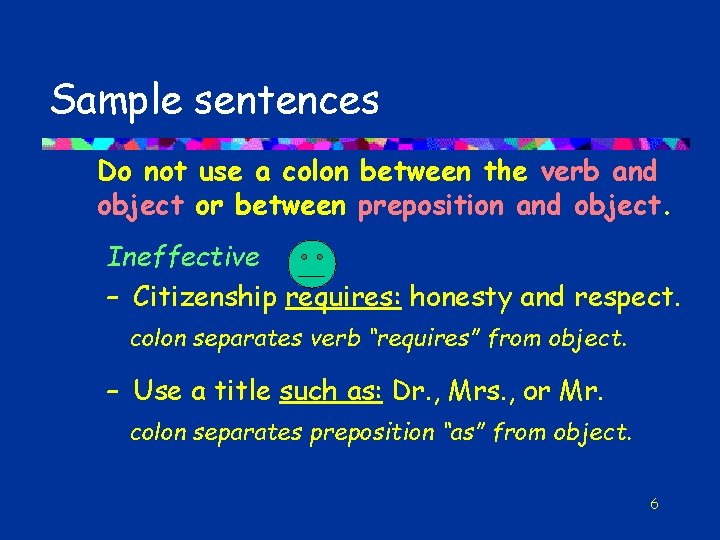
Sample sentences Do not use a colon between the verb and object or between preposition and object. Ineffective – Citizenship requires: honesty and respect. colon separates verb “requires” from object. – Use a title such as: Dr. , Mrs. , or Mr. colon separates preposition “as” from object. 6
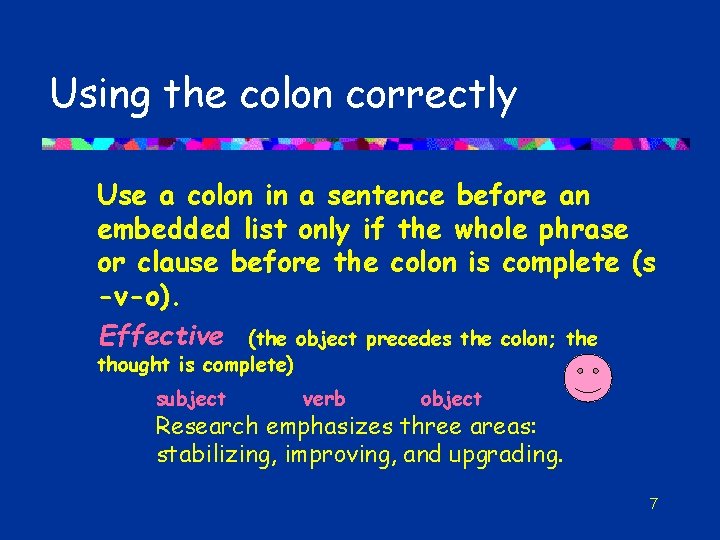
Using the colon correctly Use a colon in a sentence before an embedded list only if the whole phrase or clause before the colon is complete (s -v-o). Effective (the object precedes the colon; the thought is complete) subject verb object Research emphasizes three areas: stabilizing, improving, and upgrading. 7
Using colons grammatically Connect parts of sentences that belong together. Don’t separate these parts with punctuation subject-verb-direct object preposition-object 8
Using colons stylistically Colons and semicolons are often (not always) interchangeable grammatically, but they communicate different meanings. Choosing one or the other shapes a reader’s response. 9
What a colon means The colon communicates expectation. It signals a reader to look for additional clarifying information. 10
Colon signals expectation The product designers stated three goals: [the reader wonders: what three goals? ] Our new model has great promise: in independent tests, it was faster than competing models. [at the colon, the reader wonders: what is the promise? what is the evidence? ] 11
When to use a colon • Use a colon when you could insert “namely” at the point of punctuation. • Use a colon when the second clause is more specific than the first clause. – The product designers stated three goals: [namely, …] – Our new model has great promise: [namely, …] 12
What a semicolon means • The semicolon communicates balance. • It links clauses that are closely related in meaning but about equal in importance. – Test A measured seek time; Test B measured access time. 13
When to use a semicolon • Use a semicolon in compound sentences when there is no coordinating conjunction. – Some editors work best on hard copy; other editors prefer to work online. 14
When to use a semicolon • Sometimes use a semicolon in a complex series when some items in the series use commas. – The technical communicator needs subject-matter knowledge; skills with software and hardware; and ability to research, organize, and display information. 15
Summary: Grammar • Use punctuation to show relationships. • Punctuation that separates things that belong together (such as subject and verb, preposition and object) interferes with comprehension. 16
Summary: Style • Colon -- expectation • Semicolon – balance 17
Return to companion website for Technical Editing 3 e http: //www. ablongman. com/rude/ 18