
COLONIZATION Why explore Motives behind exploration o 1
COLONIZATION
Why explore? Motives behind exploration: o 1. The desire for wealth and power. o 2. The desire to spread Christianity. o 3. The desire for adventure and fame. o 4. Improvements in technology.
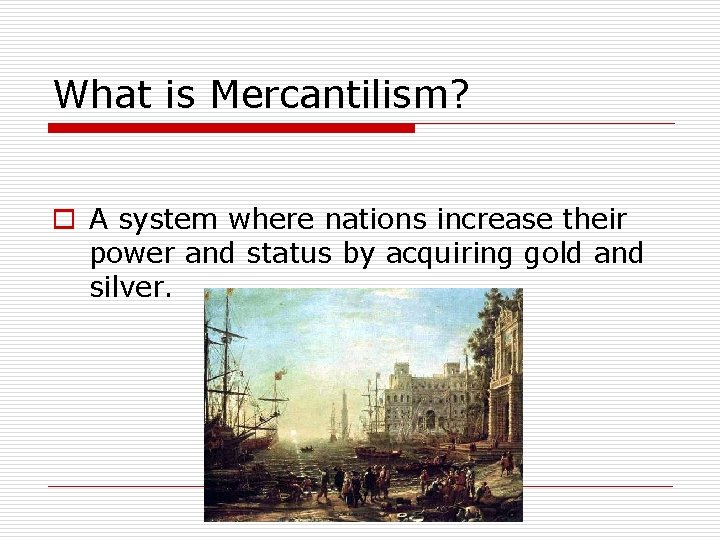
What is Mercantilism? o A system where nations increase their power and status by acquiring gold and silver.
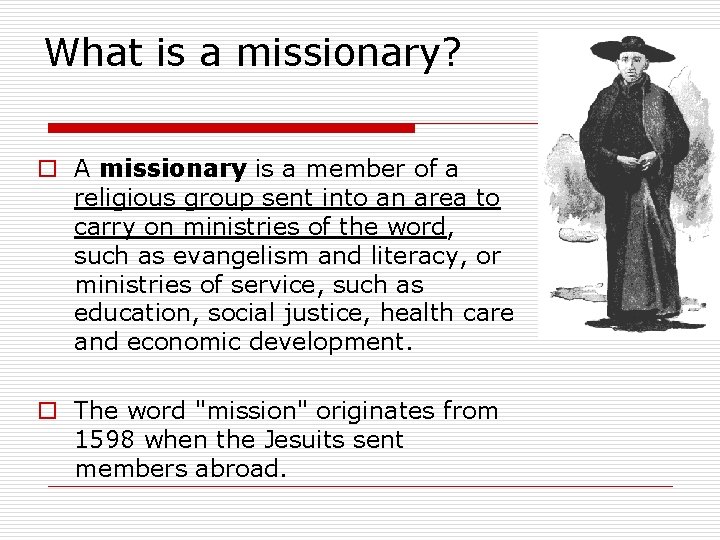
What is a missionary? o A missionary is a member of a religious group sent into an area to carry on ministries of the word, such as evangelism and literacy, or ministries of service, such as education, social justice, health care and economic development. o The word "mission" originates from 1598 when the Jesuits sent members abroad.
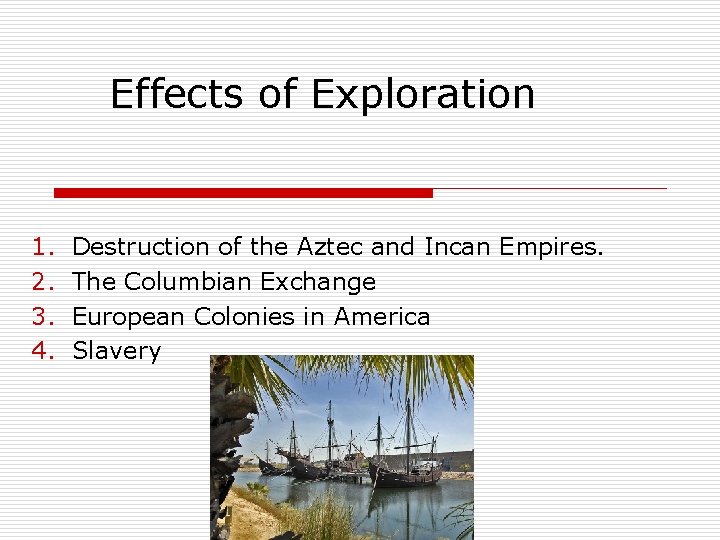
Effects of Exploration 1. 2. 3. 4. Destruction of the Aztec and Incan Empires. The Columbian Exchange European Colonies in America Slavery
Question: How were the Spanish able to defeat the Native tribes of America? o Superior military technology such as the gun. o Playing one group of indigenous people off of another. o The tribes were weakened by the effects of small pox.
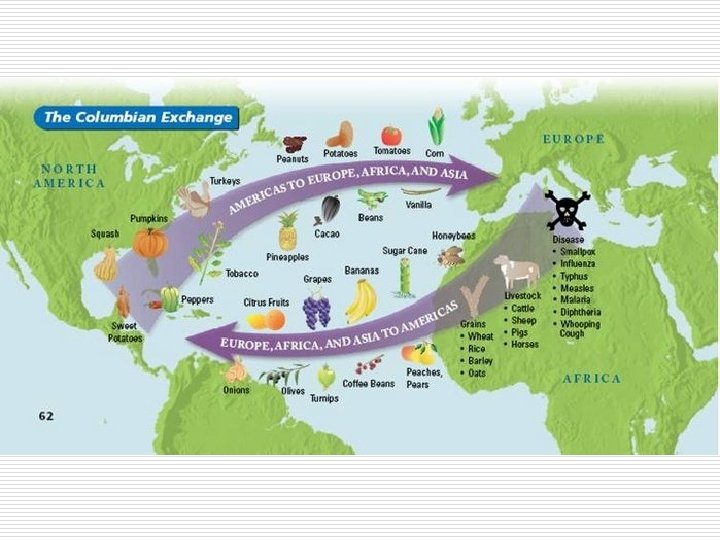
Columbian Exchange Effect in America: European disease kills millions Settlers bring sheep, cattle, pigs, and horses. Europeans and Native Americans begin to blend cultures.
Columbian Exchange Effect in Europe: ~Native American crops are taken back to Europe. ~Europeans have a more well balanced diet. ~New foods fuel rapid growth in Europe.
Colonial Government o o Royal Crown Royal Governor Council Colonial Assembly o What is Divine Right of Kings?
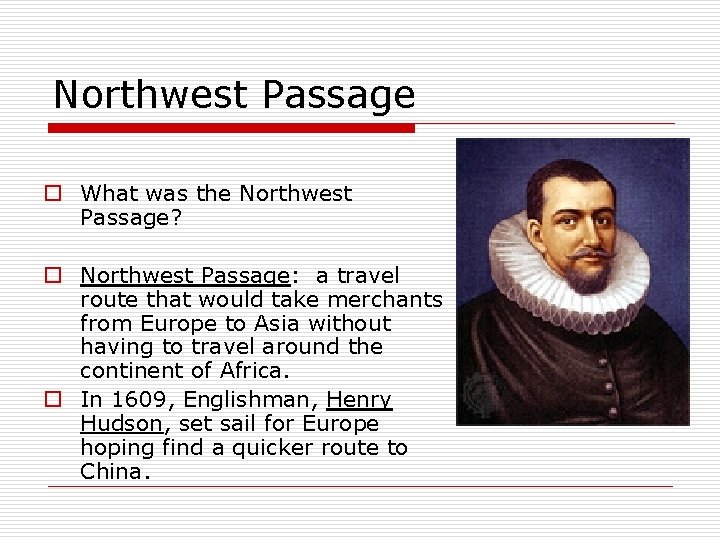
Northwest Passage o What was the Northwest Passage? o Northwest Passage: a travel route that would take merchants from Europe to Asia without having to travel around the continent of Africa. o In 1609, Englishman, Henry Hudson, set sail for Europe hoping find a quicker route to China.
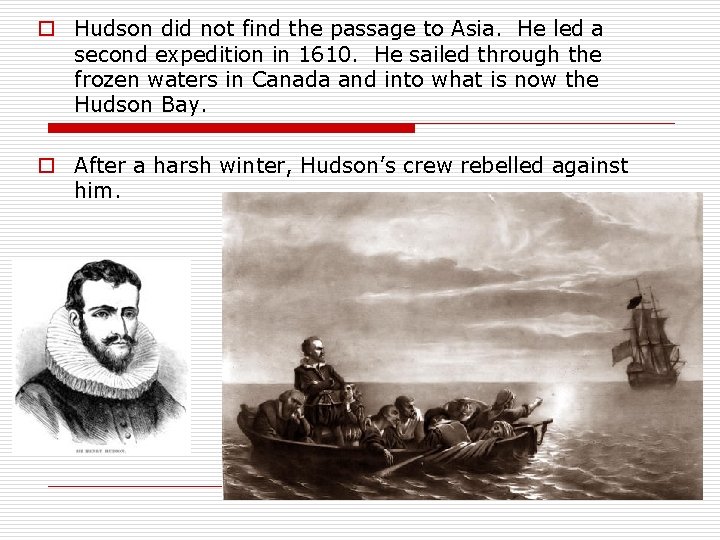
o Hudson did not find the passage to Asia. He led a second expedition in 1610. He sailed through the frozen waters in Canada and into what is now the Hudson Bay. o After a harsh winter, Hudson’s crew rebelled against him.
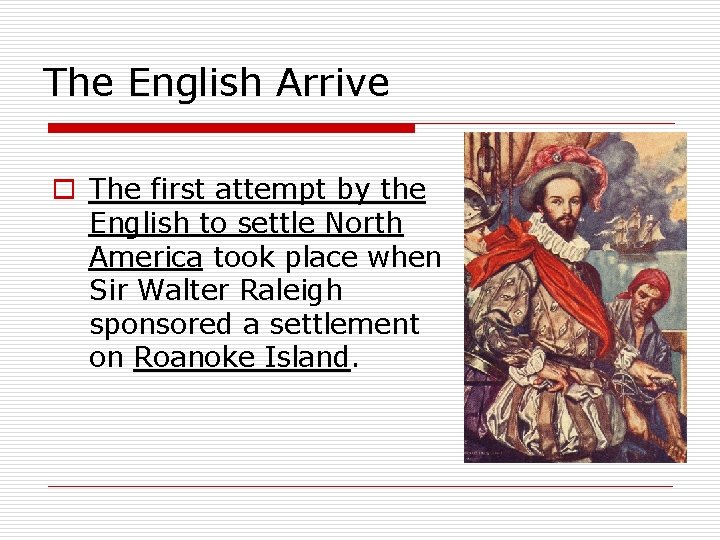
The English Arrive o The first attempt by the English to settle North America took place when Sir Walter Raleigh sponsored a settlement on Roanoke Island.
Roanoke o The colonists relied to heavily on the Native Americans for food. o Native Americans realized the colonists wanted their land cut off the food supply. o The colony disappeared which is why it has become known as the Lost Colony.
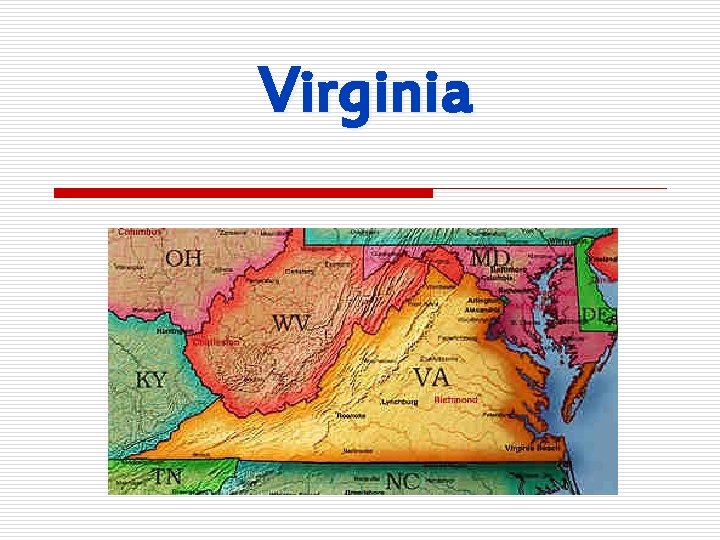
Virginia
Joint Stock Company o A group of investors who bought the right to establish New World plantations from the king. People believed there was gold in the New World and wanted to make a profit.
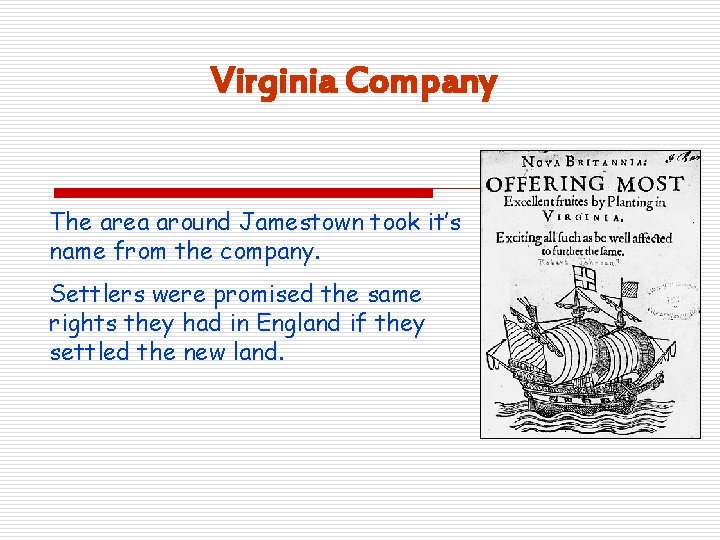
Virginia Company The area around Jamestown took it’s name from the company. Settlers were promised the same rights they had in England if they settled the new land.
![Founding of Jamestown May 24, 1607 about 100 colonists [all men] land at Jamestown,](http://slidetodoc.com/presentation_image_h2/7bdb568ec44da5869ef7f8b4e973db08/image-18.jpg "Founding of Jamestown May 24, 1607 about 100 colonists [all men] land at Jamestown,")
Founding of Jamestown May 24, 1607 about 100 colonists [all men] land at Jamestown, along banks of James River § Easily defended, but swarming with disease-causing mosquitoes. § They are ill prepared to the many adjustments to life in the New Colony.
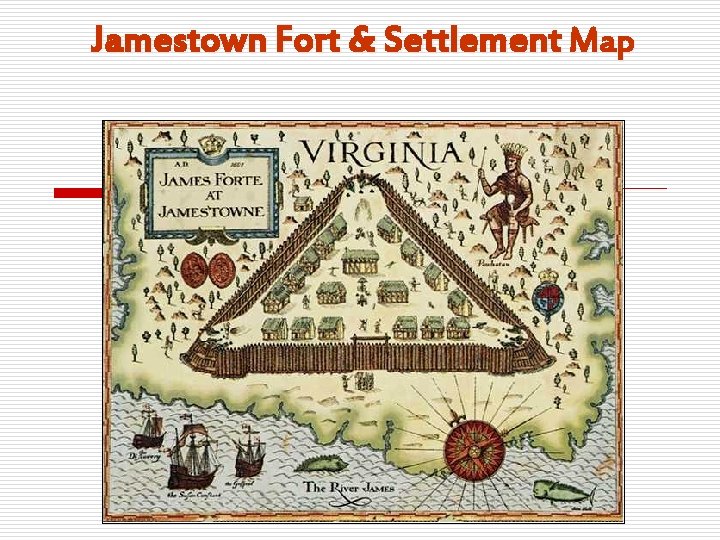
Jamestown Fort & Settlement Map
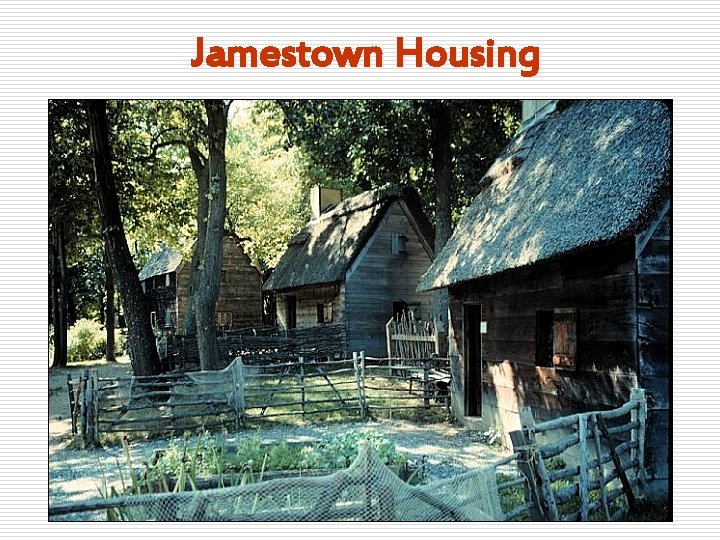
Jamestown Housing
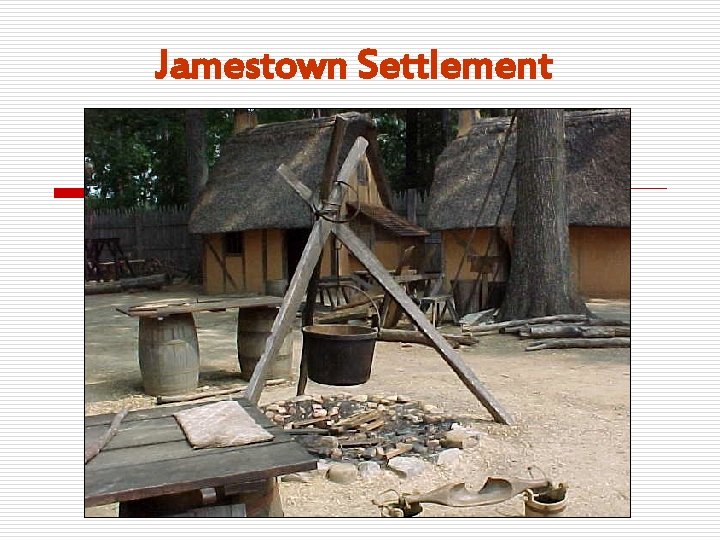
Jamestown Settlement
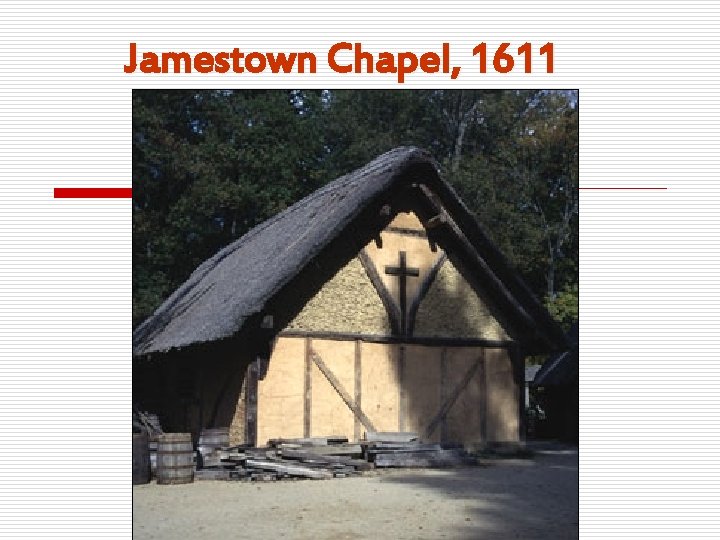
Jamestown Chapel, 1611
The Jamestown Nightmare 1606 -1607 40 people died on the voyage to the New World. 1609 another ship from England lost its leaders and supplies in a shipwreck off Bermuda. Settlers died by the dozens! “Gentlemen” colonists would not work themselves. Settlers wasted time looking for gold instead of hunting or farming.
Starving Time o During the period known as the “Starving Time” they ate rats, mice, and snakes to survive. o Some colonists resorted to cannibalism and joining neighboring Indian tribes. o By 1610 there were only 60 colonists left alive when two ships arrived from Europe.
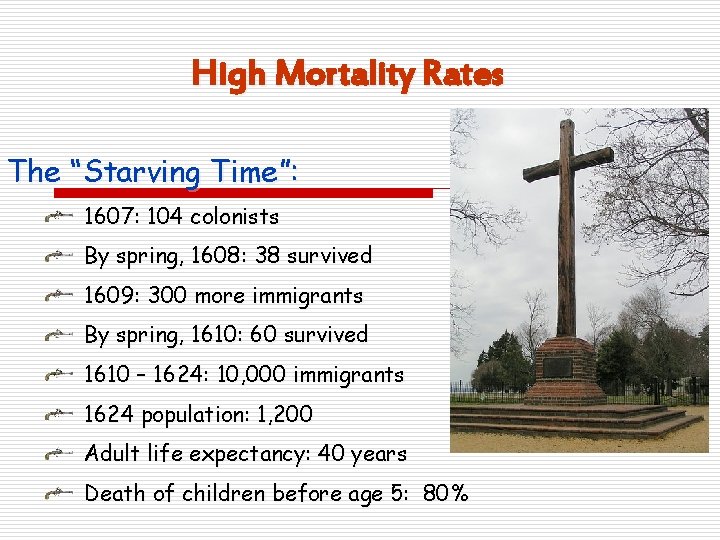
High Mortality Rates The “Starving Time”: 1607: 104 colonists By spring, 1608: 38 survived 1609: 300 more immigrants By spring, 1610: 60 survived 1610 – 1624: 10, 000 immigrants 1624 population: 1, 200 Adult life expectancy: 40 years Death of children before age 5: 80%
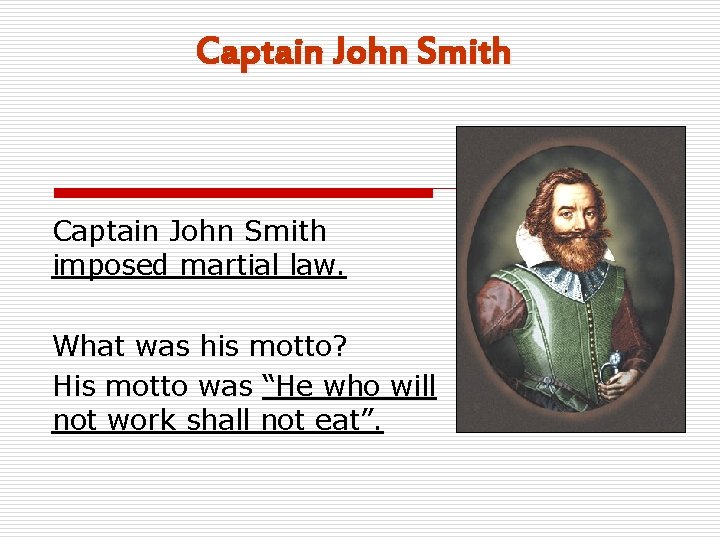
Captain John Smith imposed martial law. What was his motto? His motto was “He who will not work shall not eat”.
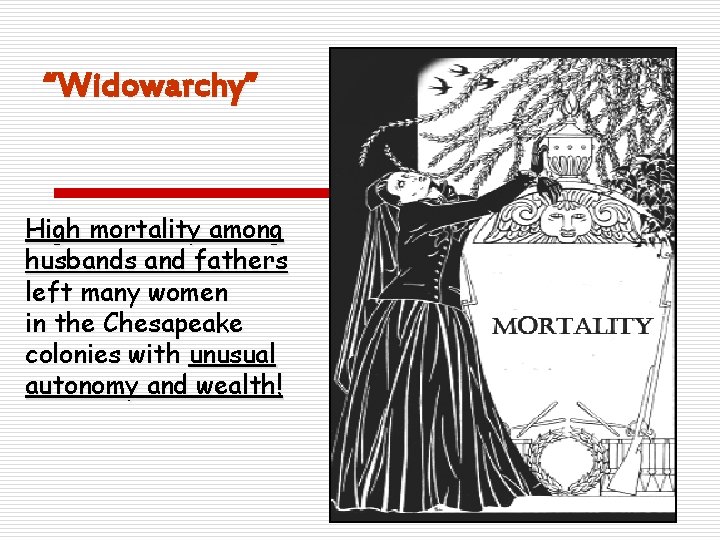
“Widowarchy” High mortality among husbands and fathers left many women in the Chesapeake colonies with unusual autonomy and wealth!
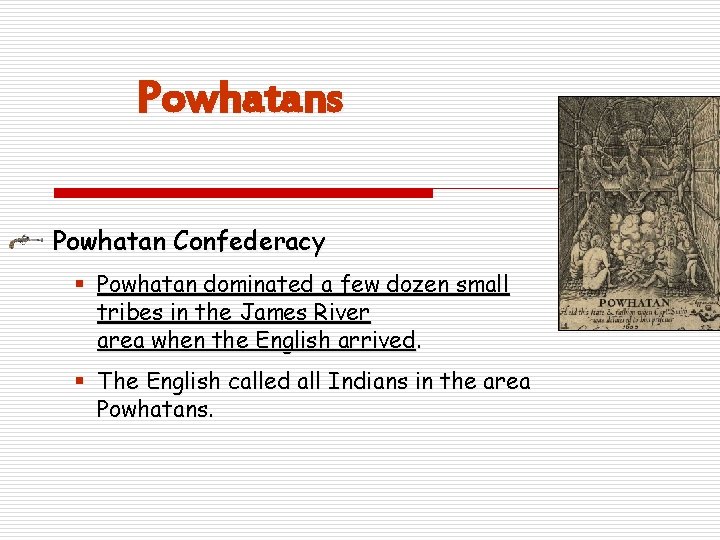
Powhatans Powhatan Confederacy § Powhatan dominated a few dozen small tribes in the James River area when the English arrived. § The English called all Indians in the area Powhatans.
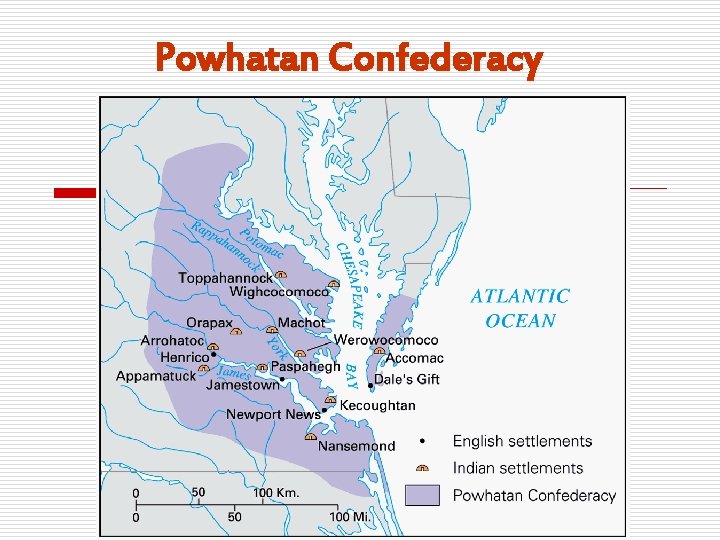
Powhatan Confederacy
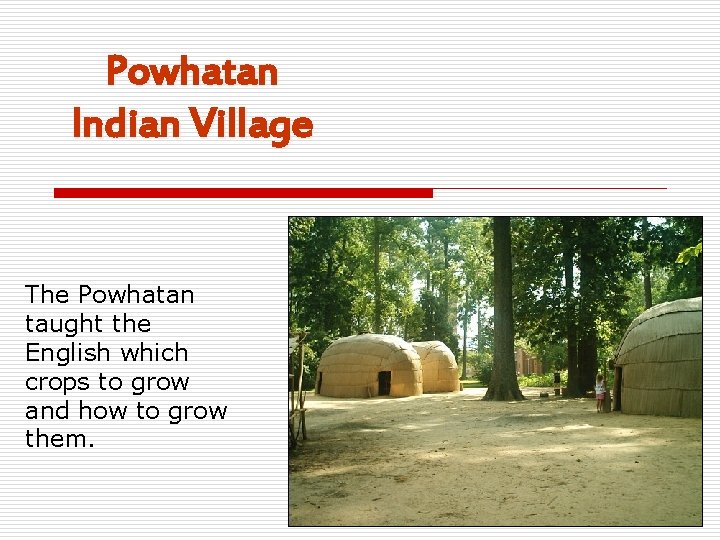
Powhatan Indian Village The Powhatan taught the English which crops to grow and how to grow them.
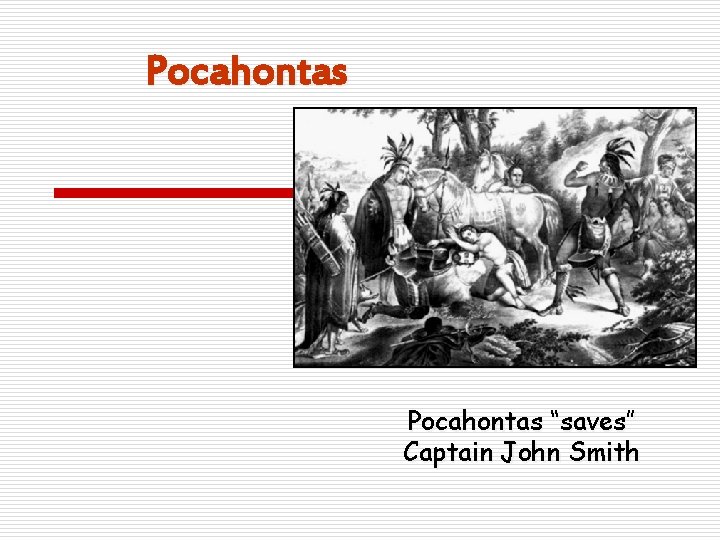
Pocahontas “saves” Captain John Smith
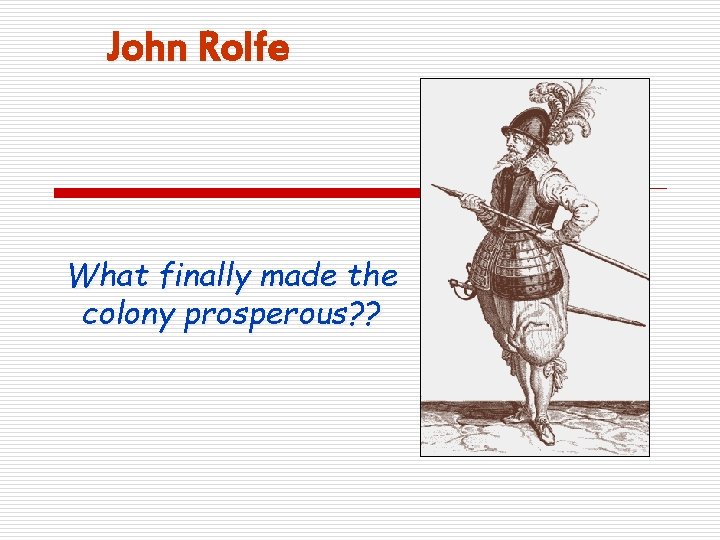
John Rolfe What finally made the colony prosperous? ?
TOBACCO o Jamestown prospered after John Rolfe introduced the cash crop of tobacco. o The crop needs vast amounts of land needs to constantly be moved to new soil. o Farmers were constantly encroaching on Native American land in search of new fields.
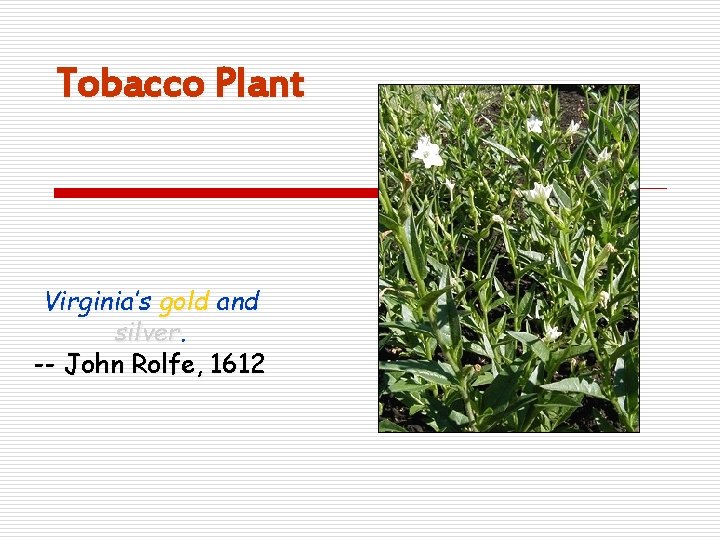
Tobacco Plant Virginia’s gold and silver. -- John Rolfe, 1612
Virginia: “Child of Tobacco” Tobacco’s effect on Virginia’s economy: § Vital role in putting VA on a firm economic footing. § Ruinous to soil when continuously planted. § Chained VA’s economy to a single crop. Tobacco promoted the use of the plantation system. § Need for cheap, abundant labor.
Early Colonial Tobacco 1618 — Virginia produces 20, 000 pounds of tobacco. 1622 — Despite losing nearly one-third of its colonists in an Indian attack, Virginia produces 60, 000 pounds of tobacco. 1627 — Virginia produces 500, 000 pounds of tobacco. 1629 — Virginia produces 1, 500, 000 pounds of tobacco.
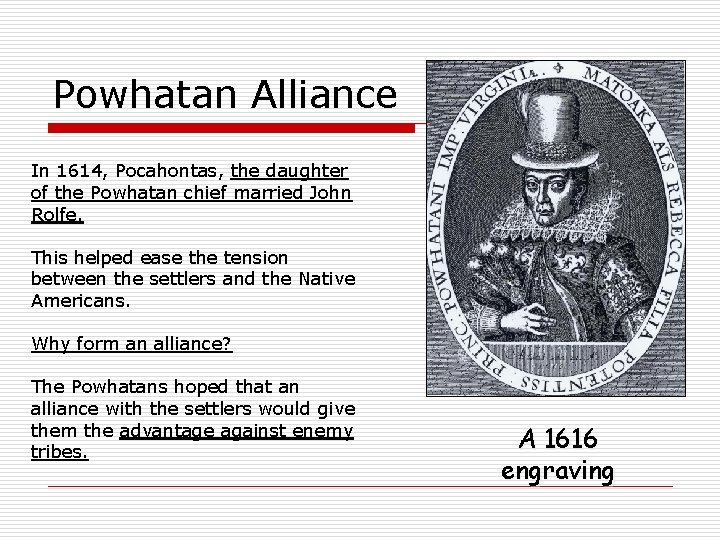
Powhatan Alliance In 1614, Pocahontas, the daughter of the Powhatan chief married John Rolfe. This helped ease the tension between the settlers and the Native Americans. Why form an alliance? The Powhatans hoped that an alliance with the settlers would give them the advantage against enemy tribes. A 1616 engraving
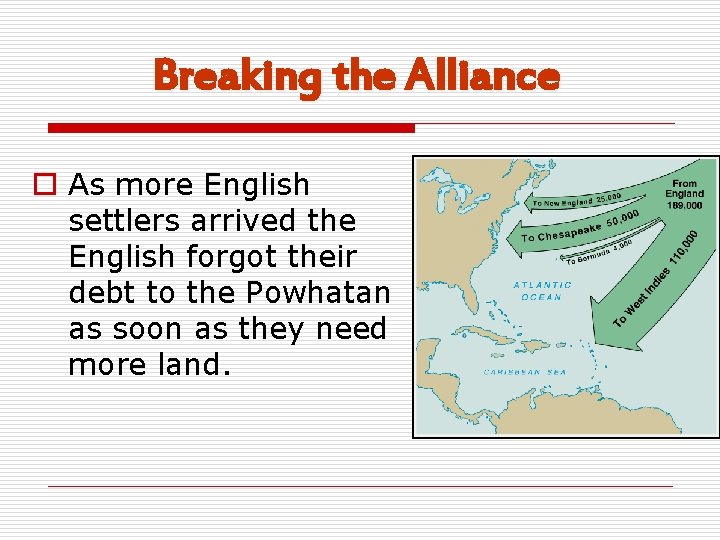
Breaking the Alliance o As more English settlers arrived the English forgot their debt to the Powhatan as soon as they need more land.
Culture Clash in the Chesapeake Relations between Indians & settlers grew worse. § General mistrust because of different cultures & languages. § English raided Indian food supplies during the starving times.
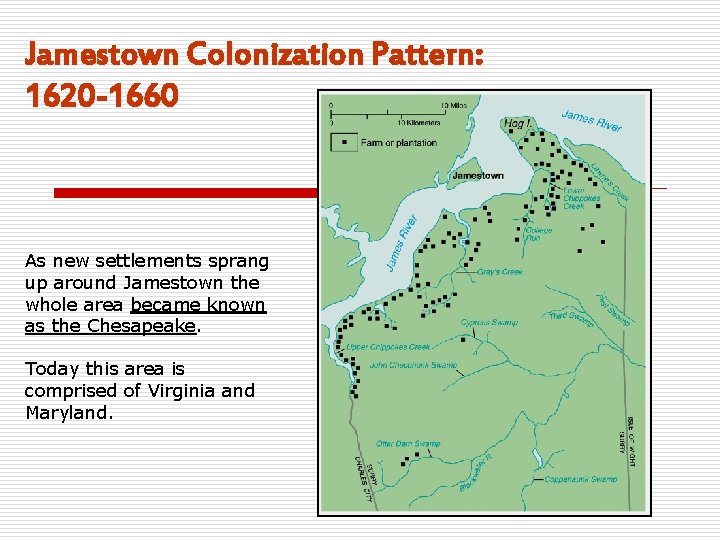
Jamestown Colonization Pattern: 1620 -1660 As new settlements sprang up around Jamestown the whole area became known as the Chesapeake. Today this area is comprised of Virginia and Maryland.
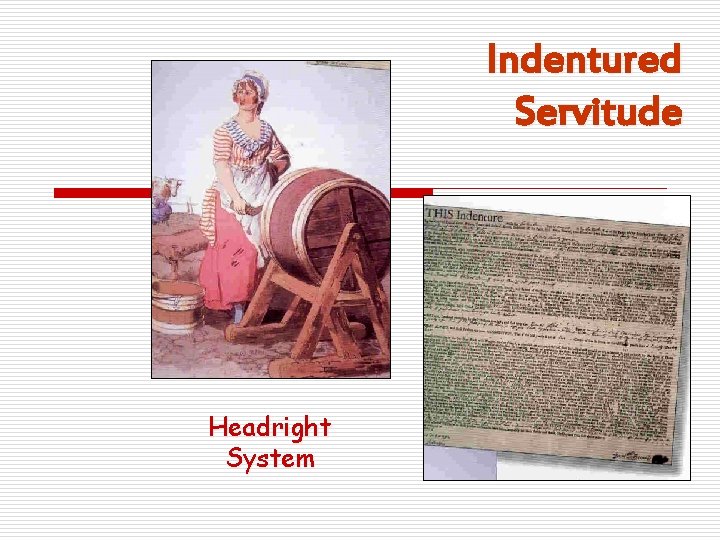
Indentured Servitude Headright System
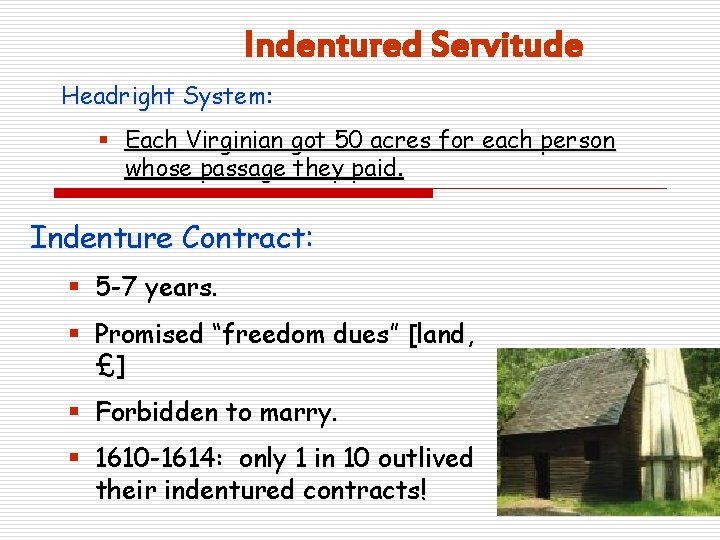
Indentured Servitude Headright System: § Each Virginian got 50 acres for each person whose passage they paid. Indenture Contract: § 5 -7 years. § Promised “freedom dues” [land, £] § Forbidden to marry. § 1610 -1614: only 1 in 10 outlived their indentured contracts!
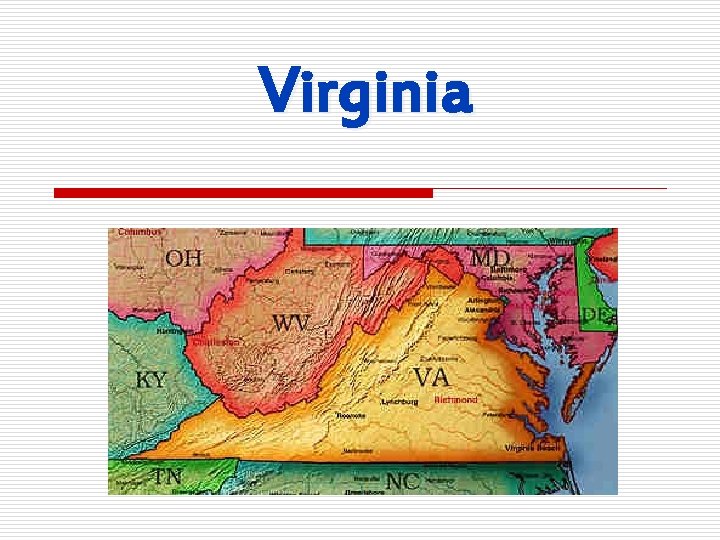
Virginia
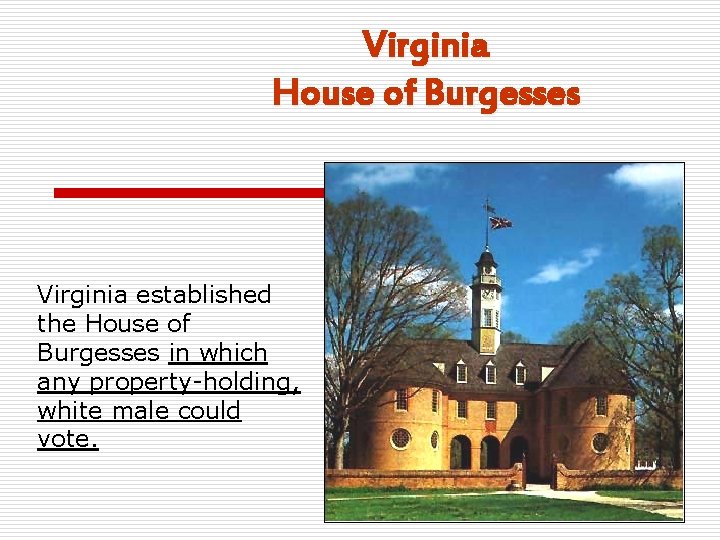
Virginia House of Burgesses Virginia established the House of Burgesses in which any property-holding, white male could vote.
Growing Political Power The House of Burgesses established in 1619 & began to assume the role of the House of Commons in England § Control over finances, militia, etc. § Mainly leading planters. § Functions like House of Lords. § High death rates ensured rapid turnover of members.
Virginia Becomes a Royal Colony James I grew hostile to Virginia § He hated tobacco. § He distrusted the House of Burgesses which he called a seminary of sedition. 1624 he revoked the charter of the bankrupt VA Company. § Thus, VA became a royal colony, under the king’s direct control!
Frustrated Freemen Late 1600 s large numbers of young, poor, discontented men in the Chesapeake area. § Little access to land or women for marriage. 1670 The Virginia Assembly disenfranchised most landless men!
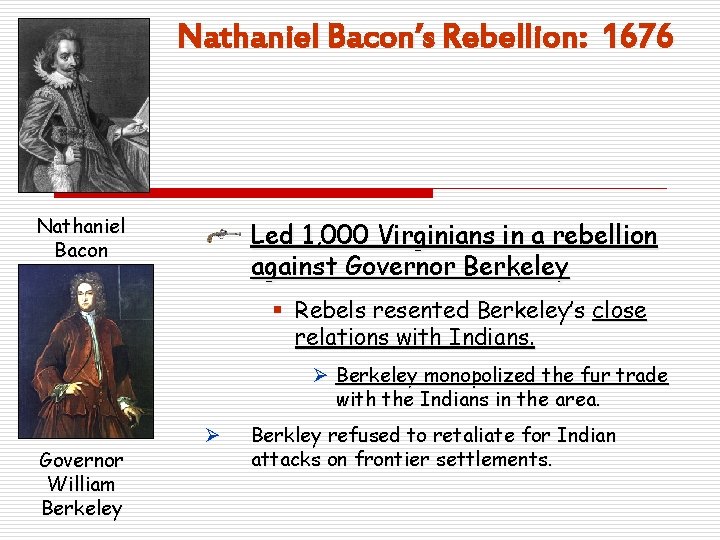
Nathaniel Bacon’s Rebellion: 1676 Nathaniel Bacon Led 1, 000 Virginians in a rebellion against Governor Berkeley § Rebels resented Berkeley’s close relations with Indians. Ø Berkeley monopolized the fur trade with the Indians in the area. Governor William Berkeley Ø Berkley refused to retaliate for Indian attacks on frontier settlements.
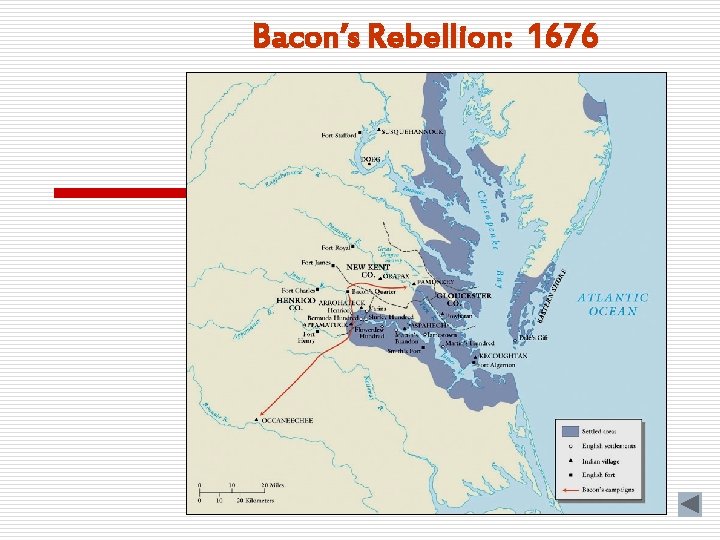
Bacon’s Rebellion: 1676
Bacon’s Rebellion Governor Berkeley driven from Jamestown. They burned the capital. § Rebels went on a rampage of plundering. Bacon suddenly died of fever. Berkeley brutally crushed the rebellion and hanged 20 rebels.
Results of Bacon’s Rebellion Socio-economic class differences/clashes between rural and urban communities would continue throughout American history. Upper class planters searched for laborers less likely to rebel Africans
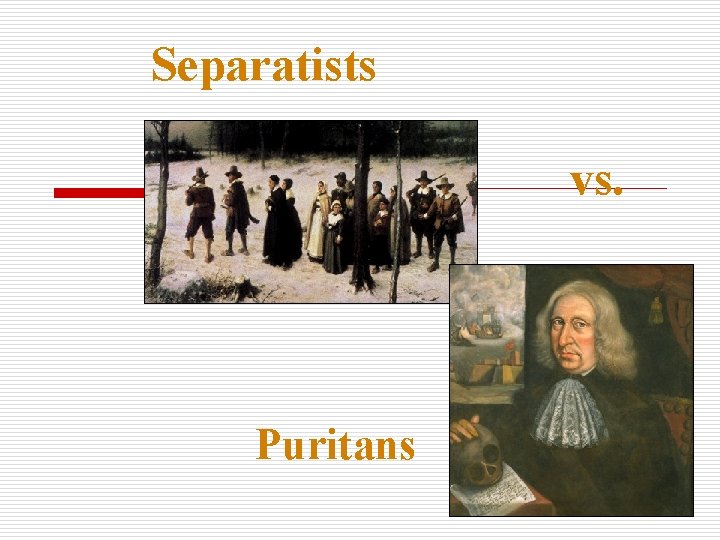
Separatists vs. Puritans
Puritanism Calvinism The English followers of John Calvin were known as Puritans § Predestination. • Good works could not save those predestined for hell. • No one could be certain of their spiritual status. Puritans: § Want to totally reform [purify] the Church of England. § Grew impatient with the slow process of Protestant Reformation back in England.
The Puritans leave England o The Puritans believed that Queen Elizabeth I’s reforms had not gone far enough to reform the church. o The Puritans controlled many congregations in England had become an influential force. o King James I abandoned the policy of religious toleration when he took the throne.
The Separatists § One Puritan group called the Separatists believed in a total break from the Church of England. § In 1629, King Charles I took the throne and launched a campaign of repression against the separatists. § This political turmoil paved the way for thousands to escape to the colonies.
The Pilgrims o The first group of dissenters are commonly known as the Pilgrims today. They went by the name “Separatist” in their time period. o The originally moved to Holland but decided to proceed to North America because they felt the Dutch were seducing their children with their ideas of tolerance.
This Week: o o o o Tues- Notes over Colonization Weds- In Class Assignment Thurs. -Notes/Witch Trials Fri-Salem Witch Trials Mon. -Salem Witch Trials Video Tues. - Discuss A. P. Exam/Review Weds. - Colonization Test
![The Mayflower 1620 a group of 102 people [half Separatists] § Negotiated with the](http://slidetodoc.com/presentation_image_h2/7bdb568ec44da5869ef7f8b4e973db08/image-58.jpg "The Mayflower 1620 a group of 102 people [half Separatists] § Negotiated with the")
The Mayflower 1620 a group of 102 people [half Separatists] § Negotiated with the Virginia Company to settle in its jurisdiction. Plymouth Bay way outside the domain of the Virginia Company. § Became squatters without legal right to land & specific authority to establish a govt.
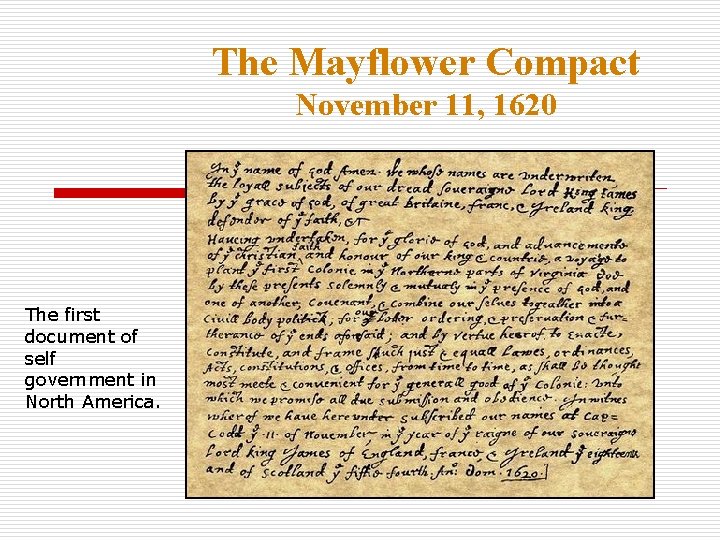
The Mayflower Compact November 11, 1620 The first document of self government in North America.
The Mayflower Compact November 11, 1620 Written and signed before the Pilgrims disembarked from the ship. Not a constitution, but an agreement to form a crude govt. and submit to majority rule. § Signed by 41 adult males. Led to adult male settlers meeting in assemblies to make laws in town meetings.
Covenant Theology “Covenant of Grace”: § between Puritan communities and God. “Social Covenant”: § Between members of Puritan communities with each other. § Required mutual watchfulness. § No toleration of deviance or disorder. § No privacy.
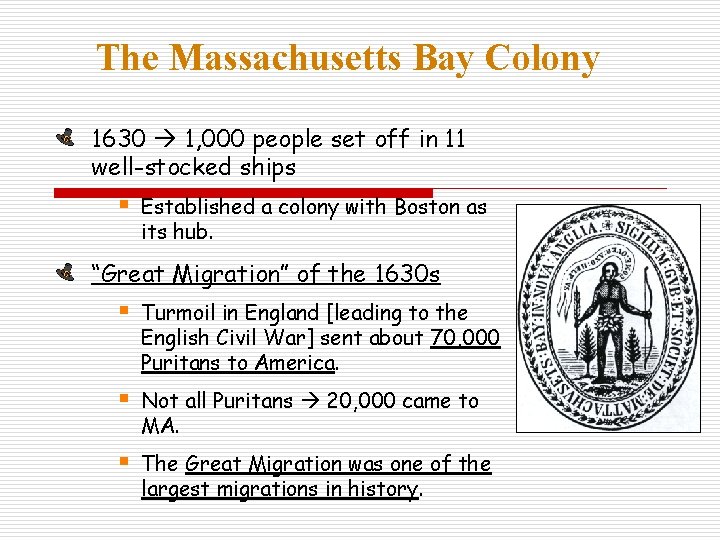
The Massachusetts Bay Colony 1630 1, 000 people set off in 11 well-stocked ships § Established a colony with Boston as its hub. “Great Migration” of the 1630 s § Turmoil in England [leading to the English Civil War] sent about 70, 000 Puritans to America. § Not all Puritans 20, 000 came to MA. § The Great Migration was one of the largest migrations in history.
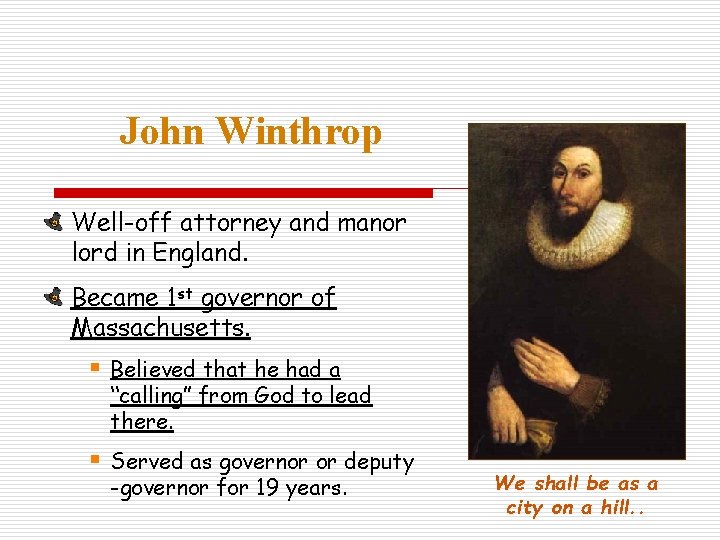
John Winthrop Well-off attorney and manor lord in England. Became 1 st governor of Massachusetts. § Believed that he had a “calling” from God to lead there. § Served as governor or deputy -governor for 19 years. We shall be as a city on a hill. .
Characteristics of New England Settlements Low mortality average life expectancy was 70 years of age. Many extended families. Average 6 children per family. Average at marriage: § Women – 22 years old § Men – 27 years old.
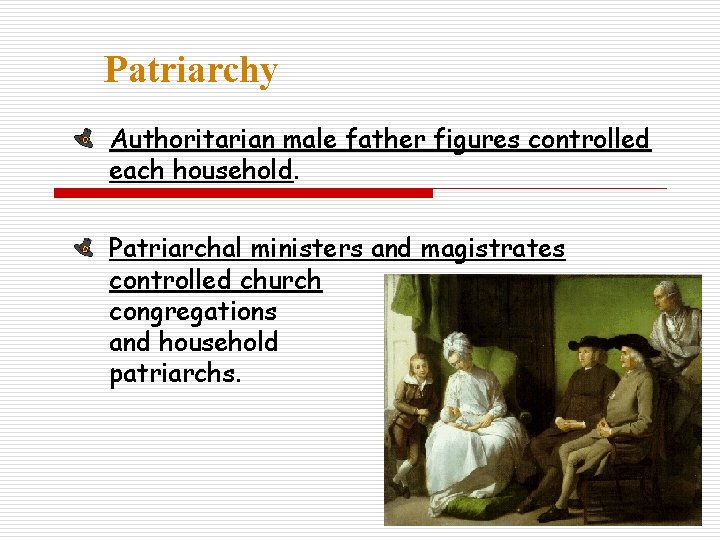
Patriarchy Authoritarian male father figures controlled each household. Patriarchal ministers and magistrates controlled church congregations and household patriarchs.
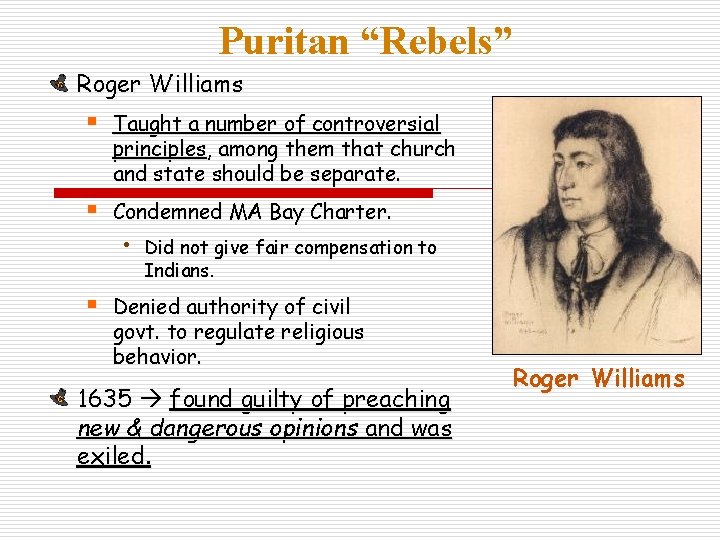
Puritan “Rebels” Roger Williams § Taught a number of controversial principles, among them that church and state should be separate. § Condemned MA Bay Charter. • Did not give fair compensation to Indians. § Denied authority of civil govt. to regulate religious behavior. 1635 found guilty of preaching new & dangerous opinions and was exiled. Roger Williams
Rhode Island 1636 Roger Williams fled there. § MA Bay Puritans had wanted to exile him to England to prevent him from founding a competing colony. § Remarkable political freedom in Providence, RI • Universal manhood suffrage later restricted by a • property qualification. Opposed to special privilege of any kind freedom of opportunity for all. RI becomes known as the “Sewer” because it is seen by the Puritans as a dumping ground for unbelievers and religious dissenters More liberal than any other colony!
![Anne Hutchinson Intelligent, strong-willed, well-spoken woman. Threatened patriarchal control. Anti-nomialism [direct revelation] § Believed](http://slidetodoc.com/presentation_image_h2/7bdb568ec44da5869ef7f8b4e973db08/image-68.jpg "Anne Hutchinson Intelligent, strong-willed, well-spoken woman. Threatened patriarchal control. Anti-nomialism [direct revelation] § Believed")
Anne Hutchinson Intelligent, strong-willed, well-spoken woman. Threatened patriarchal control. Anti-nomialism [direct revelation] § Believed faith and God’s grace could save you as opposed to the observance of moral law and performance of good deeds. § Holy life was no sure sign of salvation.
Anne Hutchinson’s Trial 1638 she confounded the Puritan leaders for days. Eventually bragged that she had received her beliefs DIRECTLY from God. Puritan leaders banished her she & her family traveled to RI and later to NY. § She and all but one member of her family were killed in an Indian attack in Westchester County. § John Winthrop saw God’s hand in this!
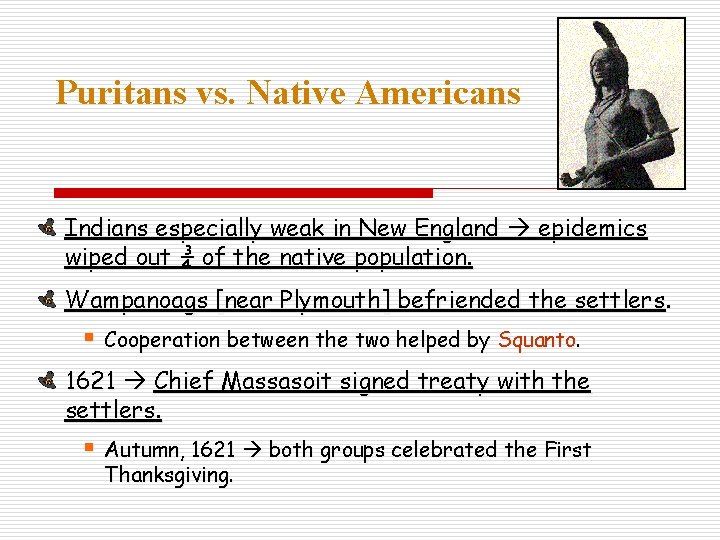
Puritans vs. Native Americans Indians especially weak in New England epidemics wiped out ¾ of the native population. Wampanoags [near Plymouth] befriended the settlers. § Cooperation between the two helped by Squanto. 1621 Chief Massasoit signed treaty with the settlers. § Autumn, 1621 both groups celebrated the First Thanksgiving.
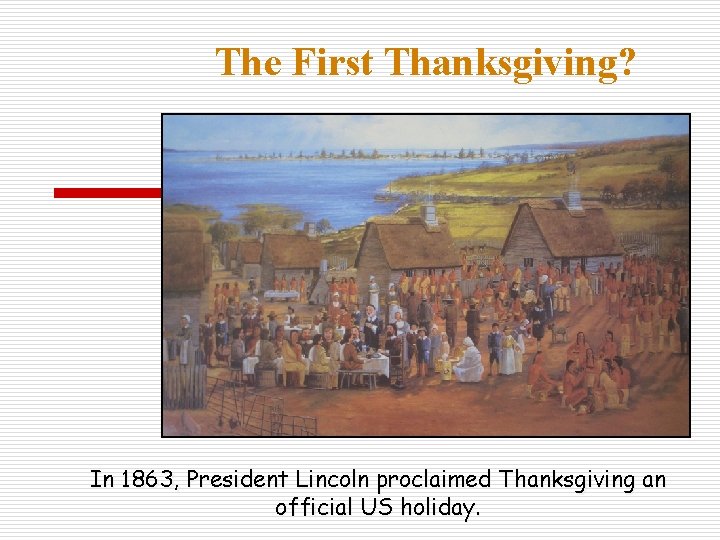
The First Thanksgiving? In 1863, President Lincoln proclaimed Thanksgiving an official US holiday.
THE CONNECTICUT VALLEY As the population grew, settlers began to look for more places to live. The Connecticut Valley was a fertile region with lots of access to the sea. This area was inhabited by the Pequots.
The Pequot Wars: 1636 -1637 Pequots very powerful tribe in CT river valley. 1637 Pequot War § § The Pequots attacked a settlement killing nine colonists. § § Whites set fire to homes & shot fleeing survivors! The members of the Massachusetts Bay Colony retaliated by killing 400 Pequot tribe virtually annihilated an uneasy peace lasted for 40 years.
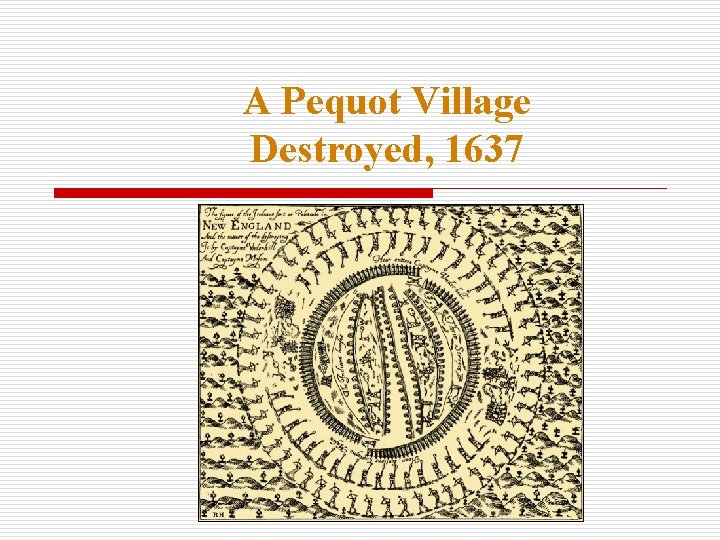
A Pequot Village Destroyed, 1637
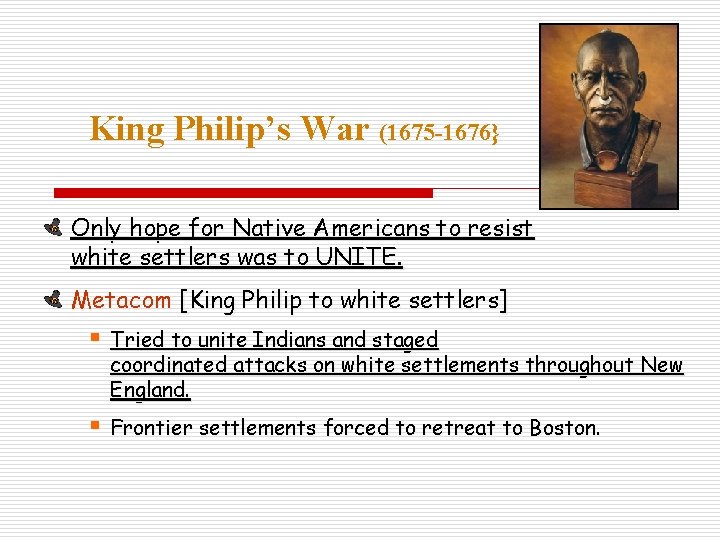
King Philip’s War (1675 -1676} Only hope for Native Americans to resist white settlers was to UNITE. Metacom [King Philip to white settlers] § Tried to unite Indians and staged coordinated attacks on white settlements throughout New England. § Frontier settlements forced to retreat to Boston.
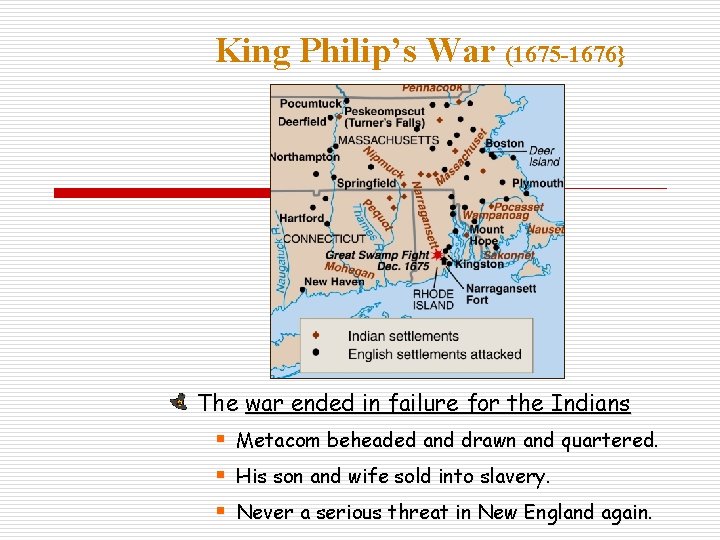
King Philip’s War (1675 -1676} The war ended in failure for the Indians § § § Metacom beheaded and drawn and quartered. His son and wife sold into slavery. Never a serious threat in New England again.
DECLINE PURITAN SOCIETY o Many colonists began to care about business and material things. o The drive for economic success competed with Puritan religious ideas. o A new royal charter allowed for religious freedom in Massachusetts. o People were allowed to vote based on land ownership rather than church affiliation.
Maryland
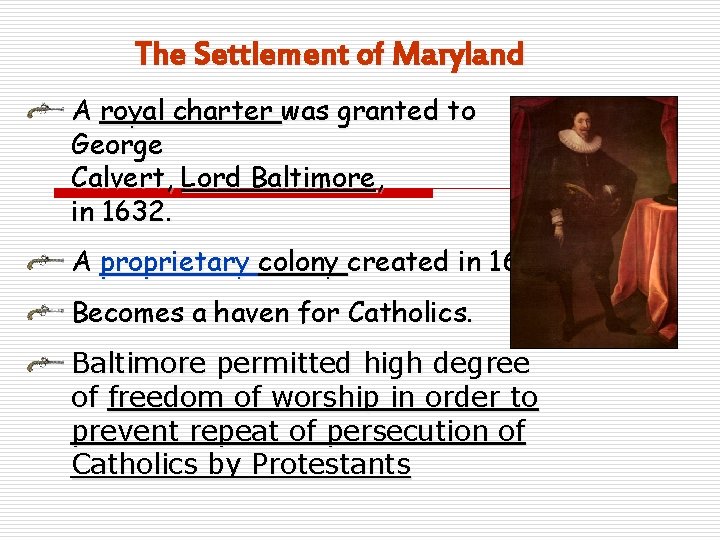
The Settlement of Maryland A royal charter was granted to George Calvert, Lord Baltimore, in 1632. A proprietary colony created in 1634. Becomes a haven for Catholics. Baltimore permitted high degree of freedom of worship in order to prevent repeat of persecution of Catholics by Protestants

New York
New Netherlands founded in the Hudson River area (1623 -1624) § Established by Dutch West India Company for quick-profit fur trade. § Aristocratic patroonships [feudal estates granted to promoters who would settle 50 people on them]. Charles II granted New Netherland’s land to his brother, the Duke of York. Renamed “New York”

Pennsylvania
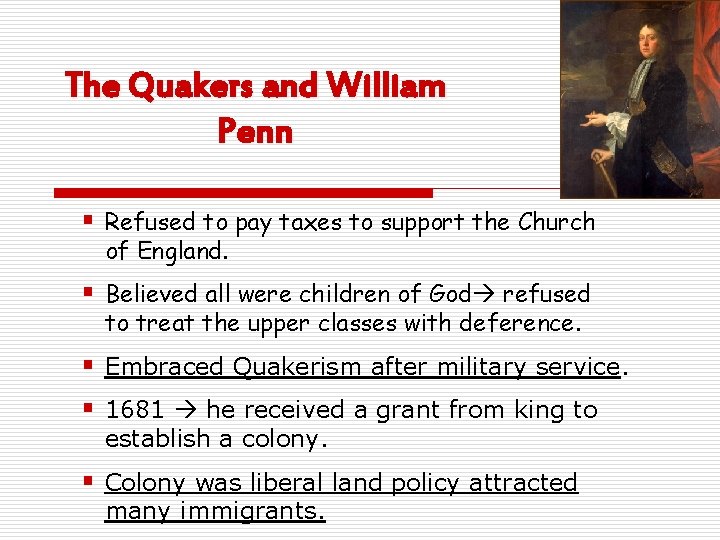
The Quakers and William Penn § Refused to pay taxes to support the Church of England. § Believed all were children of God refused to treat the upper classes with deference. § Embraced Quakerism after military service. § 1681 he received a grant from king to establish a colony. § Colony was liberal land policy attracted many immigrants.
- Slides: 83