
Colonization The Making of America Unit One The


- Slides: 40
Colonization The Making of America
Unit One The New World
Essential Question Why do people explore new worlds?
Reasons for coming to the New World • What wealth did it have to offer? – GOLD • Many came to spread Christianity. People who were not converted had to be converted by persuasion or by force. Those who rejected God were considered enemies of God, suitable only for enslavement or death. (Irony) - GOD • Adventure - GLORY
1492 - Found by mistake – Columbus named the people Indians because he thought he was near the East Indies. Once monarchs realized this was a new land – explorers were put to work to find out what this land had to offer.
Exploration • Historical documentation –Historical narratives - accounts of voyage, hardships endured, feelings (tone and imagery) – either primary sources – written by someone with firsthand knowledge of a subject or secondary sources – indirect, secondhand knowledge – i. e. Histories and biographies.
Storytelling and Written Communication • Changed after colonies began to be shaped and formed. Diaries, letters, journals, ships’ logs, financial reports
Literature • The period of European exploration produced a surprisingly large and intriguing body of literature. • Texts were printed that told of voyages, new sights, and strange peoples. • Made the New World vivid and real. People wanted to see for themselves.
First Forms of Storytelling Orally transmitted myths, legends, tales, and lyrics – varied due to different lifestyles and languages of Natives (hundreds of different languages from entirely different linguistic families. No written alphabet Records included shellwork belts and painted animal hides, tepees, and shields Many perished, but those that survived have inestimable ethnographic and literary value.
Puritans • Thought themselves as soldiers in a war against Satan who planned to ruin the kingdom of God on earth – Satan sowed discord among Christians • Saw no hope in reforming Anglican church
Puritan Dominance • 1620 – 100 people on board the Mayflower landed near Cape Cod • 1640 – nearly 20, 000 English Puritans were living in New England
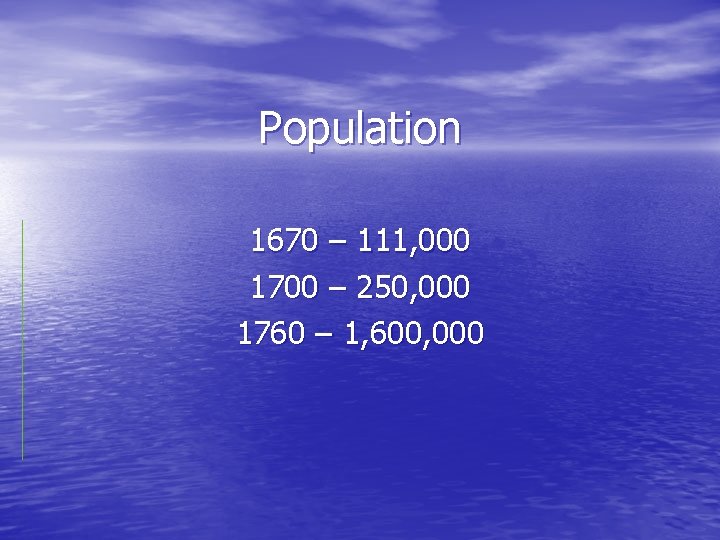
Population 1670 – 111, 000 1700 – 250, 000 1760 – 1, 600, 000
Puritanism - a movement of the 16 th century that sought to purify the Church of England. - Led to establishment of colonies in the New World when adherents sought land where they could worship without persecution or proclamation. - Strictness of Puritan beliefs led to rigid rules of conduct and severe punishment for transgressors - “Covenant of Grace” – binding agreement between men who believe in him and Christ, which he sealed with his Crucifixion, promising them eternal life. - Argued Adam broke the “Covenant of Works” – the promise God made to Adam that he was immortal and could live in Paradise forever as long as he obeyed God’s commandments; was broken when he and Eve at of the tree of knowledge of good and evil, thereby bringing sin and death into the world.
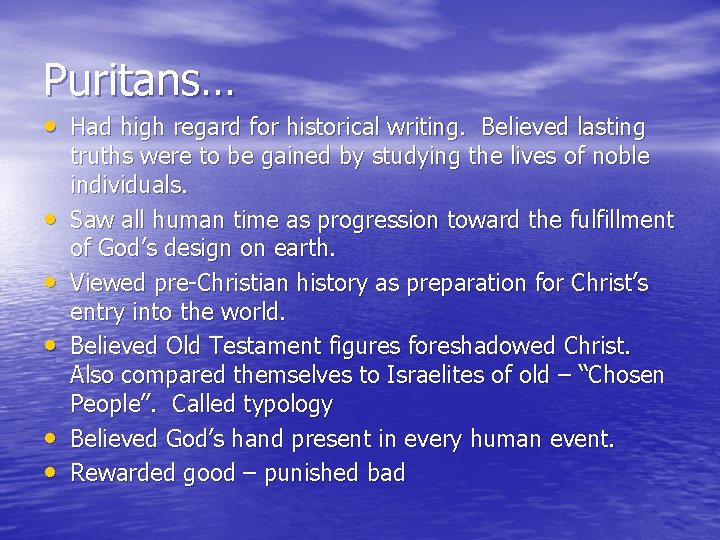
Puritans… • Had high regard for historical writing. Believed lasting • • • truths were to be gained by studying the lives of noble individuals. Saw all human time as progression toward the fulfillment of God’s design on earth. Viewed pre-Christian history as preparation for Christ’s entry into the world. Believed Old Testament figures foreshadowed Christ. Also compared themselves to Israelites of old – “Chosen People”. Called typology Believed God’s hand present in every human event. Rewarded good – punished bad
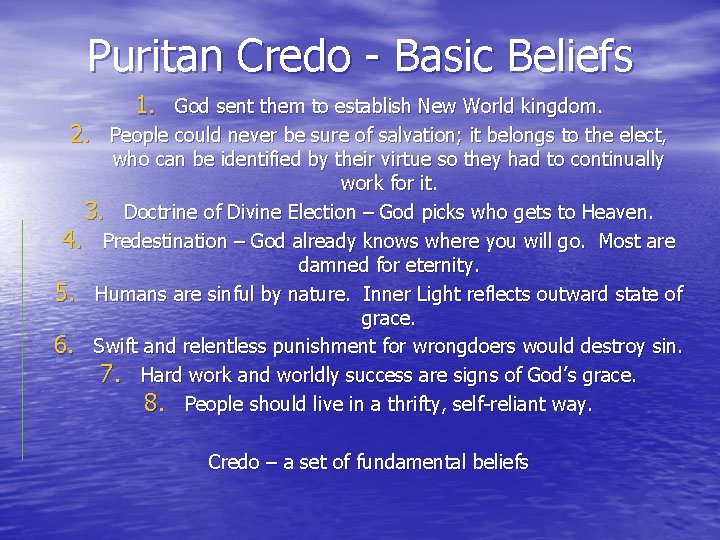
Puritan Credo - Basic Beliefs 1. God sent them to establish New World kingdom. 2. People could never be sure of salvation; it belongs to the elect, who can be identified by their virtue so they had to continually work for it. 3. Doctrine of Divine Election – God picks who gets to Heaven. 4. Predestination – God already knows where you will go. Most are damned for eternity. 5. Humans are sinful by nature. Inner Light reflects outward state of grace. 6. Swift and relentless punishment for wrongdoers would destroy sin. 7. Hard work and worldly success are signs of God’s grace. 8. People should live in a thrifty, self-reliant way. Credo – a set of fundamental beliefs
How is good writing defined? • Puritans defined good writing as that which brought home a full awareness of the importance of worshipping God and of the spiritual dangers that the soul faced on Earth. Styles varied from complex metaphysical poetry to homely journals.
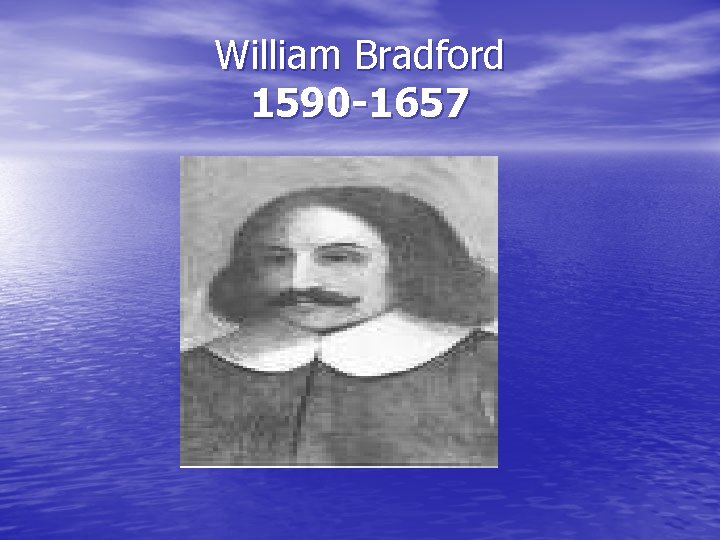
William Bradford 1590 -1657
William Bradford • Left Southampton, England – August 5, 1620 • Landfall – November 11, 1620 – Cape Cod – 2, 750 miles • Voyage took 66 days – return voyage only took 1 month • Mayflower - Left 102 passengers – 3 days before land spotted – 1 died • Misconception – Mayflower not all Pilgrims – only 27 passengers actually professed to be Christian.
William Bradford • Original destination – Jamestown, Virginia – • • seeking exile from religious persecution - hoped to reform the Church of England (Anglican Church) Joined Separatists – became Pilgrims – modeled life by Old Testament covenant made between God and Adam Bradford – served as Governor, Chief Judge, Jury, Superintendent of Agriculture, trade, and land. – wrote only primary account of the voyage.
William Bradford • Point of View – Why they instead of I? – Places • • focus on group rather than personal emphasis – Puritan - Ethics of community Diction – plain, ordinary, no figurative language. Accomplishments of Samoset and Squanto Unite two cultures and Teach Pilgrims how to survive
Terms to know and apply… • allusion: a reference in a work of literature to a • • • character, a place, or a situation from history or from music, art, or another work of literature. covenant of grace: agreement that Christ made with all who believed in him, which he sealed with his crucifixion, promising eternal life and savior by God's grace. Idealism: The practice of seeing or representing things in ideal form rather than as they usually exist in real life. apostrophe: a figure of speech in which one directly addresses an absent or imaginary person, or some abstraction
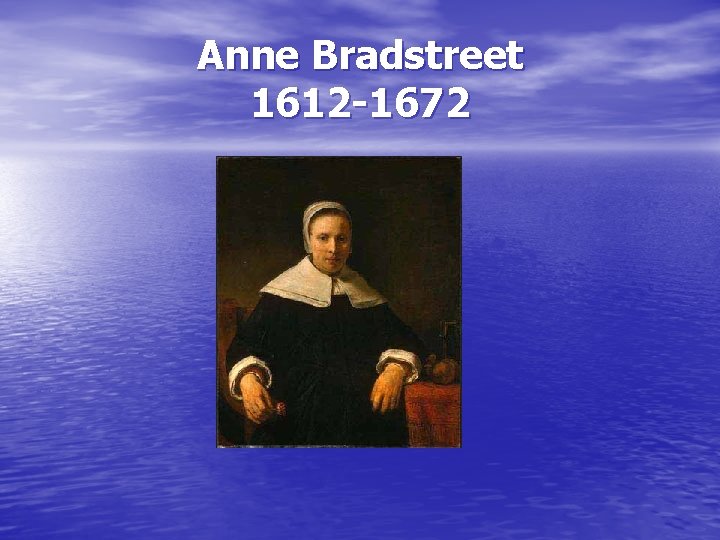
Anne Bradstreet 1612 -1672
First American Poet • Received formal education – uncommon for women in her time • Married at 16; moved to New World at 17 – husband assisted in • • preparing the colony. Had rheumatic fever and/or smallpox – left her frail yet she risked death through childbirth 8 times. Considered by many to be the first American poet, and her first collection of poems, "The Tenth Muse Lately Sprung Up in America, By a Gentlewoman of Those Parts", doesn't contain any of her best known poems, it was the first book written by a woman to be published in the United States. Bradstreet’s brother-in-law, John Woodbridge, took her manuscript to London and had it published in 1650.
Terms to Know and Apply • conceit: A fanciful expression, usually in the form of an extended metaphor or surprising analogy between seemingly dissimilar objects. • Inverted syntax • Extended metaphor: • didactic poetry: Poetry designed to teach an ethical, moral, or religious lesson.
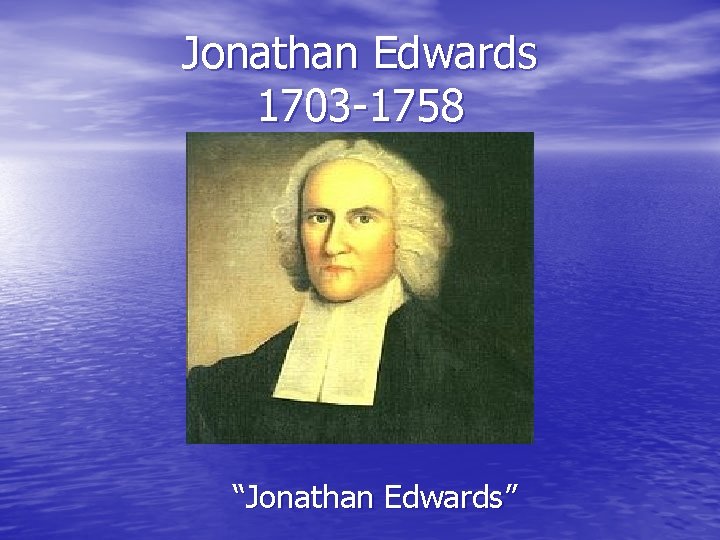
Jonathan Edwards 1703 -1758 “Jonathan Edwards”
Jonathan Edwards • Born near East Windsor, Connecticut • Father – Minister – Rev. Timothy Edwards • Studious and dutiful child • 1716 at 13 admitted to Yale College • Studied theology in New Haven • Determined to perfect himself – as a student, he rose at 4 and studied 13 hours a day.
Edwards continued • As a minister, he wanted to restore religious commitment with his congregation. • Formidable presence and vivid sermons helped to bring about the religious revival known as the Great Awakening. • Became known for his extremism as a pastor. Named backsliders from pulpit – including children.
Edwards continued • Strictness offended many • 1750 – vote 200 to 20 Edwards was dismissed from prestigious position as pastor of Northampton. • Relocated to remote Mohican community of Stockbridge, Massachusetts. • Served as missionary to Housatonnuck Indians
Edwards continued • 1758 - Named president of the College of New Jersey (Princeton University) • Died of smallpox inoculation three months after assuming position. ________ “Edwards, as “the last Puritan, ” stood between Puritan America and modern America. Tragically, he fit into neither” (Holt).
• "The Great Awakening": religious revival in the 1730 -40 s, helped by • Jonathan Edwards and George Whitefield; inspired controversy over emotionalism/revivalism versus traditionalist Protestantism, nevertheless united the Americans as a people sermon: a discourse for the purpose of religious instruction or exhortation, esp. one based on a text of Scripture and delivered by a member of the clergy as part of a religious service
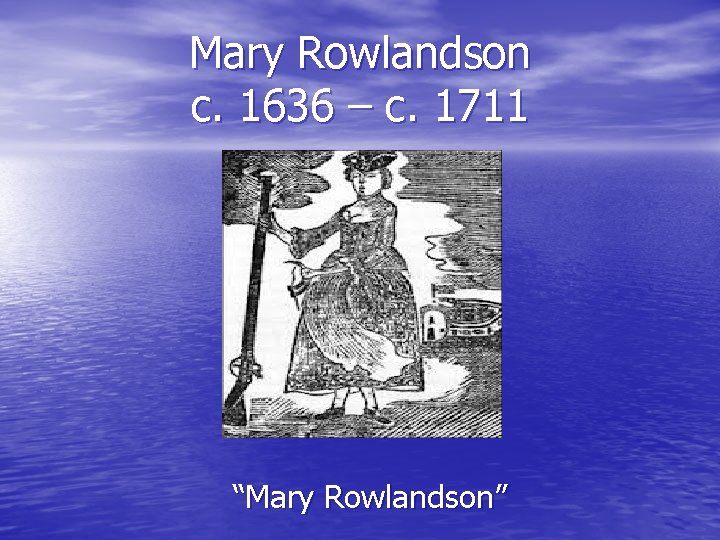
Mary Rowlandson c. 1636 – c. 1711 “Mary Rowlandson”
Mary Rowlandson • Married to Congregational minister of Lancaster, • • • a frontier town located 30 miles from Boston. Differences among colonists and American Indians led to King Phillip’s War. Rowlandson and her three children were carried away by a Wampanoag raiding party that wanted to trade hostages for money. Captive for 11 weeks and 5 days until ransom was paid.
Rowlandson continued • How is the narrative characteristic of Puritan writing? • Served two purposes – 1. record horror of experience 2. reveal God’s purpose
Rationalism • Philosophers and scientists called rationalist began the Age of Reason • Rationalists believed people could discover truth by using reason instead of faith and intuition • Inspired Declaration of Independence and the American Revolution
Deism - Deists • Believed that the universe was orderly and good • Stressed humanity’s goodness • Believed in perfectibility of every individual • • • through the use of reason Believed God wanted us to be happy Best form of worship – doing good to/for others Social welfare – political priority
Stop Here Spring 2016
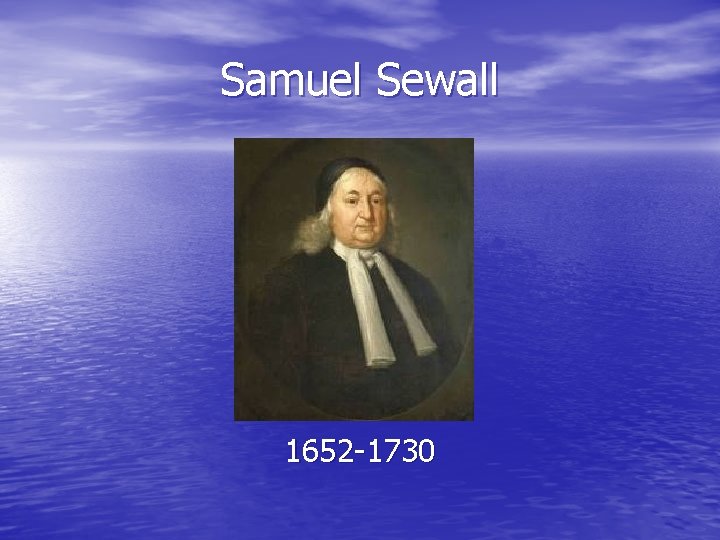
Samuel Sewall 1652 -1730
Samuel Sewall • Born to wealthy family • Rose to a position of authority during late twenties • Studied at Harvard and was appointed as Keeper of the • • College Library for a time. Studied theology Married Hannah Hull, daughter of affluent businessman Learned father-in-law’s business and became central figure in mercantile business after his death. Learned when to borrow and when to lend, filled his ships with goods Londoners were eager to buy and learned to anticipate public demand in New England
Samuel Sewall • 1679 – elected constable and represented king in military • • • affairs Worked as public servant until 1729 Served as judge during Salem Witch Trials January 14, 1697, a fast day, Sewall placed in the hand of his minister, Samuel Willard, a statement acknowledging his wrong in the trials at Salem. Only witchcraft judge to do so. It was read aloud and posted for public view. Three years later, he published antislavery tract in America, The Selling of Joseph. “Perfect servitude, ” he wrote, “can have no place by right…because our liberty in the natural account is the very next thing to life itself, yea by many is preferred before it. ”
Works Cited "Anne Bradstreet. " : The Poetry Foundation, n. d. Web. 02 Aug. 2012. <http: //www. poetryfoundation. org/bio/annebradstreet>. Holt Elements of Literature. Fifth Course. Essentials of American Literature. Orlando, FL. : Holt, Rinehart and Winston, 2007. Print. "Jonathan Edwards (theologian). " Wikipedia. Wikimedia Foundation, 31 July 2012. Web. 02 Aug. 2012. <http: //en. wikipedia. org/wiki/Jonathan_Edwards_(theologian)>. "Mary Rowlandson. " Mary Rowlandson. Soylent Communications, n. d. Web. 02 Aug. 2012. <http: //www. nndb. com/people/438/000115093/>. "PAL: William Bradford (1590 -1657). " PAL: William Bradford (1590 -1657). N. p. , n. d. Web. 02 Aug. 2012. <www. csustan. edu/english/reuben/pal/chap 1/bradford. html>.