
Colonization and First Nations in Canada Terminology IndianFirst
- Slides: 33
Colonization and First Nations in Canada
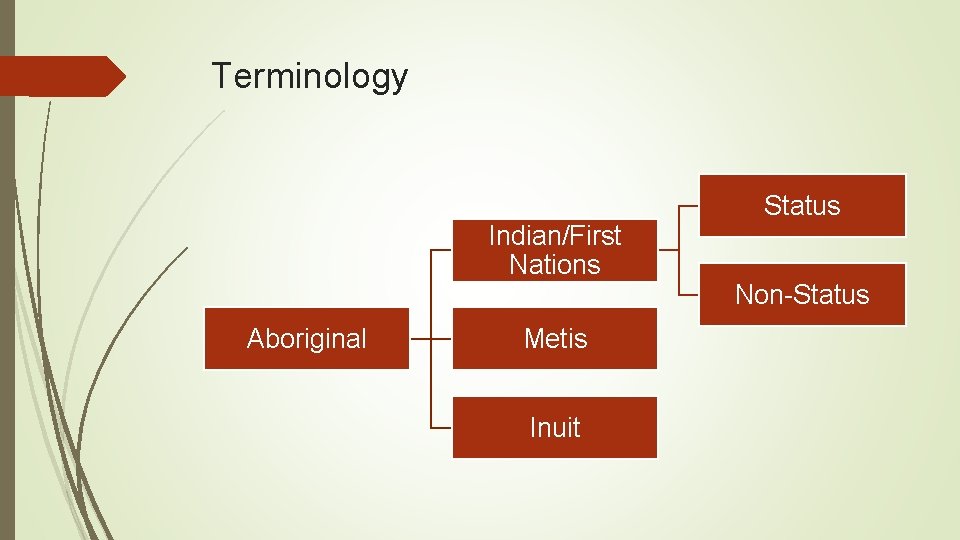
Terminology Indian/First Nations Aboriginal Metis Inuit Status Non-Status
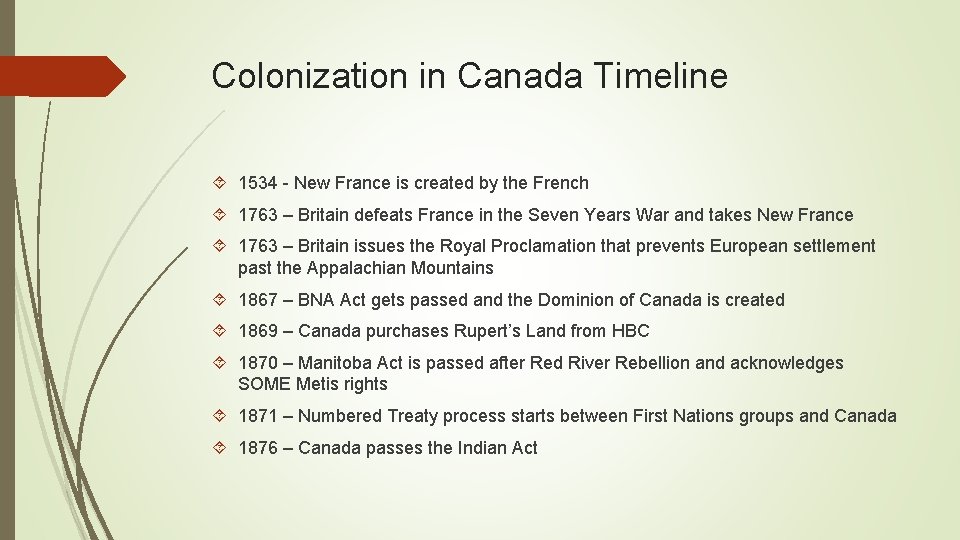
Colonization in Canada Timeline 1534 - New France is created by the French 1763 – Britain defeats France in the Seven Years War and takes New France 1763 – Britain issues the Royal Proclamation that prevents European settlement past the Appalachian Mountains 1867 – BNA Act gets passed and the Dominion of Canada is created 1869 – Canada purchases Rupert’s Land from HBC 1870 – Manitoba Act is passed after Red River Rebellion and acknowledges SOME Metis rights 1871 – Numbered Treaty process starts between First Nations groups and Canada 1876 – Canada passes the Indian Act
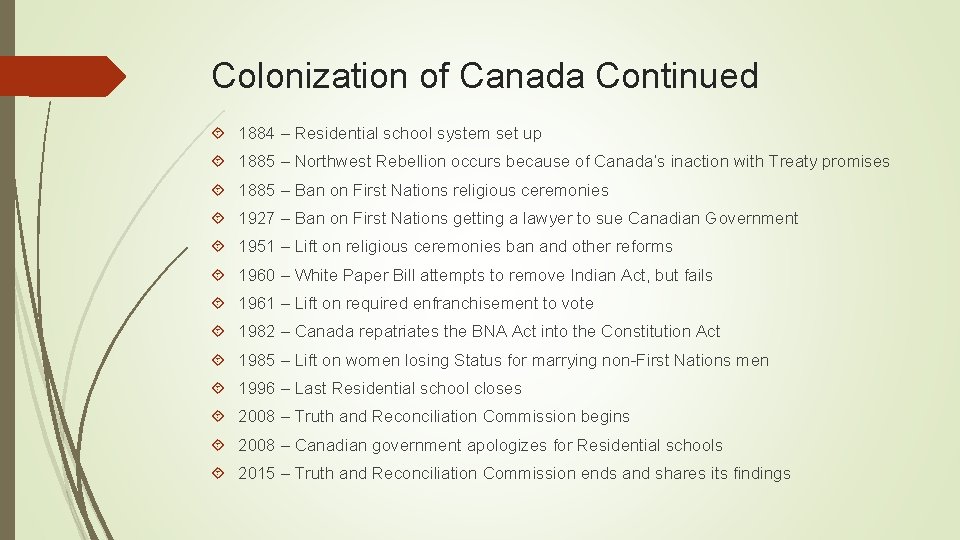
Colonization of Canada Continued 1884 – Residential school system set up 1885 – Northwest Rebellion occurs because of Canada’s inaction with Treaty promises 1885 – Ban on First Nations religious ceremonies 1927 – Ban on First Nations getting a lawyer to sue Canadian Government 1951 – Lift on religious ceremonies ban and other reforms 1960 – White Paper Bill attempts to remove Indian Act, but fails 1961 – Lift on required enfranchisement to vote 1982 – Canada repatriates the BNA Act into the Constitution Act 1985 – Lift on women losing Status for marrying non-First Nations men 1996 – Last Residential school closes 2008 – Truth and Reconciliation Commission begins 2008 – Canadian government apologizes for Residential schools 2015 – Truth and Reconciliation Commission ends and shares its findings
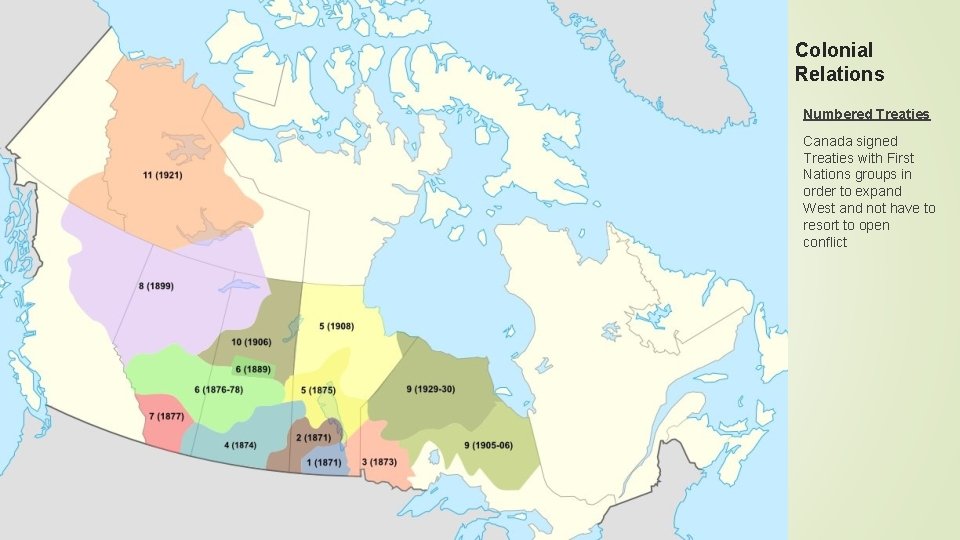
Colonial Relations Numbered Treaties Canada signed Treaties with First Nations groups in order to expand West and not have to resort to open conflict
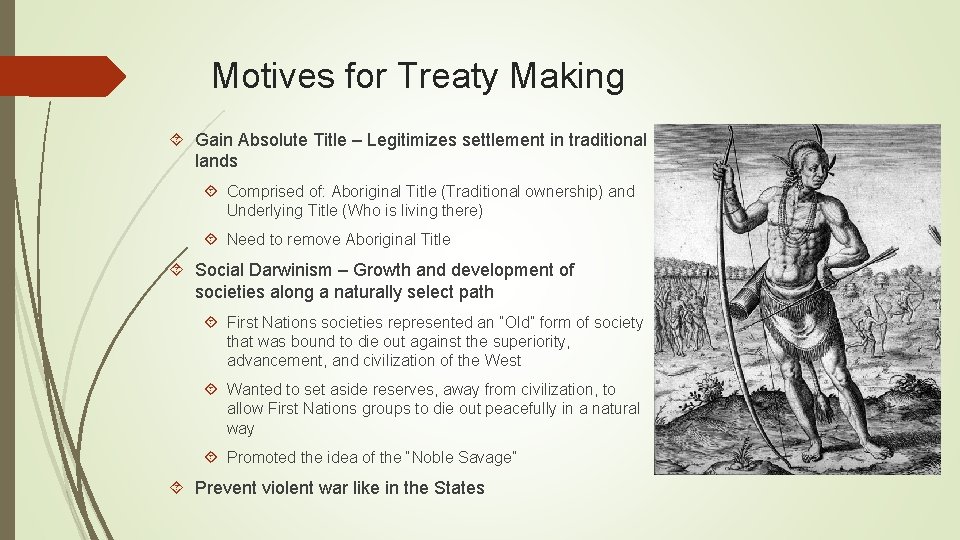
Motives for Treaty Making Gain Absolute Title – Legitimizes settlement in traditional lands Comprised of: Aboriginal Title (Traditional ownership) and Underlying Title (Who is living there) Need to remove Aboriginal Title Social Darwinism – Growth and development of societies along a naturally select path First Nations societies represented an “Old” form of society that was bound to die out against the superiority, advancement, and civilization of the West Wanted to set aside reserves, away from civilization, to allow First Nations groups to die out peacefully in a natural way Promoted the idea of the “Noble Savage” Prevent violent war like in the States
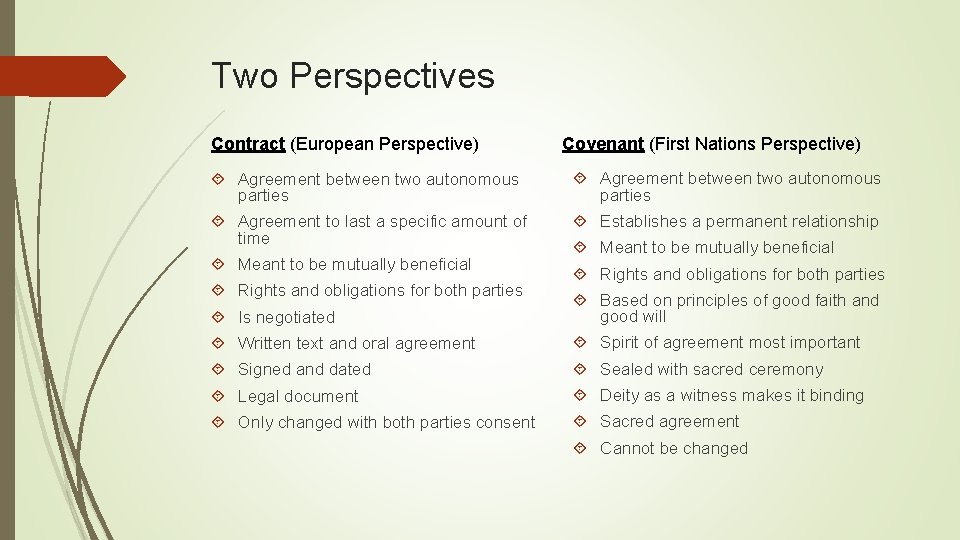
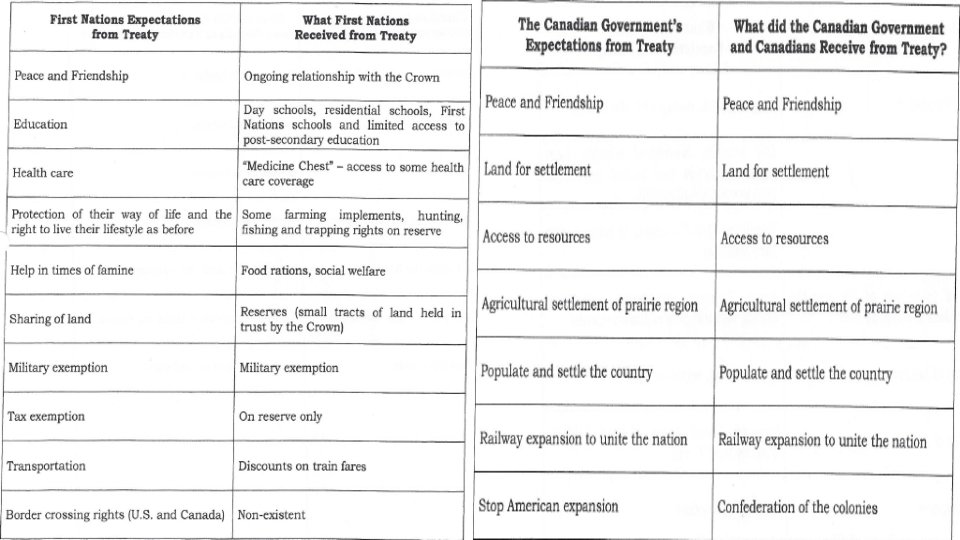
Two Perspectives Contract (European Perspective) Covenant (First Nations Perspective) Agreement between two autonomous parties Agreement to last a specific amount of time Establishes a permanent relationship Meant to be mutually beneficial Rights and obligations for both parties Is negotiated Based on principles of good faith and good will Written text and oral agreement Spirit of agreement most important Signed and dated Sealed with sacred ceremony Legal document Deity as a witness makes it binding Only changed with both parties consent Sacred agreement Cannot be changed
Lets look at some sources! Accounts: Elder Jim Ka-Nipitehtew Treaty Document What promises are mentioned in each? What is similar and different about them? (content, tone/voice…)
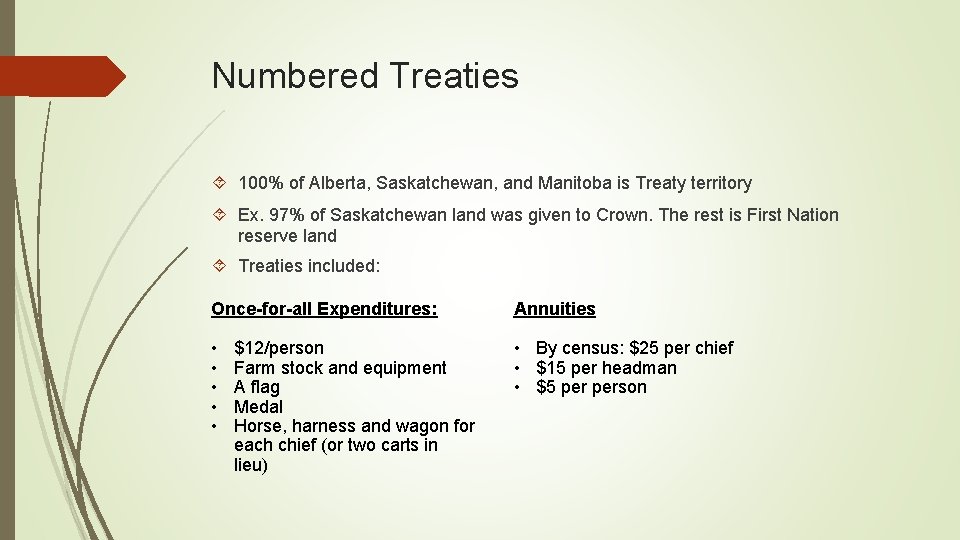
Numbered Treaties 100% of Alberta, Saskatchewan, and Manitoba is Treaty territory Ex. 97% of Saskatchewan land was given to Crown. The rest is First Nation reserve land Treaties included: Once-for-all Expenditures: Annuities • • • By census: $25 per chief • $15 per headman • $5 person $12/person Farm stock and equipment A flag Medal Horse, harness and wagon for each chief (or two carts in lieu)
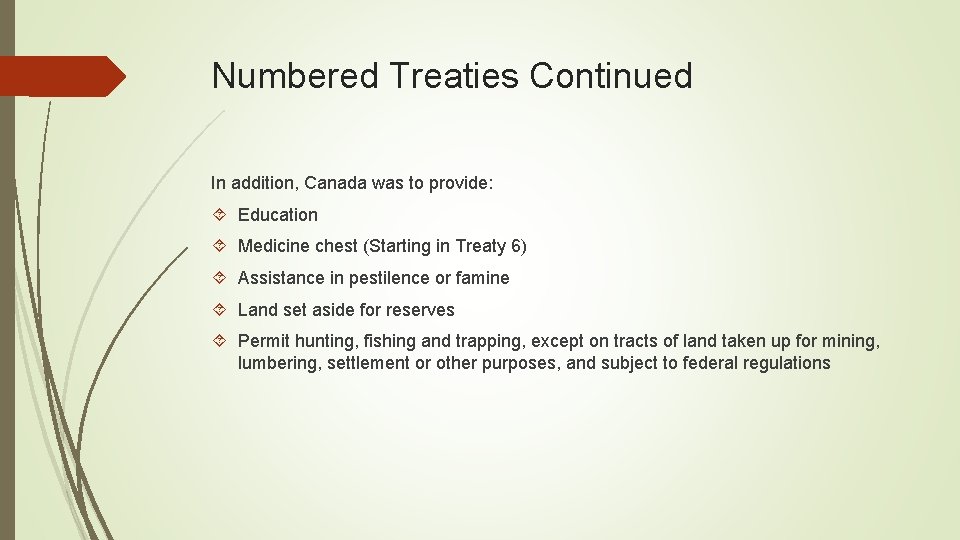
Numbered Treaties Continued In addition, Canada was to provide: Education Medicine chest (Starting in Treaty 6) Assistance in pestilence or famine Land set aside for reserves Permit hunting, fishing and trapping, except on tracts of land taken up for mining, lumbering, settlement or other purposes, and subject to federal regulations
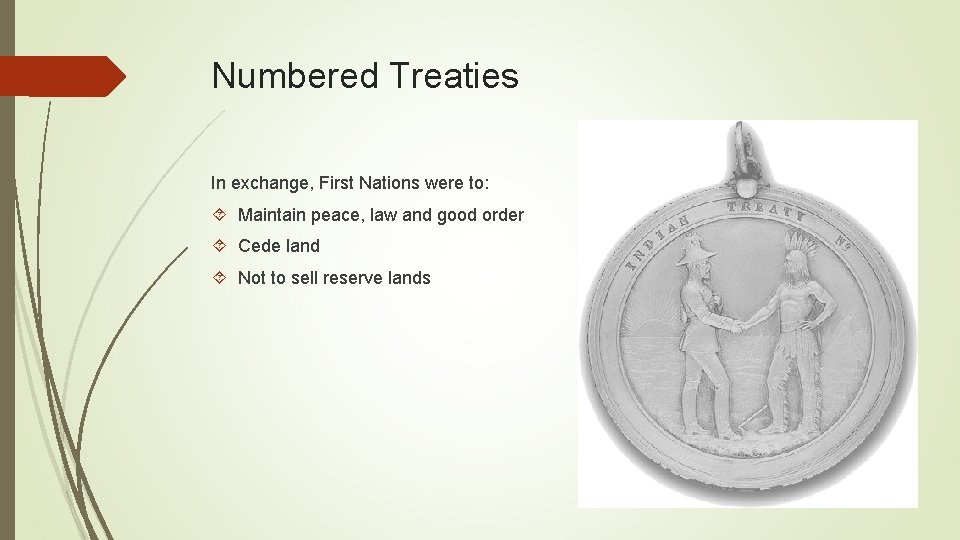
Numbered Treaties In exchange, First Nations were to: Maintain peace, law and good order Cede land Not to sell reserve lands
Indian Act
Internalized Colonization: The Indian Act first passed in 1876 Meant to administer who does get Treaty rights Set up a system for determining who was recognized as “Indian” Categorized First Nations into Status and Non-Status Indian: Registered with government Access to Treaty rights Non-Status Indian: Not recognized as First Nations by the government (despite culture or background) No access to Treaty rights
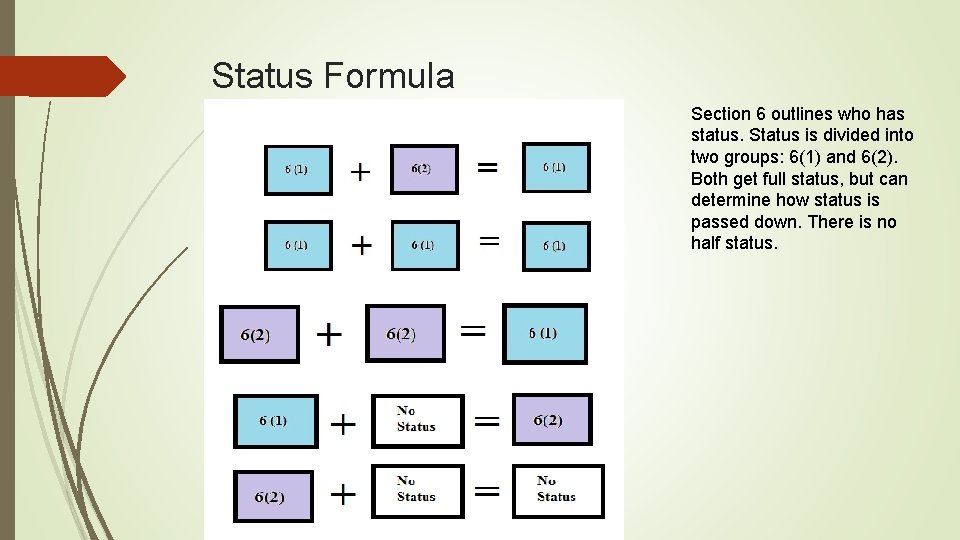
Status Formula Section 6 outlines who has status. Status is divided into two groups: 6(1) and 6(2). Both get full status, but can determine how status is passed down. There is no half status.
Internalized Colonization: The Indian Act Used blood quantum and assimilation Blood quantum: Based on family history, parents, grandparents, marriage Assimilation: integrated into mainstream society Aim of the Indian Act was to assimilate as many people as possible, removing the need to uphold Treaty rights Status could be lose if: Moved off reserve Got a post-secondary education Wanted to vote Women married a non-status man (1985) Were children of a woman who married a non-status man (until 1985)
Indian Act Continued Indian Act went through various changes in attempts to promote assimilation Residential Schools: educate First Nations children in Western/Christian ways so that they would reject their cultural and religious backgrounds Creation of Bands: Restructured First Nations social structure by introducing Band Councils Forcibly altered how First Nations governed themselves Changed how leaders were chosen more in-line with Western traditions Pass System: Restriction on movement to and from reserve land Included regulation on what and when goods produced on reserve land could be sold off the reserve Included when and how much money could be taken off reserve Ban on Religious Ceremonies: Ban on potlaches and ceremonial dances Included a ban on cultural dress unless authorized by an Indian Agent Many more restrictive policies reversed in 1951
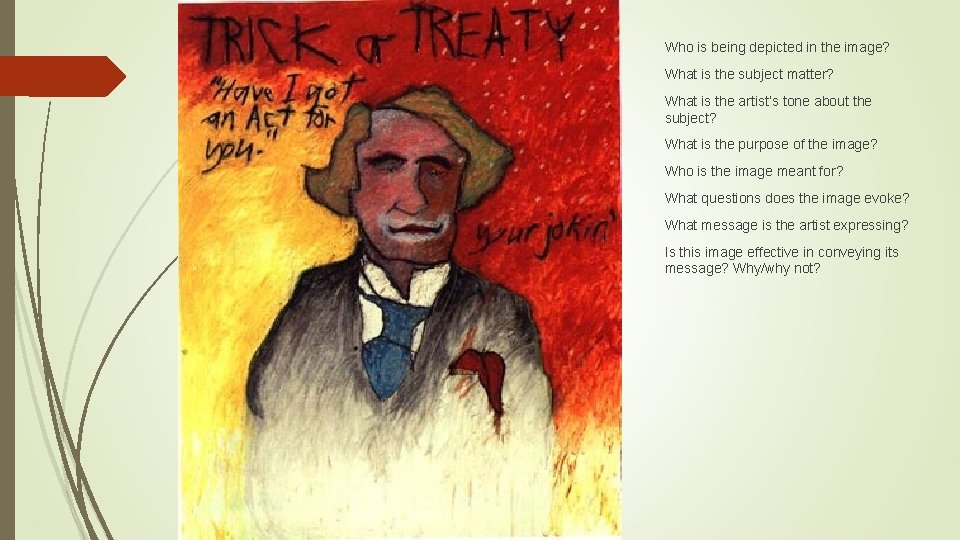
Who is being depicted in the image? What is the subject matter? What is the artist’s tone about the subject? What is the purpose of the image? Who is the image meant for? What questions does the image evoke? What message is the artist expressing? Is this image effective in conveying its message? Why/why not?
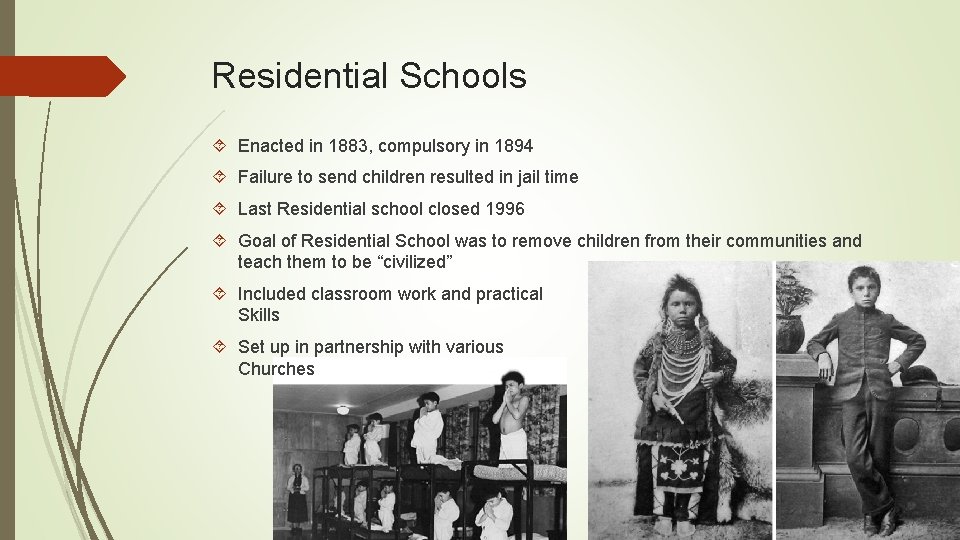
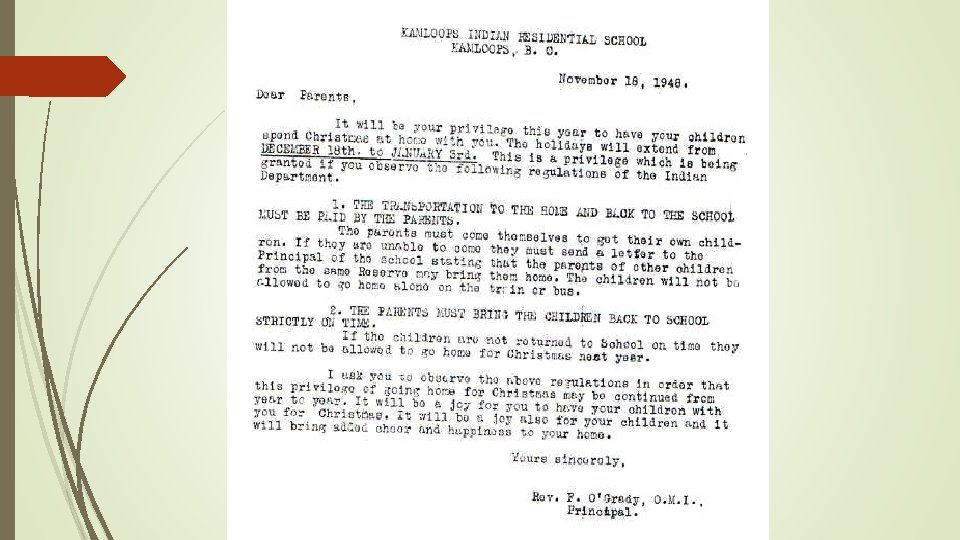
Residential Schools Enacted in 1883, compulsory in 1894 Failure to send children resulted in jail time Last Residential school closed 1996 Goal of Residential School was to remove children from their communities and teach them to be “civilized” Included classroom work and practical Skills Set up in partnership with various Churches
Residential Schools Children were forced to learn English or French Children were often beaten if caught speaking their first language Families were given very strict access to their children Often only seeing them during Christian holidays Children in residential schools were often subject to physical, sexual, and emotional abuse Children abused by instructors Younger children abused by older children Schools were often over crowded Infectious diseases ran rampant Not always enough food Some schools were part of dietary and nutrition experiments Government sponsored experiments on the effects of malnutrition
Residential School Accounts https: //www. youtube. com/watch? v=vd. R 9 Hcmi. XLA
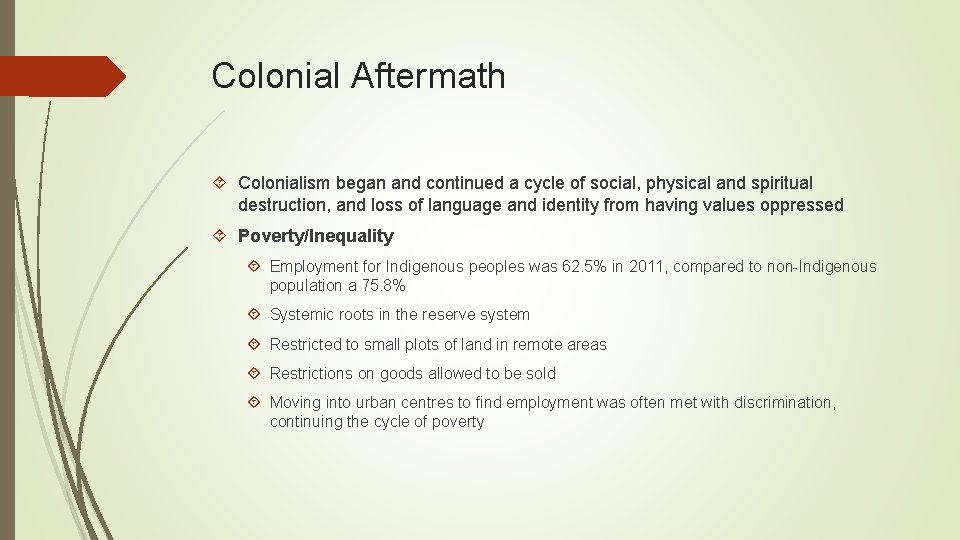
Colonial Aftermath Colonialism began and continued a cycle of social, physical and spiritual destruction, and loss of language and identity from having values oppressed Poverty/Inequality Employment for Indigenous peoples was 62. 5% in 2011, compared to non-Indigenous population a 75. 8% Systemic roots in the reserve system Restricted to small plots of land in remote areas Restrictions on goods allowed to be sold Moving into urban centres to find employment was often met with discrimination, continuing the cycle of poverty
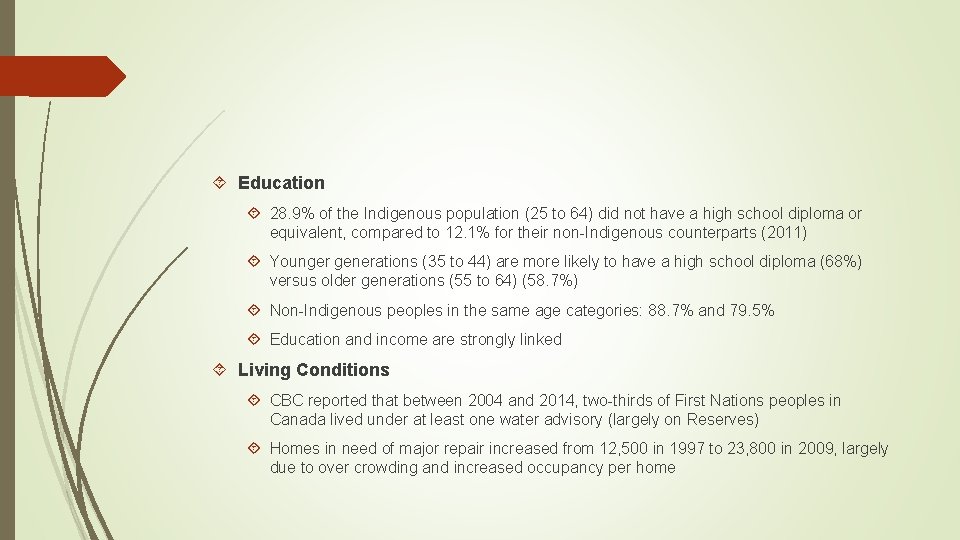
Education 28. 9% of the Indigenous population (25 to 64) did not have a high school diploma or equivalent, compared to 12. 1% for their non-Indigenous counterparts (2011) Younger generations (35 to 44) are more likely to have a high school diploma (68%) versus older generations (55 to 64) (58. 7%) Non-Indigenous peoples in the same age categories: 88. 7% and 79. 5% Education and income are strongly linked Living Conditions CBC reported that between 2004 and 2014, two-thirds of First Nations peoples in Canada lived under at least one water advisory (largely on Reserves) Homes in need of major repair increased from 12, 500 in 1997 to 23, 800 in 2009, largely due to over crowding and increased occupancy per home
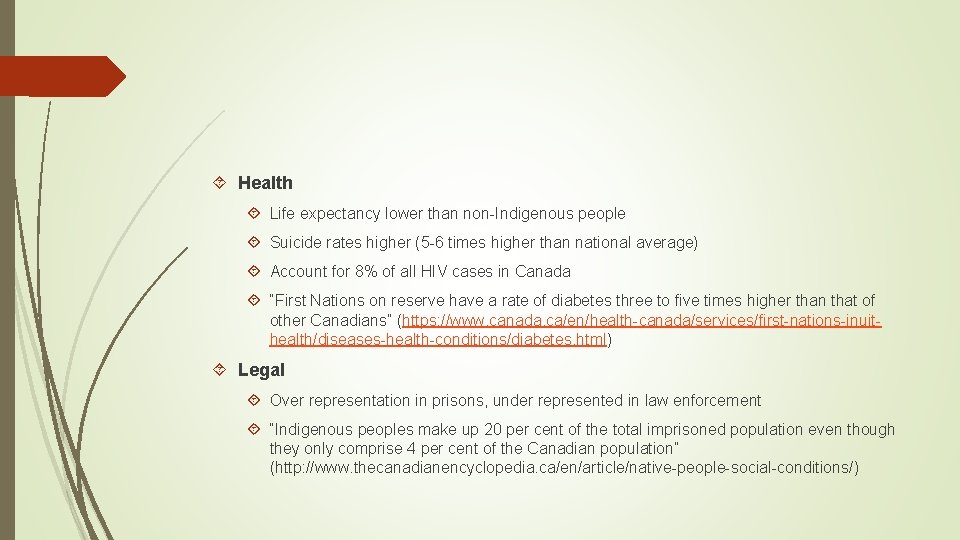
Health Life expectancy lower than non-Indigenous people Suicide rates higher (5 -6 times higher than national average) Account for 8% of all HIV cases in Canada “First Nations on reserve have a rate of diabetes three to five times higher than that of other Canadians” (https: //www. canada. ca/en/health-canada/services/first-nations-inuithealth/diseases-health-conditions/diabetes. html) Legal Over representation in prisons, under represented in law enforcement “Indigenous peoples make up 20 per cent of the total imprisoned population even though they only comprise 4 per cent of the Canadian population” (http: //www. thecanadianencyclopedia. ca/en/article/native-people-social-conditions/)
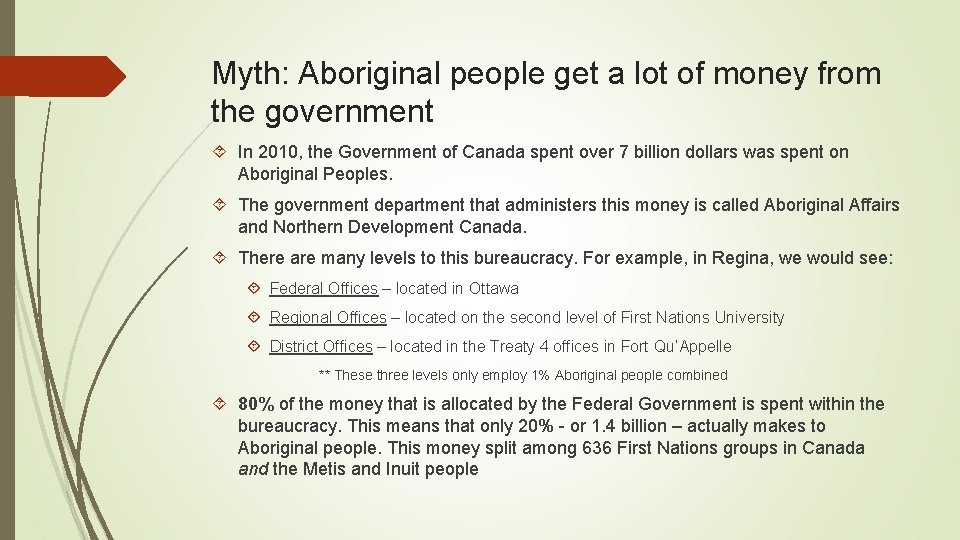
Myth: Aboriginal people get a lot of money from the government In 2010, the Government of Canada spent over 7 billion dollars was spent on Aboriginal Peoples. The government department that administers this money is called Aboriginal Affairs and Northern Development Canada. There are many levels to this bureaucracy. For example, in Regina, we would see: Federal Offices – located in Ottawa Regional Offices – located on the second level of First Nations University District Offices – located in the Treaty 4 offices in Fort Qu’Appelle ** These three levels only employ 1% Aboriginal people combined 80% of the money that is allocated by the Federal Government is spent within the bureaucracy. This means that only 20% - or 1. 4 billion – actually makes to Aboriginal people. This money split among 636 First Nations groups in Canada and the Metis and Inuit people
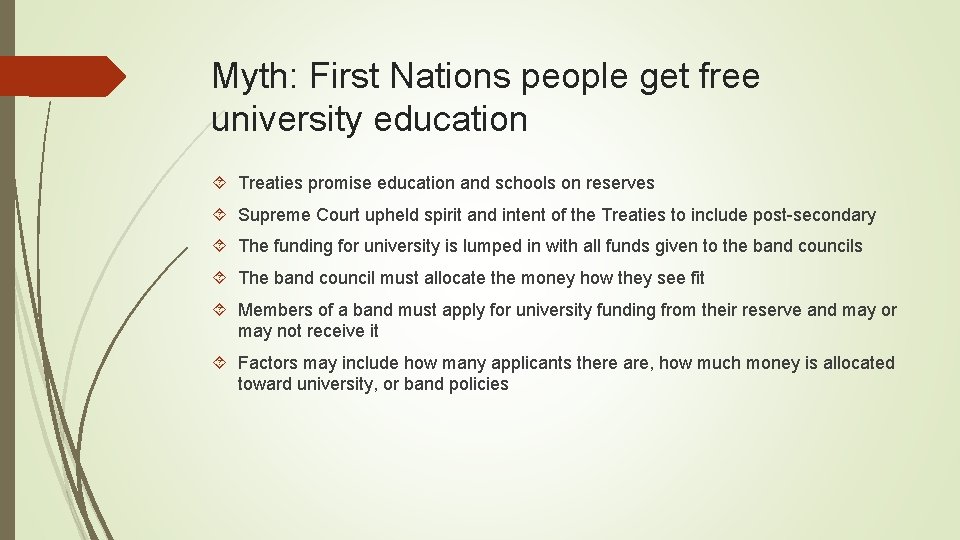
Myth: First Nations people get free university education Treaties promise education and schools on reserves Supreme Court upheld spirit and intent of the Treaties to include post-secondary The funding for university is lumped in with all funds given to the band councils The band council must allocate the money how they see fit Members of a band must apply for university funding from their reserve and may or may not receive it Factors may include how many applicants there are, how much money is allocated toward university, or band policies
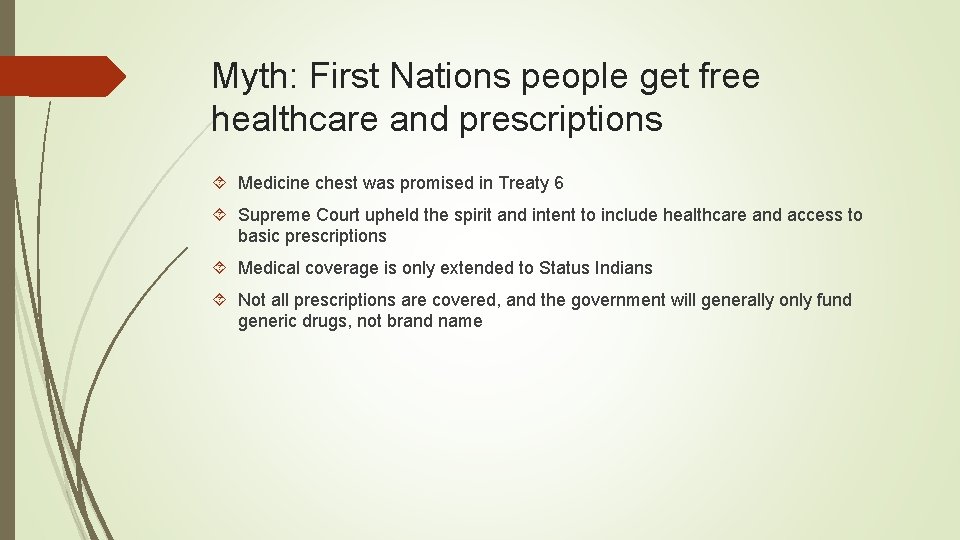
Myth: First Nations people get free healthcare and prescriptions Medicine chest was promised in Treaty 6 Supreme Court upheld the spirit and intent to include healthcare and access to basic prescriptions Medical coverage is only extended to Status Indians Not all prescriptions are covered, and the government will generally only fund generic drugs, not brand name
Myth: First Nations people don’t pay taxes Status Indians do not pay taxes on reserve No property tax on reserve (communally owned) No GST on purchases made on reserve Owning property off reserve is still subject to property tax, regardless of Status Income earned on reserve is not subject to income tax Income earned off reserve is taxed
Myth: First Nations got lots of money from residential schools Original settlement was $10, 000 for the first year of attending residential schools Additional $3000 given per year attended after One time payment 15% taken for legal fees, administrative costs, and processing fees Only applied to past family member if they attended prior to 1996 and were alive until 2005
“Get over it: Native people don’t have any holidays on which to remember the past – it’s always with us” By Drew Hayden Taylor
Decolonization Rejection of colonizer and victimization Challenge oppression through education and awareness Reclaiming languages, culture, spirituality, and ceremonies Reform sense of identity Regain sense of control and power Increase sense of autonomy UN Declaration of Indigenous Rights
Examples of Decolonization Reclaiming of various Indigenous languages Cree language classes in prairies Nunavut Largest land claim and self governing body in Canada Osoyoos Indian Band Business success story Rediscovering and reinventing traditional cultures with contemporary styles Supaman: https: //www. youtube. com/watch? v=_0 jq 7 j. Ia 34 Y A Tribe Called Red: https: //www. youtube. com/watch? v=e. AEmj. W 9 J 3_o Indigenous Heroes: http: //www. cbc. ca/news/indigenous/top-10 -indigenous-heroesincludes-elijah-harper-alanis-obomsawin-1. 2678637