
Colonial Currency Economy and Symbolism The History of
Colonial Currency Economy and Symbolism

The History of Colonial Currency Colonists arriving in the colonies were often poor, having spent most of their money for their passage to the new world. For a variety of reasons, money was almost always in short supply during the early colonial period. The lack of coins and currency forced the colonists to barter. The English leaders felt that colonial exports, such as animal skins, dried fish, and tobacco, should be paid for in English goods. Colonial exports would be accepted in return for an equal value of such goods as fabrics, window panes, pewter dishes, and mirrors. This barter system- an exchange of goods or services without using money - seemed ideal to the British but was increasingly unpopular with the colonists, who preferred coin

Early Forms of Colonial Currency Wampum made of sea shells (quahog shells) introduced to New England in 1627 by Dutch settlers in New York who traded with Indians. 1637, it was made legal tender and was accepted as payment for taxes However, the fragility of the shells, the usage of poor shells, along with artificial color, made it
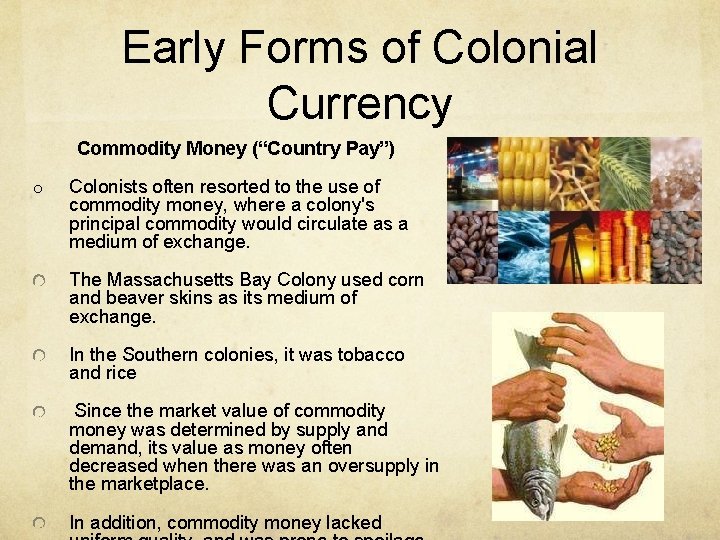
Early Forms of Colonial Currency Commodity Money (“Country Pay”) o Colonists often resorted to the use of commodity money, where a colony's principal commodity would circulate as a medium of exchange. The Massachusetts Bay Colony used corn and beaver skins as its medium of exchange. In the Southern colonies, it was tobacco and rice Since the market value of commodity money was determined by supply and demand, its value as money often decreased when there was an oversupply in the marketplace. In addition, commodity money lacked

Early Forms of Colonial Currency Foreign Coins Colonists always preferred specie (gold and silver coin) to other forms of payment, but, when colonists first arrived, they brought very little precious metal with them from Europe. Foreign trade succeeded in bringing foreign coins to New England (the colonies traded with England the Spanish West Indies, where many coins circulated. ) Foreign coins were also supplied by piracy, which was a fairly common practice in the 16 th and 17 th centuries. The most common coin circulating in the colonies was the Spanish piece-of-eight, also known as the Spanish dollar. It was divided into eight reals. The coin circulated in the United States as legal tender until 1857. The term "two bits, " or reals, meaning a quarter dollar, is still used. Problems: The value of the coins varied from colony

Early Forms of Colonial Currency New England Coinage By 1652, the problem resulting from a shortage of coins had become extreme and England had turned a deaf ear to the colonists' plea for specie. The Massachusetts Bay Colony established an illegal mint in Boston in 1652. The first coinage was unsuccessful because the simple design invited counterfeiting. In a second attempt, the colony decreed that all pieces of money coined shall have a double ring on either side, “Massachusetts” and a tree in the center on one side, and “New England” and the year. These coins were the famous "tree" pieces. In 1684 the charter of Massachusetts was

Early Forms of Colonial Currency Bills of Credit In 1690, the Massachusetts Bay Colony was authorized to raise troops to help British soldiers fight in King William's War. The King allowed the colony to pay soldiers with Bills of Credit - a promise to pay in the future printed on paper by the colony. The crudely printed notes were issued in denominations of five, ten, and twenty shillings. The bills issued by the Massachusetts colony circulated freely, and eventually each New England province began to print its own notes. The bills were meant to represent shares of commodities such as corn, grain, cattle, and ultimately silver. Some of these early experiments with paper money were successful, but in many cases the bills were seldom redeemed as promised because of the shortage of gold and silver coin.

Early Forms of Colonial Currency Continental Currency By 1751, the British Parliament passed a law forbidding the Massachusetts Bay Colony to issue money in any form. When the Revolutionary War broke out in 1775, the Continental Congress issued paper money to finance the war. These notes were backed by anticipated future tax revenues. Far too much continental currency was issued, causing it to depreciate rapidly. By the end of the war, it had become worthless or, as the saying went, "not worth a continental. " This experience was so disastrous that it created a deep distrust of paper money issued by the government. Experiments with paper money and coin continued after the Revolution, with states and private banks printing their own currencies. Bank notes became unpopular when too many banks began issuing too many different paper currencies without sufficient ability to redeem them in coin. It was not until the 1860 s, when National Bank Notes were created during the Civil War, that Americans finally achieved a reasonably stable money

Symbolism in Colonial Currency Colony: MARYLAND, One Dollar The Great Seal of the State of Maryland Counterfeit Warning Leaf and Branch Pattern helps prevent counterfeit
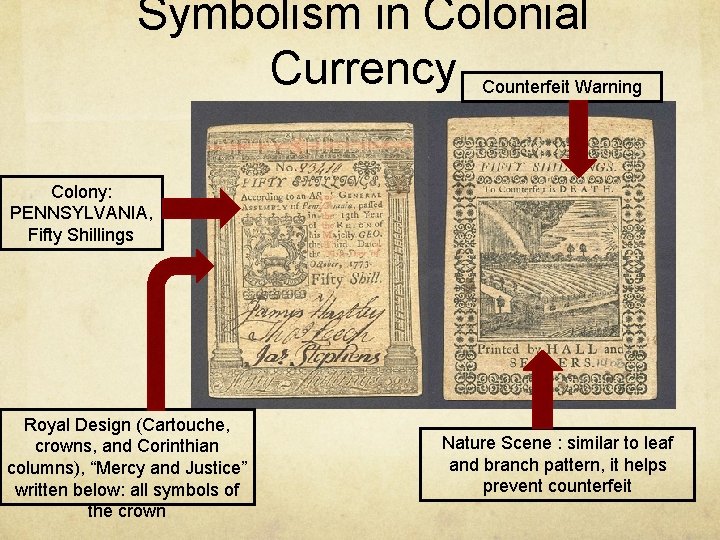
Symbolism in Colonial Currency Counterfeit Warning Colony: PENNSYLVANIA, Fifty Shillings Royal Design (Cartouche, crowns, and Corinthian columns), “Mercy and Justice” written below: all symbols of the crown Nature Scene : similar to leaf and branch pattern, it helps prevent counterfeit
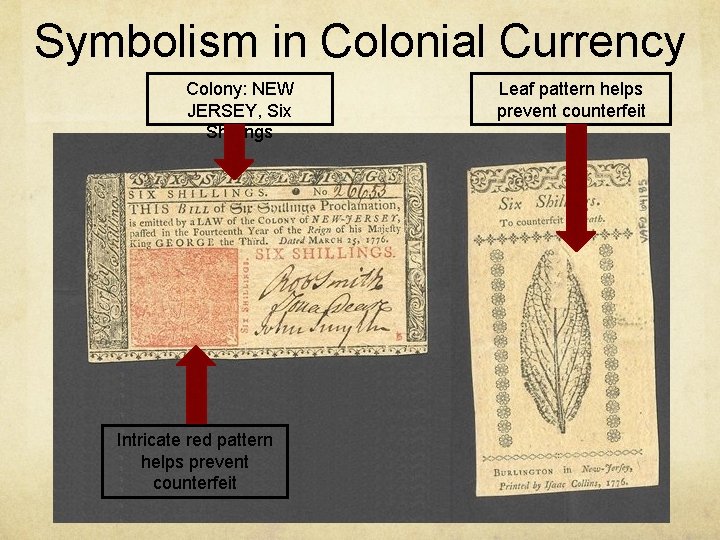
Symbolism in Colonial Currency Colony: NEW JERSEY, Six Shillings Intricate red pattern helps prevent counterfeit Leaf pattern helps prevent counterfeit

Symbolism in Continental Currency The United Colonies, Three Dollars Latin Phrase: “The Outcome is in Doubt” Continental Currency Birds attaching each other reflects nature of the Revolutionary War (fighting between England the Colonies Leaf pattern helps prevent counterfeit
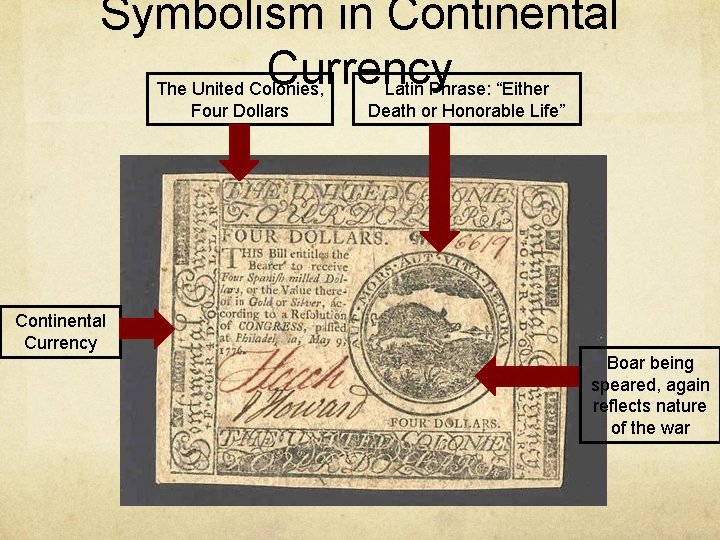
Symbolism in Continental Currency The United Colonies, Four Dollars Latin Phrase: “Either Death or Honorable Life” Continental Currency Boar being speared, again reflects nature of the war
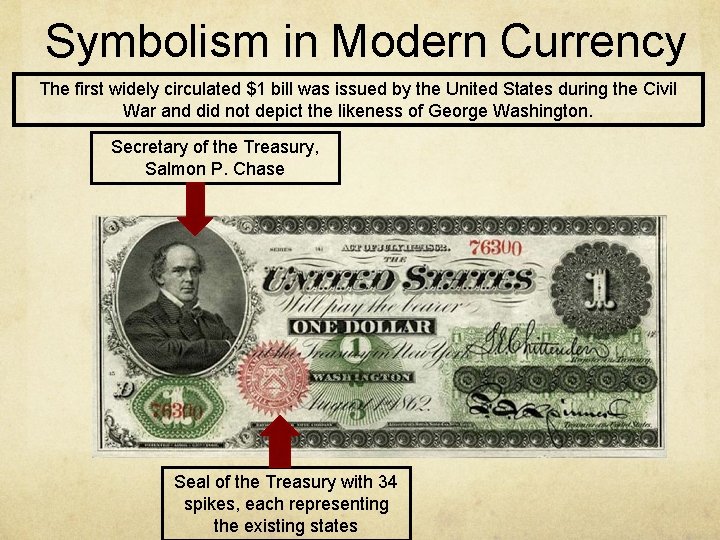
Symbolism in Modern Currency The first widely circulated $1 bill was issued by the United States during the Civil War and did not depict the likeness of George Washington. Secretary of the Treasury, Salmon P. Chase Seal of the Treasury with 34 spikes, each representing the existing states
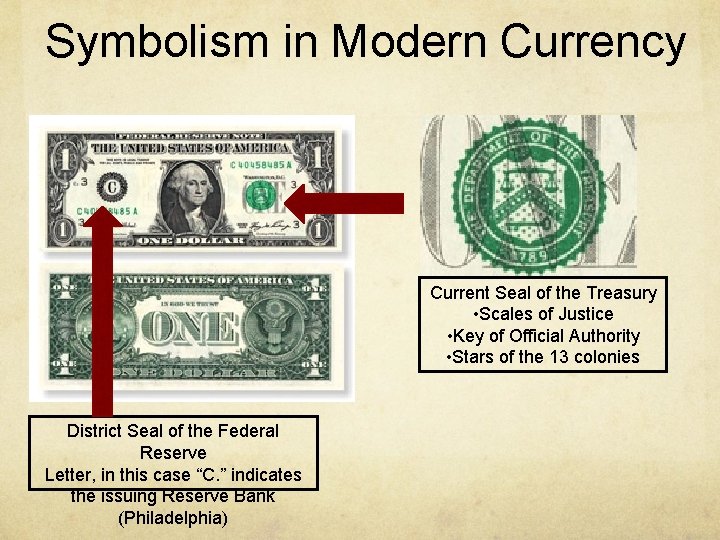
Symbolism in Modern Currency Current Seal of the Treasury • Scales of Justice • Key of Official Authority • Stars of the 13 colonies District Seal of the Federal Reserve Letter, in this case “C. ” indicates the issuing Reserve Bank (Philadelphia)
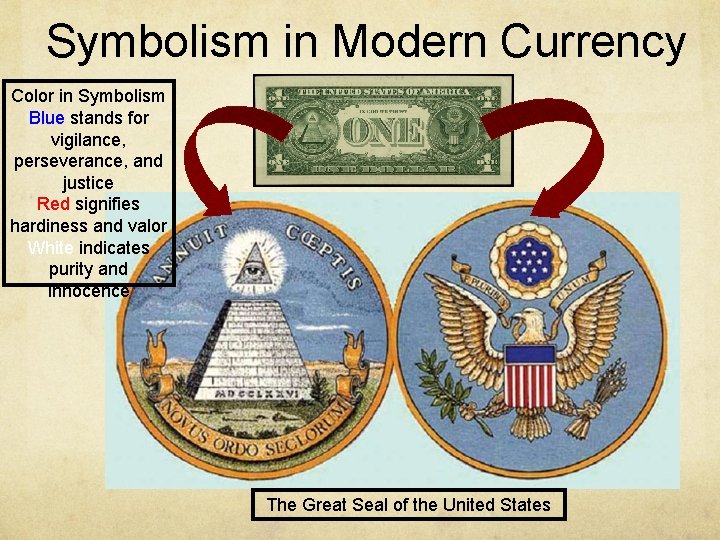
Symbolism in Modern Currency Color in Symbolism Blue stands for vigilance, perseverance, and justice Red signifies hardiness and valor White indicates purity and innocence The Great Seal of the United States
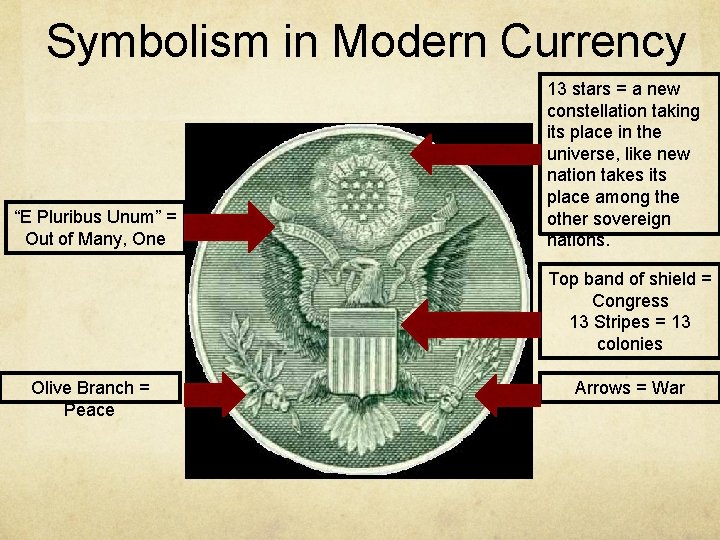
Symbolism in Modern Currency “E Pluribus Unum” = Out of Many, One 13 stars = a new constellation taking its place in the universe, like new nation takes its place among the other sovereign nations. Top band of shield = Congress 13 Stripes = 13 colonies Olive Branch = Peace Arrows = War
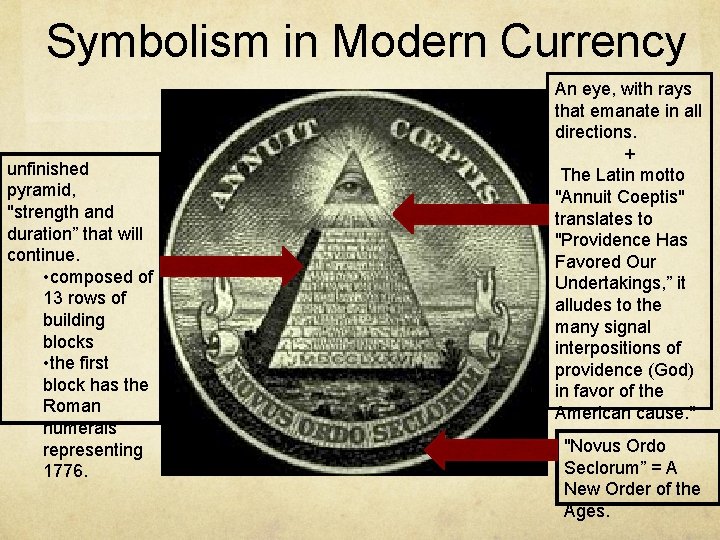
Symbolism in Modern Currency unfinished pyramid, "strength and duration” that will continue. • composed of 13 rows of building blocks • the first block has the Roman numerals representing 1776. An eye, with rays that emanate in all directions. + The Latin motto "Annuit Coeptis" translates to "Providence Has Favored Our Undertakings, ” it alludes to the many signal interpositions of providence (God) in favor of the American cause. " "Novus Ordo Seclorum” = A New Order of the Ages.
- Slides: 18