
Colloid An Introduction Kausar Ahmad Kulliyyah of Pharmacy





- Slides: 32
Colloid An Introduction Kausar Ahmad Kulliyyah of Pharmacy http: //staff. iiu. edu. my/akausar PHM 2213 2008/9 1
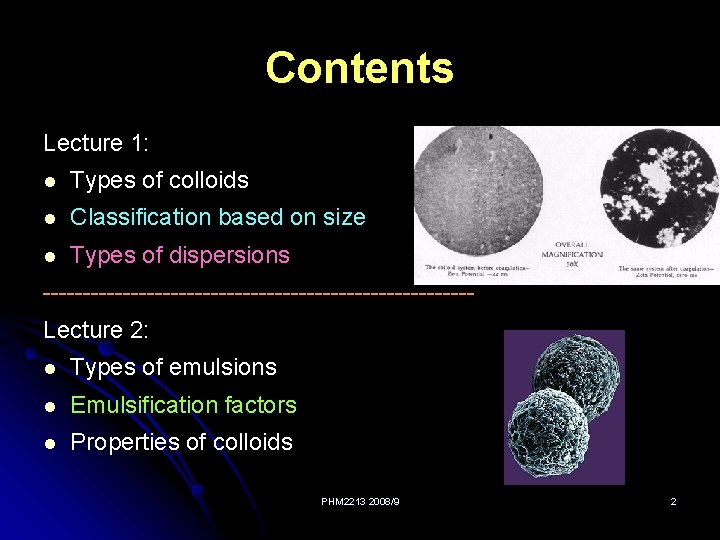
Contents Lecture 1: l Types of colloids l Classification based on size l Types of dispersions ---------------------------Lecture 2: l Types of emulsions l Emulsification factors l Properties of colloids PHM 2213 2008/9 2
Colloidal System l Particle size below 1 mm l High specific surface area l Discrete particles dispersed in a different medium l In pharmaceutical emulsions or suspensions, particle size ranges from colloidal to visible or coarse. PHM 2213 2008/9 3
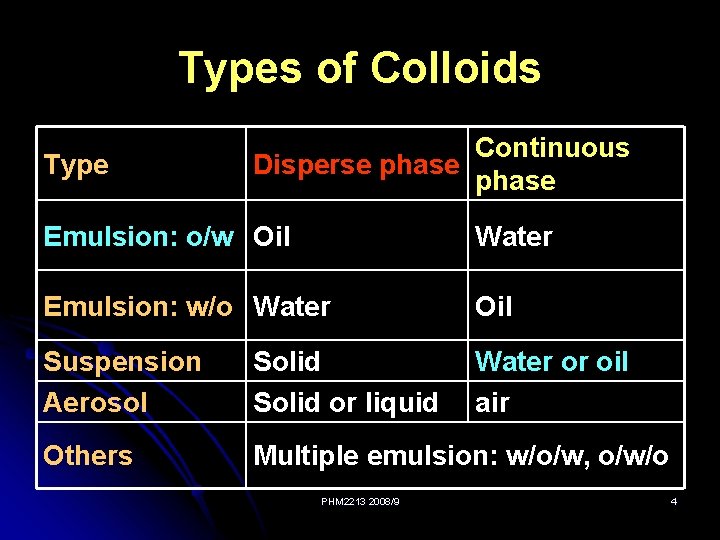
Types of Colloids Type Continuous Disperse phase Emulsion: o/w Oil Water Emulsion: w/o Water Oil Suspension Aerosol Solid or liquid Water or oil air Others Multiple emulsion: w/o/w, o/w/o PHM 2213 2008/9 4
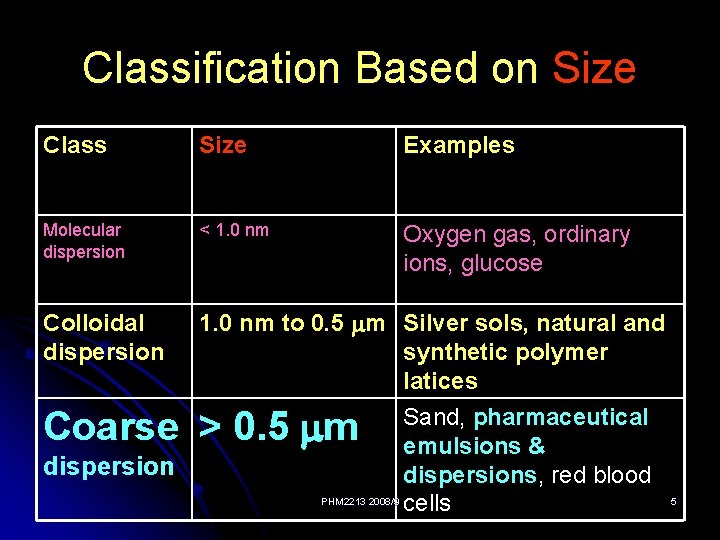
Classification Based on Size Class Size Examples Molecular dispersion < 1. 0 nm Oxygen gas, ordinary ions, glucose Colloidal dispersion 1. 0 nm to 0. 5 mm Silver sols, natural and synthetic polymer latices Coarse > 0. 5 mm dispersion Sand, pharmaceutical emulsions & dispersions, red blood PHM 2213 2008/9 cells 5
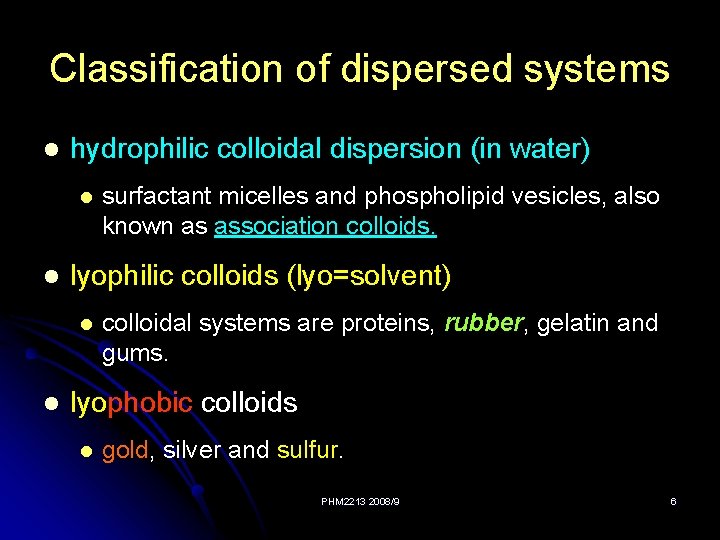
Classification of dispersed systems l hydrophilic colloidal dispersion (in water) l l lyophilic colloids (lyo=solvent) l l surfactant micelles and phospholipid vesicles, also known as association colloids. colloidal systems are proteins, rubber, gelatin and gums. lyophobic colloids l gold, silver and sulfur. PHM 2213 2008/9 6
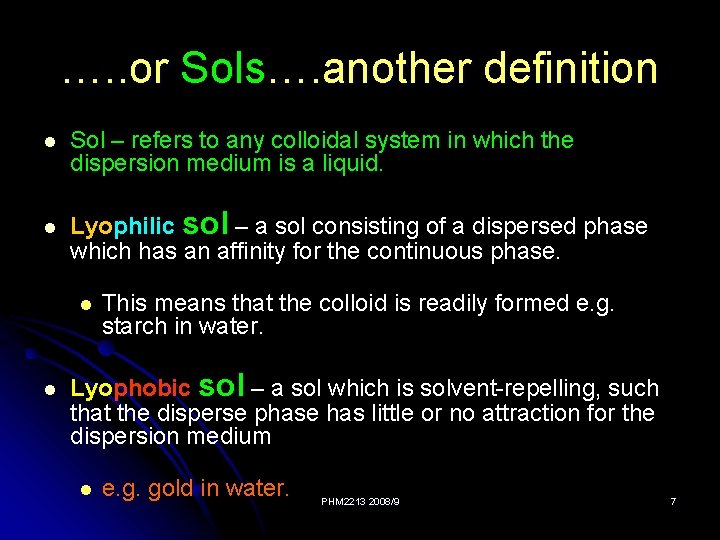
…. . or Sols…. another definition l l Sol – refers to any colloidal system in which the dispersion medium is a liquid. Lyophilic sol – a sol consisting of a dispersed phase which has an affinity for the continuous phase. l l This means that the colloid is readily formed e. g. starch in water. Lyophobic sol – a sol which is solvent-repelling, such that the disperse phase has little or no attraction for the dispersion medium l e. g. gold in water. PHM 2213 2008/9 7
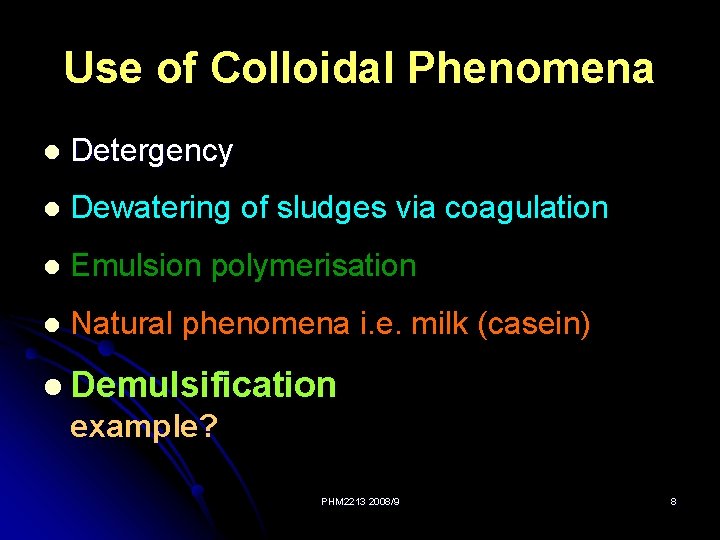
Use of Colloidal Phenomena l Detergency l Dewatering of sludges via coagulation l Emulsion polymerisation l Natural phenomena i. e. milk (casein) l Demulsification example? PHM 2213 2008/9 8
Detergency l Most important products using surfactants l Main component is surfactant l Involves in adsorption, wetting, emulsification and dispersion l Wetting of substrate ->soil-removing -> process ->preventing soil redeposition -> (PEG) PHM 2213 2008/9 9
Pharmaceutical suspensions l Coarse dispersions lyophobic colloids (lyo=solvent) l Suspension: solid in liquid l prepared from water-insoluble drugs for delivery orally or by injection (intra-muscular) in liquid vehicle. l l E. g. Oral suspensions, topical applications, Injectables: intra-muscular Surfactant/Dispersant to wet the particles Stabilisation by electric repulsive force and steric hindrance effect PHM 2213 2008/9 10
Pharmaceutical Emulsions l Emulsion: liquid drug in liquid vehicle: o/w or w/o l Main function of emulsion is to provide vehicles for drug delivery and parenteral nutrition. The drug is dissolved in the water or oil phase. l l E. g. Parenterals, creams, lotions Surfactant/Emulsifier reduces the interfacial energy and the emulsion becomes thermodynamically stable PHM 2213 2008/9 11
PHM 2213 2008/9 12
PHM 2213 2008/9 13
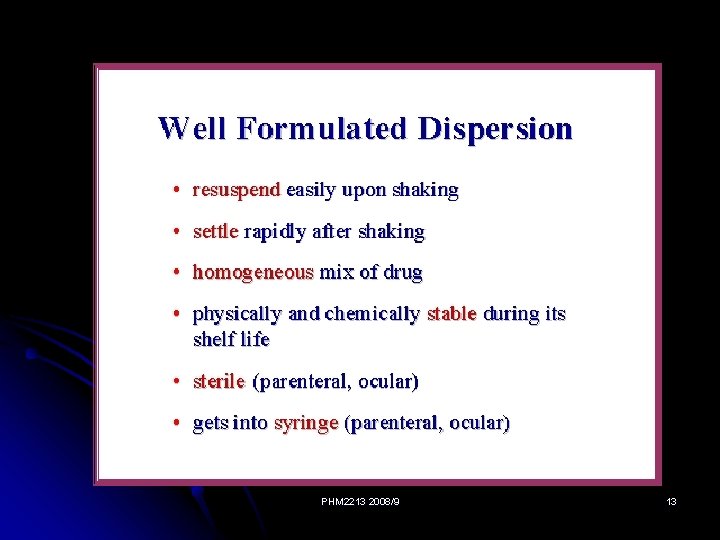
Preparing a Dispersion 1. Particle size reduction aggregates may require considerable mechanical energy to break them down completely - to the point when the surface of each primary particle is available to the wetting liquid. 2. Wetting of the powder this is necessary not to wet external surfaces but also for displacing air between the internal clusters. 2. Dispersing by using charged bulky surfactants e. g. sodium oleate, sodium or ammonium caseinate 3. Modifying the viscosity to minimise sedimentation PHM 2213 2008/9 (see Stoke’s Law) 14
Properties of dispersing agents l Adsorption of surfactants at the solid/liquid interface. l Highly charged l Can provide steric hindrance END OF LECTURE 1 OF 2 PHM 2213 2008/9 15
END OF LECTURE 1 OF 2 PHM 2213 2008/9 16
Types of Emulsions l Macroemulsion l Nanoemulsion l Microemulsion l Multiple emulsion PHM 2213 2008/9 17
Nanoemulsion and Microemulsion l Nanoemulsions l cover the size range of 50 -200 nm l Microemulsions l usually in the size range of 5 -50 nm l long term physical stability against creaming, flocculation and coalescence Ø Due to their small size they enhance penetration, spreading and will give uniform distribution on the substrate on which they are applied. Ø application in personal care products and cosmetics, agrochemicals, pharmaceuticals, household products etc. PHM 2213 2008/9 18
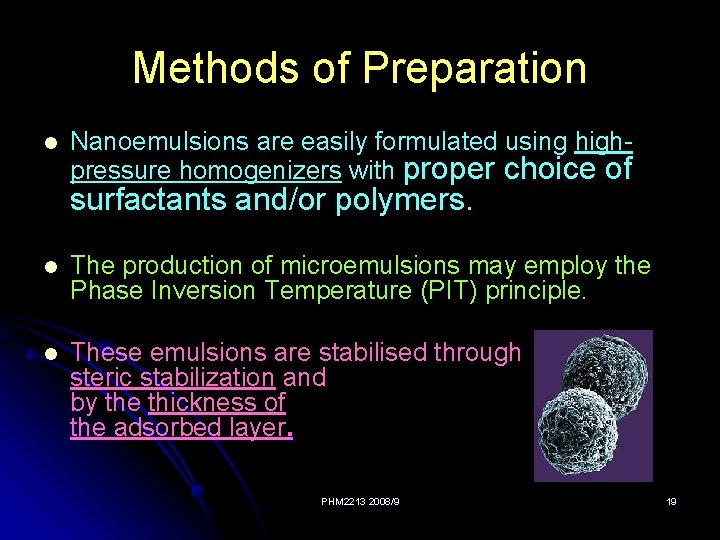
Methods of Preparation l Nanoemulsions are easily formulated using highpressure homogenizers with proper choice of surfactants and/or polymers. l The production of microemulsions may employ the Phase Inversion Temperature (PIT) principle. l These emulsions are stabilised through steric stabilization and by the thickness of the adsorbed layer. PHM 2213 2008/9 19
PHM 2213 2008/9 20
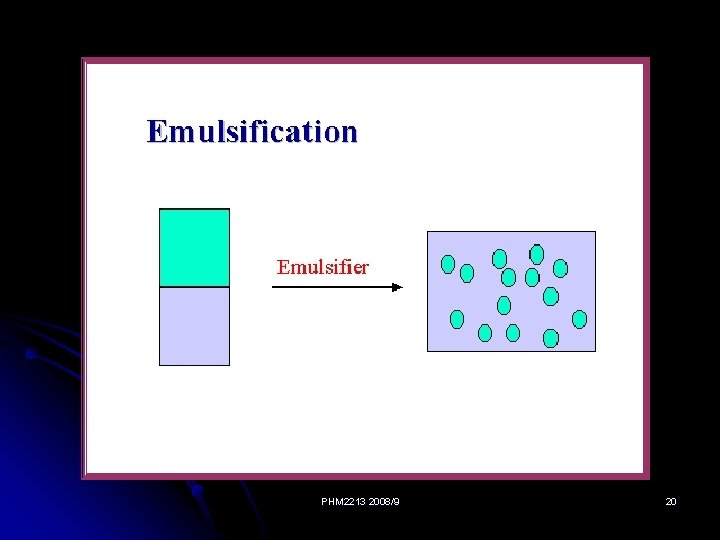
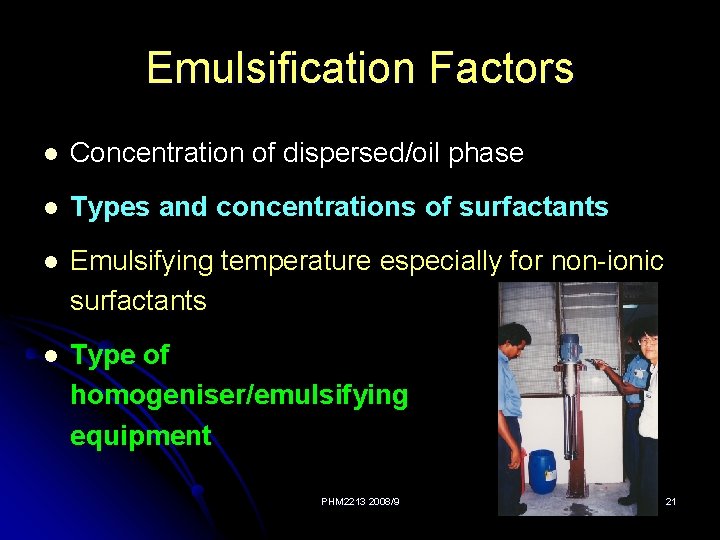
Emulsification Factors l Concentration of dispersed/oil phase l Types and concentrations of surfactants l Emulsifying temperature especially for non-ionic surfactants l Type of homogeniser/emulsifying equipment PHM 2213 2008/9 21
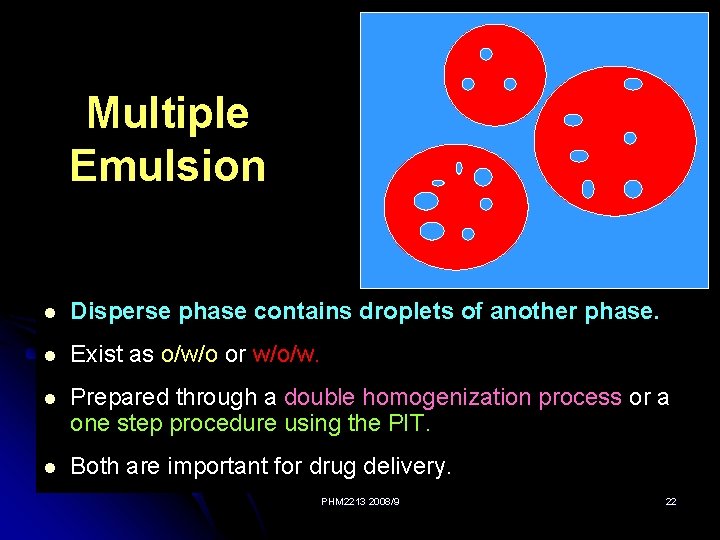
Multiple Emulsion l Disperse phase contains droplets of another phase. l Exist as o/w/o or w/o/w. l Prepared through a double homogenization process or a one step procedure using the PIT. l Both are important for drug delivery. PHM 2213 2008/9 22
Example of w/o/w emulsion for drug delivery by intra-muscular route l advantage: slow-release because drug has to diffuse through oil l disadvantage: viscosity of medium is high l solution: to disperse the w/o in aqueous medium. l On injection, the aqueous phase dissipates rapidly leaving behind the w/o. PHM 2213 2008/9 23
Multiple emulsion An example from research Evaluation of process factors in oil-water-oil multiple emulsion method for flavor encapsulation Y. H. CHO and J. Park. Dept. of Biotechnology, Yonsei University, 134, Shinchondong, Seodaemoon-gu, Seoul, 120 -749, South Korea l Multiple emulsion method is proposed for the encapsulation of sensitive ingredients since it is carried out in mild conditions and without any toxic compounds. This method has been applied in pharmaceutics and chemical industry, while it is relatively new to flavor and food industry. l Research on multiple emulsion, especially O/W/O type is limited because of the practical difficulty in preparing a stable emulsion. PHM 2213 2008/9 24
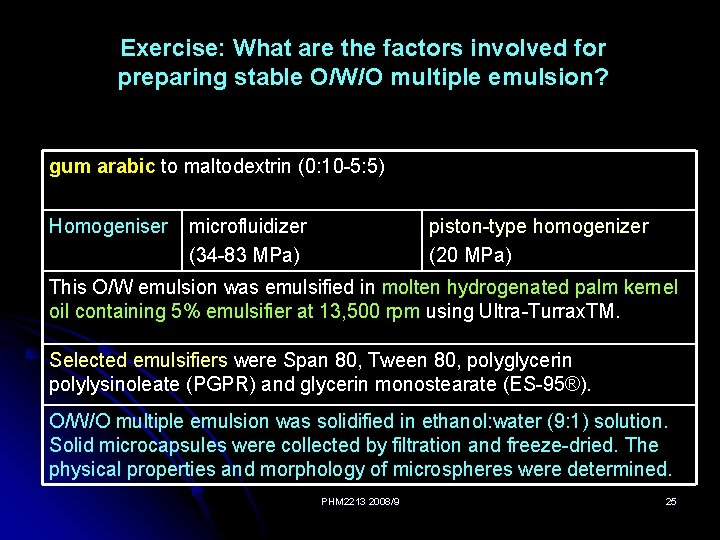
Exercise: What are the factors involved for preparing stable O/W/O multiple emulsion? gum arabic to maltodextrin (0: 10 -5: 5) Homogeniser microfluidizer (34 -83 MPa) piston-type homogenizer (20 MPa) This O/W emulsion was emulsified in molten hydrogenated palm kernel oil containing 5% emulsifier at 13, 500 rpm using Ultra-Turrax. TM. Selected emulsifiers were Span 80, Tween 80, polyglycerin polylysinoleate (PGPR) and glycerin monostearate (ES-95®). O/W/O multiple emulsion was solidified in ethanol: water (9: 1) solution. Solid microcapsules were collected by filtration and freeze-dried. The physical properties and morphology of microspheres were determined. PHM 2213 2008/9 25
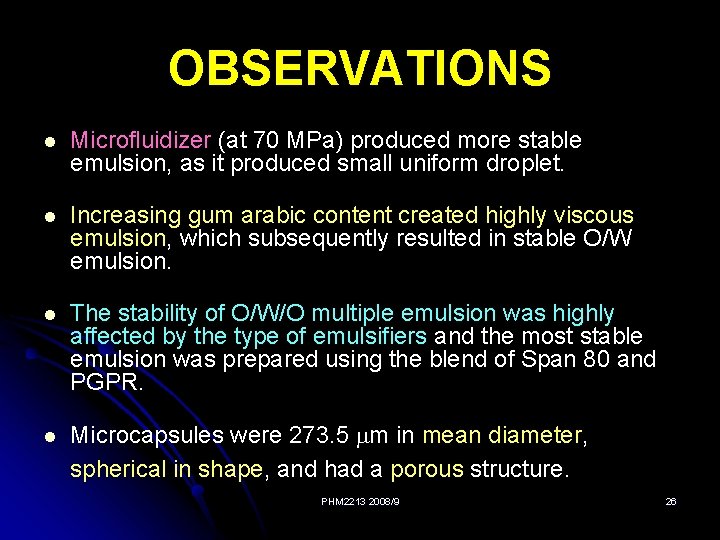
OBSERVATIONS l Microfluidizer (at 70 MPa) produced more stable emulsion, as it produced small uniform droplet. l Increasing gum arabic content created highly viscous emulsion, which subsequently resulted in stable O/W emulsion. l The stability of O/W/O multiple emulsion was highly affected by the type of emulsifiers and the most stable emulsion was prepared using the blend of Span 80 and PGPR. l Microcapsules were 273. 5 m in mean diameter, spherical in shape, and had a porous structure. PHM 2213 2008/9 26
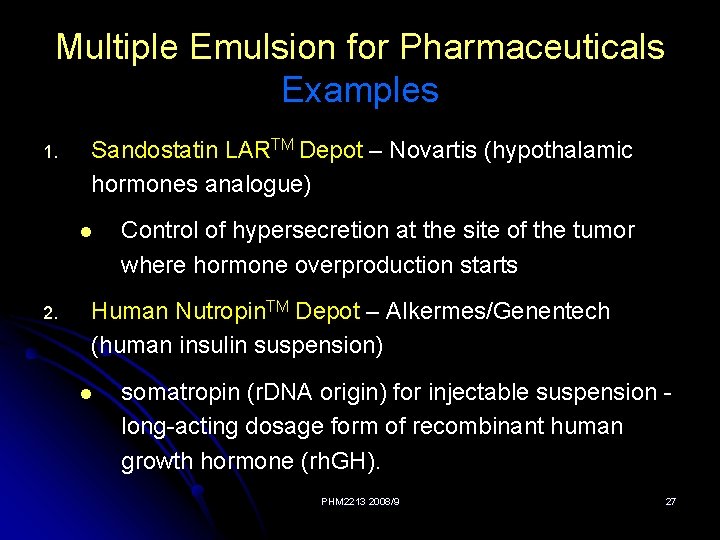
Multiple Emulsion for Pharmaceuticals Examples 1. Sandostatin LARTM Depot – Novartis (hypothalamic hormones analogue) l 2. Control of hypersecretion at the site of the tumor where hormone overproduction starts Human Nutropin. TM Depot – Alkermes/Genentech (human insulin suspension) l somatropin (r. DNA origin) for injectable suspension long-acting dosage form of recombinant human growth hormone (rh. GH). PHM 2213 2008/9 27
Multiple emulsion Pharmaceutical Problems l Rapid release during the first day typically accounts for 1080% of the total drug loading. This ‘initial burst’ poses a toxicity threat and is a major hurdle for the development of microspheres. l PHM 2213 2008/9 Very slow (close to zero) release period after the initial burst period. This can last for weeks and is referred to as the ’lagtime’. During this induction period, the patient is not effectively treated due to lack of drug release. 28
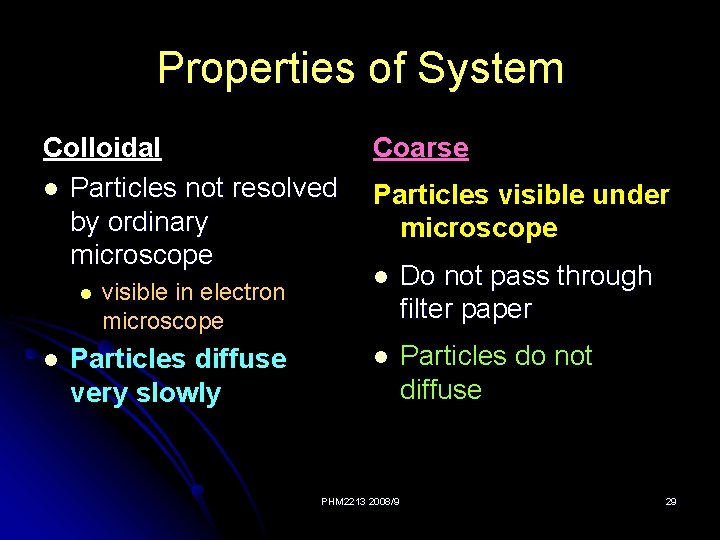
Properties of System Colloidal l Particles not resolved by ordinary microscope l l visible in electron microscope Particles diffuse very slowly Coarse Particles visible under microscope l Do not pass through filter paper l Particles do not diffuse PHM 2213 2008/9 29
Optical Properties of Colloids Faraday-Tyndall effect – when a strong beam of light is passed through a colloidal sol, a visible cone, resulting from the scattering of light by the colloidal particles is formed. Turbidity – as a result of light scattering caused by fine particles obstructing the path of light Ø Based on this property, the investigation on molecular weight of the colloid is possible via light scattering studies. PHM 2213 2008/9 30
Kinetic Properties of Colloids l Brownian motion – arises from bombardment of dispersed particles by molecules of dispersion medium. l Diffusion – particles diffuse spontaneously from region of high to low concentration l Osmotic pressure: allows the calculation of molecular weight of colloid l Sedimentation: as given by Stoke’s law l Viscosity – resistance to flow under applied stress. PHM 2213 2008/9 31
References 1. PC Hiemenz & Rajagopalan, Principles of Colloid and Surface Chemistry, Marcel Dekker, New York (1997) 2. HA Lieberman, MM Rieger & GS Banker, Pharmaceutical Dosage Forms: Disperse Systems Volume 1, Marcel Dekker, New York (1996) 3. F Nielloud & G Marti-Mestres, Pharmaceutical Emulsions and Suspensions, Marcel Dekker, New York (2000) J Kreuter (ed. ), Colloidal Drug Delivery Systems, Marcel Dekker, New York (1994) 4. PHM 2213 2008/9 32