
Collisions and Newtons Laws of Motion Introduction Unit
- Slides: 9
Collisions and Newton’s Laws of Motion Introduction
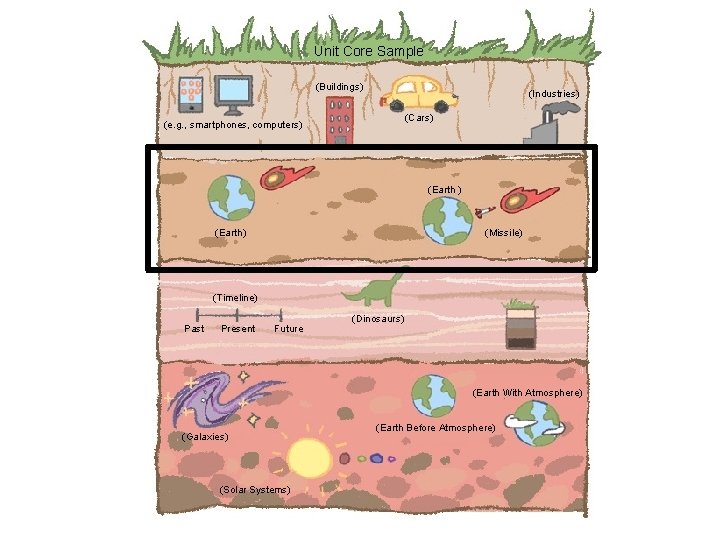
Unit Core Sample (Buildings) (Industries) (Cars) (e. g. , smartphones, computers) (Earth) (Missile) (Timeline) Past Present Future (Dinosaurs) (Earth With Atmosphere) (Galaxies) (Solar Systems) (Earth Before Atmosphere)
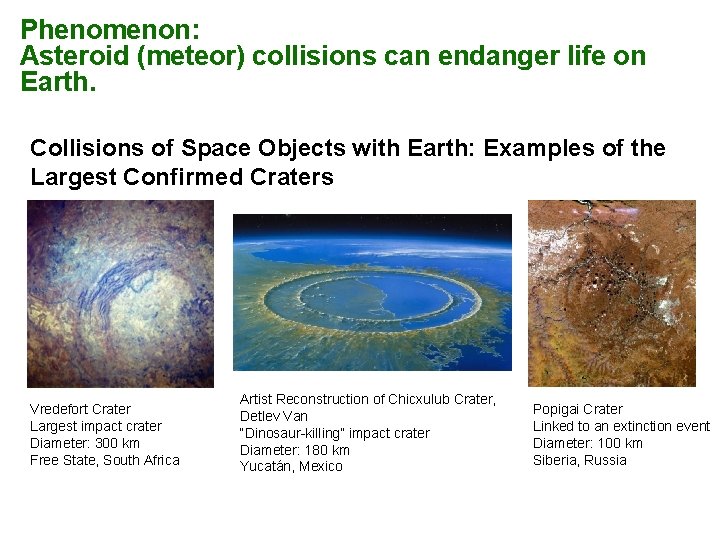
Phenomenon: Asteroid (meteor) collisions can endanger life on Earth. Collisions of Space Objects with Earth: Examples of the Largest Confirmed Craters Vredefort Crater Largest impact crater Diameter: 300 km Free State, South Africa Artist Reconstruction of Chicxulub Crater, Detlev Van “Dinosaur-killing” impact crater Diameter: 180 km Yucatán, Mexico Popigai Crater Linked to an extinction event Diameter: 100 km Siberia, Russia
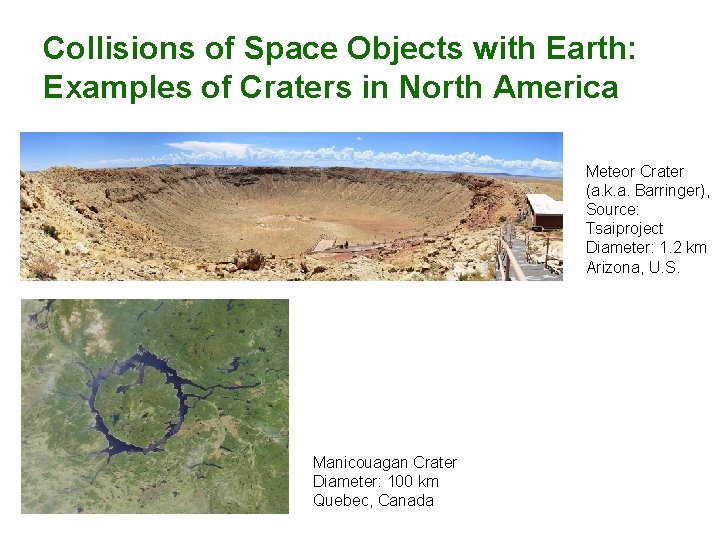
Collisions of Space Objects with Earth: Examples of Craters in North America Meteor Crater (a. k. a. Barringer), Source: Tsaiproject Diameter: 1. 2 km Arizona, U. S. Manicouagan Crater Diameter: 100 km Quebec, Canada
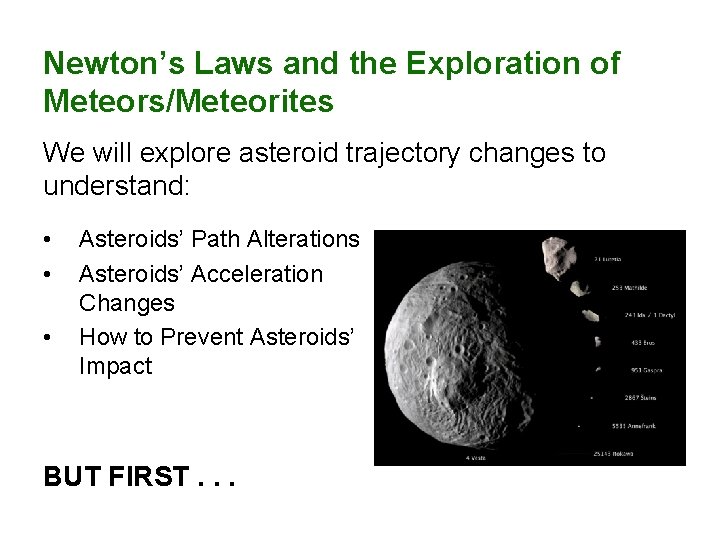
Newton’s Laws and the Exploration of Meteors/Meteorites We will explore asteroid trajectory changes to understand: • • • Asteroids’ Path Alterations Asteroids’ Acceleration Changes How to Prevent Asteroids’ Impact BUT FIRST. . .
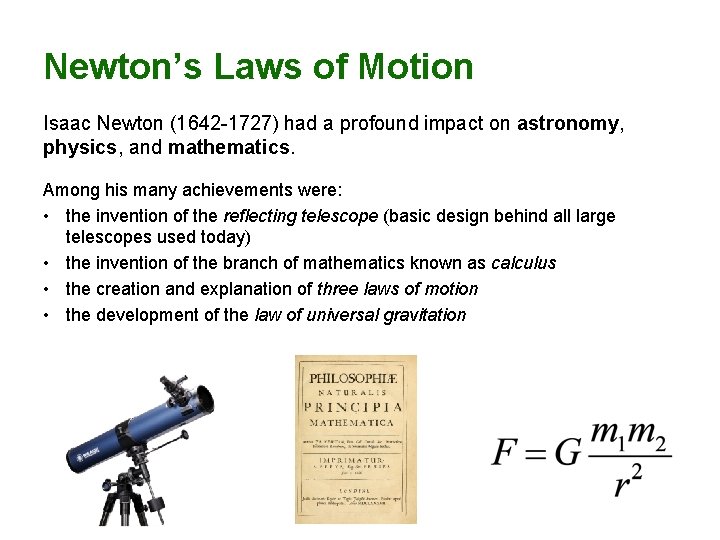
Newton’s Laws of Motion Isaac Newton (1642 -1727) had a profound impact on astronomy, physics, and mathematics. Among his many achievements were: • the invention of the reflecting telescope (basic design behind all large telescopes used today) • the invention of the branch of mathematics known as calculus • the creation and explanation of three laws of motion • the development of the law of universal gravitation
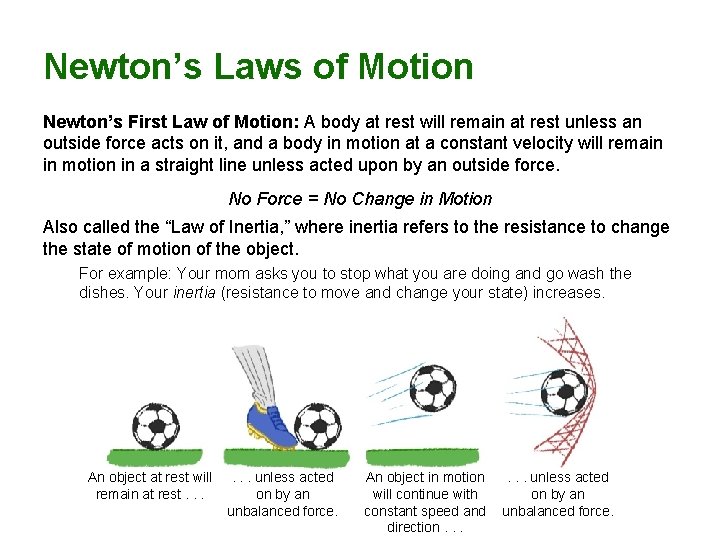
Newton’s Laws of Motion Newton’s First Law of Motion: A body at rest will remain at rest unless an outside force acts on it, and a body in motion at a constant velocity will remain in motion in a straight line unless acted upon by an outside force. No Force = No Change in Motion Also called the “Law of Inertia, ” where inertia refers to the resistance to change the state of motion of the object. For example: Your mom asks you to stop what you are doing and go wash the dishes. Your inertia (resistance to move and change your state) increases. An object at rest will remain at rest. . . unless acted on by an unbalanced force. An object in motion will continue with constant speed and direction. . . unless acted on by an unbalanced force.
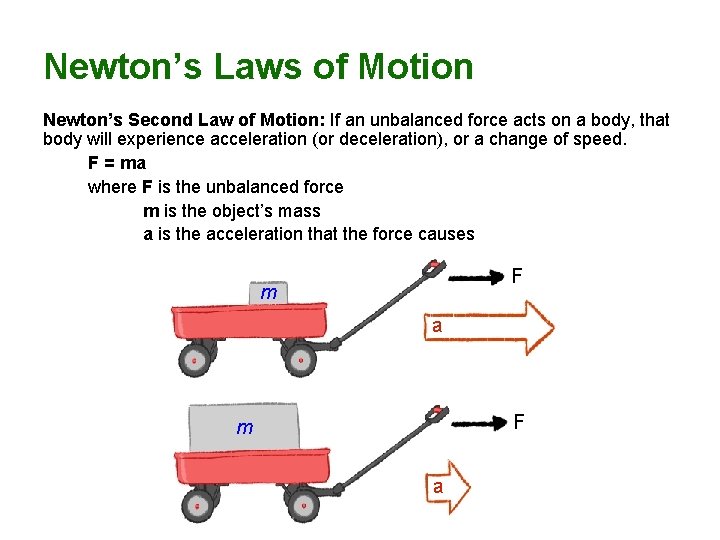
Newton’s Laws of Motion Newton’s Second Law of Motion: If an unbalanced force acts on a body, that body will experience acceleration (or deceleration), or a change of speed. F = ma where F is the unbalanced force m is the object’s mass a is the acceleration that the force causes F m a
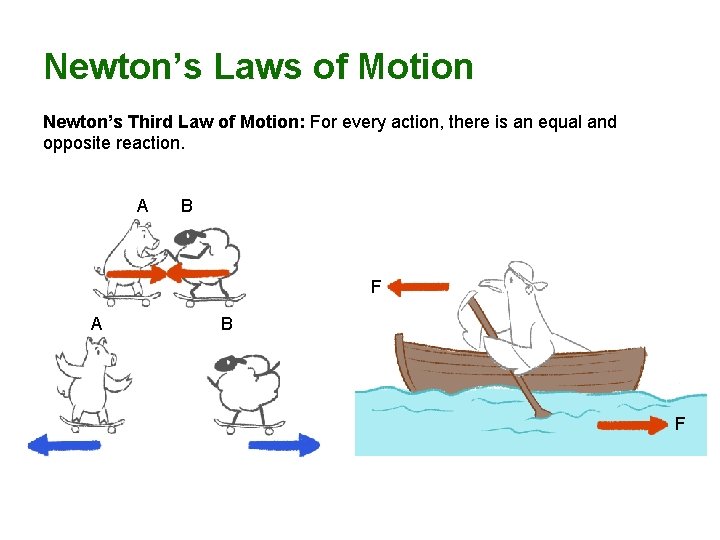
Newton’s Laws of Motion Newton’s Third Law of Motion: For every action, there is an equal and opposite reaction. A B F