
Collision Theory and Reaction Mechanisms In a successful


- Slides: 69
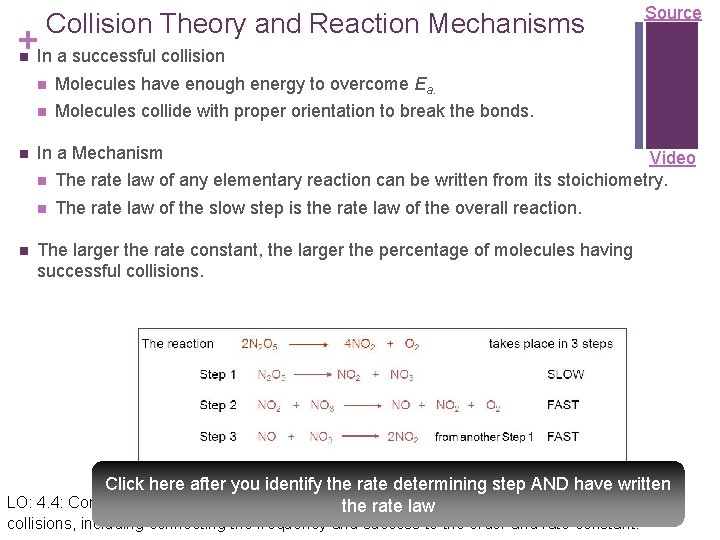
Collision Theory and Reaction Mechanisms +In a successful collision Source n n Molecules have enough energy to overcome Ea. n Molecules collide with proper orientation to break the bonds. In a Mechanism n Video The rate law of any elementary reaction can be written from its stoichiometry. n The rate law of the slow step is the rate law of the overall reaction. The larger the rate constant, the larger the percentage of molecules having successful collisions. Click here after you identify the rate determining step AND have written LO: 4. 4: Connect the rate law for an elementary reaction to the frequency/success of molecular the rate law collisions, including connecting the frequency and success to the order and rate constant.
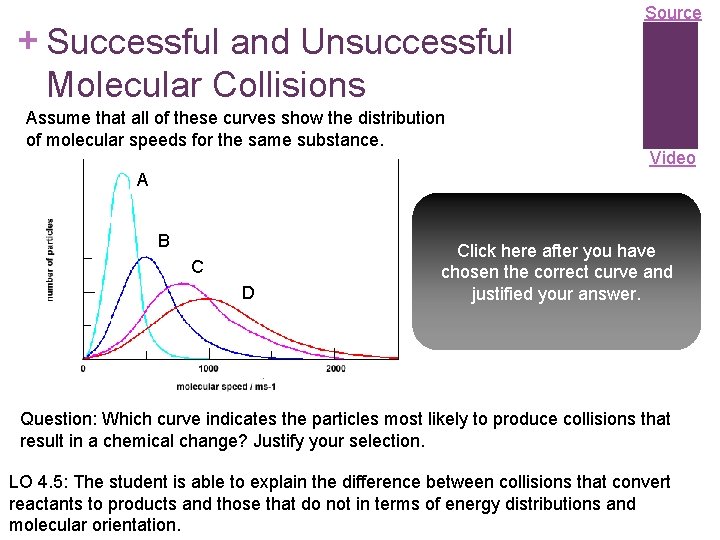
+ Successful and Unsuccessful Molecular Collisions Assume that all of these curves show the distribution of molecular speeds for the same substance. Source Video A B C D Curve D because a larger number of its particles have higher kinetic energies, and Click here after you have so are more likely to chosen the correct curve and overcome the activation justified your answer. energy barrier when they collide. Question: Which curve indicates the particles most likely to produce collisions that result in a chemical change? Justify your selection. LO 4. 5: The student is able to explain the difference between collisions that convert reactants to products and those that do not in terms of energy distributions and molecular orientation.
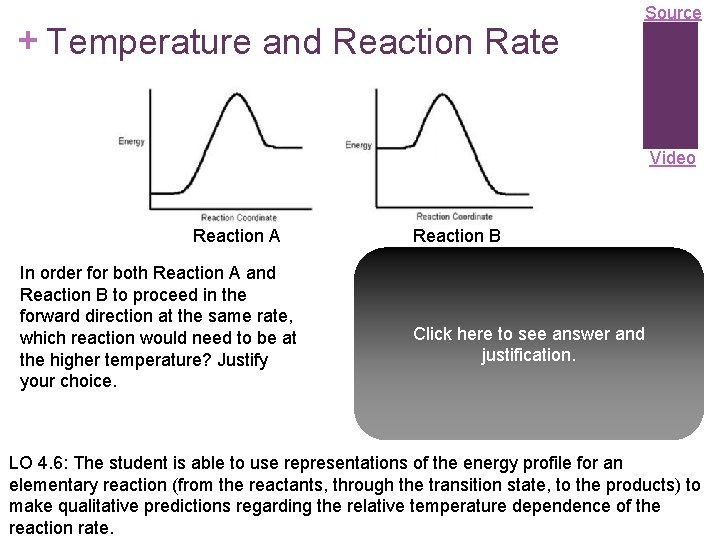
+ Temperature and Reaction Rate Source Video Reaction A In order for both Reaction A and Reaction B to proceed in the forward direction at the same rate, which reaction would need to be at the higher temperature? Justify your choice. Reaction B The greater the activation energy, the slower the reaction. Since Reaction A has a greater activation energy, it should be slower than Reaction B at the same temperature. To bring Click here to see answer and its rate up to that of Reaction B would require justification. increasing its temperature. Important note: It does not matter at all, in answering this question, that Reaction A is endothermic and Reaction B is exothermic. LO 4. 6: The student is able to use representations of the energy profile for an elementary reaction (from the reactants, through the transition state, to the products) to make qualitative predictions regarding the relative temperature dependence of the reaction rate.
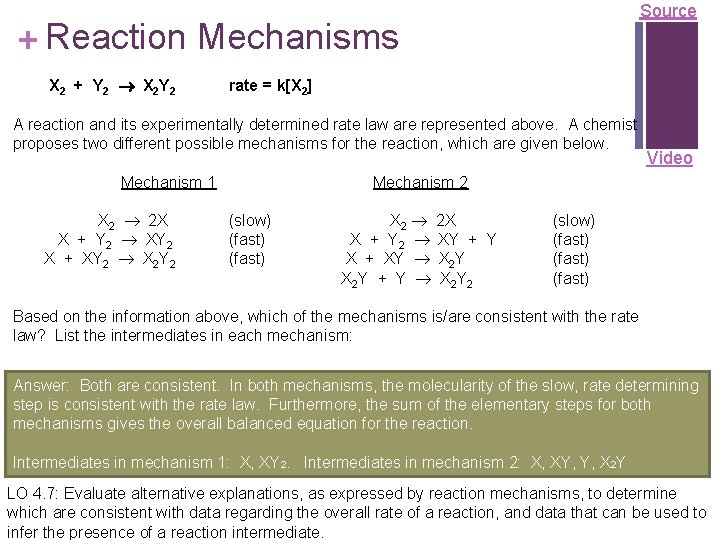
+ Reaction Mechanisms X 2 + Y 2 X 2 Y 2 Source rate = k[X 2] A reaction and its experimentally determined rate law are represented above. A chemist proposes two different possible mechanisms for the reaction, which are given below. Video Mechanism 1 Mechanism 2 X 2 2 X (slow) X 2 2 X (slow) X + Y 2 XY 2 (fast) X + Y 2 XY + Y (fast) X + XY 2 X 2 Y 2 (fast) X + XY X 2 Y (fast) X 2 Y + Y X 2 Y 2 (fast) Based on the information above, which of the mechanisms is/are consistent with the rate law? List the intermediates in each mechanism: Answer: Both are consistent. In both mechanisms, the molecularity of the slow, rate determining step is consistent with the rate law. Furthermore, the sum of the elementary steps for both mechanisms gives the overall balanced equation for the reaction. Intermediates in mechanism 1: X, XY 2. Intermediates in mechanism 2: X, XY, Y, X 2 Y LO 4. 7: Evaluate alternative explanations, as expressed by reaction mechanisms, to determine which are consistent with data regarding the overall rate of a reaction, and data that can be used to infer the presence of a reaction intermediate.
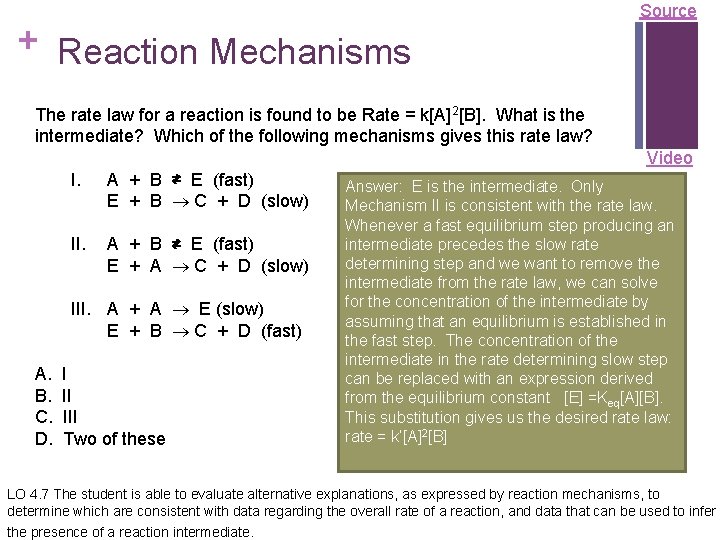
+ Reaction Mechanisms Source The rate law for a reaction is found to be Rate = k[A]2[B]. What is the intermediate? Which of the following mechanisms gives this rate law? Video I. A + B ⇄ E (fast) E + B C + D (slow) II. A + B ⇄ E (fast) E + A C + D (slow) III. A + A E (slow) E + B C + D (fast) A. I B. II C. III D. Two of these Answer: E is the intermediate. Only Mechanism II is consistent with the rate law. Whenever a fast equilibrium step producing an intermediate precedes the slow rate determining step and we want to remove the intermediate from the rate law, we can solve for the concentration of the intermediate by assuming that an equilibrium is established in the fast step. The concentration of the intermediate in the rate determining slow step can be replaced with an expression derived from the equilibrium constant [E] =Keq[A][B]. This substitution gives us the desired rate law: rate = k’[A]2[B] LO 4. 7 The student is able to evaluate alternative explanations, as expressed by reaction mechanisms, to determine which are consistent with data regarding the overall rate of a reaction, and data that can be used to infer the presence of a reaction intermediate.
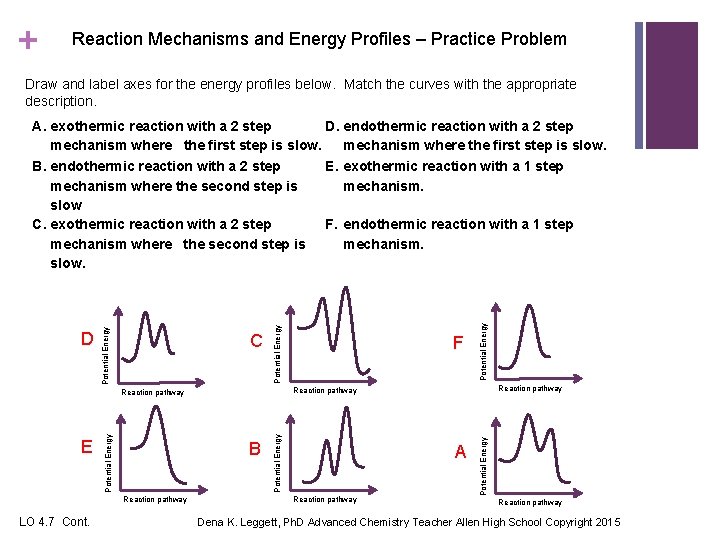
+ Reaction Mechanisms and Energy Profiles – Practice Problem Draw and label axes for the energy profiles below. Match the curves with the appropriate description. A Reaction pathway Potential Energy B Reaction pathway E F Potential Energy C Potential Energy D Potential Energy A. exothermic reaction with a 2 step D. endothermic reaction with a 2 step mechanism where the first step is slow. B. endothermic reaction with a 2 step E. exothermic reaction with a 1 step mechanism where the second step is mechanism. slow. C. exothermic reaction with a 2 step F. endothermic reaction with a 1 step mechanism where the second step is mechanism. slow. Reaction pathway LO 4. 7 Cont. Dena K. Leggett, Ph. D Advanced Chemistry Teacher Allen High School Copyright 2015
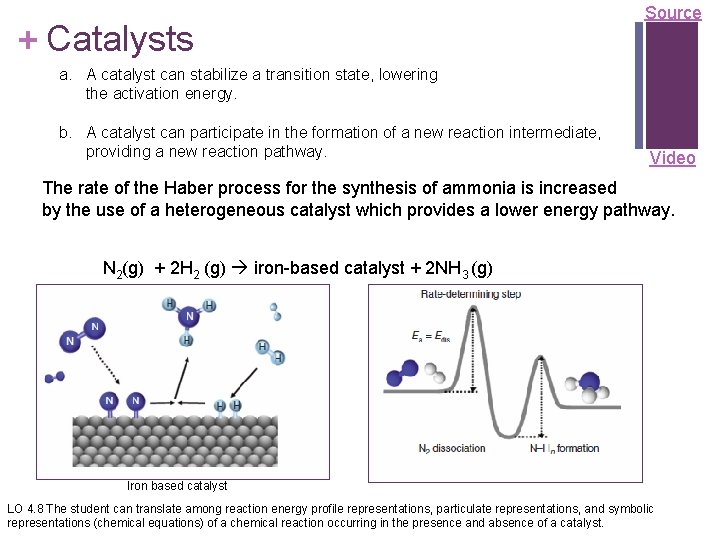
+ Catalysts Source a. A catalyst can stabilize a transition state, lowering the activation energy. b. A catalyst can participate in the formation of a new reaction intermediate, providing a new reaction pathway. Video The rate of the Haber process for the synthesis of ammonia is increased by the use of a heterogeneous catalyst which provides a lower energy pathway. N 2(g) + 2 H 2 (g) iron-based catalyst + 2 NH 3 (g) Iron based catalyst LO 4. 8 The student can translate among reaction energy profile representations, particulate representations, and symbolic representations (chemical equations) of a chemical reaction occurring in the presence and absence of a catalyst.
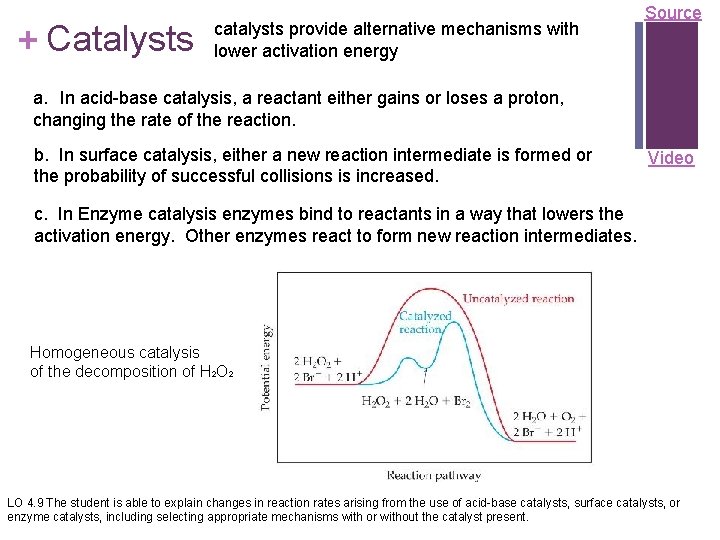
+ Catalysts catalysts provide alternative mechanisms with lower activation energy Source a. In acid-base catalysis, a reactant either gains or loses a proton, changing the rate of the reaction. b. In surface catalysis, either a new reaction intermediate is formed or the probability of successful collisions is increased. Video c. In Enzyme catalysis enzymes bind to reactants in a way that lowers the activation energy. Other enzymes react to form new reaction intermediates. Homogeneous catalysis of the decomposition of H 2 O 2 LO 4. 9 The student is able to explain changes in reaction rates arising from the use of acid-base catalysts, surface catalysts, or enzyme catalysts, including selecting appropriate mechanisms with or without the catalyst present.
+ Big Idea #5 Thermochemistry
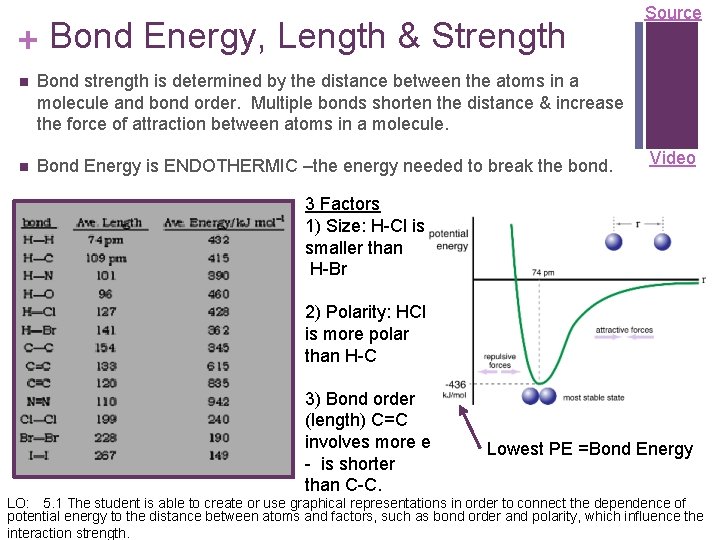
+ Bond Energy, Length & Strength n Bond strength is determined by the distance between the atoms in a molecule and bond order. Multiple bonds shorten the distance & increase the force of attraction between atoms in a molecule. n Bond Energy is ENDOTHERMIC –the energy needed to break the bond. Source Video 3 Factors 1) Size: H-Cl is smaller than H-Br 2) Polarity: HCl is more polar than H-C 3) Bond order (length) C=C involves more e - is shorter than C-C. Lowest PE =Bond Energy LO: 5. 1 The student is able to create or use graphical representations in order to connect the dependence of potential energy to the distance between atoms and factors, such as bond order and polarity, which influence the interaction strength.
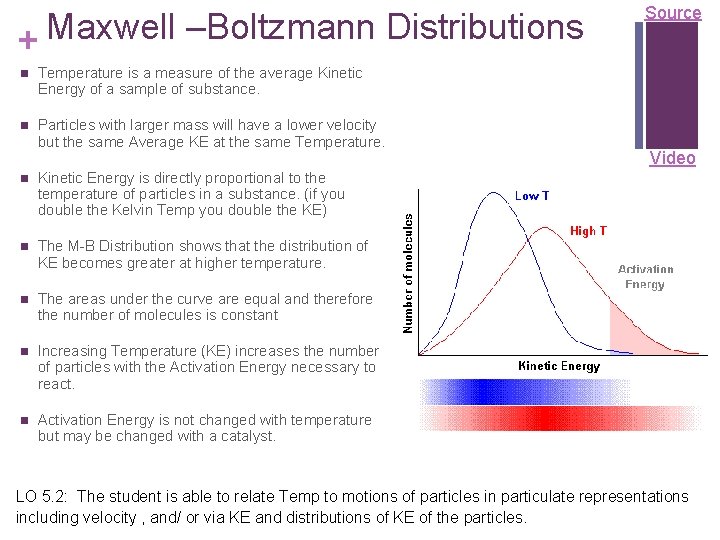
Maxwell –Boltzmann Distributions + n Temperature is a measure of the average Kinetic Energy of a sample of substance. n Particles with larger mass will have a lower velocity but the same Average KE at the same Temperature. n Kinetic Energy is directly proportional to the temperature of particles in a substance. (if you double the Kelvin Temp you double the KE) n The M-B Distribution shows that the distribution of KE becomes greater at higher temperature. n The areas under the curve are equal and therefore the number of molecules is constant n Increasing Temperature (KE) increases the number of particles with the Activation Energy necessary to react. n Activation Energy is not changed with temperature but may be changed with a catalyst. Source Video LO 5. 2: The student is able to relate Temp to motions of particles in particulate representations including velocity , and/ or via KE and distributions of KE of the particles.
+ Thermodynamic vocabulary n Universe: The sum of the system and surroundings n System: The species we want to study n Surroundings: the environment outside the system n n Source Endothermic: Heat flows to the system from the surroundings (surroundings Video temperature drops-i. e. beaker feels cold) Exothermic: Heat flows from the system to the surroundings. (surroundings temperature rises-i. e. beaker feels hot) LO 5. 3: The student can generate explanations or make predictions about the transfer of thermal energy between systems based on this transfer being due to a kinetic energy transfer between systems arising from molecular collisions.
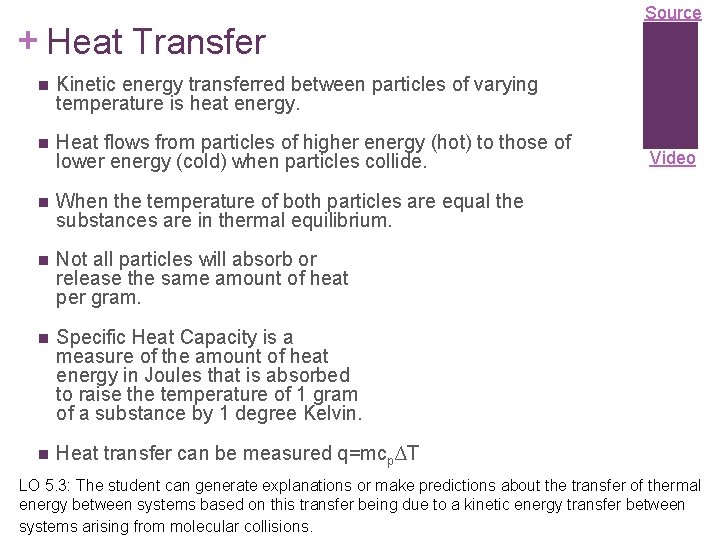
+ Heat Transfer n Kinetic energy transferred between particles of varying temperature is heat energy. n Heat flows from particles of higher energy (hot) to those of lower energy (cold) when particles collide. n When the temperature of both particles are equal the substances are in thermal equilibrium. n Not all particles will absorb or release the same amount of heat per gram. n Specific Heat Capacity is a measure of the amount of heat energy in Joules that is absorbed to raise the temperature of 1 gram of a substance by 1 degree Kelvin. n Heat transfer can be measured q=mcp∆T Source Video LO 5. 3: The student can generate explanations or make predictions about the transfer of thermal energy between systems based on this transfer being due to a kinetic energy transfer between systems arising from molecular collisions.
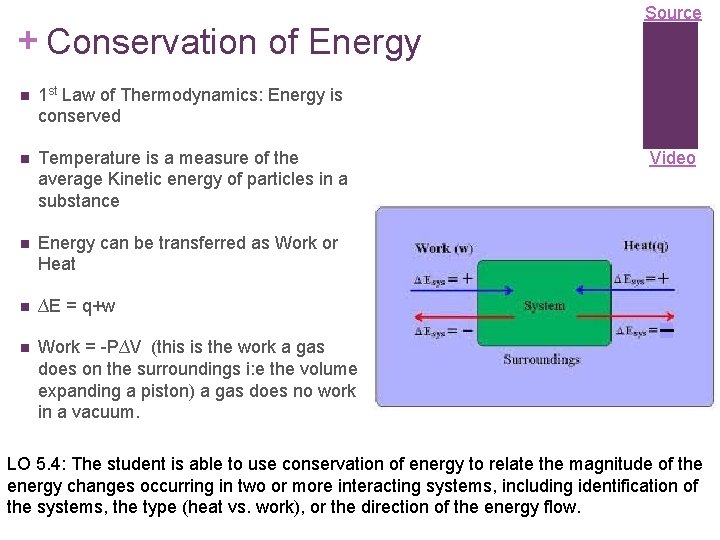
+ Conservation of Energy n 1 st Law of Thermodynamics: Energy is conserved n Temperature is a measure of the average Kinetic energy of particles in a substance n Energy can be transferred as Work or Heat n ∆E = q+w n Work = -P∆V (this is the work a gas does on the surroundings i: e the volume expanding a piston) a gas does no work in a vacuum. Source Video LO 5. 4: The student is able to use conservation of energy to relate the magnitude of the energy changes occurring in two or more interacting systems, including identification of the systems, the type (heat vs. work), or the direction of the energy flow.
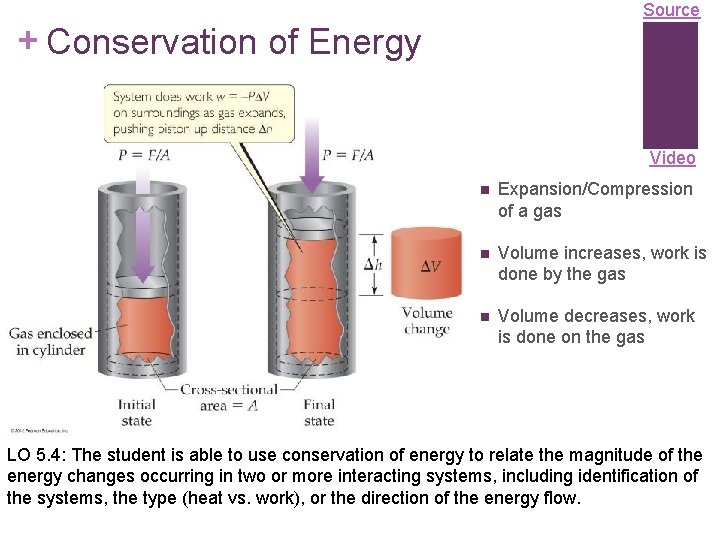
Source + Conservation of Energy Video n Expansion/Compression of a gas n Volume increases, work is done by the gas n Volume decreases, work is done on the gas LO 5. 4: The student is able to use conservation of energy to relate the magnitude of the energy changes occurring in two or more interacting systems, including identification of the systems, the type (heat vs. work), or the direction of the energy flow.
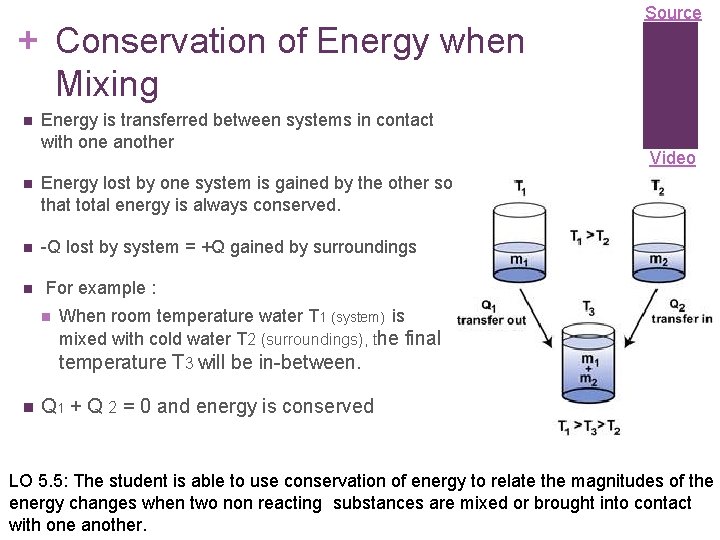
+ Conservation of Energy when Mixing n Energy is transferred between systems in contact with one another n Energy lost by one system is gained by the other so that total energy is always conserved. n -Q lost by system = +Q gained by surroundings n For example : n Source Video When room temperature water T 1 (system) is mixed with cold water T 2 (surroundings), the final temperature T 3 will be in-between. n Q 1 + Q 2 = 0 and energy is conserved LO 5. 5: The student is able to use conservation of energy to relate the magnitudes of the energy changes when two non reacting substances are mixed or brought into contact with one another.
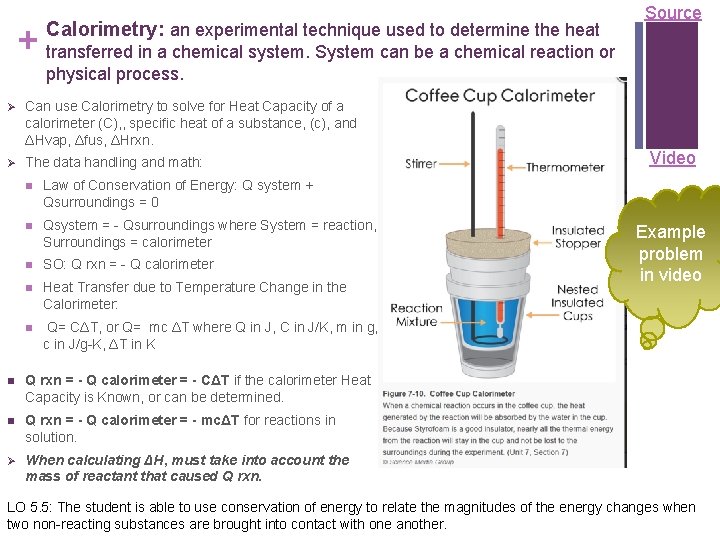
Calorimetry: an experimental technique used to determine the heat + transferred in a chemical system. System can be a chemical reaction or Source physical process. Ø Can use Calorimetry to solve for Heat Capacity of a calorimeter (C), , specific heat of a substance, (c), and ΔHvap, Δfus, ΔHrxn. Ø The data handling and math: n Law of Conservation of Energy: Q system + Qsurroundings = 0 n Qsystem = - Qsurroundings where System = reaction, Surroundings = calorimeter n SO: Q rxn = - Q calorimeter n Heat Transfer due to Temperature Change in the Calorimeter: n Q= CΔT, or Q= mc ΔT where Q in J, C in J/K, m in g, c in J/g-K, ΔT in K n Q rxn = - Q calorimeter = - CΔT if the calorimeter Heat Capacity is Known, or can be determined. n Q rxn = - Q calorimeter = - mcΔT for reactions in solution. Ø When calculating ΔH, must take into account the mass of reactant that caused Q rxn. Video Example problem in video LO 5. 5: The student is able to use conservation of energy to relate the magnitudes of the energy changes when two non-reacting substances are brought into contact with one another.
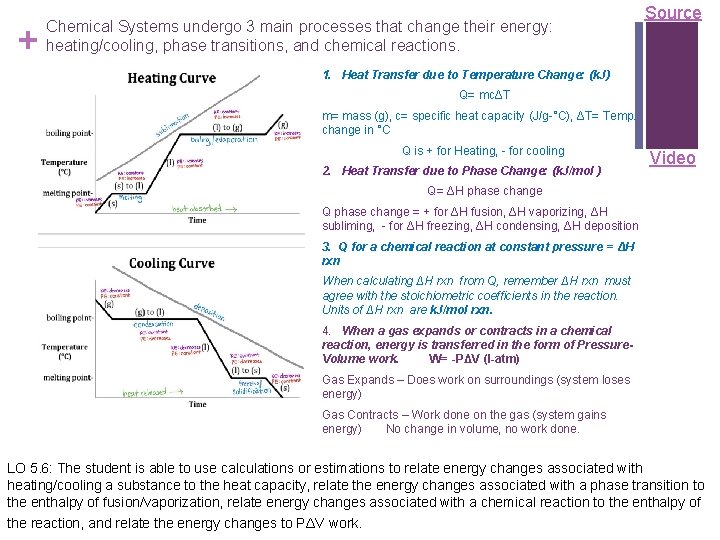
+ Chemical Systems undergo 3 main processes that change their energy: heating/cooling, phase transitions, and chemical reactions. Source 1. Heat Transfer due to Temperature Change: (k. J) Q= mcΔT m= mass (g), c= specific heat capacity (J/g-°C), ΔT= Temp. change in °C Q is + for Heating, - for cooling 2. Heat Transfer due to Phase Change: (k. J/mol ) Video Q= ΔH phase change Q phase change = + for ΔH fusion, ΔH vaporizing, ΔH subliming, - for ΔH freezing, ΔH condensing, ΔH deposition 3. Q for a chemical reaction at constant pressure = ΔH rxn When calculating ΔH rxn from Q, remember ΔH rxn must agree with the stoichiometric coefficients in the reaction. Units of ΔH rxn are k. J/mol rxn. 4. When a gas expands or contracts in a chemical reaction, energy is transferred in the form of Pressure. Volume work. W= -PΔV (l-atm) Gas Expands – Does work on surroundings (system loses energy) Gas Contracts – Work done on the gas (system gains energy) No change in volume, no work done. LO 5. 6: The student is able to use calculations or estimations to relate energy changes associated with heating/cooling a substance to the heat capacity, relate the energy changes associated with a phase transition to the enthalpy of fusion/vaporization, relate energy changes associated with a chemical reaction to the enthalpy of the reaction, and relate the energy changes to PΔV work.
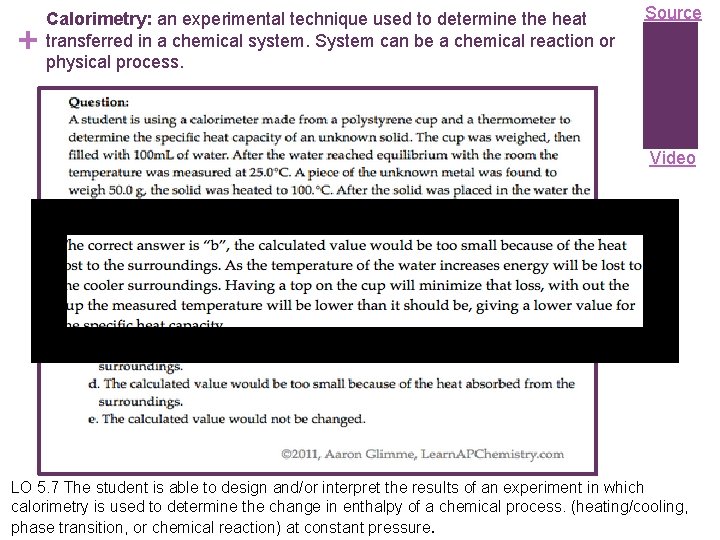
+ Calorimetry: an experimental technique used to determine the heat transferred in a chemical system. System can be a chemical reaction or physical process. Source Video LO 5. 7 The student is able to design and/or interpret the results of an experiment in which calorimetry is used to determine the change in enthalpy of a chemical process. (heating/cooling, phase transition, or chemical reaction) at constant pressure.
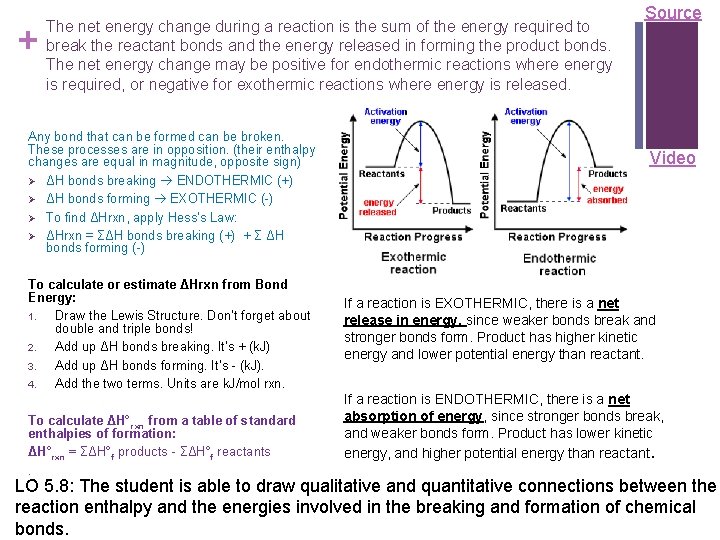
+ The net energy change during a reaction is the sum of the energy required to break the reactant bonds and the energy released in forming the product bonds. The net energy change may be positive for endothermic reactions where energy is required, or negative for exothermic reactions where energy is released. Any bond that can be formed can be broken. These processes are in opposition. (their enthalpy changes are equal in magnitude, opposite sign) Ø ΔH bonds breaking ENDOTHERMIC (+) Ø ΔH bonds forming EXOTHERMIC (-) Ø To find ΔHrxn, apply Hess’s Law: Ø ΔHrxn = ΣΔH bonds breaking (+) + Σ ΔH bonds forming (-) To calculate or estimate ΔHrxn from Bond Energy: 1. Draw the Lewis Structure. Don’t forget about double and triple bonds! 2. Add up ΔH bonds breaking. It’s + (k. J) 3. Add up ΔH bonds forming. It’s - (k. J). 4. Add the two terms. Units are k. J/mol rxn. To calculate ΔH° rxn from a table of standard enthalpies of formation: ΔH°rxn = ΣΔH°f products - ΣΔH°f reactants. Source Video If a reaction is EXOTHERMIC, there is a net release in energy, since weaker bonds break and stronger bonds form. Product has higher kinetic energy and lower potential energy than reactant. If a reaction is ENDOTHERMIC, there is a net absorption of energy, since stronger bonds break, and weaker bonds form. Product has lower kinetic energy, and higher potential energy than reactant. LO 5. 8: The student is able to draw qualitative and quantitative connections between the reaction enthalpy and the energies involved in the breaking and formation of chemical bonds.
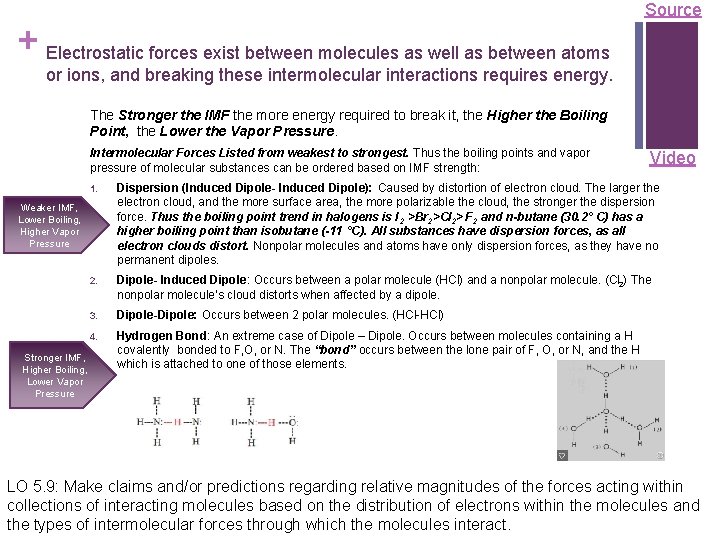
Source + Electrostatic forces exist between molecules as well as between atoms or ions, and breaking these intermolecular interactions requires energy. The Stronger the IMF the more energy required to break it, the Higher the Boiling Point, the Lower the Vapor Pressure. Intermolecular Forces Listed from weakest to strongest. Thus the boiling points and vapor Video pressure of molecular substances can be ordered based on IMF strength: 1. Dispersion (Induced Dipole- Induced Dipole): Caused by distortion of electron cloud. The larger the electron cloud, and the more surface area, the more polarizable the cloud, the stronger the dispersion force. Thus the boiling point trend in halogens is I 2 >Br 2>Cl 2> F 2 and n-butane (30. 2° C) has a higher boiling point than isobutane (-11 °C). All substances have dispersion forces, as all electron clouds distort. Nonpolar molecules and atoms have only dispersion forces, as they have no permanent dipoles. 2. Dipole- Induced Dipole: Occurs between a polar molecule (HCl) and a nonpolar molecule. (Cl 2) The nonpolar molecule’s cloud distorts when affected by a dipole. 3. Dipole-Dipole: Occurs between 2 polar molecules. (HCl-HCl) 4. Hydrogen Bond: An extreme case of Dipole – Dipole. Occurs between molecules containing a H covalently bonded to F, O, or N. The “bond” occurs between the lone pair of F, O, or N, and the H which is attached to one of those elements. Weaker IMF, Lower Boiling, Higher Vapor Pressure Stronger IMF, Higher Boiling, Lower Vapor Pressure LO 5. 9: Make claims and/or predictions regarding relative magnitudes of the forces acting within collections of interacting molecules based on the distribution of electrons within the molecules and the types of intermolecular forces through which the molecules interact.
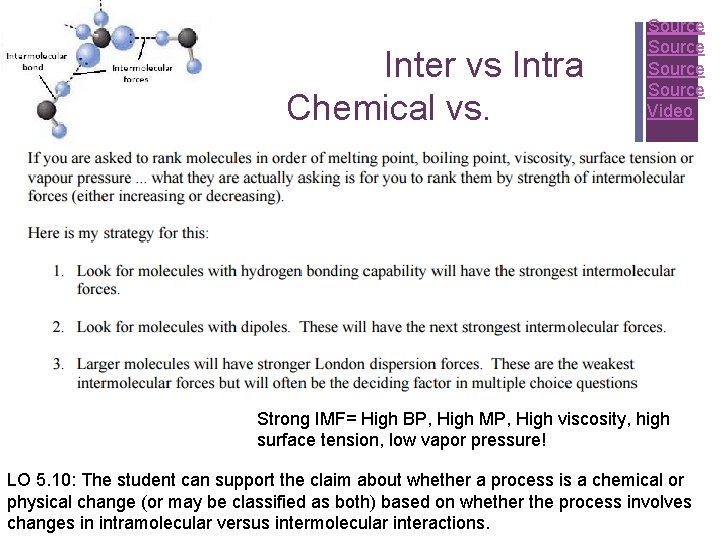
+ Inter vs Intra Chemical vs. Physical Chemical vs. Physical Changes Interstates- Between States IMF- Between Molecules • • Source Video A physical change doesn’t produce a new substance. Phase changes are the most common. It involves IMF changes. A chemical change produces new substances. Bonds are broken and new bonds are formed! The Intra-molecular forces are changed. Strong IMF= High BP, High MP, High viscosity, high surface tension, low vapor pressure! LO 5. 10: The student can support the claim about whether a process is a chemical or physical change (or may be classified as both) based on whether the process involves changes in intramolecular versus intermolecular interactions.
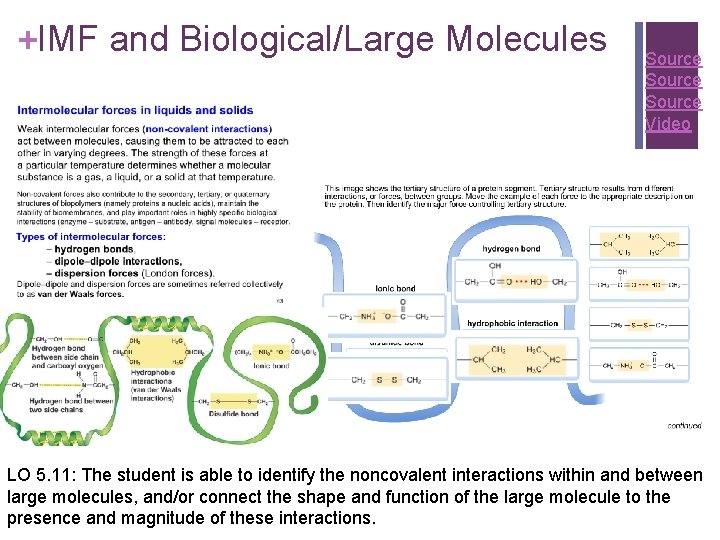
+IMF and Biological/Large Molecules Source Video LO 5. 11: The student is able to identify the noncovalent interactions within and between large molecules, and/or connect the shape and function of the large molecule to the presence and magnitude of these interactions.
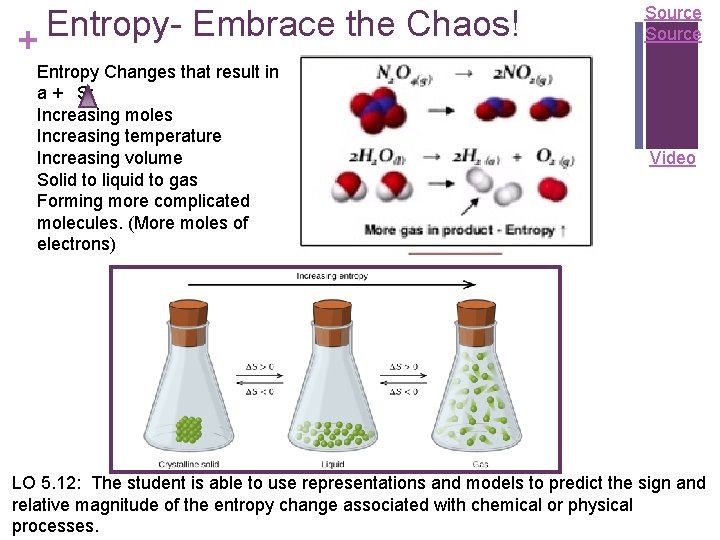
Entropy- Embrace the Chaos! + Entropy Changes that result in a + S: Increasing moles Increasing temperature Increasing volume Solid to liquid to gas Forming more complicated molecules. (More moles of electrons) Source Video LO 5. 12: The student is able to use representations and models to predict the sign and relative magnitude of the entropy change associated with chemical or physical processes.
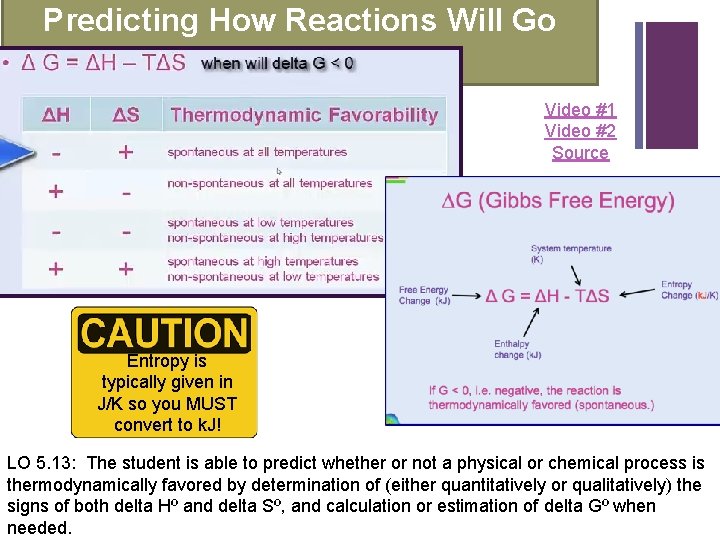
+ Predicting How Reactions Will Go Video #1 Video #2 Source Entropy is typically given in J/K so you MUST convert to k. J! LO 5. 13: The student is able to predict whether or not a physical or chemical process is thermodynamically favored by determination of (either quantitatively or qualitatively) the signs of both delta Hº and delta Sº, and calculation or estimation of delta Gº when needed.
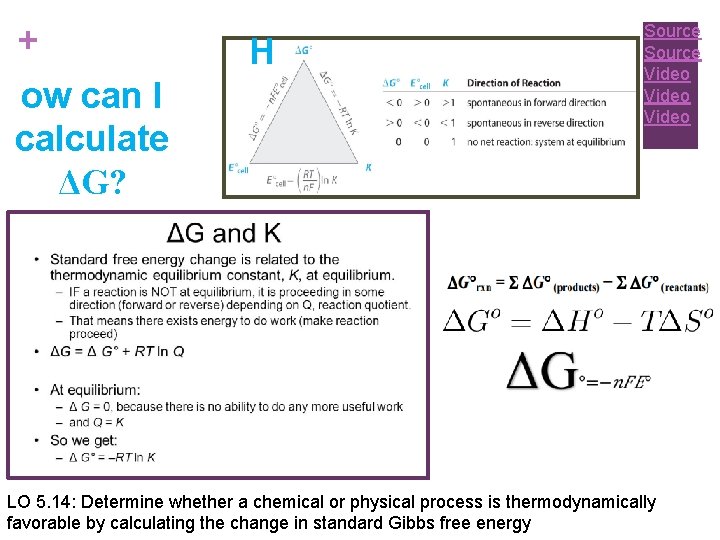
+ Source Video H ow can I calculate ΔG? LO 5. 14: Determine whether a chemical or physical process is thermodynamically favorable by calculating the change in standard Gibbs free energy
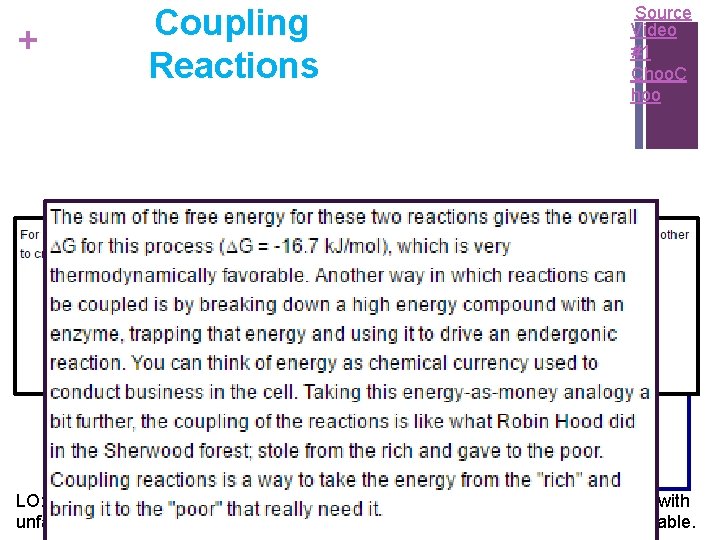
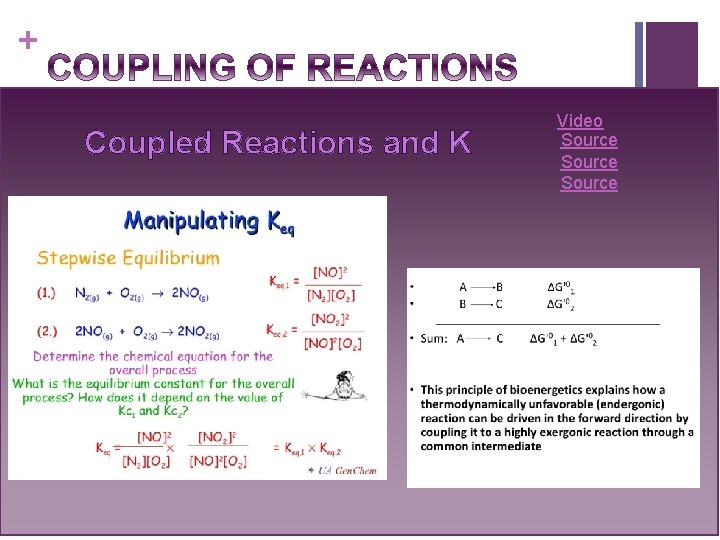
Coupling + Reactions Source Video #1 Choo. C hoo LO: 5. 15 The student is able to explain the application the coupling of favorable with unfavorable reactions to cause processes that are not favorable to become favorable.
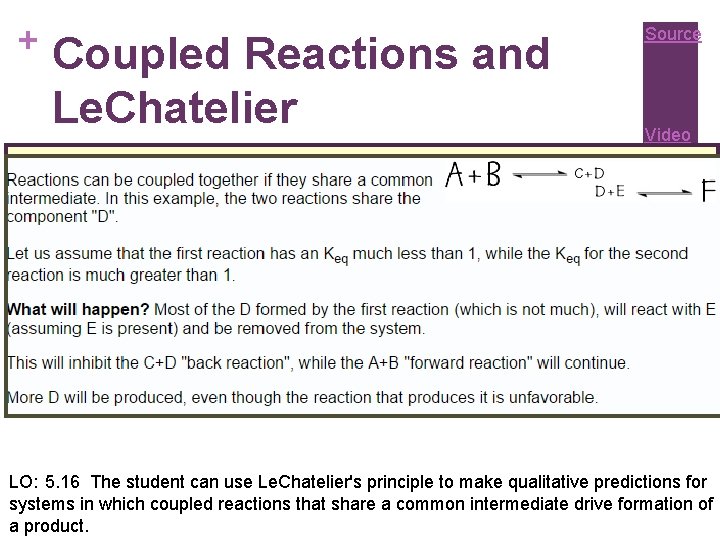
+ Coupled Reactions and Le. Chatelier Source Video LO: 5. 16 The student can use Le. Chatelier's principle to make qualitative predictions for systems in which coupled reactions that share a common intermediate drive formation of a product.
+ n Coupled Reactions and K n Video Source Manipulation Equilibrium constants (K) Free energy, enthalpy or entropy Standard Reduction potential (Eo) Multiply by factor Raise K to power of factor Multiply by factor NOTHING! Flip/reverse rxn Inverse of K Change sign Add Reactions Multiply values Add Values Add values LO 5. 17: The student can make quantitative predictions for systems involving coupled reactions that share a common intermediate, based on the equilibrium constant for the combined reaction.
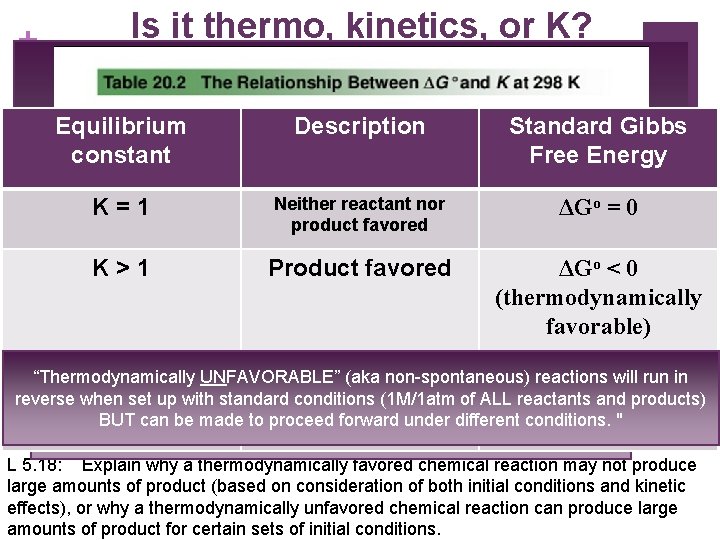
+ Is it thermo, kinetics, or K? o and the Equilibrium Constant ΔG THERMODYNAMICALLY FAVORABLE The free energy at non-standard, non-equilibrium states. Standard is given by: Gibbs Equilibrium Description Kinetics tells us how FAST a reaction will proceed. = ΔG o + RTln(Q) constant Free Energy Video Equilibrium tells how FAR a reaction proceeds. ΔG us Source Thermodynamics tells us whether or not the reaction At Equilibrium, ΔG = 0 and Q becomes “K” o = 0 Source Neither reactant nor ΔG K = 1 is FAVORABLE at a given temperature. o ΔGproduct = -RTln(K) favored Thermodynamically favorable (aka spontaneous) means oa <0 KA>reaction 1 is PRODUCT Product favored favorable ΔG reaction favored at a given temperature. that is thermodynamically will (thermodynamically form more products at equilibrium BUT the reaction may be so SLOW that few products form infavorable) a K > 1, ln(K)ΔH is positive, ΔGo is negative reasonable amount of time. “Thermodynamically UNFAVORABLE” (aka non-spontaneous) reactions will run in ΔGo > 0 K<1 Reactant favored reverse when set up with standard conditions (1 M/1 atm of ALL reactants and products) (thermodynamically BUT can be made to proceed forward under different conditions. " o As K decreases, ΔG becomes more positive unfavorable) L 5. 18: Explain why a thermodynamically favored chemical reaction may not produce large amounts of product (based on consideration of both initial conditions and kinetic effects), or why a thermodynamically unfavored chemical reaction can produce large amounts of product for certain sets of initial conditions.
+ Big Idea #6 Equilibrium
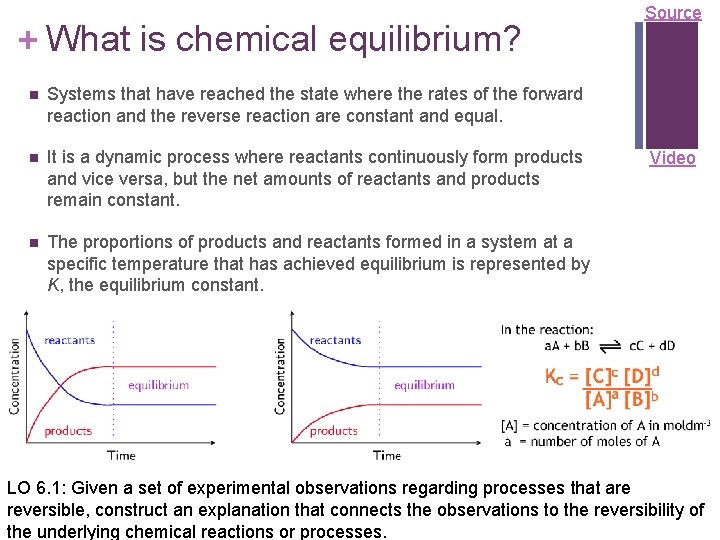
+ What is chemical equilibrium? n Systems that have reached the state where the rates of the forward reaction and the reverse reaction are constant and equal. n It is a dynamic process where reactants continuously form products and vice versa, but the net amounts of reactants and products remain constant. n The proportions of products and reactants formed in a system at a specific temperature that has achieved equilibrium is represented by K, the equilibrium constant. Source Video LO 6. 1: Given a set of experimental observations regarding processes that are reversible, construct an explanation that connects the observations to the reversibility of the underlying chemical reactions or processes.
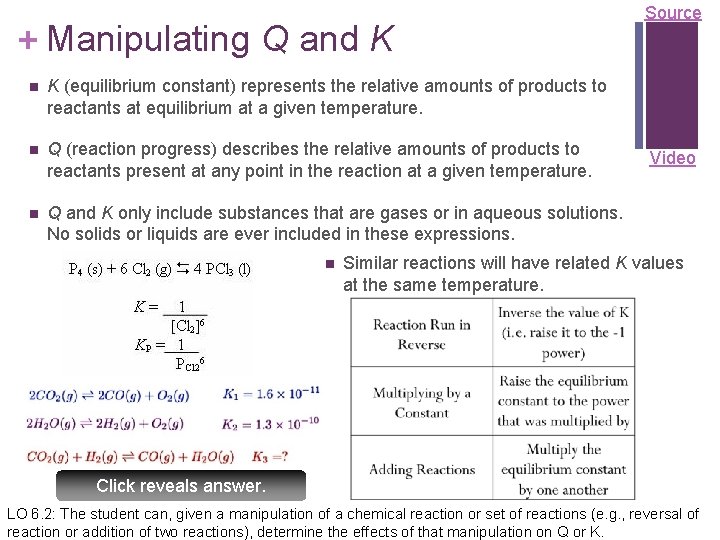
+ Manipulating Q and K n K (equilibrium constant) represents the relative amounts of products to reactants at equilibrium at a given temperature. n Q (reaction progress) describes the relative amounts of products to reactants present at any point in the reaction at a given temperature. n Q and K only include substances that are gases or in aqueous solutions. No solids or liquids are ever included in these expressions. n Source Video Similar reactions will have related K values at the same temperature. Click reveals answer. . 35 LO 6. 2: The student can, given a manipulation of a chemical reaction or set of reactions (e. g. , reversal of reaction or addition of two reactions), determine the effects of that manipulation on Q or K.
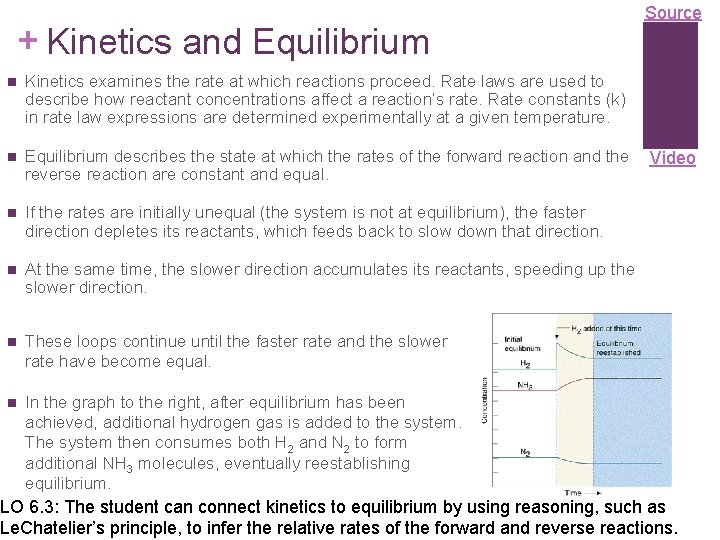
+ Kinetics and Equilibrium Source n Kinetics examines the rate at which reactions proceed. Rate laws are used to describe how reactant concentrations affect a reaction’s rate. Rate constants (k) in rate law expressions are determined experimentally at a given temperature. n Equilibrium describes the state at which the rates of the forward reaction and the Video reverse reaction are constant and equal. n If the rates are initially unequal (the system is not at equilibrium), the faster direction depletes its reactants, which feeds back to slow down that direction. n At the same time, the slower direction accumulates its reactants, speeding up the slower direction. n These loops continue until the faster rate and the slower rate have become equal. n In the graph to the right, after equilibrium has been achieved, additional hydrogen gas is added to the system. The system then consumes both H 2 and N 2 to form additional NH 3 molecules, eventually reestablishing equilibrium. LO 6. 3: The student can connect kinetics to equilibrium by using reasoning, such as Le. Chatelier’s principle, to infer the relative rates of the forward and reverse reactions.
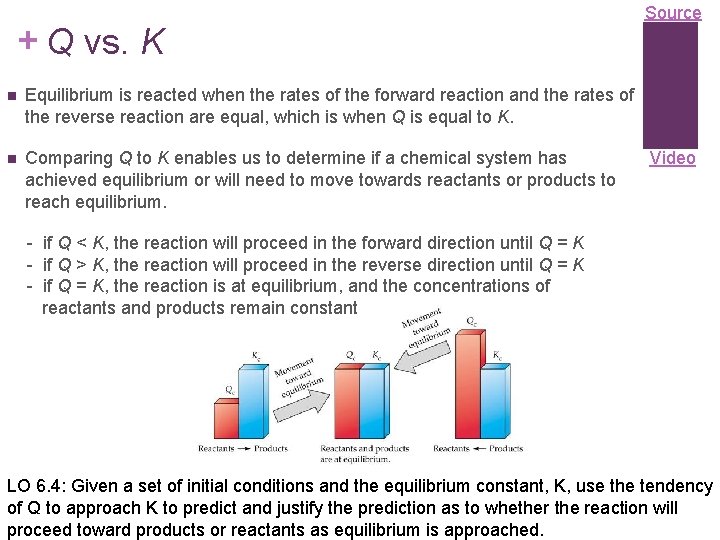
+ Q vs. K n Equilibrium is reacted when the rates of the forward reaction and the rates of the reverse reaction are equal, which is when Q is equal to K. n Comparing Q to K enables us to determine if a chemical system has achieved equilibrium or will need to move towards reactants or products to reach equilibrium. Source Video - if Q < K, the reaction will proceed in the forward direction until Q = K - if Q > K, the reaction will proceed in the reverse direction until Q = K - if Q = K, the reaction is at equilibrium, and the concentrations of reactants and products remain constant LO 6. 4: Given a set of initial conditions and the equilibrium constant, K, use the tendency of Q to approach K to predict and justify the prediction as to whether the reaction will proceed toward products or reactants as equilibrium is approached.
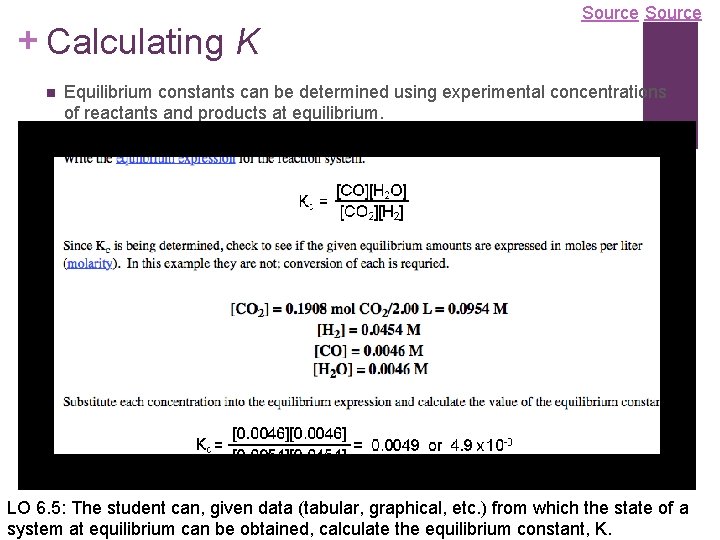
+ Calculating K Source n Equilibrium constants can be determined using experimental concentrations of reactants and products at equilibrium. n Steps: Video 1) Write an equilibrium expression 2) Determine equilibrium molar concentrations or partial pressures for all substances in expression 3) Substitute quantities into equilibrium expression and solve. n Example: Calculate K for the following system if 0. 1908 mol CO 2, 0. 0908 mol H 2, 0. 0092 CO, and 0. 0092 mol H 2 O vapor are present in a 2. 00 L vessel at equilibrium: Click reveals answer and explanation. LO 6. 5: The student can, given data (tabular, graphical, etc. ) from which the state of a system at equilibrium can be obtained, calculate the equilibrium constant, K.
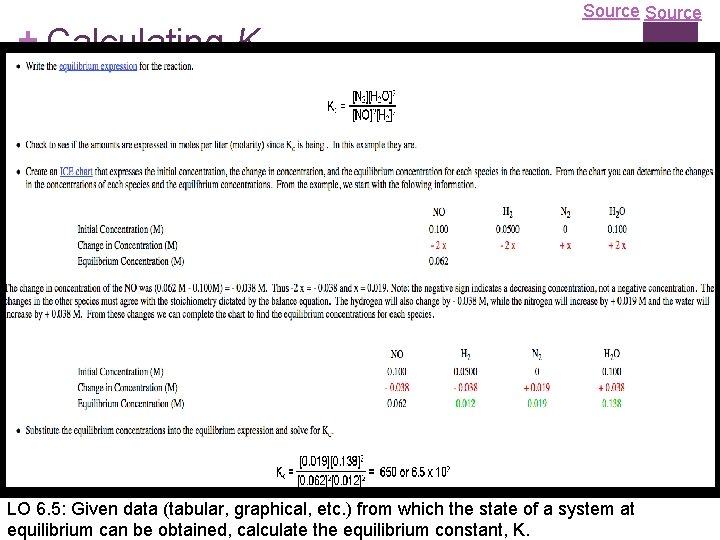
+ Calculating K Source n Equilibrium constants can also be determined from both initial and equilibrium concentrations using an ICE chart. n Steps: Video 1) Write an equilibrium expression 2) Determine molar concentrations or partial pressures for all substances in expression 3) Determine equilibrium concentrations or partial pressures using an ICE chart. 4) Substitute quantities into equilibrium expression and solve. n Example: Initially, a mixture of 0. 100 M NO, 0. 050 M H 2, and 0. 100 M H 2 O was allowed to reach equilibrium. No N 2 was present initially. At equilibrium, NO had a concentration of 0. 062 M. Determine the value of K for the reaction: Click reveals answer and explanation. LO 6. 5: Given data (tabular, graphical, etc. ) from which the state of a system at equilibrium can be obtained, calculate the equilibrium constant, K.
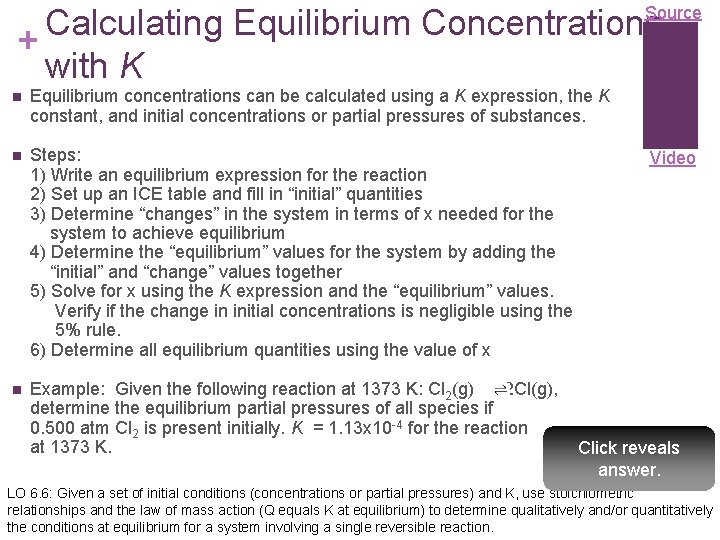
Source Calculating Equilibrium Concentrations + with K n Equilibrium concentrations can be calculated using a K expression, the K constant, and initial concentrations or partial pressures of substances. n Steps: 1) Write an equilibrium expression for the reaction 2) Set up an ICE table and fill in “initial” quantities 3) Determine “changes” in the system in terms of x needed for the system to achieve equilibrium 4) Determine the “equilibrium” values for the system by adding the “initial” and “change” values together 5) Solve for x using the K expression and the “equilibrium” values. Verify if the change in initial concentrations is negligible using the 5% rule. 6) Determine all equilibrium quantities using the value of x n Example: Given the following reaction at 1373 K: Cl 2(g) 2 Cl(g), determine the equilibrium partial pressures of all species if 0. 500 atm Cl 2 is present initially. K = 1. 13 x 10 -4 for the reaction 0. 497 atm Cl 2 and at 1373 K. Click reveals 0. 00752 atm Cl answer. Video LO 6. 6: Given a set of initial conditions (concentrations or partial pressures) and K, use stoichiometric relationships and the law of mass action (Q equals K at equilibrium) to determine qualitatively and/or quantitatively the conditions at equilibrium for a system involving a single reversible reaction.
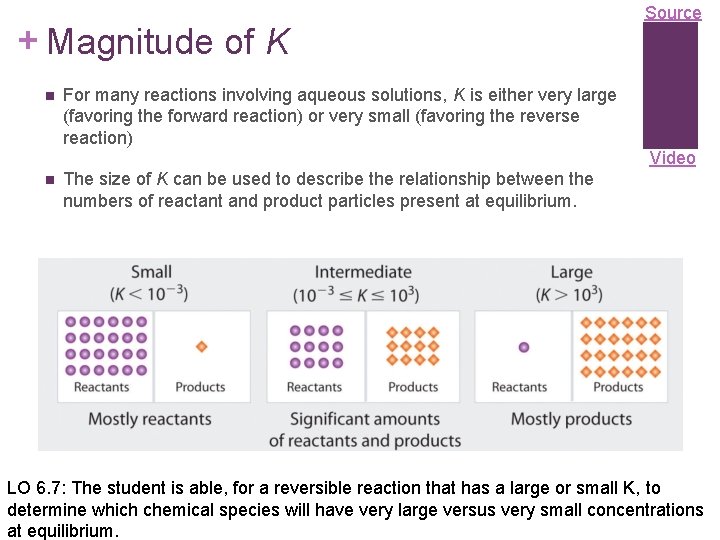
+ Magnitude of K n Source For many reactions involving aqueous solutions, K is either very large (favoring the forward reaction) or very small (favoring the reverse reaction) Video n The size of K can be used to describe the relationship between the numbers of reactant and product particles present at equilibrium. LO 6. 7: The student is able, for a reversible reaction that has a large or small K, to determine which chemical species will have very large versus very small concentrations at equilibrium.
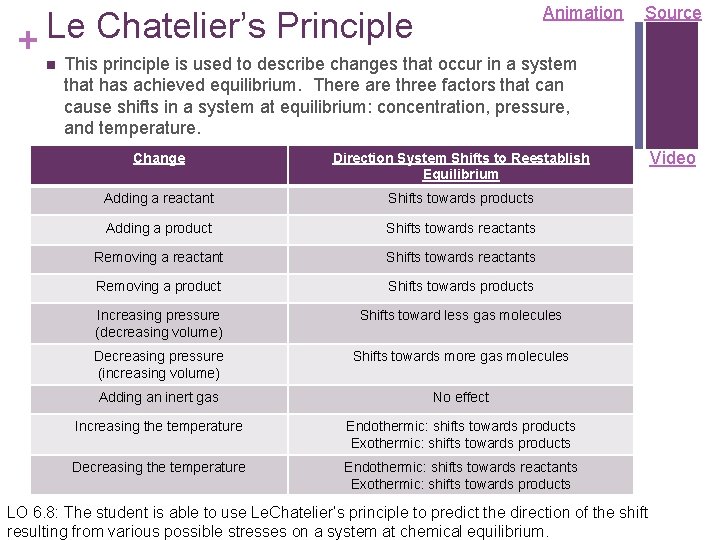
Animation Le Chatelier’s Principle + n Source This principle is used to describe changes that occur in a system that has achieved equilibrium. There are three factors that can cause shifts in a system at equilibrium: concentration, pressure, and temperature. Change Direction System Shifts to Reestablish Equilibrium Adding a reactant Shifts towards products Adding a product Shifts towards reactants Removing a reactant Shifts towards reactants Removing a product Shifts towards products Increasing pressure (decreasing volume) Shifts toward less gas molecules Decreasing pressure (increasing volume) Shifts towards more gas molecules Adding an inert gas No effect Increasing the temperature Endothermic: shifts towards products Exothermic: shifts towards products Decreasing the temperature Endothermic: shifts towards reactants Exothermic: shifts towards products Video LO 6. 8: The student is able to use Le. Chatelier’s principle to predict the direction of the shift resulting from various possible stresses on a system at chemical equilibrium.
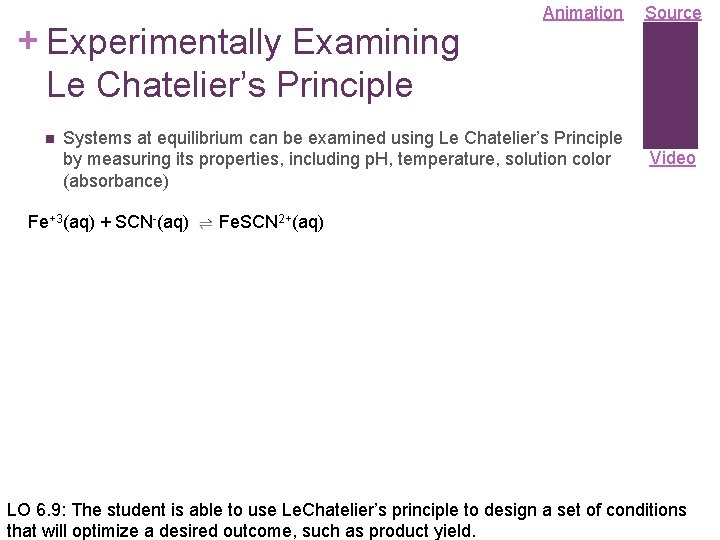
+ Experimentally Examining Le Chatelier’s Principle n Animation Systems at equilibrium can be examined using Le Chatelier’s Principle by measuring its properties, including p. H, temperature, solution color (absorbance) Source Video Fe+3(aq) + SCN-(aq) Fe. SCN 2+(aq) LO 6. 9: The student is able to use Le. Chatelier’s principle to design a set of conditions that will optimize a desired outcome, such as product yield.
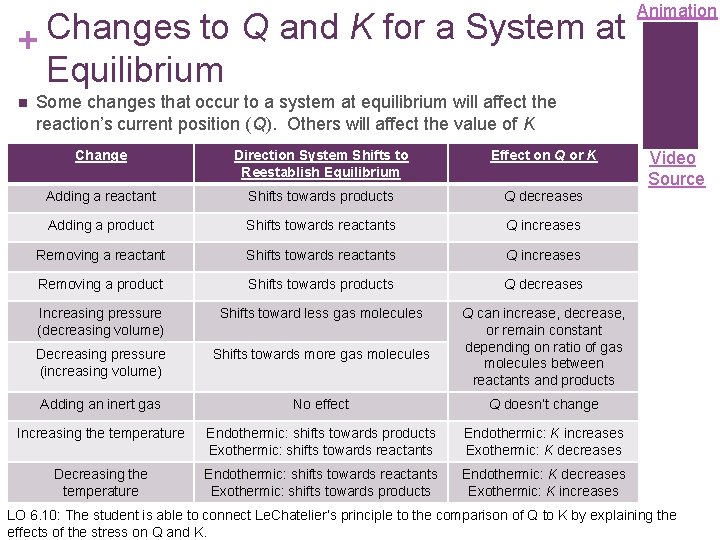
Changes to Q and K for a System at + Equilibrium n Animation Some changes that occur to a system at equilibrium will affect the reaction’s current position (Q). Others will affect the value of K Change Direction System Shifts to Reestablish Equilibrium Effect on Q or K Adding a reactant Shifts towards products Q decreases Adding a product Shifts towards reactants Q increases Removing a reactant Shifts towards reactants Q increases Removing a product Shifts towards products Q decreases Increasing pressure (decreasing volume) Shifts toward less gas molecules Decreasing pressure (increasing volume) Shifts towards more gas molecules Q can increase, decrease, or remain constant depending on ratio of gas molecules between reactants and products Adding an inert gas No effect Q doesn’t change Increasing the temperature Endothermic: shifts towards products Exothermic: shifts towards reactants Endothermic: K increases Exothermic: K decreases Decreasing the temperature Endothermic: shifts towards reactants Exothermic: shifts towards products Endothermic: K decreases Exothermic: K increases Video Source LO 6. 10: The student is able to connect Le. Chatelier’s principle to the comparison of Q to K by explaining the effects of the stress on Q and K.
+ Acid/Base Particulates Source Select Acid. Base Ionization Video LO 6. 11: The student can generate or use a particulate representation of an acid (strong or weak or polyprotic) and a strong base to explain the species that will have large versus small concentrations at equilibrium.
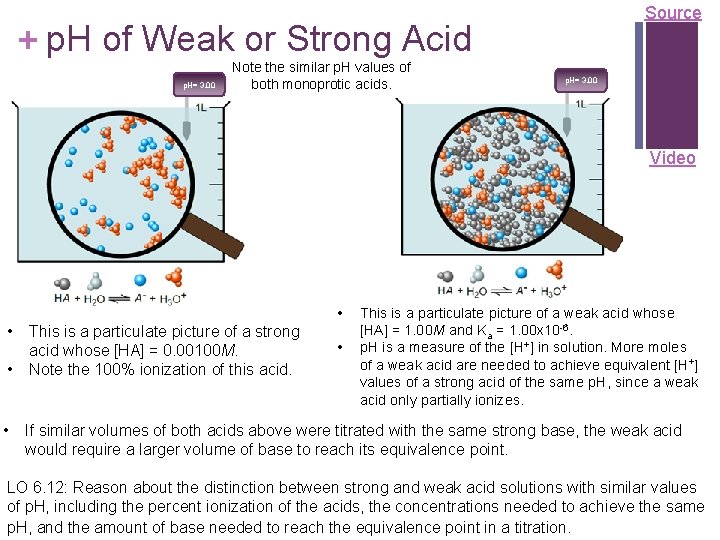
Source + p. H of Weak or Strong Acid p. H= 3. 00 Note the similar p. H values of both monoprotic acids. p. H= 3. 00 Video • • This is a particulate picture of a strong acid whose [HA] = 0. 00100 M. Note the 100% ionization of this acid. • This is a particulate picture of a weak acid whose [HA] = 1. 00 M and Ka = 1. 00 x 10 -6. p. H is a measure of the [H+] in solution. More moles of a weak acid are needed to achieve equivalent [H+] values of a strong acid of the same p. H, since a weak acid only partially ionizes. If similar volumes of both acids above were titrated with the same strong base, the weak acid would require a larger volume of base to reach its equivalence point. LO 6. 12: Reason about the distinction between strong and weak acid solutions with similar values of p. H, including the percent ionization of the acids, the concentrations needed to achieve the same p. H, and the amount of base needed to reach the equivalence point in a titration.
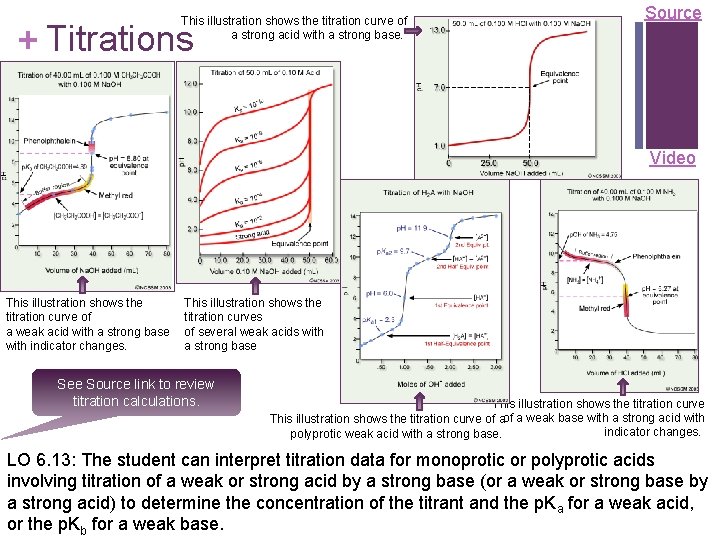
This illustration shows the titration curve of a strong acid with a strong base. + Titrations Source Video This illustration shows the titration curve of a weak acid with a strong base with indicator changes. This illustration shows the titration curves of several weak acids with a strong base See Source link to review titration calculations. This illustration shows the titration curve of a weak base with a strong acid with indicator changes. polyprotic weak acid with a strong base. LO 6. 13: The student can interpret titration data for monoprotic or polyprotic acids involving titration of a weak or strong acid by a strong base (or a weak or strong base by a strong acid) to determine the concentration of the titrant and the p. Ka for a weak acid, or the p. Kb for a weak base.
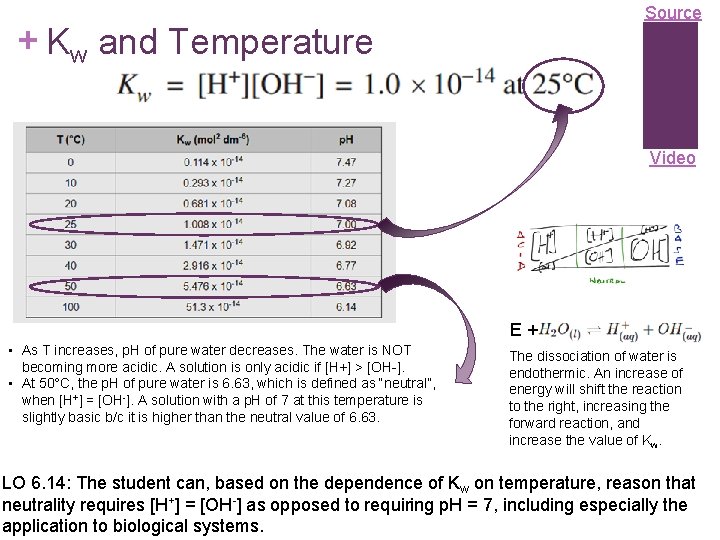
Source + Kw and Temperature Video E + • As T increases, p. H of pure water decreases. The water is NOT becoming more acidic. A solution is only acidic if [H+] > [OH-]. • At 50°C, the p. H of pure water is 6. 63, which is defined as “neutral”, when [H+] = [OH-]. A solution with a p. H of 7 at this temperature is slightly basic b/c it is higher than the neutral value of 6. 63. The dissociation of water is endothermic. An increase of energy will shift the reaction to the right, increasing the forward reaction, and increase the value of Kw. LO 6. 14: The student can, based on the dependence of Kw on temperature, reason that neutrality requires [H+] = [OH-] as opposed to requiring p. H = 7, including especially the application to biological systems.
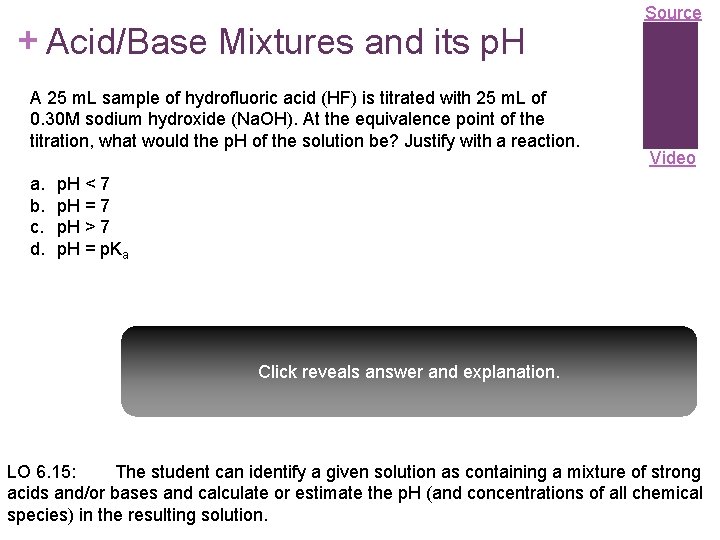
+ Acid/Base Mixtures and its p. H A 25 m. L sample of hydrofluoric acid (HF) is titrated with 25 m. L of 0. 30 M sodium hydroxide (Na. OH). At the equivalence point of the titration, what would the p. H of the solution be? Justify with a reaction. a. b. c. d. Source Video p. H < 7 p. H = 7 p. H > 7 p. H = p. Ka The correct answer is “c” p. H>7. At the equivalence point, the moles of acid equal the moles of base. The remaining species would be Na+ and F-. The conjugate base, F- will - in solution: F-(aq) + H O(l) HF(aq) + OH-(aq) Select hydrolyze with water, producing OH Click reveals answer and explanation. 2 the Source link to see more calculations in this titration. LO 6. 15: The student can identify a given solution as containing a mixture of strong acids and/or bases and calculate or estimate the p. H (and concentrations of all chemical species) in the resulting solution.
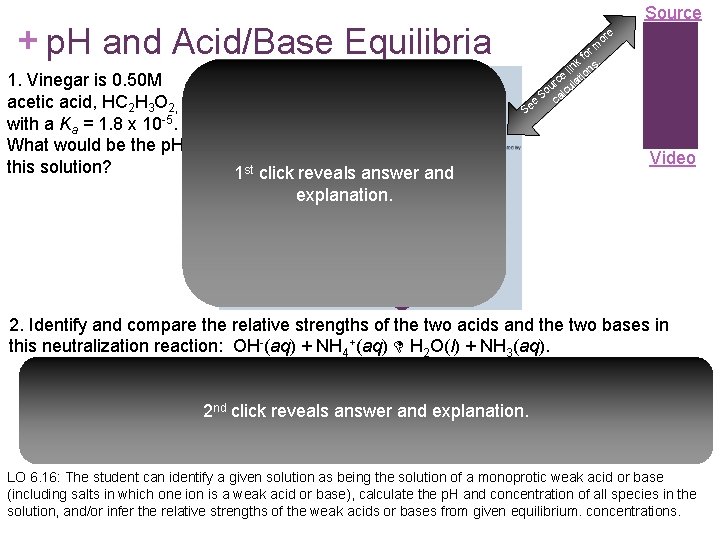
Source + p. H and Acid/Base Equilibria 1. Vinegar is 0. 50 M acetic acid, HC 2 H 3 O 2, with a Ka = 1. 8 x 10 -5. What would be the p. H of this solution? e or Se 1 st click reveals answer and explanation. r m fo. k s lin tion e c ur cula o l S e ca Video 2. Identify and compare the relative strengths of the two acids and the two bases in this neutralization reaction: OH-(aq) + NH 4+(aq) H 2 O(l) + NH 3(aq). Answer: Hydroxide(OH-), and ammonia(NH 3) are the two bases, with ammonia being the weaker, while ammonium(NH 4+) and water are the acids, nd with water the weaker. The correct formulation of acid strength is based on a comparison to the Ka's of hydronium (=1) and water (= 1 x 10 -14). Any acid that is stronger than hydronium (e. g. HCl) is a strong acid and its conjugate base (chloride) has no effect on p. H because it does not hydrolyze in water. Any acid whose strength is between hydronium and water (e. g. ammonium) is a weak acid, and its conjugate is a weak base. Similarly, for bases, any base with Kb greater than that of hydroxide, which is = 1, (e. g. , oxide ion as K 2 O) is a strong base, and its conjugate acid (K+) has no effect on p. H because it does not hydrolyze in water. Any base with Kb between that of hydroxide and water (= 1 x 10 -14) is a weak base, and its conjugate is a weak acid (e. g. , acetate). 2 click reveals answer and explanation. LO 6. 16: The student can identify a given solution as being the solution of a monoprotic weak acid or base (including salts in which one ion is a weak acid or base), calculate the p. H and concentration of all species in the solution, and/or infer the relative strengths of the weak acids or bases from given equilibrium. concentrations.
+ Acid/Base reaction species Source Ask yourself: Is it strong? Weak? A salt? A buffer? What will it do in water? See Source link for more details Video Deal w/strong A/B first. These will react to completion with the available species. LO 6. 17: The student can, given an arbitrary mixture of weak and strong acids and bases (including polyprotic systems), determine which species will react strongly with one another (i. e. , with K>1) and what species will be present in large concentrations at equilibrium.
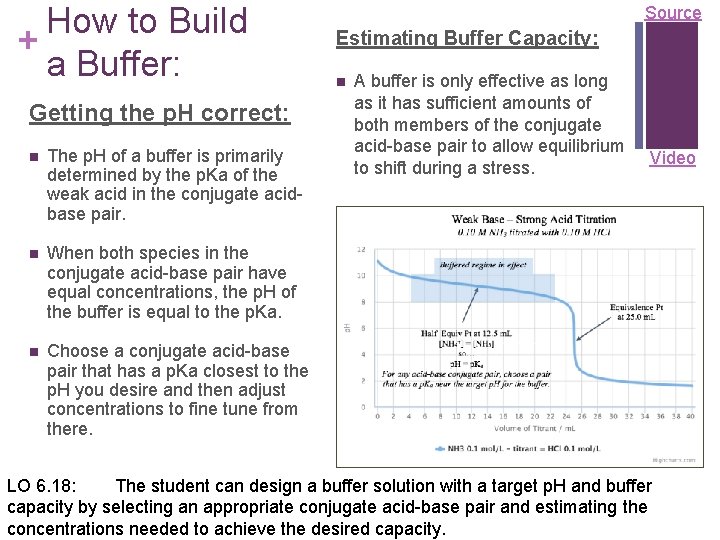
How to Build + a Buffer: Getting the p. H correct: n The p. H of a buffer is primarily determined by the p. Ka of the weak acid in the conjugate acidbase pair. n When both species in the conjugate acid-base pair have equal concentrations, the p. H of the buffer is equal to the p. Ka. n Choose a conjugate acid-base pair that has a p. Ka closest to the p. H you desire and then adjust concentrations to fine tune from there. Source Estimating Buffer Capacity: n A buffer is only effective as long as it has sufficient amounts of both members of the conjugate acid-base pair to allow equilibrium to shift during a stress. Video LO 6. 18: The student can design a buffer solution with a target p. H and buffer capacity by selecting an appropriate conjugate acid-base pair and estimating the concentrations needed to achieve the desired capacity.
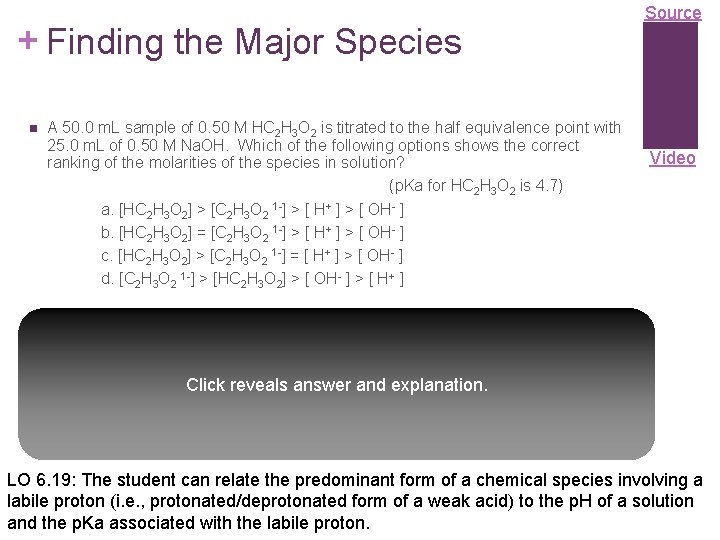
+ Finding the Major Species n A 50. 0 m. L sample of 0. 50 M HC 2 H 3 O 2 is titrated to the half equivalence point with 25. 0 m. L of 0. 50 M Na. OH. Which of the following options shows the correct ranking of the molarities of the species in solution? (p. Ka for HC 2 H 3 O 2 is 4. 7) a. [HC 2 H 3 O 2] > [C 2 H 3 O 2 1 -] > [ H+ ] > [ OH- ] b. [HC 2 H 3 O 2] = [C 2 H 3 O 2 1 -] > [ H+ ] > [ OH- ] c. [HC 2 H 3 O 2] > [C 2 H 3 O 2 1 -] = [ H+ ] > [ OH- ] d. [C 2 H 3 O 2 1 -] > [HC 2 H 3 O 2] > [ OH- ] > [ H+ ] Source Video Option B is correct. At the half equivalence point, the concentrations of the weak acid and its conjugate base are equal because the OH- ion has reacted with Click reveals answer and explanation. half of the original acetic acid. The p. H of the buffer is equal to the p. Ka at that point, so the [H+] is 10 -4. 7 which is far lower than the concentrations of the conjugates but far higher than the [OH-] which has a value of 109. 3. LO 6. 19: The student can relate the predominant form of a chemical species involving a labile proton (i. e. , protonated/deprotonated form of a weak acid) to the p. H of a solution and the p. Ka associated with the labile proton.
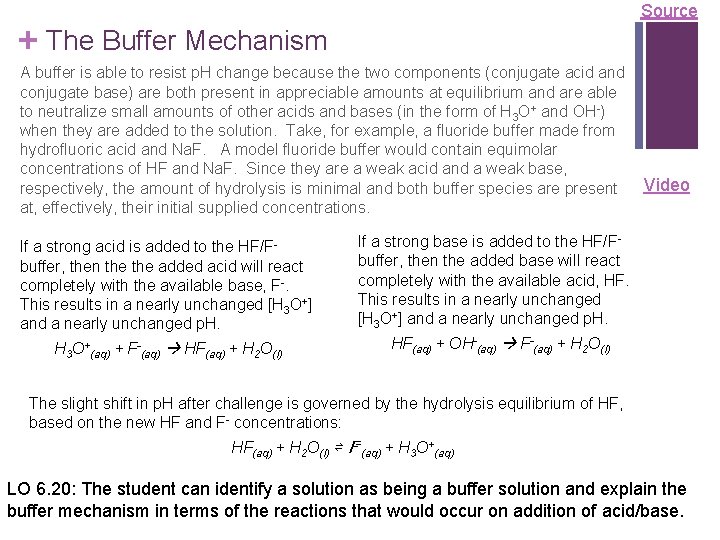
Source + The Buffer Mechanism A buffer is able to resist p. H change because the two components (conjugate acid and conjugate base) are both present in appreciable amounts at equilibrium and are able to neutralize small amounts of other acids and bases (in the form of H 3 O+ and OH-) when they are added to the solution. Take, for example, a fluoride buffer made from hydrofluoric acid and Na. F. A model fluoride buffer would contain equimolar concentrations of HF and Na. F. Since they are a weak acid and a weak base, respectively, the amount of hydrolysis is minimal and both buffer species are present Video at, effectively, their initial supplied concentrations. If a strong acid is added to the HF/F- buffer, then the added acid will react completely with the available base, F-. This results in a nearly unchanged [H 3 O+] and a nearly unchanged p. H. If a strong base is added to the HF/F- buffer, then the added base will react completely with the available acid, HF. This results in a nearly unchanged [H 3 O+] and a nearly unchanged p. H. H 3 O+(aq) + F-(aq) HF(aq) + H 2 O(l) HF(aq) + OH-(aq) F-(aq) + H 2 O(l) The slight shift in p. H after challenge is governed by the hydrolysis equilibrium of HF, based on the new HF and F- concentrations: HF(aq) + H 2 O(l) ⇌ F−(aq) + H 3 O+(aq) LO 6. 20: The student can identify a solution as being a buffer solution and explain the buffer mechanism in terms of the reactions that would occur on addition of acid/base.
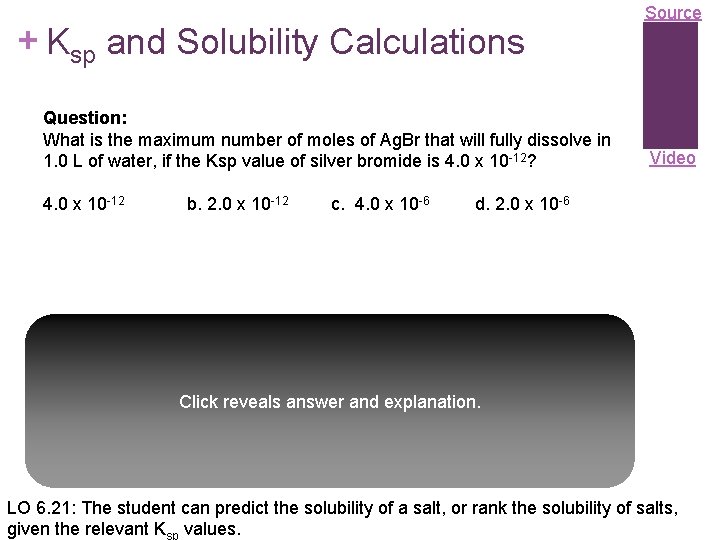
+ Ksp and Solubility Calculations Question: What is the maximum number of moles of Ag. Br that will fully dissolve in 1. 0 L of water, if the Ksp value of silver bromide is 4. 0 x 10 -12? 4. 0 x 10 -12 b. 2. 0 x 10 -12 c. 4. 0 x 10 -6 d. 2. 0 x 10 -6 Source Video Answer: The correct answer is “d” 2. 0 x 10 -6 . To determine the solubility of Ag. Br we need to determine the maximum concentrations of Ag+ and Br- that will equal the equilibrium constant. The Ksp equation is Click reveals answer and explanation. Ksp = [Ag+][Br-] with [Ag+] = [Br-] = X, so to solve for X we need to take the square root of 4. 0 x 10 -12 LO 6. 21: The student can predict the solubility of a salt, or rank the solubility of salts, given the relevant Ksp values.
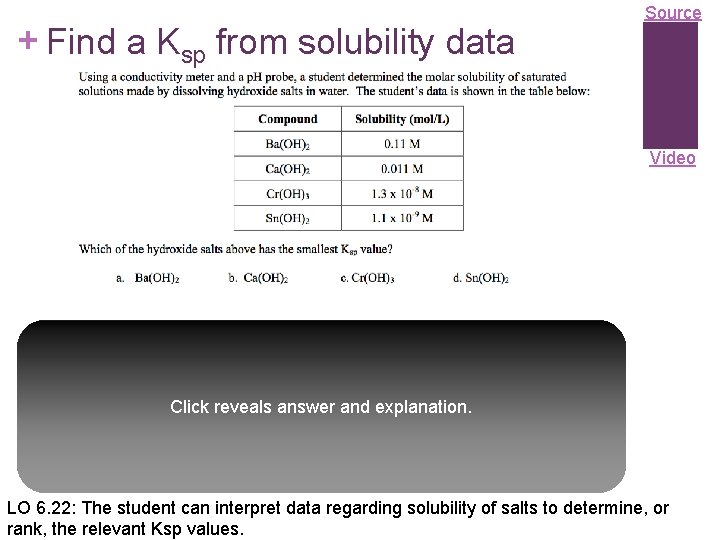
+ Find a Ksp from solubility data Source Video Click reveals answer and explanation. LO 6. 22: The student can interpret data regarding solubility of salts to determine, or rank, the relevant Ksp values.
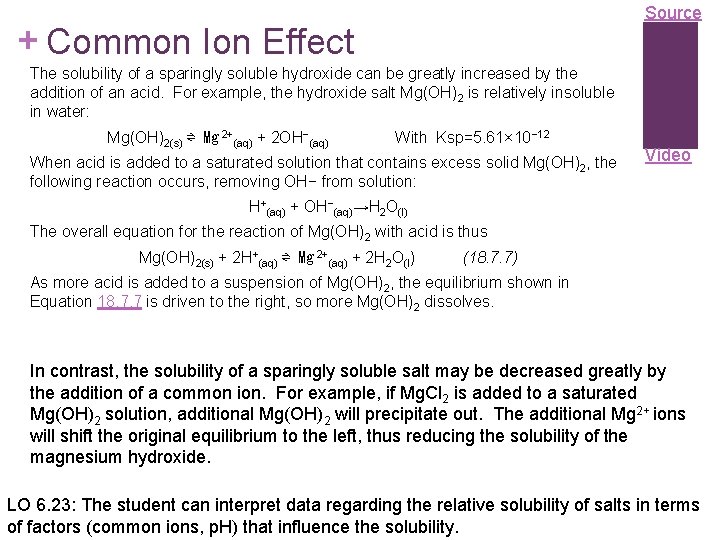
Source + Common Ion Effect The solubility of a sparingly soluble hydroxide can be greatly increased by the addition of an acid. For example, the hydroxide salt Mg(OH)2 is relatively insoluble in water: Mg(OH)2(s) ⇌ Mg 2+(aq) + 2 OH−(aq) With Ksp=5. 61× 10− 12 When acid is added to a saturated solution that contains excess solid Mg(OH)2, the following reaction occurs, removing OH− from solution: Video H+(aq) + OH−(aq)→H 2 O(l) The overall equation for the reaction of Mg(OH)2 with acid is thus Mg(OH)2(s) + 2 H+(aq) ⇌ Mg 2+(aq) + 2 H 2 O(l) (18. 7. 7) As more acid is added to a suspension of Mg(OH)2, the equilibrium shown in Equation 18. 7. 7 is driven to the right, so more Mg(OH)2 dissolves. In contrast, the solubility of a sparingly soluble salt may be decreased greatly by the addition of a common ion. For example, if Mg. Cl 2 is added to a saturated Mg(OH)2 solution, additional Mg(OH)2 will precipitate out. The additional Mg 2+ ions will shift the original equilibrium to the left, thus reducing the solubility of the magnesium hydroxide. LO 6. 23: The student can interpret data regarding the relative solubility of salts in terms of factors (common ions, p. H) that influence the solubility.
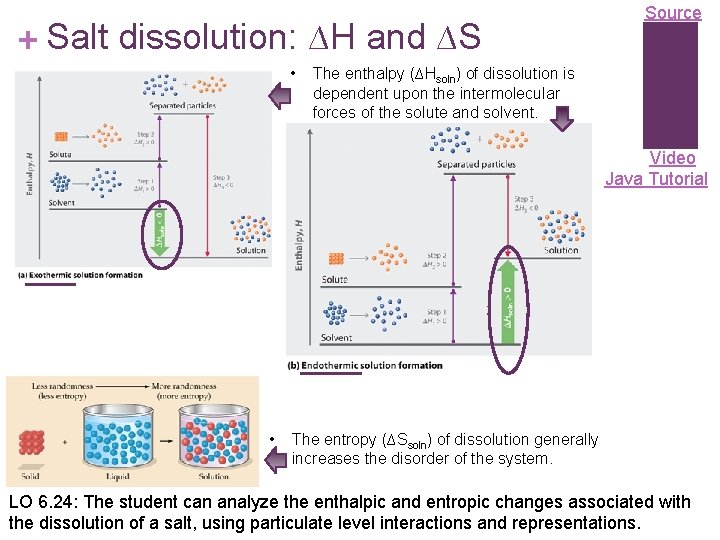
+ Salt dissolution: ∆H and ∆S • Source The enthalpy (∆Hsoln) of dissolution is dependent upon the intermolecular forces of the solute and solvent. Video Java Tutorial • The entropy (∆Ssoln) of dissolution generally increases the disorder of the system. LO 6. 24: The student can analyze the enthalpic and entropic changes associated with the dissolution of a salt, using particulate level interactions and representations.
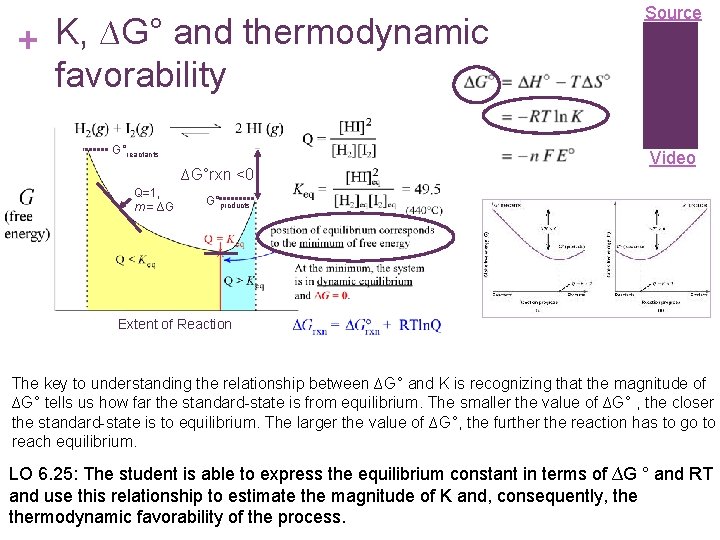
+ K, ∆G° and thermodynamic favorability G°reactants ∆G°rxn <0 Q=1, m = ∆G Source Video G°products Extent of Reaction The key to understanding the relationship between ∆G° and K is recognizing that the magnitude of ∆G° tells us how far the standard-state is from equilibrium. The smaller the value of ∆G° , the closer the standard-state is to equilibrium. The larger the value of ∆G°, the further the reaction has to go to reach equilibrium. LO 6. 25: The student is able to express the equilibrium constant in terms of ∆G ° and RT and use this relationship to estimate the magnitude of K and, consequently, thermodynamic favorability of the process.
+ Science Practices Laboratory Exercises
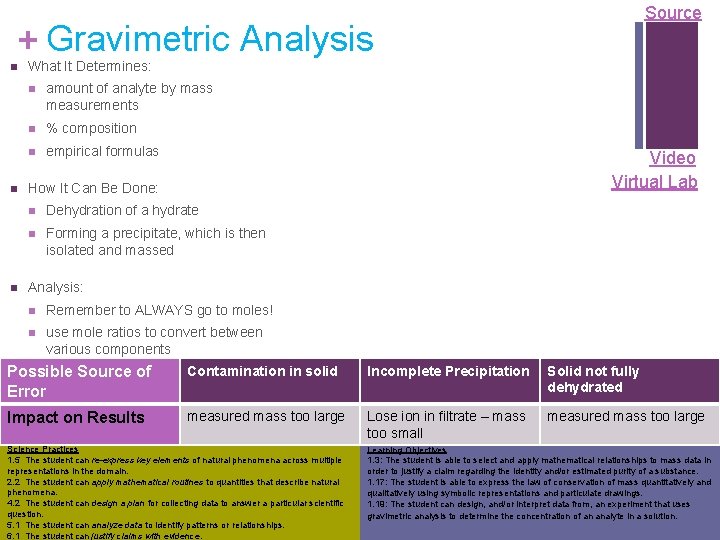
Source + Gravimetric Analysis n n n What It Determines: n amount of analyte by mass measurements n % composition n empirical formulas Video Virtual Lab How It Can Be Done: n Dehydration of a hydrate n Forming a precipitate, which is then isolated and massed Analysis: n Remember to ALWAYS go to moles! n use mole ratios to convert between various components Possible Source of Error Contamination in solid Incomplete Precipitation Solid not fully dehydrated Impact on Results measured mass too large Lose ion in filtrate – mass too small measured mass too large Science Practices 1. 5 The student can re-express key elements of natural phenomena across multiple representations in the domain. 2. 2 The student can apply mathematical routines to quantities that describe natural phenomena. 4. 2 The student can design a plan for collecting data to answer a particular scientific question. 5. 1 The student can analyze data to identify patterns or relationships. 6. 1 The student can justify claims with evidence. Learning Objectives 1. 3: The student is able to select and apply mathematical relationships to mass data in order to justify a claim regarding the identity and/or estimated purity of a substance. 1. 17: The student is able to express the law of conservation of mass quantitatively and qualitatively using symbolic representations and particulate drawings. 1. 19: The student can design, and/or interpret data from, an experiment that uses gravimetric analysis to determine the concentration of an analyte in a solution.
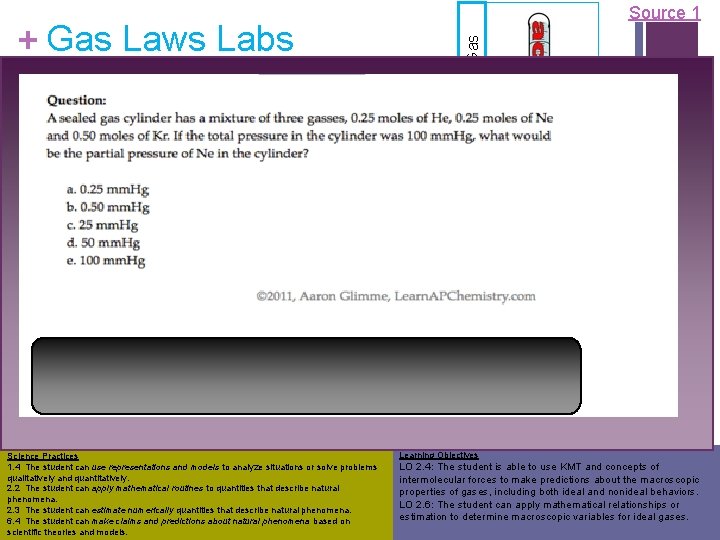
Determination of Molar Volume of a Gas + Gas Laws Labs n How It’s Done/Analysis: Determination of Molar Mass of a Volatile Liquid n Volatile liquid heated until completely vaporized n PV=n. RT to solve for n: n Temperature of water bath=T n Small hole in stopper means Pressure = room pressure n Volume=volume of flask n Divide Mass of recondensed unknown by moles, compare to known molar mass to ID unknown n Assume vapor completely recondenses If lose vapor, then mass would be too low, and moles http: //chemskills. com/? q=ideal_gas_law would be low Diffusion : Graham’s Law Demo n How It’s Done/Analysis: n Ends of glass tube plugged with soaked cotton n White ring is NH 4 Cl ppt n Ppt will not be exactly in middle… Science Practices 1. 4 The student can use representations and models to analyze situations or solve problems qualitatively and quantitatively. 2. 2 The student can apply mathematical routines to quantities that describe natural phenomena. 2. 3 The student can estimate numerically quantities that describe natural phenomena. 6. 4 The student can make claims and predictions about natural phenomena based on scientific theories and models. n After rxn, eudiometer lowered into water until levels equal so pressure inside room and tube are same n Use Dalton’s Law to subtract Pwater n Sources of error: n Mg left: moles of H 2 too low n Air bubble at start: volume of gas too high Source 1 Source 2 Video 1 Video 2 Video 3 n Molar mass of NH 3 is lower than MM of HCl, so ring will be toward right side of tube n Graham’s Law can be used to establish ratios which can be applied to distances Learning Objectives LO 2. 4: The student is able to use KMT and concepts of intermolecular forces to make predictions about the macroscopic properties of gases, including both ideal and nonideal behaviors. LO 2. 6: The student can apply mathematical relationships or estimation to determine macroscopic variables for ideal gases.
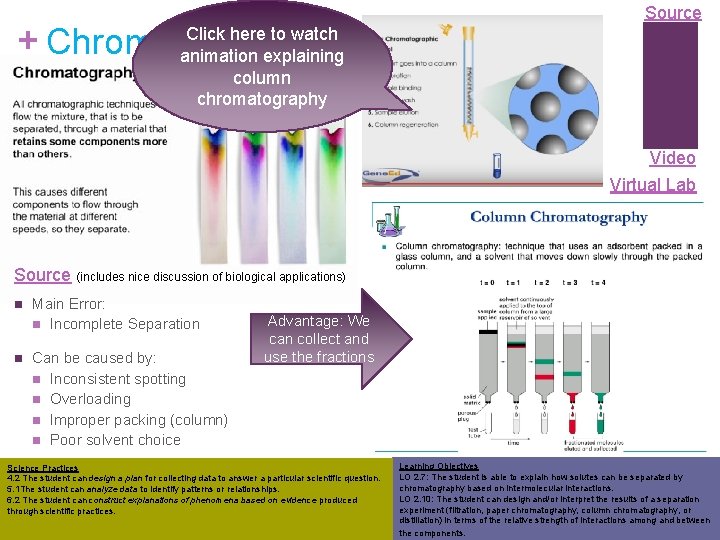
Click here to watch + Chromatography animation explaining Source column chromatography Video Virtual Lab Source (includes nice discussion of biological applications) n n Main Error: n Incomplete Separation Can be caused by: n Inconsistent spotting n Overloading n Improper packing (column) n Poor solvent choice Advantage: We can collect and use the fractions Science Practices 4. 2 The student can design a plan for collecting data to answer a particular scientific question. 5. 1 The student can analyze data to identify patterns or relationships. 6. 2 The student can construct explanations of phenomena based on evidence produced through scientific practices. Learning Objectives LO 2. 7: The student is able to explain how solutes can be separated by chromatography based on intermolecular interactions. LO 2. 10: The student can design and/or interpret the results of a separation experiment (filtration, paper chromatography, column chromatography, or distillation) in terms of the relative strength of interactions among and between the components.
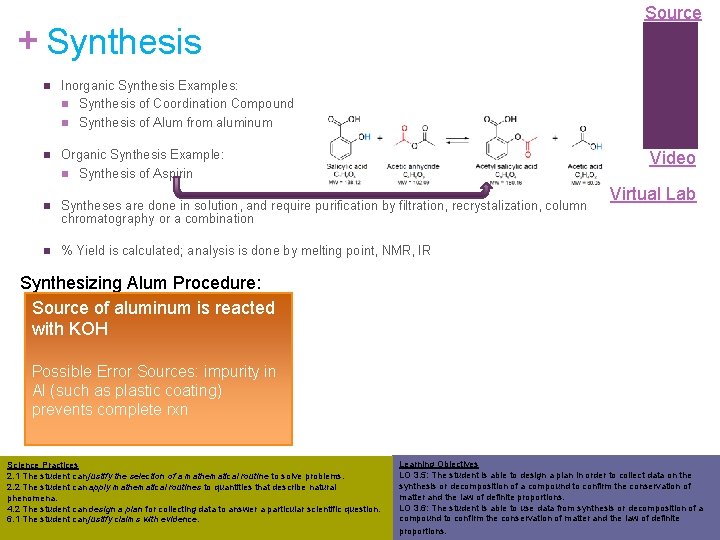
Source + Synthesis n Inorganic Synthesis Examples: n Synthesis of Coordination Compound n Synthesis of Alum from aluminum n Organic Synthesis Example: n Synthesis of Aspirin n Syntheses are done in solution, and require purification by filtration, recrystalization, column chromatography or a combination n % Yield is calculated; analysis is done by melting point, NMR, IR Video Virtual Lab Synthesizing Alum Procedure: Source of aluminum is reacted H Mixture heated until no Al(s) is Filter and collect alum crystals Recrystallize alum in ice bath 2 SO 4 is added to ppt Al(OH)3 with KOH left Possible Error Sources: incomplete Possible Error Sources: crystals Possible Error Sources: impurity in precipitation escape to filtrate, crystals not form too quickly, incomplete Possible Error Sources: some Al(s) Al (such as plastic coating) washed well and remain wet recrystallization remains undissolved prevents complete rxn Science Practices 2. 1 The student can justify the selection of a mathematical routine to solve problems. 2. 2 The student can apply mathematical routines to quantities that describe natural phenomena. 4. 2 The student can design a plan for collecting data to answer a particular scientific question. 6. 1 The student can justify claims with evidence. LO: Learning Objectives LO 3. 5: The student is able to design a plan in order to collect data on the synthesis or decomposition of a compound to confirm the conservation of matter and the law of definite proportions. LO 3. 6: The student is able to use data from synthesis or decomposition of a compound to confirm the conservation of matter and the law of definite proportions.
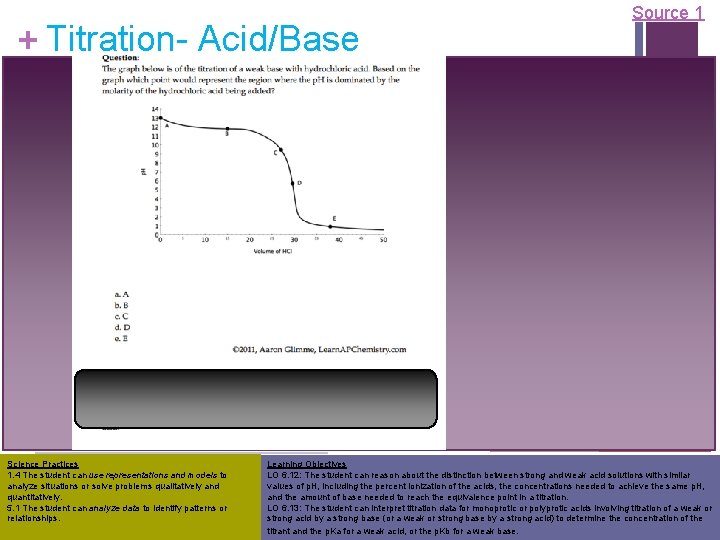
+ Titration- Acid/Base n n Assumption: Endpoint is equivalence point n This is not true – we actually “overshoot” before indicator changes Possible Sources of Error: n Overshoot Endpoint n Moles of titrant (and therefore analyte) too high n Not reading to bottom of meniscus n Moles of titrant too low n Concentration of titrant not what expected n Be sure to rinse buret with titrant first to control for this Science Practices 1. 4 The student can use representations and models to analyze situations or solve problems qualitatively and quantitatively. 5. 1 The student can analyze data to identify patterns or relationships. Source 1 Source 2 Video Source Virtual Lab Strength of Acids affects shape of graph: Polyprotic acids have multiple end points: Learning Objectives LO 6. 12: The student can reason about the distinction between strong and weak acid solutions with similar values of p. H, including the percent ionization of the acids, the concentrations needed to achieve the same p. H, and the amount of base needed to reach the equivalence point in a titration. LO 6. 13: The student can interpret titration data for monoprotic or polyprotic acids involving titration of a weak or strong acid by a strong base (or a weak or strong base by a strong acid) to determine the concentration of the titrant and the p. Ka for a weak acid, or the p. Kb for a weak base.
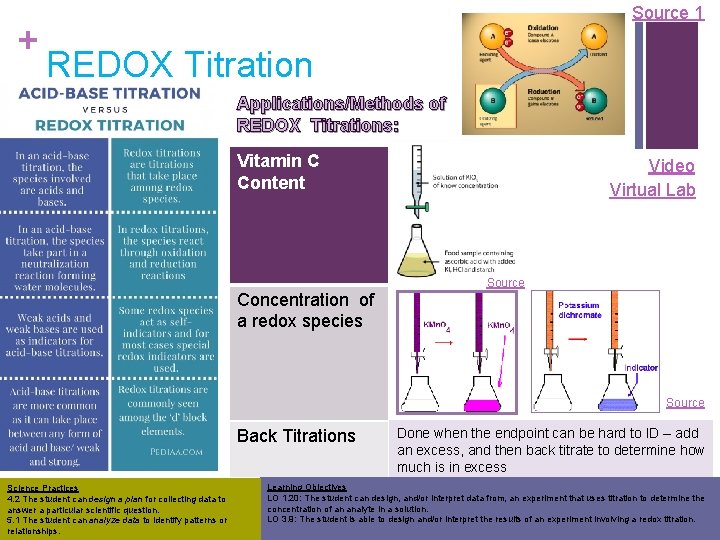
+ Source 1 REDOX Titration n Endpoint can be Or REDOX determined by Or an indicator: potentiometer: that shows the presence of a particular species: Applications/Methods of REDOX Titrations: Vitamin C Content Video Virtual Lab Source n Starch indicates presence of iodine Concentration of a redox species Source Back Titrations Science Practices 4. 2 The student can design a plan for collecting data to answer a particular scientific question. 5. 1 The student can analyze data to identify patterns or relationships. Done when the endpoint can be hard to ID – add an excess, and then back titrate to determine how much is in excess Learning Objectives LO 1. 20: The student can design, and/or interpret data from, an experiment that uses titration to determine the concentration of an analyte in a solution. LO 3. 9: The student is able to design and/or interpret the results of an experiment involving a redox titration.
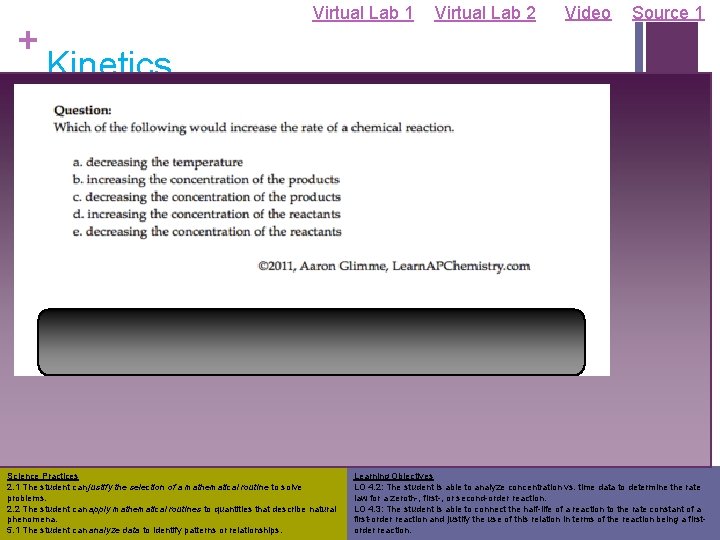
+ Virtual Lab 1 Virtual Lab 2 Video Source 1 Kinetics n Using Spectrometry: n Clock Reactions n Reactions that have a delayed physical change due to mechanism which only has a later step show color change n Concentration vs. time data can be gathered Time (s) n Data: Zero Order Plot 1 st Order Plot 2 nd Order Plot n n It is important that there is a relatively low [S 2 O 3 -] so that the I 3 - will accumulate and show the color change Analysis n rate law from straight-line graph n k from integrated rate law n Ea from Arrhenius Equation Blue in the presence of starch Science Practices 2. 1 The student can justify the selection of a mathematical routine to solve problems. 2. 2 The student can apply mathematical routines to quantities that describe natural phenomena. 5. 1 The student can analyze data to identify patterns or relationships. Learning Objectives LO 4. 2: The student is able to analyze concentration vs. time data to determine the rate law for a zeroth-, first-, or second-order reaction. LO 4. 3: The student is able to connect the half-life of a reaction to the rate constant of a first-order reaction and justify the use of this relation in terms of the reaction being a firstorder reaction.
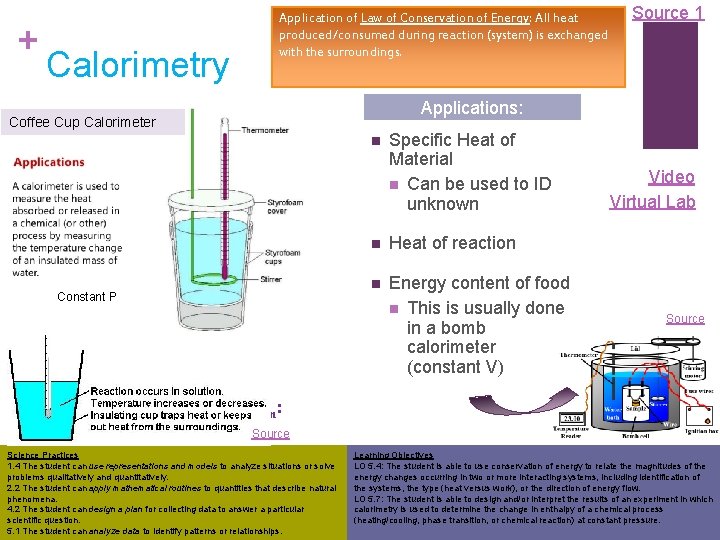
+ Calorimetry Application of Law of Conservation of Energy: All heat produced/consumed during reaction (system) is exchanged with the surroundings. Applications: Coffee Cup Calorimeter Assumption: • the calorimeter is isolated • so the surroundings are only the calorimeter setup, which includes the water • the calorimeter itself has a heat capacity, as it will absorb some heat. • So… Constant P qsurr = -qrxn qsurr = qcal+q. H 2 O+sys qcal = CcalΔT Therefore: -qrxn= CcalΔT + m. H 2 O+syscΔT Then we can use qrxn find ΔHrxn: ΔHrxn =qrxn/molreact Source Science Practices 1. 4 The student can use representations and models to analyze situations or solve problems qualitatively and quantitatively. 2. 2 The student can apply mathematical routines to quantities that describe natural phenomena. 4. 2 The student can design a plan for collecting data to answer a particular scientific question. 5. 1 The student can analyze data to identify patterns or relationships. Source 1 n Specific Heat of Material n Can be used to ID unknown n Heat of reaction n Energy content of food n This is usually done in a bomb calorimeter (constant V) Video Virtual Lab Source Learning Objectives LO 5. 4: The student is able to use conservation of energy to relate the magnitudes of the energy changes occurring in two or more interacting systems, including identification of the systems, the type (heat versus work), or the direction of energy flow. LO 5. 7: The student is able to design and/or interpret the results of an experiment in which calorimetry is used to determine the change in enthalpy of a chemical process (heating/cooling, phase transition, or chemical reaction) at constant pressure.
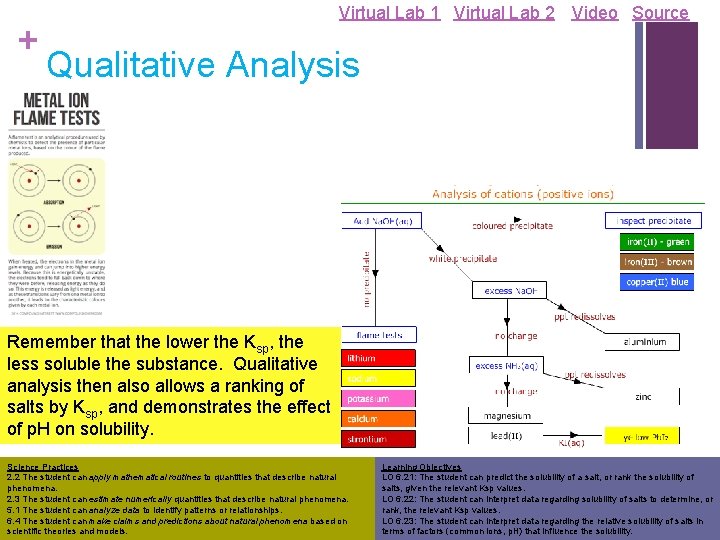
+ Virtual Lab 1 Virtual Lab 2 Video Source Qualitative Analysis Remember that the lower the Ksp, the less soluble the substance. Qualitative analysis then also allows a ranking of salts by Ksp, and demonstrates the effect of p. H on solubility. Science Practices 2. 2 The student can apply mathematical routines to quantities that describe natural phenomena. 2. 3 The student can estimate numerically quantities that describe natural phenomena. 5. 1 The student can analyze data to identify patterns or relationships. 6. 4 The student can make claims and predictions about natural phenomena based on scientific theories and models. Learning Objectives LO 6. 21: The student can predict the solubility of a salt, or rank the solubility of salts, given the relevant Ksp values. LO 6. 22: The student can interpret data regarding solubility of salts to determine, or rank, the relevant Ksp values. LO 6. 23: The student can interpret data regarding the relative solubility of salts in terms of factors (common ions, p. H) that influence the solubility.
+ Common problems and misconceptions n Going from mass to empirical formula – often switch the coefficients n Transition metals lose the s electrons first n s electrons are further on average from nucleus than p for same energy level n Units: k. J vs J, °C vs K, per mole or per gram; don’t lose track of which unit you’re using; not always at STP for a gas n Explaining is more than just an observation: a lone pair on a central atom is not sufficient for shape, the pair must act (repel the other electrons) n What occurs in the process of dissolving? The solute is not disappearing; it is mixing
+ Common problems and misconceptions n Don’t make H+ from the addition of a strong base; don’t make OH- from the addition of a strong acid n Van der Waal’s is not LDF; do not use mass as an explanation for LDF. You may use polarizability, # of electrons, size, and volume. n Limiting reactant problems are confusing – which is limiting, how much of the other is used up, how much of the other remains, etc n Combustion analysis to get empirical formula can be confusing, particularly if not using oxygen as the oxidizer