
Collision Resolution Open Addressing Quadratic Probing Double Hashing
Collision Resolution: Open Addressing • Quadratic Probing • Double Hashing • Rehashing • Algorithms for: – insert – find – withdraw 1
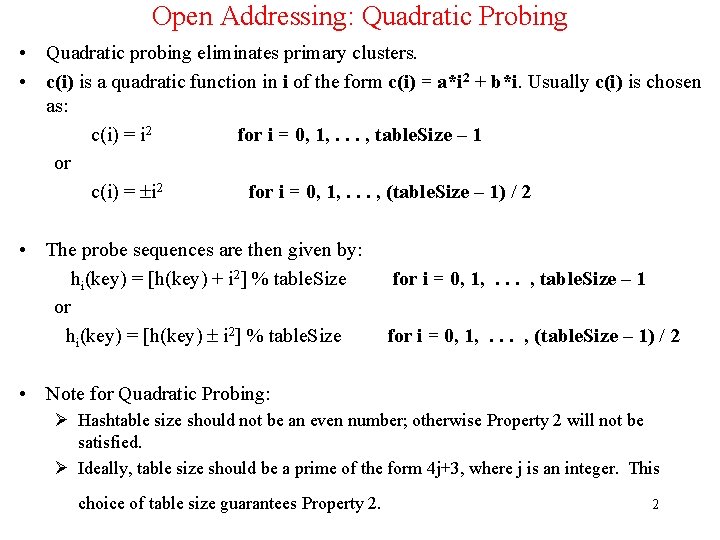
Open Addressing: Quadratic Probing • Quadratic probing eliminates primary clusters. • c(i) is a quadratic function in i of the form c(i) = a*i 2 + b*i. Usually c(i) is chosen as: c(i) = i 2 for i = 0, 1, . . . , table. Size – 1 or c(i) = i 2 for i = 0, 1, . . . , (table. Size – 1) / 2 • The probe sequences are then given by: hi(key) = [h(key) + i 2] % table. Size or hi(key) = [h(key) i 2] % table. Size for i = 0, 1, . . . , table. Size – 1 for i = 0, 1, . . . , (table. Size – 1) / 2 • Note for Quadratic Probing: Ø Hashtable size should not be an even number; otherwise Property 2 will not be satisfied. Ø Ideally, table size should be a prime of the form 4 j+3, where j is an integer. This choice of table size guarantees Property 2. 2
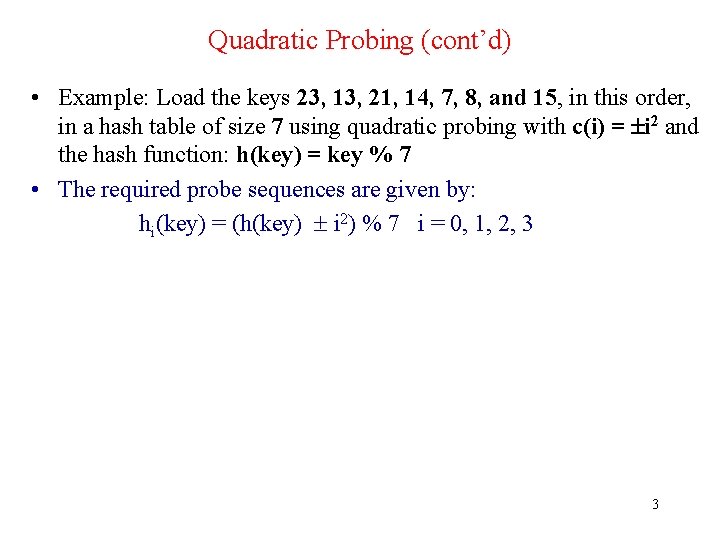
Quadratic Probing (cont’d) • Example: Load the keys 23, 13, 21, 14, 7, 8, and 15, in this order, in a hash table of size 7 using quadratic probing with c(i) = i 2 and the hash function: h(key) = key % 7 • The required probe sequences are given by: hi(key) = (h(key) i 2) % 7 i = 0, 1, 2, 3 3
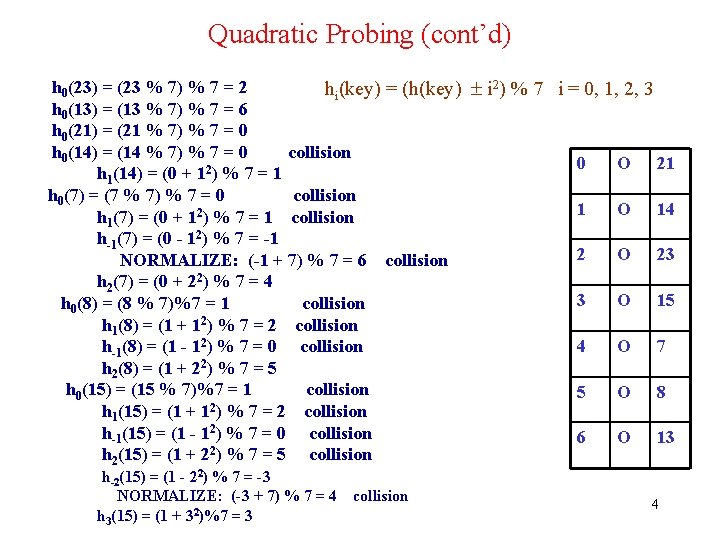
Quadratic Probing (cont’d) h 0(23) = (23 % 7) % 7 = 2 hi(key) = (h(key) i 2) % 7 i = 0, 1, 2, 3 h 0(13) = (13 % 7) % 7 = 6 h 0(21) = (21 % 7) % 7 = 0 h 0(14) = (14 % 7) % 7 = 0 collision 0 O 21 h 1(14) = (0 + 12) % 7 = 1 h 0(7) = (7 % 7) % 7 = 0 collision 1 O 14 h 1(7) = (0 + 12) % 7 = 1 collision h-1(7) = (0 - 12) % 7 = -1 2 O 23 NORMALIZE: (-1 + 7) % 7 = 6 collision h 2(7) = (0 + 22) % 7 = 4 3 O 15 h 0(8) = (8 % 7)%7 = 1 collision h 1(8) = (1 + 12) % 7 = 2 collision 4 O 7 h-1(8) = (1 - 12) % 7 = 0 collision h 2(8) = (1 + 22) % 7 = 5 h 0(15) = (15 % 7)%7 = 1 collision 5 O 8 2 h 1(15) = (1 + 1 ) % 7 = 2 collision h-1(15) = (1 - 12) % 7 = 0 collision 6 O 13 2 h 2(15) = (1 + 2 ) % 7 = 5 collision h-2(15) = (1 - 22) % 7 = -3 NORMALIZE: (-3 + 7) % 7 = 4 h 3(15) = (1 + 32)%7 = 3 collision 4

Secondary Clusters • Quadratic probing is better than linear probing because it eliminates primary clustering. • However, it may result in secondary clustering: if h(k 1) = h(k 2) the probing sequences for k 1 and k 2 are exactly the same. This sequence of locations is called a secondary cluster. • Secondary clustering is less harmful than primary clustering because secondary clusters do not combine to form large clusters. • Example of Secondary Clustering: Suppose keys k 0, k 1, k 2, k 3, and k 4 are inserted in the given order in an originally empty hash table using quadratic probing with c(i) = i 2. Assuming that each of the keys hashes to the same array index x. A secondary cluster will develop and grow in size: 5
Double Hashing • To eliminate secondary clustering, synonyms must have different probe sequences. • Double hashing achieves this by having two hash functions that both depend on the hash key. • c(i) = i * hp(key) for i = 0, 1, . . . , table. Size – 1 where hp (or h 2) is another hash function. • The probing sequence is: hi(key) = [h(key) + i*hp(key)]% table. Size for i = 0, 1, . . . , table. Size – 1 • The function c(i) = i*hp(r) satisfies Property 2 provided hp(r) and table. Size are relatively prime. • To guarantee Property 2, table. Size must be a prime number. • Common definitions for hp are : Ø hp(key) = 1 + key % (table. Size - 1) Ø hp(key) = q - (key % q) where q is a prime less than table. Size Ø hp(key) = q*(key % q) where q is a prime less than table. Size 6
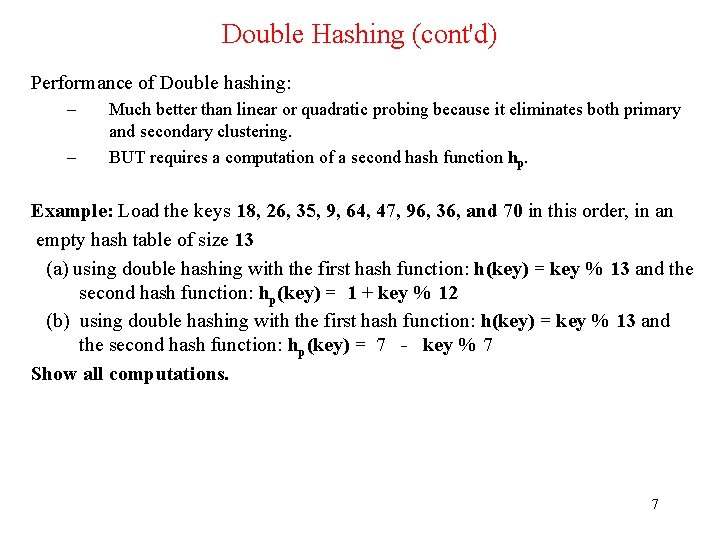
Double Hashing (cont'd) Performance of Double hashing: – – Much better than linear or quadratic probing because it eliminates both primary and secondary clustering. BUT requires a computation of a second hash function hp. Example: Load the keys 18, 26, 35, 9, 64, 47, 96, 36, and 70 in this order, in an empty hash table of size 13 (a) using double hashing with the first hash function: h(key) = key % 13 and the second hash function: hp(key) = 1 + key % 12 (b) using double hashing with the first hash function: h(key) = key % 13 and the second hash function: hp(key) = 7 - key % 7 Show all computations. 7
![Double Hashing (cont’d) hi(key) = [h(key) + i*hp(key)]% 13 h 0(18) = (18%13)%13 =](http://slidetodoc.com/presentation_image_h2/cce78755313d8eaa439c01150c2a649a/image-8.jpg "Double Hashing (cont’d) hi(key) = [h(key) + i*hp(key)]% 13 h 0(18) = (18%13)%13 =")
Double Hashing (cont’d) hi(key) = [h(key) + i*hp(key)]% 13 h 0(18) = (18%13)%13 = 5 h 0(26) = (26%13)%13 = 0 h(key) = key % 13 h 0(35) = (35%13)%13 = 9 h 0(9) = (9%13)%13 = 9 collision hp(key) = 1 + key % 12 hp(9) = 1 + 9%12 = 10 h 1(9) = (9 + 1*10)%13 = 6 h 0(64) = (64%13)%13 = 12 h 0(47) = (47%13)%13 = 8 h 0(96) = (96%13)%13 = 5 collision hp(96) = 1 + 96%12 = 1 h 1(96) = (5 + 1*1)%13 = 6 collision h 2(96) = (5 + 2*1)%13 = 7 h 0(36) = (36%13)%13 = 10 h 0(70) = (70%13)%13 = 5 collision hp(70) = 1 + 70%12 = 11 h 1(70) = (5 + 1*11)%13 = 3 8
![Double Hashing (cont'd) hi(key) = [h(key) + i*hp(key)]% 13 h 0(18) = (18%13)%13 =](http://slidetodoc.com/presentation_image_h2/cce78755313d8eaa439c01150c2a649a/image-9.jpg "Double Hashing (cont'd) hi(key) = [h(key) + i*hp(key)]% 13 h 0(18) = (18%13)%13 =")
Double Hashing (cont'd) hi(key) = [h(key) + i*hp(key)]% 13 h 0(18) = (18%13)%13 = 5 h 0(26) = (26%13)%13 = 0 h(key) = key % 13 h 0(35) = (35%13)%13 = 9 h 0(9) = (9%13)%13 = 9 collision hp(key) = 7 - key % 7 hp(9) = 7 - 9%7 = 5 h 1(9) = (9 + 1*5)%13 = 1 h 0(64) = (64%13)%13 = 12 h 0(47) = (47%13)%13 = 8 h 0(96) = (96%13)%13 = 5 collision hp(96) = 7 - 96%7 = 2 h 1(96) = (5 + 1*2)%13 = 7 h 0(36) = (36%13)%13 = 10 h 0(70) = (70%13)%13 = 5 collision hp(70) = 7 - 70%7 = 7 h 1(70) = (5 + 1*7)%13 = 12 collision h 2(70) = (5 + 2*7)%13 = 6 9
Rehashing • As noted before, with open addressing, if the hash tables become too full, performance can suffer a lot. • So, what can we do? • We can double the hash table size, modify the hash function, and re-insert the data. – More specifically, the new size of the table will be the first prime that is more than twice as large as the old table size. 10
![Implementation of Open Addressing public class protected Open. Scatter. Table Entry array[]; static final](http://slidetodoc.com/presentation_image_h2/cce78755313d8eaa439c01150c2a649a/image-11.jpg "Implementation of Open Addressing public class protected Open. Scatter. Table Entry array[]; static final")
Implementation of Open Addressing public class protected Open. Scatter. Table Entry array[]; static final int extends Abstract. Hash. Table { EMPTY = 0; OCCUPIED = 1; DELETED = 2; protected static final class Entry { public int state = EMPTY; public Comparable object; // … } public Open. Scatter. Table(int size) { array = new Entry[size]; for(int i = 0; i < size; i++) array[i] = new Entry(); } // … } 11
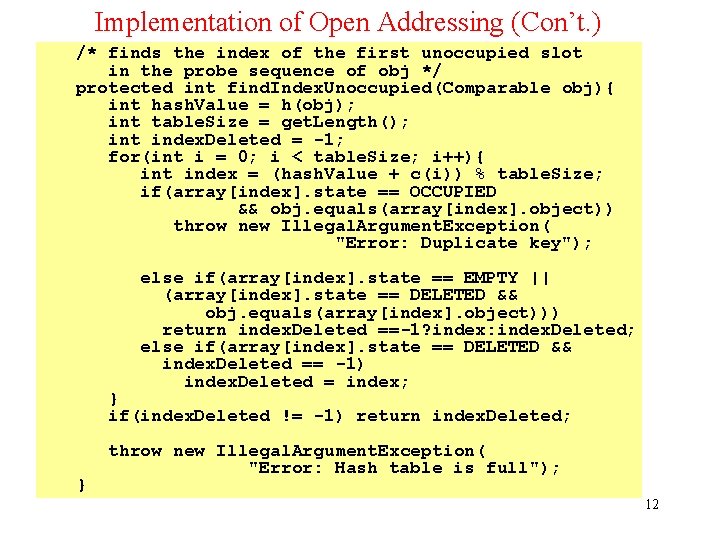
Implementation of Open Addressing (Con’t. ) /* finds the index of the first unoccupied slot in the probe sequence of obj */ protected int find. Index. Unoccupied(Comparable obj){ int hash. Value = h(obj); int table. Size = get. Length(); int index. Deleted = -1; for(int i = 0; i < table. Size; i++){ int index = (hash. Value + c(i)) % table. Size; if(array[index]. state == OCCUPIED && obj. equals(array[index]. object)) throw new Illegal. Argument. Exception( "Error: Duplicate key"); else if(array[index]. state == EMPTY || (array[index]. state == DELETED && obj. equals(array[index]. object))) return index. Deleted ==-1? index: index. Deleted; else if(array[index]. state == DELETED && index. Deleted == -1) index. Deleted = index; } if(index. Deleted != -1) return index. Deleted; } throw new Illegal. Argument. Exception( "Error: Hash table is full"); 12
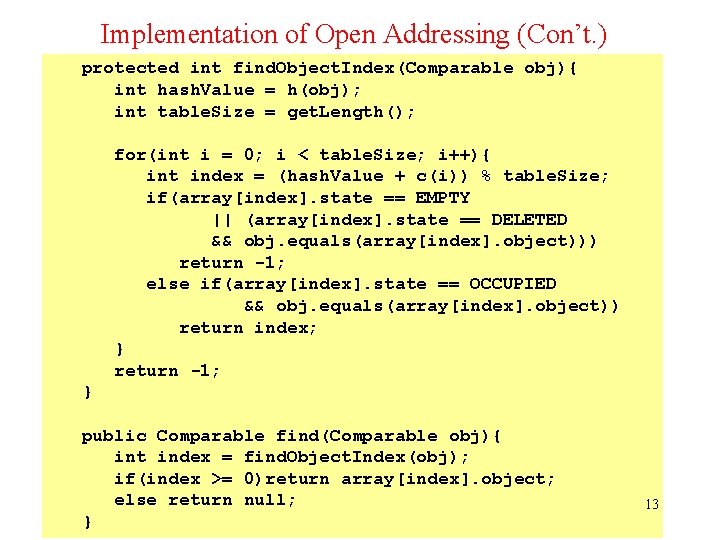
Implementation of Open Addressing (Con’t. ) protected int find. Object. Index(Comparable obj){ int hash. Value = h(obj); int table. Size = get. Length(); for(int i = 0; i < table. Size; i++){ int index = (hash. Value + c(i)) % table. Size; if(array[index]. state == EMPTY || (array[index]. state == DELETED && obj. equals(array[index]. object))) return -1; else if(array[index]. state == OCCUPIED && obj. equals(array[index]. object)) return index; } return -1; } public Comparable find(Comparable obj){ int index = find. Object. Index(obj); if(index >= 0)return array[index]. object; else return null; } 13
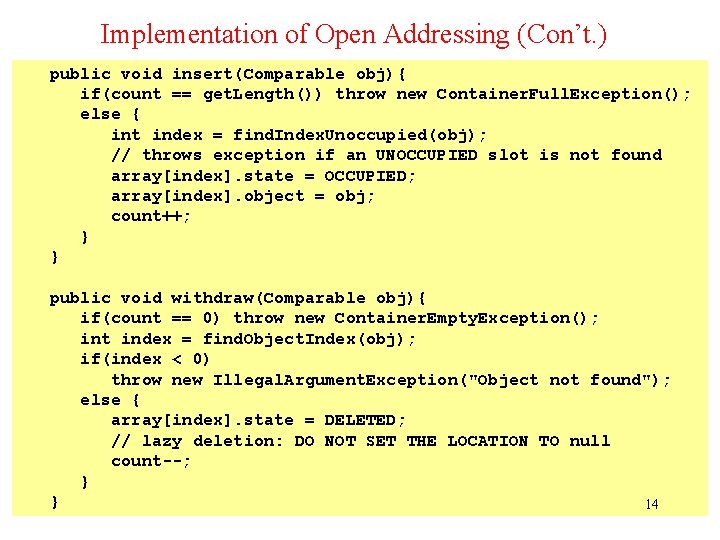
Implementation of Open Addressing (Con’t. ) public void insert(Comparable obj){ if(count == get. Length()) throw new Container. Full. Exception(); else { int index = find. Index. Unoccupied(obj); // throws exception if an UNOCCUPIED slot is not found array[index]. state = OCCUPIED; array[index]. object = obj; count++; } } public void withdraw(Comparable obj){ if(count == 0) throw new Container. Empty. Exception(); int index = find. Object. Index(obj); if(index < 0) throw new Illegal. Argument. Exception("Object not found"); else { array[index]. state = DELETED; // lazy deletion: DO NOT SET THE LOCATION TO null count--; } } 14
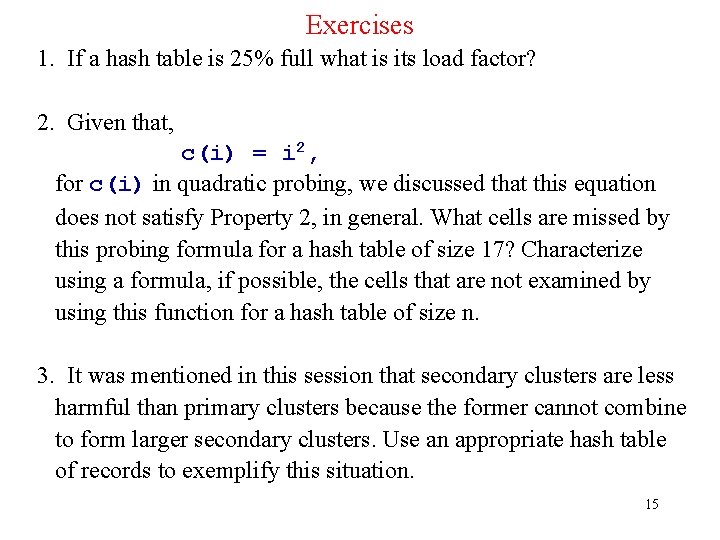
Exercises 1. If a hash table is 25% full what is its load factor? 2. Given that, c(i) = i 2, for c(i) in quadratic probing, we discussed that this equation does not satisfy Property 2, in general. What cells are missed by this probing formula for a hash table of size 17? Characterize using a formula, if possible, the cells that are not examined by using this function for a hash table of size n. 3. It was mentioned in this session that secondary clusters are less harmful than primary clusters because the former cannot combine to form larger secondary clusters. Use an appropriate hash table of records to exemplify this situation. 15
- Slides: 15