
Collision Avoidance System Testbed Critical Design Review Customer
Collision Avoidance System Testbed Critical Design Review Customer: John Reed and United Launch Alliance Team members: Trace Valade, Adam Holdridge, Angel Hoffman, Cameron Turman, Conner Martin, Griffin Van Anne, Hugo Stetz, Isaac Goldner, Jason Balke, Reade Warner, Roland Bailey, Sam Hartman Advisor: Prof. John Mah
Presentation Outline 1. Project Overview 2. Design Solution 3. Critical Project Elements 4. Requirements and their Satisfaction 5. Risk Analysis 6. Verification and Validation 7. Project Summary and Planning 2

Project Overview 3
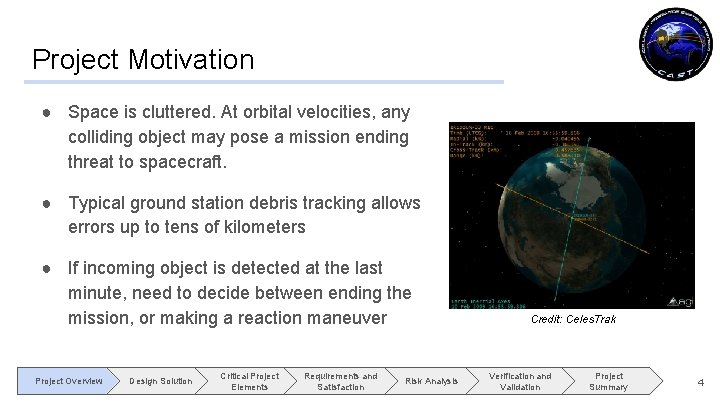
Project Motivation ● Space is cluttered. At orbital velocities, any colliding object may pose a mission ending threat to spacecraft. ● Typical ground station debris tracking allows errors up to tens of kilometers ● If incoming object is detected at the last minute, need to decide between ending the mission, or making a reaction maneuver Project Overview Design Solution Critical Project Elements Requirements and Satisfaction Risk Analysis Credit: Celes. Trak Verification and Validation Project Summary 4
Updates from PDR ● Not feasible to scale down relative orbital motion to physically representable scales ○ ○ Time frame Available resources ● Previously, we have shown near rectilinear motion in plane of collision ● Feasible to create control law, state estimator, and collision detection algorithm for unscaled, rectilinear motion ● Feasible for reaction maneuver to match acceleration profile of thruster Project Overview Design Solution Critical Project Elements Requirements and Satisfaction Risk Analysis Verification and Validation Project Summary 5
Project Objectives ● Implement physical 2 D demonstration that implements a detect and react algorithm ● Detect foreign incoming object in detection space of testing environment ● Perform state estimation and motion prediction of foreign object ● Develop control law that determines reaction maneuver in relative frame while mimicking thruster motion ● Prove control law against various collision scenarios Project Overview Design Solution Critical Project Elements Requirements and Satisfaction Risk Analysis Verification and Validation Project Summary 6
Collision Scenario Varieties Test cases involve changing aspects of the incoming object’s trajectory: Incoming object Spacecraft 2σ prediction Collision Angle Project Overview Design Solution Increased Speed of Incoming Object Critical Project Elements Requirements and Satisfaction Near-miss Situation Risk Analysis Verification and Validation Project Summary 7
Functional Requirements 1. The test system shall consist of a physical testbed capable of creating relative motion between two objects 2. The test system shall be capable of detecting a live, incoming object 3. The test system shall be capable of determining if a collision will occur 4. The test system shall be capable of avoiding a physical collision using motion characteristic of a thruster response in orbit Project Overview Design Solution Critical Project Elements Requirements and Satisfaction Risk Analysis Verification and Validation Project Summary 8
CONOPs Project Overview Design Solution Critical Project Elements Requirements and Satisfaction Risk Analysis Verification and Validation Project Summary 9
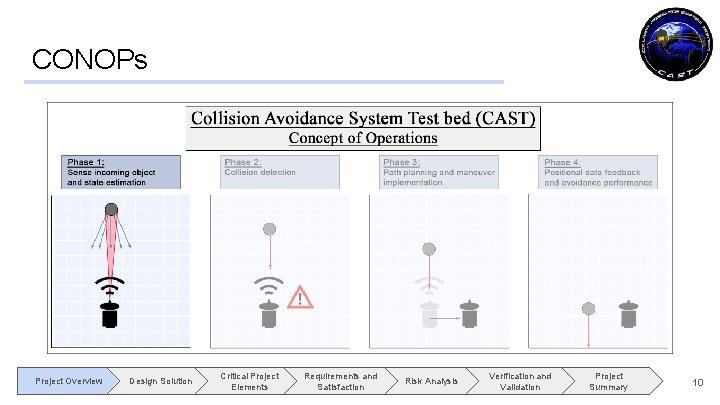
CONOPs Project Overview Design Solution Critical Project Elements Requirements and Satisfaction Risk Analysis Verification and Validation Project Summary 10

CONOPs Project Overview Design Solution Critical Project Elements Requirements and Satisfaction Risk Analysis Verification and Validation Project Summary 11
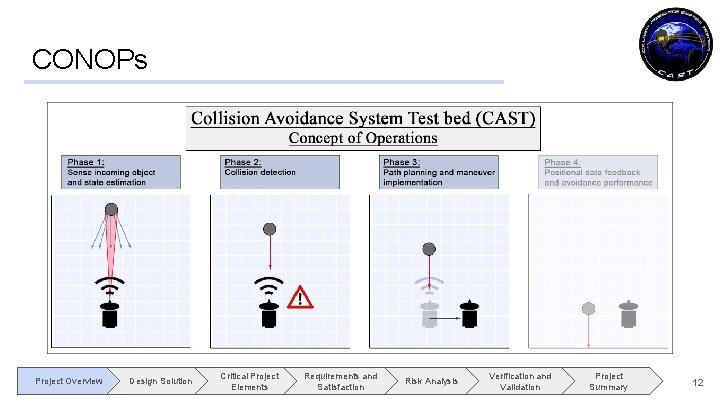
CONOPs Project Overview Design Solution Critical Project Elements Requirements and Satisfaction Risk Analysis Verification and Validation Project Summary 12
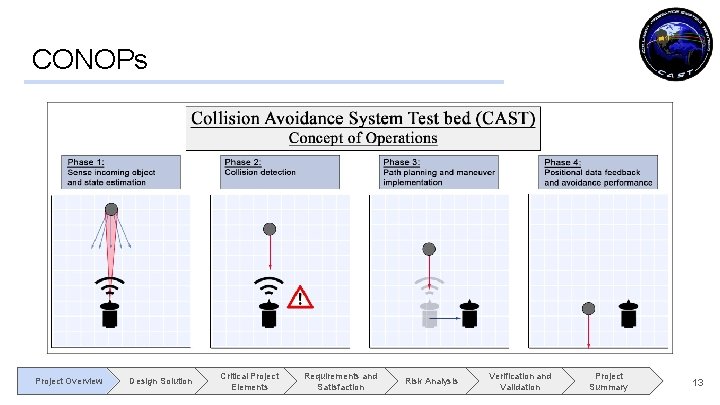
CONOPs Project Overview Design Solution Critical Project Elements Requirements and Satisfaction Risk Analysis Verification and Validation Project Summary 13

Design Solution 14
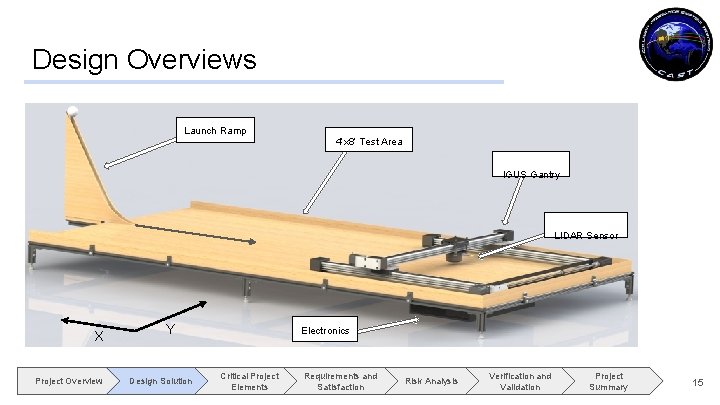
Design Overviews Launch Ramp 4’x 8’ Test Area IGUS Gantry LIDAR Sensor X Project Overview Y Design Solution Electronics Critical Project Elements Requirements and Satisfaction Risk Analysis Verification and Validation Project Summary 15
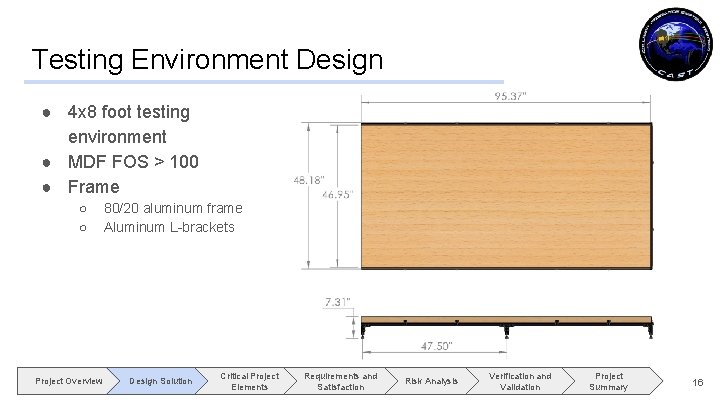
Testing Environment Design ● 4 x 8 foot testing environment ● MDF FOS > 100 ● Frame ○ ○ Project Overview 80/20 aluminum frame Aluminum L-brackets Design Solution Critical Project Elements Requirements and Satisfaction Risk Analysis Verification and Validation Project Summary 16
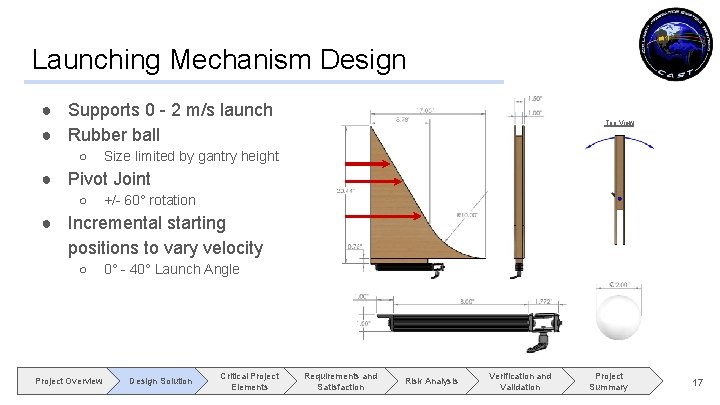
Launching Mechanism Design ● Supports 0 - 2 m/s launch ● Rubber ball ○ Top View Size limited by gantry height ● Pivot Joint ○ +/- 60° rotation ● Incremental starting positions to vary velocity ○ Project Overview 0° - 40° Launch Angle Design Solution Critical Project Elements Requirements and Satisfaction Risk Analysis Verification and Validation Project Summary 17
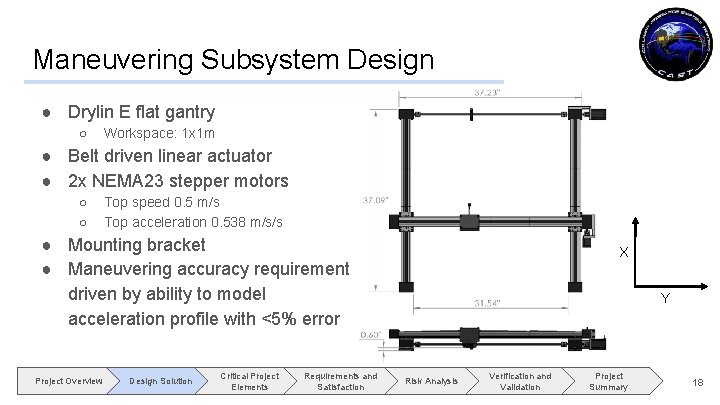
Maneuvering Subsystem Design ● Drylin E flat gantry ○ Workspace: 1 x 1 m ● Belt driven linear actuator ● 2 x NEMA 23 stepper motors ○ ○ Top speed 0. 5 m/s Top acceleration 0. 538 m/s/s ● Mounting bracket ● Maneuvering accuracy requirement driven by ability to model acceleration profile with <5% error Project Overview Design Solution Critical Project Elements Requirements and Satisfaction X Y Risk Analysis Verification and Validation Project Summary 18
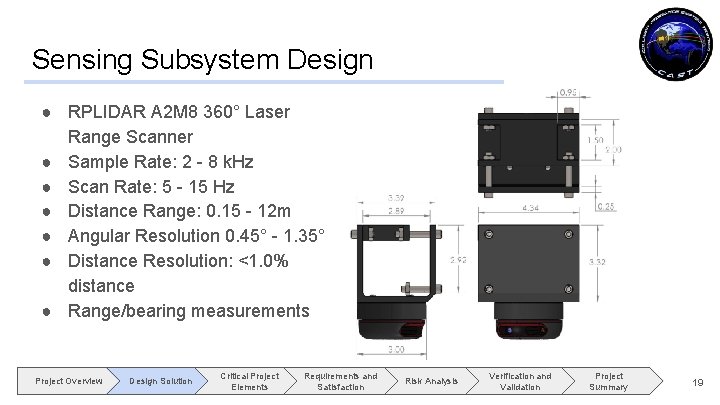
Sensing Subsystem Design ● RPLIDAR A 2 M 8 360° Laser Range Scanner ● Sample Rate: 2 - 8 k. Hz ● Scan Rate: 5 - 15 Hz ● Distance Range: 0. 15 - 12 m ● Angular Resolution 0. 45° - 1. 35° ● Distance Resolution: <1. 0% distance ● Range/bearing measurements Project Overview Design Solution Critical Project Elements Requirements and Satisfaction Risk Analysis Verification and Validation Project Summary 19
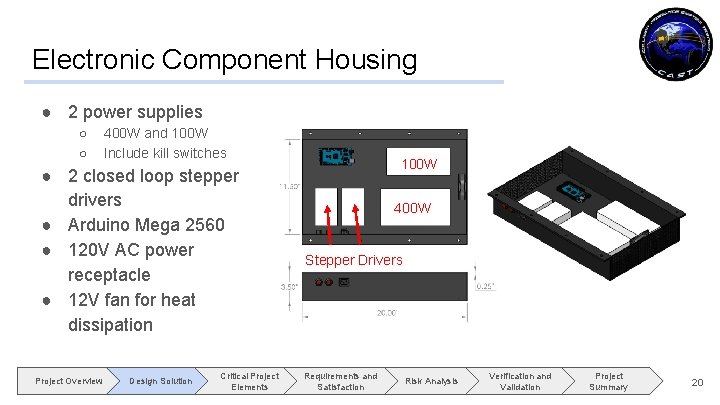
Electronic Component Housing ● 2 power supplies ○ ○ 400 W and 100 W Include kill switches ● 2 closed loop stepper drivers ● Arduino Mega 2560 ● 120 V AC power receptacle ● 12 V fan for heat dissipation Project Overview Design Solution Critical Project Elements 100 W 400 W Stepper Drivers Requirements and Satisfaction Risk Analysis Verification and Validation Project Summary 20
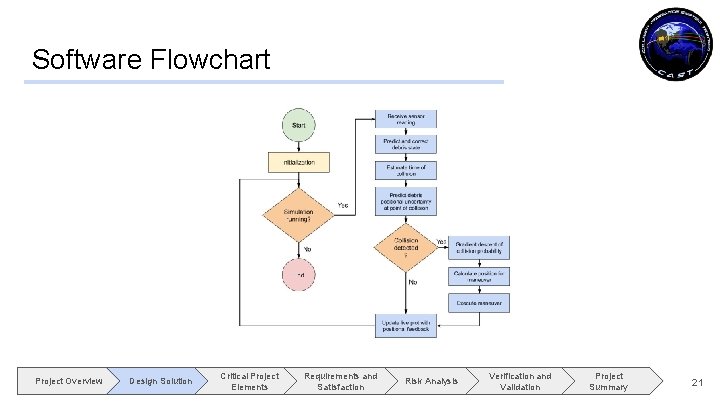
Software Flowchart Project Overview Design Solution Critical Project Elements Requirements and Satisfaction Risk Analysis Verification and Validation Project Summary 21
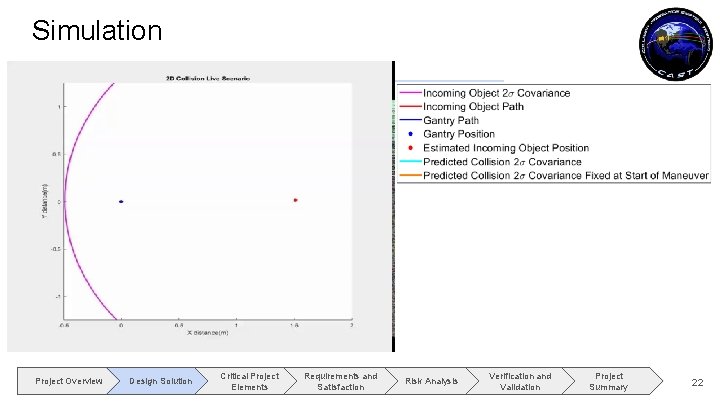
Simulation Project Overview Design Solution Critical Project Elements Requirements and Satisfaction Risk Analysis Verification and Validation Project Summary 22
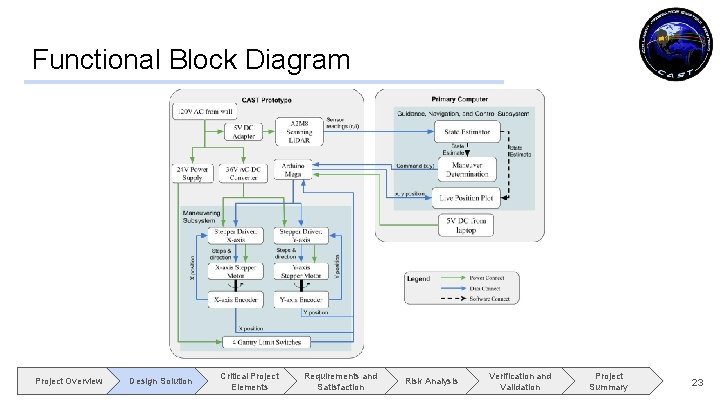
Functional Block Diagram Project Overview Design Solution Critical Project Elements Requirements and Satisfaction Risk Analysis Verification and Validation Project Summary 23
Critical Project Elements 24
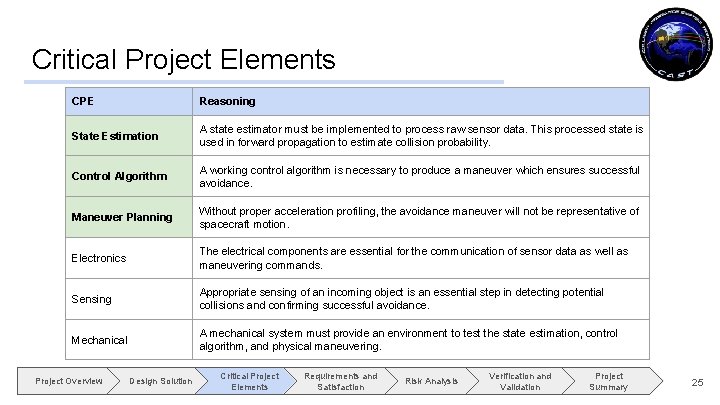
Critical Project Elements CPE Reasoning State Estimation A state estimator must be implemented to process raw sensor data. This processed state is used in forward propagation to estimate collision probability. Control Algorithm A working control algorithm is necessary to produce a maneuver which ensures successful avoidance. Maneuver Planning Without proper acceleration profiling, the avoidance maneuver will not be representative of spacecraft motion. Electronics The electrical components are essential for the communication of sensor data as well as maneuvering commands. Sensing Appropriate sensing of an incoming object is an essential step in detecting potential collisions and confirming successful avoidance. Mechanical A mechanical system must provide an environment to test the state estimation, control algorithm, and physical maneuvering. Project Overview Design Solution Critical Project Elements Requirements and Satisfaction Risk Analysis Verification and Validation Project Summary 25

Requirements and their Satisfaction 26
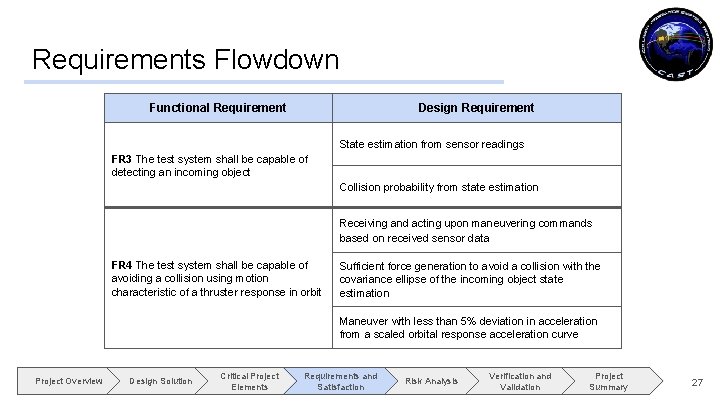
Requirements Flowdown Functional Requirement Design Requirement State estimation from sensor readings FR 3 The test system shall be capable of detecting an incoming object Collision probability from state estimation Receiving and acting upon maneuvering commands based on received sensor data FR 4 The test system shall be capable of avoiding a collision using motion characteristic of a thruster response in orbit Sufficient force generation to avoid a collision with the covariance ellipse of the incoming object state estimation Maneuver with less than 5% deviation in acceleration from a scaled orbital response acceleration curve Project Overview Design Solution Critical Project Elements Requirements and Satisfaction Risk Analysis Verification and Validation Project Summary 27
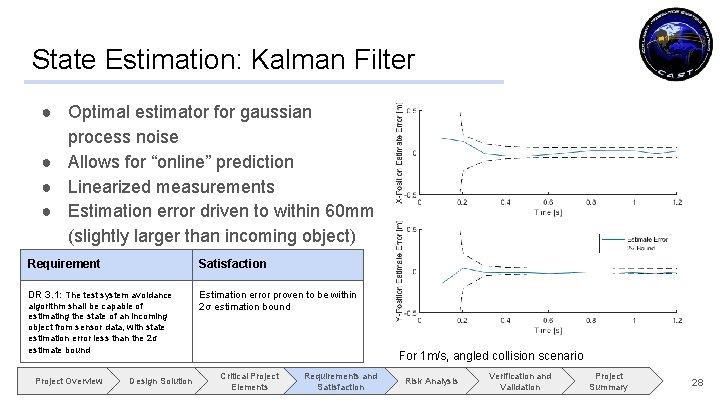
State Estimation: Kalman Filter ● Optimal estimator for gaussian process noise ● Allows for “online” prediction ● Linearized measurements ● Estimation error driven to within 60 mm (slightly larger than incoming object) Requirement Satisfaction DR 3. 1: The test system avoidance Estimation error proven to be within 2σ estimation bound algorithm shall be capable of estimating the state of an incoming object from sensor data, with state estimation error less than the 2σ estimate bound Project Overview Design Solution For 1 m/s, angled collision scenario Critical Project Elements Requirements and Satisfaction Risk Analysis Verification and Validation Project Summary 28
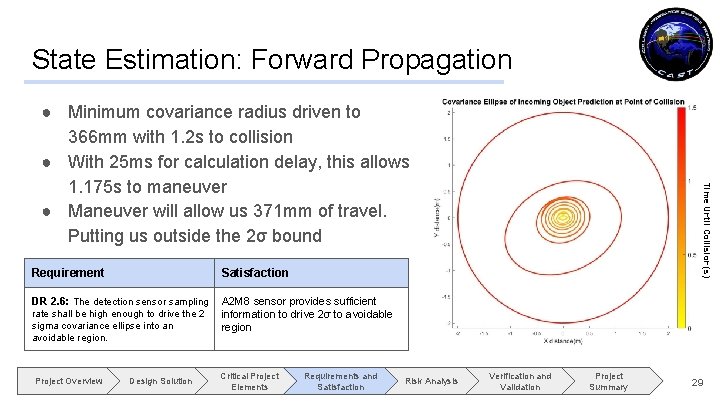
State Estimation: Forward Propagation Requirement Satisfaction DR 2. 6: The detection sensor sampling A 2 M 8 sensor provides sufficient information to drive 2σ to avoidable region rate shall be high enough to drive the 2 sigma covariance ellipse into an avoidable region. Project Overview Design Solution Critical Project Elements Requirements and Satisfaction Risk Analysis Time Until Collision(s) ● Minimum covariance radius driven to 366 mm with 1. 2 s to collision ● With 25 ms for calculation delay, this allows 1. 175 s to maneuver ● Maneuver will allow us 371 mm of travel. Putting us outside the 2σ bound Verification and Validation Project Summary 29
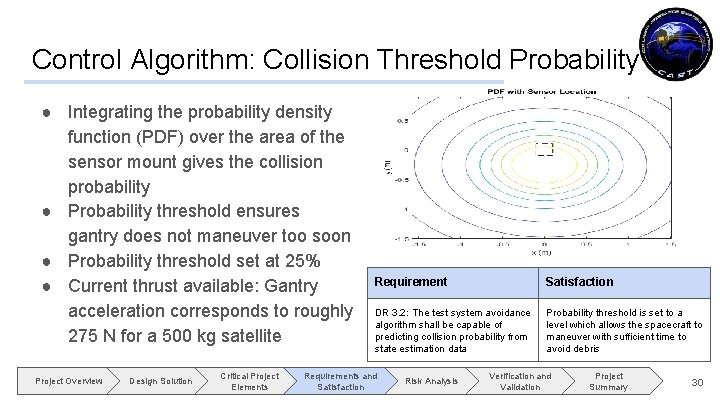
Control Algorithm: Collision Threshold Probability ● Integrating the probability density function (PDF) over the area of the sensor mount gives the collision probability ● Probability threshold ensures gantry does not maneuver too soon ● Probability threshold set at 25% ● Current thrust available: Gantry acceleration corresponds to roughly 275 N for a 500 kg satellite Project Overview Design Solution Critical Project Elements Requirement Satisfaction DR 3. 2: The test system avoidance algorithm shall be capable of predicting collision probability from state estimation data Probability threshold is set to a level which allows the spacecraft to maneuver with sufficient time to avoid debris Requirements and Satisfaction Risk Analysis Verification and Validation Project Summary 30
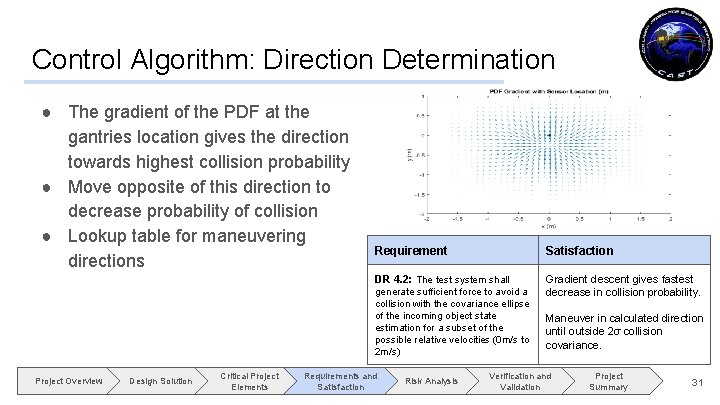
Control Algorithm: Direction Determination ● The gradient of the PDF at the gantries location gives the direction towards highest collision probability ● Move opposite of this direction to decrease probability of collision ● Lookup table for maneuvering directions Requirement Satisfaction DR 4. 2: The test system shall Gradient descent gives fastest decrease in collision probability. generate sufficient force to avoid a collision with the covariance ellipse of the incoming object state estimation for a subset of the possible relative velocities (0 m/s to 2 m/s) Project Overview Design Solution Critical Project Elements Requirements and Satisfaction Risk Analysis Maneuver in calculated direction until outside 2σ collision covariance. Verification and Validation Project Summary 31
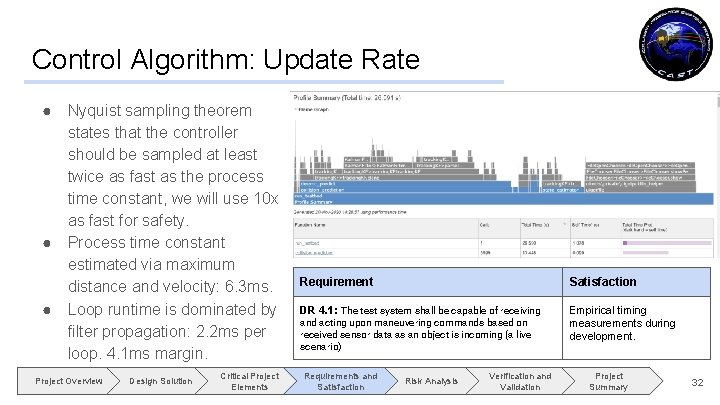
Control Algorithm: Update Rate ● ● ● Nyquist sampling theorem states that the controller should be sampled at least twice as fast as the process time constant, we will use 10 x as fast for safety. Process time constant estimated via maximum distance and velocity: 6. 3 ms. Loop runtime is dominated by filter propagation: 2. 2 ms per loop. 4. 1 ms margin. Project Overview Design Solution Critical Project Elements IMAGE Requirement Satisfaction DR 4. 1: The test system shall be capable of receiving Empirical timing measurements during development. and acting upon maneuvering commands based on received sensor data as an object is incoming (a live scenario) Requirements and Satisfaction Risk Analysis Verification and Validation Project Summary 32
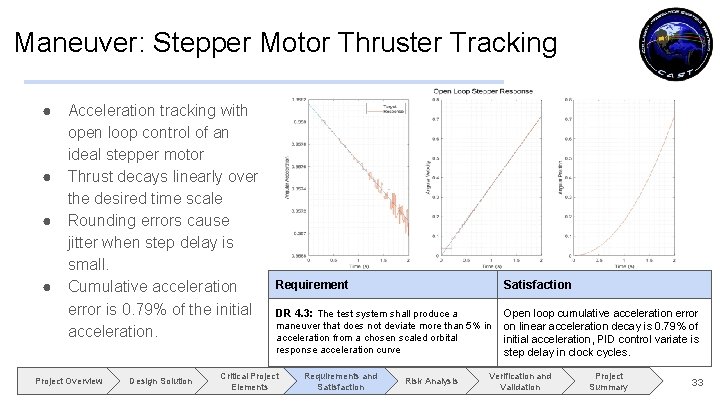
Maneuver: Stepper Motor Thruster Tracking ● ● Acceleration tracking with open loop control of an ideal stepper motor Thrust decays linearly over the desired time scale Rounding errors cause jitter when step delay is small. Cumulative acceleration error is 0. 79% of the initial acceleration. Project Overview Design Solution Requirement Satisfaction DR 4. 3: The test system shall produce a Open loop cumulative acceleration error on linear acceleration decay is 0. 79% of initial acceleration, PID control variate is step delay in clock cycles. maneuver that does not deviate more than 5% in acceleration from a chosen scaled orbital response acceleration curve Critical Project Elements Requirements and Satisfaction Risk Analysis Verification and Validation Project Summary 33
Risk Analysis 34
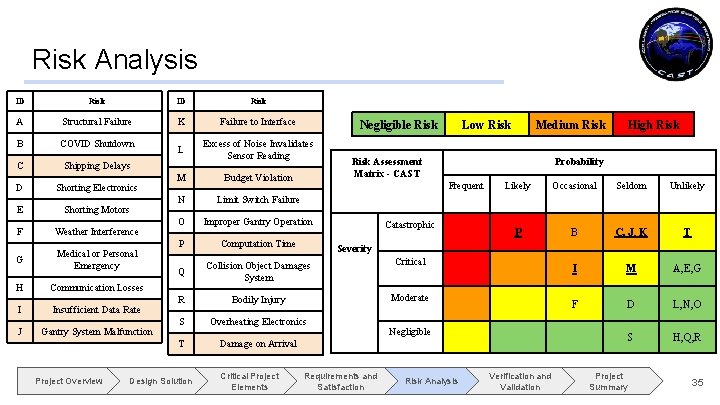
Risk Analysis ID Risk A Structural Failure K Failure to Interface B COVID Shutdown L C Shipping Delays Excess of Noise Invalidates Sensor Reading D Shorting Electronics E Shorting Motors F Weather Interference G Medical or Personal Emergency H Communication Losses I Insufficient Data Rate J Gantry System Malfunction Project Overview Negligible Risk Budget Violation N Limit Switch Failure O Improper Gantry Operation P Computation Time Q Collision Object Damages System Critical R Bodily Injury Moderate S Overheating Electronics T Damage on Arrival Critical Project Elements Medium Risk Assessment Matrix - CAST M Design Solution Low Risk High Risk Probability Frequent Catastrophic Likely Occasional Seldom Unlikely P B C, J, K T I M A, E, G F D L, N, O S H, Q, R Severity Requirements and Satisfaction Negligible Risk Analysis Verification and Validation Project Summary 35
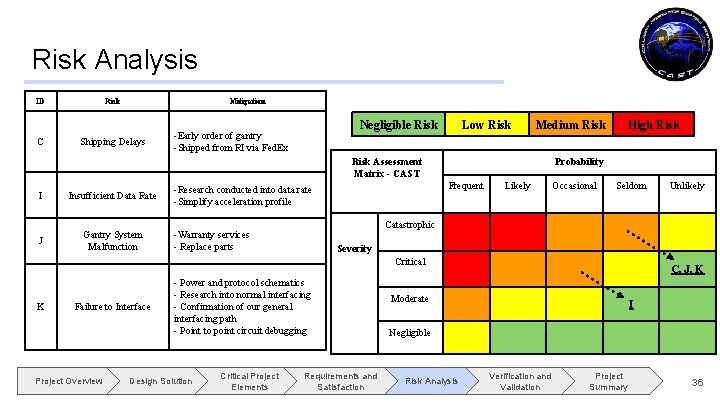
Risk Analysis ID C Risk Mitigation Shipping Delays Negligible Risk -Early order of gantry -Shipped from RI via Fed. Ex Low Risk Medium Risk Assessment Matrix - CAST I Insufficient Data Rate J Gantry System Malfunction Probability Frequent -Research conducted into data rate -Simplify acceleration profile High Risk Likely Occasional Seldom Catastrophic -Warranty services - Replace parts Severity Critical K Failure to Interface Project Overview - Power and protocol schematics - Research into normal interfacing - Confirmation of our general interfacing path - Point to point circuit debugging Design Solution Critical Project Elements Unlikely Requirements and Satisfaction C, J, K Moderate I Negligible Risk Analysis Verification and Validation Project Summary 36
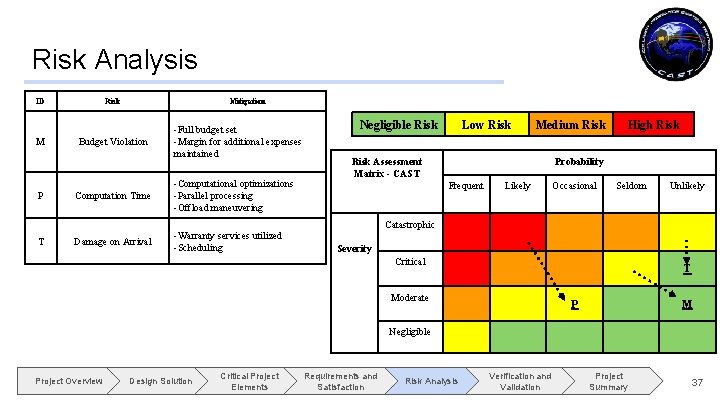
Risk Analysis ID M P T Risk Mitigation Budget Violation -Full budget set -Margin for additional expenses maintained Computation Time -Computational optimizations -Parallel processing -Offload maneuvering Damage on Arrival -Warranty services utilized -Scheduling Negligible Risk Low Risk Medium Risk Assessment Matrix - CAST High Risk Probability Frequent Likely Occasional Seldom Unlikely Catastrophic Severity Critical T Moderate P M Negligible Project Overview Design Solution Critical Project Elements Requirements and Satisfaction Risk Analysis Verification and Validation Project Summary 37

Verification and Validation 38
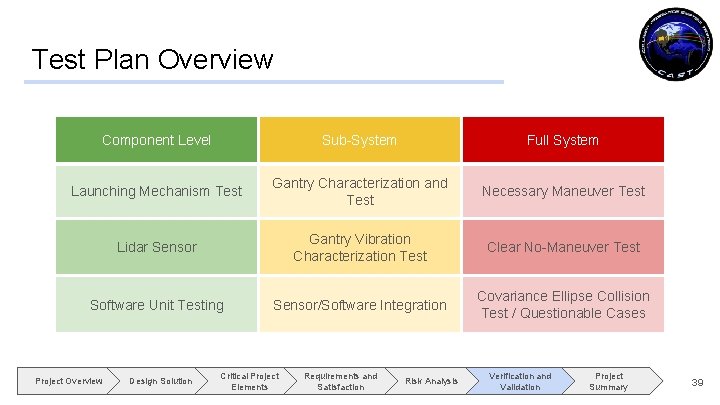
Test Plan Overview Component Level Sub-System Full System Launching Mechanism Test Gantry Characterization and Test Necessary Maneuver Test Lidar Sensor Gantry Vibration Characterization Test Clear No-Maneuver Test Software Unit Testing Sensor/Software Integration Covariance Ellipse Collision Test / Questionable Cases Project Overview Design Solution Critical Project Elements Requirements and Satisfaction Risk Analysis Verification and Validation Project Summary 39
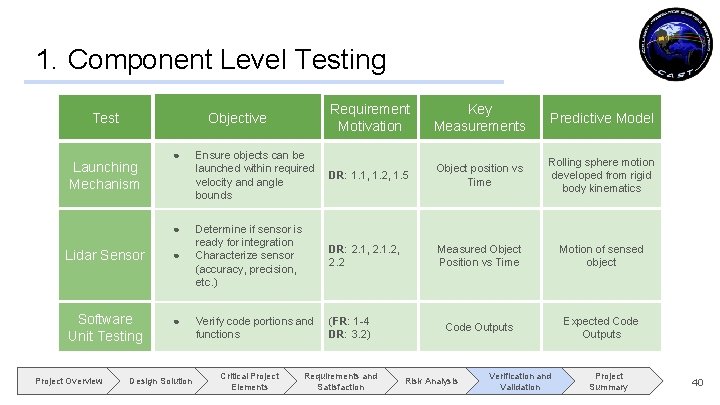
1. Component Level Testing Test Launching Mechanism ● ● Lidar Sensor ● Software Unit Testing ● Project Overview Requirement Motivation Key Measurements Predictive Model Ensure objects can be launched within required velocity and angle bounds DR: 1. 1, 1. 2, 1. 5 Object position vs Time Rolling sphere motion developed from rigid body kinematics Determine if sensor is ready for integration Characterize sensor (accuracy, precision, etc. ) DR: 2. 1, 2. 1. 2, 2. 2 Measured Object Position vs Time Motion of sensed object Verify code portions and functions (FR: 1 -4 DR: 3. 2) Code Outputs Expected Code Outputs Objective Design Solution Critical Project Elements Requirements and Satisfaction Risk Analysis Verification and Validation Project Summary 40
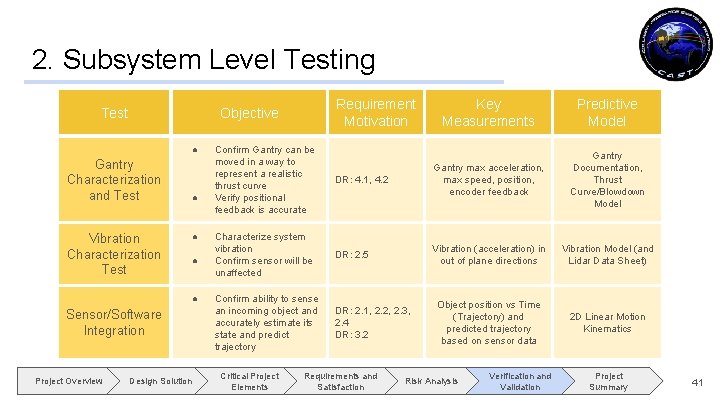
2. Subsystem Level Testing Test ● Gantry Characterization and Test Vibration Characterization Test ● ● Sensor/Software Integration Project Overview Requirement Motivation Objective Design Solution Key Measurements Predictive Model Gantry Documentation, Thrust Curve/Blowdown Model Confirm Gantry can be moved in a way to represent a realistic thrust curve Verify positional feedback is accurate DR: 4. 1, 4. 2 Gantry max acceleration, max speed, position, encoder feedback Characterize system vibration Confirm sensor will be unaffected DR: 2. 5 Vibration (acceleration) in out of plane directions Vibration Model (and Lidar Data Sheet) Confirm ability to sense an incoming object and accurately estimate its state and predict trajectory DR: 2. 1, 2. 2, 2. 3, 2. 4 DR: 3. 2 Object position vs Time (Trajectory) and predicted trajectory based on sensor data 2 D Linear Motion Kinematics Critical Project Elements Requirements and Satisfaction Risk Analysis Verification and Validation Project Summary 41
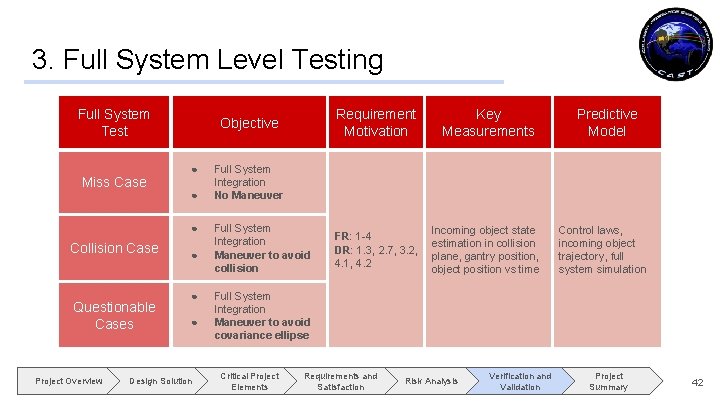
3. Full System Level Testing Full System Test Miss Case Objective ● ● ● Collision Case Questionable Cases Project Overview ● ● ● Design Solution Requirement Motivation Key Measurements FR: 1 -4 DR: 1. 3, 2. 7, 3. 2, 4. 1, 4. 2 Incoming object state estimation in collision plane, gantry position, object position vs time Predictive Model Full System Integration No Maneuver Full System Integration Maneuver to avoid collision Control laws, incoming object trajectory, full system simulation Full System Integration Maneuver to avoid covariance ellipse Critical Project Elements Requirements and Satisfaction Risk Analysis Verification and Validation Project Summary 42
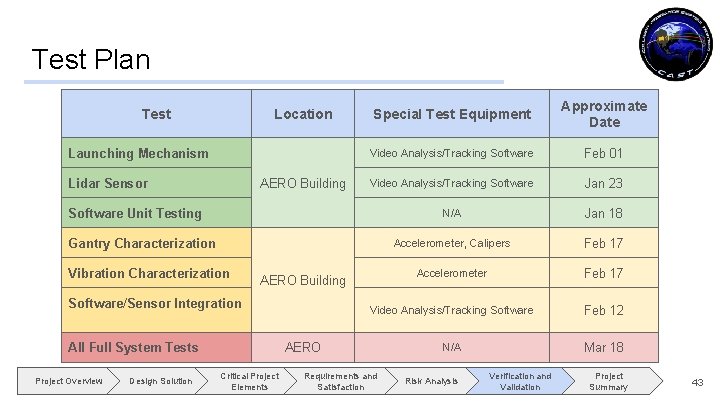
Test Plan Test Location Launching Mechanism Lidar Sensor AERO Building Special Test Equipment Approximate Date Video Analysis/Tracking Software Feb 01 Video Analysis/Tracking Software Jan 23 N/A Jan 18 Accelerometer, Calipers Feb 17 Accelerometer Feb 17 Video Analysis/Tracking Software Feb 12 N/A Mar 18 Software Unit Testing Gantry Characterization Vibration Characterization AERO Building Software/Sensor Integration All Full System Tests Project Overview Design Solution AERO Critical Project Elements Requirements and Satisfaction Risk Analysis Verification and Validation Project Summary 43

Project Summary and Planning 44
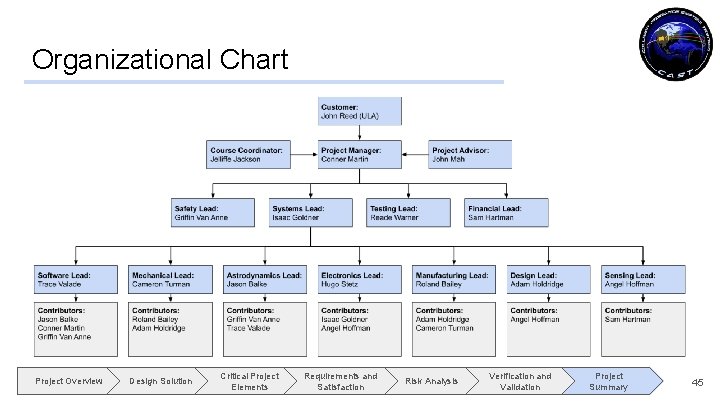
Organizational Chart Project Overview Design Solution Critical Project Elements Requirements and Satisfaction Risk Analysis Verification and Validation Project Summary 45
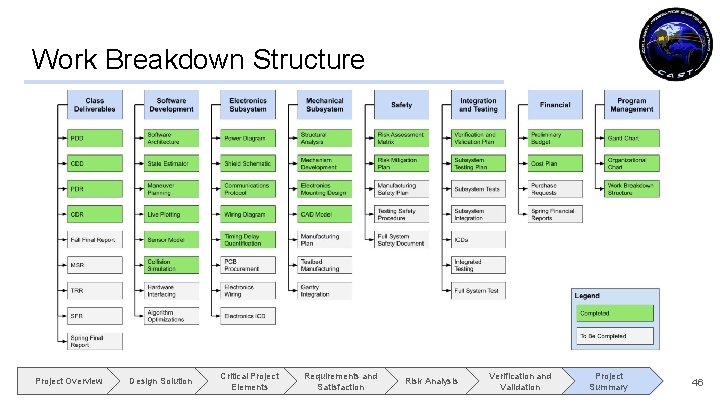
Work Breakdown Structure Project Overview Design Solution Critical Project Elements Requirements and Satisfaction Risk Analysis Verification and Validation Project Summary 46
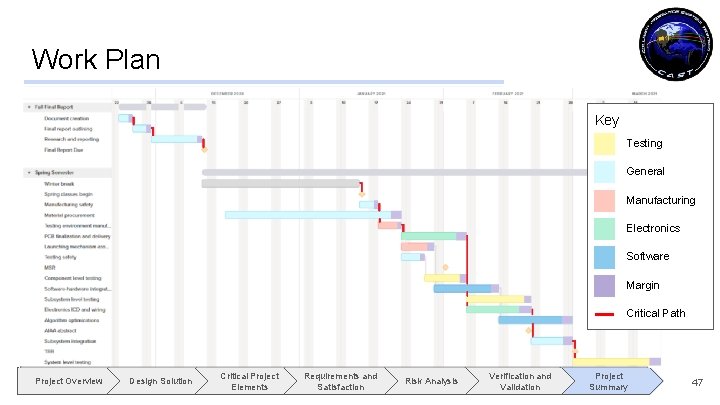
Work Plan Key Testing General Manufacturing Electronics Software Margin Critical Path Project Overview Design Solution Critical Project Elements Requirements and Satisfaction Risk Analysis Verification and Validation Project Summary 47
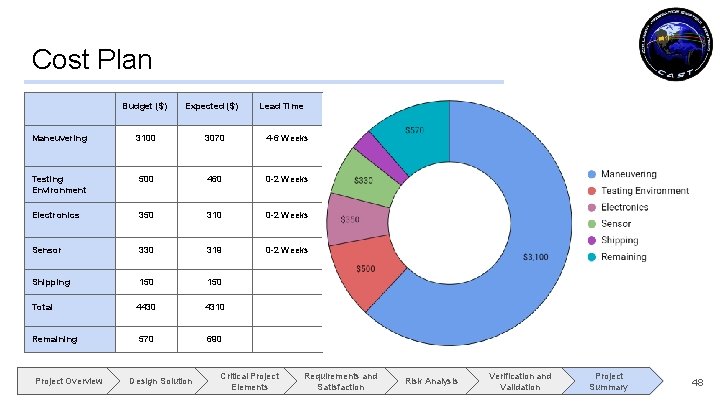
Cost Plan Budget ($) Expected ($) Lead Time Maneuvering 3100 3070 4 -6 Weeks Testing Environment 500 460 0 -2 Weeks Electronics 350 310 0 -2 Weeks Sensor 330 319 0 -2 Weeks Shipping 150 Total 4430 4310 Remaining 570 690 Project Overview Design Solution Critical Project Elements Requirements and Satisfaction Risk Analysis Verification and Validation Project Summary 48

Questions? 49
Backup Slides 50
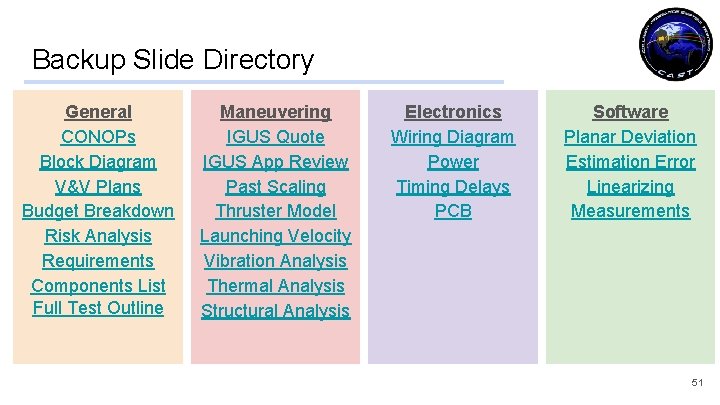
Backup Slide Directory General CONOPs Block Diagram V&V Plans Budget Breakdown Risk Analysis Requirements Components List Full Test Outline Maneuvering IGUS Quote IGUS App Review Past Scaling Thruster Model Launching Velocity Vibration Analysis Thermal Analysis Structural Analysis Electronics Wiring Diagram Power Timing Delays PCB Software Planar Deviation Estimation Error Linearizing Measurements 51
Full System Test Outline 1. Launch incoming object along desired trajectory ○ Clear miss cases (maneuver required) ○ Clear collision cases (no maneuver) ○ Case where object won’t collide but object covariance ellipse could (Near collision case, maneuver required) 2. Sensor outputs data on potential colliding object position and time 3. Determine speed, trajectory, and covariance of oncoming object (state estimation) 4. Control laws determine: ○ If maneuver is necessary ○ Direction and acceleration of maneuver 5. Maneuver plan sent to testbed 6. Testbed maneuvers 7. Avoidance of colliding object (and its 2σ covariance ellipse) verified through visual confirmation, live plot, and post data analysis (DR 1. 5) Project Overview Design Solution Critical Project Elements Requirements and Satisfaction Risk Analysis Verification and Validation Project Summary 52
Quote from IGUS Back 53
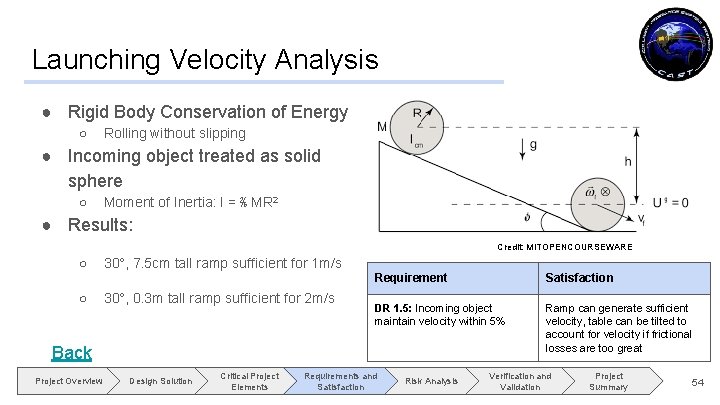
Launching Velocity Analysis ● Rigid Body Conservation of Energy ○ Rolling without slipping ● Incoming object treated as solid sphere ○ Moment of Inertia: I = ⅖ MR 2 ● Results: Credit: MITOPENCOURSEWARE ○ ○ 30°, 7. 5 cm tall ramp sufficient for 1 m/s 30°, 0. 3 m tall ramp sufficient for 2 m/s Requirement Satisfaction DR 1. 5: Incoming object maintain velocity within 5% Ramp can generate sufficient velocity, table can be tilted to account for velocity if frictional losses are too great Back Project Overview Design Solution Critical Project Elements Requirements and Satisfaction Risk Analysis Verification and Validation Project Summary 54
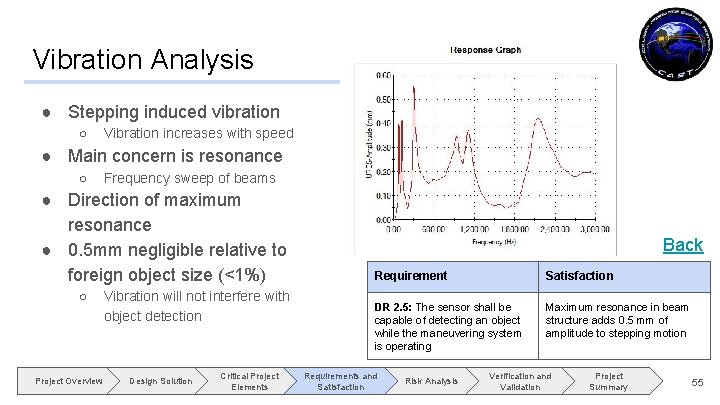
Vibration Analysis ● Stepping induced vibration ○ Vibration increases with speed ● Main concern is resonance ○ Frequency sweep of beams ● Direction of maximum resonance ● 0. 5 mm negligible relative to foreign object size (<1%) ○ Project Overview Vibration will not interfere with object detection Design Solution Critical Project Elements Back Requirement Satisfaction DR 2. 5: The sensor shall be capable of detecting an object while the maneuvering system is operating Maximum resonance in beam structure adds 0. 5 mm of amplitude to stepping motion Requirements and Satisfaction Risk Analysis Verification and Validation Project Summary 55
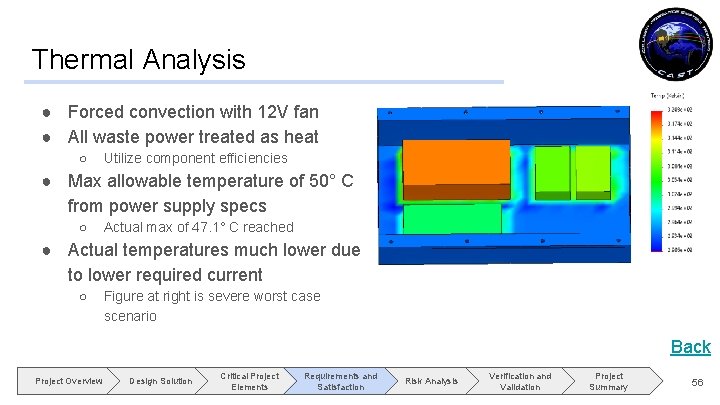
Thermal Analysis ● Forced convection with 12 V fan ● All waste power treated as heat ○ Utilize component efficiencies ● Max allowable temperature of 50° C from power supply specs ○ Actual max of 47. 1° C reached ● Actual temperatures much lower due to lower required current ○ Figure at right is severe worst case scenario Back Project Overview Design Solution Critical Project Elements Requirements and Satisfaction Risk Analysis Verification and Validation Project Summary 56
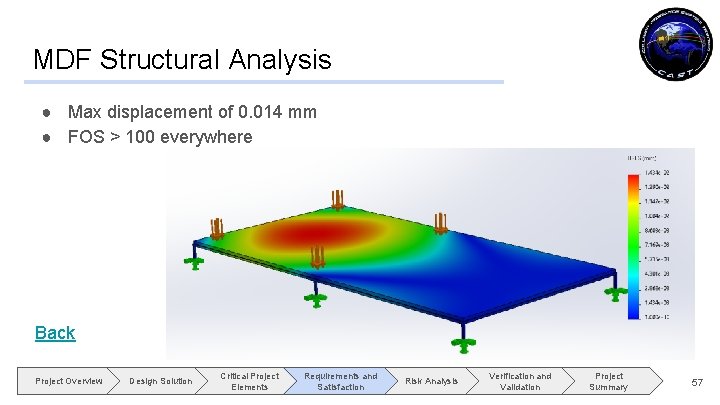
MDF Structural Analysis ● Max displacement of 0. 014 mm ● FOS > 100 everywhere Back Project Overview Design Solution Critical Project Elements Requirements and Satisfaction Risk Analysis Verification and Validation Project Summary 57
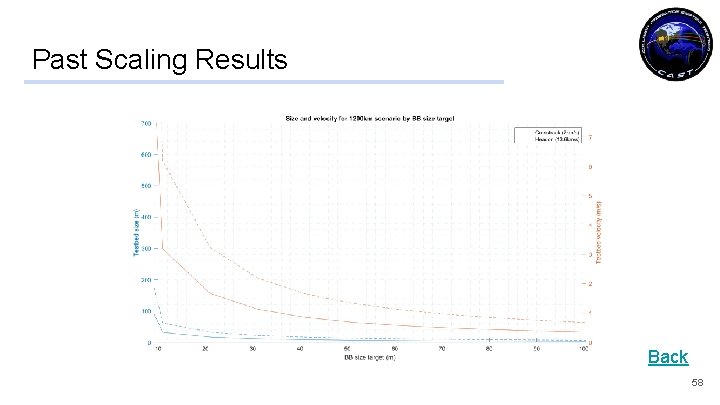
Past Scaling Results Back 58
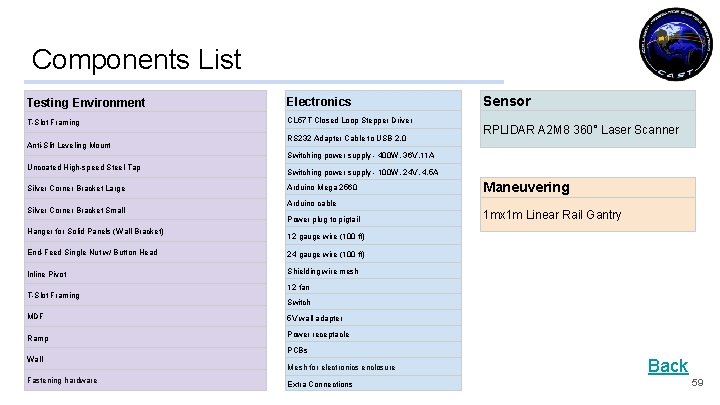
Components List Testing Environment Electronics T-Slot Framing CL 57 T Closed Loop Stepper Driver Anti-Slit Leveling Mount RPLIDAR A 2 M 8 360° Laser Scanner Component Uncoated High-speed Steel Tap 1 mx 1 m Linear Rail Gantry Silver Corner Bracket Large Silver Corner Bracket Small RS 232 Adapter Cable to USB 2. 0 Switching power supply - 100 W, 24 V, 4. 5 A Arduino Mega 2560 Maneuvering Arduino cable 1 mx 1 m Linear Rail Gantry 12 gauge wire (100 ft) End-Feed Single Nut w/ Button Head 24 gauge wire (100 ft) Inline Pivot Shielding wire mesh T-Slot Framing RPLIDAR A 2 M 8 360° Laser Scanner Switching power supply - 400 W, 36 V, 11 A Power plug to pigtail Hanger for Solid Panels (Wall Bracket) Sensor 12 fan Switch MDF 5 V wall adapter Ramp Power receptacle PCBs Wall Fastening hardware Mesh for electronics enclosure Extra Connections Back 59
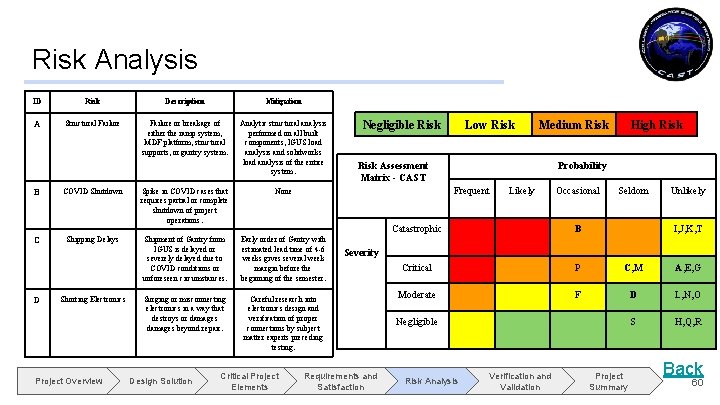
Risk Analysis ID Risk Description Mitigation A Structural Failure or breakage of either the ramp system, MDF platform, structural supports, or gantry system. Analytic structural analysis performed on all built components, IGUS load analysis and solidworks load analysis of the entire system. COVID Shutdown Spike in COVID cases that requires partial or complete shutdown of project operations. None C Shipping Delays Shipment of Gantry from IGUS is delayed or severely delayed due to COVID conditions or unforeseen circumstances. Early order of Gantry with estimated lead time of 4 -6 weeks gives several week margin before the beginning of the semester. Surging or misconnecting electronics in a way that destroys or damages beyond repair. Careful research into electronics design and verification of proper connections by subject matter experts preceding testing. Shorting Electronics Project Overview Design Solution Critical Project Elements Low Risk Medium Risk Assessment Matrix - CAST High Risk Probability Frequent B D Negligible Risk Likely Occasional Seldom Unlikely Catastrophic B I, J, K, T Critical P C, M A, E, G Moderate F D L, N, O S H, Q, R Severity Requirements and Satisfaction Negligible Risk Analysis Verification and Validation Project Summary Back 60
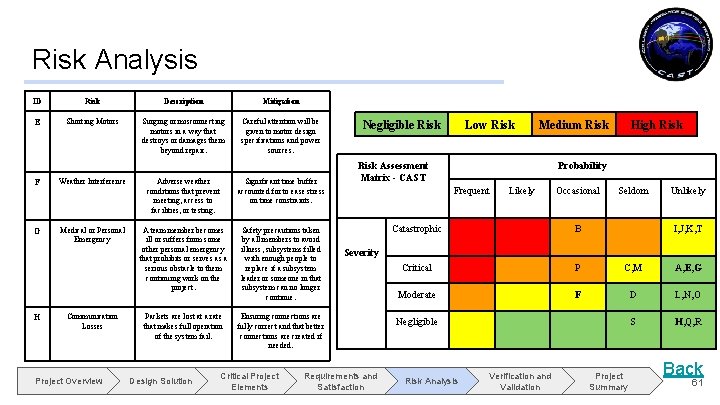
Risk Analysis ID Risk Description Mitigation E Shorting Motors Surging or misconnecting motors in a way that destroys or damages them beyond repair. Careful attention will be given to motor design specifications and power sources. F Weather Interference Adverse weather conditions that prevent meeting, access to facilities, or testing. Significant time buffer accounted for to ease stress on time constraints. G Medical or Personal Emergency A team member becomes ill or suffers from some other personal emergency that prohibits or serves as a serious obstacle to them continuing work on the project. Safety precautions taken by all members to avoid illness, subsystems filled with enough people to replace if a subsystem leader or someone in that subsystem can no longer continue. Packets are lost at a rate that makes full operation of the system fail. Ensuring connections are fully correct and that better connections are created if needed. H Communication Losses Project Overview Design Solution Critical Project Elements Negligible Risk Low Risk Medium Risk Assessment Matrix - CAST High Risk Probability Frequent Likely Occasional Seldom Unlikely Catastrophic B I, J, K, T Critical P C, M A, E, G Moderate F D L, N, O S H, Q, R Severity Requirements and Satisfaction Negligible Risk Analysis Verification and Validation Project Summary Back 61
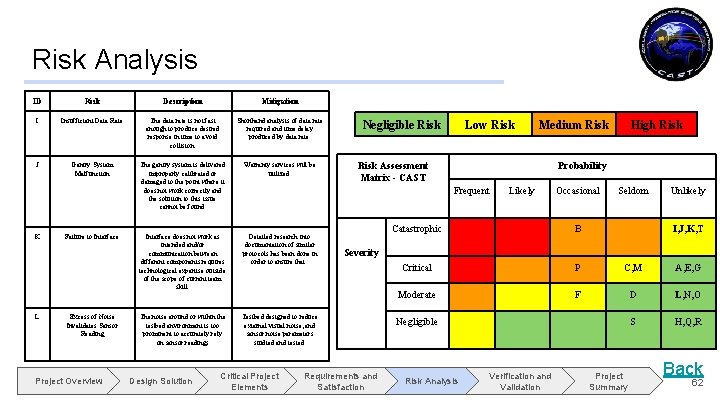
Risk Analysis ID Risk Description Mitigation I Insufficient Data Rate The data rate is not fast enough to produce desired response in time to avoid collision. Shorthand analysis of data rate required and time delay produced by data rate. J Gantry System Malfunction The gantry system is delivered improperly calibrated or damaged to the point where it does not work correctly and the solution to this issue cannot be found. Warranty services will be utilized. Interface does not work as intended and/or communication between different components requires technological expertise outside of the scope of current team skill. Detailed research into documentation of similar protocols has been done in order to ensure that. The noise around or within the testbed environment is too prominent to accurately rely on sensor readings Testbed designed to reduce external visual noise, and sensor noise parameters studied and tested. K L Failure to Interface Excess of Noise Invalidates Sensor Reading Project Overview Design Solution Negligible Risk Low Risk Assessment Matrix - CAST High Risk Probability Frequent Critical Project Elements Medium Risk Likely Occasional Seldom Unlikely Catastrophic B I, J, K, T Critical P C, M A, E, G Moderate F D L, N, O S H, Q, R Severity Requirements and Satisfaction Negligible Risk Analysis Verification and Validation Project Summary Back 62
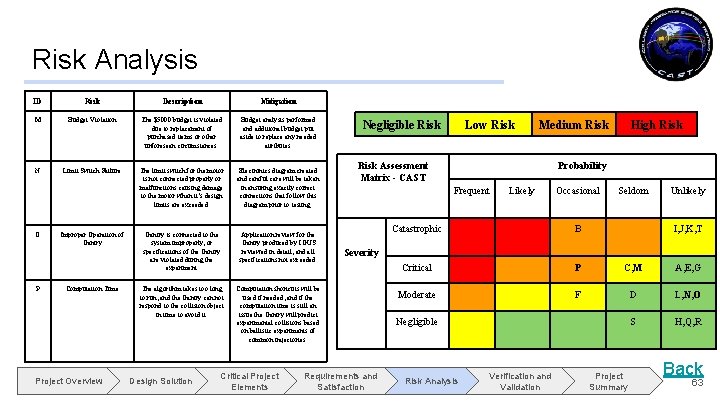
Risk Analysis ID Risk Description Mitigation M Budget Violation The $5000 budget is violated due to replacement of purchased items or other unforeseen circumstances. Budget analysis performed and additional budget put aside to replace any needed attributes. N Limit Switch Failure The limit switch for the motor is not connected properly or malfunctions causing damage to the motor when it’s design limits are exceeded. Electronics diagram created and careful care will be taken in ensuring exactly correct connections that follow this diagram prior to testing. Gantry is connected to the system improperly, or specifications of the Gantry are violated during the experiment. Application review for the Gantry produced by IGUS reviewed in detail, and all specifications not exceeded. The algorithm takes too long to run, and the Gantry can not respond to the collision object in time to avoid it. Computation shortcuts will be used if needed, and if the computation time is still an issue the Gantry will predict experimental collisions based on ballistic experiments of common trajectories. O P Improper Operation of Gantry Computation Time Project Overview Design Solution Critical Project Elements Negligible Risk Low Risk Medium Risk Assessment Matrix - CAST High Risk Probability Frequent Likely Occasional Seldom Unlikely Catastrophic B I, J, K, T Critical P C, M A, E, G Moderate F D L, N, O S H, Q, R Severity Requirements and Satisfaction Negligible Risk Analysis Verification and Validation Project Summary Back 63
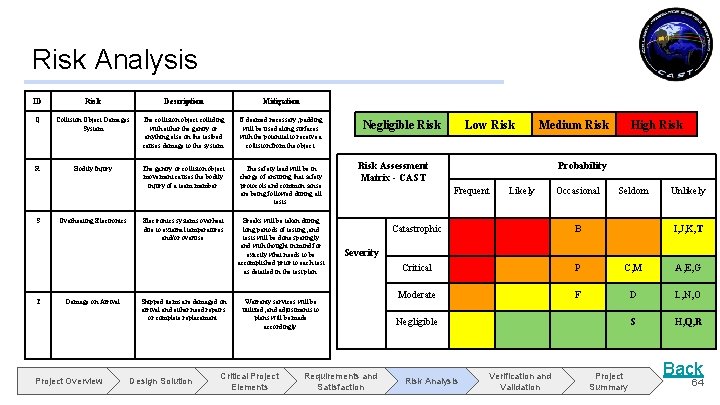
Risk Analysis ID Risk Description Mitigation Q Collision Object Damages System The collision object colliding with either the gantry or anything else on the testbed causes damage to the system. If deemed necessary, padding will be used along surfaces with the potential to receive a collision from the object. R Bodily Injury The gantry or collision object movement causes the bodily injury of a team member. The safety lead will be in charge of ensuring that safety protocols and common sense are being followed during all tests. Electronics systems overheat due to external temperatures and/or overuse. Breaks will be taken during long periods of testing, and tests will be done sparingly and with thought in mind for exactly what needs to be accomplished prior to each test as detailed in the test plan. S T Overheating Electronics Damage on Arrival Project Overview Shipped items are damaged on arrival and either need repairs or complete replacement. Design Solution Negligible Risk Medium Risk Assessment Matrix - CAST High Risk Probability Frequent Likely Occasional Seldom Unlikely Catastrophic B I, J, K, T Critical P C, M A, E, G Moderate F D L, N, O S H, Q, R Severity Warranty services will be utilized, and adjustments to plans will be made accordingly. Critical Project Elements Low Risk Requirements and Satisfaction Negligible Risk Analysis Verification and Validation Project Summary Back 64
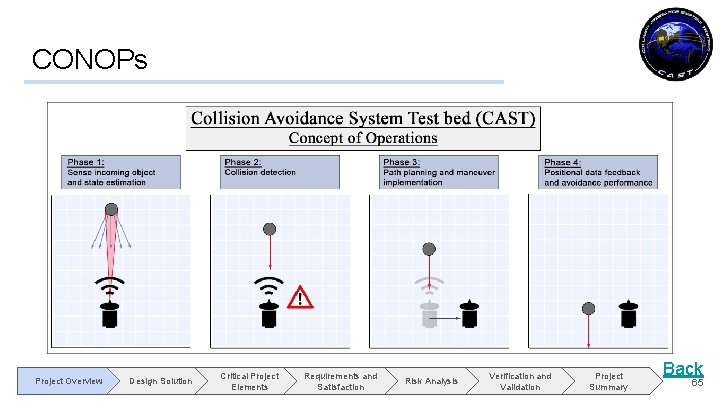
CONOPs Project Overview Design Solution Critical Project Elements Requirements and Satisfaction Risk Analysis Verification and Validation Project Summary Back 65
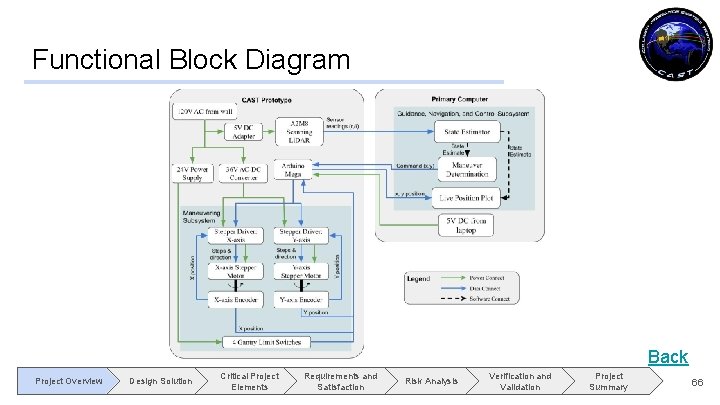
Functional Block Diagram Back Project Overview Design Solution Critical Project Elements Requirements and Satisfaction Risk Analysis Verification and Validation Project Summary 66
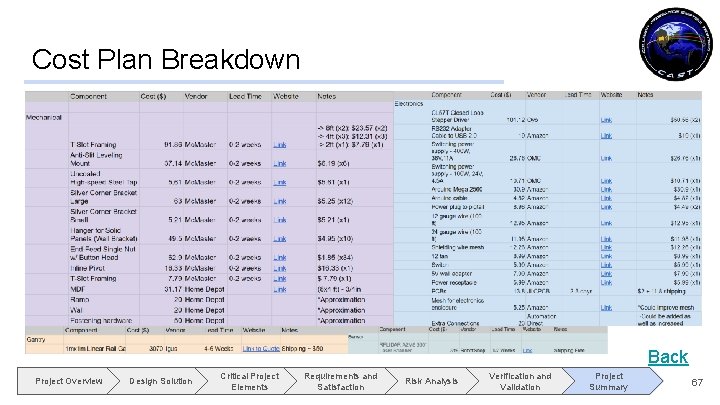
Cost Plan Breakdown Back Project Overview Design Solution Critical Project Elements Requirements and Satisfaction Risk Analysis Verification and Validation Project Summary 67
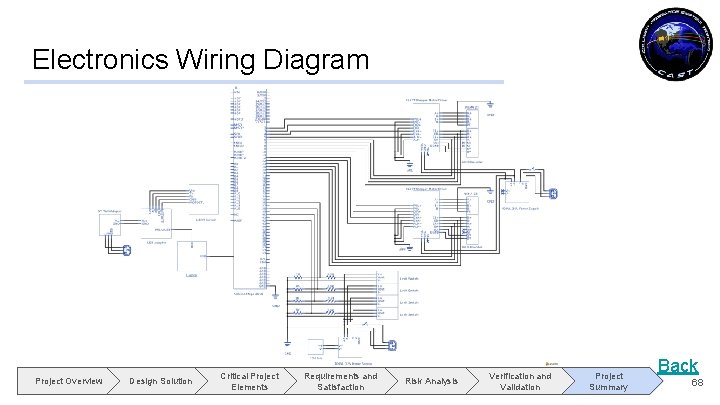
Electronics Wiring Diagram Project Overview Design Solution Critical Project Elements Requirements and Satisfaction Risk Analysis Verification and Validation Project Summary Back 68
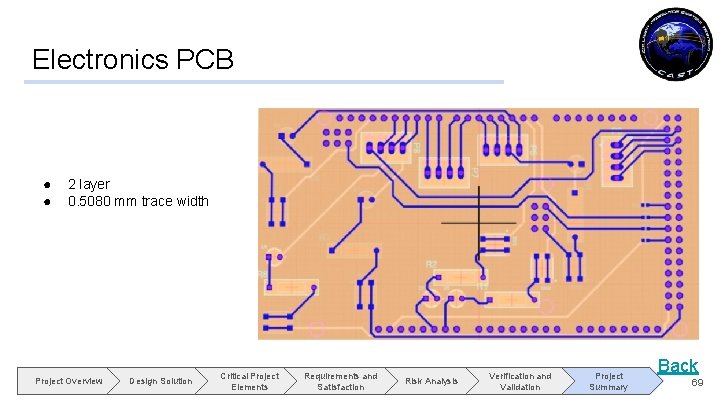
Electronics PCB ● ● 2 layer 0. 5080 mm trace width Project Overview Design Solution Critical Project Elements Requirements and Satisfaction Risk Analysis Verification and Validation Project Summary Back 69
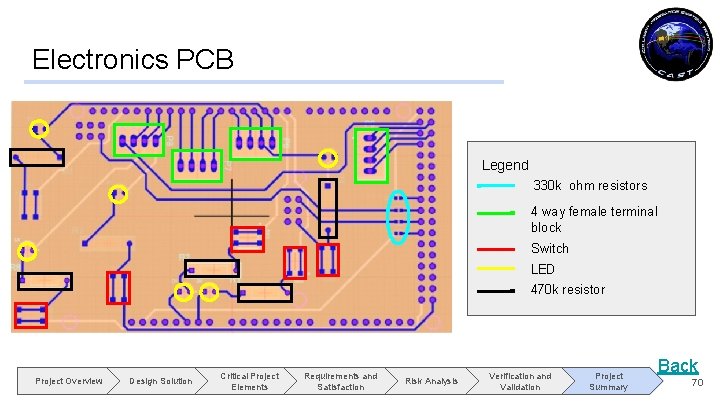
Electronics PCB Legend 330 k ohm resistors 4 way female terminal block Switch LED 470 k resistor Project Overview Design Solution Critical Project Elements Requirements and Satisfaction Risk Analysis Verification and Validation Project Summary Back 70
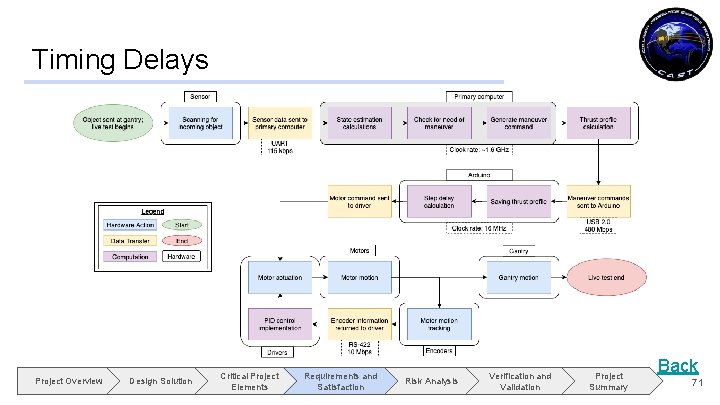
Timing Delays Project Overview Design Solution Critical Project Elements Requirements and Satisfaction Risk Analysis Verification and Validation Project Summary Back 71
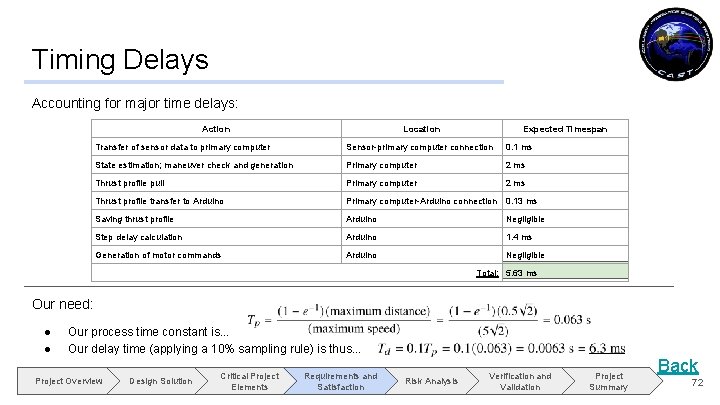
Timing Delays Accounting for major time delays: Action Location Expected Timespan Transfer of sensor data to primary computer Sensor-primary computer connection 0. 1 ms State estimation; maneuver check and generation Primary computer 2 ms Thrust profile pull Primary computer 2 ms Thrust profile transfer to Arduino Primary computer-Arduino connection 0. 13 ms Saving thrust profile Arduino Negligible Step delay calculation Arduino 1. 4 ms Generation of motor commands Arduino Negligible Total: 5. 63 ms Our need: ● ● Our process time constant is. . . Our delay time (applying a 10% sampling rule) is thus. . . Project Overview Design Solution Critical Project Elements Requirements and Satisfaction Risk Analysis Verification and Validation Project Summary Back 72
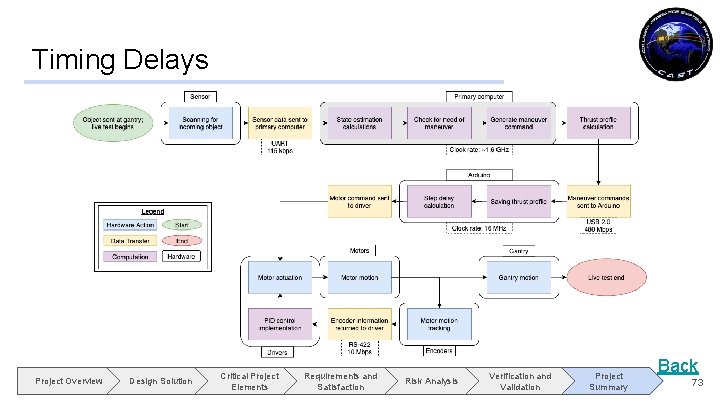
Timing Delays Project Overview Design Solution Critical Project Elements Requirements and Satisfaction Risk Analysis Verification and Validation Project Summary Back 73
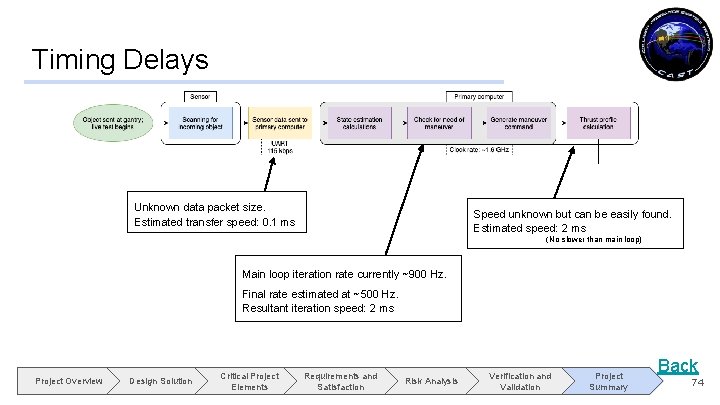
Timing Delays Unknown data packet size. Estimated transfer speed: 0. 1 ms Speed unknown but can be easily found. Estimated speed: 2 ms (No slower than main loop) Main loop iteration rate currently ~900 Hz. Final rate estimated at ~500 Hz. Resultant iteration speed: 2 ms Project Overview Design Solution Critical Project Elements Requirements and Satisfaction Risk Analysis Verification and Validation Project Summary Back 74
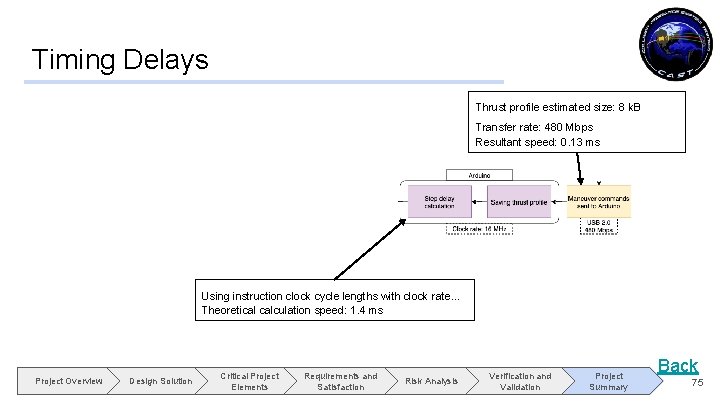
Timing Delays Thrust profile estimated size: 8 k. B Transfer rate: 480 Mbps Resultant speed: 0. 13 ms Using instruction clock cycle lengths with clock rate. . . Theoretical calculation speed: 1. 4 ms Project Overview Design Solution Critical Project Elements Requirements and Satisfaction Risk Analysis Verification and Validation Project Summary Back 75
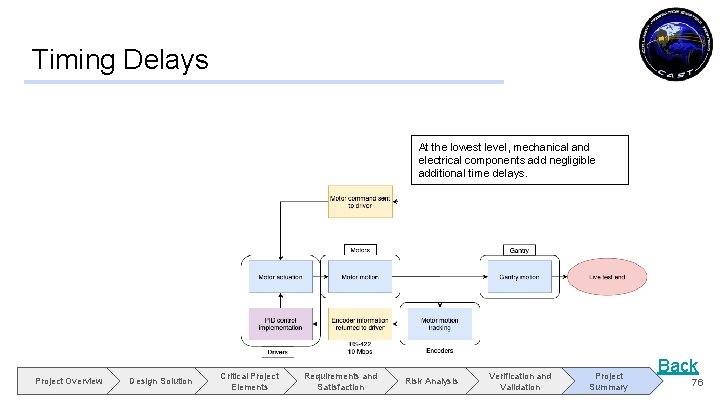
Timing Delays At the lowest level, mechanical and electrical components add negligible additional time delays. Project Overview Design Solution Critical Project Elements Requirements and Satisfaction Risk Analysis Verification and Validation Project Summary Back 76
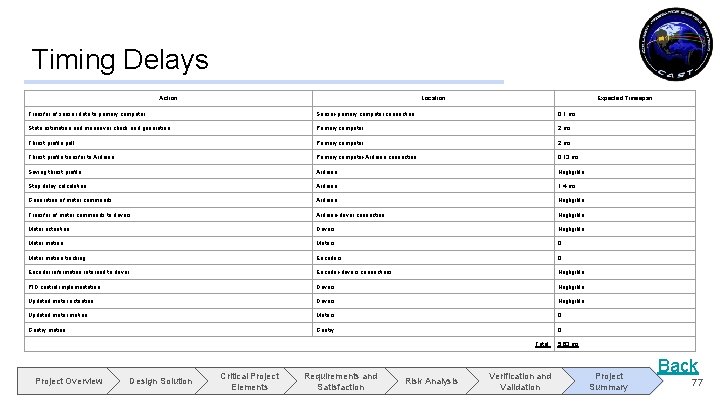
Timing Delays Action Location Expected Timespan Transfer of sensor data to primary computer Sensor-primary computer connection 0. 1 ms State estimation and maneuver check and generation Primary computer 2 ms Thrust profile pull Primary computer 2 ms Thrust profile transfer to Arduino Primary computer-Arduino connection 0. 13 ms Saving thrust profile Arduino Negligible Step delay calculation Arduino 1. 4 ms Generation of motor commands Arduino Negligible Transfer of motor commands to drivers Arduino-driver connection Negligible Motor actuation Drivers Negligible Motor motion Motors 0 Motor motion tracking Encoders 0 Encoder information returned to driver Encoder-drivers connections Negligible PID control implementation Drivers Negligible Updated motor actuation Drivers Negligible Updated motor motion Motors 0 Gantry motion Gantry 0 Total: Project Overview Design Solution Critical Project Elements Requirements and Satisfaction Risk Analysis Verification and Validation 5. 63 ms Project Summary Back 77
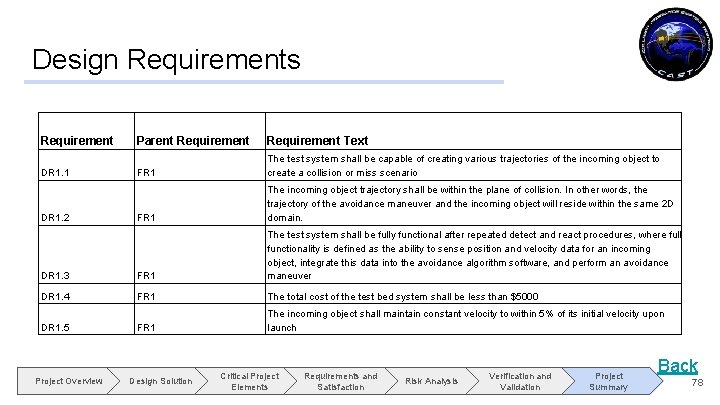
Design Requirements Requirement Parent Requirement Text FR 1 The test system shall be capable of creating various trajectories of the incoming object to create a collision or miss scenario FR 1 The incoming object trajectory shall be within the plane of collision. In other words, the trajectory of the avoidance maneuver and the incoming object will reside within the same 2 D domain. DR 1. 3 FR 1 The test system shall be fully functional after repeated detect and react procedures, where full functionality is defined as the ability to sense position and velocity data for an incoming object, integrate this data into the avoidance algorithm software, and perform an avoidance maneuver DR 1. 4 FR 1 The total cost of the test bed system shall be less than $5000 DR 1. 5 FR 1 The incoming object shall maintain constant velocity to within 5% of its initial velocity upon launch DR 1. 1 DR 1. 2 Project Overview Design Solution Critical Project Elements Requirements and Satisfaction Risk Analysis Verification and Validation Project Summary Back 78
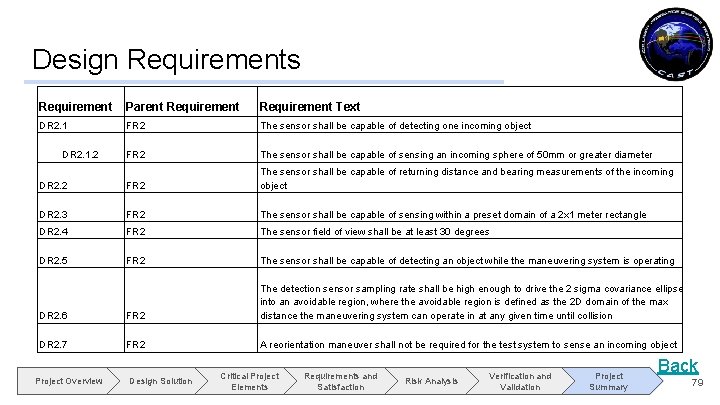
Design Requirements Requirement Parent Requirement Text DR 2. 1 FR 2 The sensor shall be capable of detecting one incoming object FR 2 The sensor shall be capable of sensing an incoming sphere of 50 mm or greater diameter DR 2. 2 FR 2 The sensor shall be capable of returning distance and bearing measurements of the incoming object DR 2. 3 FR 2 The sensor shall be capable of sensing within a preset domain of a 2 x 1 meter rectangle DR 2. 4 FR 2 The sensor field of view shall be at least 30 degrees DR 2. 5 FR 2 The sensor shall be capable of detecting an object while the maneuvering system is operating DR 2. 6 FR 2 The detection sensor sampling rate shall be high enough to drive the 2 sigma covariance ellipse into an avoidable region, where the avoidable region is defined as the 2 D domain of the max distance the maneuvering system can operate in at any given time until collision DR 2. 7 FR 2 A reorientation maneuver shall not be required for the test system to sense an incoming object DR 2. 1. 2 Project Overview Design Solution Critical Project Elements Requirements and Satisfaction Risk Analysis Verification and Validation Project Summary Back 79
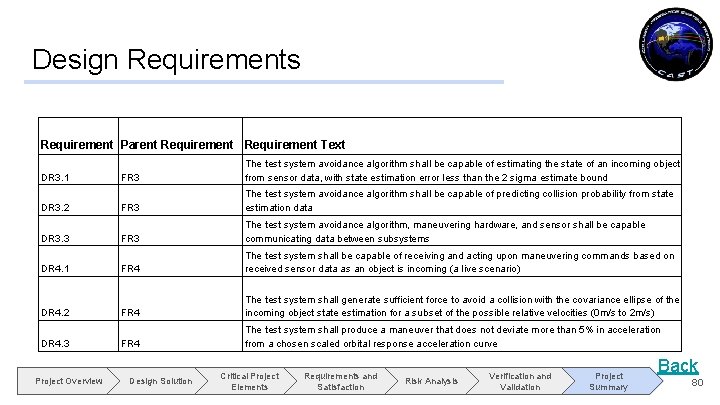
Design Requirements Requirement Parent Requirement Text DR 3. 1 FR 3 The test system avoidance algorithm shall be capable of estimating the state of an incoming object from sensor data, with state estimation error less than the 2 sigma estimate bound DR 3. 2 FR 3 The test system avoidance algorithm shall be capable of predicting collision probability from state estimation data FR 3 The test system avoidance algorithm, maneuvering hardware, and sensor shall be capable communicating data between subsystems FR 4 The test system shall be capable of receiving and acting upon maneuvering commands based on received sensor data as an object is incoming (a live scenario) DR 4. 2 FR 4 The test system shall generate sufficient force to avoid a collision with the covariance ellipse of the incoming object state estimation for a subset of the possible relative velocities (0 m/s to 2 m/s) DR 4. 3 FR 4 The test system shall produce a maneuver that does not deviate more than 5% in acceleration from a chosen scaled orbital response acceleration curve DR 3. 3 DR 4. 1 Project Overview Design Solution Critical Project Elements Requirements and Satisfaction Risk Analysis Verification and Validation Project Summary Back 80
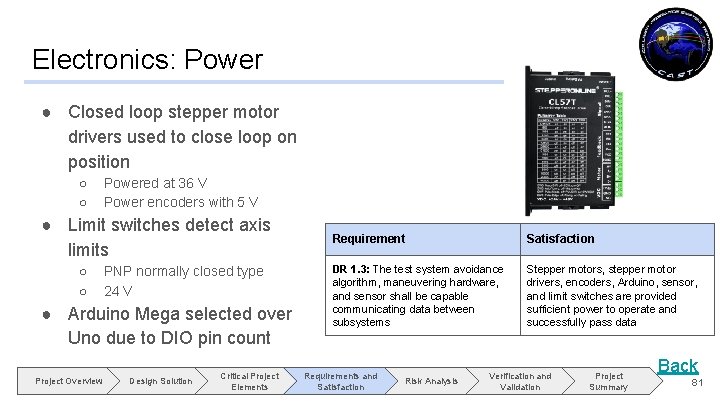
Electronics: Power ● Closed loop stepper motor drivers used to close loop on position ○ ○ Powered at 36 V Power encoders with 5 V ● Limit switches detect axis limits ○ ○ PNP normally closed type 24 V ● Arduino Mega selected over Uno due to DIO pin count Project Overview Design Solution Critical Project Elements Requirement Satisfaction DR 1. 3: The test system avoidance algorithm, maneuvering hardware, and sensor shall be capable communicating data between subsystems Stepper motors, stepper motor drivers, encoders, Arduino, sensor, and limit switches are provided sufficient power to operate and successfully pass data Requirements and Satisfaction Risk Analysis Verification and Validation Project Summary Back 81
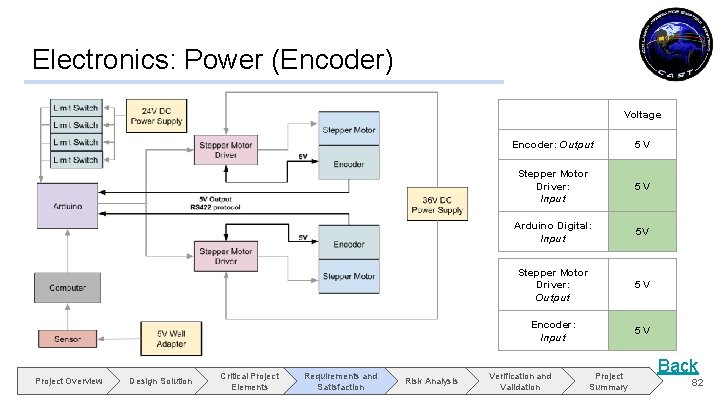
Electronics: Power (Encoder) Voltage Project Overview Design Solution Critical Project Elements Requirements and Satisfaction Risk Analysis Encoder: Output 5 V Stepper Motor Driver: Input 5 V Arduino Digital: Input 5 V Stepper Motor Driver: Output 5 V Encoder: Input 5 V Verification and Validation Project Summary Back 82
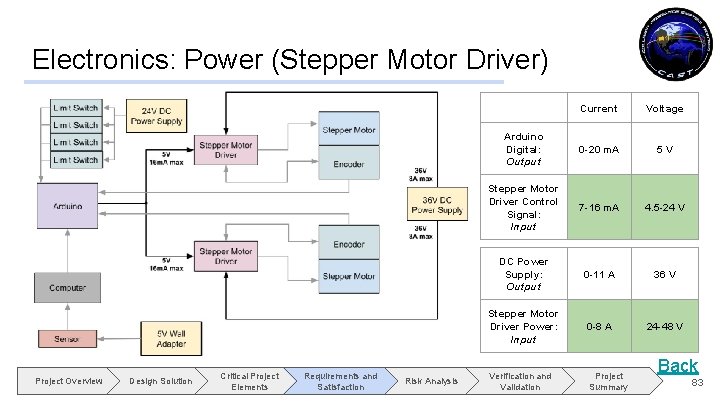
Electronics: Power (Stepper Motor Driver) Project Overview Design Solution Critical Project Elements Requirements and Satisfaction Risk Analysis Current Voltage Arduino Digital: Output 0 -20 m. A 5 V Stepper Motor Driver Control Signal: Input 7 -16 m. A 4. 5 -24 V DC Power Supply: Output 0 -11 A 36 V Stepper Motor Driver Power: Input 0 -8 A 24 -48 V Verification and Validation Project Summary Back 83
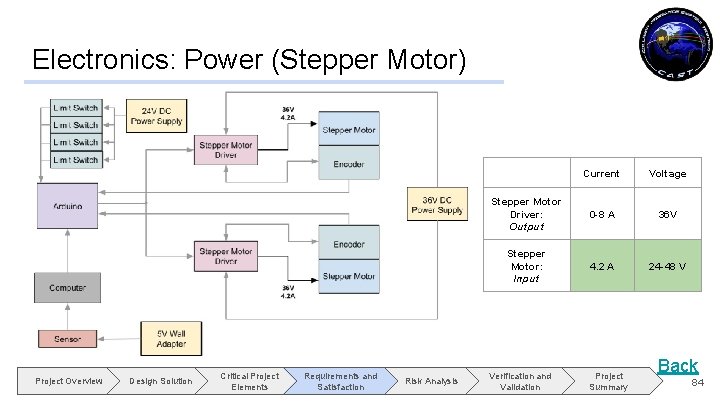
Electronics: Power (Stepper Motor) Project Overview Design Solution Critical Project Elements Requirements and Satisfaction Risk Analysis Current Voltage Stepper Motor Driver: Output 0 -8 A 36 V Stepper Motor: Input 4. 2 A 24 -48 V Verification and Validation Project Summary Back 84
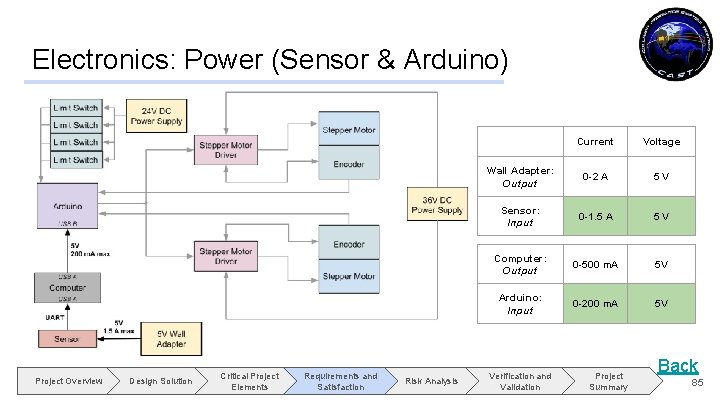
Electronics: Power (Sensor & Arduino) Project Overview Design Solution Critical Project Elements Requirements and Satisfaction Risk Analysis Current Voltage Wall Adapter: Output 0 -2 A 5 V Sensor: Input 0 -1. 5 A 5 V Computer: Output 0 -500 m. A 5 V Arduino: Input 0 -200 m. A 5 V Verification and Validation Project Summary Back 85
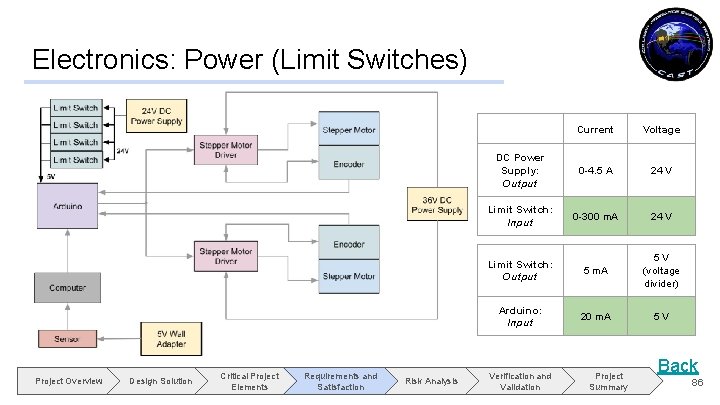
Electronics: Power (Limit Switches) Project Overview Design Solution Critical Project Elements Requirements and Satisfaction Risk Analysis Current Voltage DC Power Supply: Output 0 -4. 5 A 24 V Limit Switch: Input 0 -300 m. A 24 V Limit Switch: Output 5 m. A 5 V (voltage divider) Arduino: Input 20 m. A 5 V Verification and Validation Project Summary Back 86
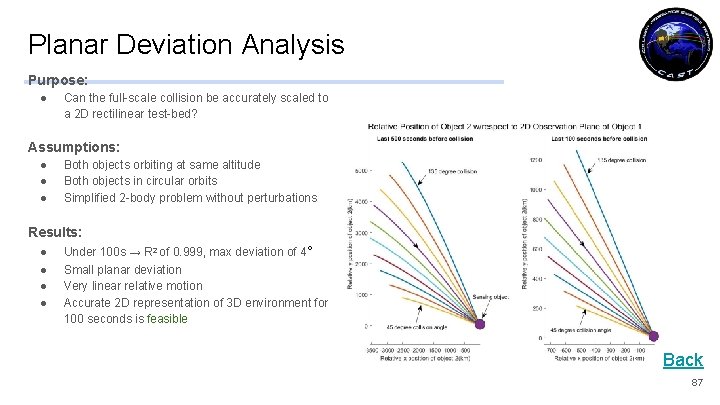
Planar Deviation Analysis Purpose: ● Can the full-scale collision be accurately scaled to a 2 D rectilinear test-bed? Assumptions: ● ● ● Both objects orbiting at same altitude Both objects in circular orbits Simplified 2 -body problem without perturbations Results: ● ● Under 100 s → R 2 of 0. 999, max deviation of 4° Small planar deviation Very linear relative motion Accurate 2 D representation of 3 D environment for 100 seconds is feasible Back 87
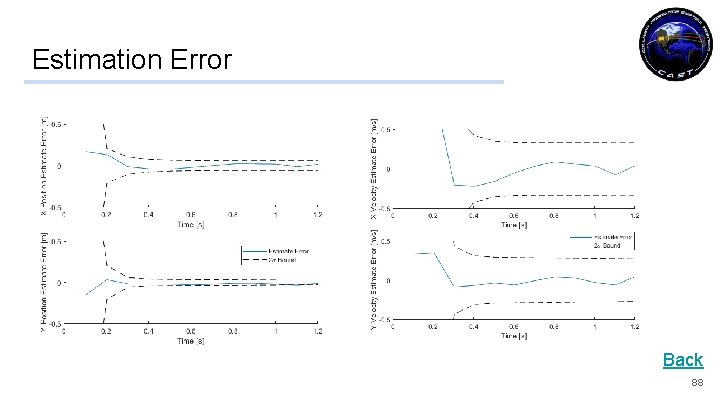
Estimation Error Back 88
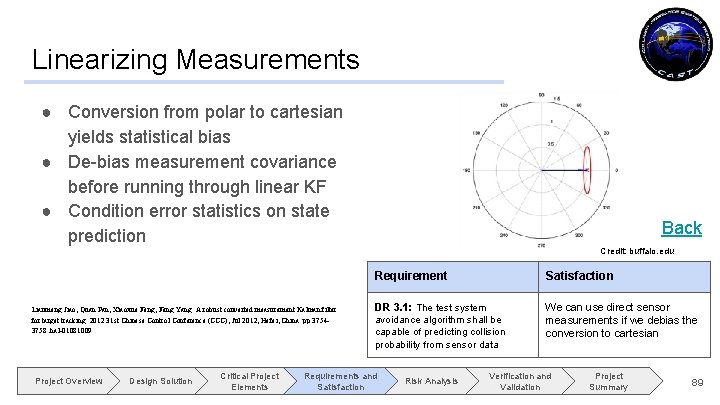
Linearizing Measurements ● Conversion from polar to cartesian yields statistical bias ● De-bias measurement covariance before running through linear KF ● Condition error statistics on state prediction Lianmeng Jiao, Quan Pan, Xiaoxue Feng, Feng Yang. A robust converted measurement Kalman filter for target tracking. 2012 31 st Chinese Control Conference (CCC), Jul 2012, Hefei, China. pp. 37543758. hal-01081009 Project Overview Design Solution Critical Project Elements Back Credit: buffalo. edu Requirement Satisfaction DR 3. 1: The test system We can use direct sensor measurements if we debias the conversion to cartesian avoidance algorithm shall be capable of predicting collision probability from sensor data Requirements and Satisfaction Risk Analysis Verification and Validation Project Summary 89
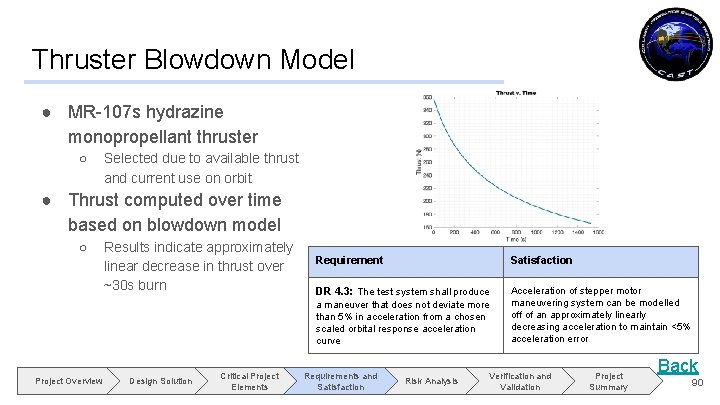
Thruster Blowdown Model ● MR-107 s hydrazine monopropellant thruster ○ Selected due to available thrust and current use on orbit ● Thrust computed over time based on blowdown model ○ Results indicate approximately linear decrease in thrust over ~30 s burn Requirement Satisfaction DR 4. 3: The test system shall produce Acceleration of stepper motor maneuvering system can be modelled off of an approximately linearly decreasing acceleration to maintain <5% acceleration error a maneuver that does not deviate more than 5% in acceleration from a chosen scaled orbital response acceleration curve Project Overview Design Solution Critical Project Elements Requirements and Satisfaction Risk Analysis Verification and Validation Project Summary Back 90
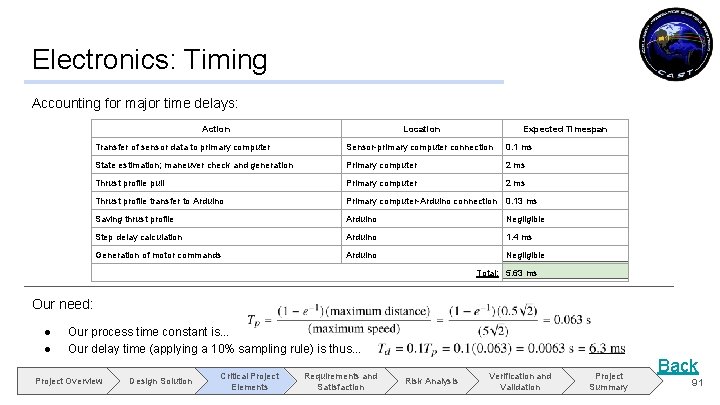
Electronics: Timing Accounting for major time delays: Action Location Expected Timespan Transfer of sensor data to primary computer Sensor-primary computer connection 0. 1 ms State estimation; maneuver check and generation Primary computer 2 ms Thrust profile pull Primary computer 2 ms Thrust profile transfer to Arduino Primary computer-Arduino connection 0. 13 ms Saving thrust profile Arduino Negligible Step delay calculation Arduino 1. 4 ms Generation of motor commands Arduino Negligible Total: 5. 63 ms Our need: ● ● Our process time constant is. . . Our delay time (applying a 10% sampling rule) is thus. . . Project Overview Design Solution Critical Project Elements Requirements and Satisfaction Risk Analysis Verification and Validation Project Summary Back 91
- Slides: 91