
Collinear laser spectroscopy A powerful tool to study
- Slides: 28
Collinear laser spectroscopy: A powerful tool to study the structure of exotic nuclei Gerda Neyens IKS, KU Leuven, Belgium Belgian Research Initiative on Exotic nulcei Saclay, May 2012 1
Collinear laser spectroscopy: A powerful tool to study the structure of exotic nuclei - Introduction: goal of our research - Hyperfine structure – link to observables - Detect the hyperfine structure • Optical detection COLLAPS, ISOLDE-CERN • Resonantly excited ion detection CRIS, ISOLDE-CERN - Some results - Outlook Saclay, May 2012 2
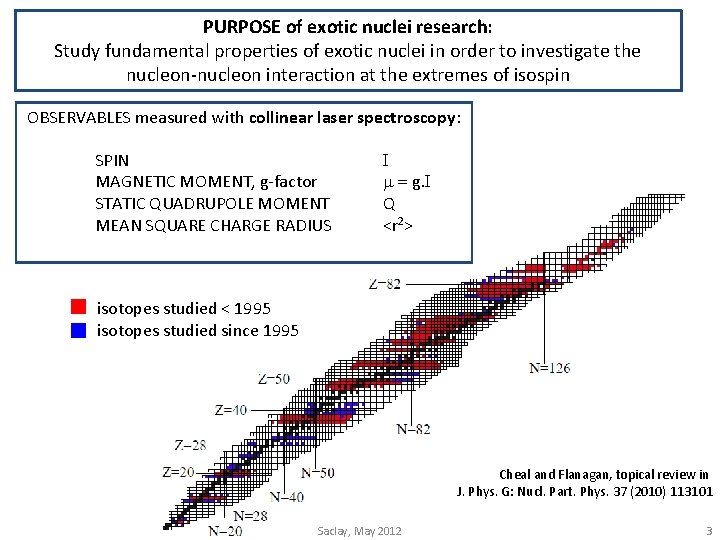
PURPOSE of exotic nuclei research: Study fundamental properties of exotic nuclei in order to investigate the nucleon-nucleon interaction at the extremes of isospin OBSERVABLES measured with collinear laser spectroscopy: SPIN MAGNETIC MOMENT, g-factor STATIC QUADRUPOLE MOMENT MEAN SQUARE CHARGE RADIUS I m = g. I Q <r 2> isotopes studied < 1995 isotopes studied since 1995 Cheal and Flanagan, topical review in J. Phys. G: Nucl. Part. Phys. 37 (2010) 113101 Saclay, May 2012 3
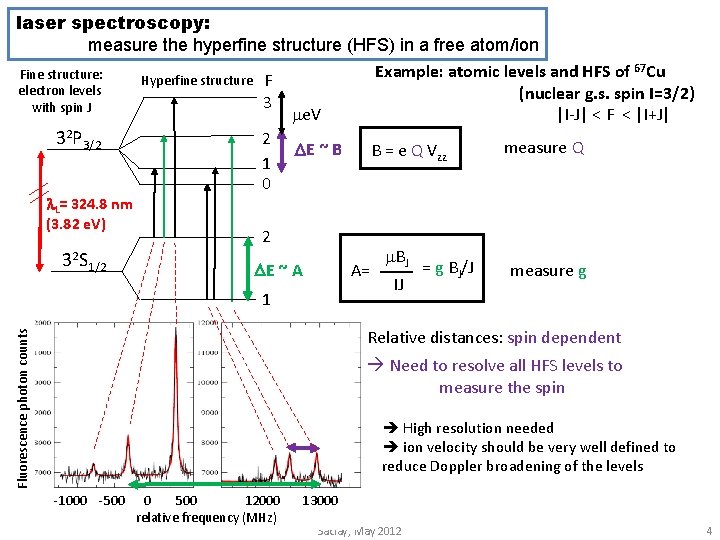
laser spectroscopy: measure the hyperfine structure (HFS) in a free atom/ion 67 Cu Example: atomic levels and HFS of Fine structure: Hyperfine structure F electron levels (nuclear g. s. spin I=3/2) 3 with spin J |I-J| < F < |I+J| me. V 32 P 3/2 2 measure Q DE ~ B B = e Q Vzz 1 0 l. L= 324. 8 nm (3. 82 e. V) 32 S 1/2 2 DE ~ A A= 1 m. BJ IJ = g BJ/J measure g Fluorescence photon counts Relative distances: spin dependent Need to resolve all HFS levels to measure the spin High resolution needed ion velocity should be very well defined to reduce Doppler broadening of the levels -1000 -500 0 500 12000 relative frequency (MHz) 13000 Saclay, May 2012 4
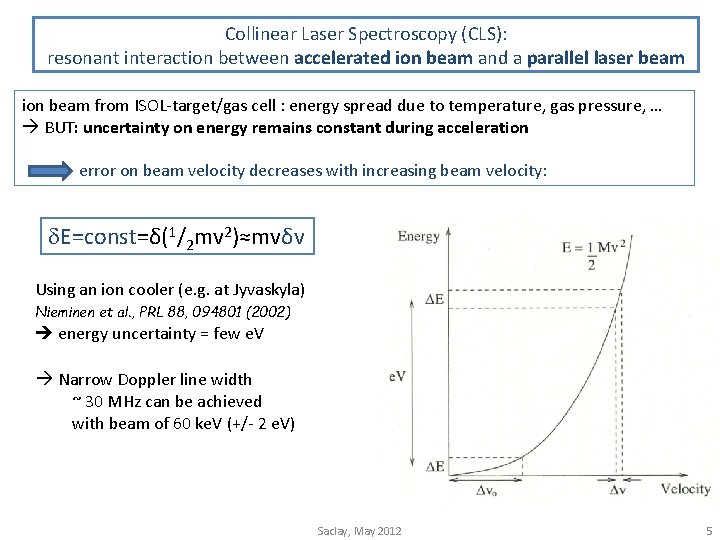
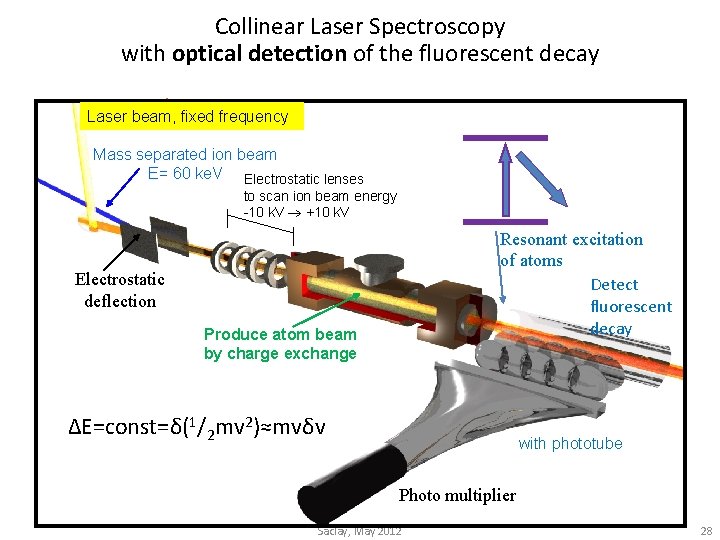
Collinear Laser Spectroscopy (CLS): resonant interaction between accelerated ion beam and a parallel laser beam ion beam from ISOL-target/gas cell : energy spread due to temperature, gas pressure, … BUT: uncertainty on energy remains constant during acceleration error on beam velocity decreases with increasing beam velocity: d. E=const=δ(1/2 mv 2)≈mvδv Using an ion cooler (e. g. at Jyvaskyla) Nieminen et al. , PRL 88, 094801 (2002) energy uncertainty = few e. V Narrow Doppler line width ~ 30 MHz can be achieved with beam of 60 ke. V (+/- 2 e. V) Saclay, May 2012 5
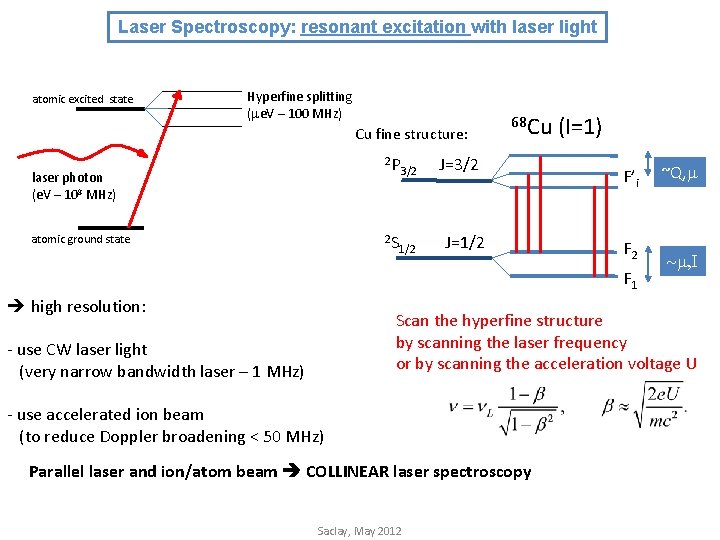
Laser Spectroscopy: resonant excitation with laser light atomic excited state Hyperfine splitting (me. V – 100 MHz) Cu fine structure: 2 P laser photon (e. V – 108 MHz) 2 S atomic ground state 3/2 1/2 68 Cu J=3/2 J=1/2 (I=1) F’i F 2 F 1 high resolution: ~Q, m ~m, I Scan the hyperfine structure by scanning the laser frequency or by scanning the acceleration voltage U - use CW laser light (very narrow bandwidth laser – 1 MHz) - use accelerated ion beam (to reduce Doppler broadening < 50 MHz) Parallel laser and ion/atom beam COLLINEAR laser spectroscopy Saclay, May 2012
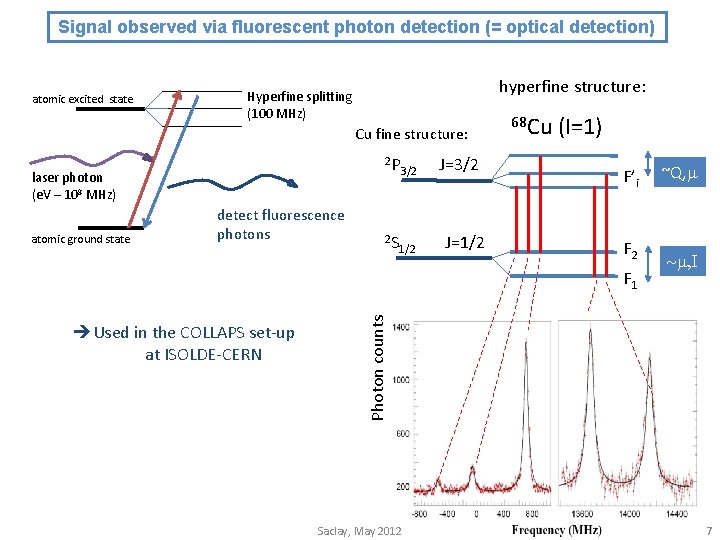
Signal observed via fluorescent photon detection (= optical detection) atomic excited state hyperfine structure: Hyperfine splitting (100 MHz) Cu fine structure: 2 P laser photon (e. V – 108 MHz) atomic ground state detect fluorescence photons 2 S 3/2 1/2 J=3/2 J=1/2 68 Cu (I=1) F’i F 2 Used in the COLLAPS set-up at ISOLDE-CERN ~m, I Photon counts F 1 ~Q, m Saclay, May 2012 7
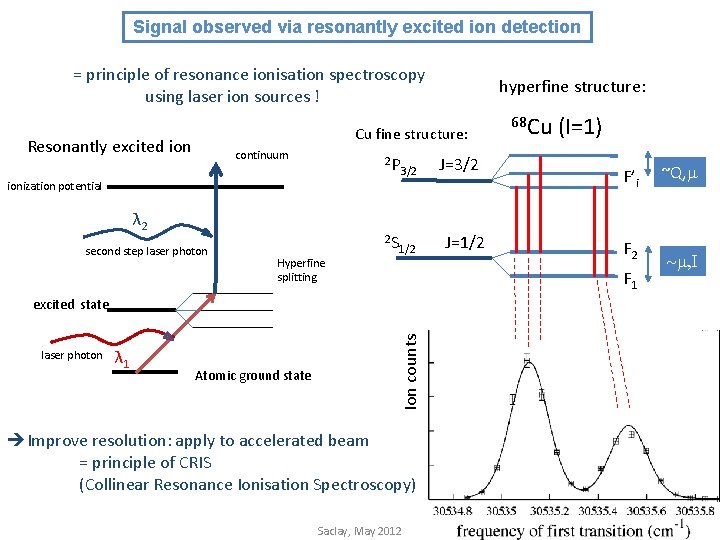
Signal observed via resonantly excited ion detection = principle of resonance ionisation spectroscopy using laser ion sources ! hyperfine structure: Cu fine structure: Resonantly excited ion continuum 2 P 3/2 J=3/2 ionization potential λ 2 second step laser photon 2 S Hyperfine splitting 1/2 J=1/2 68 Cu (I=1) F’i F 2 F 1 ~Q, m ~m, I laser photon λ 1 Atomic ground state Ion counts excited state Improve resolution: apply to accelerated beam = principle of CRIS (Collinear Resonance Ionisation Spectroscopy) Saclay, May 2012 8
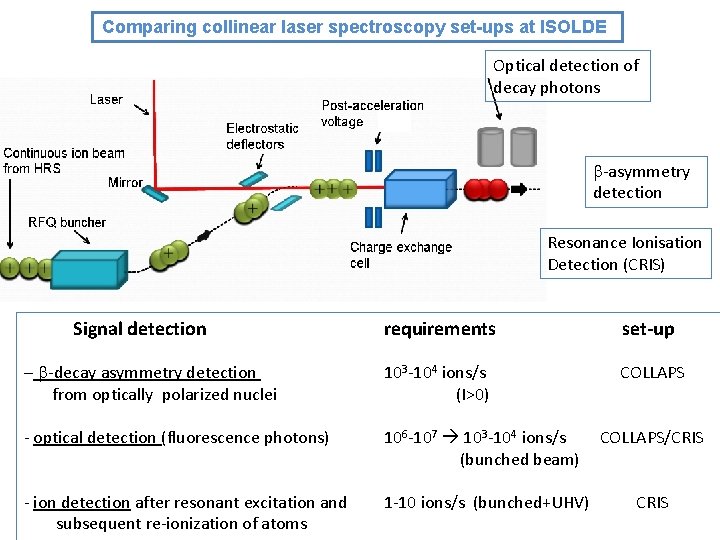
Comparing collinear laser spectroscopy set-ups at ISOLDE Optical detection of decay photons b-asymmetry detection Resonance Ionisation Detection (CRIS) Signal detection requirements set-up - b-decay asymmetry detection from optically polarized nuclei 103 -104 ions/s (I>0) COLLAPS - optical detection (fluorescence photons) 106 -107 103 -104 ions/s (bunched beam) COLLAPS/CRIS - ion detection after resonant excitation and subsequent re-ionization of atoms 1 -10 ions/s (bunched+UHV) CRIS
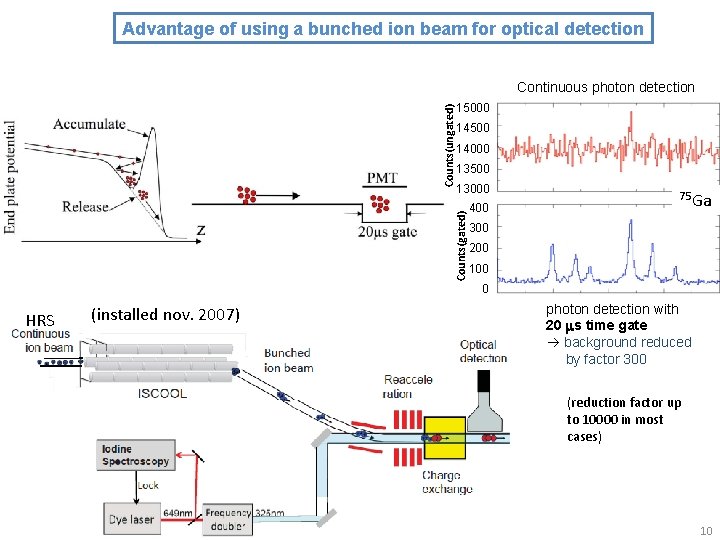
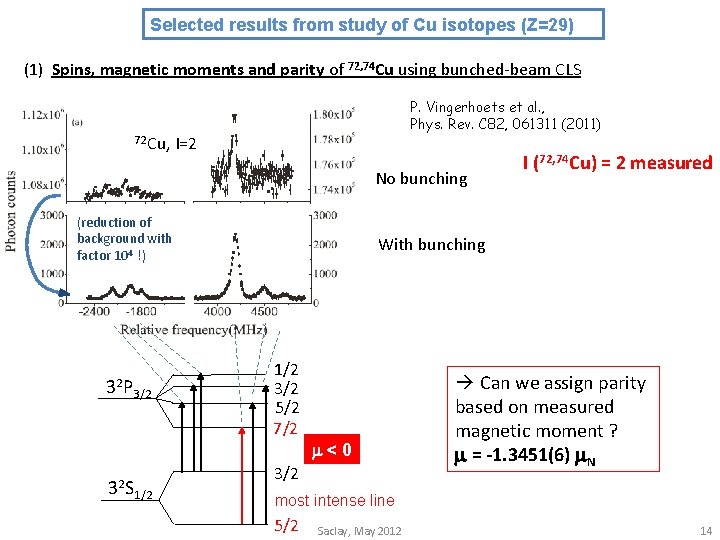
Advantage of using a bunched ion beam for optical detection 15000 14500 14000 13500 13000 Counts(gated) Counts(ungated) Continuous photon detection 400 300 75 Ga 200 100 0 HRS photon detection with 20 ms time gate background reduced by factor 300 (installed nov. 2007) (reduction factor up to 10000 in most cases) Saclay, May 2012 10
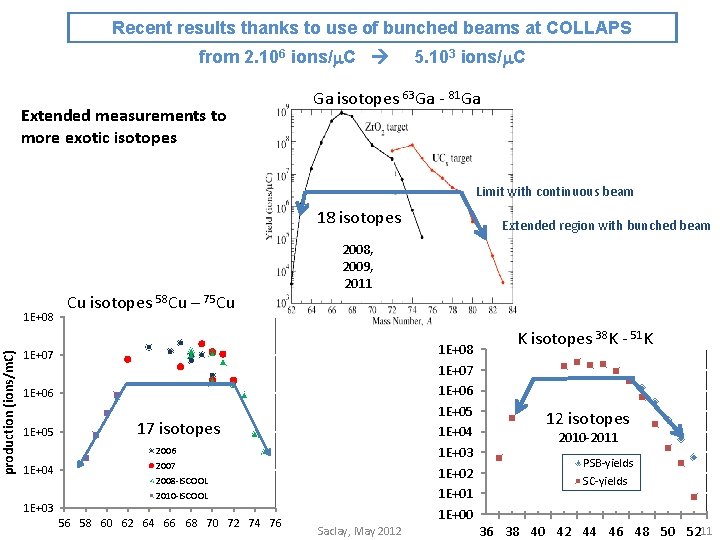
Recent results thanks to use of bunched beams at COLLAPS from 2. 106 ions/m. C Extended measurements to more exotic isotopes 5. 103 ions/m. C Ga isotopes 63 Ga - 81 Ga Limit with continuous beam 18 isotopes production (ions/m. C) 1 E+08 Cu isotopes 58 Cu – 75 Cu 2008, 2009, 2011 1 E+08 1 E+07 1 E+06 1 E+05 1 E+04 1 E+03 1 E+02 1 E+01 1 E+00 1 E+07 1 E+06 1 E+05 1 E+04 1 E+03 17 isotopes 2006 2007 2008 -ISCOOL 2010 -ISCOOL 56 58 60 62 64 66 68 70 72 74 76 Extended region with bunched beam Saclay, May 2012 K isotopes 38 K - 51 K 12 isotopes 2010 -2011 PSB-yields SC-yields 36 38 40 42 44 46 48 50 5211
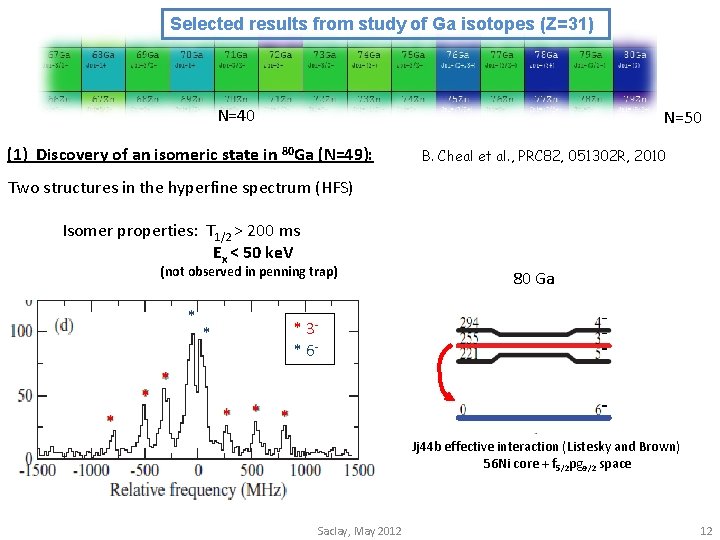
Selected results from study of Ga isotopes (Z=31) N=40 N=50 (1) Discovery of an isomeric state in 80 Ga (N=49): B. Cheal et al. , PRC 82, 051302 R, 2010 Two structures in the hyperfine spectrum (HFS) Isomer properties: T 1/2 > 200 ms Ex < 50 ke. V (not observed in penning trap) * * * 80 Ga * 3* 6 - * * * Jj 44 b effective interaction (Listesky and Brown) 56 Ni core + f 5/2 pg 9/2 space Saclay, May 2012 12
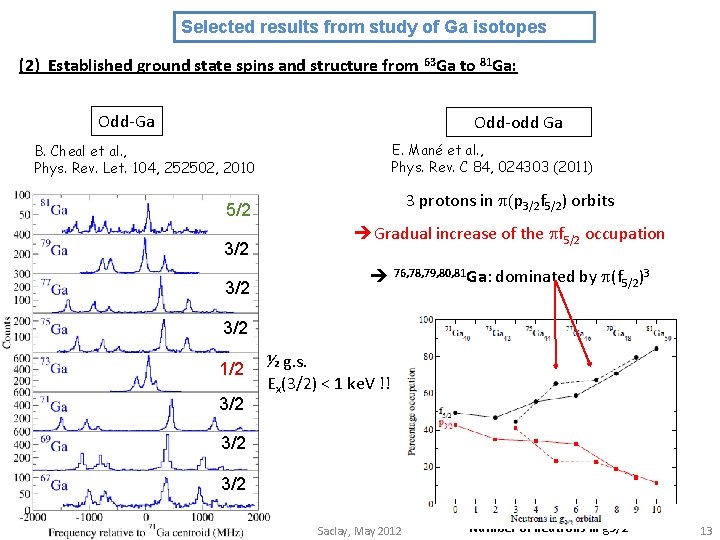
Selected results from study of Ga isotopes (2) Established ground state spins and structure from 63 Ga to 81 Ga: Odd-Ga Odd-odd Ga E. Mané et al. , Phys. Rev. C 84, 024303 (2011) B. Cheal et al. , Phys. Rev. Let. 104, 252502, 2010 3 protons in p(p 3/2 f 5/2) orbits 5/2 3/2 Gradual increase of the pf 5/2 occupation 76, 78, 79, 80, 81 Ga: dominated by p(f 5/2)3 1/2 3/2 ½ g. s. Ex(3/2) < 1 ke. V !! Occupation probability 3/2 f 5/2 p 3/2 Saclay, May 2012 Number of neutrons in g 9/2 13
Selected results from study of Cu isotopes (Z=29) (1) Spins, magnetic moments and parity of 72, 74 Cu using bunched-beam CLS 72 Cu, P. Vingerhoets et al. , Phys. Rev. C 82, 061311 (2011) I=2 No bunching (reduction of background with factor 104 !) 32 P 3/2 32 S With bunching 1/2 3/2 5/2 7/2 m<0 3/2 1/2 I (72, 74 Cu) = 2 measured Can we assign parity based on measured magnetic moment ? m = -1. 3451(6) m. N most intense line 5/2 Saclay, May 2012 14
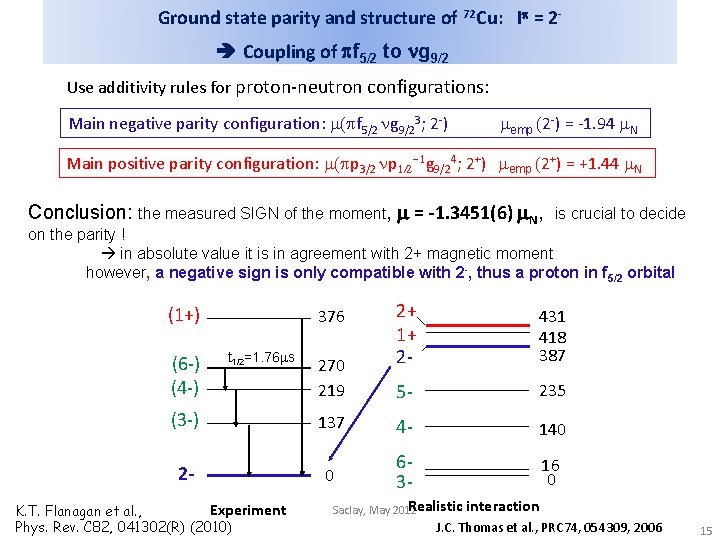
Ground state parity and structure of 72 Cu: Ip = 2 Coupling of pf 5/2 to ng 9/2 Use additivity rules for proton-neutron configurations: Main negative parity configuration: m(pf 5/2 ng 9/23; 2 -) memp (2 -) = -1. 94 m. N Main positive parity configuration: m(pp 3/2 np 1/2 -1 g 9/24; 2+) memp (2+) = +1. 44 m. N Conclusion: the measured SIGN of the moment, m = -1. 3451(6) m. N, is crucial to decide on the parity ! in absolute value it is in agreement with 2+ magnetic moment however, a negative sign is only compatible with 2 -, thus a proton in f 5/2 orbital (1+) (6 -) (4 -) 376 t 1/2=1. 76 ms 270 219 2+ 1+ 2 - 431 418 387 5 - 235 (3 -) 137 4 - 140 2 - 0 63 - 16 0 Experiment K. T. Flanagan et al. , Phys. Rev. C 82, 041302(R) (2010) Realistic Saclay, May 2012 interaction J. C. Thomas et al. , PRC 74, 054309, 2006 15
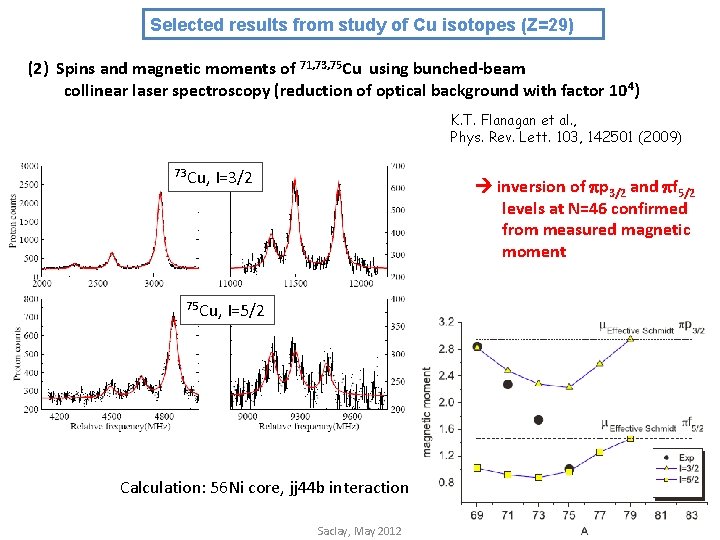
Selected results from study of Cu isotopes (Z=29) (2) Spins and magnetic moments of 71, 73, 75 Cu using bunched-beam collinear laser spectroscopy (reduction of optical background with factor 10 4) K. T. Flanagan et al. , Phys. Rev. Lett. 103, 142501 (2009) 73 Cu, I=3/2 75 Cu, inversion of pp 3/2 and pf 5/2 levels at N=46 confirmed from measured magnetic moment I=5/2 Calculation: 56 Ni core, jj 44 b interaction Saclay, May 2012 16
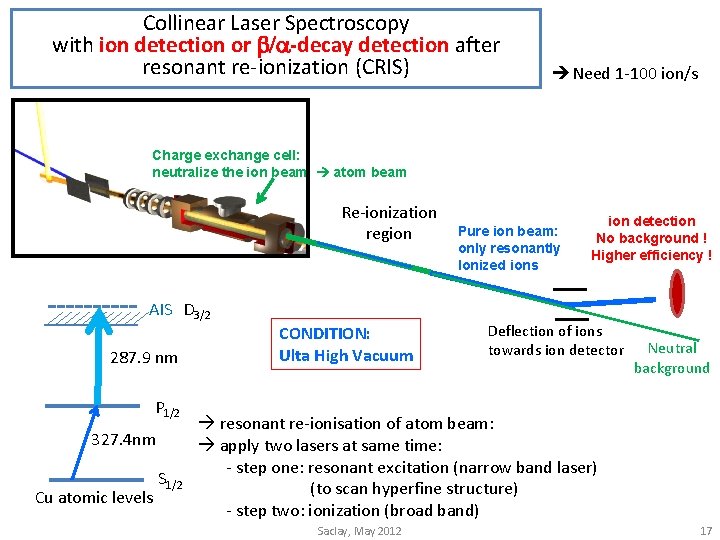
Collinear Laser Spectroscopy with ion detection or b/a-decay detection after resonant re-ionization (CRIS) Need 1 -100 ion/s Charge exchange cell: neutralize the ion beam atom beam Re-ionization region AIS D 3/2 287. 9 nm P 1/2 327. 4 nm Cu atomic levels S 1/2 CONDITION: Ulta High Vacuum Pure ion beam: only resonantly Ionized ions ion detection No background ! Higher efficiency ! Deflection of ions towards ion detector Neutral background resonant re-ionisation of atom beam: apply two lasers at same time: - step one: resonant excitation (narrow band laser) (to scan hyperfine structure) - step two: ionization (broad band) Saclay, May 2012 17
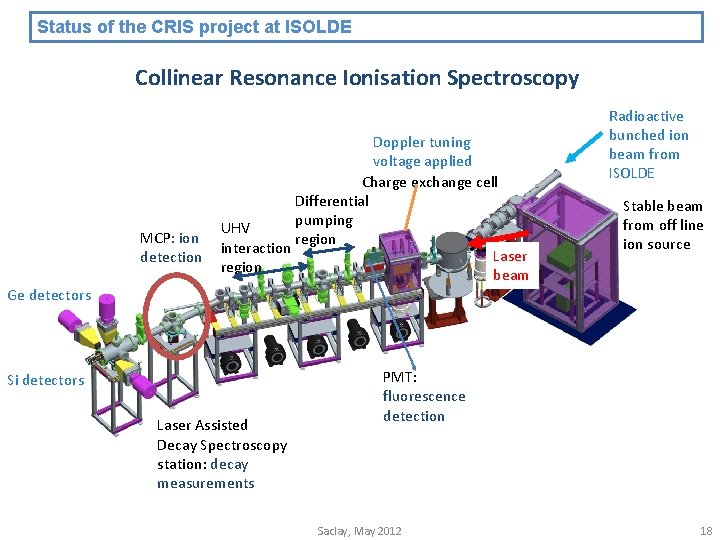
Status of the CRIS project at ISOLDE Collinear Resonance Ionisation Spectroscopy MCP: ion detection Doppler tuning voltage applied Charge exchange cell Differential pumping UHV region interaction Laser region beam Radioactive bunched ion beam from ISOLDE Stable beam from off line ion source Ge detectors Si detectors Laser Assisted Decay Spectroscopy station: decay measurements PMT: fluorescence detection Saclay, May 2012 18
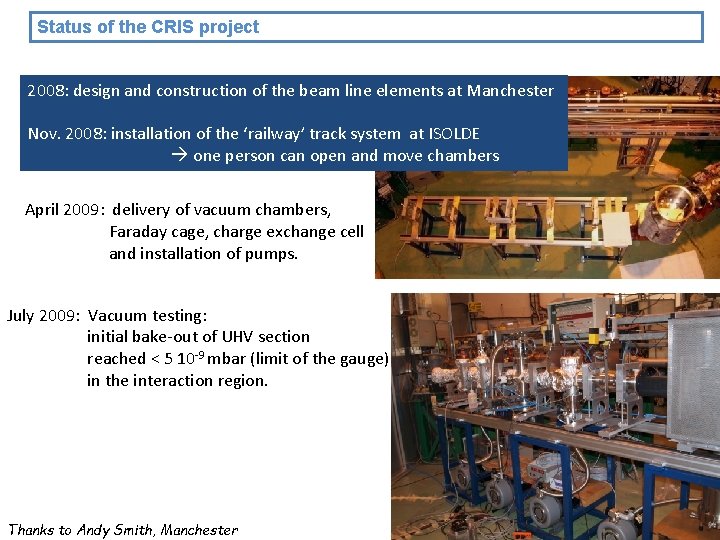
Status of the CRIS project 2008: design and construction of the beam line elements at Manchester Nov. 2008: installation of the ‘railway’ track system at ISOLDE one person can open and move chambers April 2009: delivery of vacuum chambers, Faraday cage, charge exchange cell and installation of pumps. July 2009: Vacuum testing: initial bake-out of UHV section reached < 5 10 -9 mbar (limit of the gauge) in the interaction region. Thanks to Andy Smith, Manchester
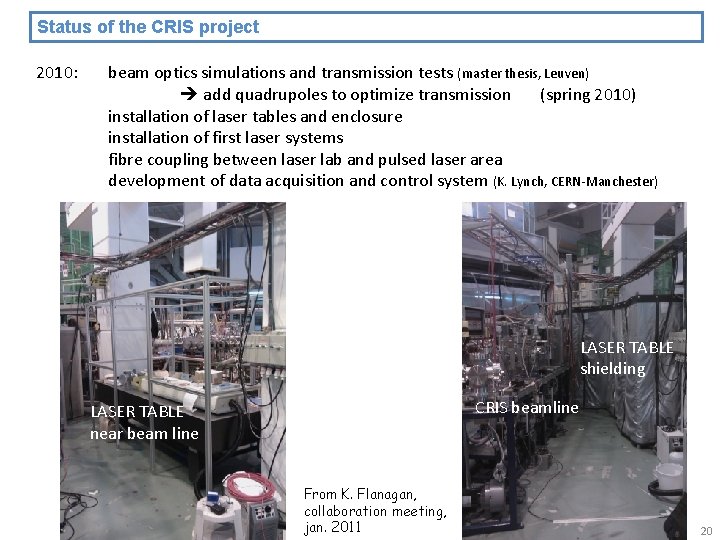
Status of the CRIS project 2010: beam optics simulations and transmission tests (master thesis, Leuven) add quadrupoles to optimize transmission (spring 2010) installation of laser tables and enclosure installation of first laser systems fibre coupling between laser lab and pulsed laser area development of data acquisition and control system (K. Lynch, CERN-Manchester) LASER TABLE shielding CRIS beamline LASER TABLE near beam line From K. Flanagan, collaboration meeting, jan. 2011 20
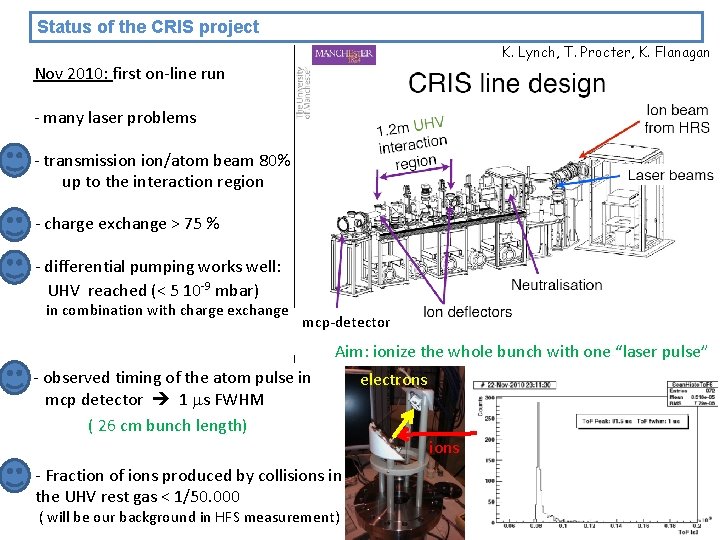
Status of the CRIS project K. Lynch, T. Procter, K. Flanagan Nov 2010: first on-line run - many laser problems - transmission ion/atom beam 80% up to the interaction region - charge exchange > 75 % - differential pumping works well: UHV reached (< 5 10 -9 mbar) in combination with charge exchange mcp-detector Aim: ionize the whole bunch with one “laser pulse” - observed timing of the atom pulse in mcp detector 1 ms FWHM ( 26 cm bunch length) - Fraction of ions produced by collisions in the UHV rest gas < 1/50. 000 ( will be our background in HFS measurement) electrons ions
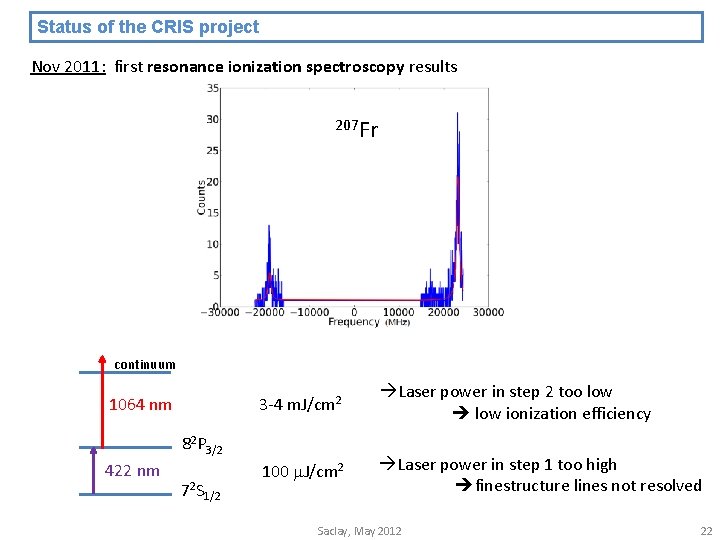
Status of the CRIS project Nov 2011: first resonance ionization spectroscopy results 207 Fr continuum 1064 nm 3 -4 m. J/cm 2 Laser power in step 2 too low ionization efficiency 100 m. J/cm 2 Laser power in step 1 too high finestructure lines not resolved 82 P 3/2 422 nm 72 S 1/2 Saclay, May 2012 22
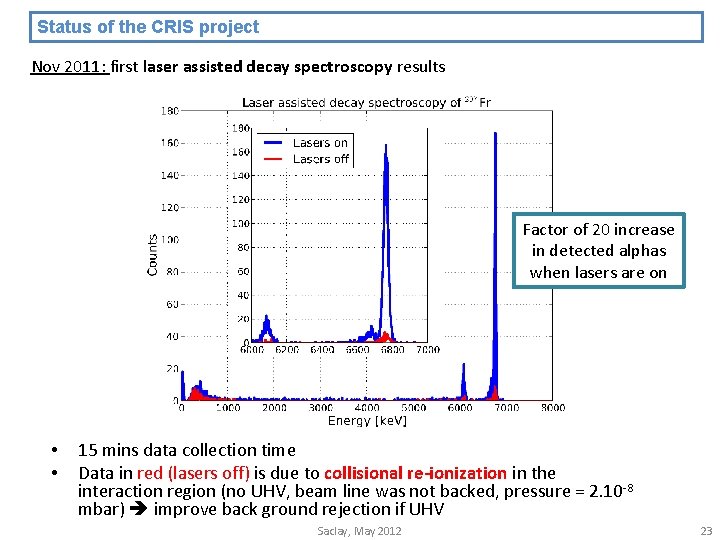
Status of the CRIS project Nov 2011: first laser assisted decay spectroscopy results Factor of 20 increase in detected alphas when lasers are on • • 15 mins data collection time Data in red (lasers off) is due to collisional re-ionization in the interaction region (no UHV, beam line was not backed, pressure = 2. 10 -8 mbar) improve back ground rejection if UHV Saclay, May 2012 23
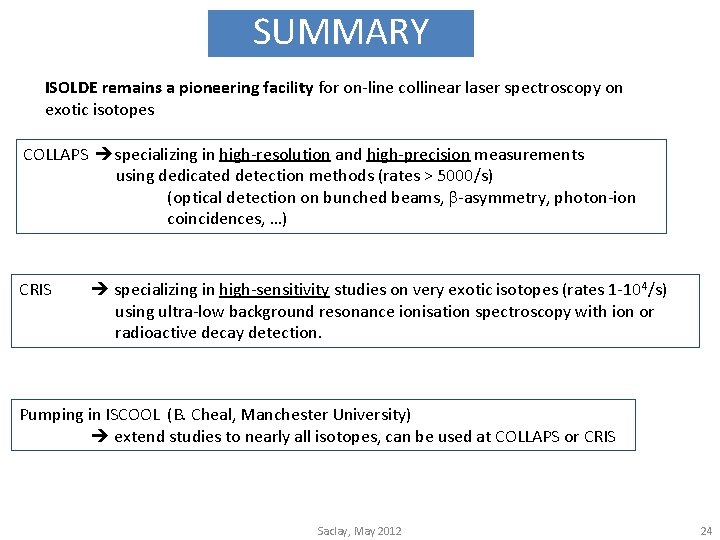
SUMMARY ISOLDE remains a pioneering facility for on-line collinear laser spectroscopy on exotic isotopes COLLAPS specializing in high-resolution and high-precision measurements using dedicated detection methods (rates > 5000/s) (optical detection on bunched beams, b-asymmetry, photon-ion coincidences, …) CRIS specializing in high-sensitivity studies on very exotic isotopes (rates 1 -104/s) using ultra-low background resonance ionisation spectroscopy with ion or radioactive decay detection. Pumping in ISCOOL (B. Cheal, Manchester University) extend studies to nearly all isotopes, can be used at COLLAPS or CRIS Saclay, May 2012 24
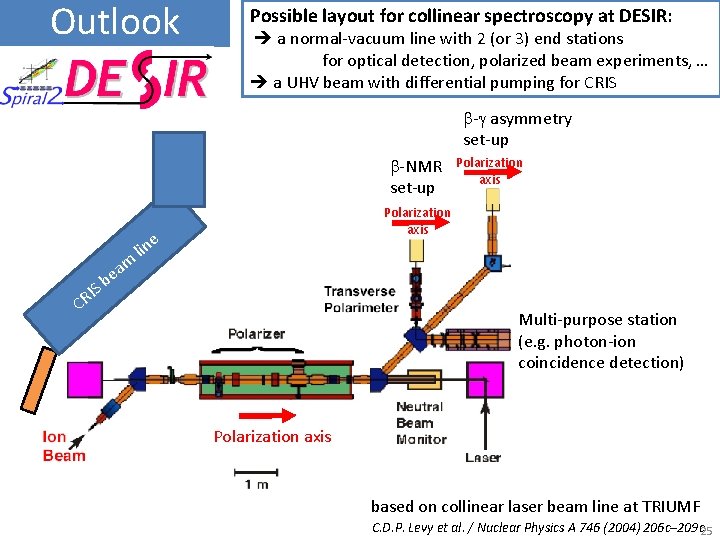
Outlook Possible layout for collinear spectroscopy at DESIR: a normal-vacuum line with 2 (or 3) end stations for optical detection, polarized beam experiments, … a UHV beam with differential pumping for CRIS b-g asymmetry set-up b-NMR set-up m ea b S RI Polarization axis e lin C Multi-purpose station (e. g. photon-ion coincidence detection) Polarization axis based on collinear laser beam line at TRIUMF C. D. P. Levy et al. / Nuclear Physics A 746 (2004) 206 c– 209 c 25
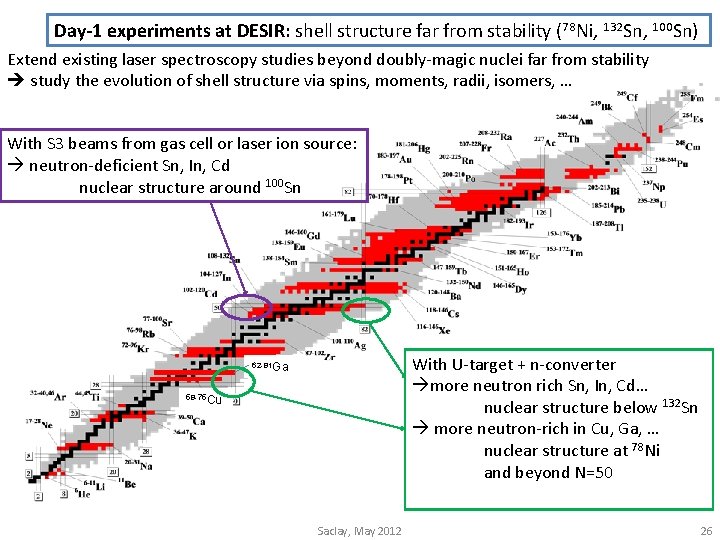
Day-1 experiments at DESIR: shell structure far from stability (78 Ni, 132 Sn, 100 Sn) Extend existing laser spectroscopy studies beyond doubly-magic nuclei far from stability study the evolution of shell structure via spins, moments, radii, isomers, … With S 3 beams from gas cell or laser ion source: neutron-deficient Sn, In, Cd nuclear structure around 100 Sn With U-target + n-converter more neutron rich Sn, In, Cd… nuclear structure below 132 Sn more neutron-rich in Cu, Ga, … nuclear structure at 78 Ni and beyond N=50 62 -81 Ga 58 -75 Cu Saclay, May 2012 26
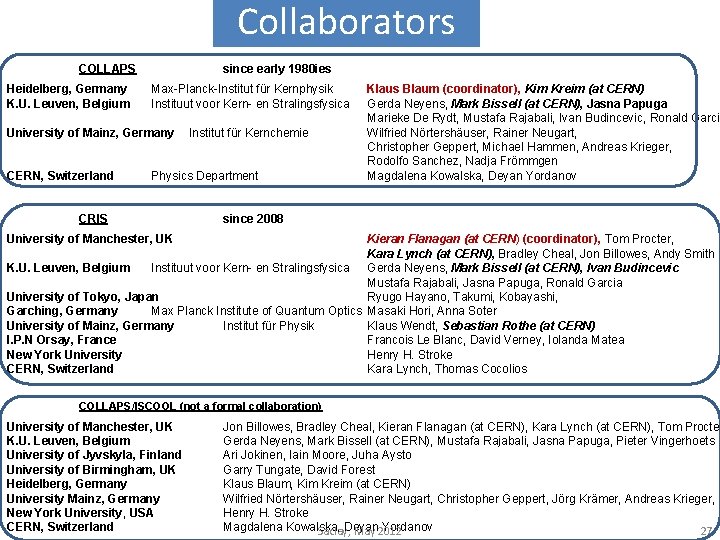
Collaborators COLLAPS Heidelberg, Germany K. U. Leuven, Belgium since early 1980 ies Max-Planck-Institut für Kernphysik Instituut voor Kern- en Stralingsfysica University of Mainz, Germany CERN, Switzerland Institut für Kernchemie Physics Department CRIS Klaus Blaum (coordinator), Kim Kreim (at CERN) Gerda Neyens, Mark Bissell (at CERN), Jasna Papuga Marieke De Rydt, Mustafa Rajabali, Ivan Budincevic, Ronald Garcia Wilfried Nörtershäuser, Rainer Neugart, Christopher Geppert, Michael Hammen, Andreas Krieger, Rodolfo Sanchez, Nadja Frömmgen Magdalena Kowalska, Deyan Yordanov since 2008 University of Manchester, UK Kieran Flanagan (at CERN) (coordinator), Tom Procter, Kara Lynch (at CERN), Bradley Cheal, Jon Billowes, Andy Smith K. U. Leuven, Belgium Instituut voor Kern- en Stralingsfysica Gerda Neyens, Mark Bissell (at CERN), Ivan Budincevic Mustafa Rajabali, Jasna Papuga, Ronald Garcia University of Tokyo, Japan Ryugo Hayano, Takumi, Kobayashi, Garching, Germany Max Planck Institute of Quantum Optics Masaki Hori, Anna Soter University of Mainz, Germany Institut für Physik Klaus Wendt, Sebastian Rothe (at CERN) I. P. N Orsay, France Francois Le Blanc, David Verney, Iolanda Matea New York University Henry H. Stroke CERN, Switzerland Kara Lynch, Thomas Cocolios COLLAPS/ISCOOL (not a formal collaboration) University of Manchester, UK K. U. Leuven, Belgium University of Jyvskyla, Finland University of Birmingham, UK Heidelberg, Germany University Mainz, Germany New York University, USA CERN, Switzerland Jon Billowes, Bradley Cheal, Kieran Flanagan (at CERN), Kara Lynch (at CERN), Tom Procter Gerda Neyens, Mark Bissell (at CERN), Mustafa Rajabali, Jasna Papuga, Pieter Vingerhoets Ari Jokinen, Iain Moore, Juha Aysto Garry Tungate, David Forest Klaus Blaum, Kim Kreim (at CERN) Wilfried Nörtershäuser, Rainer Neugart, Christopher Geppert, Jörg Krämer, Andreas Krieger, Henry H. Stroke Magdalena Kowalska, Deyan Yordanov Saclay, May 2012 27
Collinear Laser Spectroscopy with optical detection of the fluorescent decay Laser beam, Laser on fixed frequency Mass separatedion beam E= 60 ke. V Retardation zone: Electrostatic lenses Laser beam, fixed frequency to scan ion beam energy electrostatic lenses -10 k. V +10 k. V Electrostatic deflection Alkaline vapor Produce atom beam Chargeexchange cell, by charge Excitation / Observation region Resonant excitation of atoms Detect fluorescent decay heated ΔE=const=δ(1/2 mv 2)≈mvδv Light guide with phototube Photo multiplier Saclay, May 2012 28