
Colligative Properties Use this eq once for every
- Slides: 4
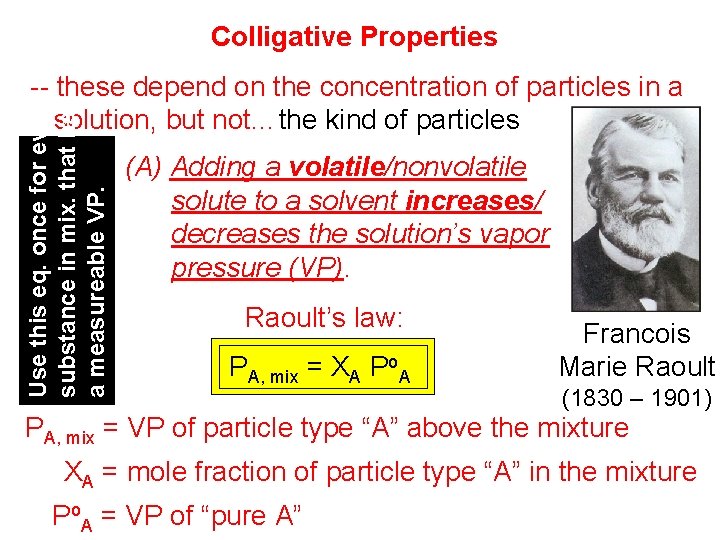
Colligative Properties Use this eq. once for every substance in mix. that has a measureable VP. -- these depend on the concentration of particles in a solution, but not. . . the kind of particles (A) Adding a volatile/nonvolatile solute to a solvent increases/ decreases the solution’s vapor pressure (VP). Raoult’s law: PA, mix = XA Po. A Francois Marie Raoult (1830 – 1901) PA, mix = VP of particle type “A” above the mixture XA = mole fraction of particle type “A” in the mixture Po. A = VP of “pure A”
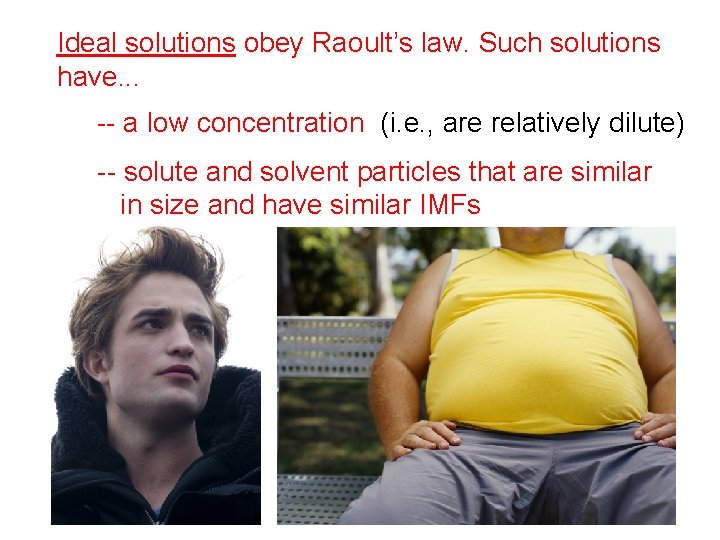
Ideal solutions obey Raoult’s law. Such solutions have. . . -- a low concentration (i. e. , are relatively dilute) -- solute and solvent particles that are similar in size and have similar IMFs
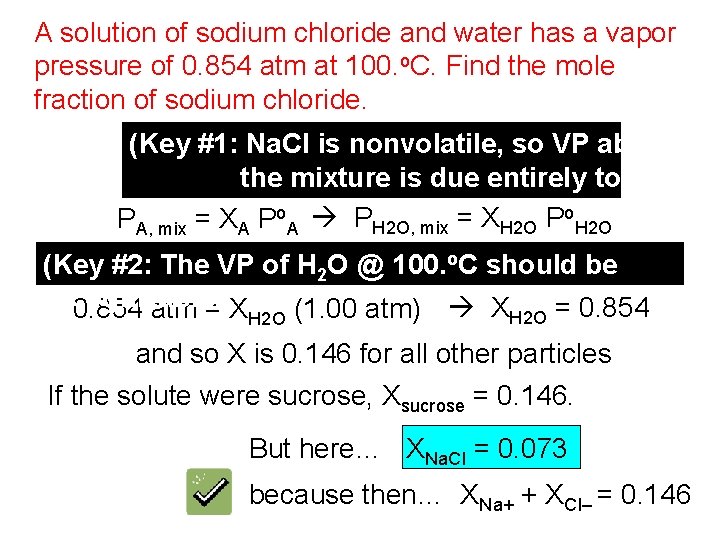
A solution of sodium chloride and water has a vapor pressure of 0. 854 atm at 100. o. C. Find the mole fraction of sodium chloride. (Key #1: Na. Cl is nonvolatile, so VP above the mixture is due entirely to H 2 O. ) PA, mix = XA Po. A PH 2 O, mix = XH 2 O Po. H 2 O (Key #2: The VP of H 2 O @ 100. o. C should be recognizable. ) = 0. 854 atm = X (1. 00 atm) X H 2 O and so X is 0. 146 for all other particles If the solute were sucrose, Xsucrose = 0. 146. But here… XNa. Cl = 0. 073 because then… XNa+ + XCl– = 0. 146
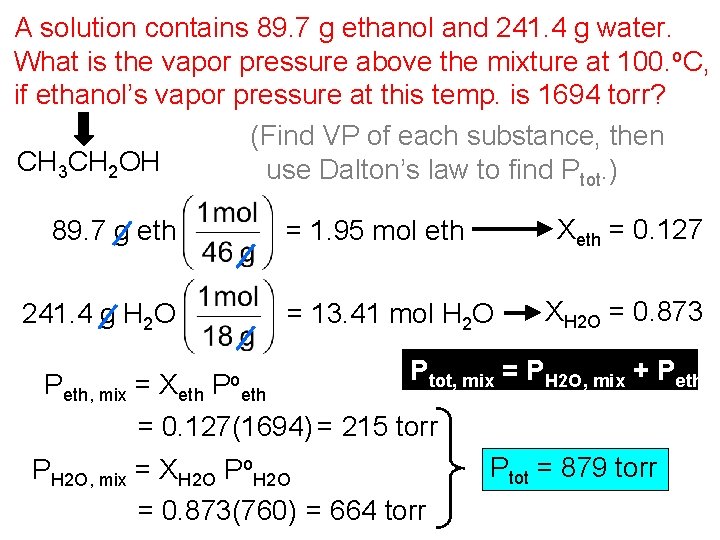
A solution contains 89. 7 g ethanol and 241. 4 g water. What is the vapor pressure above the mixture at 100. o. C, if ethanol’s vapor pressure at this temp. is 1694 torr? (Find VP of each substance, then CH 3 CH 2 OH use Dalton’s law to find Ptot. ) 89. 7 g eth Xeth = 0. 127 = 1. 95 mol eth 241. 4 g H 2 O = 13. 41 mol H 2 O Po XH 2 O = 0. 873 Ptot, mix = PH 2 O, mix + Peth, mix = Xeth = 0. 127(1694) = 215 torr PH 2 O, mix = XH 2 O Po. H 2 O = 0. 873(760) = 664 torr Ptot = 879 torr