
Colligative Properties Molality m the number of moles

Colligative Properties
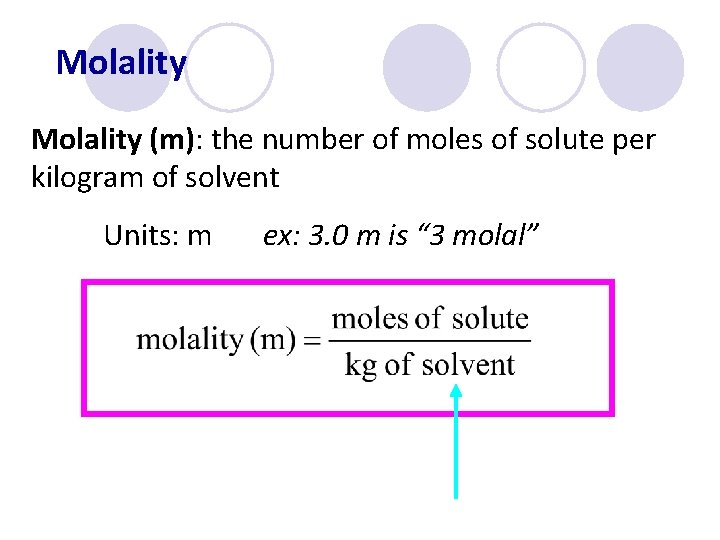
Molality (m): the number of moles of solute per kilogram of solvent Units: m ex: 3. 0 m is “ 3 molal”
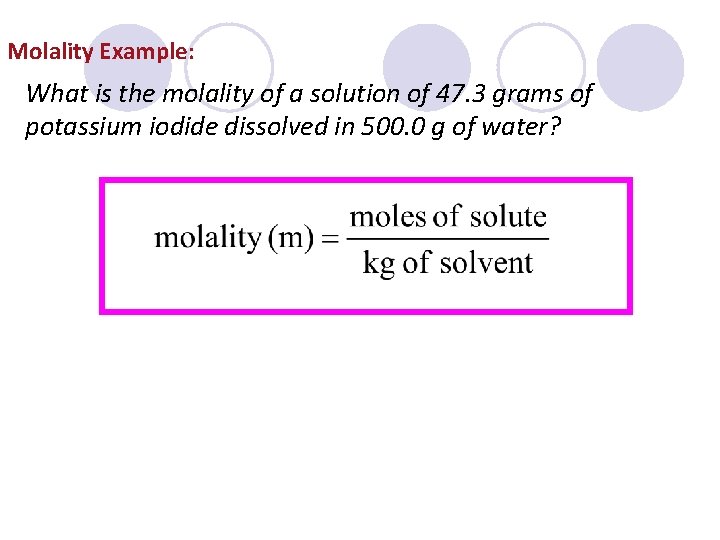
Molality Example: What is the molality of a solution of 47. 3 grams of potassium iodide dissolved in 500. 0 g of water?
Colligative Properties Colligative Property: a property that depends only on the number of solute particles, and not the type of particle. Examples of some colligative properties: 1. Freezing Point Depression 2. Boiling Point Elevation 3. Vapor Pressure Lowering We will focus on Freezing Point and Boiling Point.
Freezing Point Depression What happens when something freezes (for example, water)? • Decrease in energy slows molecules/atoms down • Intermolecular forces have more effect (atoms have less energy to fight them) • Frozen water (ice) molecules are in an orderly pattern. Adding Solute What happens when you add a solute? l The addition of another substance (a solute) disrupts and prevents water molecules from forming an orderly pattern.
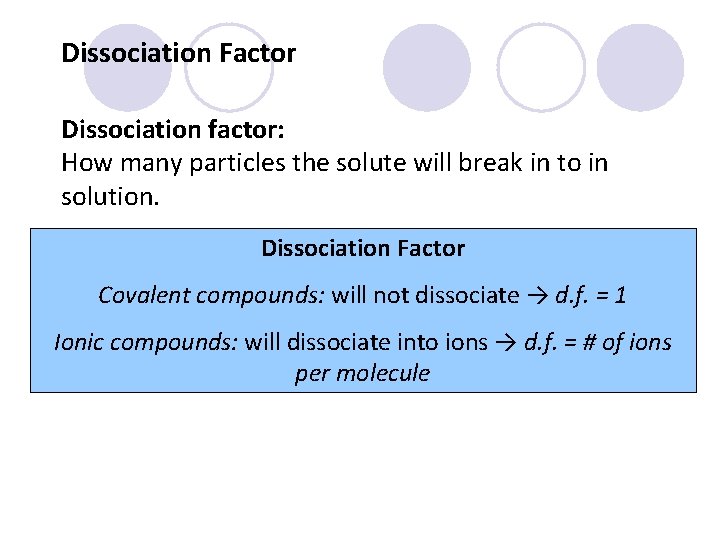
Dissociation Factor Dissociation factor: How many particles the solute will break in to in solution. Dissociation Factor Covalent compounds: will not dissociate → d. f. = 1 Ionic compounds: will dissociate into ions → d. f. = # of ions per molecule
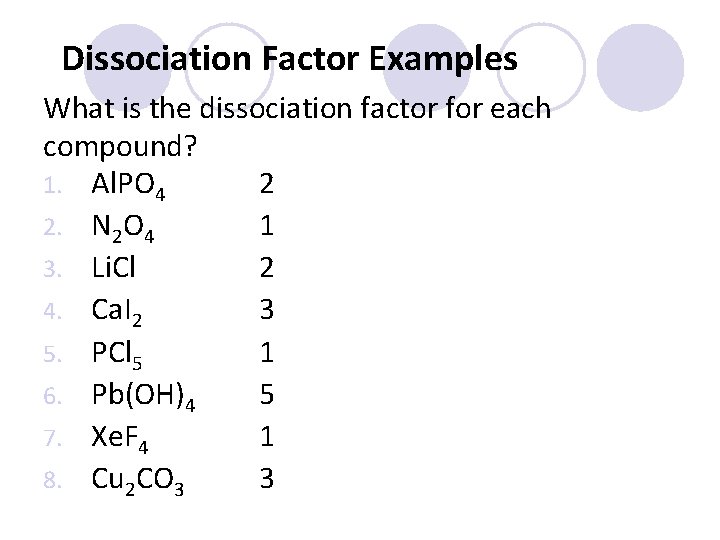
Dissociation Factor Examples What is the dissociation factor for each compound? 1. Al. PO 4 2 2. N 2 O 4 1 3. Li. Cl 2 4. Ca. I 2 3 5. PCl 5 1 6. Pb(OH)4 5 7. Xe. F 4 1 8. Cu 2 CO 3 3
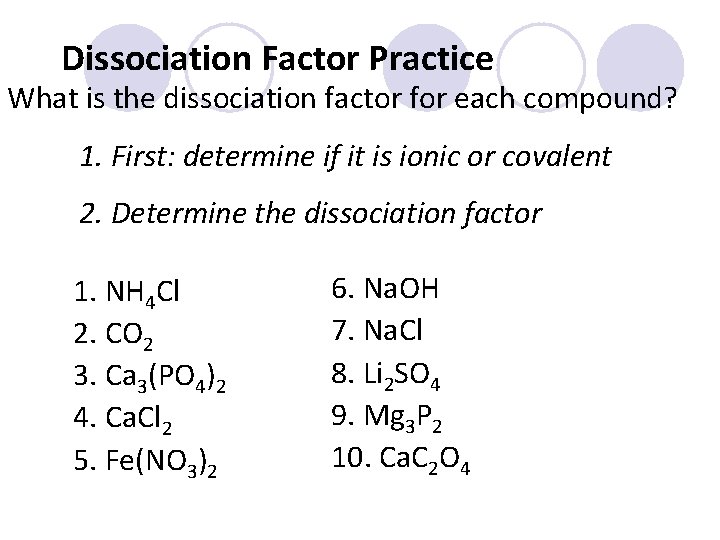
Dissociation Factor Practice What is the dissociation factor for each compound? 1. First: determine if it is ionic or covalent 2. Determine the dissociation factor 1. NH 4 Cl 2. CO 2 3. Ca 3(PO 4)2 4. Ca. Cl 2 5. Fe(NO 3)2 6. Na. OH 7. Na. Cl 8. Li 2 SO 4 9. Mg 3 P 2 10. Ca. C 2 O 4
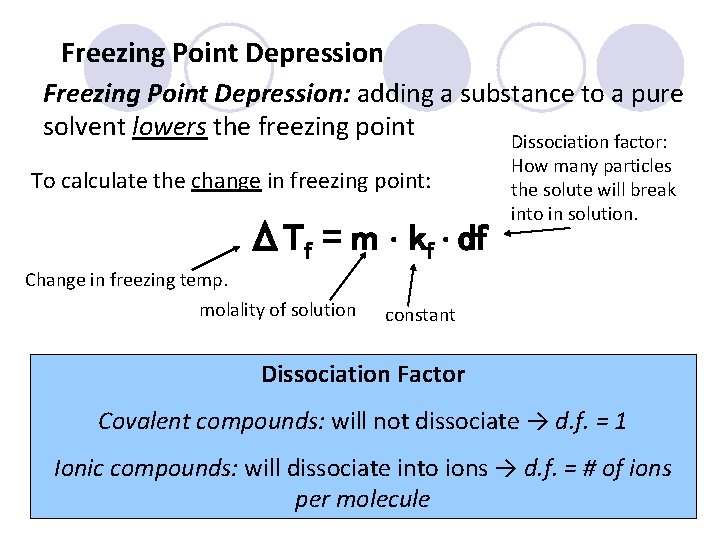
Freezing Point Depression: adding a substance to a pure solvent lowers the freezing point Dissociation factor: To calculate the change in freezing point: ΔTf = m ∙ kf ∙ df Change in freezing temp. molality of solution How many particles the solute will break into in solution. constant Dissociation Factor Covalent compounds: will not dissociate → d. f. = 1 Ionic compounds: will dissociate into ions → d. f. = # of ions per molecule
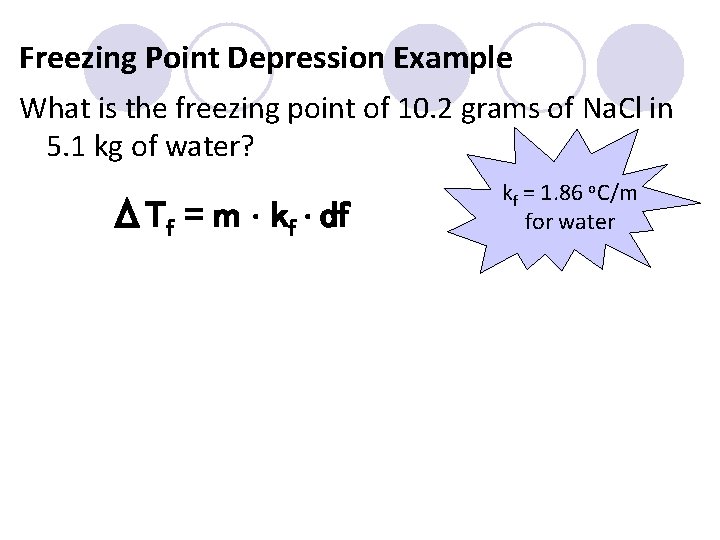
Freezing Point Depression Example What is the freezing point of 10. 2 grams of Na. Cl in 5. 1 kg of water? ΔTf = m ∙ kf ∙ df kf = 1. 86 o. C/m for water
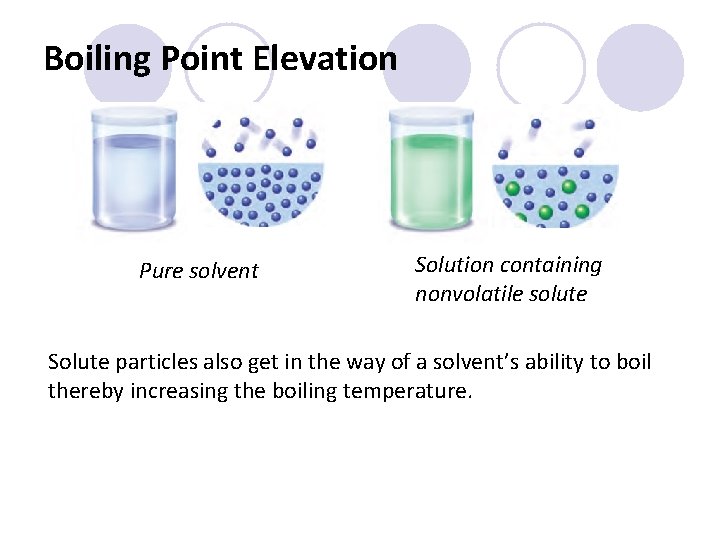
Boiling Point Elevation Pure solvent Solution containing nonvolatile solute Solute particles also get in the way of a solvent’s ability to boil thereby increasing the boiling temperature.
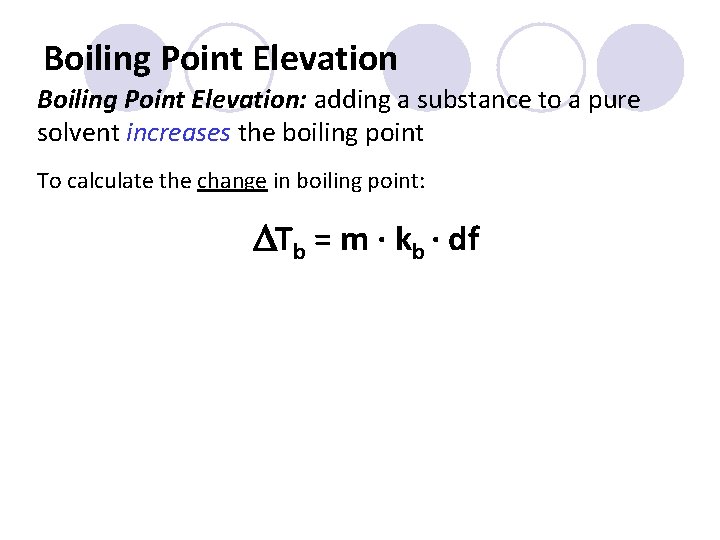
Boiling Point Elevation: adding a substance to a pure solvent increases the boiling point To calculate the change in boiling point: DTb = m ∙ kb ∙ df
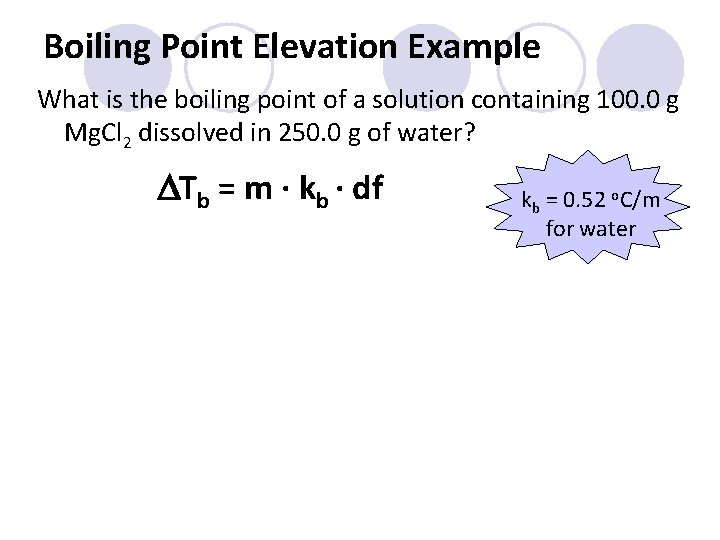
Boiling Point Elevation Example What is the boiling point of a solution containing 100. 0 g Mg. Cl 2 dissolved in 250. 0 g of water? DTb = m ∙ kb ∙ df kb = 0. 52 o. C/m for water
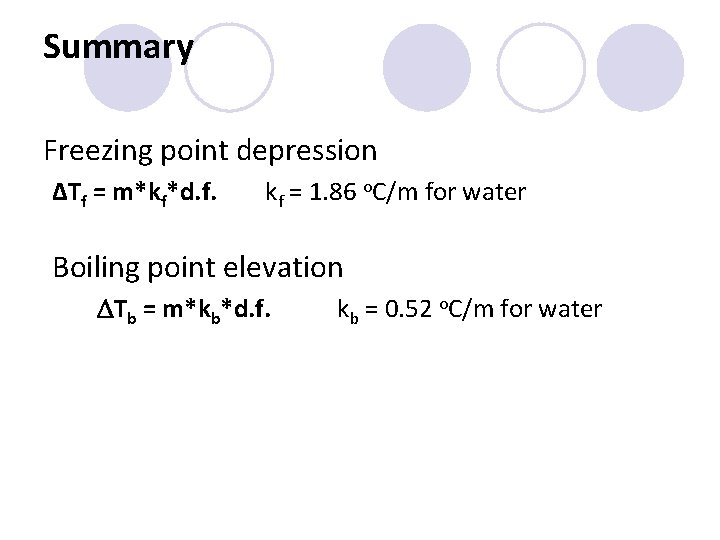
Summary Freezing point depression ΔTf = m*kf*d. f. kf = 1. 86 o. C/m for water Boiling point elevation DTb = m*kb*d. f. kb = 0. 52 o. C/m for water
- Slides: 14