
COLLIGATIVE PROPERTIES Elevation of Boiling Point Depression of
COLLIGATIVE PROPERTIES • • Elevation of Boiling Point Depression of Freezing Point Lowering of Vapor Pressure Osmotic Pressure
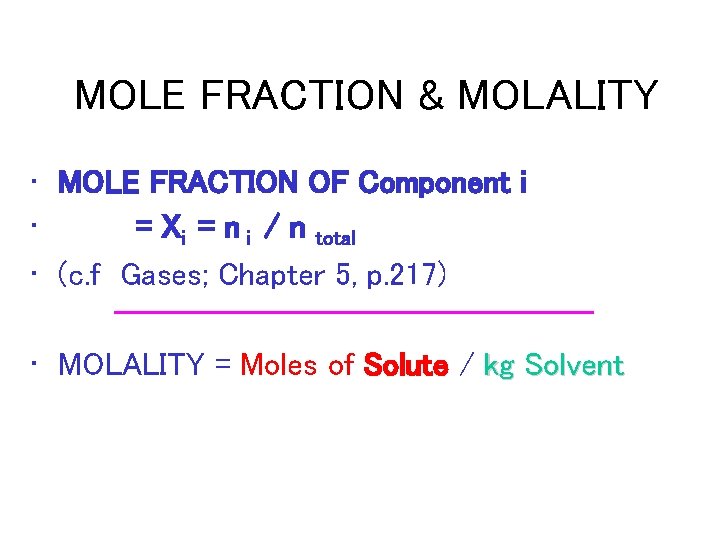
MOLE FRACTION & MOLALITY • MOLE FRACTION OF Component i • = Xi = n i / n total • (c. f Gases; Chapter 5, p. 217) • MOLALITY = Moles of Solute / kg Solvent
MOLALITY • Useful when Temperature Changes are considered, as Volumes of solutions change with changing temperature, whereas Masses of Solvents do not! • Note: In dilute solutions, Molarity & Molarity have nearly the same values!
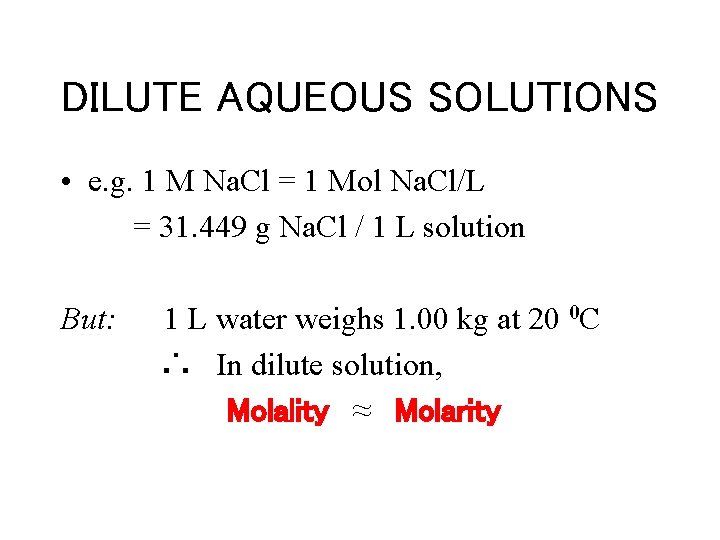
DILUTE AQUEOUS SOLUTIONS • e. g. 1 M Na. Cl = 1 Mol Na. Cl/L = 31. 449 g Na. Cl / 1 L solution But: 1 L water weighs 1. 00 kg at 20 0 C ∴ In dilute solution, Molality ≈ Molarity

CONVERSIONS BETWEEN SOLUTION PROPERTIES
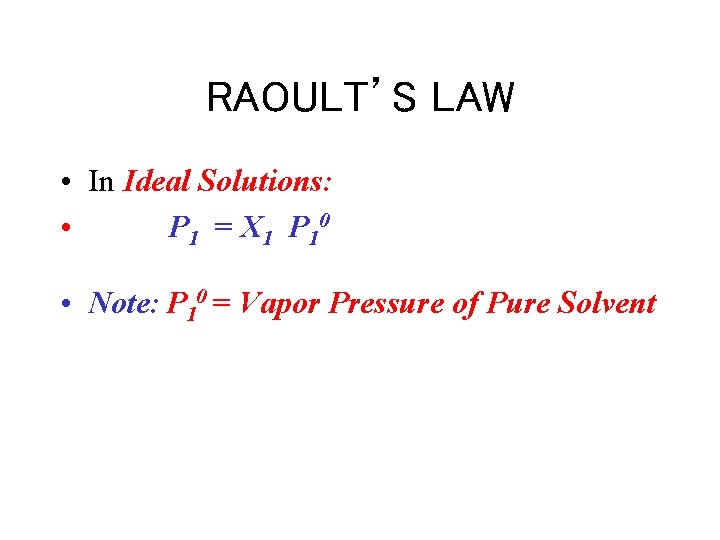
RAOULT’S LAW • In Ideal Solutions: • P 1 = X 1 P 10 • Note: P 10 = Vapor Pressure of Pure Solvent

VAPOR PRESSURE OF SOLVENT (P 1) vs. MOLE FRACTION OF SOLVENT (X 1)

ELEVATION OF BOILING POINT
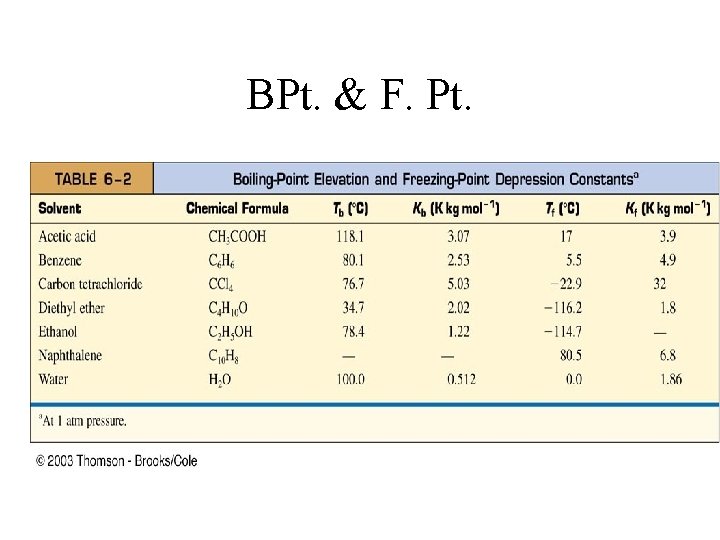
BPt. & F. Pt.
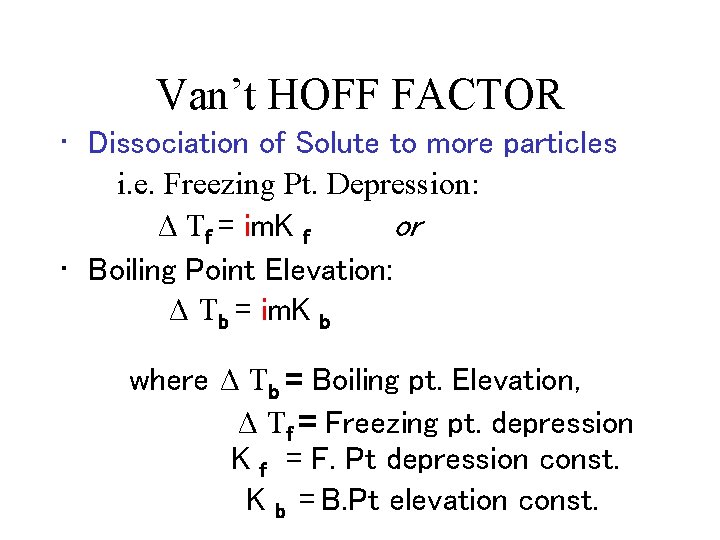
Van’t HOFF FACTOR • Dissociation of Solute to more particles i. e. Freezing Pt. Depression: Δ Tf = im. K f or • Boiling Point Elevation: Δ Tb = im. K b where Δ Tb = Boiling pt. Elevation, Δ Tf = Freezing pt. depression K f = F. Pt depression const. K b = B. Pt elevation const.
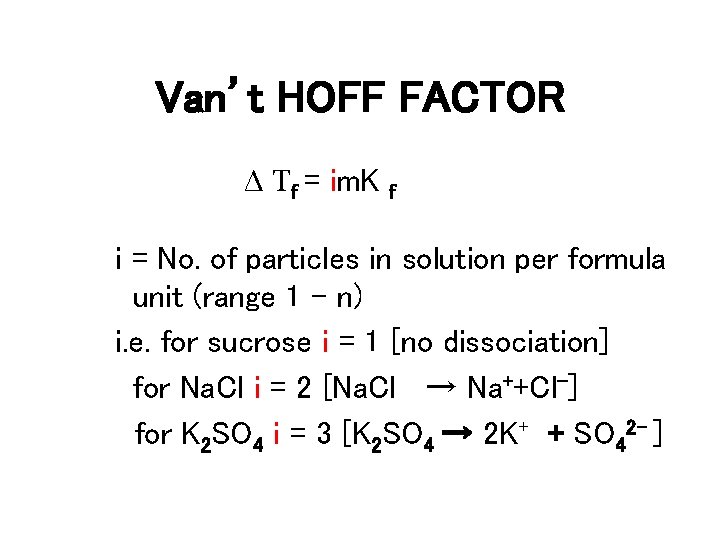
Van’t HOFF FACTOR Δ Tf = im. K f i = No. of particles in solution per formula unit (range 1 – n) i. e. for sucrose i = 1 [no dissociation] for Na. Cl i = 2 [Na. Cl → Na++Cl-] for K 2 SO 4 i = 3 [K 2 SO 4 → 2 K+ + SO 42 - ]
Van’t HOFF FACTOR • i has maximum value of υ (Gk nu), when dissociation is complete, but association through ion-pairs often occurs, which makes i < υ.
FRREZING POINT DEPRESSION EXAMPLE • Home work Problem Chapter 6 No. 44 • 44. If Na. Cl, Ca. Cl 2 and Urea used to melt street ice. Which is best?
- Slides: 13