
Colligative Properties Chemistry GT 51115 Drill List the


- Slides: 13
Colligative Properties Chemistry GT 5/11/15
Drill • List the four colligative properties. Give a real world example of each. • What is the molality of a solution made with 25. 0 g Li. Br and 750. g of water? • HW: Effect of a Solute on FP and BP
Objectives • Today I will be able to: – Calculate the molality of a solution – Describe the 4 colligative properties of vapor pressure, boiling point, freezing point and osmotic pressure – Calculate the Van’t Hoff Factor for a Compound – Calculate the freezing point depression and boiling point elevation of a solute
Agenda • • Drill Finish Colligative Properties Notes Colligative Properties Calculations Exit Ticket
Boiling and Freezing Point Calculations
BEFORE WE CALCULATE… WE NEED TO TALK ABOUT THE VAN’T HOFF FACTOR
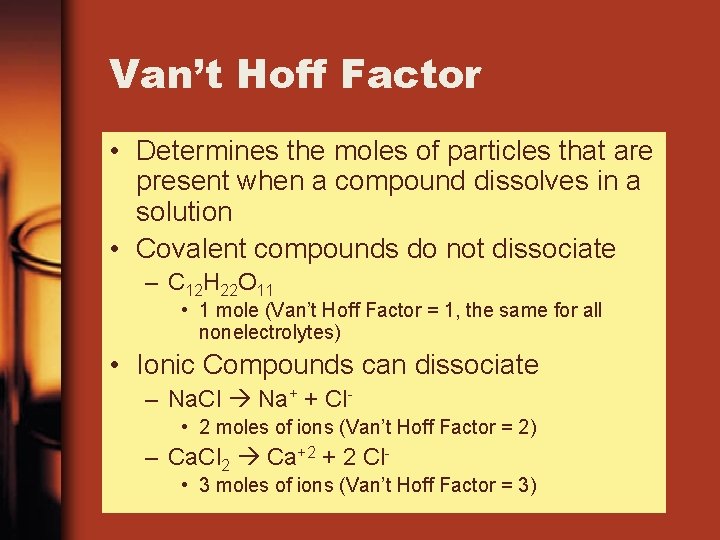
Van’t Hoff Factor • Determines the moles of particles that are present when a compound dissolves in a solution • Covalent compounds do not dissociate – C 12 H 22 O 11 • 1 mole (Van’t Hoff Factor = 1, the same for all nonelectrolytes) • Ionic Compounds can dissociate – Na. Cl Na+ + Cl • 2 moles of ions (Van’t Hoff Factor = 2) – Ca. Cl 2 Ca+2 + 2 Cl- • 3 moles of ions (Van’t Hoff Factor = 3)
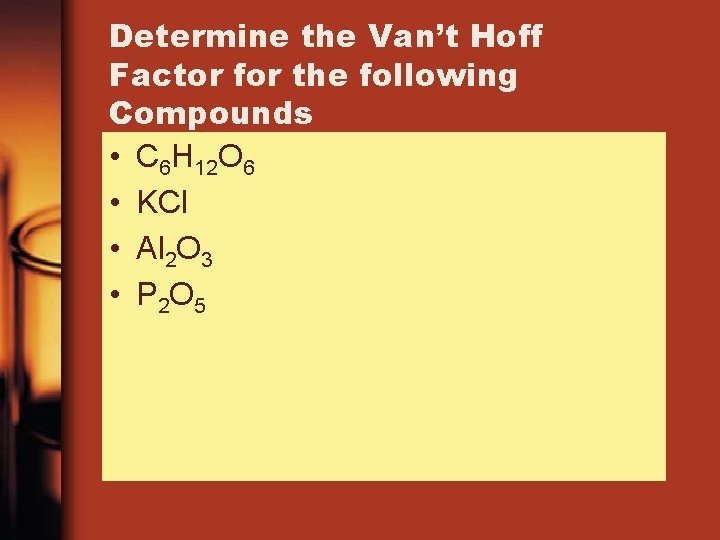
Determine the Van’t Hoff Factor for the following Compounds • C 6 H 12 O 6 • KCl • Al 2 O 3 • P 2 O 5
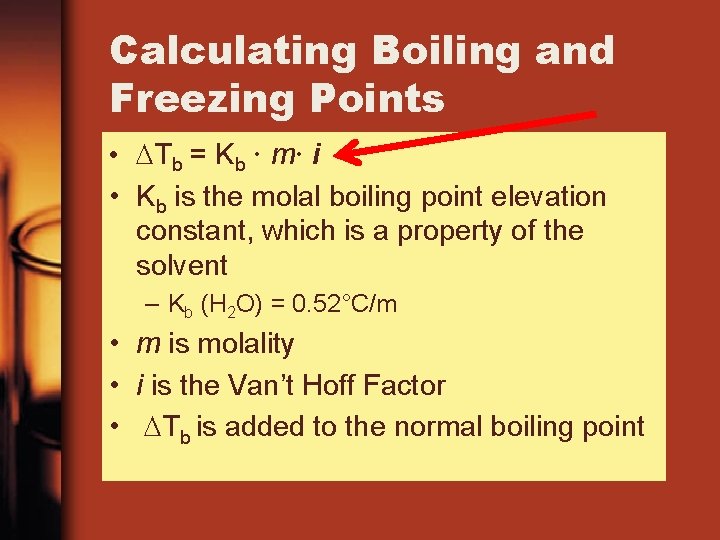
Calculating Boiling and Freezing Points • Tb = Kb m i • Kb is the molal boiling point elevation constant, which is a property of the solvent – Kb (H 2 O) = 0. 52°C/m • m is molality • i is the Van’t Hoff Factor • Tb is added to the normal boiling point
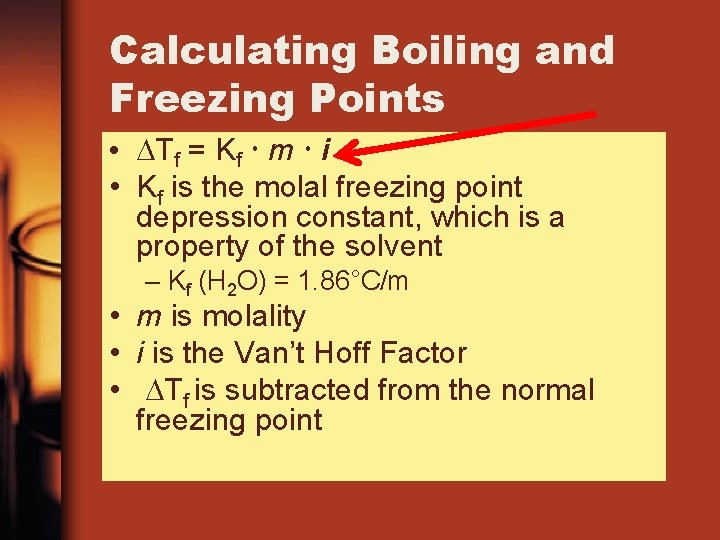
Calculating Boiling and Freezing Points • Tf = Kf m i • Kf is the molal freezing point depression constant, which is a property of the solvent – Kf (H 2 O) = 1. 86°C/m • m is molality • i is the Van’t Hoff Factor • Tf is subtracted from the normal freezing point
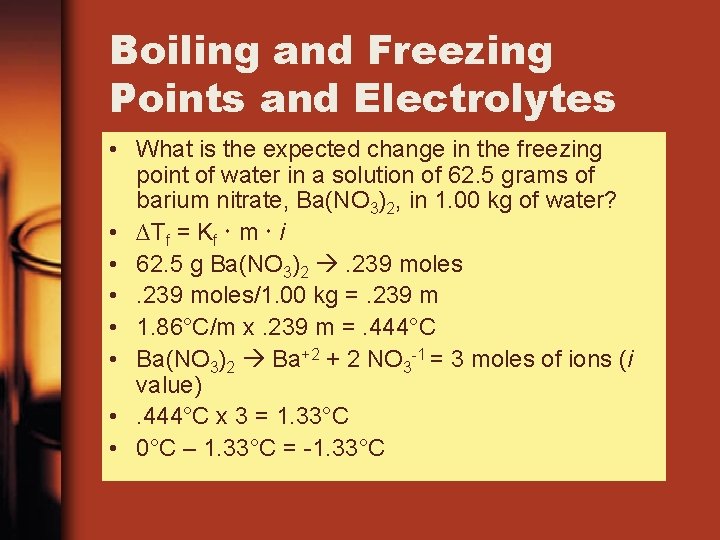
Boiling and Freezing Points and Electrolytes • What is the expected change in the freezing point of water in a solution of 62. 5 grams of barium nitrate, Ba(NO 3)2, in 1. 00 kg of water? • ∆Tf = Kf m i • 62. 5 g Ba(NO 3)2 . 239 moles • . 239 moles/1. 00 kg =. 239 m • 1. 86°C/m x. 239 m =. 444°C • Ba(NO 3)2 Ba+2 + 2 NO 3 -1 = 3 moles of ions (i value) • . 444°C x 3 = 1. 33°C • 0°C – 1. 33°C = -1. 33°C
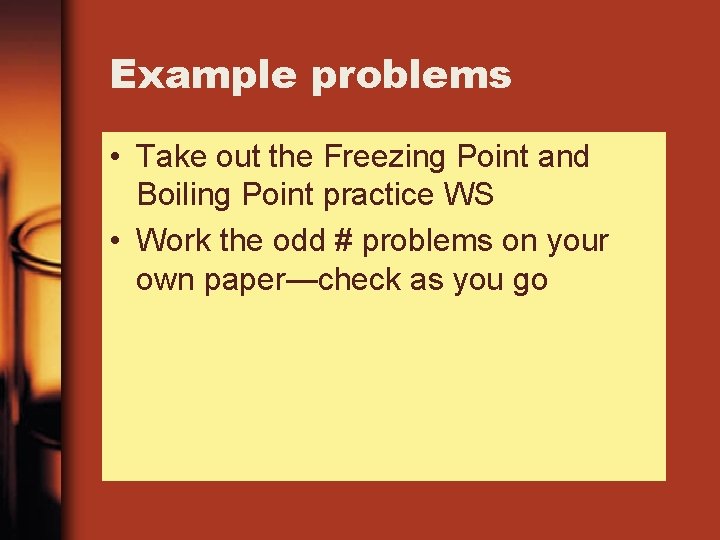
Example problems • Take out the Freezing Point and Boiling Point practice WS • Work the odd # problems on your own paper—check as you go
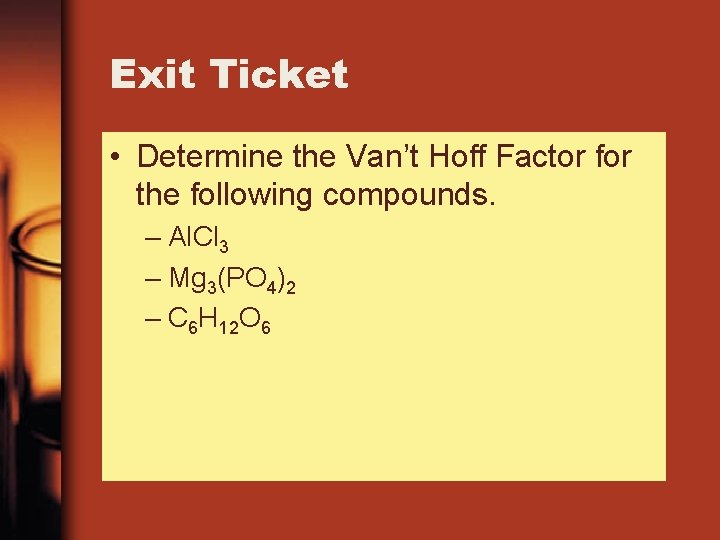
Exit Ticket • Determine the Van’t Hoff Factor for the following compounds. – Al. Cl 3 – Mg 3(PO 4)2 – C 6 H 12 O 6