
College of Engineering The Ohio State University Fundamentals
- Slides: 1
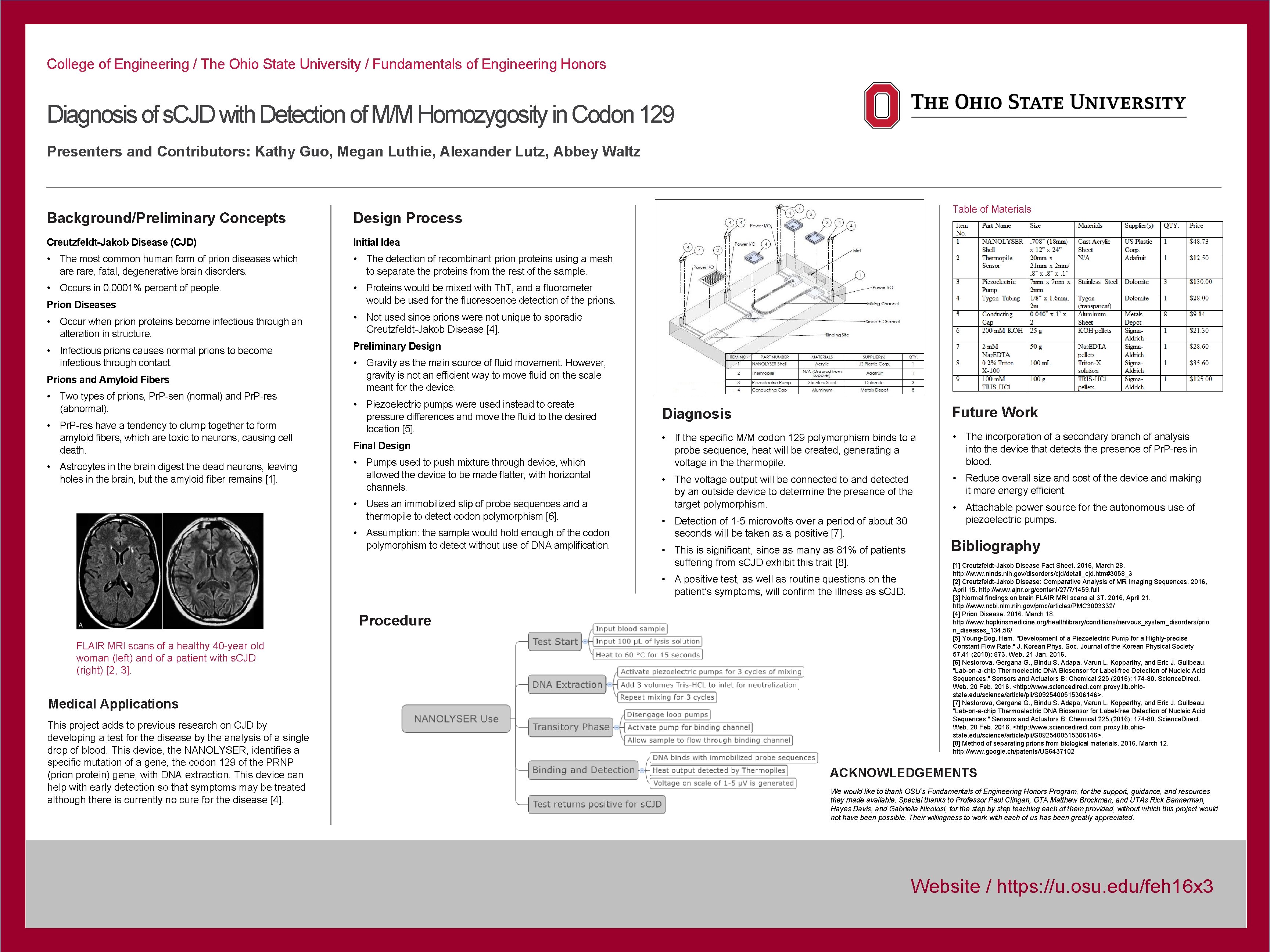
College of Engineering / The Ohio State University / Fundamentals of Engineering Honors Diagnosis of s. CJD with Detection of M/M Homozygosity in Codon 129 Presenters and Contributors: Kathy Guo, Megan Luthie, Alexander Lutz, Abbey Waltz Background/Preliminary Concepts Design Process Creutzfeldt-Jakob Disease (CJD) Initial Idea • The most common human form of prion diseases which are rare, fatal, degenerative brain disorders. • The detection of recombinant prion proteins using a mesh to separate the proteins from the rest of the sample. • Occurs in 0. 0001% percent of people. Prion Diseases • Proteins would be mixed with Th. T, and a fluorometer would be used for the fluorescence detection of the prions. • Occur when prion proteins become infectious through an alteration in structure. • Not used since prions were not unique to sporadic Creutzfeldt-Jakob Disease [4]. • Infectious prions causes normal prions to become infectious through contact. Preliminary Design Prions and Amyloid Fibers • Two types of prions, Pr. P-sen (normal) and Pr. P-res (abnormal). • Pr. P-res have a tendency to clump together to form amyloid fibers, which are toxic to neurons, causing cell death. • Astrocytes in the brain digest the dead neurons, leaving holes in the brain, but the amyloid fiber remains [1]. Table of Materials • Gravity as the main source of fluid movement. However, gravity is not an efficient way to move fluid on the scale meant for the device. • Piezoelectric pumps were used instead to create pressure differences and move the fluid to the desired location [5]. Final Design • Pumps used to push mixture through device, which allowed the device to be made flatter, with horizontal channels. • Uses an immobilized slip of probe sequences and a thermopile to detect codon polymorphism [6]. • Assumption: the sample would hold enough of the codon polymorphism to detect without use of DNA amplification. – Diagnosis Future Work • If the specific M/M codon 129 polymorphism binds to a probe sequence, heat will be created, generating a voltage in thermopile. • The incorporation of a secondary branch of analysis into the device that detects the presence of Pr. P-res in blood. • The voltage output will be connected to and detected by an outside device to determine the presence of the target polymorphism. • Reduce overall size and cost of the device and making it more energy efficient. • Detection of 1 -5 microvolts over a period of about 30 seconds will be taken as a positive [7]. • This is significant, since as many as 81% of patients suffering from s. CJD exhibit this trait [8]. • A positive test, as well as routine questions on the patient’s symptoms, will confirm the illness as s. CJD. Procedure FLAIR MRI scans of a healthy 40 -year old woman (left) and of a patient with s. CJD (right) [2, 3]. Medical Applications This project adds to previous research on CJD by developing a test for the disease by the analysis of a single drop of blood. This device, the NANOLYSER, identifies a specific mutation of a gene, the codon 129 of the PRNP (prion protein) gene, with DNA extraction. This device can help with early detection so that symptoms may be treated although there is currently no cure for the disease [4]. • Attachable power source for the autonomous use of piezoelectric pumps. Bibliography [1] Creutzfeldt-Jakob Disease Fact Sheet. 2016, March 28. http: //www. ninds. nih. gov/disorders/cjd/detail_cjd. htm#3058_3 [2] Creutzfeldt-Jakob Disease: Comparative Analysis of MR Imaging Sequences. 2016, April 15. http: //www. ajnr. org/content/27/7/1459. full [3] Normal findings on brain FLAIR MRI scans at 3 T. 2016, April 21. http: //www. ncbi. nlm. nih. gov/pmc/articles/PMC 3003332/ [4] Prion Disease. 2016, March 18. http: //www. hopkinsmedicine. org/healthlibrary/conditions/nervous_system_disorders/prio n_diseases_134, 56/ [5] Young-Bog, Ham. "Development of a Piezoelectric Pump for a Highly-precise Constant Flow Rate. " J. Korean Phys. Soc. Journal of the Korean Physical Society 57. 41 (2010): 873. Web. 21 Jan. 2016. [6] Nestorova, Gergana G. , Bindu S. Adapa, Varun L. Kopparthy, and Eric J. Guilbeau. "Lab-on-a-chip Thermoelectric DNA Biosensor for Label-free Detection of Nucleic Acid Sequences. " Sensors and Actuators B: Chemical 225 (2016): 174 -80. Science. Direct. Web. 20 Feb. 2016. <http: //www. sciencedirect. com. proxy. lib. ohiostate. edu/science/article/pii/S 0925400515306146>. [7] Nestorova, Gergana G. , Bindu S. Adapa, Varun L. Kopparthy, and Eric J. Guilbeau. "Lab-on-a-chip Thermoelectric DNA Biosensor for Label-free Detection of Nucleic Acid Sequences. " Sensors and Actuators B: Chemical 225 (2016): 174 -80. Science. Direct. Web. 20 Feb. 2016. <http: //www. sciencedirect. com. proxy. lib. ohiostate. edu/science/article/pii/S 0925400515306146>. [8] Method of separating prions from biological materials. 2016, March 12. http: //www. google. ch/patents/US 6437102 ACKNOWLEDGEMENTS We would like to thank OSU’s Fundamentals of Engineering Honors Program, for the support, guidance, and resources they made available. Special thanks to Professor Paul Clingan, GTA Matthew Brockman, and UTAs Rick Bannerman, Hayes Davis, and Gabriella Nicolosi, for the step by step teaching each of them provided, without which this project would not have been possible. Their willingness to work with each of us has been greatly appreciated. Website / https: //u. osu. edu/feh 16 x 3