
College Career and Civic Life C 3 Framework
- Slides: 34
College, Career and Civic Life (C 3): Framework for Social Studies State Standards Guidance for states to use in enhancing their standards for rigor in civics, economics, geography and history in K-12 schools
Background and process for developing the C 3 Framework
What is the C 3 Framework? Background and Process Foundations of Social Studies • Prepares the nation’s young people for college, careers, and civic life. • Inquiry is its foundation. • Formed by core* disciplines of civics, economics, geography, and history. • Composed of deep and enduring understandings, concepts, and skills from the disciplines. • Emphasizes skills and practices as preparation for democratic decision-making. • Shares in the responsibilities for literacy instruction in K-12 education. *Behavioral Sciences underway
What is the C 3 Framework? Background and Process Civic Engagement Now more than ever, students need the intellectual power to recognize societal problems, ask good questions and develop robust investigations into them, consider possible solutions and consequences, separate evidence-based claims from parochial opinions, and communicate and act upon what they learn.
Background and Process Common Core ELA The C 3 Framework fully incorporates and extends the expectations for literacy learning put forward in the ELA Common Core. We view the literacy skills detailed in the ELA Common Core as establishing a foundation for inquiry in social studies. These literacy skills are an indispensable part of social studies.
Background and Process The C 3 Process C 3 Framework is a state led effort facilitated by the Council of Chief State School Officers (CCSSO) and the National Council for the Social Studies (NCSS) to develop a resource for states to use when upgrading their state social studies standards. Collaboration and community is a central tenet of the work. Conscious effort to bring stakeholders who have not talked in the same room, for an extended period of time.
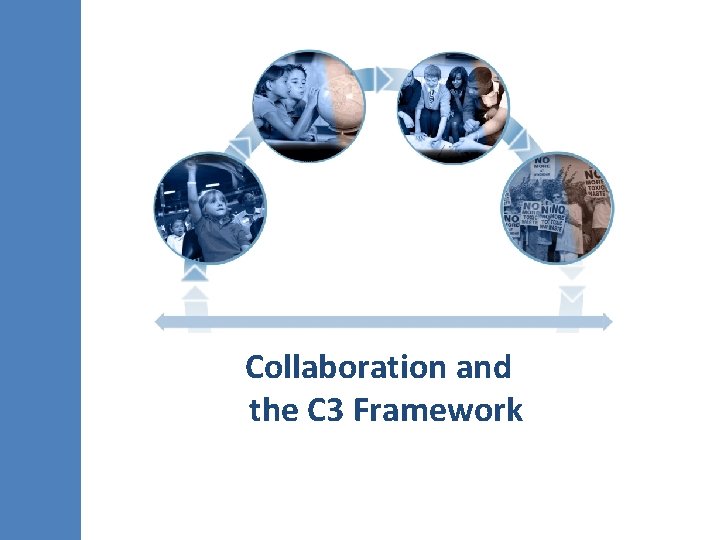
Collaboration and the C 3 Framework
Social Studies Assessment, Curriculum and Instruction Collaborative Arizona Arkansas Colorado District of Columbia Georgia Hawaii Iowa Illinois Indiana Kansas Kentucky Maine Maryland Michigan Missouri Montana Nebraska North Carolina Ohio Utah Washington Wisconsin Wyoming Los Angeles County University of Delaware
Task Force American Association of Geographers American Bar Association American Historical Association Center for Civic Education Campaign for the Civic Mission of Schools Constitutional Rights Foundation/USA Constitutional Rights Foundation/Chicago Council for Economic Education National Council for Geographic Education National Council for History Education National Council for the Social Studies National Geographic Society National History Day Street Law, Inc. World History Association
Writing Team Keith C. Barton, Indiana University Stephen Buckles, Vanderbilt University Flannery Burke, Saint Louis University Jim Charkins, California State Robert Morrill, Virginia Polytechnic University Kathy Swan, University of Kentucky S. G. Grant, Binghamton University Karen Thomas-Brown, University of Susan W. Hardwick, University of Michigan-Dearborn Oregon Cynthia Tyson, The Ohio State John Lee, North Carolina State University Bruce Van. Sledright, University of Peter Levine, Tufts University Maryland Meira Levinson, Harvard University Merry Wiesner-Hanks University of Anand Marri, Columbia University Wisconsin-Milwaukee Chauncey Monte-Sano, University of Michigan
Teacher Collaborative Council • • • • Lisa Lacefield, Arkansas • John White, Arkansas • Charlee Passig Archuleta, • Colorado • Anton Schulzki, Colorado • Wendy Harrington, Delaware • Sally J. Meyer, Georgia William S. Rakosnik, • Georgia • Pamela M. T. (Takehiro) King, Hawaii • Carrie Sato, Hawaii • Mitzie Higa, Hawaii • Rob Dittmer, Iowa • Nancy Peterson, Iowa Beth Levinsky, Illinois • Jeffrey W. Lightfoot, Illinois • Michael Hutchison, Indiana Callie Marksbary, Indiana Amanda Jessee, Kansas James K. Robb , Kansas Barry Leonard, Kentucky Thad Elmore, Kentucky • Rebecca K. Valbuena, California • Michael A. Long, California Kimberly Loisel, Maryland • • Dr. Donna Phillips, Maryland • Shane Gower, Maine • Barbara Perry, Maine David Johnson, Michigan • • Raymond Walker, Michigan • Debra Williams, Missouri • Roxanna Mechem, Missouri • • Mary G. Stevens, North Carolina Traci Barger, North Carolina Lonnie Moore, Nebraska Mary Lynn Reiser, Nebraska Tim Dove, Ohio Gloria Wu, Ohio Laura Finney, Ohio Pam Merrill, Oklahoma Tara Gray, Washington Sabrina Shaw, Washington Lauren Mittermann, Wisconsin Tina Flood, Wisconsin
Editorial Team Rosanna Fukado, Hawaii Department of Education Fay Gore, Lead Editor, North Carolina Department of Education Mitzie Higa, Teacher, Hawaii Kim Eggborn, Teacher, Maryland William Muthig, Lead Editor, Ohio Department of Education Marcie Taylor Thoma, Maryland Department of Education Maggie Herrick, Arkansas Department of Education Jessica Vehlwald, Teacher, Missouri
Critical Voices American Heritage Bill of Rights Institute C-Span Center for Economic Education and Entrepreneurship, U of Delaware Citizen Me Colonial Williamsburg Council of Economic Education DBQ Project Junior Achievement Federal Judicial Center-History Office Federal Reserve Bank of St. Louis, Economic Education Freedom Forum First Amendment Center Heritage Education Services—National Park Services Library of Congress Mikva Challenge, Chicago National Archives National Constitution Center Newseum Smithsonian Institution Smithsonian American Art Museum Smithsonian American Indian Museum Teaching for Change What So Proudly We Hail
When will the C 3 Framework be published? Next Steps A review of the C 3 Framework was recently completed with targeted groups of educators and education leaders. Final revisions are currently underway. The C 3 Framework will be made available by NCSS in late summer 2013. Implementation of the C 3 Framework will begin immediately.
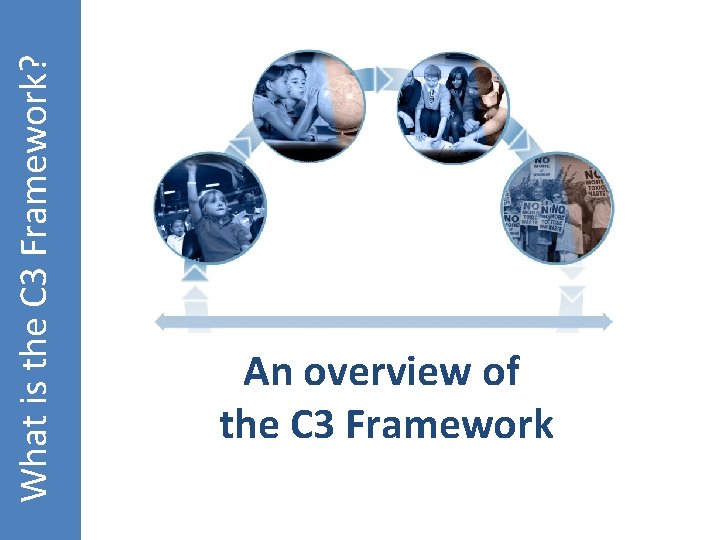
What is the C 3 Framework? An overview of the C 3 Framework
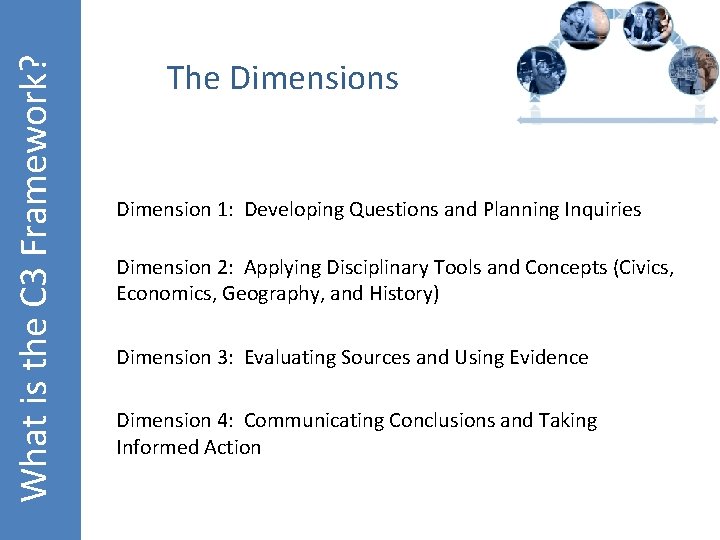
What is the C 3 Framework? The Inquiry Arc The primary purpose of the College, Career and Civic Life (C 3) Framework for Social Studies State Standards is to provide guidance to states on the concepts, skills and disciplinary tools necessary to prepare students for college, career, and civic life. In doing so, the C 3 Framework offers guidance and support for rigorous student learning. That guidance and support takes form in an inquiry arc—a set of interlocking and mutually reinforcing ideas that feature the four Dimensions of informed inquiry in social studies:
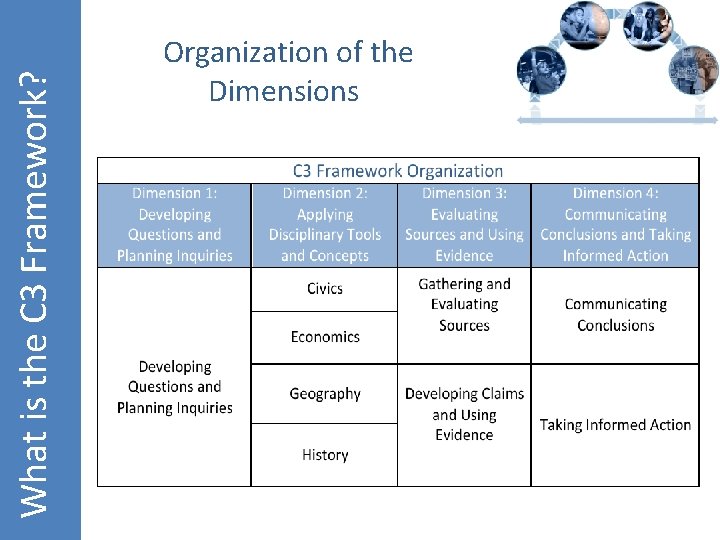
What is the C 3 Framework? The Dimensions Dimension 1: Developing Questions and Planning Inquiries Dimension 2: Applying Disciplinary Tools and Concepts (Civics, Economics, Geography, and History) Dimension 3: Evaluating Sources and Using Evidence Dimension 4: Communicating Conclusions and Taking Informed Action
What is the C 3 Framework? Organization of the Dimensions
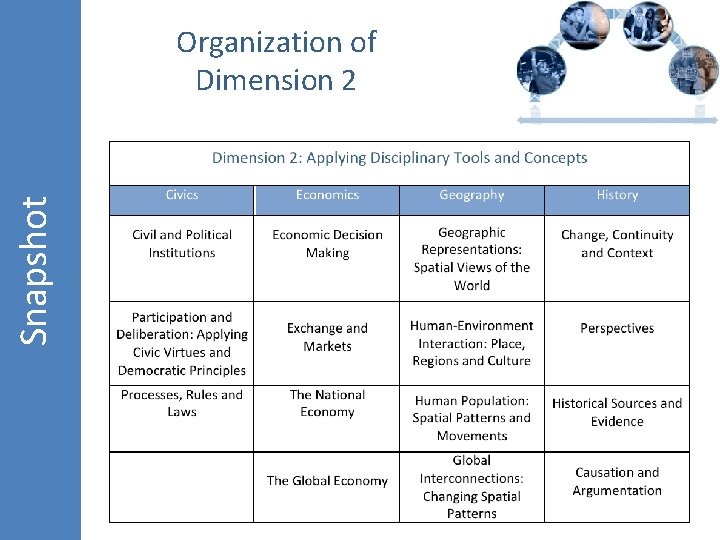
Snapshot Organization of Dimension 2
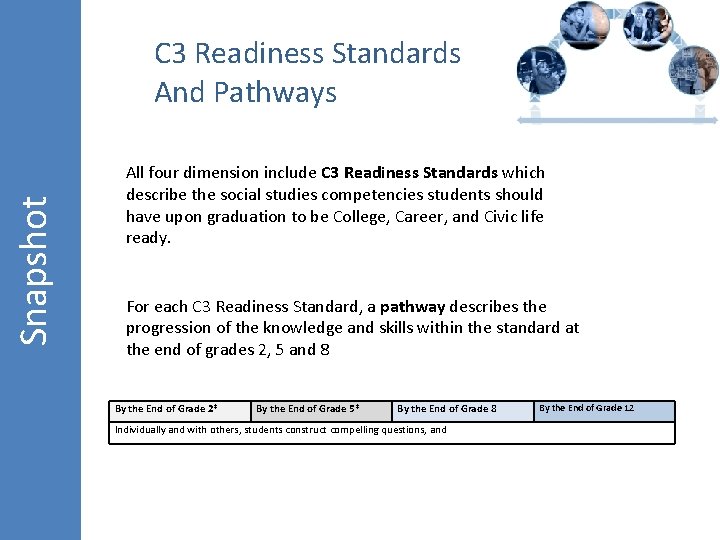
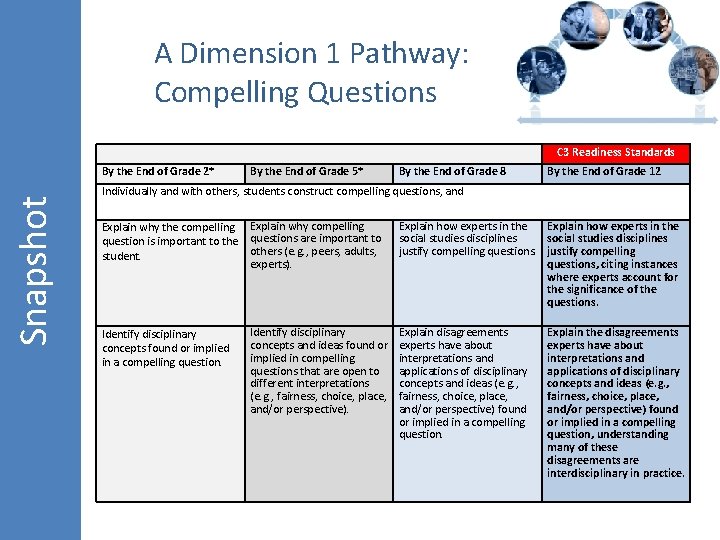
Snapshot C 3 Readiness Standards And Pathways All four dimension include C 3 Readiness Standards which describe the social studies competencies students should have upon graduation to be College, Career, and Civic life ready. For each C 3 Readiness Standard, a pathway describes the progression of the knowledge and skills within the standard at the end of grades 2, 5 and 8 By the End of Grade 2* By the End of Grade 5* By the End of Grade 8 Individually and with others, students construct compelling questions, and By the End of Grade 12
A Dimension 1 Pathway: Compelling Questions C 3 Readiness Standards Snapshot By the End of Grade 2* By the End of Grade 5* By the End of Grade 8 By the End of Grade 12 Individually and with others, students construct compelling questions, and Explain why the compelling Explain why compelling question is important to the questions are important to others (e. g. , peers, adults, student. experts). Identify disciplinary concepts found or implied in a compelling question. Identify disciplinary concepts and ideas found or implied in compelling questions that are open to different interpretations (e. g. , fairness, choice, place, and/or perspective). Explain how experts in the social studies disciplines justify compelling questions, citing instances where experts account for the significance of the questions. Explain disagreements experts have about interpretations and applications of disciplinary concepts and ideas (e. g. , fairness, choice, place, and/or perspective) found or implied in a compelling question. Explain the disagreements experts have about interpretations and applications of disciplinary concepts and ideas (e. g. , fairness, choice, place, and/or perspective) found or implied in a compelling question, understanding many of these disagreements are interdisciplinary in practice.
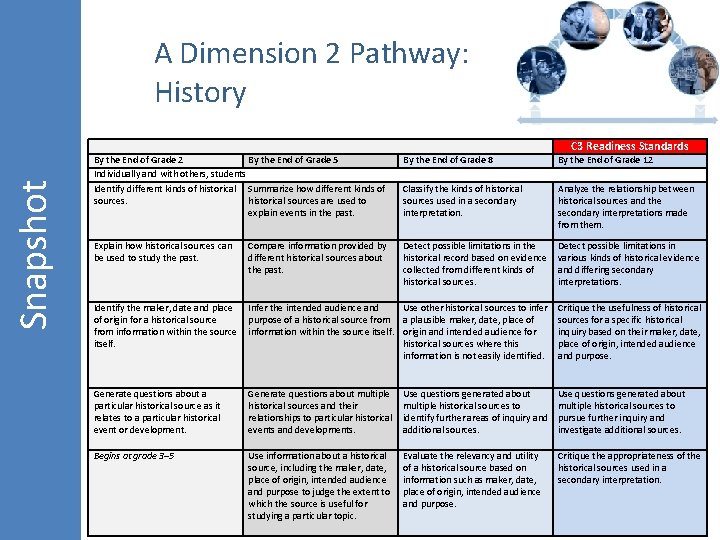
Snapshot A Dimension 2 Pathway: History C 3 Readiness Standards By the End of Grade 2 By the End of Grade 5 Individually and with others, students Identify different kinds of historical Summarize how different kinds of sources. historical sources are used to explain events in the past. By the End of Grade 8 By the End of Grade 12 Classify the kinds of historical sources used in a secondary interpretation. Analyze the relationship between historical sources and the secondary interpretations made from them. Explain how historical sources can be used to study the past. Detect possible limitations in the historical record based on evidence collected from different kinds of historical sources. Detect possible limitations in various kinds of historical evidence and differing secondary interpretations. Identify the maker, date and place Infer the intended audience and of origin for a historical source purpose of a historical source from information within the source itself. Use other historical sources to infer a plausible maker, date, place of origin and intended audience for historical sources where this information is not easily identified. Critique the usefulness of historical sources for a specific historical inquiry based on their maker, date, place of origin, intended audience and purpose. Generate questions about a particular historical source as it relates to a particular historical event or development. Generate questions about multiple historical sources and their relationships to particular historical events and developments. Use questions generated about multiple historical sources to identify further areas of inquiry and additional sources. Use questions generated about multiple historical sources to pursue further inquiry and investigate additional sources. Begins at grade 3– 5 Use information about a historical source, including the maker, date, place of origin, intended audience and purpose to judge the extent to which the source is useful for studying a particular topic. Evaluate the relevancy and utility of a historical source based on information such as maker, date, place of origin, intended audience and purpose. Critique the appropriateness of the historical sources used in a secondary interpretation. Compare information provided by different historical sources about the past.
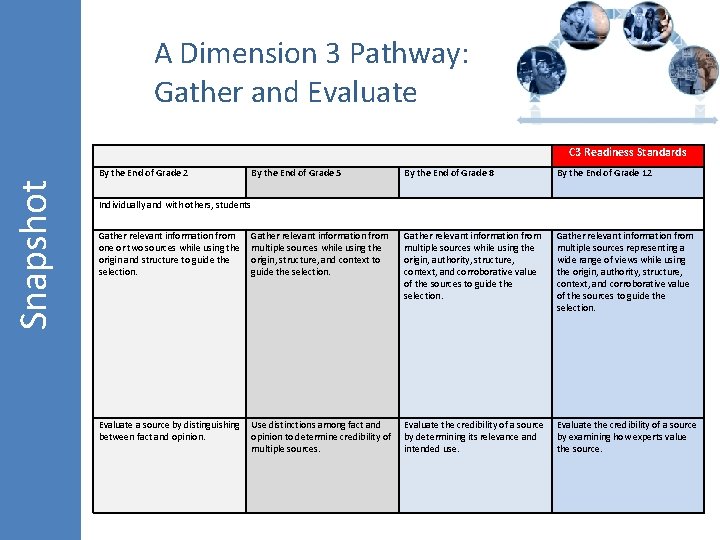
A Dimension 3 Pathway: Gather and Evaluate C 3 Readiness Standards Snapshot By the End of Grade 2 By the End of Grade 5 By the End of Grade 8 By the End of Grade 12 Gather relevant information from multiple sources while using the origin, authority, structure, context, and corroborative value of the sources to guide the selection. Gather relevant information from multiple sources representing a wide range of views while using the origin, authority, structure, context, and corroborative value of the sources to guide the selection. Evaluate the credibility of a source by determining its relevance and intended use. Evaluate the credibility of a source by examining how experts value the source. Individually and with others, students Gather relevant information from one or two sources while using the origin and structure to guide the selection. Gather relevant information from multiple sources while using the origin, structure, and context to guide the selection. Evaluate a source by distinguishing Use distinctions among fact and between fact and opinion to determine credibility of multiple sources.
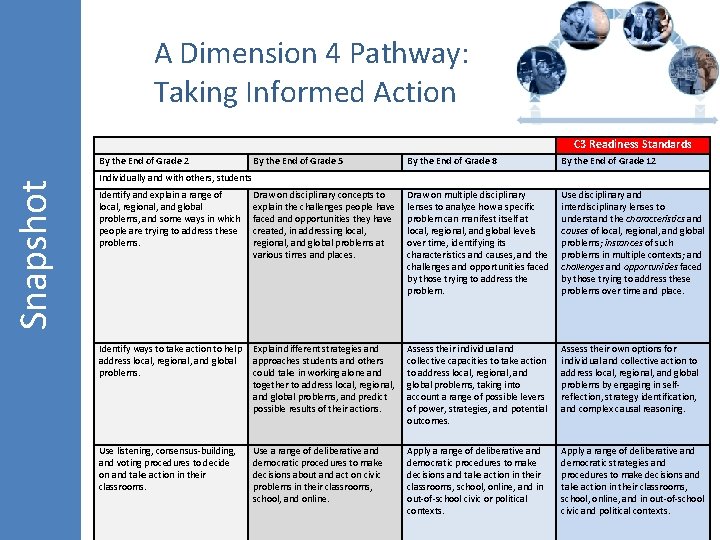
A Dimension 4 Pathway: Taking Informed Action C 3 Readiness Standards Snapshot By the End of Grade 2 By the End of Grade 5 By the End of Grade 8 By the End of Grade 12 Draw on disciplinary concepts to explain the challenges people have faced and opportunities they have created, in addressing local, regional, and global problems at various times and places. Draw on multiple disciplinary lenses to analyze how a specific problem can manifest itself at local, regional, and global levels over time, identifying its characteristics and causes, and the challenges and opportunities faced by those trying to address the problem. Use disciplinary and interdisciplinary lenses to understand the characteristics and causes of local, regional, and global problems; instances of such problems in multiple contexts; and challenges and opportunities faced by those trying to address these problems over time and place. Identify ways to take action to help Explain different strategies and address local, regional, and global approaches students and others problems. could take in working alone and together to address local, regional, and global problems, and predict possible results of their actions. Assess their individual and collective capacities to take action to address local, regional, and global problems, taking into account a range of possible levers of power, strategies, and potential outcomes. Assess their own options for individual and collective action to address local, regional, and global problems by engaging in selfreflection, strategy identification, and complex causal reasoning. Use listening, consensus-building, and voting procedures to decide on and take action in their classrooms. Apply a range of deliberative and democratic procedures to make decisions and take action in their classrooms, school, online, and in out-of-school civic or political contexts. Apply a range of deliberative and democratic strategies and procedures to make decisions and take action in their classrooms, school, online, and in out-of-school civic and political contexts. Individually and with others, students Identify and explain a range of local, regional, and global problems, and some ways in which people are trying to address these problems. Use a range of deliberative and democratic procedures to make decisions about and act on civic problems in their classrooms, school, and online.
Snapshot ELA/Literacy Common Core Connections The C 3 framework establishes its connections to ELA/Literacy Common Core in two substantive ways: • Anchor Standard Connections • Shared Language Narrative & graphical representations.
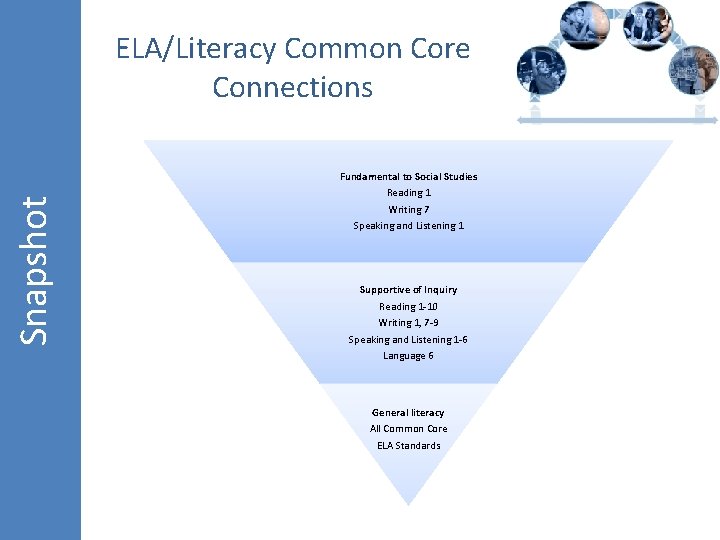
Snapshot ELA/Literacy Common Core Connections Fundamental to Social Studies Reading 1 Writing 7 Speaking and Listening 1 Supportive of Inquiry Reading 1 -10 Writing 1, 7 -9 Speaking and Listening 1 -6 Language 6 General literacy All Common Core ELA Standards
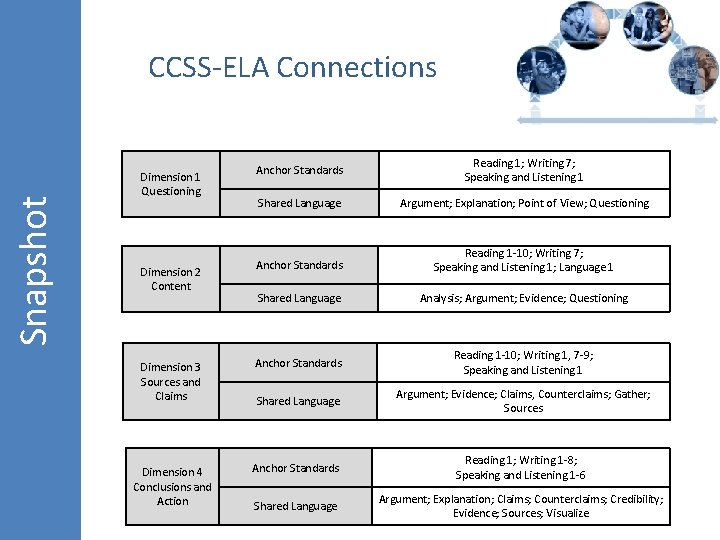
Snapshot CCSS-ELA Connections Anchor Standards Reading 1; Writing 7; Speaking and Listening 1 Shared Language Argument; Explanation; Point of View; Questioning Anchor Standards Reading 1 -10; Writing 7; Speaking and Listening 1; Language 1 Shared Language Analysis; Argument; Evidence; Questioning Dimension 3 Sources and Claims Anchor Standards Reading 1 -10; Writing 1, 7 -9; Speaking and Listening 1 Shared Language Argument; Evidence; Claims, Counterclaims; Gather; Sources Dimension 4 Conclusions and Action Anchor Standards Reading 1; Writing 1 -8; Speaking and Listening 1 -6 Shared Language Argument; Explanation; Claims; Counterclaims; Credibility; Evidence; Sources; Visualize Dimension 1 Questioning Dimension 2 Content
Snapshot Scholarly Rationale for the C 3 Framework “In the C 3 Framework, the call for students to become more prepared for the challenges of college and career (Bellanca & Brandt, 2010; Di Giacomo, Linn, Monthey, Pack, & Wyatt, 2013; Partnership for 21 st Century Schools, 2011) is united with a third element: preparation for civic life. Advocates of citizenship education cross the political spectrum, but they are bound by a common belief that our democratic republic will not sustain unless students are aware of their changing cultural and physical environments; know the past; read, write, and think deeply; and act in ways that promote the common good. There will always be differing perspectives on these objectives. The goal of knowledgeable, thinking, and active citizens, however, is universal. ”
Snapshot A Disciplinary Inquiry Matrix The Disciplinary Inquiry Matrix articulates how each of the four dimensions of the C 3 Framework coheres and builds upon one another through the use of a content-specific example: How bad was the recent Great Recession? The Disciplinary Inquiry Matrix describes what experts think and do. It is a four-part target example to which students should aspire.
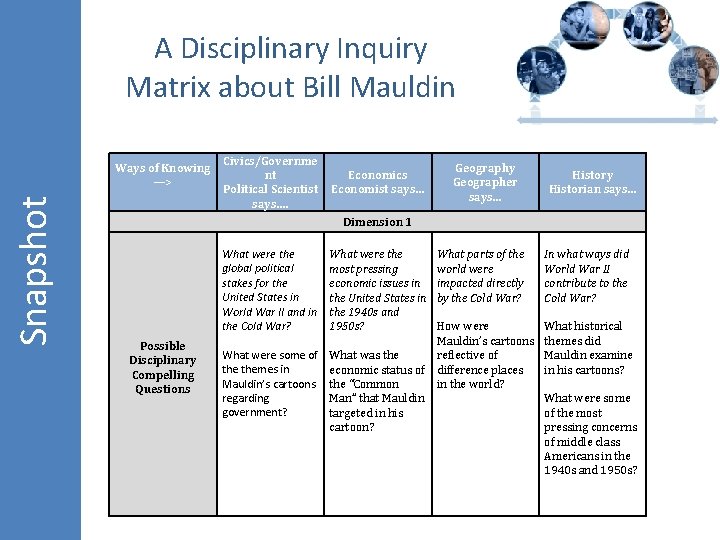
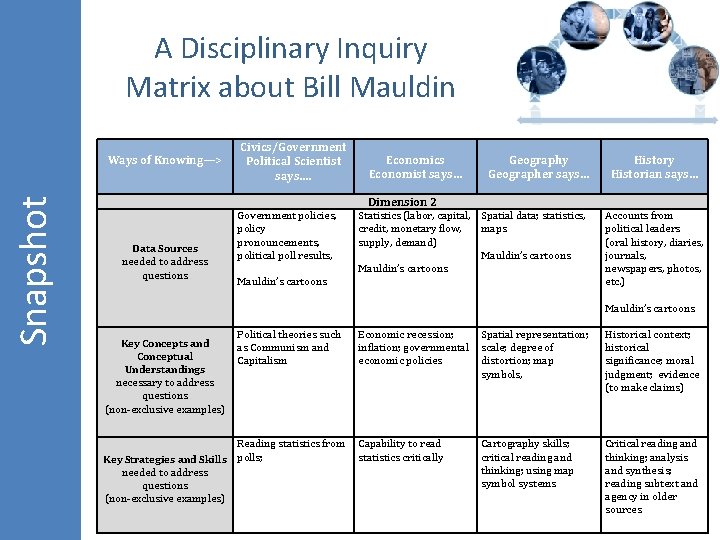
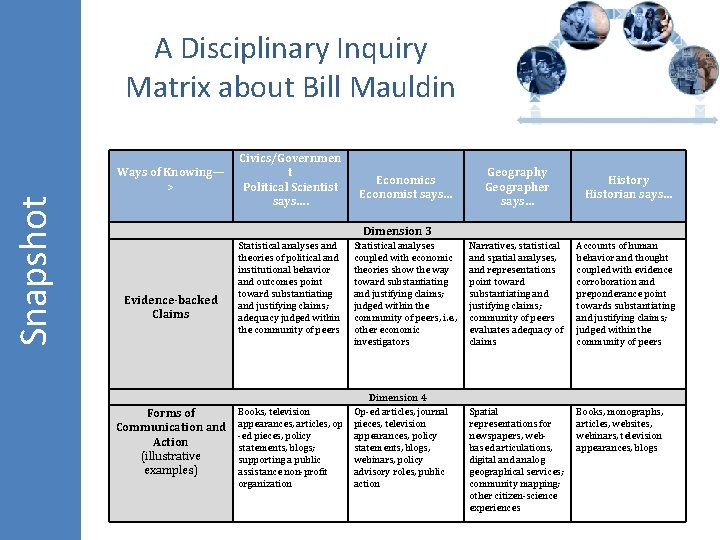
Snapshot A Disciplinary Inquiry Matrix Another Disciplinary Inquiry Matrix might explore the compelling question: What made cartoonist Bill Mauldin so popular?
Snapshot A Disciplinary Inquiry Matrix about Bill Mauldin Ways of Knowing —> Civics/Governme nt Economics Political Scientist Economist says…. Geography Geographer says… History Historian says… Dimension 1 What were the global political stakes for the United States in World War II and in the Cold War? Possible Disciplinary Compelling Questions What were the most pressing economic issues in the United States in the 1940 s and 1950 s? What parts of the world were impacted directly by the Cold War? How were Mauldin’s cartoons What were some of What was the reflective of themes in economic status of difference places Mauldin’s cartoons the “Common in the world? regarding Man” that Mauldin government? targeted in his cartoon? In what ways did World War II contribute to the Cold War? What historical themes did Mauldin examine in his cartoons? What were some of the most pressing concerns of middle class Americans in the 1940 s and 1950 s?
A Disciplinary Inquiry Matrix about Bill Mauldin Snapshot Ways of Knowing—> Civics/Government Political Scientist says…. Economics Economist says… Geography Geographer says… History Historian says… Dimension 2 Data Sources needed to address questions Government policies, policy pronouncements, political poll results, Statistics (labor, capital, Spatial data; statistics, credit, monetary flow, maps supply, demand) Mauldin’s cartoons Accounts from political leaders (oral history, diaries, journals, newspapers, photos, etc. ) Mauldin’s cartoons Key Concepts and Conceptual Understandings necessary to address questions (non-exclusive examples) Political theories such as Communism and Capitalism Economic recession; Spatial representation; inflation; governmental scale; degree of economic policies distortion; map symbols, Reading statistics from Capability to read statistics critically Key Strategies and Skills polls; needed to address questions (non-exclusive examples) Cartography skills; critical reading and thinking; using map symbol systems Historical context; historical significance; moral judgment; evidence (to make claims) Critical reading and thinking; analysis and synthesis; reading subtext and agency in older sources
Snapshot A Disciplinary Inquiry Matrix about Bill Mauldin Ways of Knowing— > Civics/Governmen t Political Scientist says…. Economics Economist says… Geography Geographer says… History Historian says… Narratives, statistical and spatial analyses, and representations point toward substantiating and justifying claims; community of peers evaluates adequacy of claims Accounts of human behavior and thought coupled with evidence corroboration and preponderance point towards substantiating and justifying claims; judged within the community of peers Spatial representations for newspapers, webbased articulations, digital and analog geographical services; community mapping; other citizen-science experiences Books, monographs, articles, websites, webinars, television appearances, blogs Dimension 3 Evidence-backed Claims Statistical analyses and theories of political and institutional behavior and outcomes point toward substantiating and justifying claims; adequacy judged within the community of peers Forms of Communication and Action (illustrative examples) Books, television appearances, articles, op -ed pieces, policy statements, blogs; supporting a public assistance non-profit organization Statistical analyses coupled with economic theories show the way toward substantiating and justifying claims; judged within the community of peers, i. e. , other economic investigators Dimension 4 Op-ed articles, journal pieces, television appearances, policy statements, blogs, webinars, policy advisory roles, public action
Review Thanks John Lee jklee@ncsu. edu