
College and Career Readiness Mission To make every
- Slides: 57
College and Career Readiness
Mission: To make every child’s potential a reality by engaging and empowering families and communities to advocate for all children.
Statistics
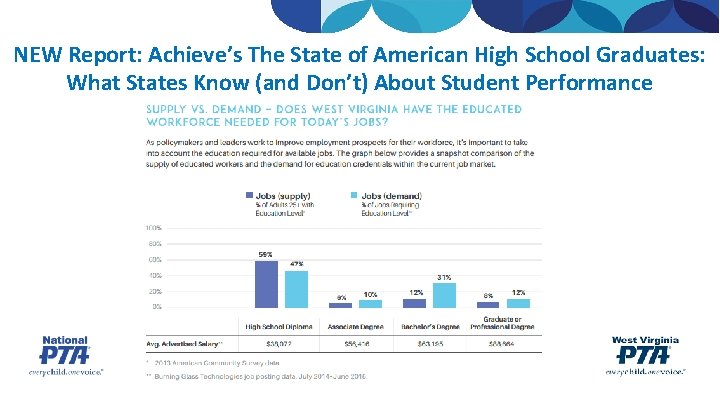
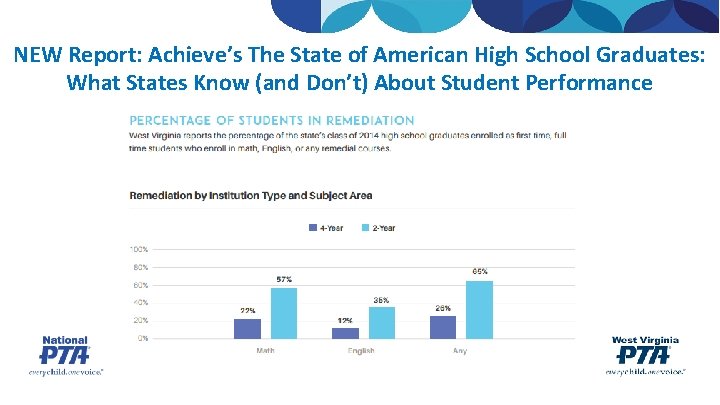
NEW Report: Achieve’s The State of American High School Graduates: What States Know (and Don’t) About Student Performance
NEW Report: Achieve’s The State of American High School Graduates: What States Know (and Don’t) About Student Performance
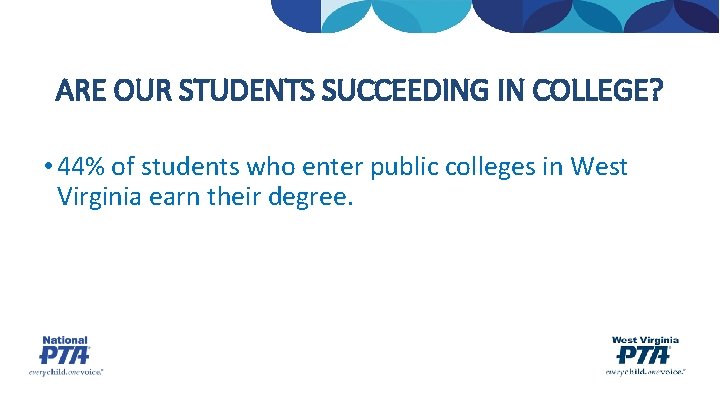
ARE OUR STUDENTS SUCCEEDING IN COLLEGE? • 44% of students who enter public colleges in West Virginia earn their degree.
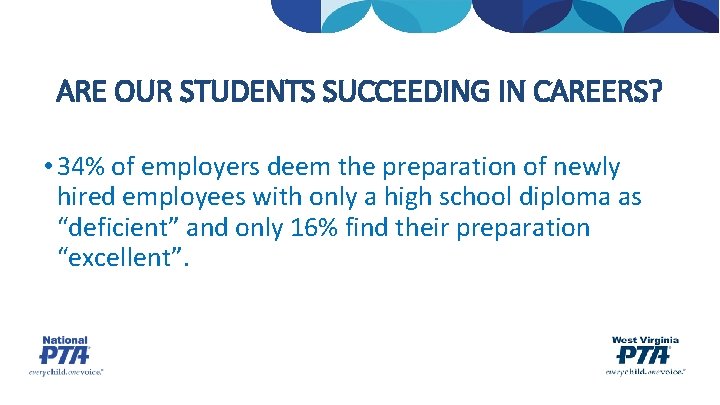
ARE OUR STUDENTS SUCCEEDING IN CAREERS? • 34% of employers deem the preparation of newly hired employees with only a high school diploma as “deficient” and only 16% find their preparation “excellent”.
College & Career Readiness
WHAT DOES COLLEGE AND CAREER READINESS MEAN? • Exit high school prepared for success! • No need for remediation. • Equipped with skills and knowledge to make a successful transition.
HOW DO WE GET THERE? 1. 2. 3. 4. Set high standards. Implement new standards. Assess mastery of new standards. Create new accountability systems.
Step 1: Standards
WHAT ARE STANDARDS? • Education standards are not new. • Over the past seven years, most states have adopted more rigorous standards. • The goal of education standards is to ensure all students leave school with prepared for the next step.
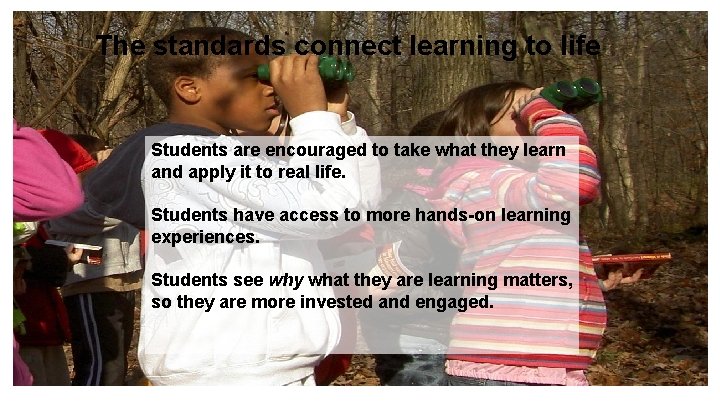
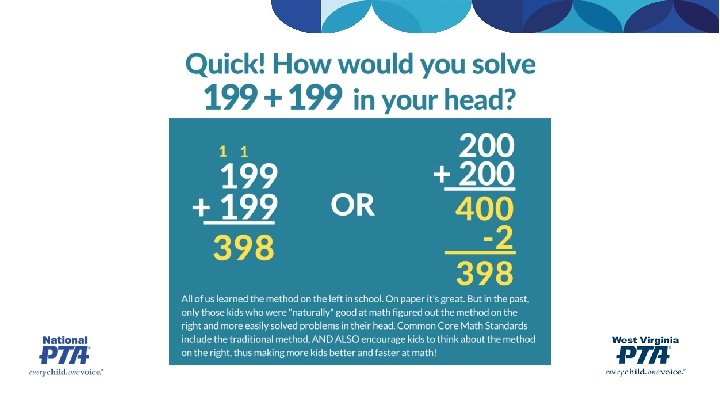
The standards connect learning to life Students are encouraged to take what they learn and apply it to real life. Students have access to more hands-on learning experiences. Students see why what they are learning matters, so they are more invested and engaged.
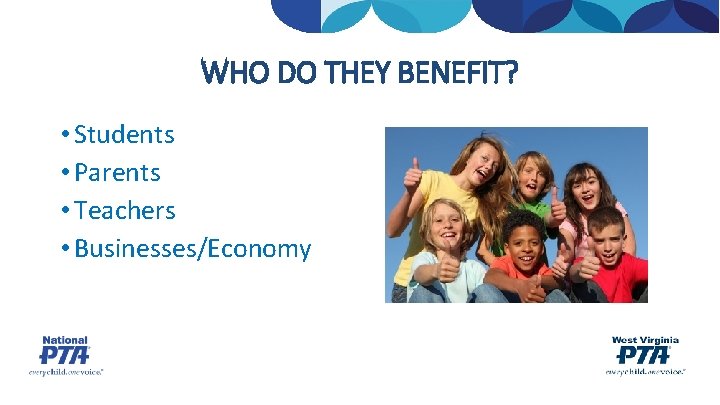
WHO DO THEY BENEFIT? • Students • Parents • Teachers • Businesses/Economy
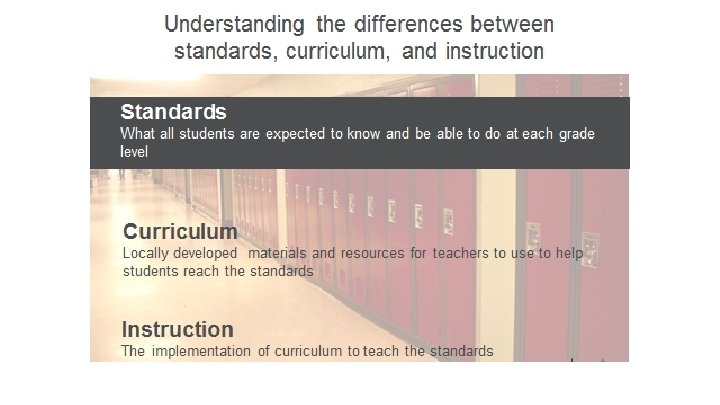
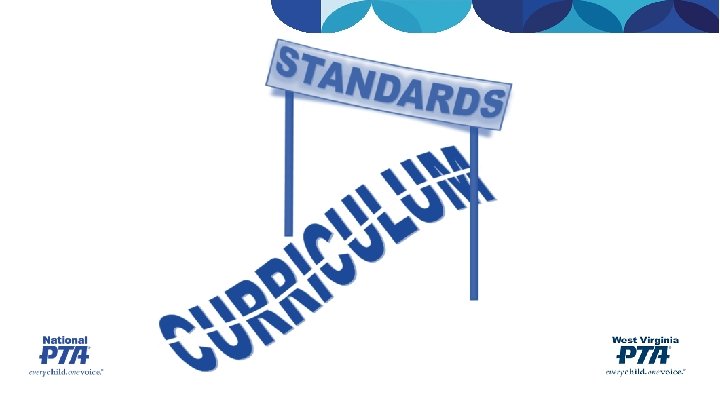
Standards vs. Curriculum
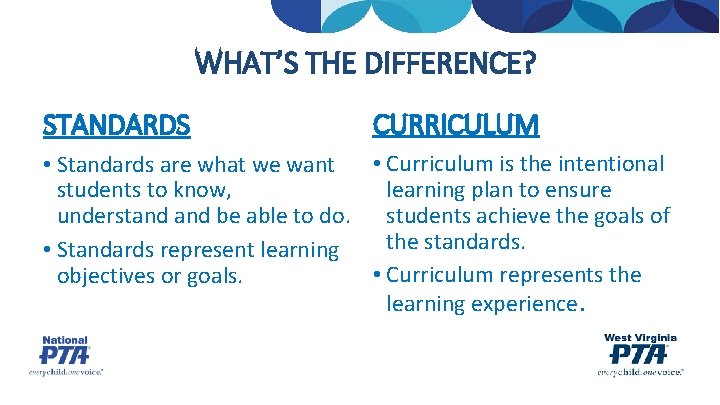
WHAT’S THE DIFFERENCE? STANDARDS CURRICULUM • Curriculum is the intentional • Standards are what we want learning plan to ensure students to know, understand be able to do. students achieve the goals of the standards. • Standards represent learning • Curriculum represents the objectives or goals. learning experience.
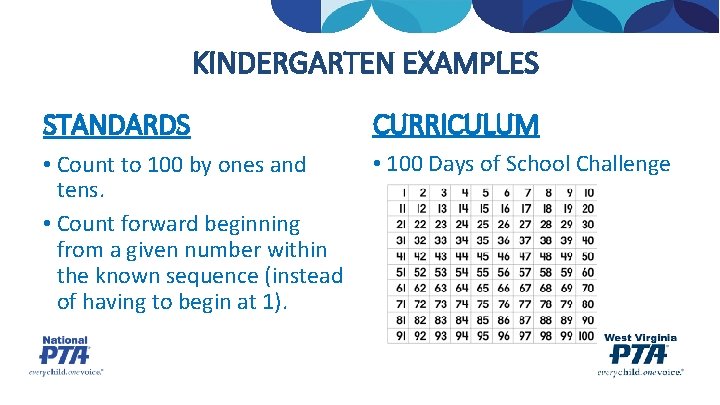
KINDERGARTEN EXAMPLES STANDARDS CURRICULUM • Count to 100 by ones and tens. • Count forward beginning from a given number within the known sequence (instead of having to begin at 1). • 100 Days of School Challenge
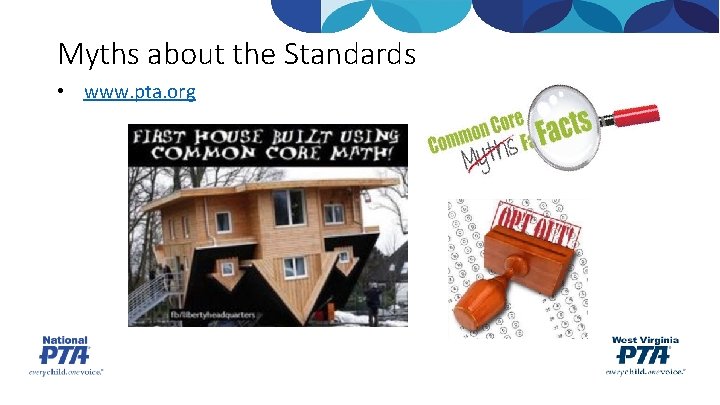
Myths about the Standards • www. pta. org
UPDATE: WEST VIRGINIA STANDARDS • In December 2015, WV Department of Education voted unanimously to repeal the Common Corebased education standards. • Replaced with WV College and Career Readiness Standards.
Step 2: Implementation
STANDARDS IMPLEMENTATION COMPONENTS • • Curriculum alignment Teacher development Text book selections Resource and information sharing
Step 3: Assessments
WHY DO WE TEST? • Academic check up. • Tests are part of life. • Tests give teachers and parents valuable data.
CHANGES TO ASSESSMENTS • Computer based. • Answers require critical thinking and multiple formats. • Measure the skills outlined in the standards. • More challenging.
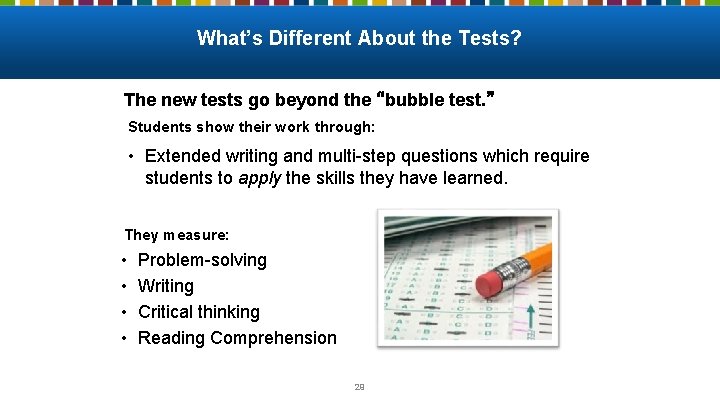
What’s Different About the Tests? The new tests go beyond the “bubble test. ” Students show their work through: • Extended writing and multi-step questions which require students to apply the skills they have learned. They measure: • • Problem-solving Writing Critical thinking Reading Comprehension 29
ELA ASSESSMENTS • Students will show they can read and understand complex passages. • Use evidence to support their ideas in written responses at every grade level. • Research a topic and use findings to make a claim and draw a conclusion.
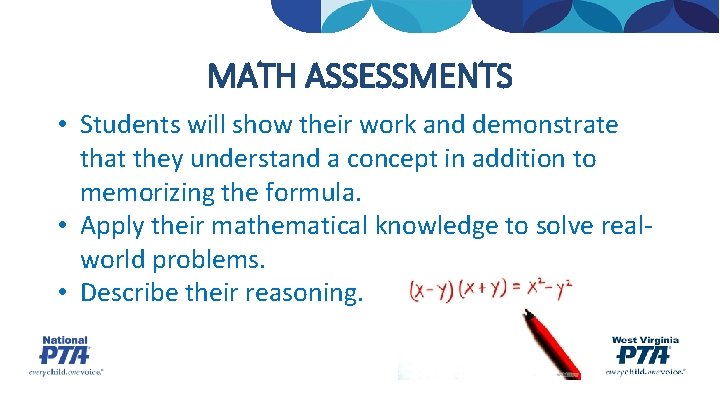
MATH ASSESSMENTS • Students will show their work and demonstrate that they understand a concept in addition to memorizing the formula. • Apply their mathematical knowledge to solve realworld problems. • Describe their reasoning.
WEST VIRGINIA UPDATE • What is the WV General Summative Assessment? • What subjects and grades are tested? • What information do the student reports provide? • What do the different levels on the test mean?
How Can I Help at Home? • No stress! This is just a measure! • Just a snap shot to ensure we are serving kids and preparing them for their futures. • Tests do not measure your child. • Tests do not measure your teacher. • Tests do not measure your school. • With your help, every child’s potential is a reality!
How Will Scores be Used? Test results will help schools to: • Make instructional decisions. • Determine individual needs of students: q Extra support? q More challenging work? q Recommendations for future classes? • Scores do not impact GPA, class ranking, or college acceptance. 34
Step 4: Accountability
WHO IS ACCOUNTABLE FOR STUDENT SUCCESS? üStates üDistricts üStudents üParents üEducators
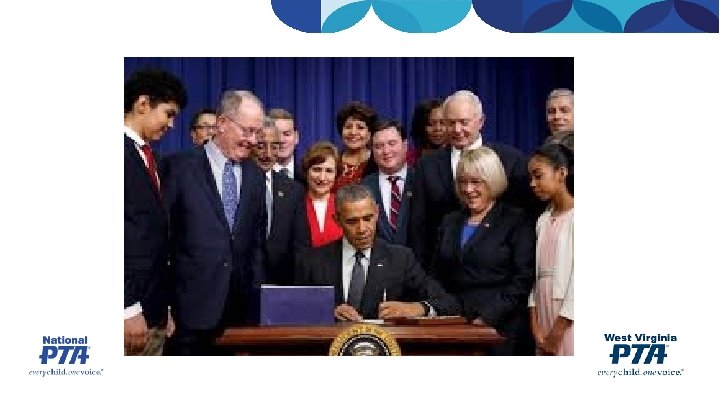
Every Student Succeeds Act (ESSA)
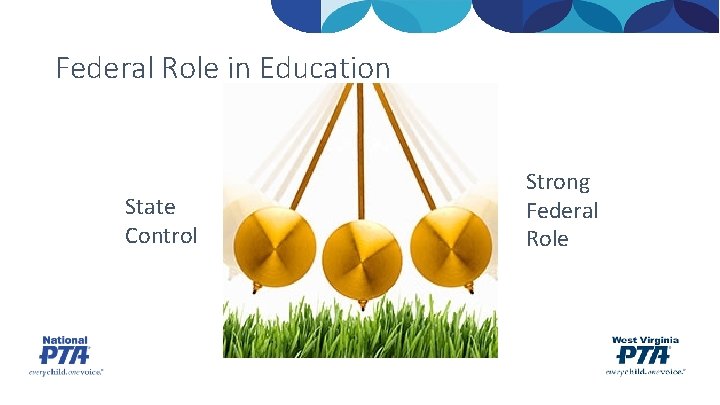
Federal Role in Education State Control Strong Federal Role
ESSA: STANDARDS & ACCOUNTABILITY • States must adopt challenging state academic standards and state designed long-term and interim progress goals. • States are required to develop accountability systems that feature multiple measures of student growth and achievement.
ESSA Stakeholder Engagement • Under ESSA, parents are required to be “meaningfully consulted” and involved in: o o o o State and local Title I plans Title II state and local applications Title III state and local plans Title IV-A local applications Title IV-B state applications State and local report cards School improvement plans
ESSA Stakeholder Engagement Required participants in state plans Governor State legislature State board of education Local educational agencies Representatives of Indian tribes located in the State • Teachers • • • Principals & other school leaders • Specialized instructional support personnel • Paraprofessionals • Administrators & other staff • Parents
ESSA: ASSESSMENT REQUIREMENTS • Annual assessments in mathematics and reading/language arts in grades 3 - 8 and once in grades 9 -12. • Science assessment once in grades 3 -5, 6 -9 and 10 -12. • At least 95% of all students—or of any group of students— must participate in the state assessment.
ESSA: SCHOOL ACCOUNTABILITY PLANS • Accountability systems for schools must include multiple measures of student achievement, but at a minimum they must consist of: 1. Student achievement on annual assessments. 2. A second academic indicator. 3. English language proficiency. 4. One non-academic indicator. 5. High school graduation rates.
HOLDING TEACHERS & STUDENTS ACCOUNTABLE • ESSA does not require teacher accountability systems – this is left to the states. • ESSA does not require that assessment scores must be used in teacher accountability systems. • ESSA does not specify student accountability systems.
ESSA SUMMARY • ESSA provides greater flexibility to states and school districts to design educational plans and programs. • With great opportunity, comes great responsibility. • The goal is for systems to provide more supports for all students and less punitive consequences.
ESSA IMPLEMENTATION AND THE TRUMP ADMINISTRATION
“This morning (March 13), the U. S. Department of Education released a new guide for states to use in developing their education plans under the Every Student Succeeds Act (ESSA). While ESSA requires meaningful stakeholder engagement, the new guide does not compel states to include a description of how they are engaging and consulting stakeholders in developing their plans.
“National PTA is extremely disappointed that stakeholder engagement is no longer prioritized. We have learned from the implementation of other education initiatives that engaging all stakeholders— especially parents—is critical, not optional. ” Reach out to your state education leaders, including the state chief/superintendent and tell them that they MUST include a description of how stakeholders have been engaged in the development of state plans.
… TO BE CONTINUED
Resources
YOU! PTA is a child advocacy organization. To get the best results for all children, we must join together to teach others. • Sharing information • Email distribution lists • Be involved in the process
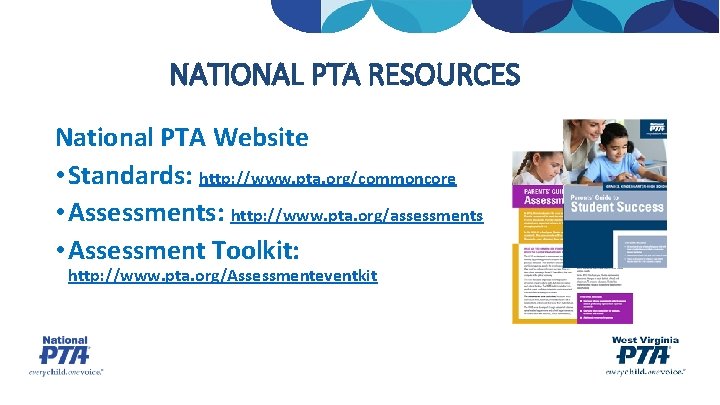
NATIONAL PTA RESOURCES National PTA Website • Standards: http: //www. pta. org/commoncore • Assessments: http: //www. pta. org/assessments • Assessment Toolkit: http: //www. pta. org/Assessmenteventkit
STANDARDS AND ASSESSMENT RESOURCES • • • WV Department of Education: https: //wvde. state. wv. us/teach 21/Nx. GCSOs. html Be A Learning Hero: www. learningheroes. org Student Achievement Partners: http: //achievethecore. org/ Smarter Balanced Practice Tests: http: //sbac. portal. airast. org/practice-test/ Smarter Balanced Website: www. parcconline. org
FAMILY RESOURCES • Be A Learning Hero: http: //www. bealearninghero. org/ • Great! Kids Milestones: http: //www. greatkids. org/milestones • Council of the Great City Schools‘ Parent Roadmaps & Video: http: //www. cgcs. org/Page/244 • Parent Toolkit: http: //www. parenttoolkit. com/parenttoolkit. com • Khan Academy: https: //www. khanacademy. org/ • Homework Help Desk: http: //homeworkhelpdesk. org/
Questions?
FOR MORE INFORMATION CONTACT: Janelle Sperry President, West Virginia PTA 304 -279 -7270 president@westvirginiapta. org