
College Algebra Twelfth Edition Chapter 1 Equations and
College Algebra Twelfth Edition Chapter 1 Equations and Inequalities Copyright © 2017, 2013, 2009 Pearson Education, Inc. All Rights Reserved Slide - 1
Section 1. 6 Other Types of Equations and Applications • Rational Equations • Equations with Radicals • Equations with Rational Exponents Copyright © 2017, 2013, 2009 Pearson Education, Inc. All Rights Reserved Slide - 2
Rational Equations A rational equation is an equation that has a rational expression for one or more terms. To solve a rational equation, multiply each side by the least common denominator (LCD) of the terms of the equation and then solve the resulting equation. Because a rational expression is not defined when its denominator is 0, proposed solutions for which any denominator equals 0 are excluded from the solution set. Copyright © 2017, 2013, 2009 Pearson Education, Inc. All Rights Reserved Slide - 3
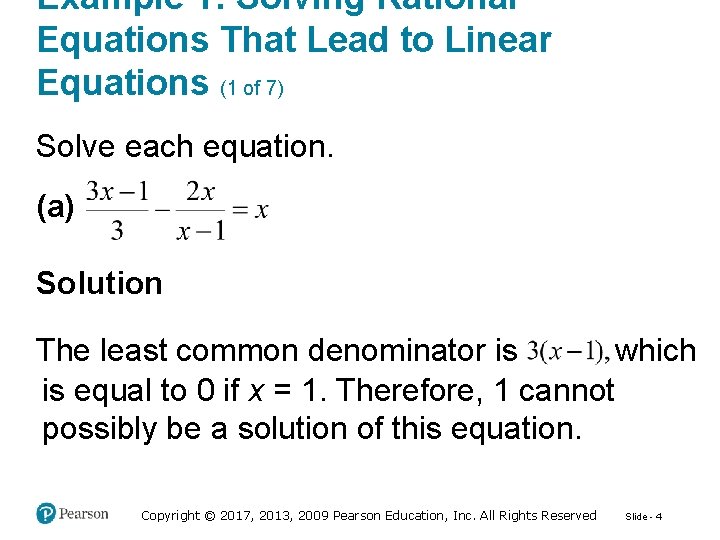
Example 1: Solving Rational Equations That Lead to Linear Equations (1 of 7) Solve each equation. (a) Solution The least common denominator is which is equal to 0 if x = 1. Therefore, 1 cannot possibly be a solution of this equation. Copyright © 2017, 2013, 2009 Pearson Education, Inc. All Rights Reserved Slide - 4
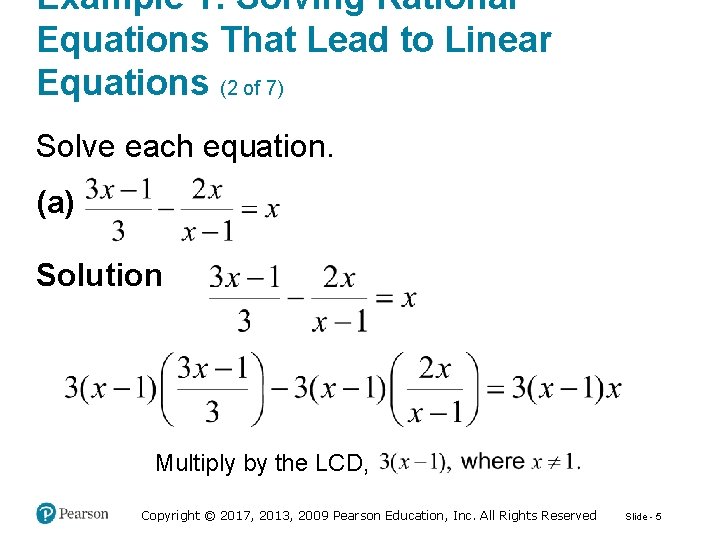
Example 1: Solving Rational Equations That Lead to Linear Equations (2 of 7) Solve each equation. (a) Solution Multiply by the LCD, Copyright © 2017, 2013, 2009 Pearson Education, Inc. All Rights Reserved Slide - 5
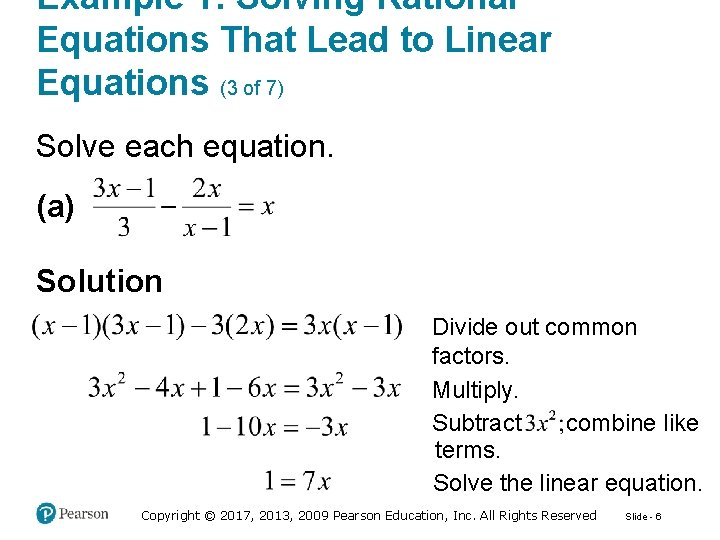
Example 1: Solving Rational Equations That Lead to Linear Equations (3 of 7) Solve each equation. (a) Solution Divide out common factors. Multiply. Subtract combine like terms. Solve the linear equation. Copyright © 2017, 2013, 2009 Pearson Education, Inc. All Rights Reserved Slide - 6
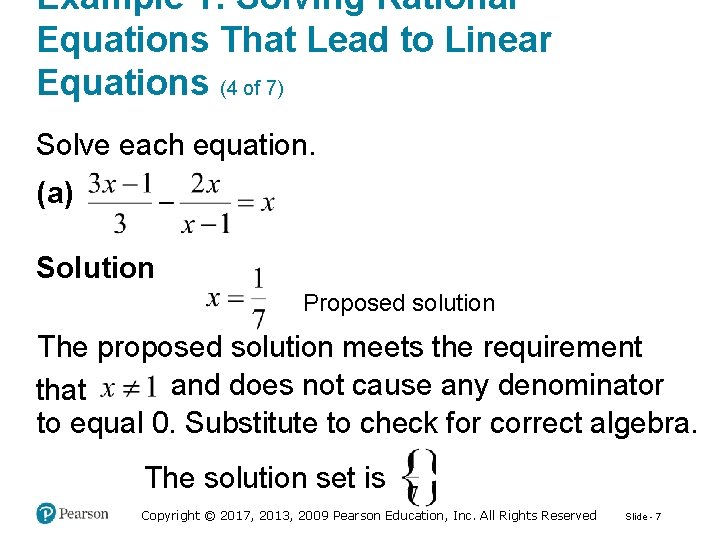
Example 1: Solving Rational Equations That Lead to Linear Equations (4 of 7) Solve each equation. (a) Solution Proposed solution The proposed solution meets the requirement and does not cause any denominator that to equal 0. Substitute to check for correct algebra. The solution set is Copyright © 2017, 2013, 2009 Pearson Education, Inc. All Rights Reserved Slide - 7
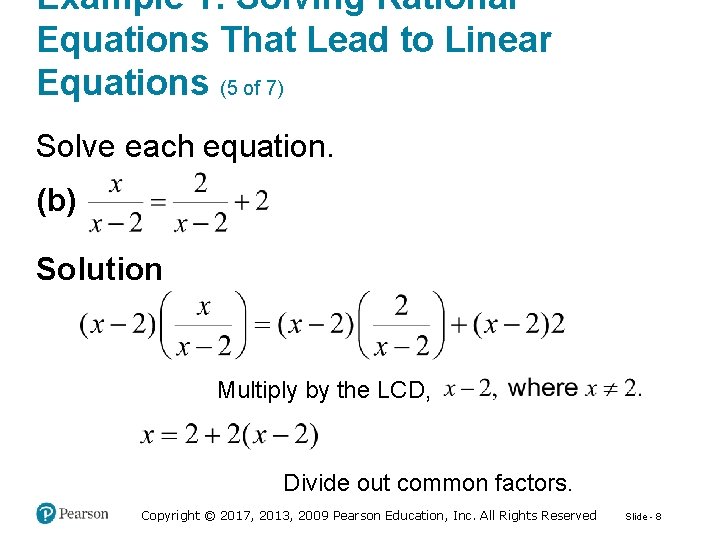
Example 1: Solving Rational Equations That Lead to Linear Equations (5 of 7) Solve each equation. (b) Solution Multiply by the LCD, Divide out common factors. Copyright © 2017, 2013, 2009 Pearson Education, Inc. All Rights Reserved Slide - 8
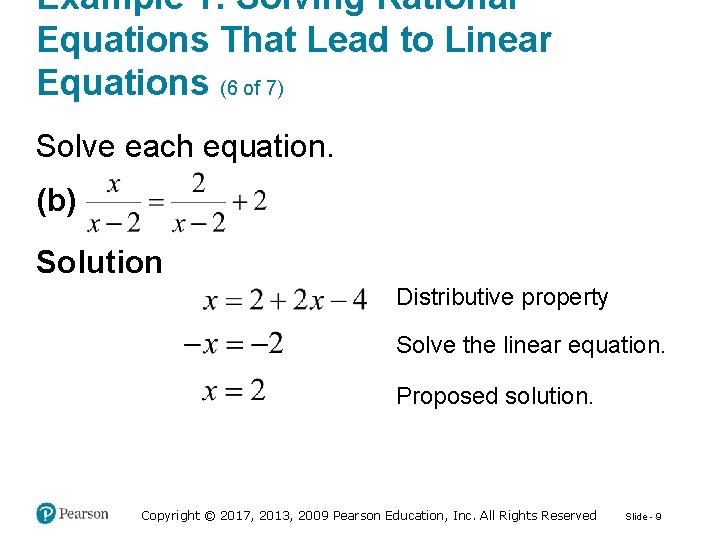
Example 1: Solving Rational Equations That Lead to Linear Equations (6 of 7) Solve each equation. (b) Solution Distributive property Solve the linear equation. Proposed solution. Copyright © 2017, 2013, 2009 Pearson Education, Inc. All Rights Reserved Slide - 9
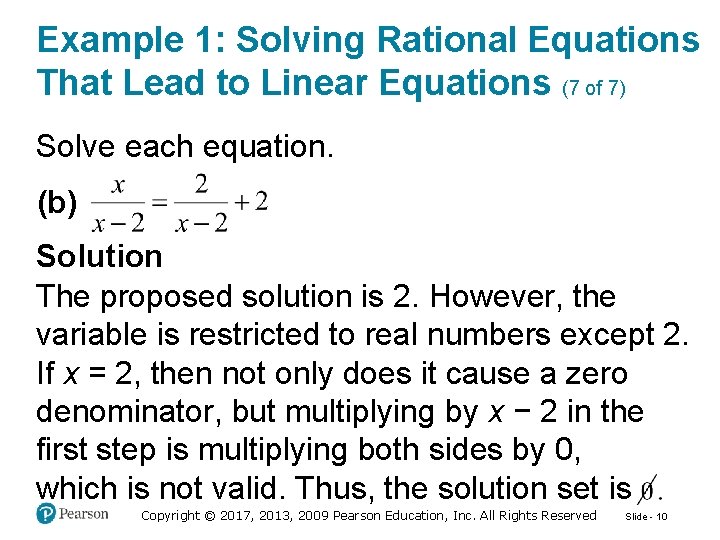
Example 1: Solving Rational Equations That Lead to Linear Equations (7 of 7) Solve each equation. (b) Solution The proposed solution is 2. However, the variable is restricted to real numbers except 2. If x = 2, then not only does it cause a zero denominator, but multiplying by x − 2 in the first step is multiplying both sides by 0, which is not valid. Thus, the solution set is Copyright © 2017, 2013, 2009 Pearson Education, Inc. All Rights Reserved Slide - 10
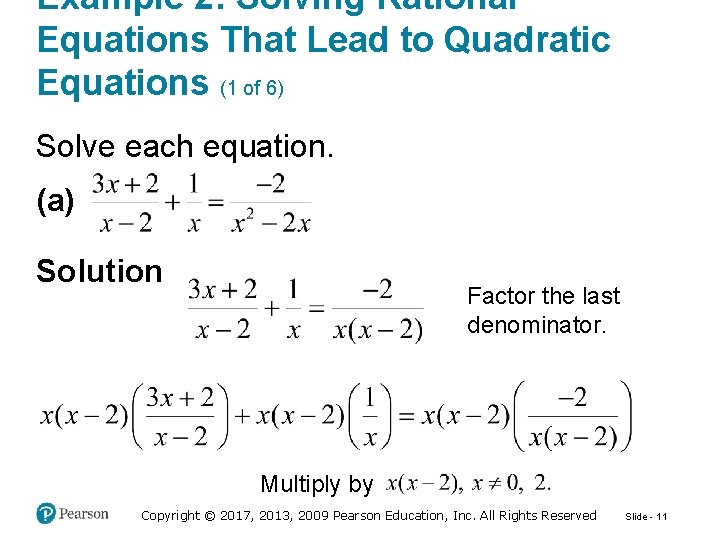
Example 2: Solving Rational Equations That Lead to Quadratic Equations (1 of 6) Solve each equation. (a) Solution Factor the last denominator. Multiply by Copyright © 2017, 2013, 2009 Pearson Education, Inc. All Rights Reserved Slide - 11
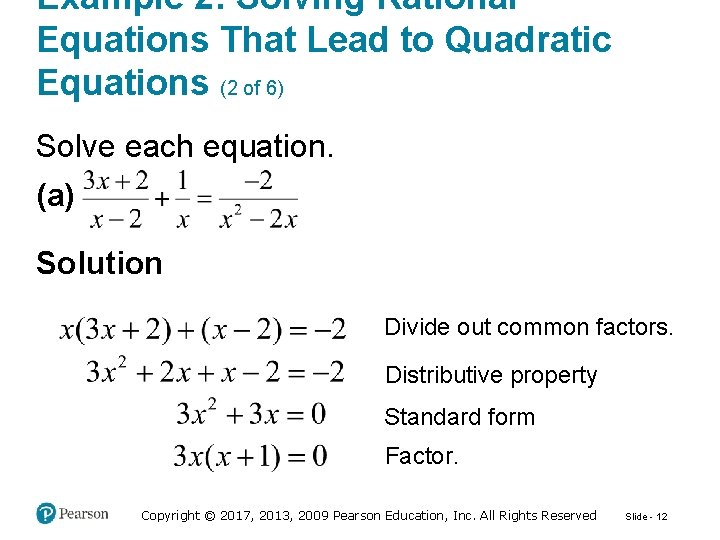
Example 2: Solving Rational Equations That Lead to Quadratic Equations (2 of 6) Solve each equation. (a) Solution Divide out common factors. Distributive property Standard form Factor. Copyright © 2017, 2013, 2009 Pearson Education, Inc. All Rights Reserved Slide - 12
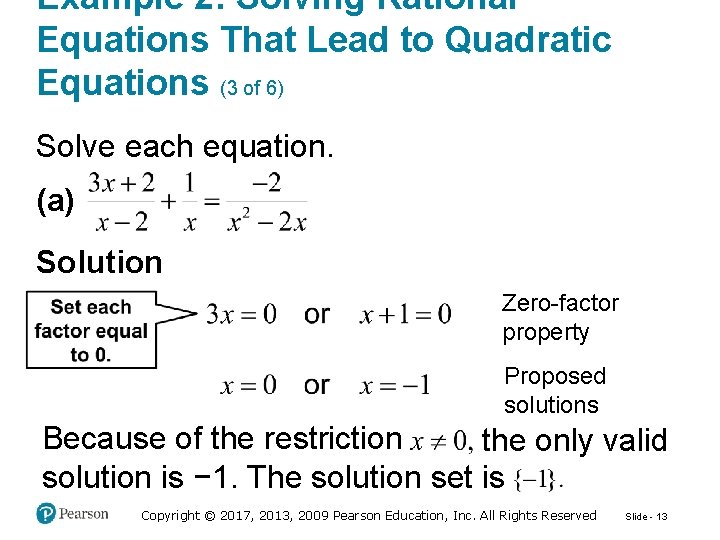
Example 2: Solving Rational Equations That Lead to Quadratic Equations (3 of 6) Solve each equation. (a) Solution Zero-factor property Proposed solutions Because of the restriction the only valid solution is − 1. The solution set is Copyright © 2017, 2013, 2009 Pearson Education, Inc. All Rights Reserved Slide - 13
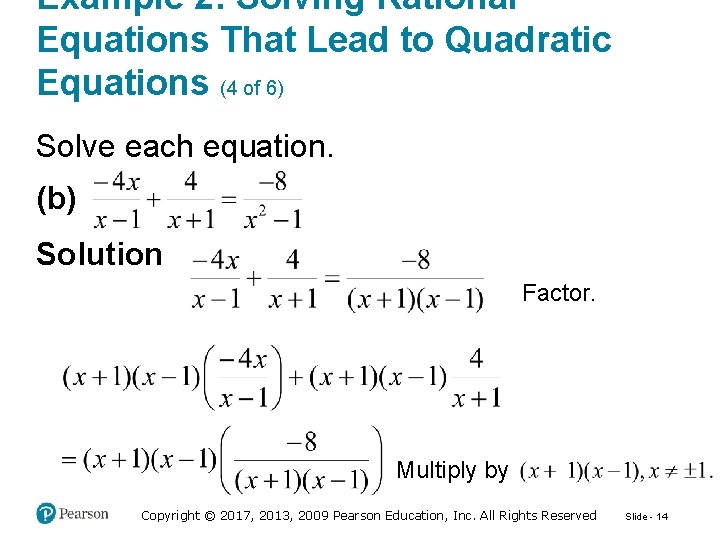
Example 2: Solving Rational Equations That Lead to Quadratic Equations (4 of 6) Solve each equation. (b) Solution Factor. Multiply by Copyright © 2017, 2013, 2009 Pearson Education, Inc. All Rights Reserved Slide - 14
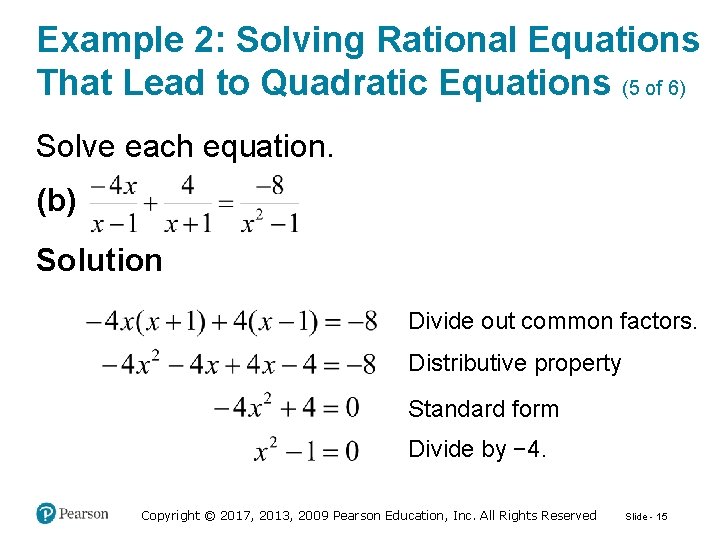
Example 2: Solving Rational Equations That Lead to Quadratic Equations (5 of 6) Solve each equation. (b) Solution Divide out common factors. Distributive property Standard form Divide by − 4. Copyright © 2017, 2013, 2009 Pearson Education, Inc. All Rights Reserved Slide - 15
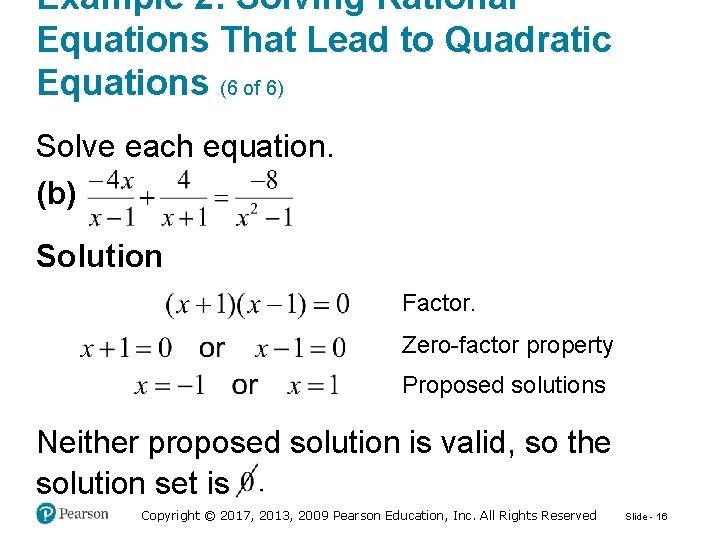
Example 2: Solving Rational Equations That Lead to Quadratic Equations (6 of 6) Solve each equation. (b) Solution Factor. Zero-factor property Proposed solutions Neither proposed solution is valid, so the solution set is Copyright © 2017, 2013, 2009 Pearson Education, Inc. All Rights Reserved Slide - 16
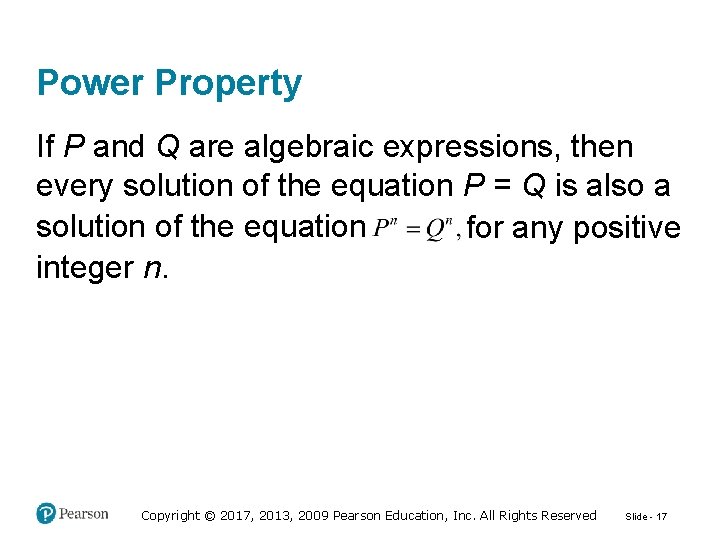
Power Property If P and Q are algebraic expressions, then every solution of the equation P = Q is also a solution of the equation for any positive integer n. Copyright © 2017, 2013, 2009 Pearson Education, Inc. All Rights Reserved Slide - 17
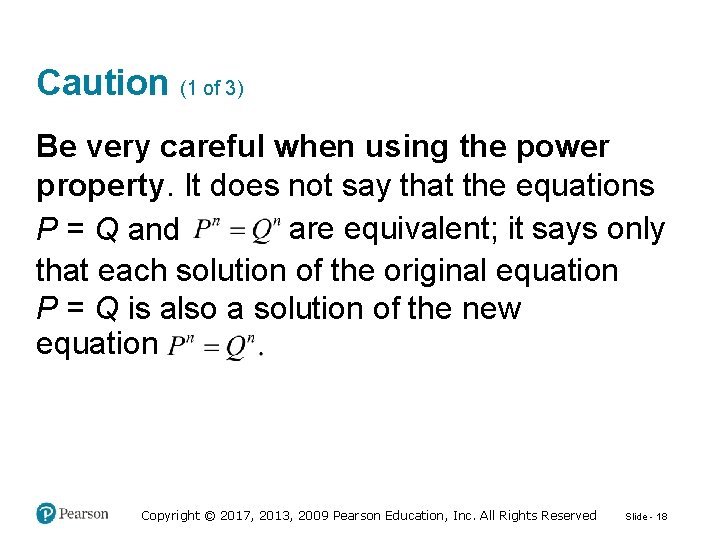
Caution (1 of 3) Be very careful when using the power property. It does not say that the equations are equivalent; it says only P = Q and that each solution of the original equation P = Q is also a solution of the new equation Copyright © 2017, 2013, 2009 Pearson Education, Inc. All Rights Reserved Slide - 18
Solving an Equation Involving Radicals Step 1 Isolate the radical on one side of the equation. Step 2 Raise each side of the equation to a power that is the same as the index of the radical so that the radical is eliminated. If the equation still contains a radical, repeat Steps 1 and 2. Step 3 Solve the resulting equation. Step 4 Check each proposed solution in the original equation. Copyright © 2017, 2013, 2009 Pearson Education, Inc. All Rights Reserved Slide - 19
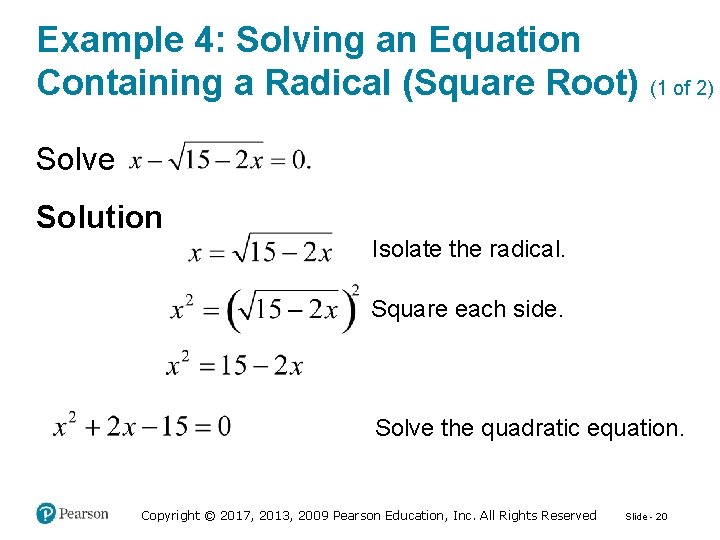
Example 4: Solving an Equation Containing a Radical (Square Root) (1 of 2) Solve Solution Isolate the radical. Square each side. Solve the quadratic equation. Copyright © 2017, 2013, 2009 Pearson Education, Inc. All Rights Reserved Slide - 20
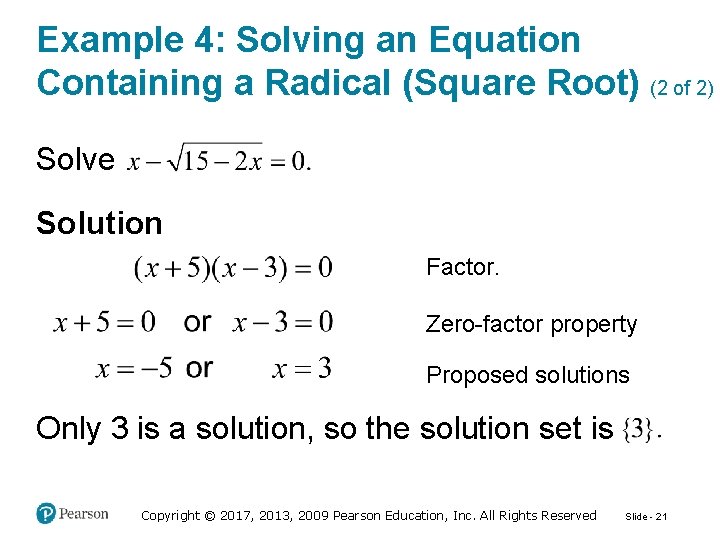
Example 4: Solving an Equation Containing a Radical (Square Root) (2 of 2) Solve Solution Factor. Zero-factor property Proposed solutions Only 3 is a solution, so the solution set is Copyright © 2017, 2013, 2009 Pearson Education, Inc. All Rights Reserved Slide - 21
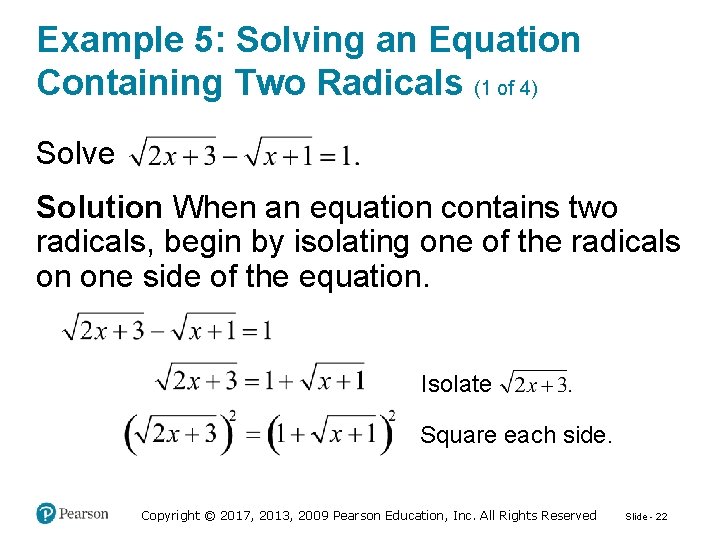
Example 5: Solving an Equation Containing Two Radicals (1 of 4) Solve Solution When an equation contains two radicals, begin by isolating one of the radicals on one side of the equation. Isolate Square each side. Copyright © 2017, 2013, 2009 Pearson Education, Inc. All Rights Reserved Slide - 22
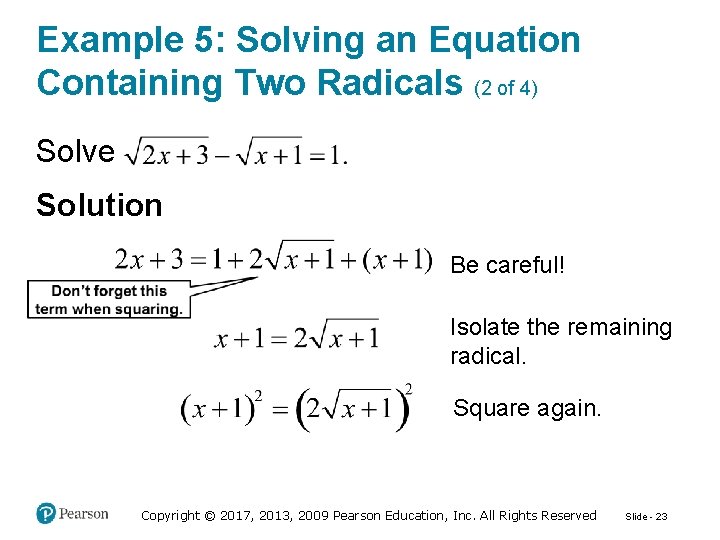
Example 5: Solving an Equation Containing Two Radicals (2 of 4) Solve Solution Be careful! Isolate the remaining radical. Square again. Copyright © 2017, 2013, 2009 Pearson Education, Inc. All Rights Reserved Slide - 23
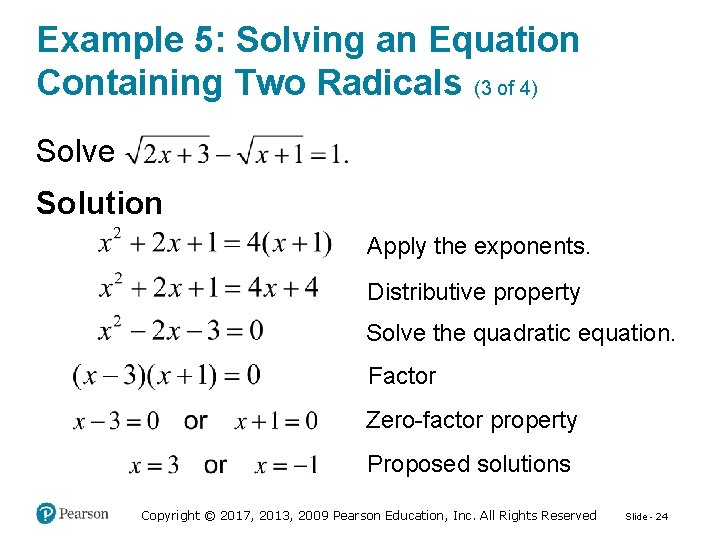
Example 5: Solving an Equation Containing Two Radicals (3 of 4) Solve Solution Apply the exponents. Distributive property Solve the quadratic equation. Factor Zero-factor property Proposed solutions Copyright © 2017, 2013, 2009 Pearson Education, Inc. All Rights Reserved Slide - 24
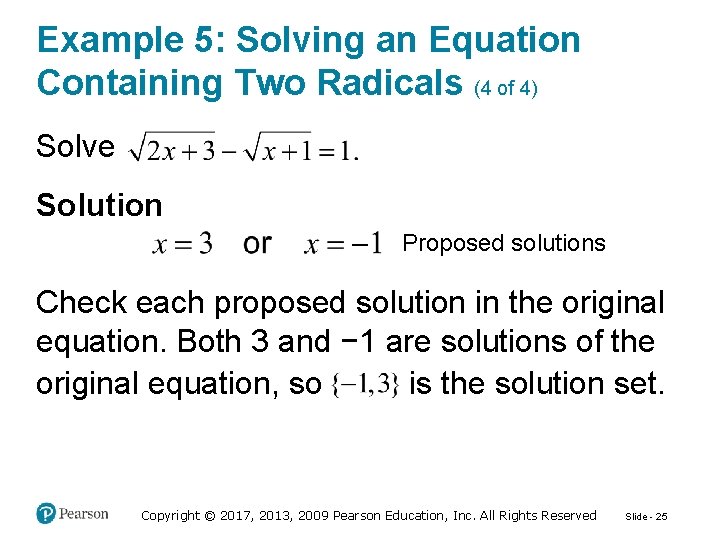
Example 5: Solving an Equation Containing Two Radicals (4 of 4) Solve Solution Proposed solutions Check each proposed solution in the original equation. Both 3 and − 1 are solutions of the is the solution set. original equation, so Copyright © 2017, 2013, 2009 Pearson Education, Inc. All Rights Reserved Slide - 25
Caution (2 of 3) Remember to isolate a radical in Step 1. It would be incorrect to square each term individually as the first step in Example 5. Copyright © 2017, 2013, 2009 Pearson Education, Inc. All Rights Reserved Slide - 26
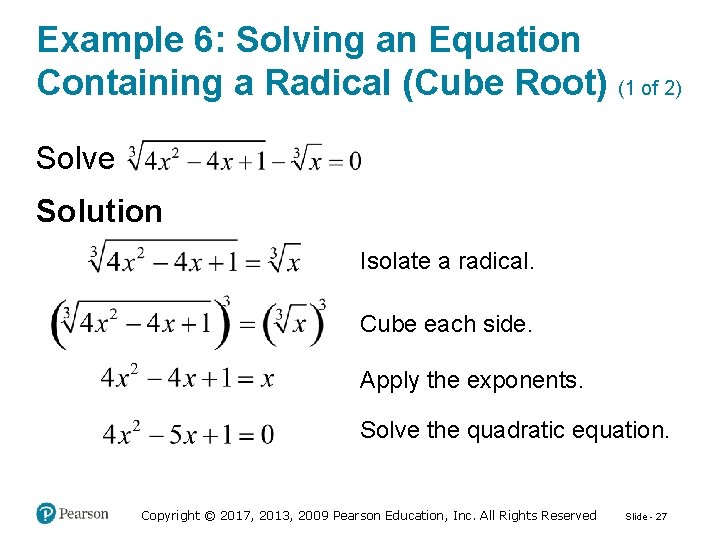
Example 6: Solving an Equation Containing a Radical (Cube Root) (1 of 2) Solve Solution Isolate a radical. Cube each side. Apply the exponents. Solve the quadratic equation. Copyright © 2017, 2013, 2009 Pearson Education, Inc. All Rights Reserved Slide - 27
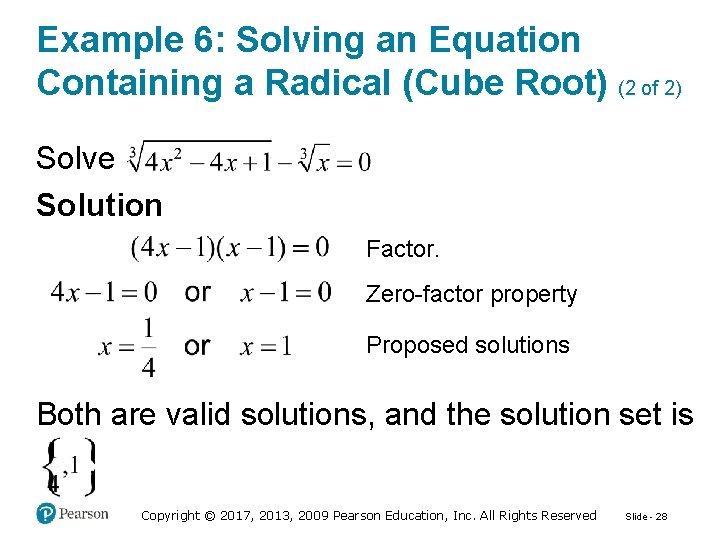
Example 6: Solving an Equation Containing a Radical (Cube Root) (2 of 2) Solve Solution Factor. Zero-factor property Proposed solutions Both are valid solutions, and the solution set is Copyright © 2017, 2013, 2009 Pearson Education, Inc. All Rights Reserved Slide - 28
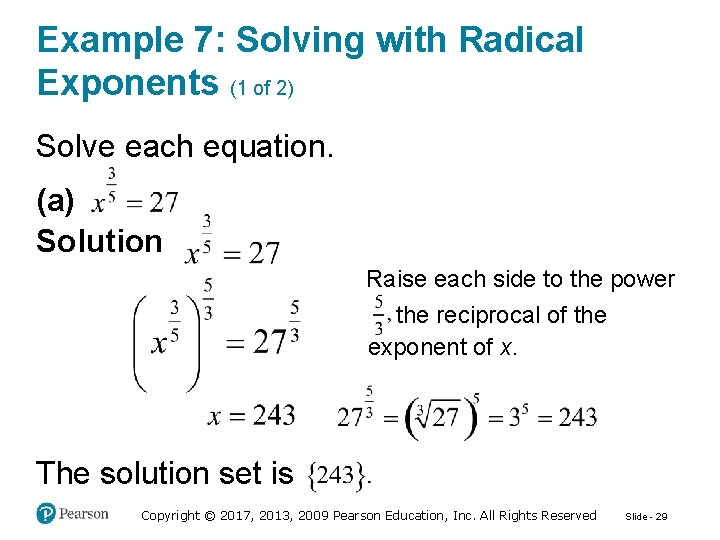
Example 7: Solving with Radical Exponents (1 of 2) Solve each equation. (a) Solution Raise each side to the power the reciprocal of the exponent of x. The solution set is Copyright © 2017, 2013, 2009 Pearson Education, Inc. All Rights Reserved Slide - 29
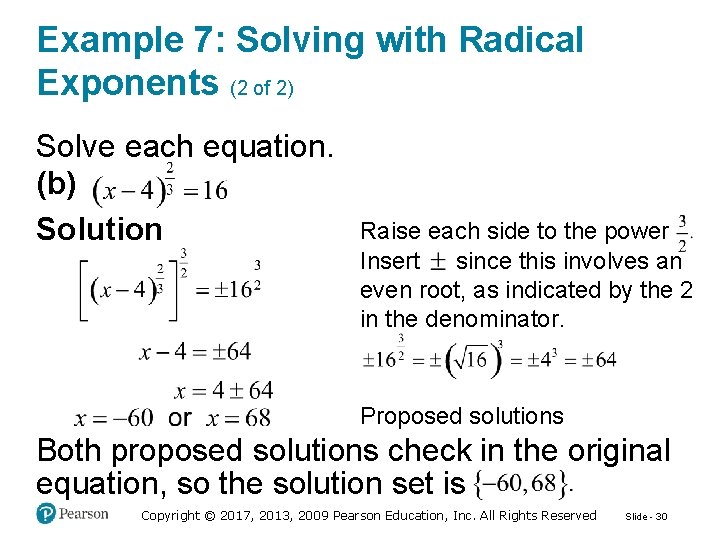
Example 7: Solving with Radical Exponents (2 of 2) Solve each equation. (b) Solution Raise each side to the power Insert since this involves an even root, as indicated by the 2 in the denominator. Proposed solutions Both proposed solutions check in the original equation, so the solution set is Copyright © 2017, 2013, 2009 Pearson Education, Inc. All Rights Reserved Slide - 30
- Slides: 30