
Collective bargaining for the selfemployed Karen Curtis Chief
Collective bargaining for the self-employed Karen Curtis Chief, Freedom of Association Branch, ILO
Trade union rights for Employees, Bogus Self Employed, Self. Employed Workers, Freelancers, Agency Workers. . .
Labour is not a commodity Cornerstone of the ILO and turning point of antitrust legislation in the first quarter of the 20 th century Recognized that collective bargaining and industrial action were legitimate objectives of self -help and could not be construed as illegal combinations or conspiracies Critical tool for setting basic minimum conditions Labour is defined as not having capital stock or conducted for profit as distinguished from an undertaking subject to competition rules
No place for bogus/disguised selfemployed and self-employed dichotomy Most ILO standards refer to workers, not employees Article 2 of C 87 provides that the right to organise is to be granted to “all workers without distinction whatsoever” for the purposes of furthering an defending their interests (Article 10) ILO Conventions 98, 151 and 154 extend collective bargaining rights to all employers and workers and all subjects 2012 General Survey: the right to collective bargaining should also cover organizations representing self-employed workers (para 209)
ILO Global Forum on Employment Relationships in the Media and Culture Sector (2014 Points Of Consensus) Fundamental principles and rights at work apply to all workers in the media and culture sector, regardless of the nature of their employment relationship Freedom of expression and independence must underpin the sector Governments need to ensure that competition legislation does not obstruct the right of media and culture workers to freedom of association or to engage in social dialogue with their social partners (information sharing, consultation and CB) Good starting point, but also need to go beyond more broadly to self-employed regardless of sectors
Ensuring fundamental rights in an Orwellian world Freedom of association and collective bargaining Problems in online activism – Easy monitoring of workers via GPS and ITdevices – Reputation and ratings Discrimination (including indirect discrimination) Implicit and explicit bias in rating – Exclusion of workers Gender pay gap
Collective bargaining mechanisms that adapt to the risks Collective bargaining is between an employer(s) or their organizations and organizations of workers Need clear understanding of who is an “employer” and a “worker” to determine which side of the negotiation table Collective voice may be used to participate in regulatory choices Bargaining units and mechanisms may differ and be adapted to new forms of work and work organization
Korea – Self-employed truck drivers CFA Case 2602 Can work outside of the labour relations law by virtue of constitutional right to organize and protect their interests through negotiation with their business counterpart BUT are not trade unions Even if no employee status, right to join the union of their own choosing, including being represented by a national confederation of workers Hold consultations with all the parties involved with the aim of ensuring that workers who are self-employed fully enjoy trade union rights under Conventions Nos 87 and 98 for the purpose of furthering and defending their interest, including by the means of collective bargaining Identify the particularities of self-employed workers that have a bearing on collective bargaining so as to develop specific collective bargaining mechanisms relevant to self-employed workers, if appropriate.
Cases before regular supervisory machinery Ireland Self-employed voice-over actors, session musicians and freelance journalists – workers in vulnerable situations CEACR – Ensure that self-employed may bargain collectively for these workers and other types of freelancers and independent workers CAS 2016: identify the types of contractual arrangements that would have a bearing on collective bargaining mechanisms. 2017 Competition amendment Act – noted with satisfaction – coverage of the above plus possible applications for fully dependent/false self-employed Comments by employers’ organizations focused on determination of fully dependent and false self-employed Who is the bargaining partner – previously Institute of Advertising Practitioners
The Netherlands – the continuing debate around true self-employed and bogus Netherlands Trade Union Confederation (FNV) brings case related to Netherlands Competition Authority opinion discouraging collective bargaining of contract labour and refers “serious matters” to CEACR in 2008 ECJ preliminary ruling December 2014: FNV Kunsten Informatie en Media (KIEM) v. the State of the Netherlands: national identification of false selfemployed Hague Court of Appeal September 2015 - competition law does not preclude a collective agreement from requiring an employer to apply its provisions to self-employed substitutes (musicians substituting for members of an orchestra) and, in particular, to apply certain (minimum) rates CEACR: Government reply continues to refer to negotiations between employers’ and employees’ organizations that may include “bogus selfemployed persons” (service providers in similar positions to employees), which do not fall within the concept of “entrepreneurs” under European competition law, even if they are genuine self-employed under national law FNV observes that the Netherlands Authority for Consumers and Markets (ACM) still refuses to more broadly acknowledge the collective bargaining rights of self-employed workers that work side by side with regular employees
The Netherlands conclusion: Adaptability The Committee is nevertheless aware that the mechanisms for collective bargaining applied in traditional workplace relationships may not be adapted to the specific circumstances and conditions in which the self-employed work. The Committee invites the Government to hold consultations with all the parties concerned with the aim of ensuring that all workers including self-employed workers may engage in free and voluntary collective bargaining. Considering that such consultations will allow the Government and the social partners concerned to identify the appropriate adjustments to be introduced to the collective bargaining mechanisms so as to facilitate their application to selfemployed workers, the Committee requests the Government to provide information on the progress achieved in this respect.
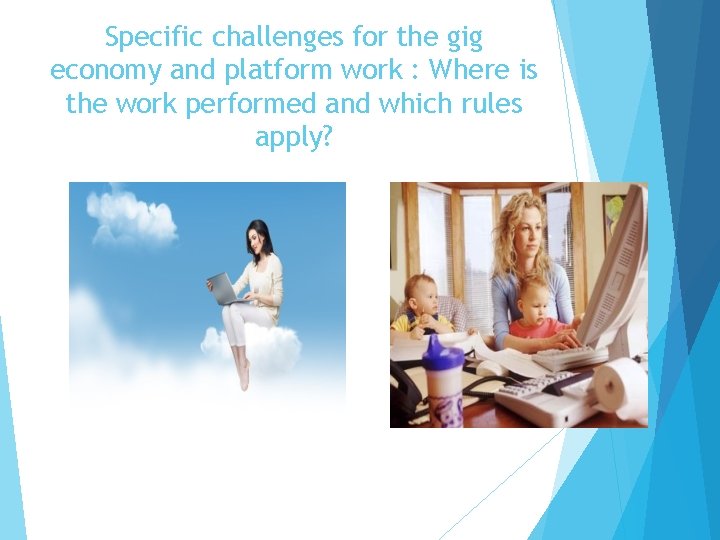
Specific challenges for the gig economy and platform work : Where is the work performed and which rules apply?
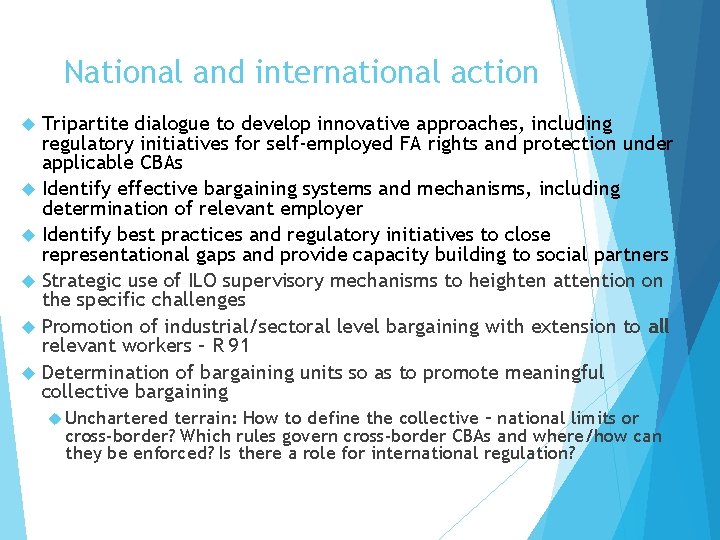
National and international action Tripartite dialogue to develop innovative approaches, including regulatory initiatives for self-employed FA rights and protection under applicable CBAs Identify effective bargaining systems and mechanisms, including determination of relevant employer Identify best practices and regulatory initiatives to close representational gaps and provide capacity building to social partners Strategic use of ILO supervisory mechanisms to heighten attention on the specific challenges Promotion of industrial/sectoral level bargaining with extension to all relevant workers – R 91 Determination of bargaining units so as to promote meaningful collective bargaining Unchartered terrain: How to define the collective – national limits or cross-border? Which rules govern cross-border CBAs and where/how can they be enforced? Is there a role for international regulation?
- Slides: 13