
Collections Chapter 5 TH EDITION Lewis Loftus java
- Slides: 34
Collections Chapter 5 TH EDITION Lewis & Loftus java Software Solutions Foundations of Program Design © 2007 Pearson Addison-Wesley. All rights reserved 12
Collections • A collection is an object that helps us organize and manage other objects • Chapter 12 focuses on: § § § § the concept of a collection separating the interface from the implementation dynamic data structures linked lists queues and stacks trees and graphs generics © 2007 Pearson Addison-Wesley. All rights reserved 2
Outline Collections and Data Structures Dynamic Representations Queues and Stacks Trees and Graphs The Java Collections API © 2007 Pearson Addison-Wesley. All rights reserved 3
Collections • A collection is an object that serves as a repository for other objects • A collection usually provides services such as adding, removing, and otherwise managing the elements it contains • Sometimes the elements in a collection are ordered, sometimes they are not • Sometimes collections are homogeneous, containing all the same type of objects, and sometimes they are heterogeneous © 2007 Pearson Addison-Wesley. All rights reserved 4
Abstraction • Collections can be implemented in many different ways • Our data structures should be abstractions • That is, they should hide unneeded details • We want to separate the interface of the structure from its underlying implementation • This helps manage complexity and makes it possible to change the implementation without changing the interface 5
Abstract Data Types • An abstract data type (ADT) is an organized collection of information and a set of operations used to manage that information • The set of operations defines the interface to the ADT • In one sense, as long as the ADT fulfills the promises of the interface, it doesn't matter how the ADT is implemented • Objects are a perfect programming mechanism to create ADTs because their internal details are encapsulated 6
Outline Collections and Data Structures Dynamic Representations Queues and Stacks Trees and Graphs The Java Collections API © 2007 Pearson Addison-Wesley. All rights reserved 7
Dynamic Structures • A static data structure has a fixed size • This meaning is different from the meaning of the static modifier • Arrays are static; once you define the number of elements it can hold, the size doesn’t change • A dynamic data structure grows and shrinks at execution time as required by its contents • A dynamic data structure is implemented using links 8
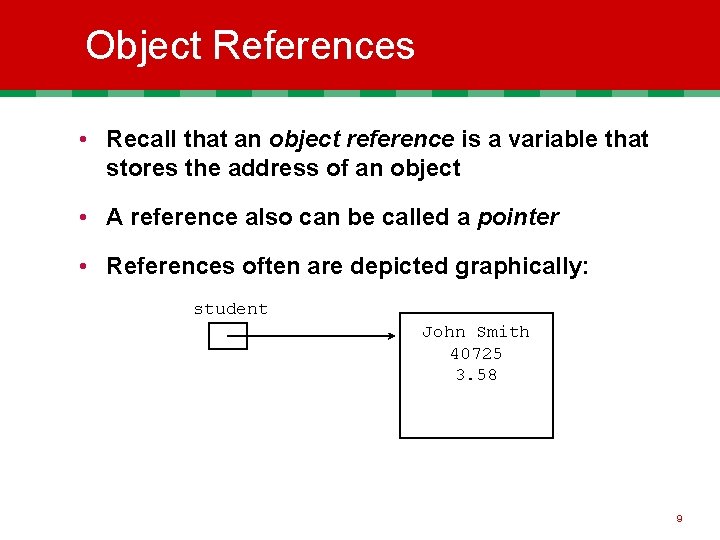
Object References • Recall that an object reference is a variable that stores the address of an object • A reference also can be called a pointer • References often are depicted graphically: student John Smith 40725 3. 58 9
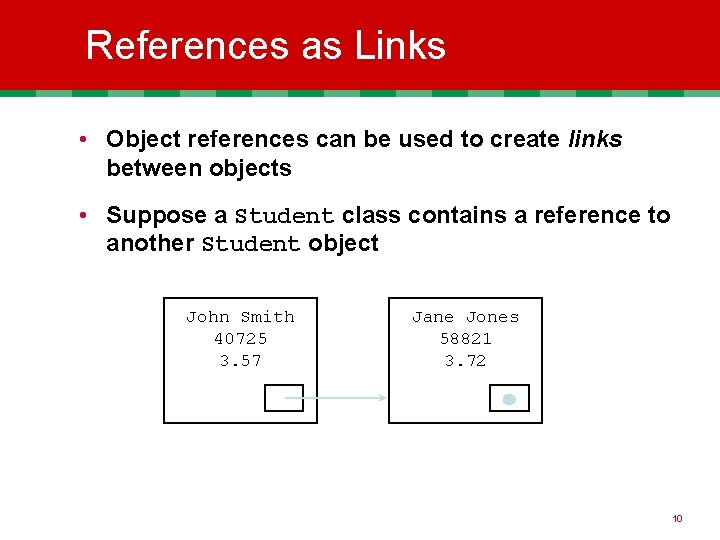
References as Links • Object references can be used to create links between objects • Suppose a Student class contains a reference to another Student object John Smith 40725 3. 57 Jane Jones 58821 3. 72 10
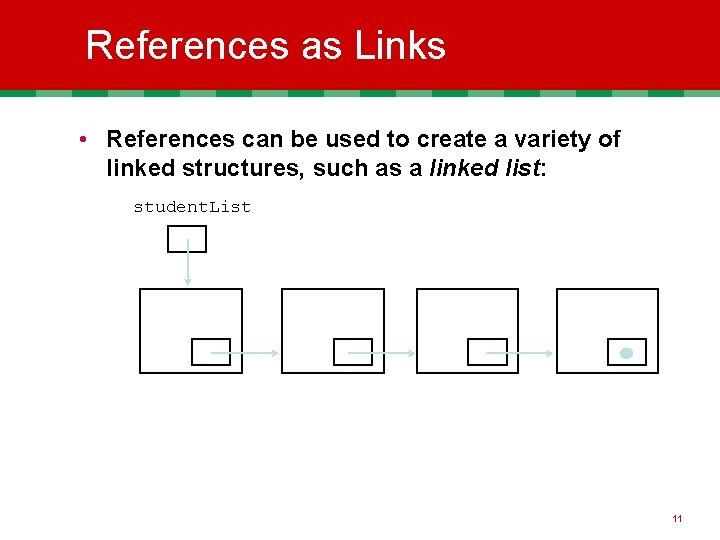
References as Links • References can be used to create a variety of linked structures, such as a linked list: student. List 11
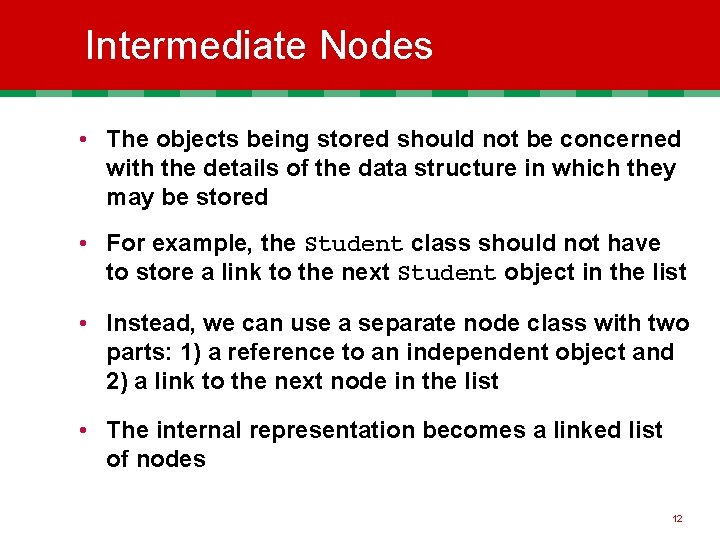
Intermediate Nodes • The objects being stored should not be concerned with the details of the data structure in which they may be stored • For example, the Student class should not have to store a link to the next Student object in the list • Instead, we can use a separate node class with two parts: 1) a reference to an independent object and 2) a link to the next node in the list • The internal representation becomes a linked list of nodes 12
Magazine Collection • Let’s explore an example of a collection of Magazine objects, managed by the Magazine. List class, which has an private inner class called Magazine. Node • Because the Magazine. Node is private to Magazine. List, the Magazine. List methods can directly access Magazine. Node data without violating encapsulation • See Magazine. Rack. java (page 619) • See Magazine. List. java (page 620) • See Magazine. java (page 622) © 2007 Pearson Addison-Wesley. All rights reserved 13
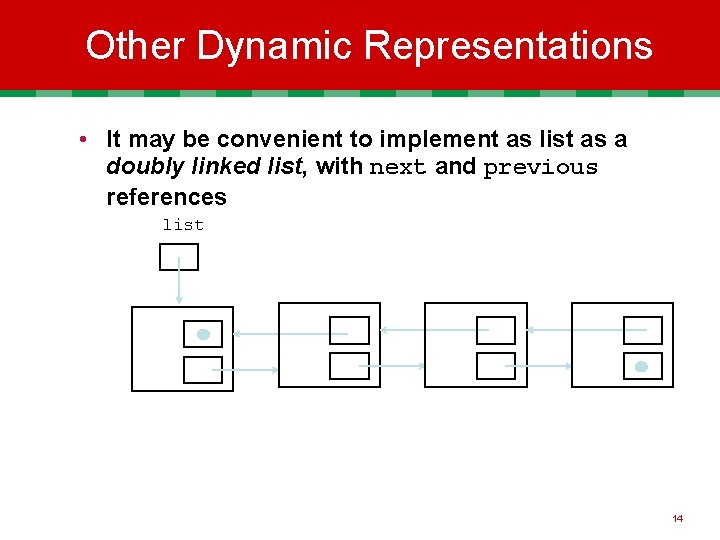
Other Dynamic Representations • It may be convenient to implement as list as a doubly linked list, with next and previous references list 14
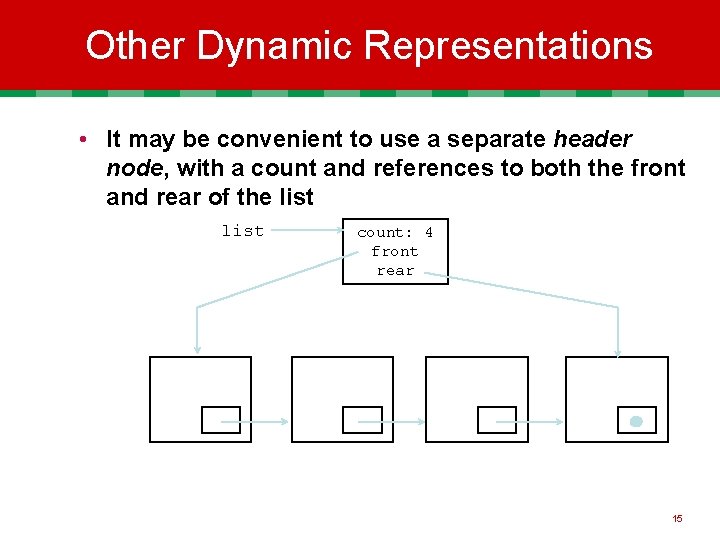
Other Dynamic Representations • It may be convenient to use a separate header node, with a count and references to both the front and rear of the list count: 4 front rear 15
Outline Collections and Data Structures Dynamic Representations Queues and Stacks Trees and Graphs The Java Collections API © 2007 Pearson Addison-Wesley. All rights reserved 16
Classic Data Structures • Now we'll examine some classic data structures • Classic linear data structures include queues and stacks • Classic nonlinear data structures include trees and graphs © 2007 Pearson Addison-Wesley. All rights reserved 17
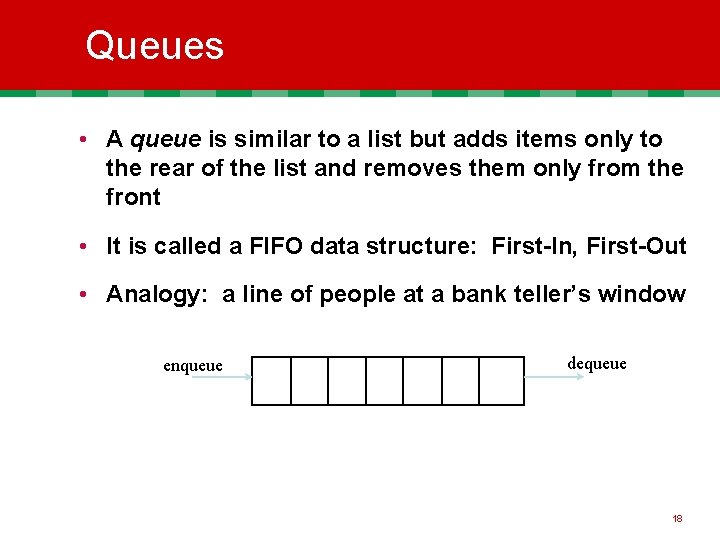
Queues • A queue is similar to a list but adds items only to the rear of the list and removes them only from the front • It is called a FIFO data structure: First-In, First-Out • Analogy: a line of people at a bank teller’s window enqueue dequeue 18
Queues • We can define the operations for a queue § enqueue - add an item to the rear of the queue § dequeue (or serve) - remove an item from the front of the queue § empty - returns true if the queue is empty • As with our linked list example, by storing generic Object references, any object can be stored in the queue • Queues often are helpful in simulations or any situation in which items get “backed up” while awaiting processing 19
Queues • A queue can be represented by a singly-linked list; it is most efficient if the references point from the front toward the rear of the queue • A queue can be represented by an array, using the remainder operator (%) to “wrap around” when the end of the array is reached and space is available at the front of the array © 2007 Pearson Addison-Wesley. All rights reserved 20
Stacks • A stack ADT is also linear, like a list or a queue • Items are added and removed from only one end of a stack • It is therefore LIFO: Last-In, First-Out • Analogies: a stack of plates in a cupboard, a stack of bills to be paid, or a stack of hay bales in a barn 21
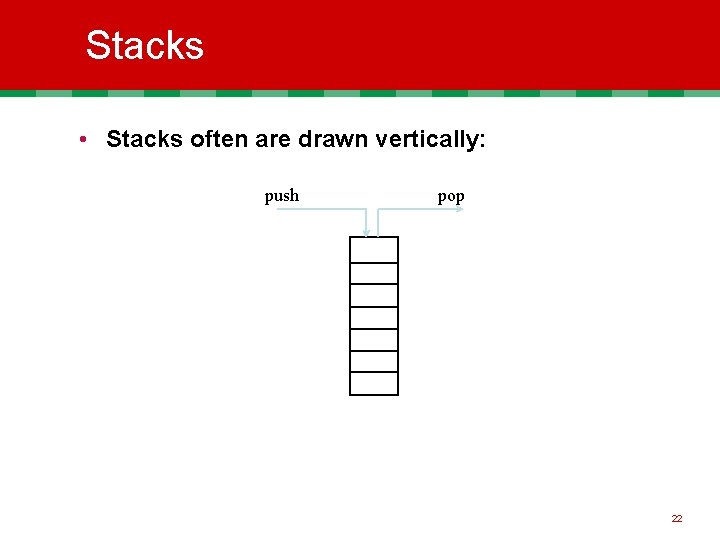
Stacks • Stacks often are drawn vertically: push pop 22
Stacks • Some stack operations: § § push - add an item to the top of the stack pop - remove an item from the top of the stack peek (or top) - retrieves the top item without removing it empty - returns true if the stack is empty • A stack can be represented by a singly-linked list; it doesn’t matter whether the references point from the top toward the bottom or vice versa • A stack can be represented by an array, but the new item should be placed in the next available place in the array rather than at the end 23
Stacks • The java. util package contains a Stack class • Like Array. List operations, the Stack operations operate on Object references • See Decode. java (page 627) © 2007 Pearson Addison-Wesley. All rights reserved 24
Outline Collections and Data Structures Dynamic Representations Queues and Stacks Trees and Graphs The Java Collections API © 2007 Pearson Addison-Wesley. All rights reserved 25
Trees • A tree is a non-linear data structure that consists of a root node and potentially many levels of additional nodes that form a hierarchy • Nodes that have no children are called leaf nodes • Nodes except for the root and leaf nodes are called internal nodes • In a general tree, each node can have many child nodes © 2007 Pearson Addison-Wesley. All rights reserved 26
Binary Trees • In a binary tree, each node can have no more than two child nodes • A binary tree can be defined recursively. Either it is empty (the base case) or it consists of a root and two subtrees, each of which is a binary tree • Trees are typically are represented using references as dynamic links, though it is possible to use fixed representations like arrays • For binary trees, this requires storing only two links per node to the left and right child © 2007 Pearson Addison-Wesley. All rights reserved 27
Graphs • A graph is a non-linear structure • Unlike a tree or binary tree, a graph does not have a root • Any node in a graph can be connected to any other node by an edge • Analogy: the highway system connecting cities on a map © 2007 Pearson Addison-Wesley. All rights reserved 28
Digraphs • In a directed graph or digraph, each edge has a specific direction. • Edges with direction sometimes are called arcs • Analogy: airline flights between airports © 2007 Pearson Addison-Wesley. All rights reserved 29
Representing Graphs • Both graphs and digraphs can be represented using dynamic links or using arrays. • As always, the representation should facilitate the intended operations and make them convenient to implement © 2007 Pearson Addison-Wesley. All rights reserved 30
Outline Collections and Data Structures Dynamic Representations Queues and Stacks Trees and Graphs The Java Collections API © 2007 Pearson Addison-Wesley. All rights reserved 31
Collection Classes • The Java standard library contains several classes that represent collections, often referred to as the Java Collections API • Their underlying implementation is implied in the class names such as Array. List and Linked. List • Several interfaces are used to define operations on the collections, such as List, Set, Sorted. Set, Map, and Sorted. Map © 2007 Pearson Addison-Wesley. All rights reserved 32
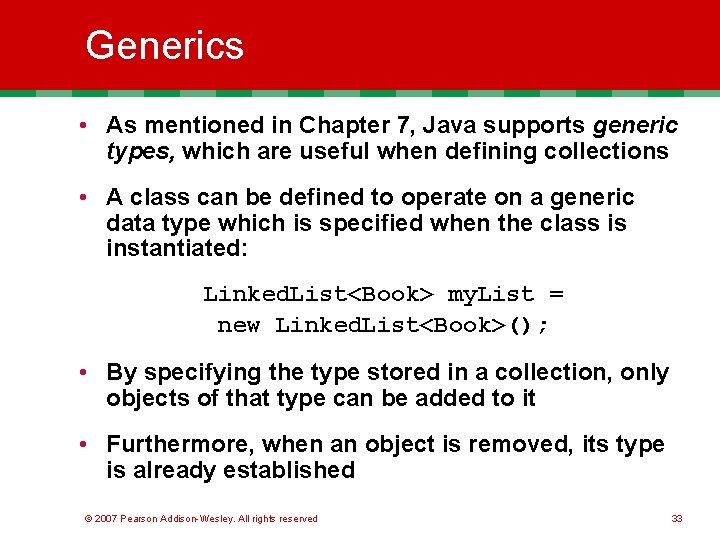
Generics • As mentioned in Chapter 7, Java supports generic types, which are useful when defining collections • A class can be defined to operate on a generic data type which is specified when the class is instantiated: Linked. List<Book> my. List = new Linked. List<Book>(); • By specifying the type stored in a collection, only objects of that type can be added to it • Furthermore, when an object is removed, its type is already established © 2007 Pearson Addison-Wesley. All rights reserved 33
Summary • Chapter 12 has focused on: § § § § the concept of a collection separating the interface from the implementation dynamic data structures linked lists queues and stacks trees and graphs generics © 2007 Pearson Addison-Wesley. All rights reserved 34