
Collection of Water and Wastewater Samples Learning objectives
Collection of Water and Wastewater Samples • Learning objectives: At the end this of chapter students will be able to: Learn the reasons for sampling Develop an understanding about different sampling methods Discuss the relative advantages & disadvantages of each sampling methods
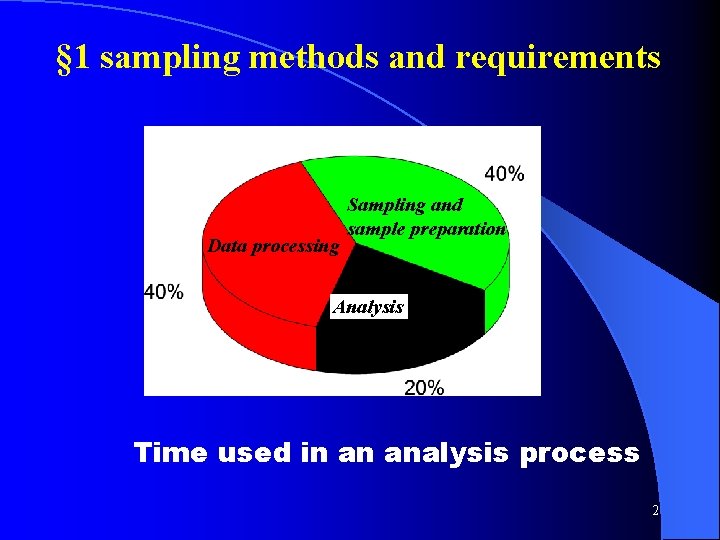
§ 1 sampling methods and requirements Data processing Sampling and sample preparation Analysis Time used in an analysis process 2
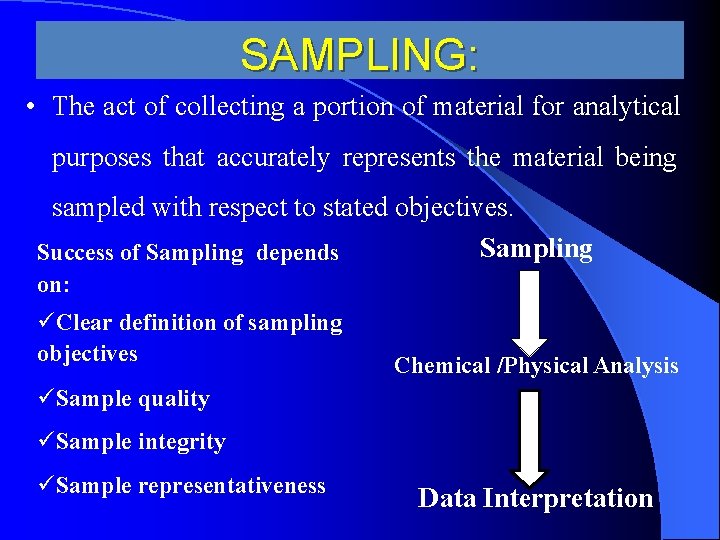
SAMPLING: • The act of collecting a portion of material for analytical purposes that accurately represents the material being sampled with respect to stated objectives. Sampling Success of Sampling depends on: Clear definition of sampling objectives Chemical /Physical Analysis Sample quality Sample integrity Sample representativeness Data Interpretation
Importance of sampling and sample preparation 1. It spends analysts almost 40% time in a whole analysis; 2. It has an important effect on the analytical results, even vital to results 3. It converts the sample to proper status (physcial state, specification, isomer) for analysis 4
Planning of Sampling • Ask yourself the purpose of study (? ) • What data are needed (? ) and then select most suitable location that can provide the required information.
Sampling requirements: @Representative @Homogeneous @Enough amount @Removal of obvious interferences 6
Water Sampling • The objective of sampling is: to collect a portion of water which is small enough in volume to be transported conveniently handled in the laboratory representative of the characteristics of the water available in that water body • Why sample? – Resources (time, money) and workload – Gives results with known accuracy that can be calculated mathematically.

Site location for river • Upstream (u/s) of the industrial and domestic discharge points • Immediately downstream (dis) of industrial and domestic discharge points. • At a place of abstraction for industrial use and public water supply. • Baseline stations where water is available in natural state.
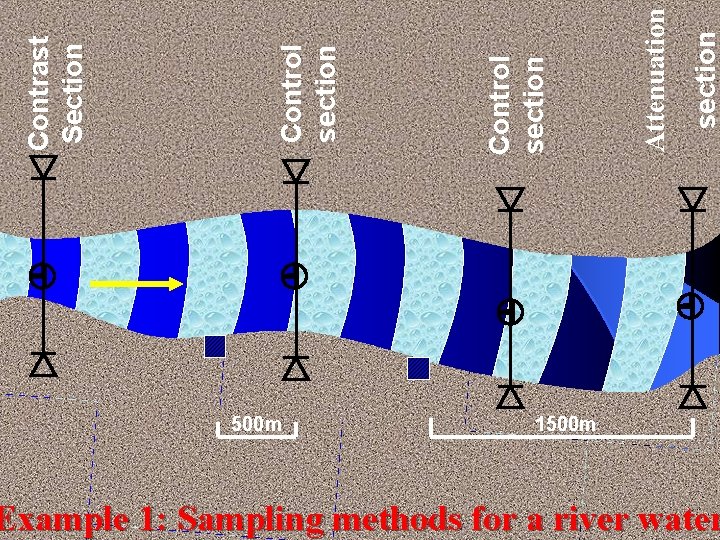
500 m 1500 m Example 1: Sampling methods for a river water section Attenuation Control section Contrast Section
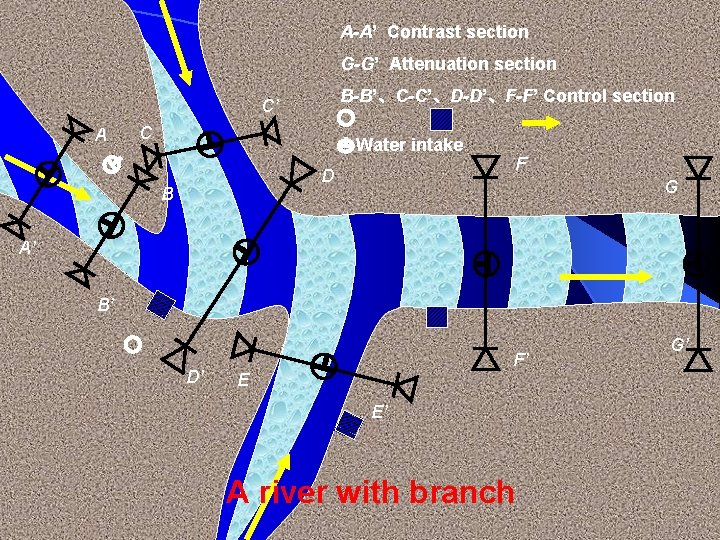
A-A’ Contrast section G-G’ Attenuation section B-B’、C-C’、D-D’、F-F’ Control section C’ A C Water intake D B F G A’ B’ D’ F’ E E’ A river with branch G’
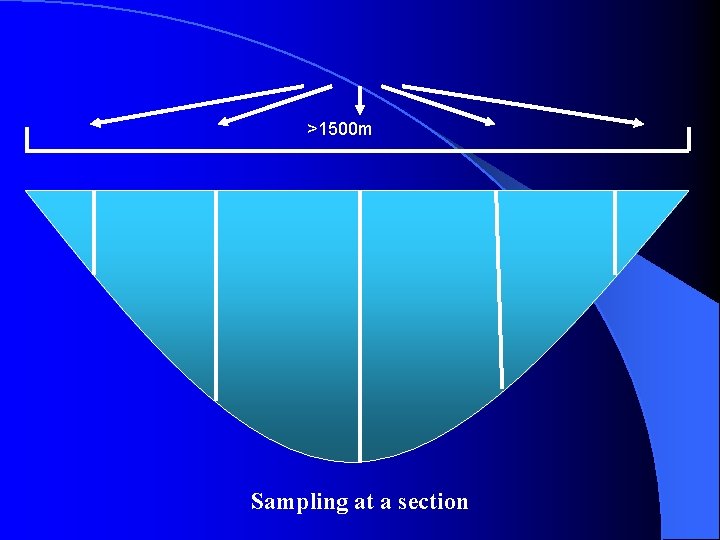
>1500 m Sampling at a section
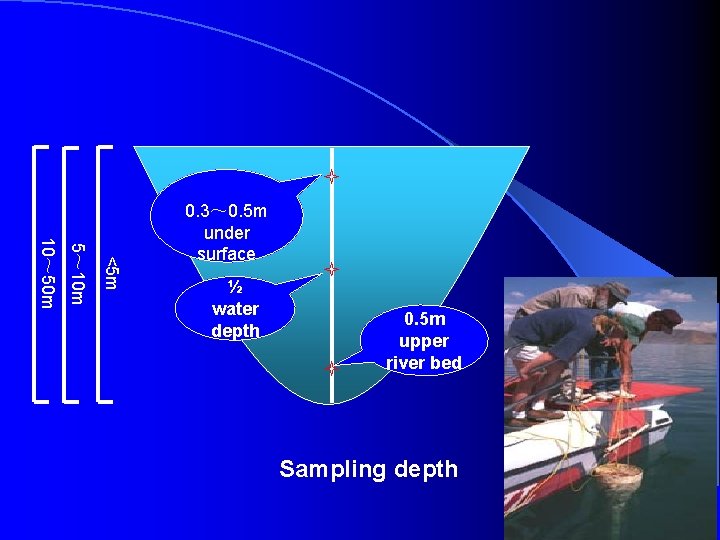
<5 m 5~ 10 m 10~ 50 m 0. 3~ 0. 5 m under surface ½ water depth 0. 5 m upper river bed Sampling depth
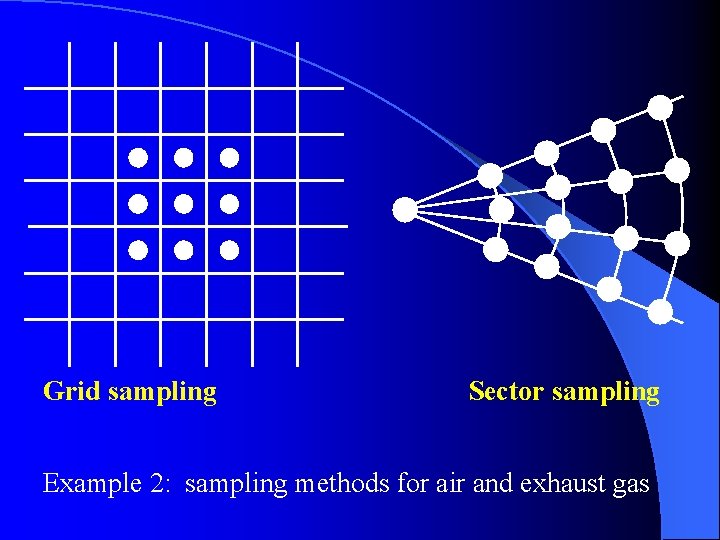
Grid sampling Sector sampling Example 2: sampling methods for air and exhaust gas
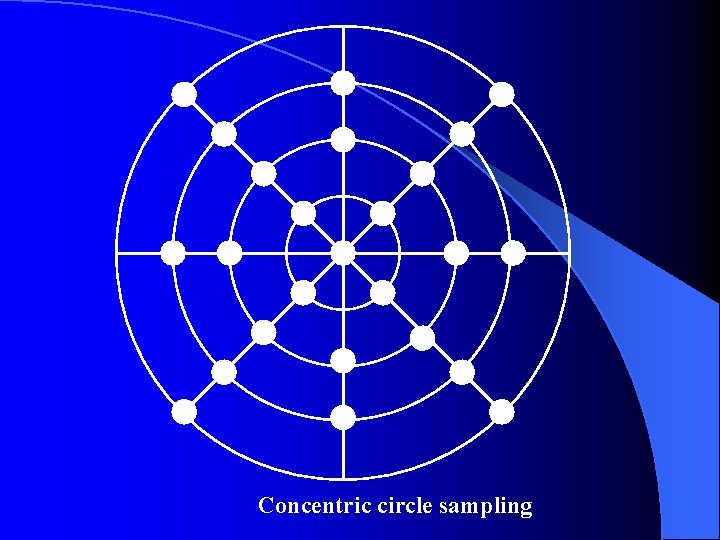
Concentric circle sampling
General requirements 1. Meet the requirements of the sampling program 2. Handle sample so that it does not deteriorate or become contaminated or compromised before analyzed. 3. Ensure sampling equipments are clean and quality assured before use. 4. Use sample containers that are clean and free of contaminants. 5. Fill sample containers with/or without pre-rinsing with sample. 6. Make a record of every sample collected and identify every bottle.
§ 2. Sample preparation General principles: 1. Should not lose any analytes 2. Converting the analytes into the best chemical form for the assay 3. Removal interferences in matrix as much as possible 4. Without adding any new interference 5. Concentrating the analytes 16
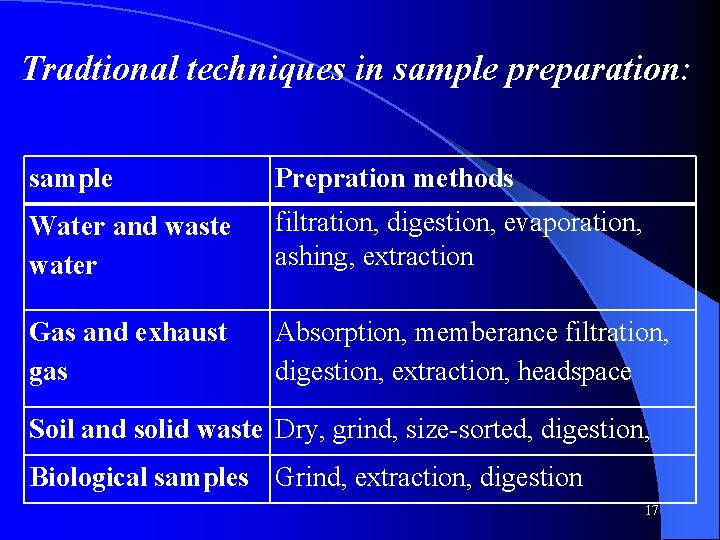
Tradtional techniques in sample preparation: sample Prepration methods Water and waste water filtration, digestion, evaporation, ashing, extraction Gas and exhaust gas Absorption, memberance filtration, digestion, extraction, headspace Soil and solid waste Dry, grind, size-sorted, digestion, Biological samples Grind, extraction, digestion 17
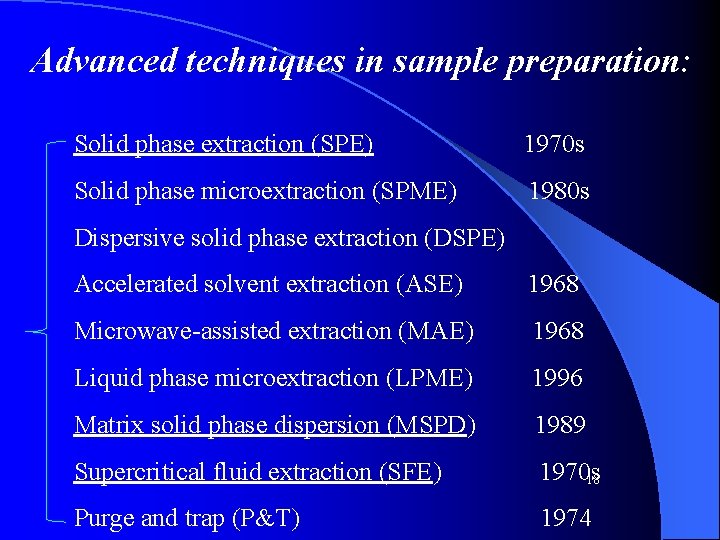
Advanced techniques in sample preparation: Solid phase extraction (SPE) 1970 s Solid phase microextraction (SPME) 1980 s Dispersive solid phase extraction (DSPE) Accelerated solvent extraction (ASE) 1968 Microwave-assisted extraction (MAE) 1968 Liquid phase microextraction (LPME) 1996 Matrix solid phase dispersion (MSPD) 1989 Supercritical fluid extraction (SFE) 1970 s 18 Purge and trap (P&T) 1974
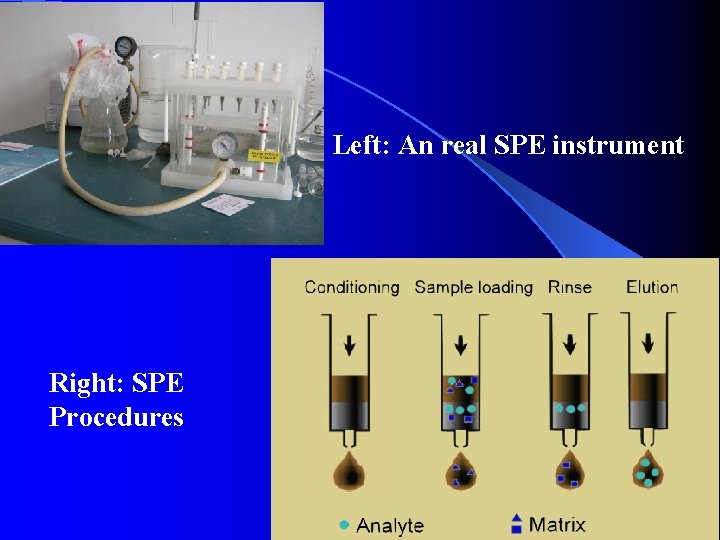
Left: An real SPE instrument Right: SPE Procedures 19
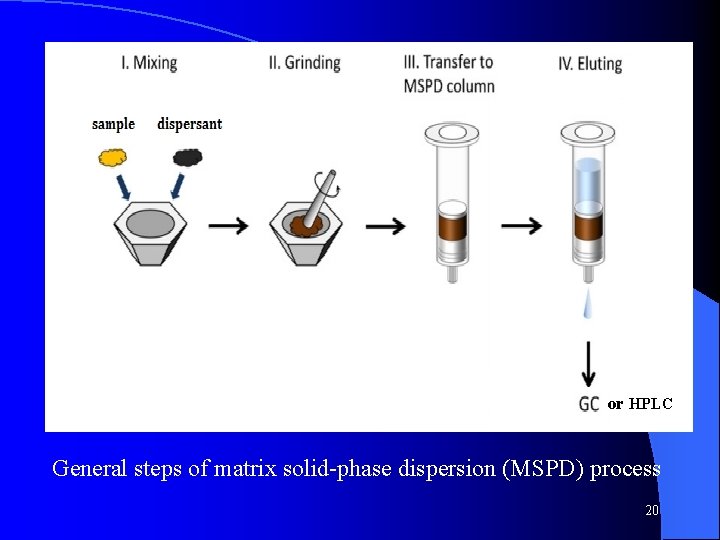
or HPLC General steps of matrix solid-phase dispersion (MSPD) process 20
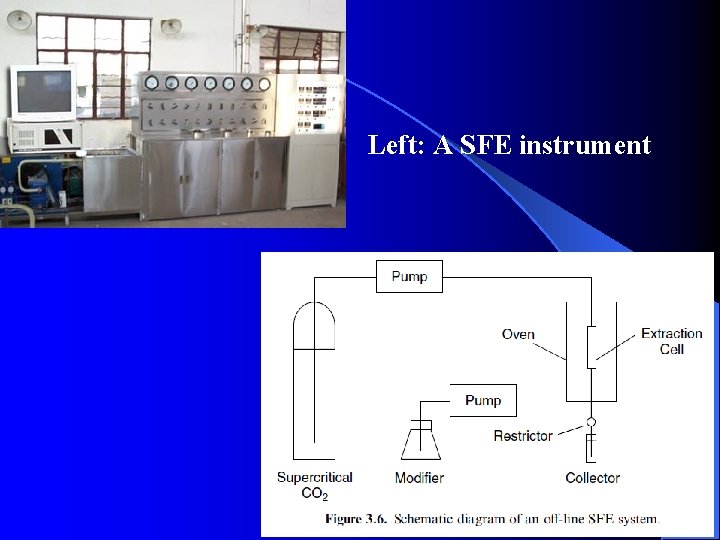
Left: A SFE instrument 21

- Slides: 22