
Collection of Empirical Materials Session 6 23 E

![Example • Interviewer: Can you tell me how you feel about this [advertisement]? •](https://slidetodoc.com/presentation_image/7e5d330b654667fe45a6b309032877d0/image-62.jpg "Example • Interviewer: Can you tell me how you feel about this [advertisement]? •")
- Slides: 83
Collection of Empirical Materials Session 6 23 E 88001 Qualitative Research Methods in Marketing - 1
Today’s agenda • Overview of methods and empirical materials • Ethnography as a qualitative research method − What is ethnography? − Different levels of engagement − Thick description • Interviewing − Types of interview and interview data − Interview process and guidelines − Use of elicitation materials − Transcription • Assignment 4 (choice between ethnography and interviewing) 2 -
METHODS AND EMPIRICAL MATERIALS -
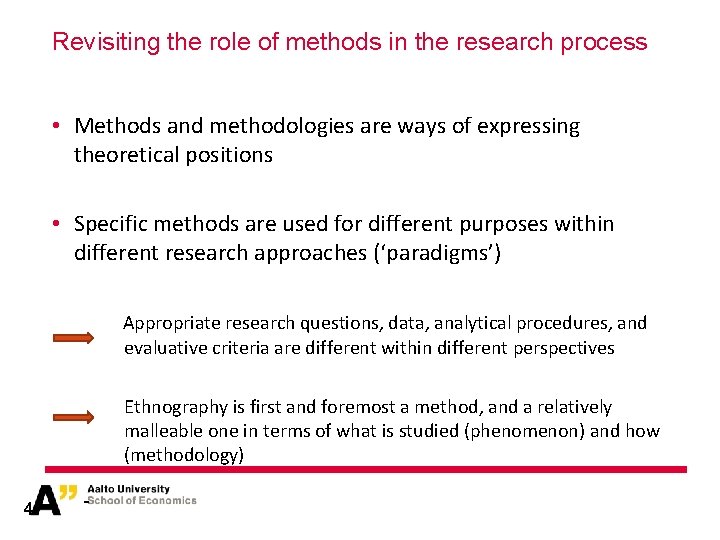
Revisiting the role of methods in the research process • Methods and methodologies are ways of expressing theoretical positions • Specific methods are used for different purposes within different research approaches (‘paradigms’) Appropriate research questions, data, analytical procedures, and evaluative criteria are different within different perspectives Ethnography is first and foremost a method, and a relatively malleable one in terms of what is studied (phenomenon) and how (methodology) 4 -
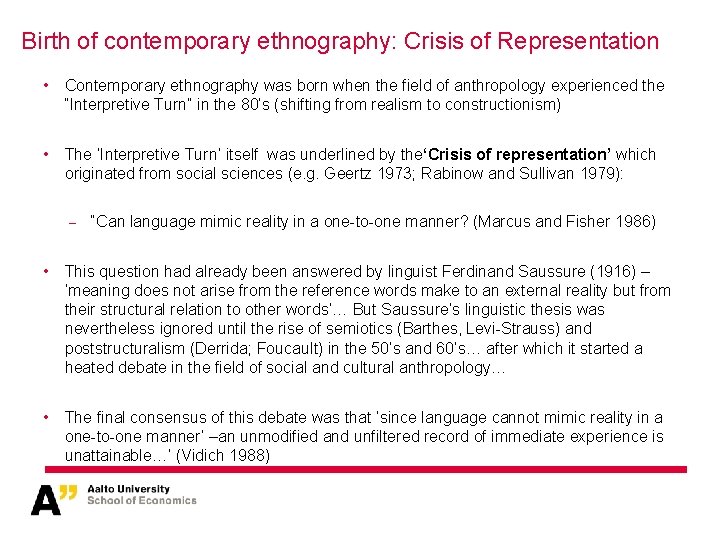
Birth of contemporary ethnography: Crisis of Representation • Contemporary ethnography was born when the field of anthropology experienced the “Interpretive Turn” in the 80’s (shifting from realism to constructionism) • The ‘Interpretive Turn’ itself was underlined by the‘Crisis of representation’ which originated from social sciences (e. g. Geertz 1973; Rabinow and Sullivan 1979): − “Can language mimic reality in a one-to-one manner? (Marcus and Fisher 1986) • This question had already been answered by linguist Ferdinand Saussure (1916) – ’meaning does not arise from the reference words make to an external reality but from their structural relation to other words’… But Saussure’s linguistic thesis was nevertheless ignored until the rise of semiotics (Barthes, Levi-Strauss) and poststructuralism (Derrida; Foucault) in the 50’s and 60’s… after which it started a heated debate in the field of social and cultural anthropology… • The final consensus of this debate was that ‘since language cannot mimic reality in a one-to-one manner’ –an unmodified and unfiltered record of immediate experience is unattainable…’ (Vidich 1988)
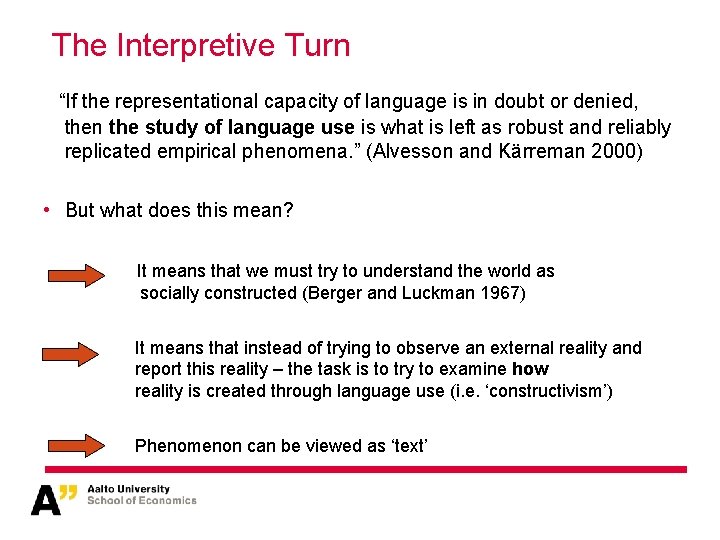
The Interpretive Turn “If the representational capacity of language is in doubt or denied, then the study of language use is what is left as robust and reliably replicated empirical phenomena. ” (Alvesson and Kärreman 2000) • But what does this mean? It means that we must try to understand the world as socially constructed (Berger and Luckman 1967) It means that instead of trying to observe an external reality and report this reality – the task is to try to examine how reality is created through language use (i. e. ‘constructivism’) Phenomenon can be viewed as ‘text’
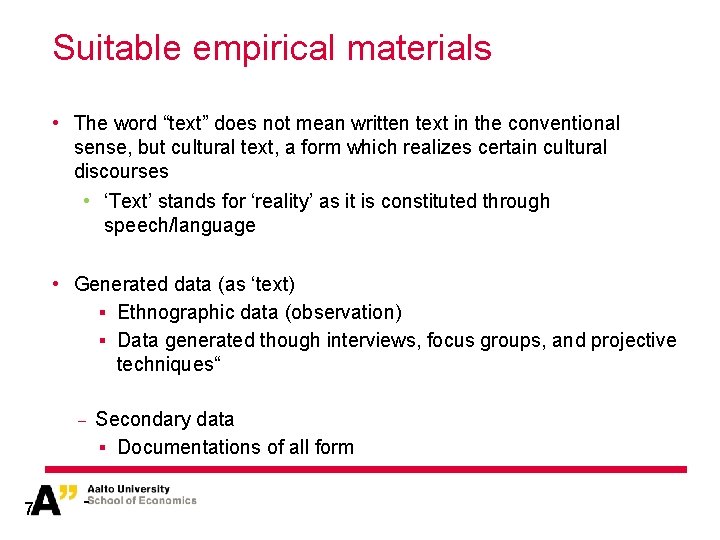
Suitable empirical materials • The word “text” does not mean written text in the conventional sense, but cultural text, a form which realizes certain cultural discourses • ‘Text’ stands for ‘reality’ as it is constituted through speech/language • Generated data (as ‘text) § Ethnographic data (observation) § Data generated though interviews, focus groups, and projective techniques“ − 7 - Secondary data § Documentations of all form
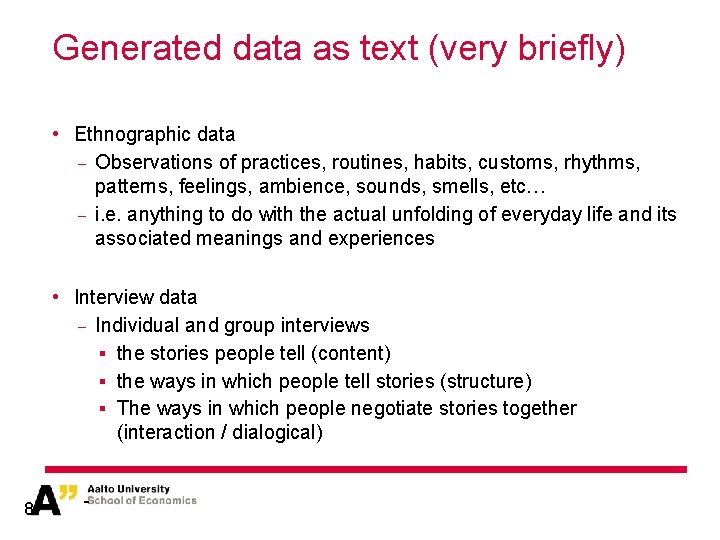
Generated data as text (very briefly) • Ethnographic data − Observations of practices, routines, habits, customs, rhythms, patterns, feelings, ambience, sounds, smells, etc… − i. e. anything to do with the actual unfolding of everyday life and its associated meanings and experiences • Interview data − Individual and group interviews § the stories people tell (content) § the ways in which people tell stories (structure) § The ways in which people negotiate stories together (interaction / dialogical) 8 -
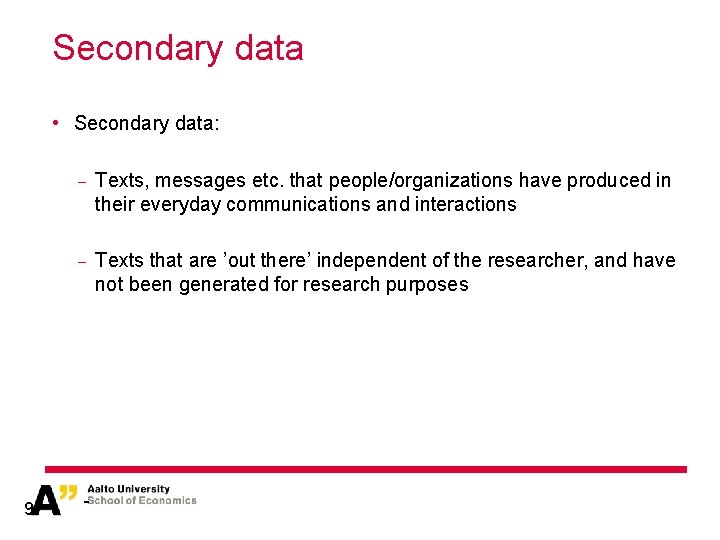
Secondary data • Secondary data: 9 − Texts, messages etc. that people/organizations have produced in their everyday communications and interactions − Texts that are ’out there’ independent of the researcher, and have not been generated for research purposes -
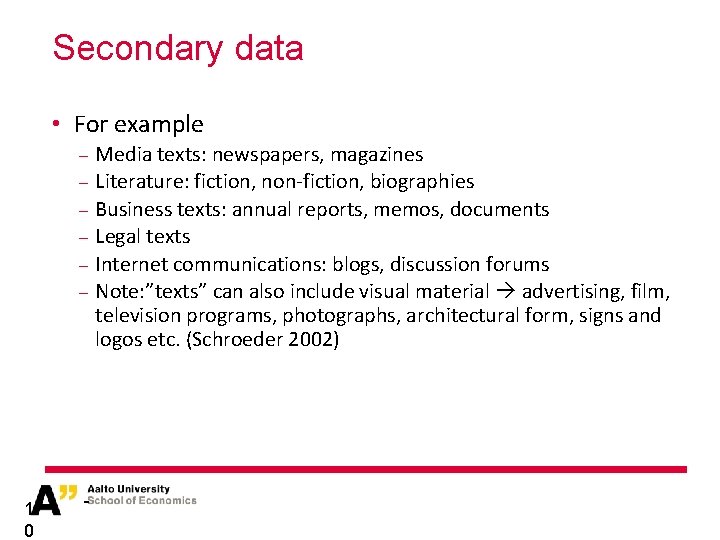
Secondary data • For example Media texts: newspapers, magazines − Literature: fiction, non-fiction, biographies − Business texts: annual reports, memos, documents − Legal texts − Internet communications: blogs, discussion forums − Note: ”texts” can also include visual material advertising, film, television programs, photographs, architectural form, signs and logos etc. (Schroeder 2002) − 1 0 -
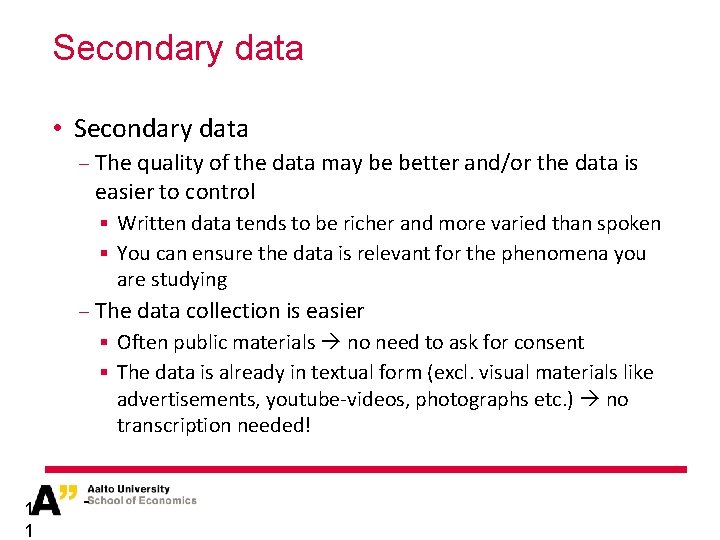
Secondary data • Secondary data − The quality of the data may be better and/or the data is easier to control § Written data tends to be richer and more varied than spoken § You can ensure the data is relevant for the phenomena you are studying − The data collection is easier § Often public materials no need to ask for consent § The data is already in textual form (excl. visual materials like advertisements, youtube-videos, photographs etc. ) no transcription needed! 1 1 -
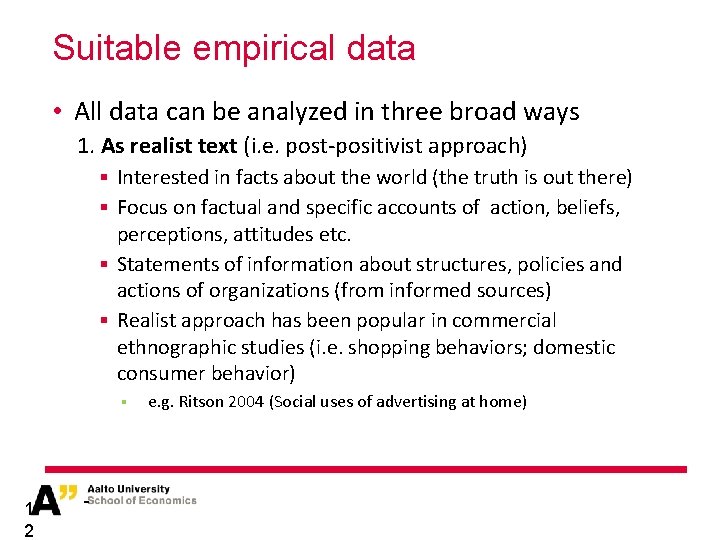
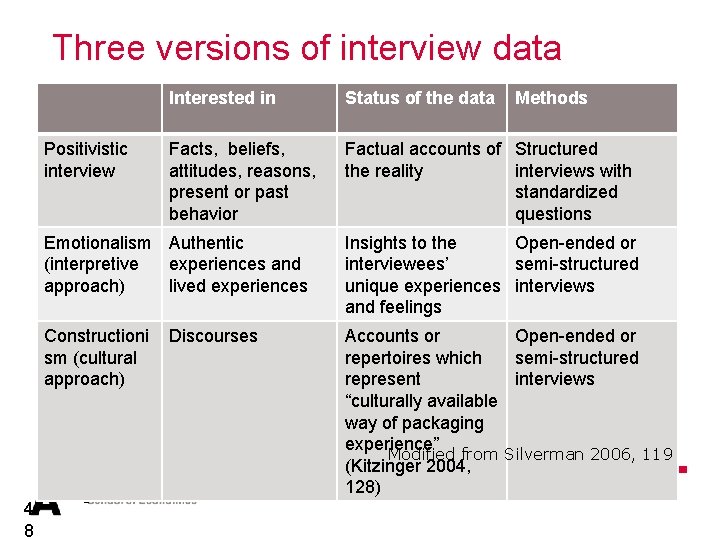
Suitable empirical data • All data can be analyzed in three broad ways 1. As realist text (i. e. post-positivist approach) § Interested in facts about the world (the truth is out there) § Focus on factual and specific accounts of action, beliefs, perceptions, attitudes etc. § Statements of information about structures, policies and actions of organizations (from informed sources) § Realist approach has been popular in commercial ethnographic studies (i. e. shopping behaviors; domestic consumer behavior) § 1 2 - e. g. Ritson 2004 (Social uses of advertising at home)
Suitable empirical data (‘texts’) 2. As self-referential text (interpretivist approach): § Interested in eliciting authentic accounts of subjective experience (‘lived experience’) § The text representing personal or group identity and/or biographical make-up § e. g. Extended self at workplace (Tian and Belk 2005) or White-water river rafting (Arnould and Price 1993) 1 3 -
Suitable empirical data (‘texts’) 3. As cultural text(cultural approach, critical approach): § Interested in the cultural forms data realize and make available (the world is constructed) § Focus on the discourses and systems of representations they make use of, they reproduce, or they contest through narration and bodily expression of subjectivity) § E. g. Biker brand community (Schouten and Mc. Alexander 1995) or Ludic Agency (Kozinets et al 1998) 1 4 -
Ethnographic methods - 15
What is ethnography? • The word ethnography comes from Greek words − ἔθνος (ethnos) = folk/people and − γράφω (grapho) = to write § Freely translated: writing(s) about people • The favored method of anthropology (“study of humanity”), especially of cultural anthroplogy 1 6 -
What is ethnography? • Ethnography is a methodology based on direct observation. Of course, when doing ethnography, it is also essential to listen to the conversations of the actors ‘on stage’, read the documents produced by the organization(s) under study, and ask people questions. Yet, what most distinguishes ethnography from other methodologies is a more active role assigned to the modes of observing, watching, seeing, looking at, gazing at and scrutinising (Gobo 2011) 1 7 -
What is ethnography? “…a research process in which the ethnographer closely observes, records, and engages in the daily life of another culture – an experience labeled as the field work method – and then writes accounts of this culture, emphasizing descriptive detail. ” § (Marcus and Fisher, 1999: 18) Remember that observation becomes concrete only when it is put into words (commonly in written form)! 1 8 -
What is ethnography The process of research– doing field work, “hanging out” Research strategy • • Studies people in their natural environments − And to reemphasize - the product of ethnographic research is the field work report • § § 1 9 - In other words, a central part of ‘doing’ ethnography is the writing process We cannot capture reality as ‘unfiltered phenomenon’: reality is always reconstructed through research writing
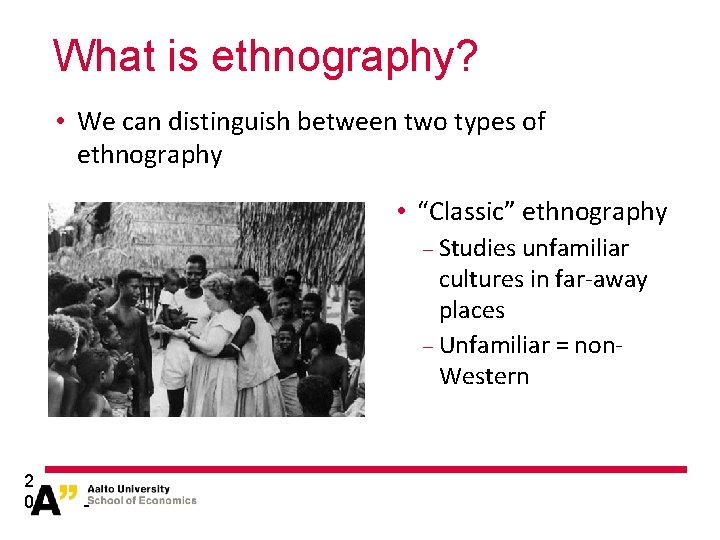
What is ethnography? • We can distinguish between two types of ethnography • “Classic” ethnography − Studies unfamiliar cultures in far-away places − Unfamiliar = non. Western 2 0 -
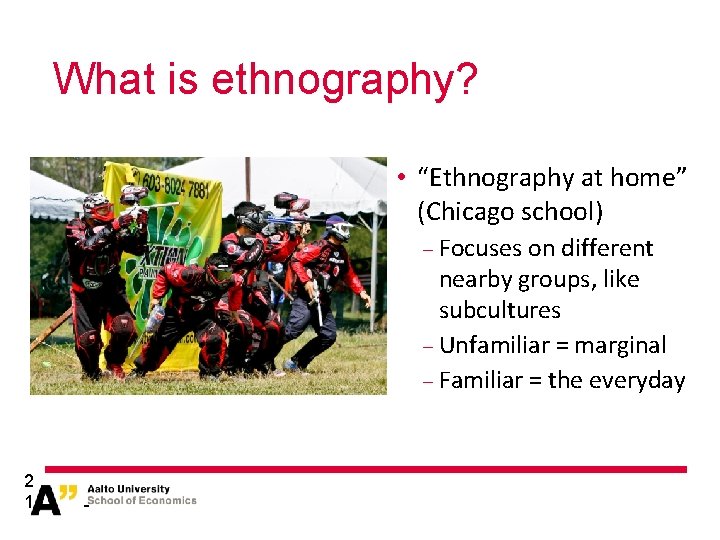
What is ethnography? • “Ethnography at home” (Chicago school) − Focuses on different nearby groups, like subcultures − Unfamiliar = marginal − Familiar = the everyday 2 1 -
What is ethnography? • Contemporary ethnographic research Mini ethnography − ”Go-along” ethnography (a hybrid between observing and interviewing) ‘Helsinki Prison’ − Ethnographic organization research (observations in organizations) ‘Paperless Office’ − Virtual ethnography (netnography) ‘ 5 Street’ − Auto-ethnography (the researcher becomes the primary subject of the research) ‘’Warwick Library’ − Visual ethnography and video ethnography ‘Brothers in Paint’ − (observing through taking photos and making videos) − § For example http: //vimeo. com/20486489 (Hietanen, Rokka & Roman) 2 2 -
Principles of ethnography (Nardi 2000) • Holism focus on relations among activities and not on single tasks or single isolated individuals − everything connected to everything else − • Natives’ point(s) of view how people see their own worlds − opportunity to engage with customers − • Study people in their “native habitats” − e. g. , home, office, school, library, hospital, community. . . • Making the ‘taken-for-granted’ explicit and ‘strange’ − 2 3 - Deconstructing tacit assumptions about everyday phenomenon
Ethnography – focus of analysis • Research focuses on culture (however it is defined), people as members of culture, and people’s practices in culture − how the members of some particular group organize their lives to manage everyday routines, communicate what they know and what they expect of others, and cope with forces within and beyond their control − We are not interested in recording and recounting events as such but “to render a theory of cultural behavior” (Wolcott 1995) 2 4 -
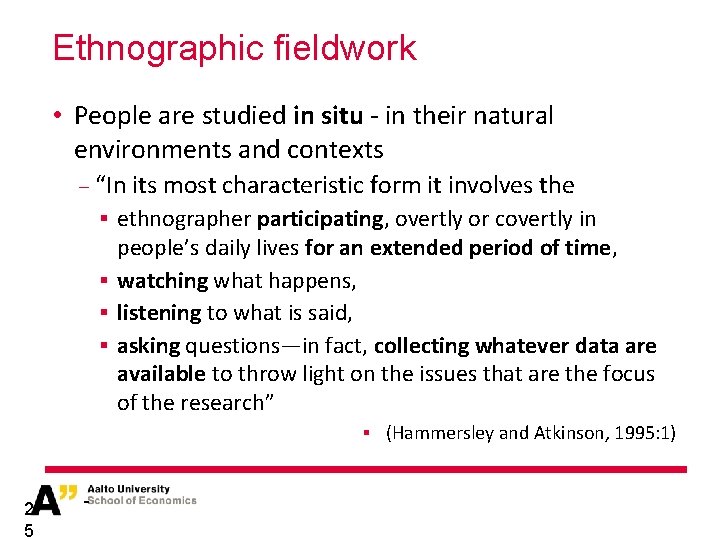
Ethnographic fieldwork • People are studied in situ - in their natural environments and contexts − “In its most characteristic form it involves the § ethnographer participating, overtly or covertly in people’s daily lives for an extended period of time, § watching what happens, § listening to what is said, § asking questions—in fact, collecting whatever data are available to throw light on the issues that are the focus of the research” § (Hammersley and Atkinson, 1995: 1) 2 5 -
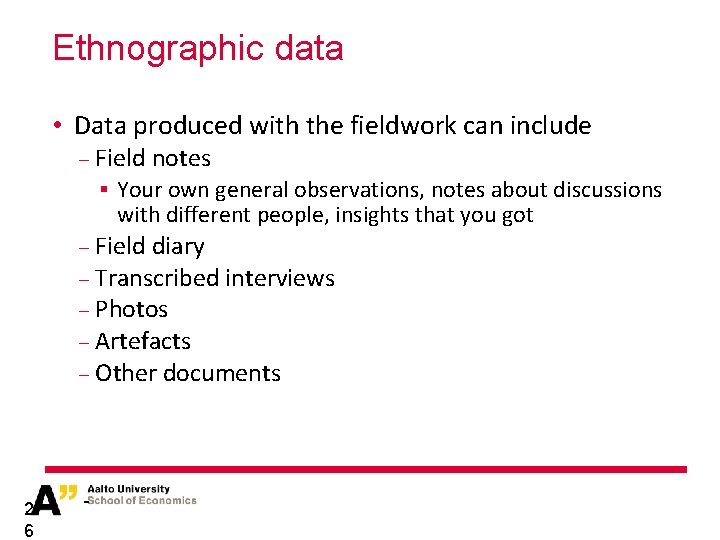
Ethnographic data • Data produced with the fieldwork can include − Field notes § Your own general observations, notes about discussions with different people, insights that you got − Field diary − Transcribed interviews − Photos − Artefacts − Other documents 2 6 -
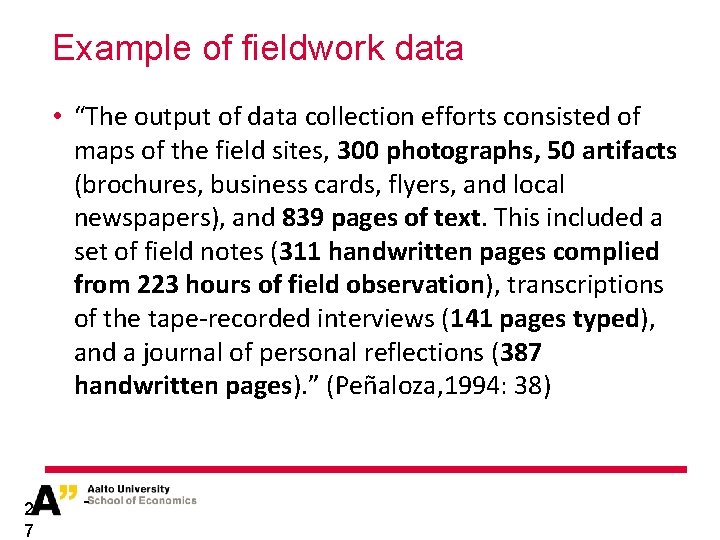
Example of fieldwork data • “The output of data collection efforts consisted of maps of the field sites, 300 photographs, 50 artifacts (brochures, business cards, flyers, and local newspapers), and 839 pages of text. This included a set of field notes (311 handwritten pages complied from 223 hours of field observation), transcriptions of the tape-recorded interviews (141 pages typed), and a journal of personal reflections (387 handwritten pages). ” (Peñaloza, 1994: 38) 2 7 -
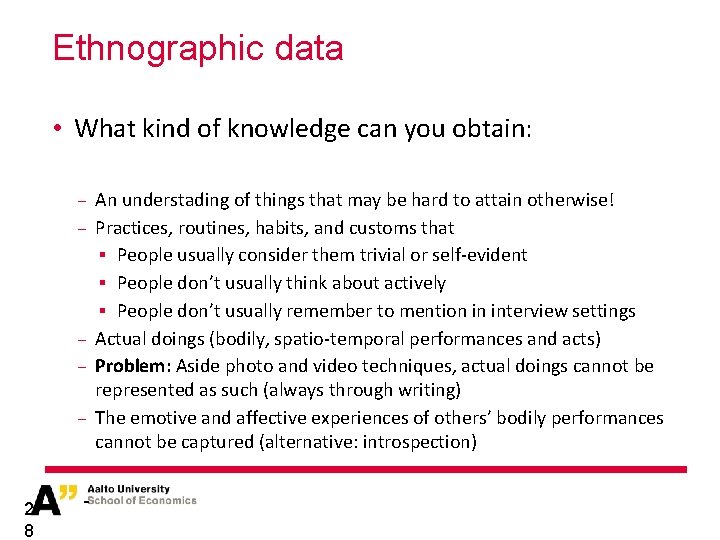
Ethnographic data • What kind of knowledge can you obtain: − − − 2 8 - An understading of things that may be hard to attain otherwise! Practices, routines, habits, and customs that § People usually consider them trivial or self-evident § People don’t usually think about actively § People don’t usually remember to mention in interview settings Actual doings (bodily, spatio-temporal performances and acts) Problem: Aside photo and video techniques, actual doings cannot be represented as such (always through writing) The emotive and affective experiences of others’ bodily performances cannot be captured (alternative: introspection)
Observation as an ethnographic method • You can choose to engage in “pure” observation, or be a participant observer In ‘pure observation’ you will literally look from the outside in and record not only what is said but also non-verbal communications, habitual or routine practices, physical and spatial arrangements, atmospheres and decorations − As a ‘participating observer’ you will join the activities yourself, trying to form an insider's perspective − § See Kozinets, Robert V. (2002), “Can Consumers Escape the Market? Emancipatory Illuminations from Burning Man, ” Journal of Consumer Research, 29 (June), 20 -38. 2 9 -
Thick description 3 0 -
Thick description • Thick description is a term introduced by anthropologist Clifford Geertz − Thin description is superficial information that contains no explanations and little or no context − Thick description is in-depth information that tells not only what is present, but how and why it is there, what accompanies it, and what emotions and meanings are attached to it -
Thin description - example “A single golfer, with six golf balls in front of him [sic], hitting each of them, one after another, towards one and the same green. He [sic] then goes and collects the balls, comes back to where he [sic] was before, and does it again. What is he doing? ” (Ryle 1971, 474) − Thin description tells us exactly what is happening physically: a person is repeatedly hitting a little round white object with a club like device 3 2 -
Thick description - example − Thick description interprets the behavior within the context of the golf course and the game of golf, and ascribes thinking and intentionality to the observed behavior § the golfer is practicing approach shots on the green in anticipation of a future real golf match - - with the hope that the practicing of approach shots at the present time will improve his approach shot skill in a real match at some time in the future. (Ponteretto 2006, 539) 3 3 -
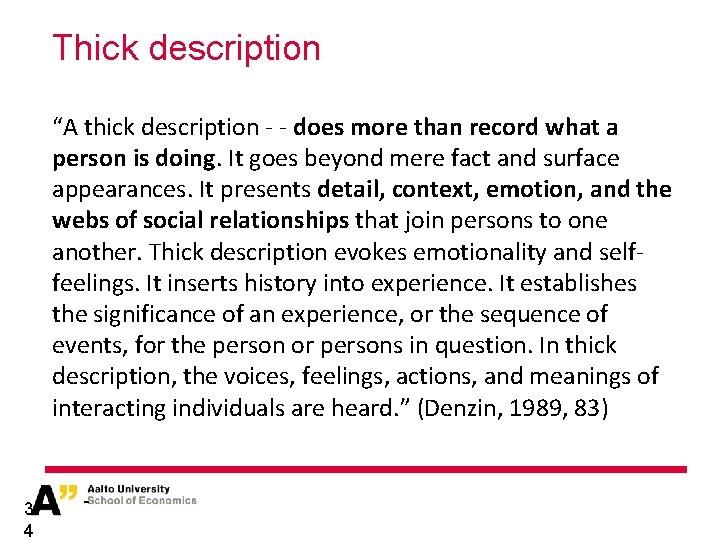
Thick description “A thick description - - does more than record what a person is doing. It goes beyond mere fact and surface appearances. It presents detail, context, emotion, and the webs of social relationships that join persons to one another. Thick description evokes emotionality and selffeelings. It inserts history into experience. It establishes the significance of an experience, or the sequence of events, for the person or persons in question. In thick description, the voices, feelings, actions, and meanings of interacting individuals are heard. ” (Denzin, 1989, 83) 3 4 -
Some examples to check out • Kozinets (2002) Can Consumers Escape the Market? Emancipatory Illuminations from Burning Man. Journal of Consumer Research, 29(1), 20 -38. • Mc. Grath et al (1993) An Ethnographic Study of an Urban Periodic Marketplace: Lessons from the Midville Farmers’ Market. Journal of Retailing, 69(3). • Sherry (1990) A Sociocultural Analysis of a Midwestern American Flea Market. Journal of Consumer Research, 17 (June). 3 5 -
Types of interviews and interview data - 36
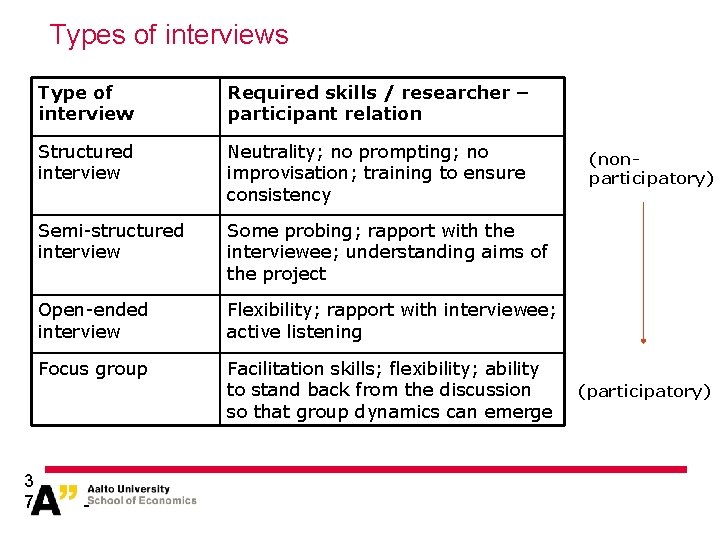
Types of interviews 3 7 Type of interview Required skills / researcher – participant relation Structured interview Neutrality; no prompting; no improvisation; training to ensure consistency Semi-structured interview Some probing; rapport with the interviewee; understanding aims of the project Open-ended interview Flexibility; rapport with interviewee; active listening Focus group Facilitation skills; flexibility; ability to stand back from the discussion so that group dynamics can emerge - (nonparticipatory) (participatory)
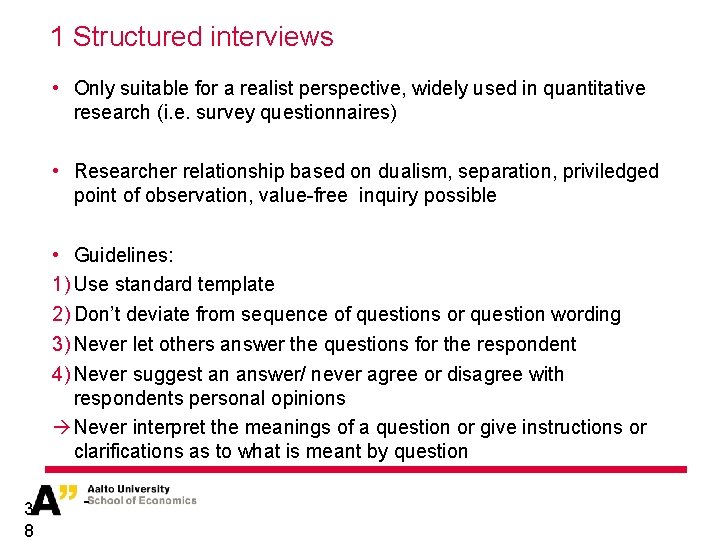
1 Structured interviews • Only suitable for a realist perspective, widely used in quantitative research (i. e. survey questionnaires) • Researcher relationship based on dualism, separation, priviledged point of observation, value-free inquiry possible • Guidelines: 1) Use standard template 2) Don’t deviate from sequence of questions or question wording 3) Never let others answer the questions for the respondent 4) Never suggest an answer/ never agree or disagree with respondents personal opinions Never interpret the meanings of a question or give instructions or clarifications as to what is meant by question 3 8 -
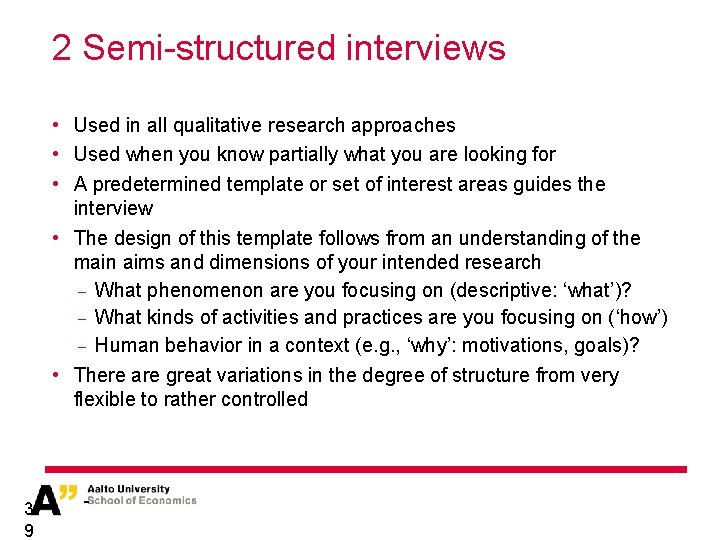
2 Semi-structured interviews • Used in all qualitative research approaches • Used when you know partially what you are looking for • A predetermined template or set of interest areas guides the interview • The design of this template follows from an understanding of the main aims and dimensions of your intended research − What phenomenon are you focusing on (descriptive: ‘what’)? − What kinds of activities and practices are you focusing on (‘how’) − Human behavior in a context (e. g. , ‘why’: motivations, goals)? • There are great variations in the degree of structure from very flexible to rather controlled 3 9 -
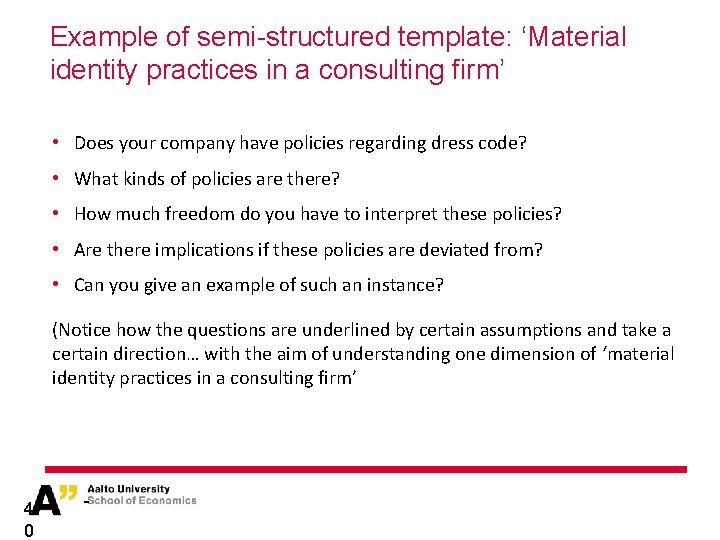
Example of semi-structured template: ‘Material identity practices in a consulting firm’ • Does your company have policies regarding dress code? • What kinds of policies are there? • How much freedom do you have to interpret these policies? • Are there implications if these policies are deviated from? • Can you give an example of such an instance? (Notice how the questions are underlined by certain assumptions and take a certain direction… with the aim of understanding one dimension of ‘material identity practices in a consulting firm’ 4 0 -
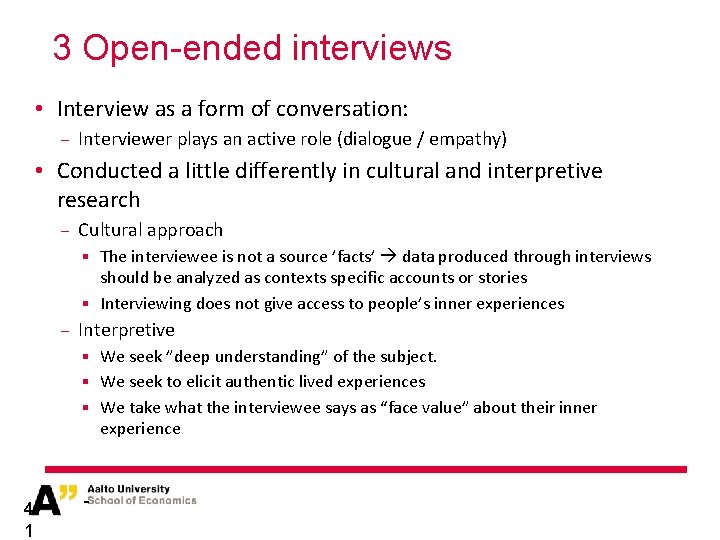
3 Open-ended interviews • Interview as a form of conversation: − Interviewer plays an active role (dialogue / empathy) • Conducted a little differently in cultural and interpretive research − Cultural approach § The interviewee is not a source ’facts’ data produced through interviews should be analyzed as contexts specific accounts or stories § Interviewing does not give access to people’s inner experiences − Interpretive § We seek ”deep understanding” of the subject. § We seek to elicit authentic lived experiences § We take what the interviewee says as “face value” about their inner experience 4 1 -
Cultural approach to interviewing: Underlined by assumptions of ‘Hermeneutics of Suspicion’ • In this approach, language and consciousness are seen largely distorted (e. g. , Freud, Marx, Nietzsche) • Human experience is not assumed to be transparent. Thus, what may be ‘taken-forgranted’ is problematized (e. g. , discourse analysis, psychoanalysis, gender studies) • Experience and behavior is ‘over-determined’ – all aspects of the (interview) text have some meaning (hidden or otherwise) – nothing is ‘accidental’ • If major events or actions described by the interviewee contradict or conflict with the broader story given (‘does not feel right’), or otherwise arouses ‘suspicion’ insofar as it reflects some form of ‘hidden’ message, then these discrepancies serve as ‘themes’ for interpretation and reconfiguration of the interview data.
Interpretive approach to interviewing: Underlined by assumptions of ‘Hermeneutics of Faith’ • The objective of a hermeneutics of faith is to “build” theory that is faithful to the participants point-of-view (thus it aligns with ‘analysis of narrative’) • Practically - the idea is to inquire about major themes and/or structures that might constitute a person’s storied life-world • Thus - the purpose is to highlight tacit and taken-for-granted knowledge by bringing it to the foreground (focus is on underlying cultural assumptions) • Common interview data type are ‘personal narratives’ and ‘life-stories’
Open-ended interviewing • The key to successful open-ended interviewing is active listening − Give the interviewee the freedom to talk and ascribe meanings while bearing in mind the broader aims of the project • There is a need to understand the language and culture of the respondents How to see the world from the viewpoint of respondents (without having to ‘go native’)? Example: − Interviewing prisoners − Learn their lingo (be empathetic) − Balance between being respectful while not overtly patronizing − 4 4 -
Prison interview excerpt • See handouts: − Timo’s interview − Timo’s re-configured life-story 4 5 -
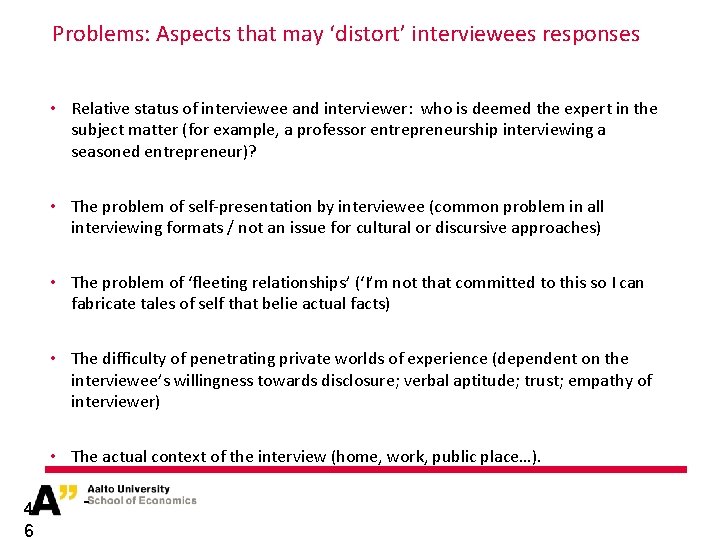
Problems: Aspects that may ‘distort’ interviewees responses • Relative status of interviewee and interviewer: who is deemed the expert in the subject matter (for example, a professor entrepreneurship interviewing a seasoned entrepreneur)? • The problem of self-presentation by interviewee (common problem in all interviewing formats / not an issue for cultural or discursive approaches) • The problem of ‘fleeting relationships’ (‘I’m not that committed to this so I can fabricate tales of self that belie actual facts) • The difficulty of penetrating private worlds of experience (dependent on the interviewee’s willingness towards disclosure; verbal aptitude; trust; empathy of interviewer) • The actual context of the interview (home, work, public place…). 4 6 -
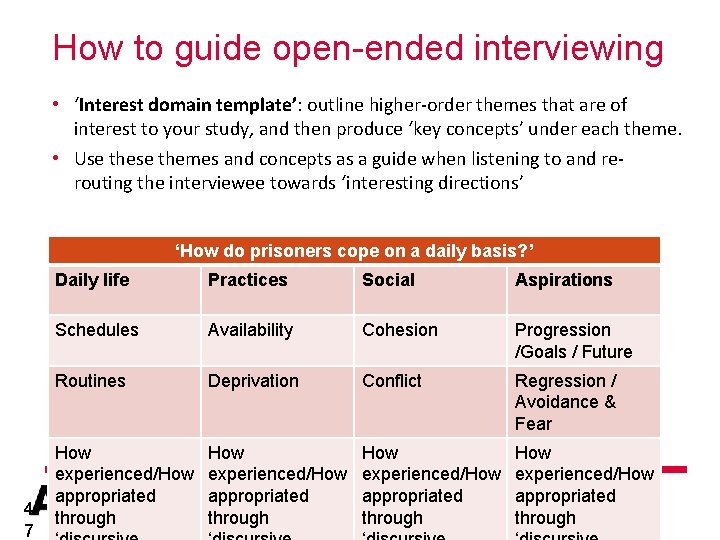
How to guide open-ended interviewing • ‘Interest domain template’: outline higher-order themes that are of interest to your study, and then produce ‘key concepts’ under each theme. • Use themes and concepts as a guide when listening to and rerouting the interviewee towards ‘interesting directions’ ‘How do prisoners cope on a daily basis? ’ 4 7 Daily life Practices Social Aspirations Schedules Availability Cohesion Progression /Goals / Future Routines Deprivation Conflict Regression / Avoidance & Fear How experienced/How appropriated through
Three versions of interview data Positivistic interview 4 8 Interested in Status of the data Methods Facts, beliefs, attitudes, reasons, present or past behavior Factual accounts of Structured the reality interviews with standardized questions Emotionalism Authentic (interpretive experiences and approach) lived experiences Insights to the Open-ended or interviewees’ semi-structured unique experiences interviews and feelings Constructioni sm (cultural approach) Accounts or repertoires which represent “culturally available way of packaging experience” Modified from (Kitzinger 2004, 128) - Discourses Open-ended or semi-structured interviews Silverman 2006, 119
Interview process and guidelines 4 9 -
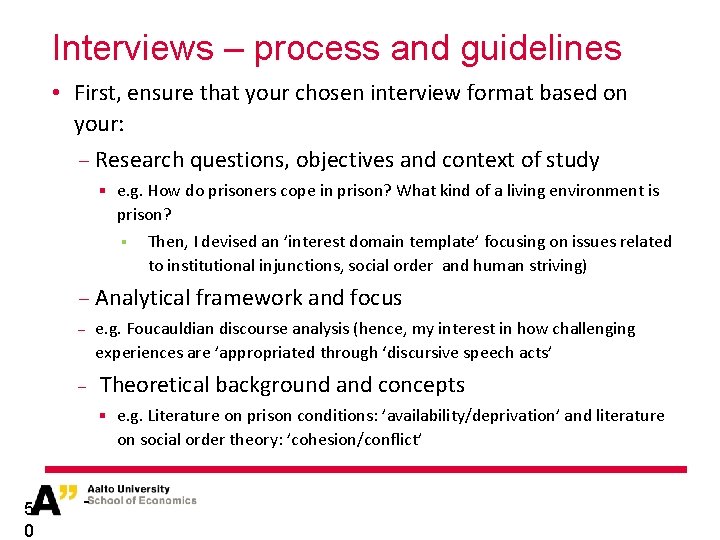
Interviews – process and guidelines • First, ensure that your chosen interview format based on your: − Research questions, objectives and context of study § e. g. How do prisoners cope in prison? What kind of a living environment is prison? § − − − Then, I devised an ’interest domain template’ focusing on issues related to institutional injunctions, social order and human striving) Analytical framework and focus e. g. Foucauldian discourse analysis (hence, my interest in how challenging experiences are ’appropriated through ‘discursive speech acts’ Theoretical background and concepts § e. g. Literature on prison conditions: ’availability/deprivation’ and literature on social order theory: ’cohesion/conflict’ 5 0 -
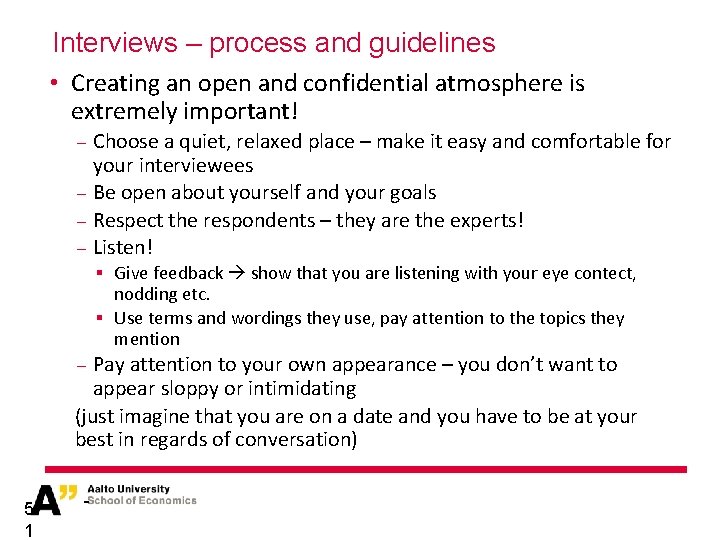
Interviews – process and guidelines • Creating an open and confidential atmosphere is extremely important! Choose a quiet, relaxed place – make it easy and comfortable for your interviewees − Be open about yourself and your goals − Respect the respondents – they are the experts! − Listen! − § Give feedback show that you are listening with your eye contect, nodding etc. § Use terms and wordings they use, pay attention to the topics they mention Pay attention to your own appearance – you don’t want to appear sloppy or intimidating (just imagine that you are on a date and you have to be at your best in regards of conversation) − 5 1 -
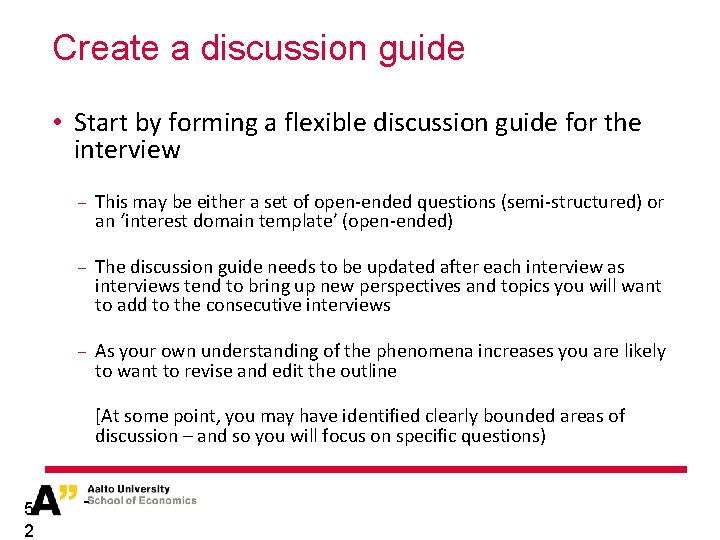
Create a discussion guide • Start by forming a flexible discussion guide for the interview − This may be either a set of open-ended questions (semi-structured) or an ‘interest domain template’ (open-ended) − The discussion guide needs to be updated after each interview as interviews tend to bring up new perspectives and topics you will want to add to the consecutive interviews − As your own understanding of the phenomena increases you are likely to want to revise and edit the outline [At some point, you may have identified clearly bounded areas of discussion – and so you will focus on specific questions) 5 2 -
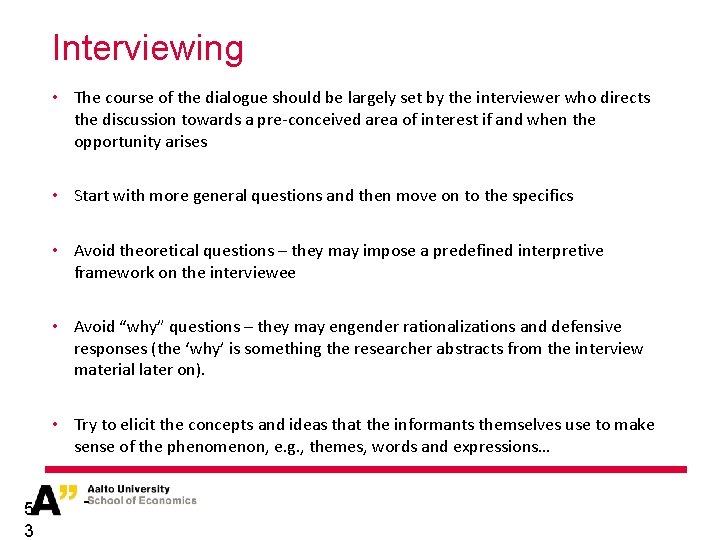
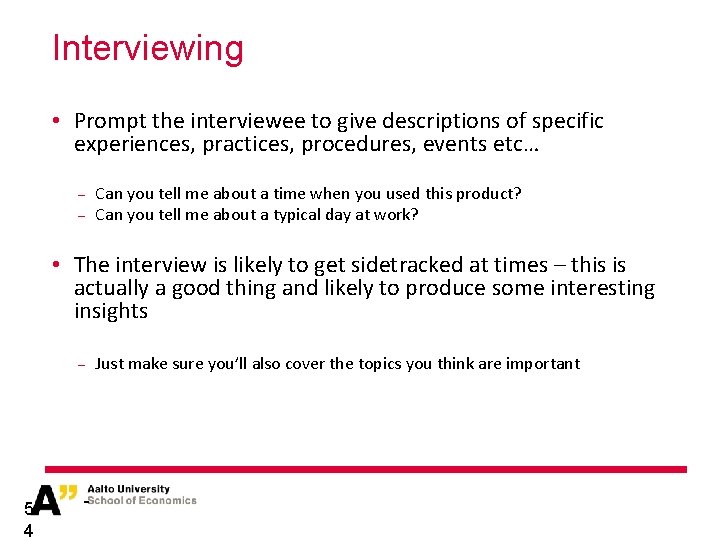
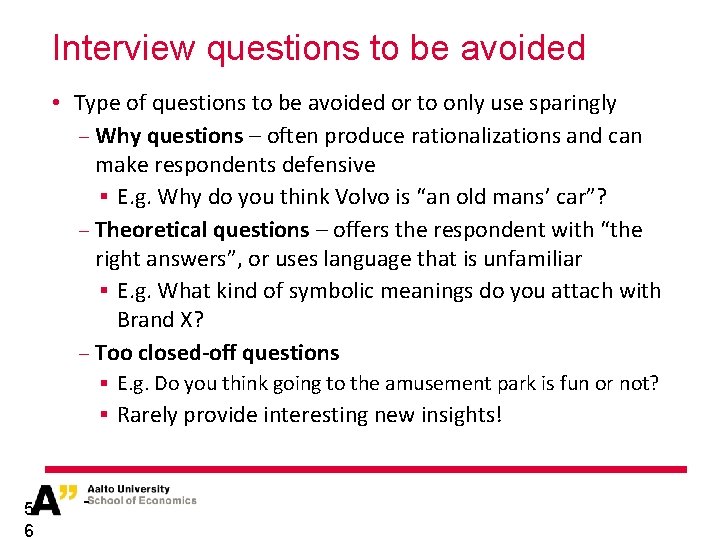
Interviewing • The course of the dialogue should be largely set by the interviewer who directs the discussion towards a pre-conceived area of interest if and when the opportunity arises • Start with more general questions and then move on to the specifics • Avoid theoretical questions – they may impose a predefined interpretive framework on the interviewee • Avoid “why” questions – they may engender rationalizations and defensive responses (the ‘why’ is something the researcher abstracts from the interview material later on). • Try to elicit the concepts and ideas that the informants themselves use to make sense of the phenomenon, e. g. , themes, words and expressions… 5 3 -
Interviewing • Prompt the interviewee to give descriptions of specific experiences, practices, procedures, events etc… − − Can you tell me about a time when you used this product? Can you tell me about a typical day at work? • The interview is likely to get sidetracked at times – this is actually a good thing and likely to produce some interesting insights − 5 4 - Just make sure you’ll also cover the topics you think are important
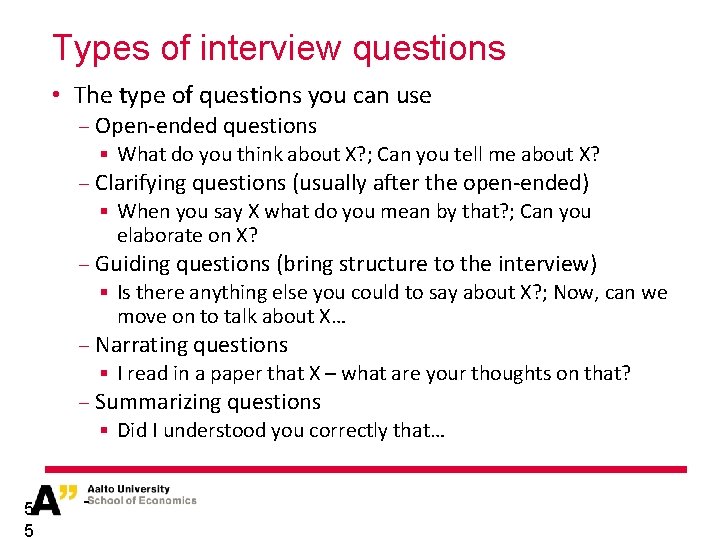
Types of interview questions • The type of questions you can use − Open-ended questions § What do you think about X? ; Can you tell me about X? − Clarifying questions (usually after the open-ended) § When you say X what do you mean by that? ; Can you elaborate on X? − Guiding questions (bring structure to the interview) § Is there anything else you could to say about X? ; Now, can we move on to talk about X… − Narrating questions § I read in a paper that X – what are your thoughts on that? − Summarizing questions § Did I understood you correctly that… 5 5 -
Interview questions to be avoided • Type of questions to be avoided or to only use sparingly − Why questions – often produce rationalizations and can make respondents defensive § E. g. Why do you think Volvo is “an old mans’ car”? − Theoretical questions – offers the respondent with “the right answers”, or uses language that is unfamiliar § E. g. What kind of symbolic meanings do you attach with Brand X? − Too closed-off questions § E. g. Do you think going to the amusement park is fun or not? § Rarely provide interesting new insights! 5 6 -
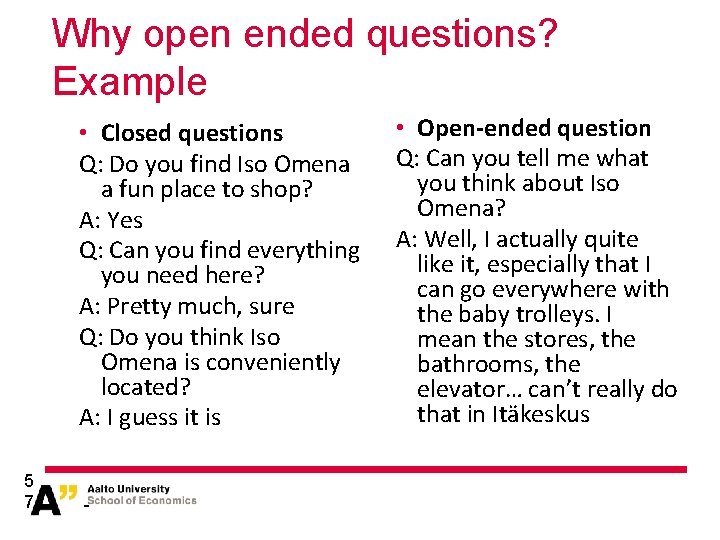
Why open ended questions? Example • Closed questions Q: Do you find Iso Omena a fun place to shop? A: Yes Q: Can you find everything you need here? A: Pretty much, sure Q: Do you think Iso Omena is conveniently located? A: I guess it is 5 7 - • Open-ended question Q: Can you tell me what you think about Iso Omena? A: Well, I actually quite like it, especially that I can go everywhere with the baby trolleys. I mean the stores, the bathrooms, the elevator… can’t really do that in Itäkeskus
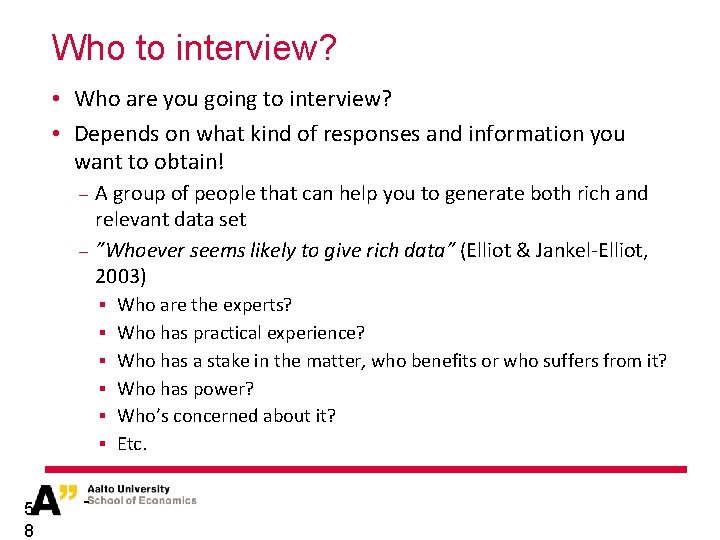
Who to interview? • Who are you going to interview? • Depends on what kind of responses and information you want to obtain! A group of people that can help you to generate both rich and relevant data set − ”Whoever seems likely to give rich data” (Elliot & Jankel-Elliot, 2003) − § Who are the experts? § Who has practical experience? § Who has a stake in the matter, who benefits or who suffers from it? § Who has power? § Who’s concerned about it? § Etc. 5 8 -
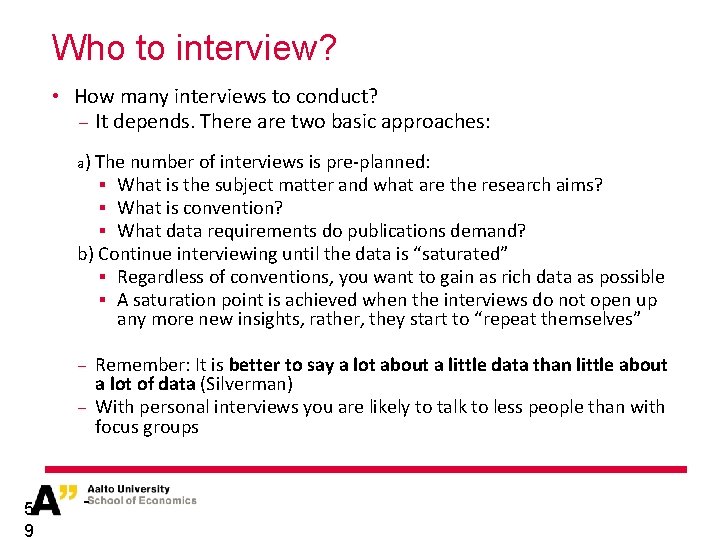
Who to interview? • How many interviews to conduct? − It depends. There are two basic approaches: a) The number of interviews is pre-planned: § What is the subject matter and what are the research aims? § What is convention? § What data requirements do publications demand? b) Continue interviewing until the data is “saturated” § Regardless of conventions, you want to gain as rich data as possible § A saturation point is achieved when the interviews do not open up any more new insights, rather, they start to “repeat themselves” − − 5 9 - Remember: It is better to say a lot about a little data than little about a lot of data (Silverman) With personal interviews you are likely to talk to less people than with focus groups
Transcription 6 0 -
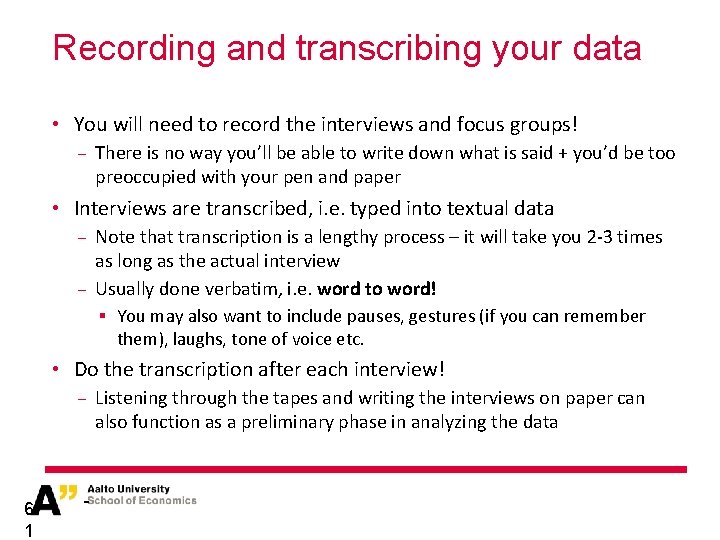
Recording and transcribing your data • You will need to record the interviews and focus groups! − There is no way you’ll be able to write down what is said + you’d be too preoccupied with your pen and paper • Interviews are transcribed, i. e. typed into textual data − − Note that transcription is a lengthy process – it will take you 2 -3 times as long as the actual interview Usually done verbatim, i. e. word to word! § You may also want to include pauses, gestures (if you can remember them), laughs, tone of voice etc. • Do the transcription after each interview! − 6 1 - Listening through the tapes and writing the interviews on paper can also function as a preliminary phase in analyzing the data
Example • Interviewer: Can you tell me how you feel about this [advertisement]? • P: Well I get some mixed feelings because she… I mean this is supposed to be like two women that prentend to be like all hot together but that one [a charachter in the ad]is anyway fake • S: I. . . I don’t like • I: So by fake you mean. . What do you mean [by that]? • S: That she’s not… ; P: she’s not really lesbian • I: I see, what makes you… • S: The lipstick • P: Yeah, she seems like that… like too much aimed for men • S: Yeah. . 6 2 -
Translation of transcription • Transcribe the interview into Finnish • Then, translate into English those parts that you deem relevant/useful for your study • Do not translate word-to-word if difficult (can result in incomprehensible language). Rather, consider what is said in the original language (taking into consideration cultural issues) and how best to express it in the secondary language) 6 3 -
Use of elicitation materials 6 4 -
Using elicitation materials • Elicitation = acquisition of information from a person or group in a manner that does not disclose the intent of the interview or conversation − “(Visual) elicitation stimuli are artifacts employed during interviews where the subject matter defies the use of a strictly verbal approach” (Crilly et al 2006) − For example advertisements, photographs, drawings, video-clips, physical specimen, graphs etc. 6 5 -
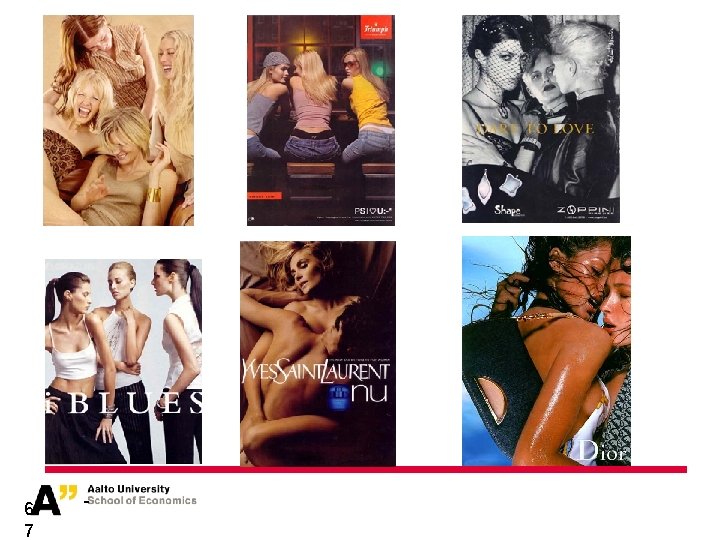
Example All of the interviews and discussions utilised elicitation material to facilitate the process and to help generate cultural talk (Moisander & Valtonen 2006). This elicitation material consisted of five full-page print advertisements depicting female characters in interactions with each other. The advertisements were collected from international women’s lifestyle and fashion magazines Cosmopolitan UK, New Woman, marie claire UK and In Style (Pictures 1– 5), all generally aimed at mainstream, straight audiences. In addition the material included one advertisement printed from the Commercial Closet archives (Picture 6). The advertisements represented three different product categories: cosmetics, fashion and apparel, and alcoholic beverages. Excluding brand names and slogans, the advertisements included no copy, and thus were determined to be appropriate to use when interviewing Finnish consumers. 6 6 -
6 7 -
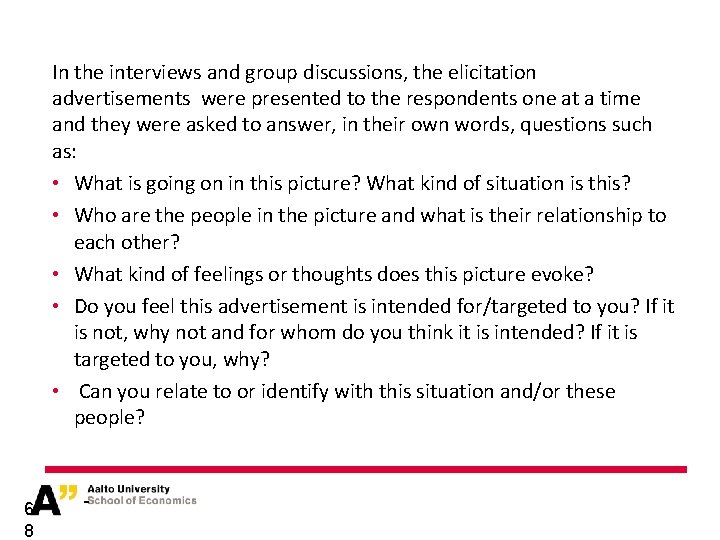
In the interviews and group discussions, the elicitation advertisements were presented to the respondents one at a time and they were asked to answer, in their own words, questions such as: • What is going on in this picture? What kind of situation is this? • Who are the people in the picture and what is their relationship to each other? • What kind of feelings or thoughts does this picture evoke? • Do you feel this advertisement is intended for/targeted to you? If it is not, why not and for whom do you think it is intended? If it is targeted to you, why? • Can you relate to or identify with this situation and/or these people? 6 8 -
Focus groups 6 9 -
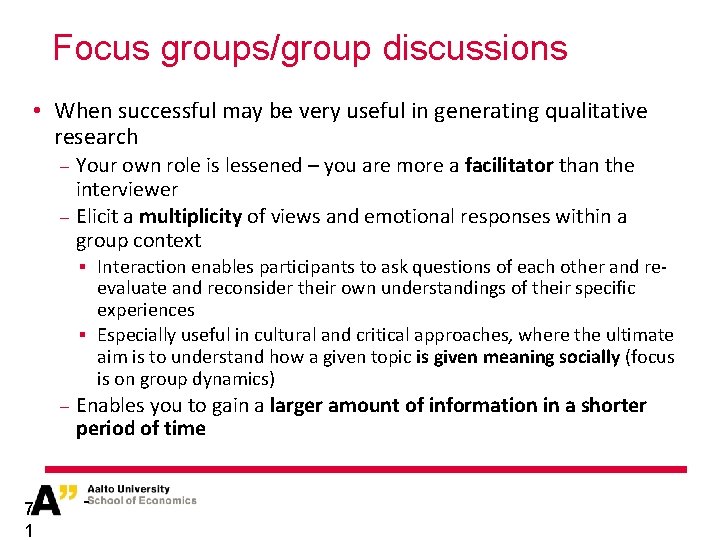
Focus groups/group discussions • Focus group = an event where you invite a group of people to discuss a topic Has been used in marketing research to generate ideas, test concepts, and map attitudes and opinions − Note that in social sciences there is a distinction between group interview and focus group/group discussion! − § Group interview: interviewing a number of people at the same time, the emphasis being on questions and responses between the researcher and participants (Gibbs 1997) § Focus groups: interaction within the group based on topics that are supplied by the researcher. (Morgan 1997: 12) 7 0 -
Focus groups/group discussions • When successful may be very useful in generating qualitative research Your own role is lessened – you are more a facilitator than the interviewer − Elicit a multiplicity of views and emotional responses within a group context − § Interaction enables participants to ask questions of each other and re- evaluate and reconsider their own understandings of their specific experiences § Especially useful in cultural and critical approaches, where the ultimate aim is to understand how a given topic is given meaning socially (focus is on group dynamics) − 7 1 Enables you to gain a larger amount of information in a shorter period of time -
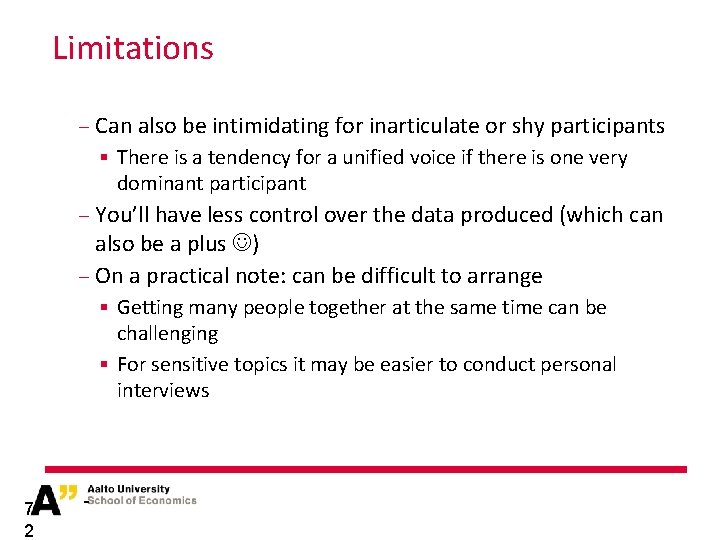
Limitations − Can also be intimidating for inarticulate or shy participants § There is a tendency for a unified voice if there is one very dominant participant You’ll have less control over the data produced (which can also be a plus ) − On a practical note: can be difficult to arrange − § Getting many people together at the same time can be challenging § For sensitive topics it may be easier to conduct personal interviews 7 2 -
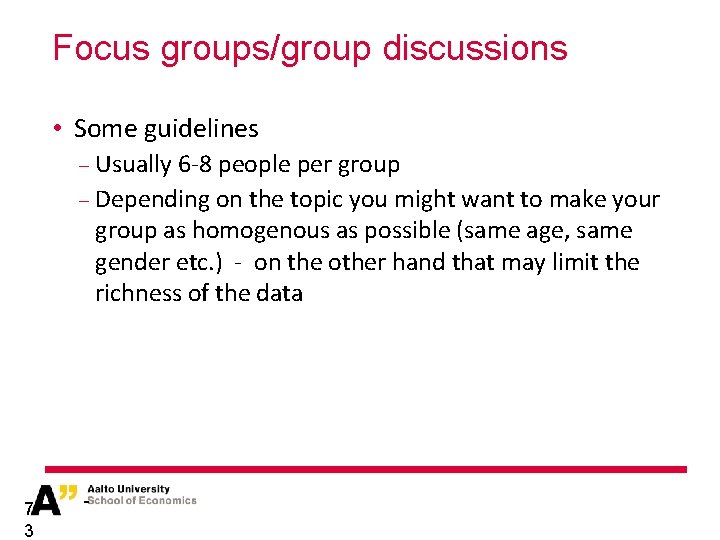
Focus groups/group discussions • Some guidelines − Usually 6 -8 people per group − Depending on the topic you might want to make your group as homogenous as possible (same age, same gender etc. ) - on the other hand that may limit the richness of the data 7 3 -
Assignment 4 (for next time) 7 4 -
For next Session Readings: • Eriksson, Päivi & Kovalainen, Anne (2008) Qualitative methods in business research. Chapter(s): 7, 10 • See also ‘course outline’ for optional readings Assignment (select one of the following): 1) Ethnography 2) Interviewing 7 5 -
Option One: Ethnographic fieldwork • Based on your identified research idea and positioning strategy, select an ethnographic site to study (e. g. making observations and field notes). If you do not have access to the particular site you have in mind for your identified study (i. e. for your future MSc thesis research), select some other site for this exercise. Any site will do, as long as there is plenty of activity to observe. What is most important at this stage is for you to practice how to do ethnographic observation. 7 6 -
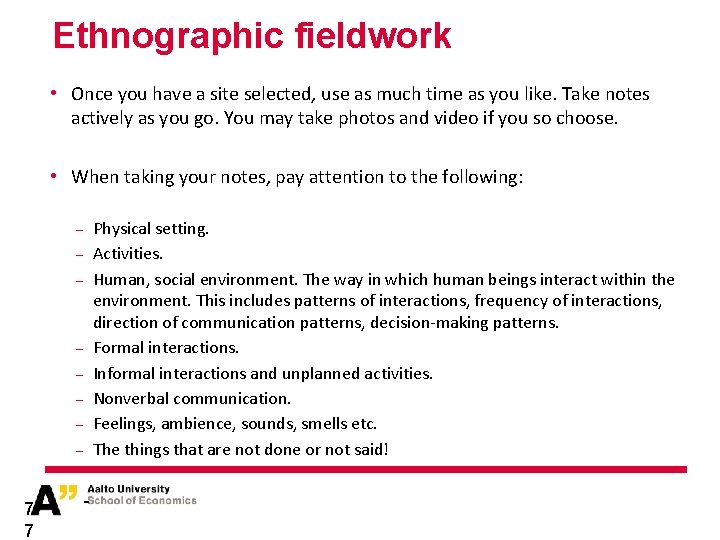
Ethnographic fieldwork • Once you have a site selected, use as much time as you like. Take notes actively as you go. You may take photos and video if you so choose. • When taking your notes, pay attention to the following: − − − − 7 7 - Physical setting. Activities. Human, social environment. The way in which human beings interact within the environment. This includes patterns of interactions, frequency of interactions, direction of communication patterns, decision-making patterns. Formal interactions. Informal interactions and unplanned activities. Nonverbal communication. Feelings, ambience, sounds, smells etc. The things that are not done or not said!
Writing up the report • Start the report with a paragraph or two where you justify briefly your methodological choice of ethnography. Here, you need to explain the research philosophy underlying qualitative research and ethnography. Also describe briefly your data-collection methods (actual tools used in ethnographic work). This is an important aspect of this exercise because you will need to be able to account for these issues in the final assignment too (‘writing up the final research plan’). • Then, based on your field notes write a complete report of the experience. Try to write a thick description of the physical environment, the people, and the “doings” involved. Try to “see the place as you never have before”. Observe the patrons – how do the people move within the locale, and how do they seem to interact, what kind of practices can you discern? 7 8 -
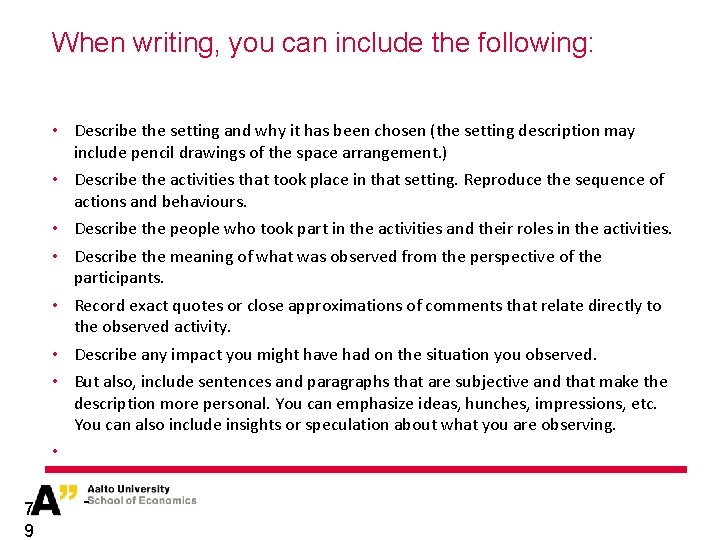
When writing, you can include the following: • Describe the setting and why it has been chosen (the setting description may include pencil drawings of the space arrangement. ) • Describe the activities that took place in that setting. Reproduce the sequence of actions and behaviours. • Describe the people who took part in the activities and their roles in the activities. • Describe the meaning of what was observed from the perspective of the participants. • Record exact quotes or close approximations of comments that relate directly to the observed activity. • Describe any impact you might have had on the situation you observed. • But also, include sentences and paragraphs that are subjective and that make the description more personal. You can emphasize ideas, hunches, impressions, etc. You can also include insights or speculation about what you are observing. • 7 9 -
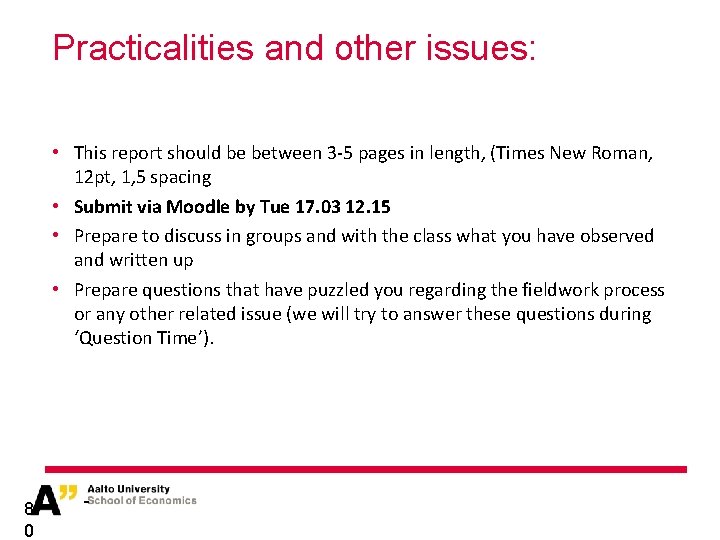
Practicalities and other issues: • This report should be between 3 -5 pages in length, (Times New Roman, 12 pt, 1, 5 spacing • Submit via Moodle by Tue 17. 03 12. 15 • Prepare to discuss in groups and with the class what you have observed and written up • Prepare questions that have puzzled you regarding the fieldwork process or any other related issue (we will try to answer these questions during ‘Question Time’). 8 0 -
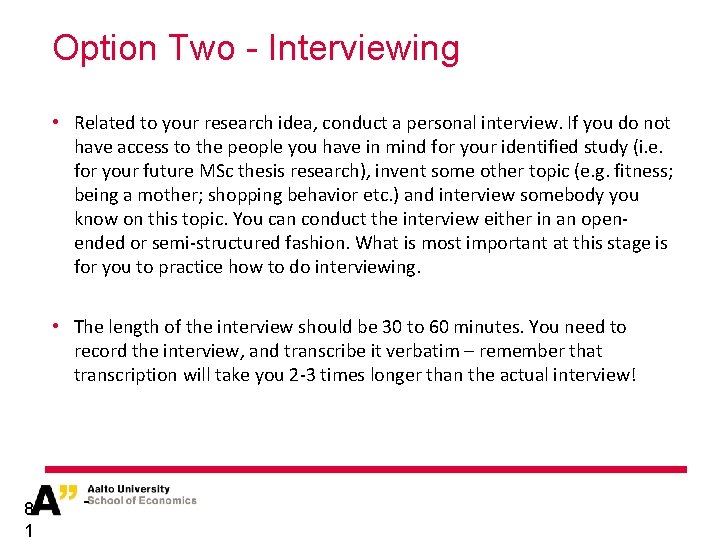
Option Two - Interviewing • Related to your research idea, conduct a personal interview. If you do not have access to the people you have in mind for your identified study (i. e. for your future MSc thesis research), invent some other topic (e. g. fitness; being a mother; shopping behavior etc. ) and interview somebody you know on this topic. You can conduct the interview either in an openended or semi-structured fashion. What is most important at this stage is for you to practice how to do interviewing. • The length of the interview should be 30 to 60 minutes. You need to record the interview, and transcribe it verbatim – remember that transcription will take you 2 -3 times longer than the actual interview! 8 1 -
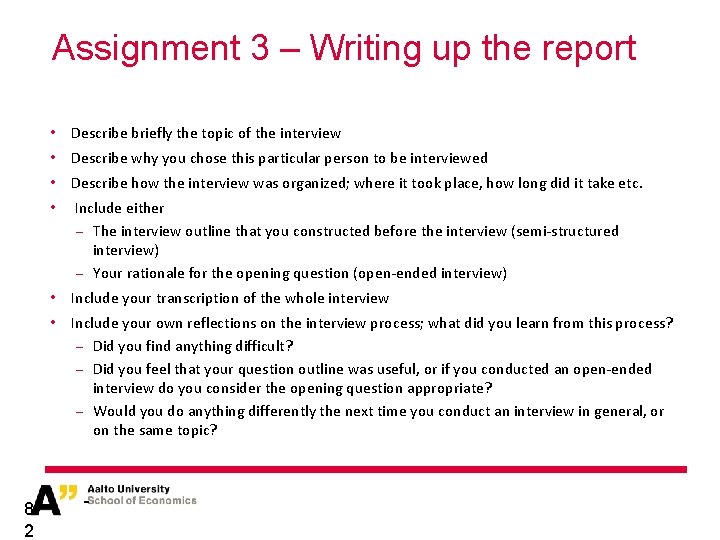
Assignment 3 – Writing up the report • Describe briefly the topic of the interview • Describe why you chose this particular person to be interviewed • Describe how the interview was organized; where it took place, how long did it take etc. • Include either − The interview outline that you constructed before the interview (semi-structured interview) − Your rationale for the opening question (open-ended interview) • Include your transcription of the whole interview • Include your own reflections on the interview process; what did you learn from this process? − Did you find anything difficult? − Did you feel that your question outline was useful, or if you conducted an open-ended interview do you consider the opening question appropriate? − Would you do anything differently the next time you conduct an interview in general, or on the same topic? 8 2 -
Practicalities and other issues • This report should be between 3 -5 pages in length, excluding interview transcriptions and outlines (Times New Roman, 12 pt, 1, 5 spacing) • Submit via Moodle by Tue 17. 03 12. 15 • Prepare to discuss in groups and with the class what you have written up • Prepare questions that have puzzled you regarding the interviewing process or any other related issue (we will try to answer these questions during ‘Question Time’). 8 3 -