
Collection and Preservation of Water and Wastewater Samples





- Slides: 26
Collection and Preservation of Water and Wastewater Samples
The objective of sampling is to collect a portion of material small enough in volume to be transported conveniently and yet large enough for analytical purposes while still accurately representing the material being sampled.
General Requirements eat the requirements of the sampling program. e sample so that it does not deteriorate or become contaminated or compromised before it analyzed. Ensure sampling equipments are clean and quality assured before use. e sample containers that are clean and free of contaminants.
5 -Fill sample containers with/or without -Composite samples can be obtained by collecting over a period of time, depth, or at many different sampling points. 7 record of every sample collected and identify every bottle.
abel bottles and document suffecient information for sample identification. 9 -Before collecting samples from distribution ems, flush lines with 3 -5 pipe lumes (or until water is being drawn the main source).
Documentation of sufficient information for sample identification - unique sample identification number ame of the sample collector -date - time -exact location -sample type -water temperature -weather conditions -water level -stream flow
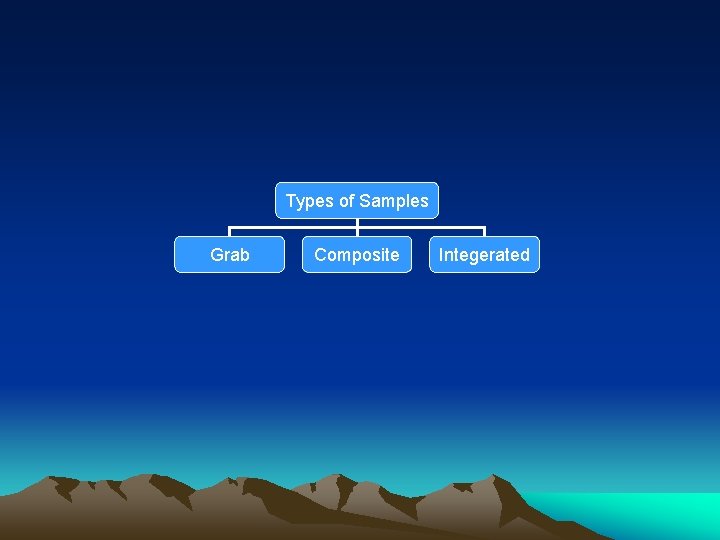
Types of Samples Grab Composite Integerated
Grab Samples Grab samples are single samples collected at a specific spot at a site over a short period of time (typically seconds or minutes).
Composite Samples Provides a more representative sampling of heterogeneous matrices in which the concentration of the analytes of interest may vary over short periods of time and/or space.
Composite Samples Can be obtained by combining portions of multiple grab samples or by using specially designed automatic sampling devices.
Integrated (discharge-weighed) Samples Mixture of grab samples collected from different points simultaneously, or as nearly so as possible, using dischargeweighed methods
Advantages of Composite Samples Reduced costs of analyzing a large ü number of samples. more representative samples of ü heterogeneous matrices, and larger sample sizes when amounts of ü test samples are limited.
Disadvantages of Composite Samples Loss of analyte relationships in individual samples. potential dilution of analytes below detection levels increased potential analytical interferences and increased possibility of analytes interactions.
Chain-of-Custody Procedures a-Sample labels (including bar-code labels). b-Sample seals. c-Field log book. d-Chain-of-custody record. e-Sample analysis request sheet. f-Sample delivery to the laboratory. g-Receipt and logging of sample. h-Assignment of sample for analysis. i-Disposal.
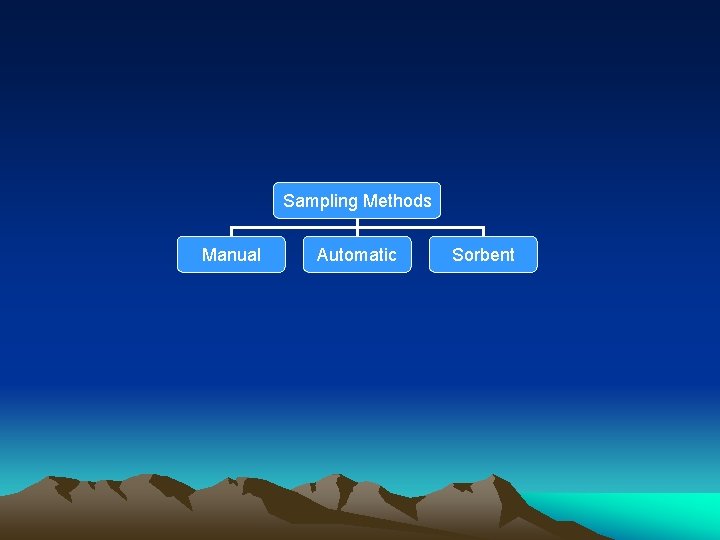
Sampling Methods Manual Automatic Sorbent
Sample Container Collect samples in a glass or plastic bottles that have been cleansed and rinsed carefully, given a final rinse with deionized or distilled water, and sterilized. Volume of the sample should be 100 ml or more.
Sample Containers Considerations Silica , sodium, and boron may be leached from soft glass but not plastic. Trace levels of some pesticides and metals may sorb onto the walls of glass containers. Use glass containers for all organic analyses such as volatile organics , semi volatile organics , pesticides , PCB’s , and oil and grease. Some analytes are light sensitive , collect them in amber glass containers to minimize photodegradation. Plastic caps also can be a problem.
-Temperature -Redox Potential -Dissolved Gases Determine those parameters in situ.
-p. H ctrical Conductivity -Turbidity -Alkalinity Determine those parameters immediately after sample collection.
-Radon 222 -volatile organic compounds Zero head-space is important in preservation of those parameters.
What may happen during sample transportation ? Certain cations are subject to loss by adsorption on, or ion exchange with the walls of the glass containers, these includes: Al, Cd, Cr, Cu, Fe, Pb, Mn, Ag, and Zn. Those are best collected in a separate clean bottle and acidified with nitric acid to p. H below 2. 0 to minimize precipitation and adsorption on container walls.
What may happen during sample transportation ? Changes in the p. Halkalinity-carbon dioxide balance may cause calcium carbonate to precipitate, decreasing the values of calcium and total hardness. Hardness can be preserved by adding nitric acid to p. H <2
What may happen during sample transportation ? Biological activity taking place in a sample may change the oxidation state of some constituents Changes caused by growth of microorganisms are greatly retarded by keeping the sample at a low temperature (<4 C) but above freezing.
What may happen during sample transportation ? Chlorine will oxidize cyanide. Dechlorinate sample , add Na. OH to p. H >12, And refrigerate in dark.
Preservation and Storage General Consideration 1 -Start microbiological examination of water ples as soon as possible after Ice samples preferably at <10 C during transport if they can’t be analyzed within 1 h ion. 3 -Analyze samples on day of receipt whenever possible and refrigerate overnight if arrival is too ing on same day.
Preservation and Storage Do not exceed 30 h holding time from collection to analysis for coliform bacteria. 5 -Do not exceed 8 h holding time for heterotrophic plate counts.