
Collecting for Digital Repositories New Ways to Disseminate
- Slides: 63
Collecting for Digital Repositories: New Ways to Disseminate and Share Information Institutional Repositories American Library Association Annual Convention Chicago, Illinois July 12, 2009 Co-sponsored by ACRL EBSS E-Resources in Communication Studies Committee; ACRL Scholarly Communications Committee
Paul Royster Coordinator of Scholarly Communications UNL Libraries University of Nebraska-Lincoln Manager of the institutional repository: http: //digitalcommons. unl. edu
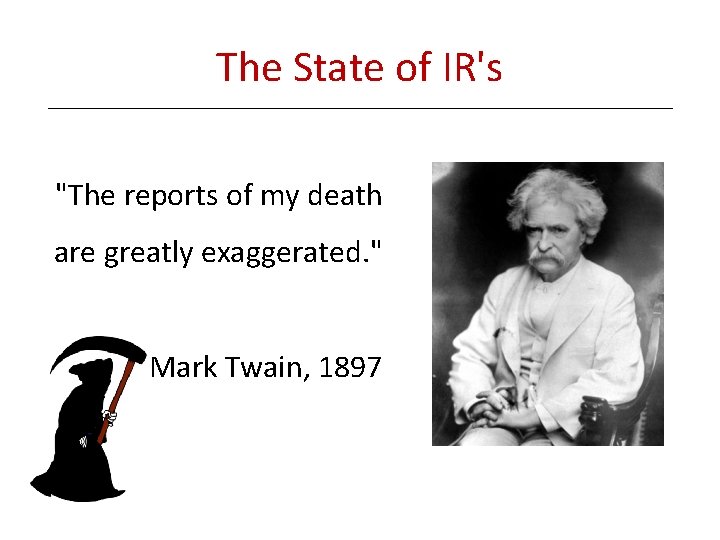
The State of IR's "The reports of my death are greatly exaggerated. " Mark Twain, 1897
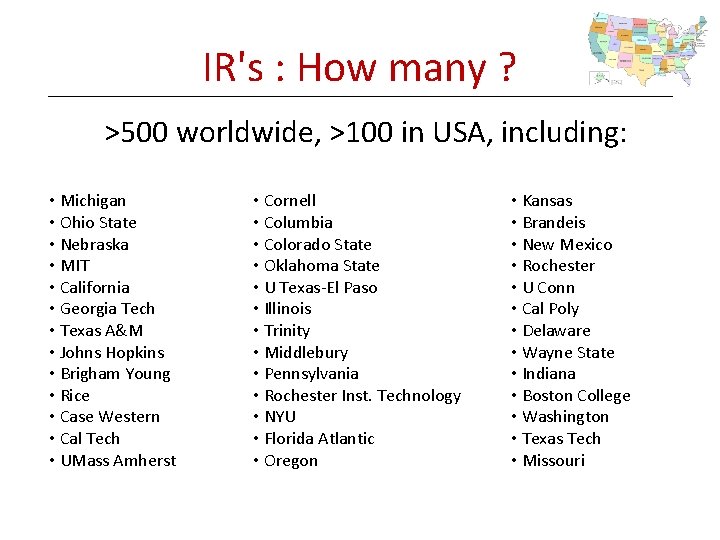
IR's : How many ? >500 worldwide, >100 in USA, including: • Michigan • Ohio State • Nebraska • MIT • California • Georgia Tech • Texas A&M • Johns Hopkins • Brigham Young • Rice • Case Western • Cal Tech • UMass Amherst • Cornell • Columbia • Colorado State • Oklahoma State • U Texas-El Paso • Illinois • Trinity • Middlebury • Pennsylvania • Rochester Inst. Technology • NYU • Florida Atlantic • Oregon • Kansas • Brandeis • New Mexico • Rochester • U Conn • Cal Poly • Delaware • Wayne State • Indiana • Boston College • Washington • Texas Tech • Missouri
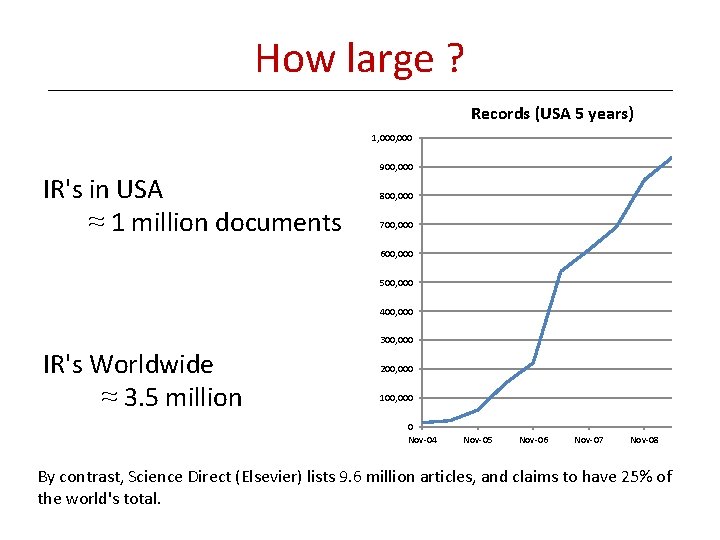
How large ? Records (USA 5 years) 1, 000 IR's in USA ≈ 1 million documents 900, 000 800, 000 700, 000 600, 000 500, 000 400, 000 IR's Worldwide ≈ 3. 5 million 300, 000 200, 000 100, 000 0 Nov-04 Nov-05 Nov-06 Nov-07 Nov-08 By contrast, Science Direct (Elsevier) lists 9. 6 million articles, and claims to have 25% of the world's total.
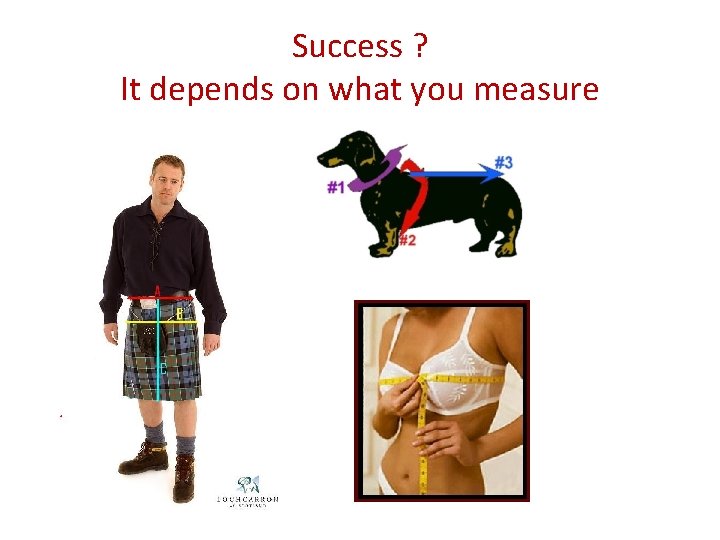
Success ? It depends on what you measure
What we measure • Contents • Usage • Participation And there are intangibles that cannot be measured directly
4 Challenges for IRs 1. Software and implementation 2. The permissions patchwork 3. Faculty apathy 4. The "Roach Motel" issue
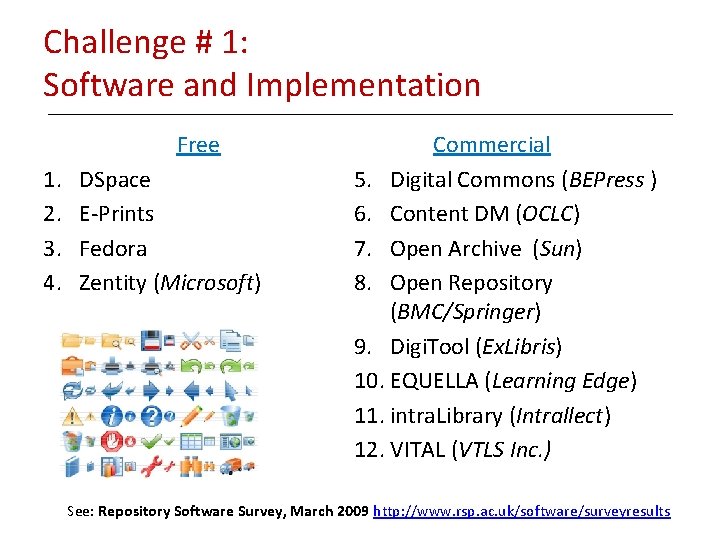
Challenge # 1: Software and Implementation Free 1. 2. 3. 4. DSpace E-Prints Fedora Zentity (Microsoft) Commercial 5. Digital Commons (BEPress ) 6. Content DM (OCLC) 7. Open Archive (Sun) 8. Open Repository (BMC/Springer) 9. Digi. Tool (Ex. Libris) 10. EQUELLA (Learning Edge) 11. intra. Library (Intrallect) 12. VITAL (VTLS Inc. ) See: Repository Software Survey, March 2009 http: //www. rsp. ac. uk/software/surveyresults
Open Source: "Free lunch" or "Free puppy" ? • Free software • Your server, your IT staff • You install, customize, host, maintain, troubleshoot, de-bug, patch, update, . . .
Outsourced solution: • Vendor installs, customizes, maintains, upgrades, & hosts • We pay annual license fee (~ $1. 50 per FTE) • No toll on library computer resources or staff • IR staff focuses 100% on content acquisition
Budget (at UNL) • Salaries (1. 5 FT) + software license + student workers wages ≈ $125, 000 /year • 4 -year expenditure ≈ $500, 000 • Yield: collection of 35, 000 documents delivery of 2. 5 million downloads By way of comparison, we cut $300, 000 in Elsevier publications this year (to offset their price increases).
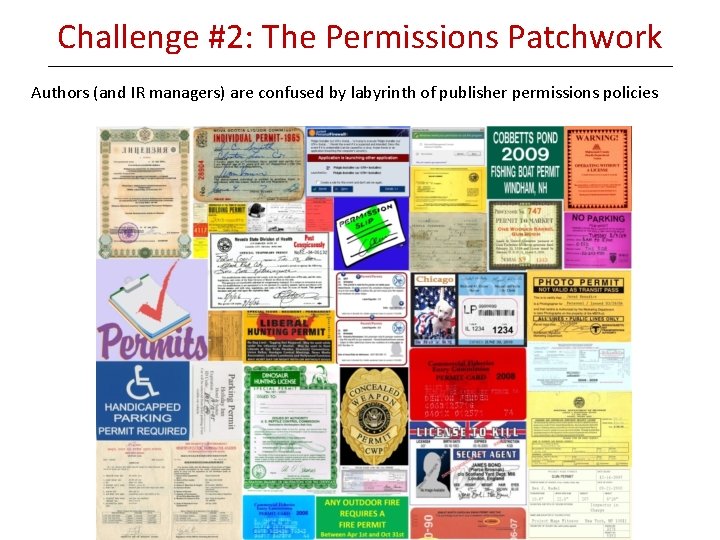
Challenge #2: The Permissions Patchwork Authors (and IR managers) are confused by labyrinth of publisher permissions policies
The Good Guys Some publishers allow use of the published version of an article: American Physical Society Company of Biologists University of Chicago Press IEEE American Astronomical Society American Library Association American Mathematical Society Am. Soc. Agricultural & Biological Eng. American Society of Microbiologists Cambridge University Press Duke University Press Bio. Med Central Research Council of Canada Animal Science Association Society of Mammalogists Entomological Society of America
Good | Evil Less than perfect, but better than some, these publishers have given authors permission to post an “author’s version, ” but not their exact publisher’s version: Elsevier Springer Verlag Institute of Physics Oxford University Press Lippincott Nature Publishing Group John Wiley & Sons Taylor & Francis Sage Publications American Psychological Society National Academy of Sciences American Society of Civil Engineers
Evil only These publishers do not allow full-text posting of any versions: American Chemical Society American Sociological Association American Society of Mechanical Engineers Karger Publishers Geological Society of American School Psychology Association Mary Ann Liebert
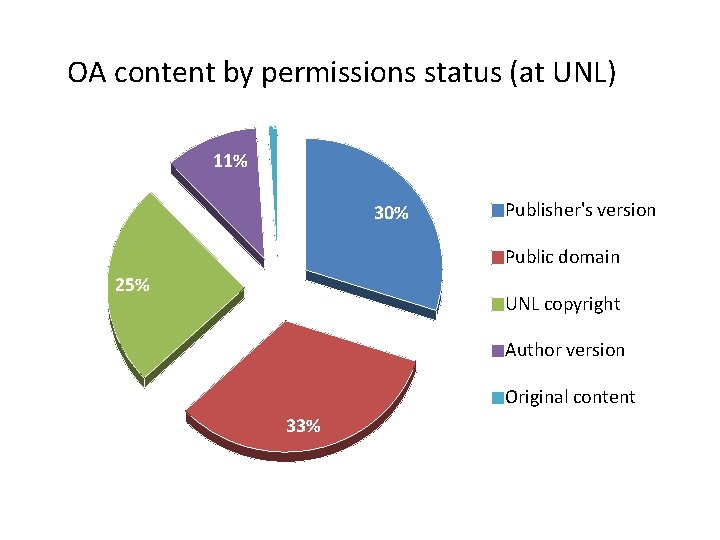
OA content by permissions status (at UNL) 1% 11% 30% Publisher's version Public domain 25% UNL copyright Author version Original content 33%
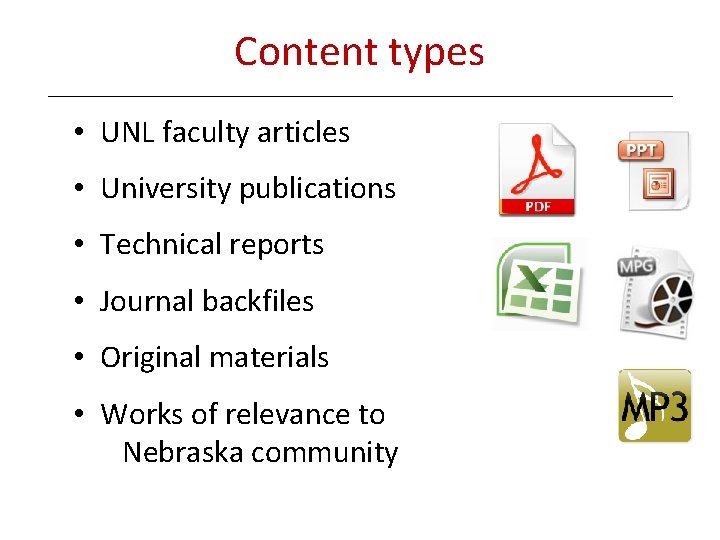
Content types • UNL faculty articles • University publications • Technical reports • Journal backfiles • Original materials • Works of relevance to Nebraska community
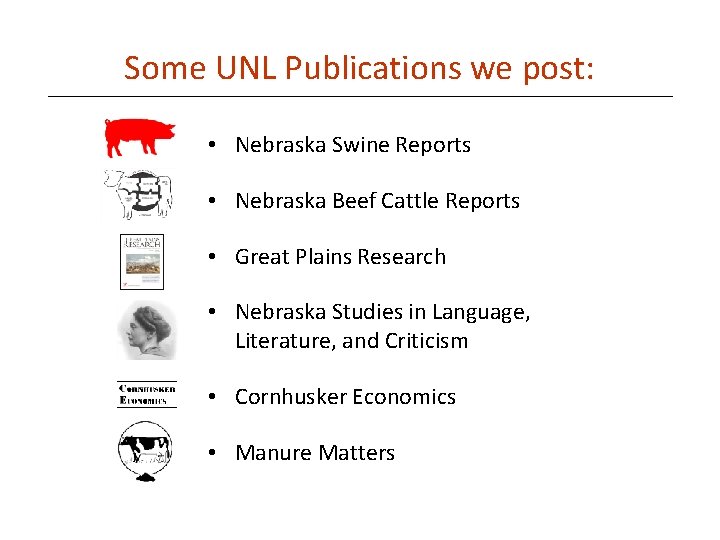
Some UNL Publications we post: • Nebraska Swine Reports • Nebraska Beef Cattle Reports • Great Plains Research • Nebraska Studies in Language, Literature, and Criticism • Cornhusker Economics • Manure Matters
Journals we host or archive: • Library Philosophy and Practice • Journal of Parasitology • Insecta Mundi • Court Review • RURALS
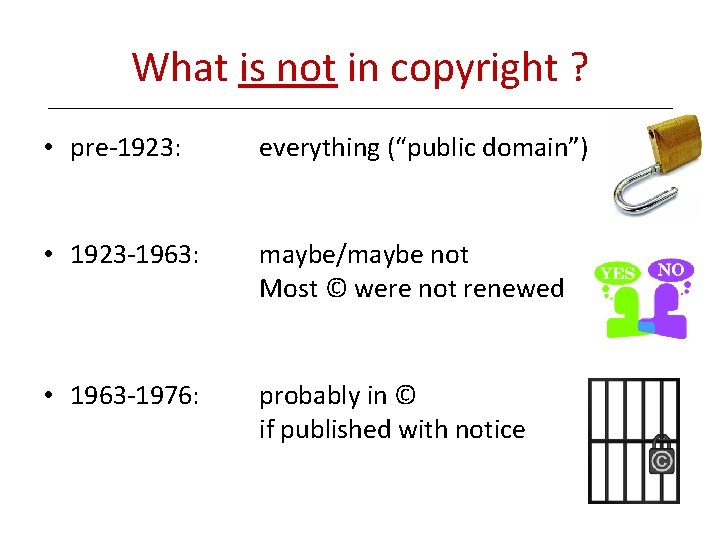
What is not in copyright ? • pre-1923: everything (“public domain”) • 1923 -1963: maybe/maybe not Most © were not renewed • 1963 -1976: probably in © if published with notice
Copyright Renewal: 1923 -1963 • Works published 1923 -1963 have passed into public domain if they were not renewed in their 28 th & 56 th years of coverage. • These can be checked at the website: http: //www. scils. rutgers. edu/~lesk/copyrenew. html
The Federal Employee Loop-hole § 105. Subject matter of copyright: United States Government works “Copyright protection under this title is not available for any work of the United States Government, *. . . ” *A “work of the United States Government” is a work prepared by an officer or employee of the United States Government as part of that person's official duties. – Copyright Law of the United States of America and Related Laws Contained in Title 17 of the United States Code This means articles by federal employees can be posted regardless of the publisher’s policy.
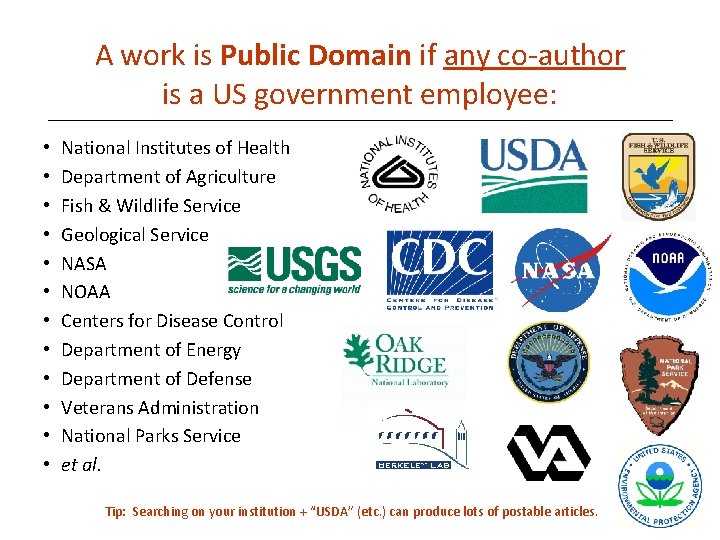
A work is Public Domain if any co-author is a US government employee: • • • National Institutes of Health Department of Agriculture Fish & Wildlife Service Geological Service NASA NOAA Centers for Disease Control Department of Energy Department of Defense Veterans Administration National Parks Service et al. Tip: Searching on your institution + “USDA” (etc. ) can produce lots of postable articles.
State Sovereign Immunity If you mistakenly post a work that is in copyright, your (state) institution cannot be sued for damages, because of the principle of "state sovereign immunity. " The Judicial power of the United States shall not be construed to extend to any suit in law or equity, commenced or prosecuted against one of the United States by Citizens of another State, or by Citizens or Subjects of any Foreign State. — 11 th Amendment (1793), formalizing understanding that the States had not surrendered their immunity from suit in ratifying the Constitution.
Challenge #3: Faculty Apathy Despite the proliferation of IRs, most faculty are not motivated to self-archive or deposit their works. IR
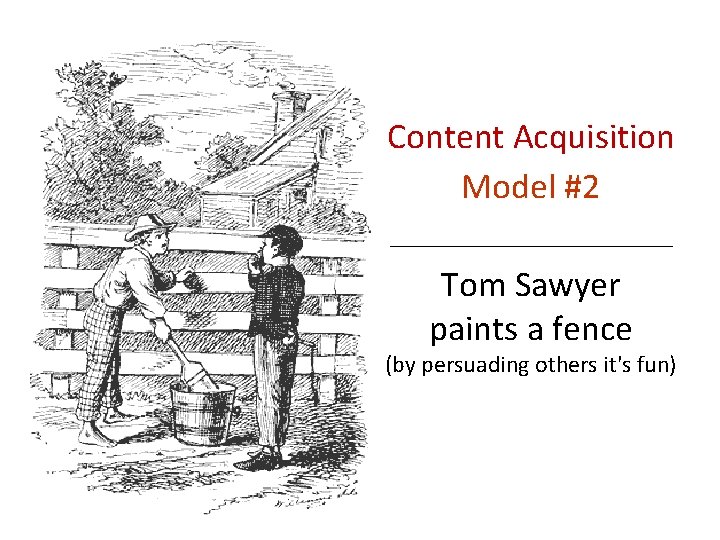
4 Models for Content Acquisition : 1. "If you build it, they will come" [The articles will add themselves] 2. Make it seem fun/cool/attractive [Tom Sawyer's fence-painting] 3. Mandates: make it compulsory 4. Provide services
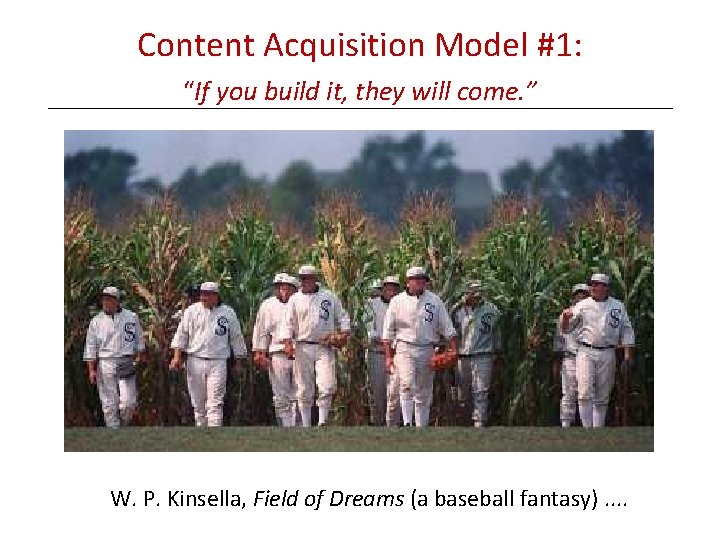
Content Acquisition Model #1: “If you build it, they will come. ” W. P. Kinsella, Field of Dreams (a baseball fantasy). .
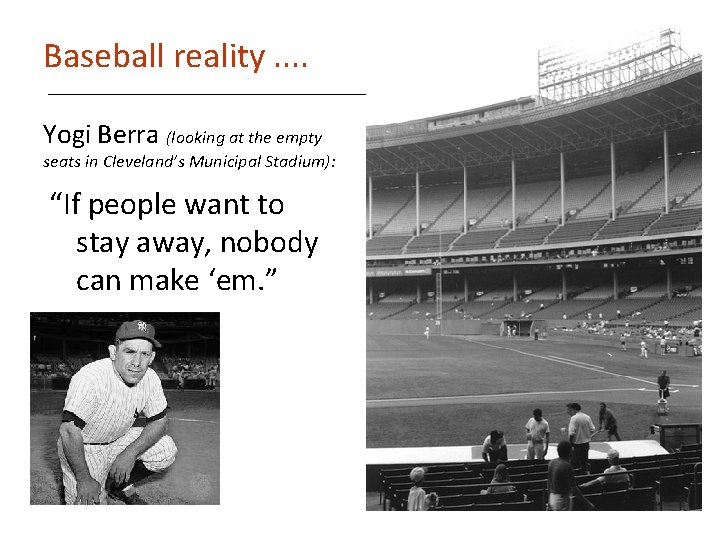
Baseball reality. . Yogi Berra (looking at the empty seats in Cleveland’s Municipal Stadium): “If people want to stay away, nobody can make ‘em. ”
Content Acquisition Model #2 Tom Sawyer paints a fence (by persuading others it's fun)
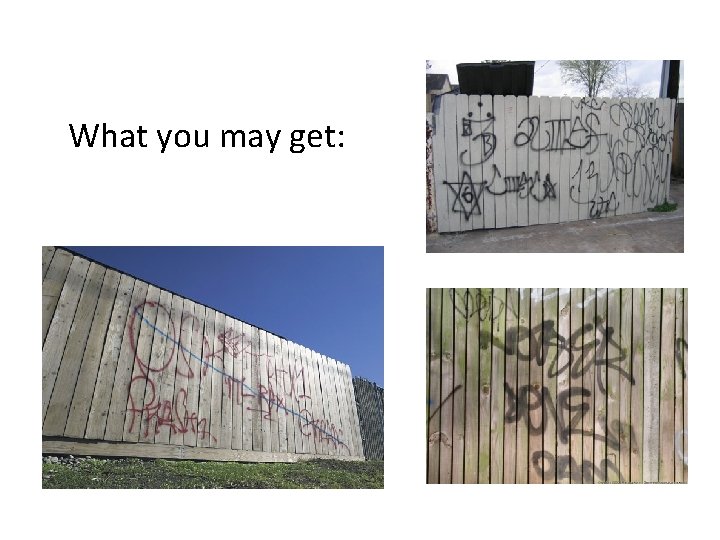
What you may get:
Issues with self-archived materials • permission violations • incomplete metadata • nasty files: poor scans, non-OCR'ed text, huge file sizes 180 Mb
Content Acquisition Model #3: Mandates • Get faculty to require themselves to deposit research articles in the repository • Follows Harvard example, passed in early 2007 • Sometimes accompanied by institution's assertion of part-ownership interest in the publication rights
Why we are not pursuing this path at UNL 1. Conflicts with our intellectual property policy 2. Would put Library in a rule-enforcement role 3. Not worth the cost in political capital and good will 4. Would not necessarily produce more deposits 5. We already have more business than we can handle (Adds neither carrot nor stick to our repertoire. )
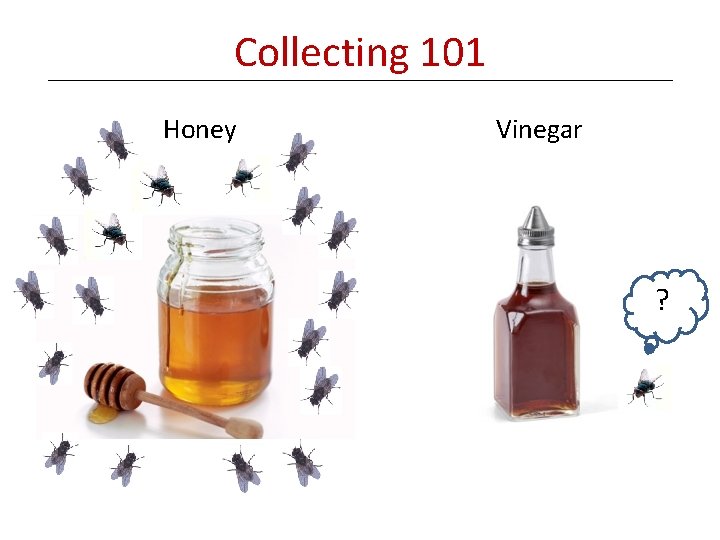
Collecting 101 Honey Vinegar ?
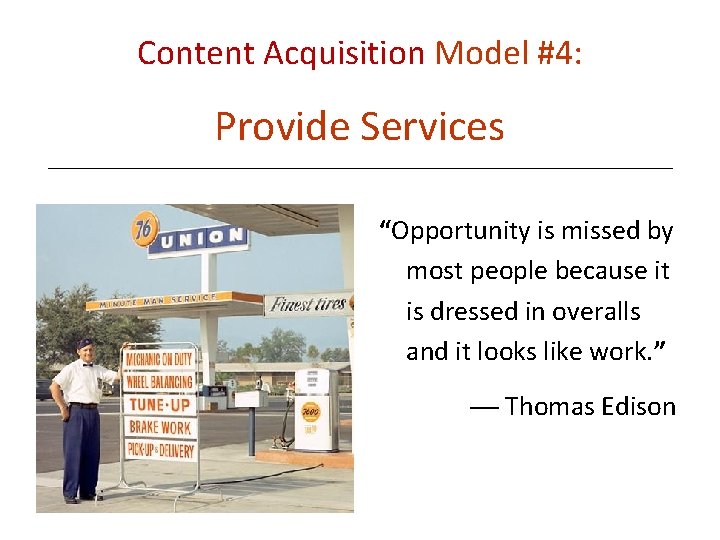
Content Acquisition Model #4: Provide Services “Opportunity is missed by most people because it is dressed in overalls and it looks like work. ” — Thomas Edison
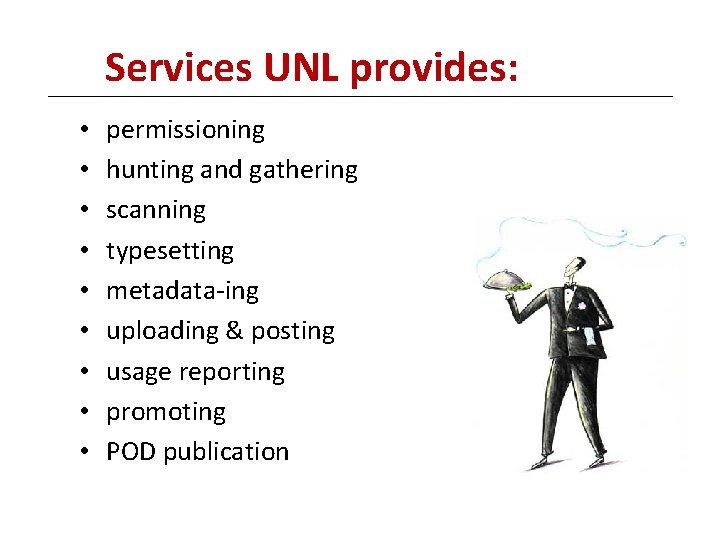
Services UNL provides: • • • permissioning hunting and gathering scanning typesetting metadata-ing uploading & posting usage reporting promoting POD publication
Useful Tools & Skills • Adobe Acrobat • Adobe Photoshop • Adobe In. Design (or Quark Xpress) • MS Word • scanning • graphic design • proofreading • copy-editing
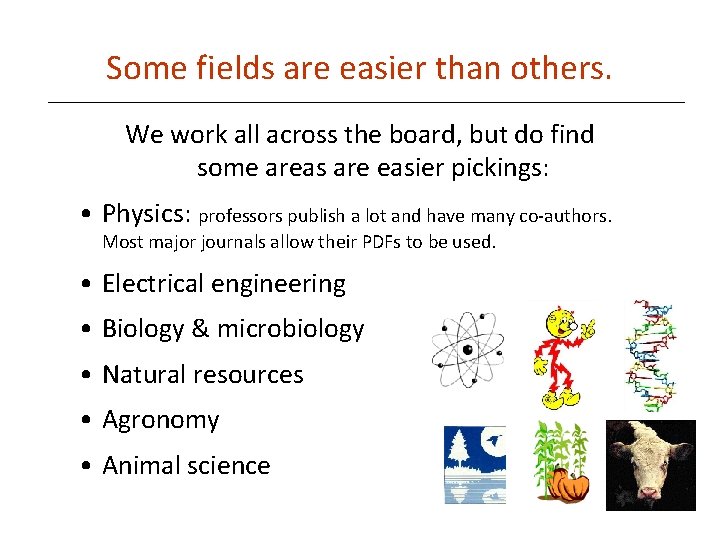
Some fields are easier than others. We work all across the board, but do find some areas are easier pickings: • Physics: professors publish a lot and have many co-authors. Most major journals allow their PDFs to be used. • Electrical engineering • Biology & microbiology • Natural resources • Agronomy • Animal science
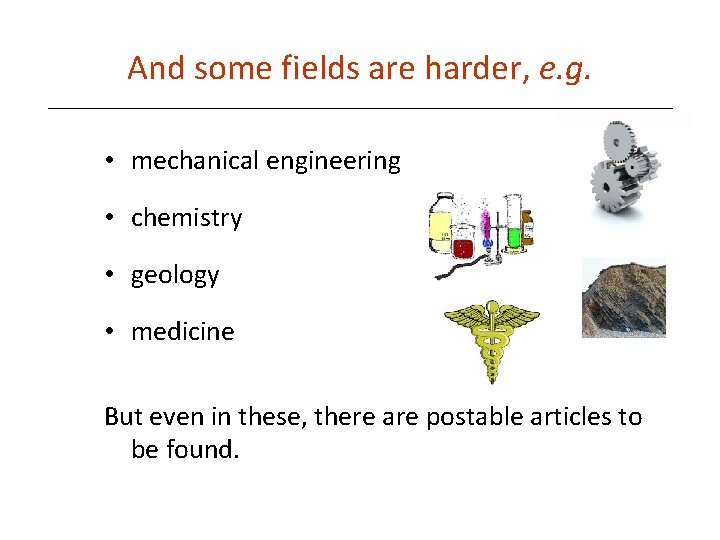
And some fields are harder, e. g. • mechanical engineering • chemistry • geology • medicine But even in these, there are postable articles to be found.
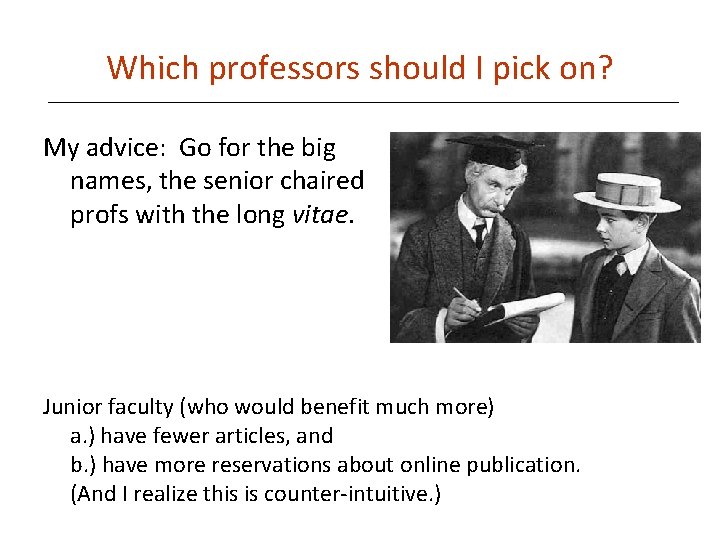
Which professors should I pick on? My advice: Go for the big names, the senior chaired profs with the long vitae. Junior faculty (who would benefit much more) a. ) have fewer articles, and b. ) have more reservations about online publication. (And I realize this is counter-intuitive. )
Most successful recruiting strategy: 1. Find postable articles 2. Email the authors ("I have recently seen your article. . ) 3. Request permission and additional publications list
How do I find postable articles ? • Use SHERPA/Ro. MEO publisher site (or OAKList) to find publishers who allow posting • Search those publishers' sites for your institution name http: //www. oaklist. qut. edu. au/ http: //www. sherpa. ac. uk/romeo. php? all=yes
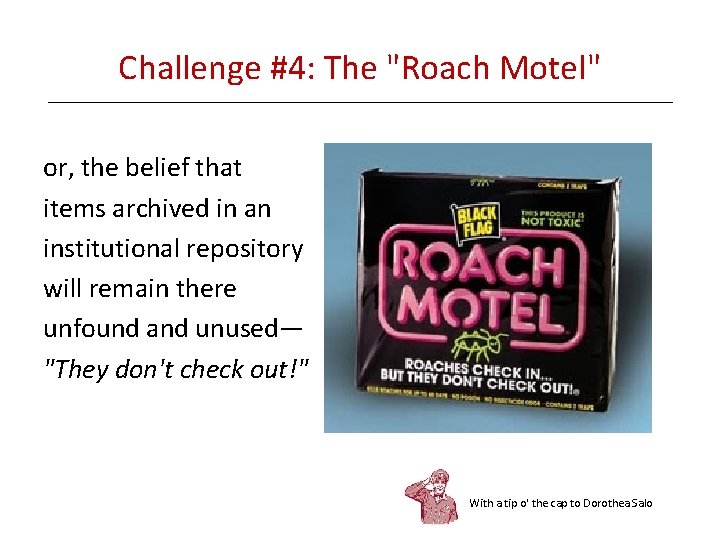
Challenge #4: The "Roach Motel" or, the belief that items archived in an institutional repository will remain there unfound and unused— "They don't check out!" With a tip o' the cap to Dorothea Salo
Our Experience at UNL
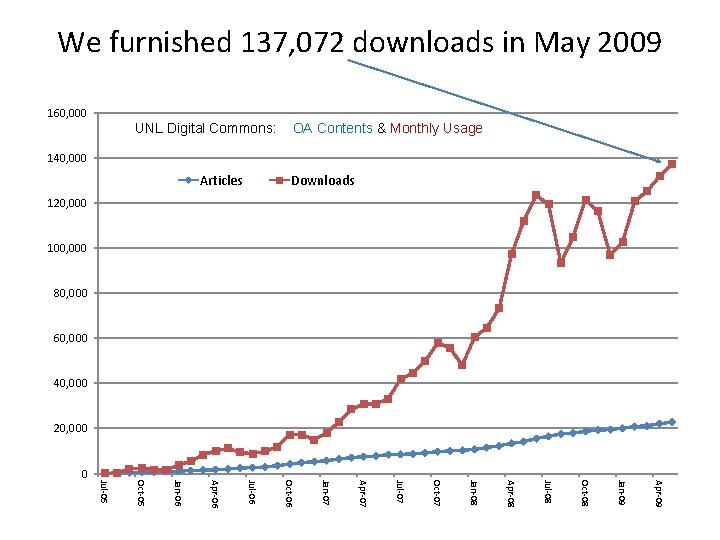
We furnished 137, 072 downloads in May 2009 160, 000 UNL Digital Commons: OA Contents & Monthly Usage 140, 000 Articles Downloads 120, 000 100, 000 80, 000 60, 000 40, 000 20, 000 Apr-09 Jan-09 Oct-08 Jul-08 Apr-08 Jan-08 Oct-07 Jul-07 Apr-07 Jan-07 Oct-06 Jul-06 Apr-06 Jan-06 Oct-05 Jul-05 0
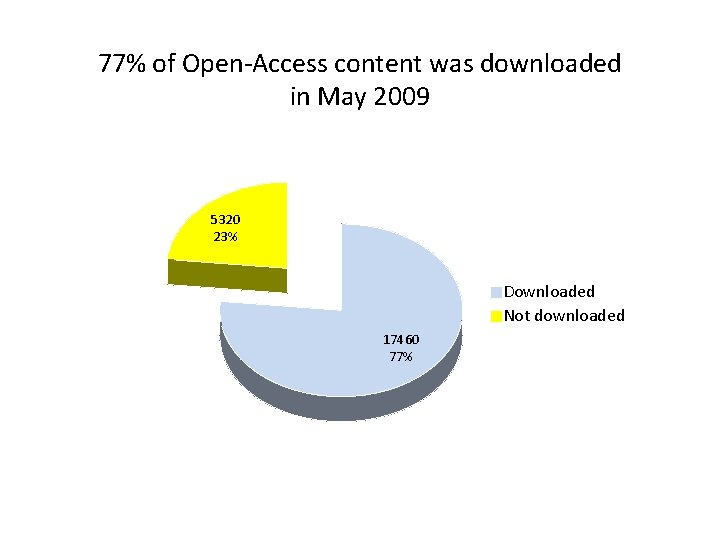
77% of Open-Access content was downloaded in May 2009 5320 23% Downloaded Not downloaded 17460 77%
Faculty Publications, Department of Psychology http: //digitalcommons. unl. edu/psychfacpub/ 367 articles → 5, 008 downloads avg. = 13. 6
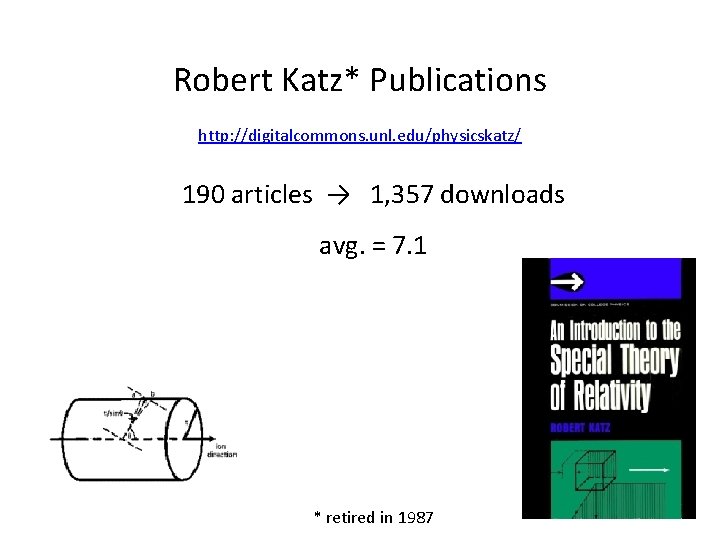
Robert Katz* Publications http: //digitalcommons. unl. edu/physicskatz/ 190 articles → 1, 357 downloads avg. = 7. 1 * retired in 1987
UNL Larsen Tractor Museum Archives http: //digitalcommons. unl. edu/tractormuseumlit/ 2, 274 articles → 16, 648 downloads avg. = 7. 3
Dissertations: Department of History http: //digitalcommons. unl. edu/historydiss/ 19 documents → 994 downloads avg. = 52. 3 ————— Dissertations: Modern Languages and Literatures http: //digitalcommons. unl. edu/modlangdiss/ 6 documents → 984 downloads avg. = 164. 0 !!
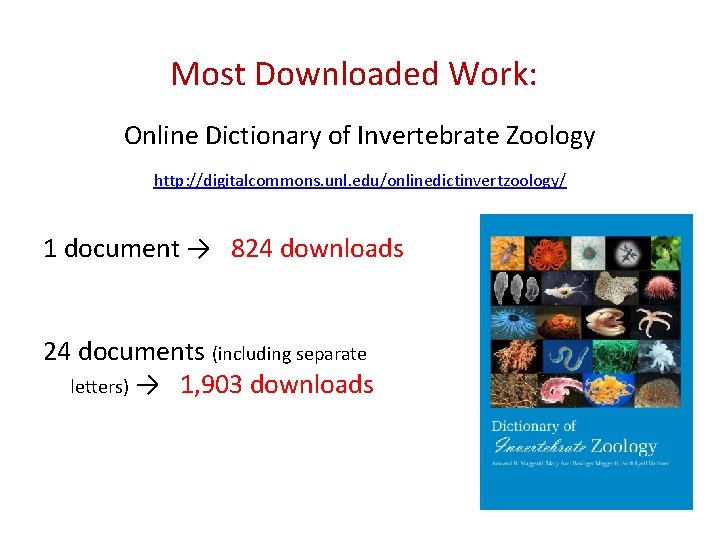
Most Downloaded Work: Online Dictionary of Invertebrate Zoology http: //digitalcommons. unl. edu/onlinedictinvertzoology/ 1 document → 824 downloads 24 documents (including separate letters) → 1, 903 downloads
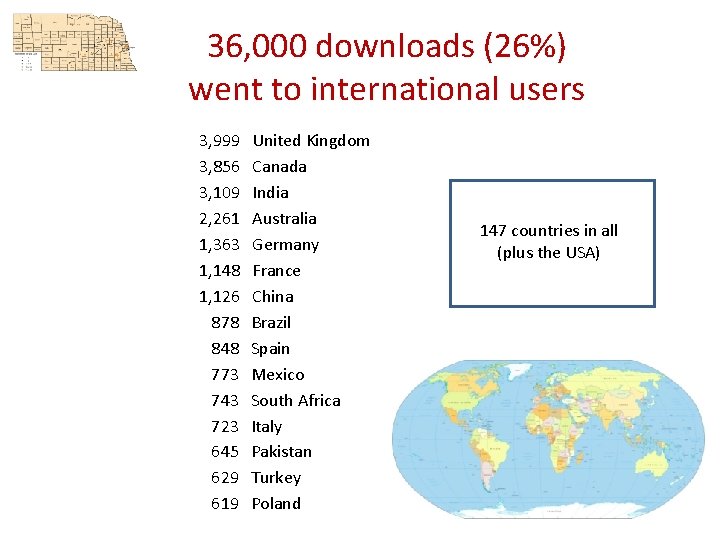
36, 000 downloads (26%) went to international users 3, 999 United Kingdom 3, 856 Canada 3, 109 India 2, 261 Australia 1, 363 Germany 1, 148 France 1, 126 China 878 Brazil 848 Spain 773 Mexico 743 South Africa 723 Italy 645 Pakistan 629 Turkey 619 Poland 147 countries in all (plus the USA)
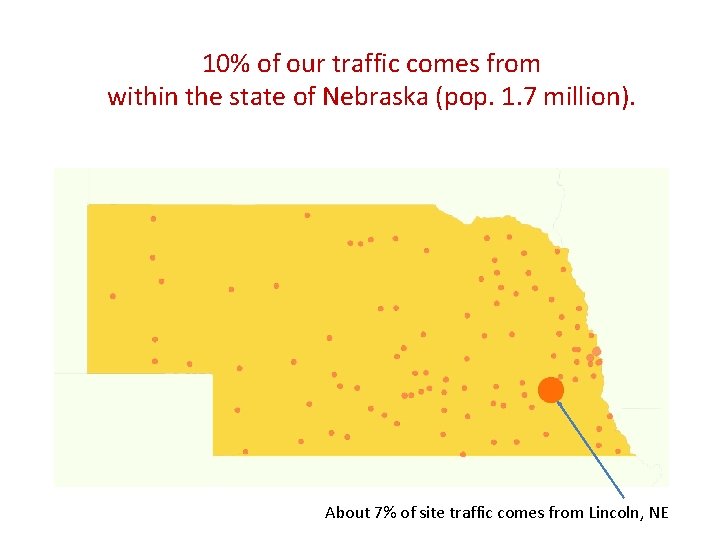
10% of our traffic comes from within the state of Nebraska (pop. 1. 7 million). About 7% of site traffic comes from Lincoln, NE
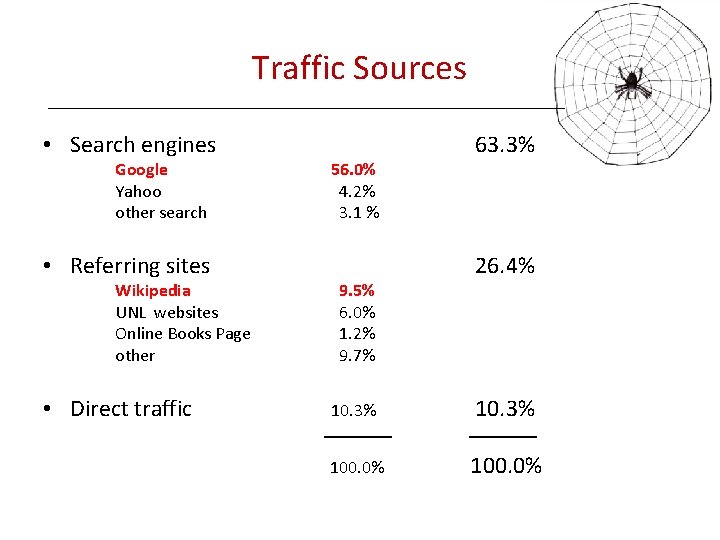
Traffic Sources • Search engines Google Yahoo other search • Referring sites Wikipedia UNL websites Online Books Page other • Direct traffic 56. 0% 4. 2% 3. 1 % 9. 5% 6. 0% 1. 2% 9. 7% 63. 3% 26. 4% 10. 3% ──── 100. 0% 10. 3%
Scholarly Communication We are entering an era of competition between: • The restricted-access, for-profit, scholarship-asproperty publishers, and • The open-access, for-knowledge, scholarship-as -shared-resource publishers and re-publishers And that is what repositories essentially are — publishers and re-publishers. Our clientele is the world, not just our local campus.
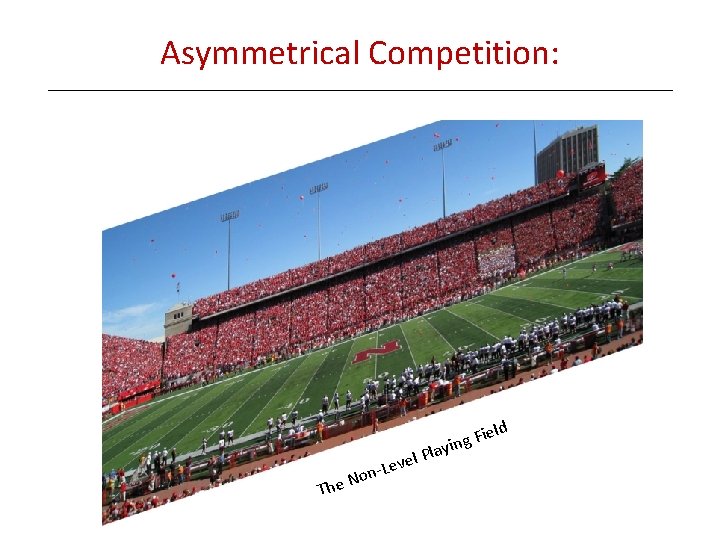
Asymmetrical Competition: ld Fie g n i lay N The el P v e L on-
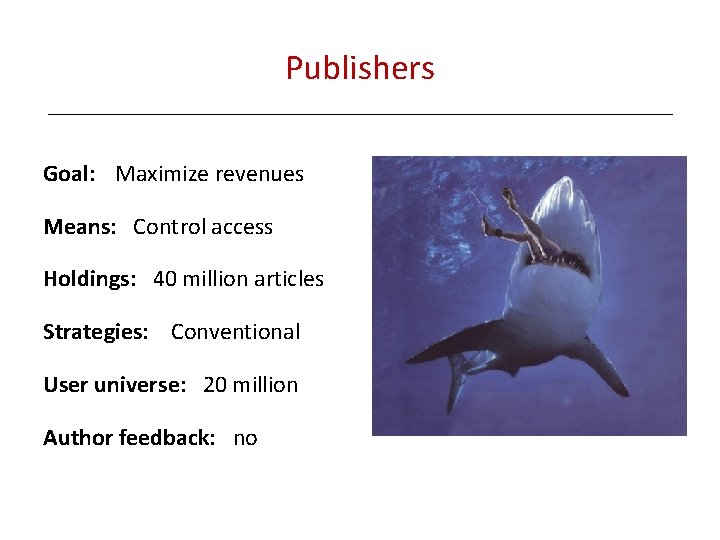
Publishers Goal: Maximize revenues Means: Control access Holdings: 40 million articles Strategies: Conventional User universe: 20 million Author feedback: no
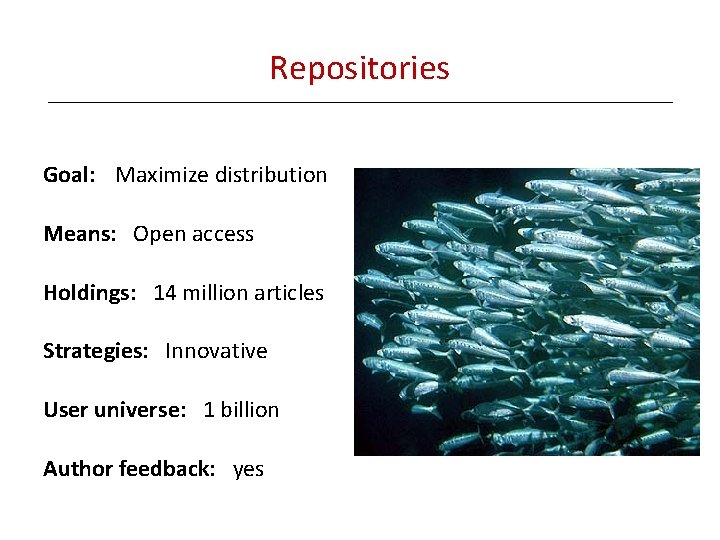
Repositories Goal: Maximize distribution Means: Open access Holdings: 14 million articles Strategies: Innovative User universe: 1 billion Author feedback: yes
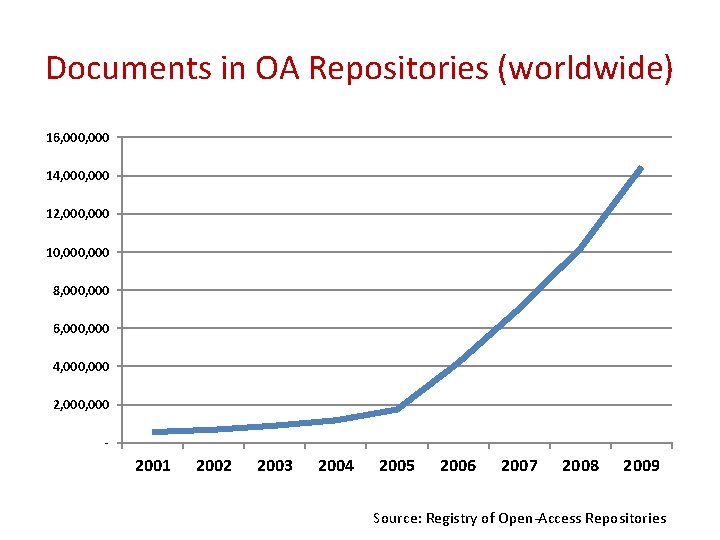
Documents in OA Repositories (worldwide) 16, 000 14, 000 12, 000 10, 000 8, 000 6, 000 4, 000 2, 000 - 2001 2002 2003 2004 2005 2006 2007 2008 2009 Source: Registry of Open-Access Repositories
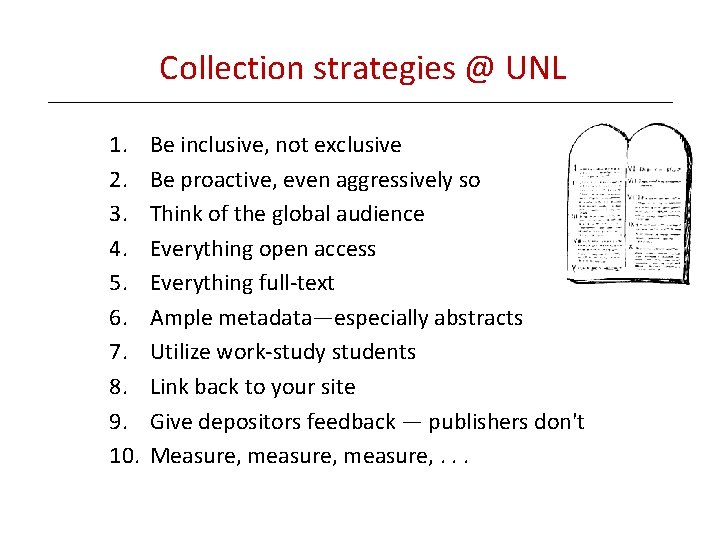
Collection strategies @ UNL 1. 2. 3. 4. 5. 6. 7. 8. 9. 10. Be inclusive, not exclusive Be proactive, even aggressively so Think of the global audience Everything open access Everything full-text Ample metadata—especially abstracts Utilize work-study students Link back to your site Give depositors feedback — publishers don't Measure, measure, . . .