
Collecting Data and Sampling Measures of Location Spread


- Slides: 65
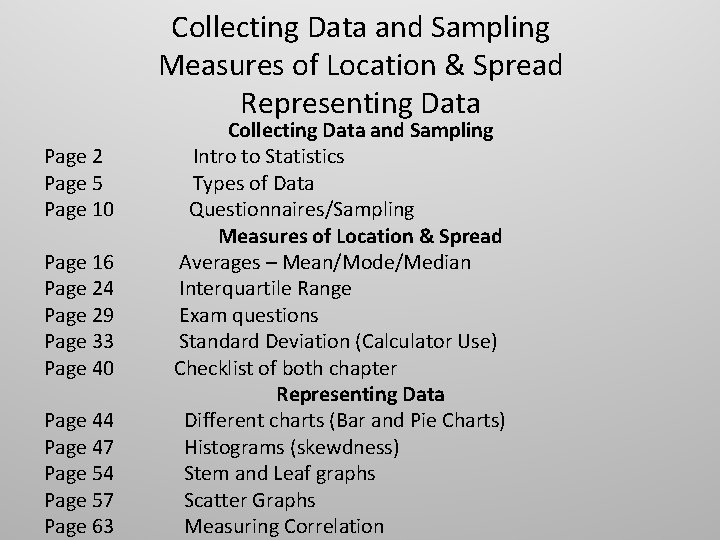
Collecting Data and Sampling Measures of Location & Spread Representing Data Page 2 Page 5 Page 10 Page 16 Page 24 Page 29 Page 33 Page 40 Page 44 Page 47 Page 54 Page 57 Page 63 Collecting Data and Sampling Intro to Statistics Types of Data Questionnaires/Sampling Measures of Location & Spread Averages – Mean/Mode/Median Interquartile Range Exam questions Standard Deviation (Calculator Use) Checklist of both chapter Representing Data Different charts (Bar and Pie Charts) Histograms (skewdness) Stem and Leaf graphs Scatter Graphs Measuring Correlation
Statistics is the collection of some sort of data and ordering it so it can be analysed Where it is used Entertainment -Music? - Sport? Government -population of an area - location of car crashes - Census?
Moneyball • Moneyball: The Art of Winning an Unfair Game is a book by Michael Lewis, published in 2003, about the Oakland Athletics baseball team and its general manager Billy Beane. • “Its focus is the team's analytical, evidencebased, sabermetrics approach to assembling a competitive baseball team, despite Oakland's disadvantaged revenue situation”
Census • A census calculates the population of a country which can be used for many things, such as locating places to put public service facilities (schools, post offices, roads, libraries, etc. ). In a census the citizen is asked questions about their jobs, income, and family members (children). This allows the government to see the average income of citizens, and predict the population of the future.
Aims of this chapter • Understand the best ways to collect data • Understand how to organise the data and visualise the data • Be able to analyse the data and draw conclusions
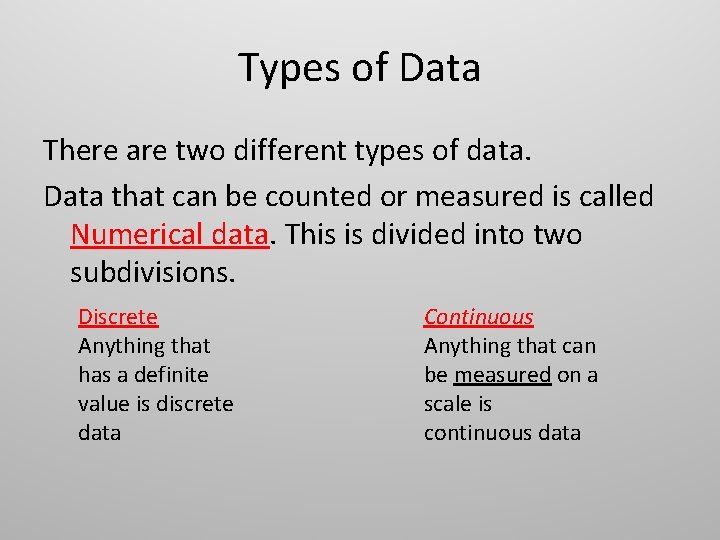
Types of Data There are two different types of data. Data that can be counted or measured is called Numerical data. This is divided into two subdivisions. Discrete Anything that has a definite value is discrete data Continuous Anything that can be measured on a scale is continuous data
Statistics Give an example of the following: • Discrete Numerical Data • Ordinal Data • Categorical Data • Bivariate Data • Continuous Numerical Data
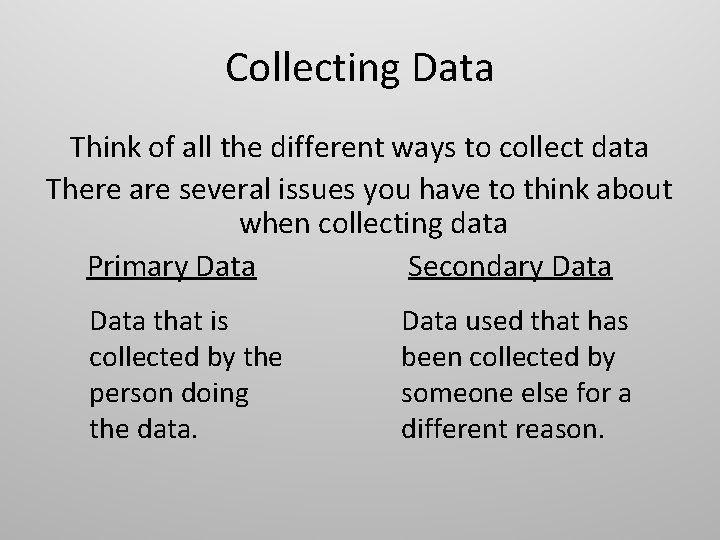
Collecting Data Think of all the different ways to collect data There are several issues you have to think about when collecting data Primary Data Secondary Data that is collected by the person doing the data. Data used that has been collected by someone else for a different reason.
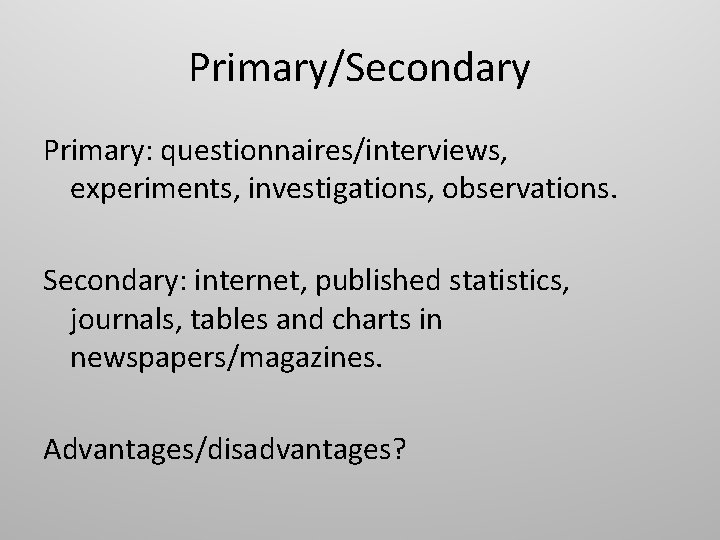
Primary/Secondary Primary: questionnaires/interviews, experiments, investigations, observations. Secondary: internet, published statistics, journals, tables and charts in newspapers/magazines. Advantages/disadvantages?
Questionnaires • A good study could possibly need 100 s of respondents. In what way could the design of your questions help you when analysing the surveys? • Most surveys are anonymous. Why is it still not a good idea to ask personal or embarrassing questions in your survey? Avoiding bias in your questions. . .
Questions • Keep them short and easy to answer. • No personal questions • Be careful of bias in your questions Page 90 -91 Q 12, 15 Q 17 OR Q 18
Sampling In the census the government gets data from every person in the country. Why would this not be suitable for most other studies? The population is the group of people who the study relates to. The sample is the section of that group that you use to get your data. The bigger the sample is the more accurate the results will be
Bias in sampling A group wanted to give out surveys to help measure the alcohol consumption of people in Ireland. Where would be a bad place for them to give out surveys? Another group wanted to get data on the eating habits of Irish families. Where would be an ideal place for them to gather data? The best method for getting the correct sample? (Ryder cup example)
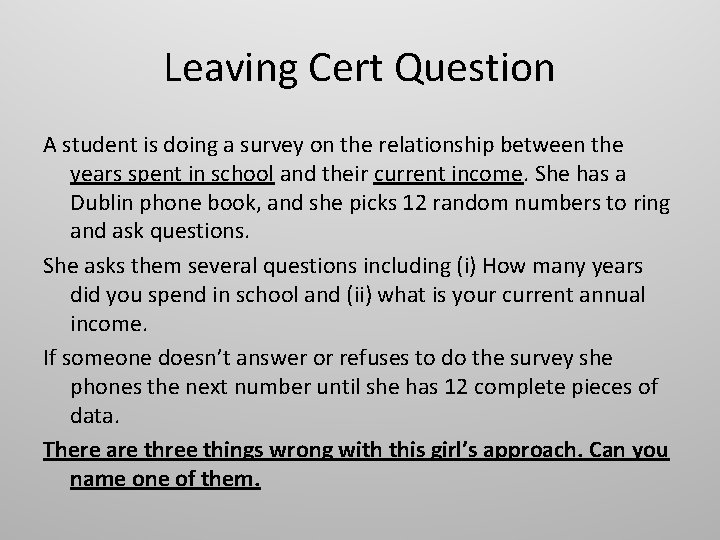
Leaving Cert Question A student is doing a survey on the relationship between the years spent in school and their current income. She has a Dublin phone book, and she picks 12 random numbers to ring and ask questions. She asks them several questions including (i) How many years did you spend in school and (ii) what is your current annual income. If someone doesn’t answer or refuses to do the survey she phones the next number until she has 12 complete pieces of data. There are three things wrong with this girl’s approach. Can you name one of them.
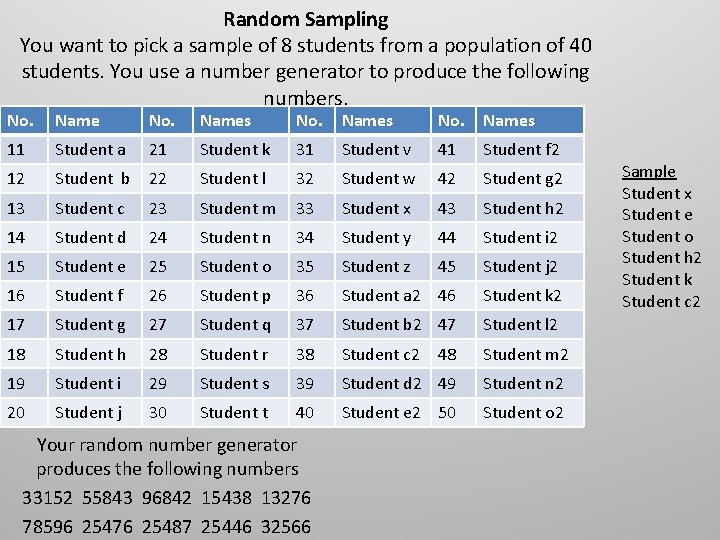
Random Sampling You want to pick a sample of 8 students from a population of 40 students. You use a number generator to produce the following numbers. No. Names 1 11 Student a 11 21 Student k 21 31 Student v 31 41 Student f 2 2 12 Student b 12 22 Student l 22 32 Student w 32 42 Student g 2 3 13 Student c 13 23 Student m 23 33 Student x 33 43 Student h 2 4 14 Student d 14 24 Student n 24 34 Student y 34 44 Student i 2 5 15 Student e 15 25 Student o 25 35 Student z 35 45 Student j 2 6 16 Student f 16 26 Student p 26 36 Student a 2 46 36 Student k 2 7 17 Student g 17 27 Student q 27 37 Student b 2 47 37 Student l 2 8 18 Student h 18 28 Student r 28 38 Student c 2 48 38 Student m 2 9 19 Student i 19 29 Student s 29 39 Student d 2 49 39 Student n 2 10 20 Student j 20 30 Student t 30 40 Student e 2 50 40 Student o 2 Your random number generator produces the following numbers 33152 55843 96842 15438 13276 78596 25476 25487 25446 32566 Sample Student x Student e Student o Student h 2 Student k Student c 2
Chapter 8 Measures of Location and Spread
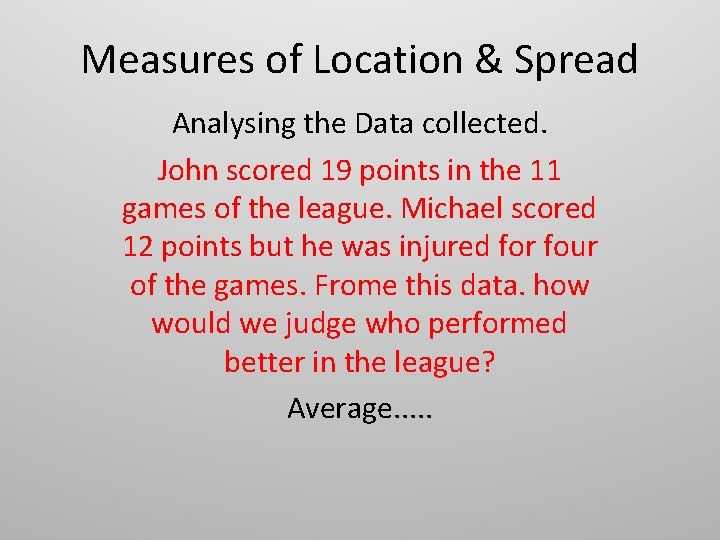
Measures of Location & Spread Analysing the Data collected. John scored 19 points in the 11 games of the league. Michael scored 12 points but he was injured for four of the games. Frome this data. how would we judge who performed better in the league? Average. . .
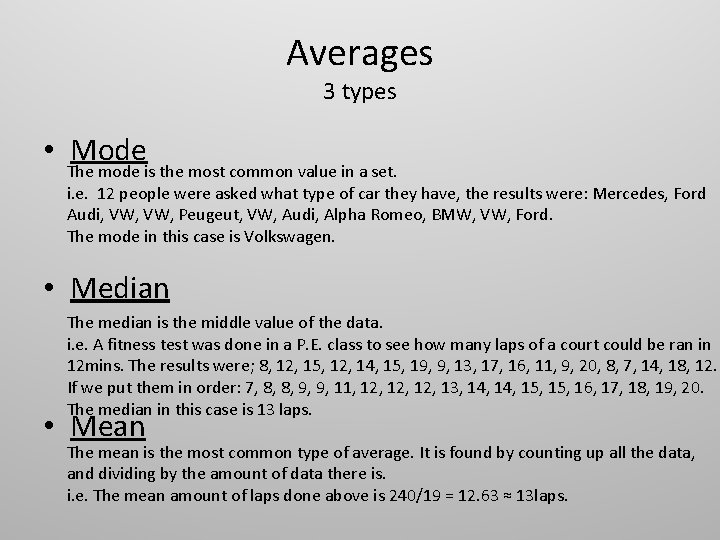
Averages 3 types • Mode The mode is the most common value in a set. i. e. 12 people were asked what type of car they have, the results were: Mercedes, Ford Audi, VW, Peugeut, VW, Audi, Alpha Romeo, BMW, VW, Ford. The mode in this case is Volkswagen. • Median The median is the middle value of the data. i. e. A fitness test was done in a P. E. class to see how many laps of a court could be ran in 12 mins. The results were; 8, 12, 15, 12, 14, 15, 19, 9, 13, 17, 16, 11, 9, 20, 8, 7, 14, 18, 12. If we put them in order: 7, 8, 8, 9, 9, 11, 12, 12, 13, 14, 15, 16, 17, 18, 19, 20. The median in this case is 13 laps. • Mean The mean is the most common type of average. It is found by counting up all the data, and dividing by the amount of data there is. i. e. The mean amount of laps done above is 240/19 = 12. 63 ≈ 13 laps.
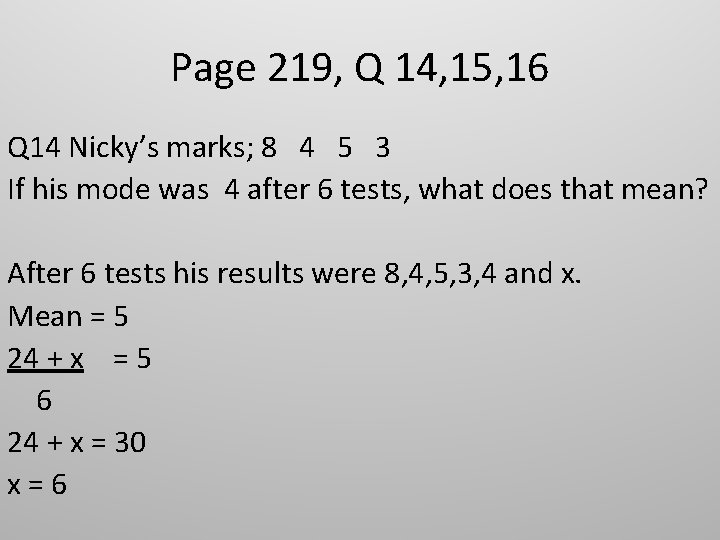
Page 219, Q 14, 15, 16 Q 14 Nicky’s marks; 8 4 5 3 If his mode was 4 after 6 tests, what does that mean? After 6 tests his results were 8, 4, 5, 3, 4 and x. Mean = 5 24 + x = 5 6 24 + x = 30 x=6
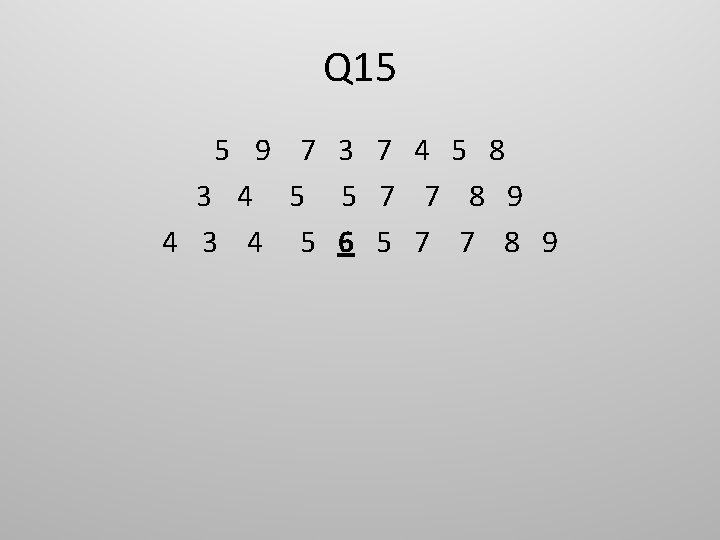
Q 15 5 9 7 3 7 4 5 8 3 4 5 5 7 7 8 9 4 3 4 5 6 5 7 7 8 9
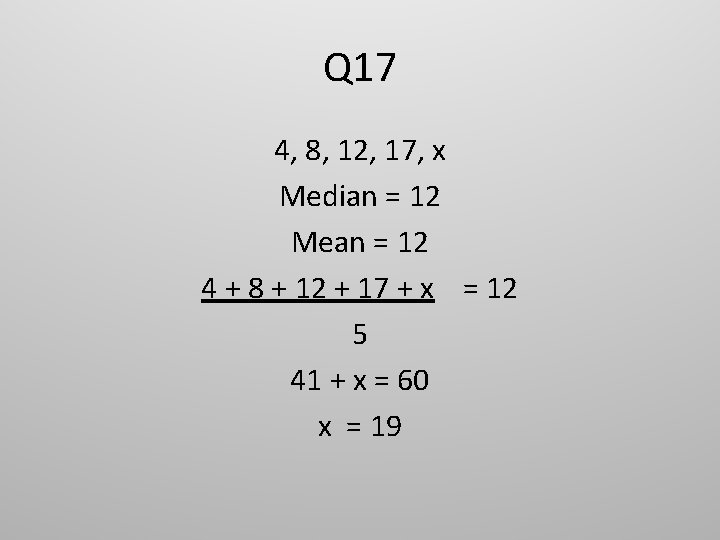
Q 17 4, 8, 12, 17, x Median = 12 Mean = 12 4 + 8 + 12 + 17 + x = 12 5 41 + x = 60 x = 19
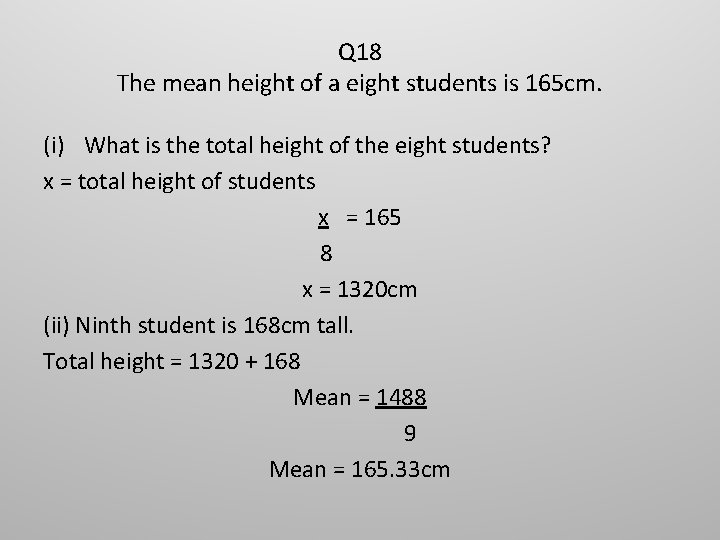
Q 18 The mean height of a eight students is 165 cm. (i) What is the total height of the eight students? x = total height of students x = 165 8 x = 1320 cm (ii) Ninth student is 168 cm tall. Total height = 1320 + 168 Mean = 1488 9 Mean = 165. 33 cm
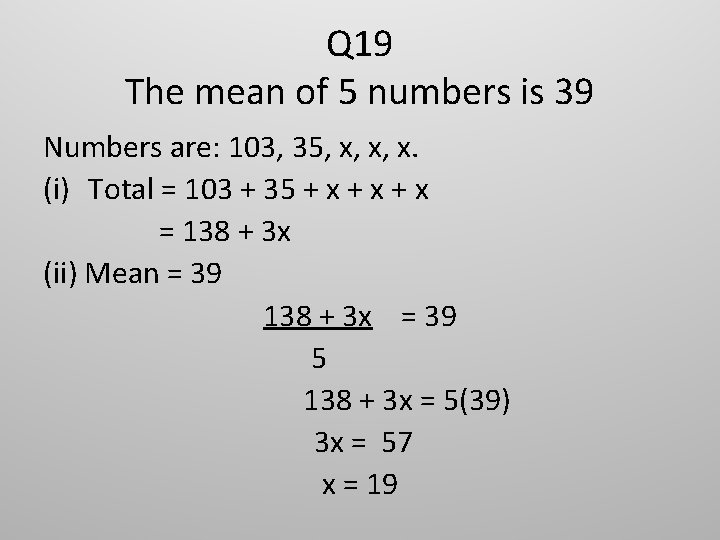
Q 19 The mean of 5 numbers is 39 Numbers are: 103, 35, x, x, x. (i) Total = 103 + 35 + x + x = 138 + 3 x (ii) Mean = 39 138 + 3 x = 39 5 138 + 3 x = 5(39) 3 x = 57 x = 19
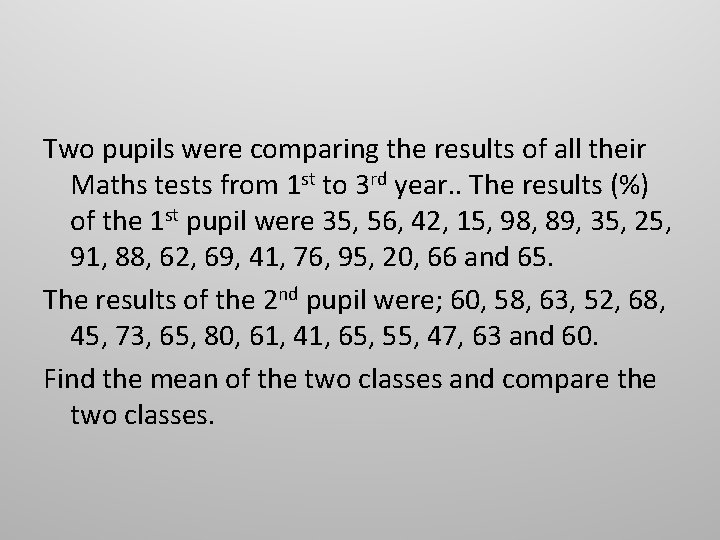
Two pupils were comparing the results of all their Maths tests from 1 st to 3 rd year. . The results (%) of the 1 st pupil were 35, 56, 42, 15, 98, 89, 35, 25, 91, 88, 62, 69, 41, 76, 95, 20, 66 and 65. The results of the 2 nd pupil were; 60, 58, 63, 52, 68, 45, 73, 65, 80, 61, 41, 65, 55, 47, 63 and 60. Find the mean of the two classes and compare the two classes.
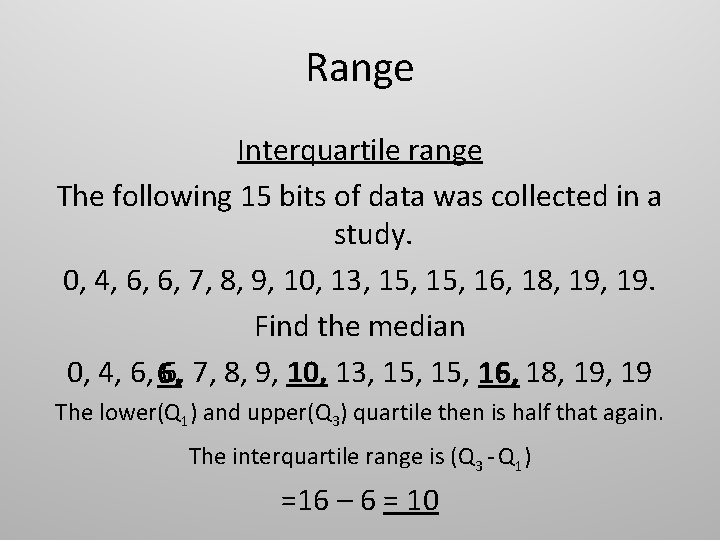
Range Interquartile range The following 15 bits of data was collected in a study. 0, 4, 6, 6, 7, 8, 9, 10, 13, 15, 16, 18, 19. Find the median 0, 4, 6, 6, 6, 7, 8, 9, 10, 13, 15, 16, 18, 19 The lower(Q 1) and upper(Q 3) quartile then is half that again. The interquartile range is (Q 3 - Q 1) =16 – 6 = 10
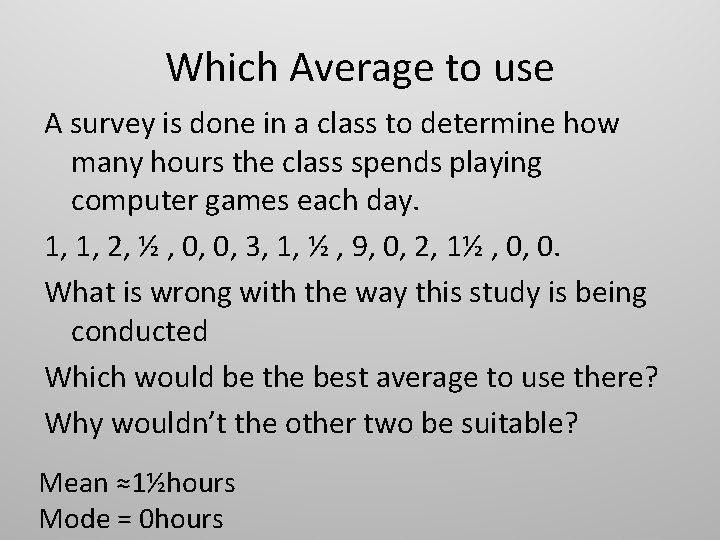
Which Average to use A survey is done in a class to determine how many hours the class spends playing computer games each day. 1, 1, 2, ½ , 0, 0, 3, 1, ½ , 9, 0, 2, 1½ , 0, 0. What is wrong with the way this study is being conducted Which would be the best average to use there? Why wouldn’t the other two be suitable? Mean ≈1½hours Mode = 0 hours
Q’s 1 , 4, 5, 6, 8, 9
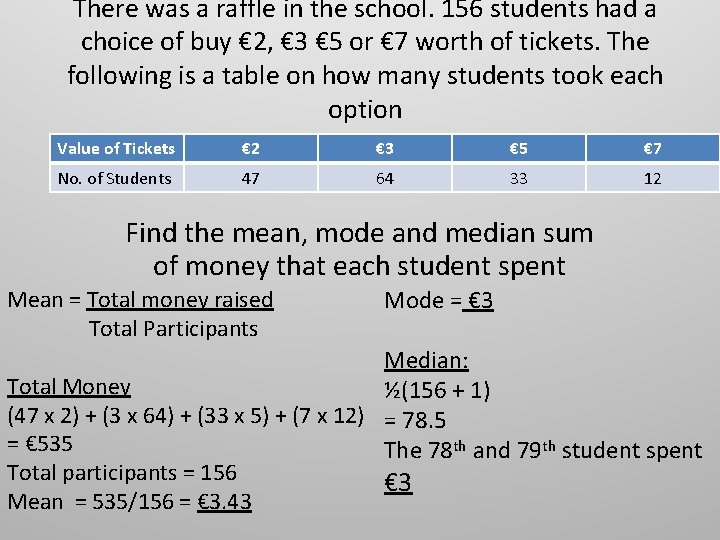
There was a raffle in the school. 156 students had a choice of buy € 2, € 3 € 5 or € 7 worth of tickets. The following is a table on how many students took each option Value of Tickets € 2 € 3 € 5 € 7 No. of Students 47 64 33 12 Find the mean, mode and median sum of money that each student spent Mean = Total money raised Total Participants Mode = € 3 Median: Total Money ½(156 + 1) (47 x 2) + (3 x 64) + (33 x 5) + (7 x 12) = 78. 5 = € 535 The 78 th and 79 th student spent Total participants = 156 € 3 Mean = 535/156 = € 3. 43
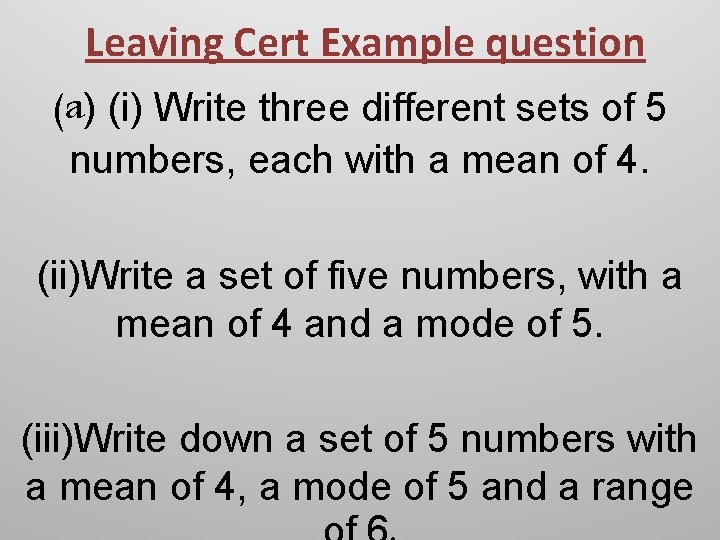
Leaving Cert Example question (a) (i) Write three different sets of 5 numbers, each with a mean of 4. (ii)Write a set of five numbers, with a mean of 4 and a mode of 5. (iii)Write down a set of 5 numbers with a mean of 4, a mode of 5 and a range
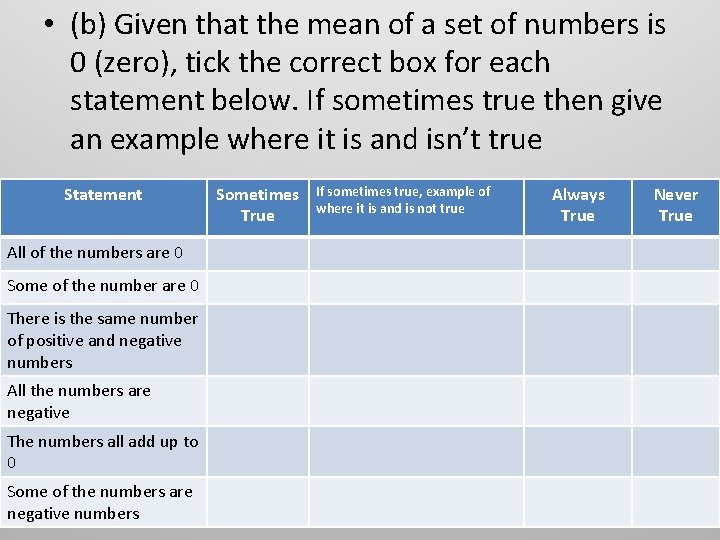
• (b) Given that the mean of a set of numbers is 0 (zero), tick the correct box for each statement below. If sometimes true then give an example where it is and isn’t true Statement All of the numbers are 0 Some of the number are 0 There is the same number of positive and negative numbers All the numbers are negative The numbers all add up to 0 Some of the numbers are negative numbers Sometimes True If sometimes true, example of where it is and is not true Always True Never True
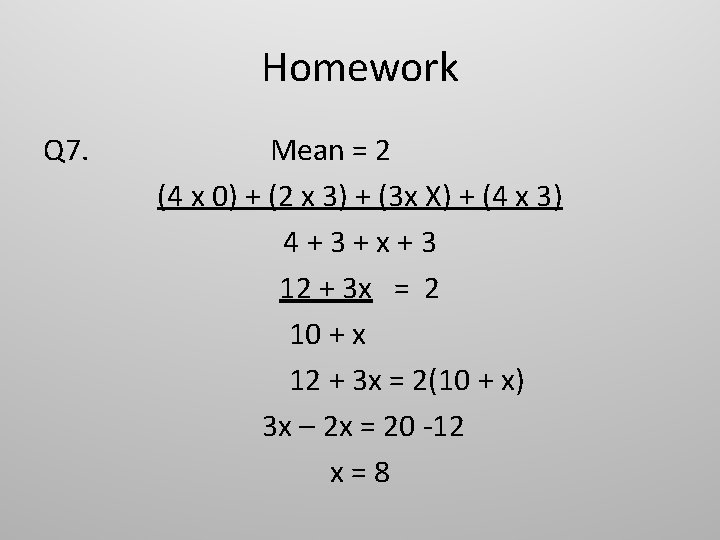
Homework Q 7. Mean = 2 (4 x 0) + (2 x 3) + (3 x X) + (4 x 3) 4+3+x+3 12 + 3 x = 2 10 + x 12 + 3 x = 2(10 + x) 3 x – 2 x = 20 -12 x=8
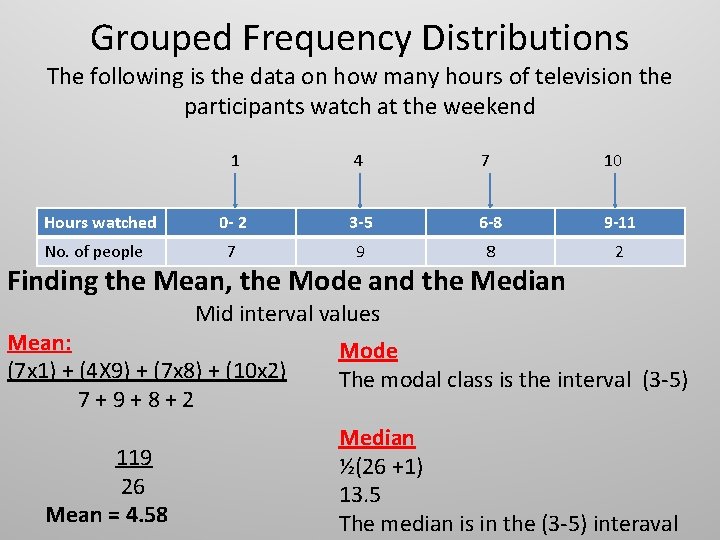
Grouped Frequency Distributions The following is the data on how many hours of television the participants watch at the weekend Hours watched No. of people 1 4 7 10 0 - 2 3 -5 6 -8 9 -11 7 9 8 2 Finding the Mean, the Mode and the Median Mid interval values Mean: (7 x 1) + (4 X 9) + (7 x 8) + (10 x 2) 7+9+8+2 119 26 Mean = 4. 58 Mode The modal class is the interval (3 -5) Median ½(26 +1) 13. 5 The median is in the (3 -5) interaval
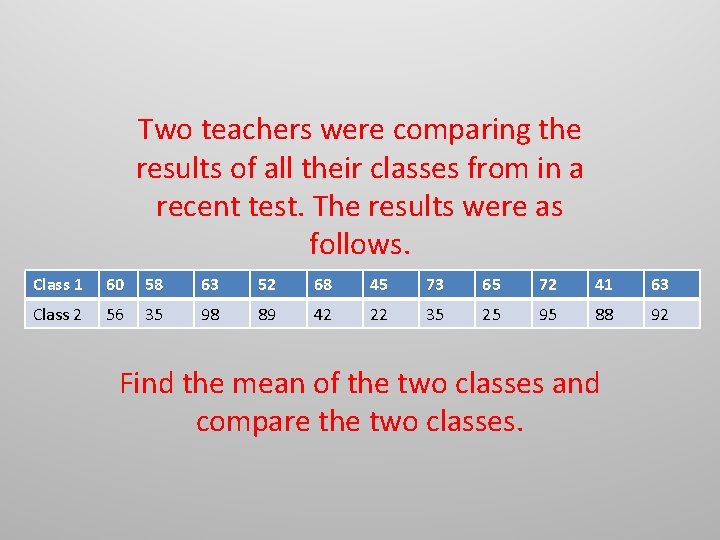
Two teachers were comparing the results of all their classes from in a recent test. The results were as follows. Class 1 60 58 63 52 68 45 73 65 72 41 63 Class 2 56 35 98 89 42 22 35 25 95 88 92 Find the mean of the two classes and compare the two classes.
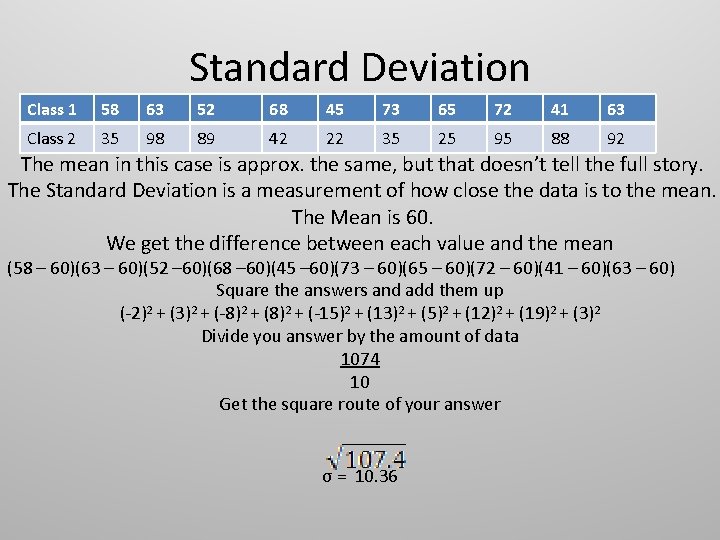
Standard Deviation Class 1 58 63 52 68 45 73 65 72 41 63 Class 2 35 98 89 42 22 35 25 95 88 92 The mean in this case is approx. the same, but that doesn’t tell the full story. The Standard Deviation is a measurement of how close the data is to the mean. The Mean is 60. We get the difference between each value and the mean (58 – 60)(63 – 60)(52 – 60)(68 – 60)(45 – 60)(73 – 60)(65 – 60)(72 – 60)(41 – 60)(63 – 60) Square the answers and add them up (-2)2 + (3)2 + (-8)2 + (-15)2 + (13)2 + (5)2 + (12)2 + (19)2 + (3)2 Divide you answer by the amount of data 1074 10 Get the square route of your answer σ = 10. 36
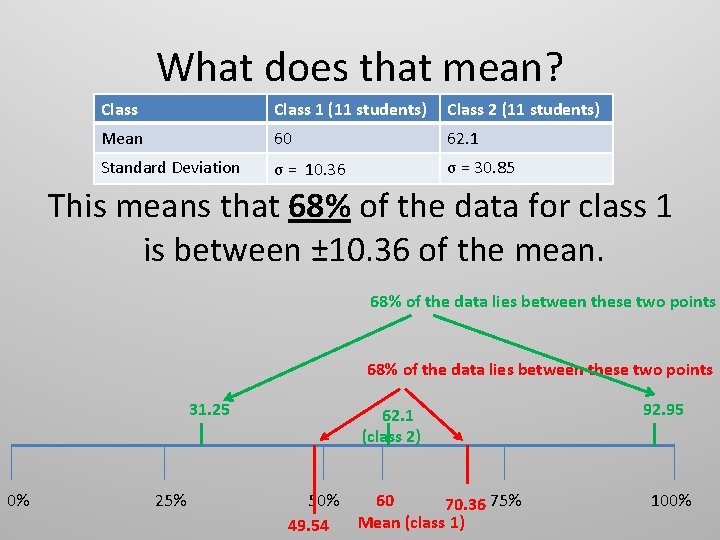
What does that mean? Class 1 (11 students) Class 2 (11 students) Mean 60 62. 1 Standard Deviation σ = 10. 36 σ = 30. 85 This means that 68% of the data for class 1 is between ± 10. 36 of the mean. 68% of the data lies between these two points 31. 25 0% 25% 62. 1 (class 2) 50% 49. 54 60 70. 36 75% Mean (class 1) 92. 95 100%
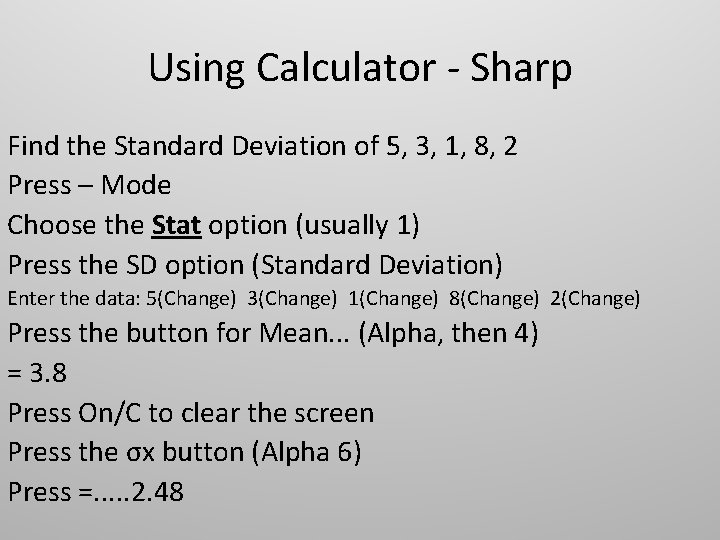
Using Calculator - Sharp Find the Standard Deviation of 5, 3, 1, 8, 2 Press – Mode Choose the Stat option (usually 1) Press the SD option (Standard Deviation) Enter the data: 5(Change) 3(Change) 1(Change) 8(Change) 2(Change) Press the button for Mean. . . (Alpha, then 4) = 3. 8 Press On/C to clear the screen Press the σx button (Alpha 6) Press =. . . 2. 48
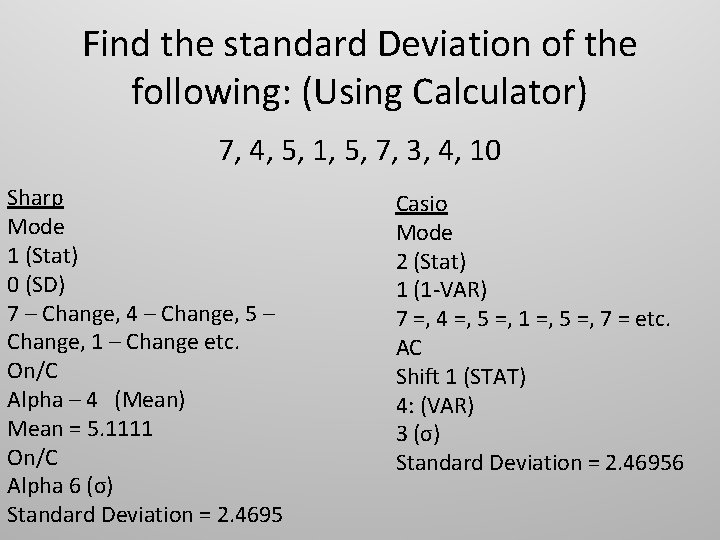
Find the standard Deviation of the following: (Using Calculator) 7, 4, 5, 1, 5, 7, 3, 4, 10 Sharp Mode 1 (Stat) 0 (SD) 7 – Change, 4 – Change, 5 – Change, 1 – Change etc. On/C Alpha – 4 (Mean) Mean = 5. 1111 On/C Alpha 6 (σ) Standard Deviation = 2. 4695 Casio Mode 2 (Stat) 1 (1 -VAR) 7 =, 4 =, 5 =, 1 =, 5 =, 7 = etc. AC Shift 1 (STAT) 4: (VAR) 3 (σ) Standard Deviation = 2. 46956
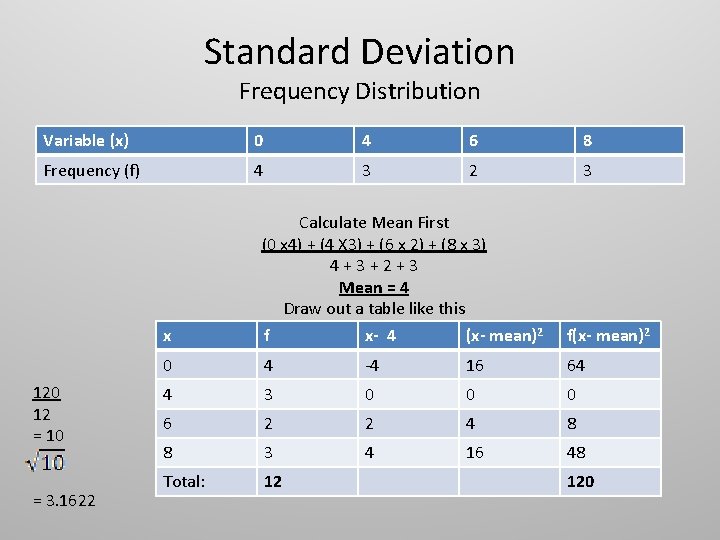
Standard Deviation Frequency Distribution Variable (x) 0 4 6 8 Frequency (f) 4 3 2 3 120 12 = 10 = 3. 1622 x Calculate Mean First (0 x 4) + (4 X 3) + (6 x 2) + (8 x 3) 4+3+2+3 Mean = 4 Draw out a table like this f x- 4 (x- mean)2 f(x- mean)2 0 4 -4 16 64 4 3 0 0 0 6 2 2 4 8 8 3 4 16 48 Total: 12 120
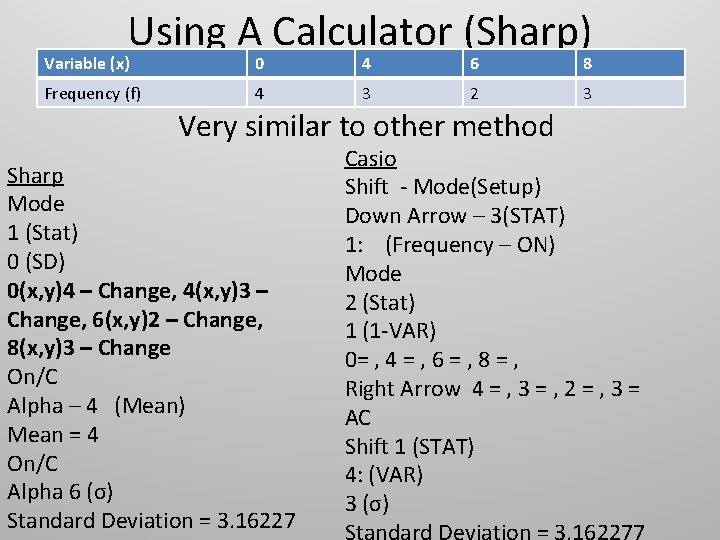
Using A Calculator (Sharp) Variable (x) 0 4 6 8 Frequency (f) 4 3 2 3 Very similar to other method Sharp Mode 1 (Stat) 0 (SD) 0(x, y)4 – Change, 4(x, y)3 – Change, 6(x, y)2 – Change, 8(x, y)3 – Change On/C Alpha – 4 (Mean) Mean = 4 On/C Alpha 6 (σ) Standard Deviation = 3. 16227 Casio Shift - Mode(Setup) Down Arrow – 3(STAT) 1: (Frequency – ON) Mode 2 (Stat) 1 (1 -VAR) 0= , 4 = , 6 = , 8 = , Right Arrow 4 = , 3 = , 2 = , 3 = AC Shift 1 (STAT) 4: (VAR) 3 (σ)
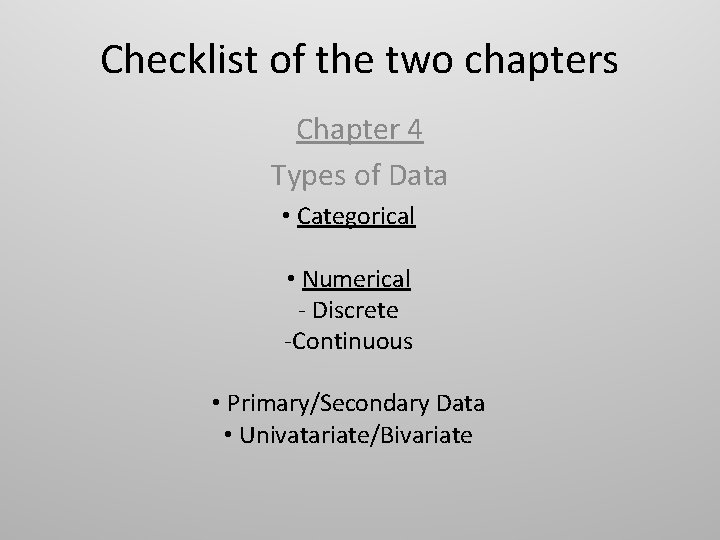
Checklist of the two chapters Chapter 4 Types of Data • Categorical • Numerical - Discrete -Continuous • Primary/Secondary Data • Univatariate/Bivariate
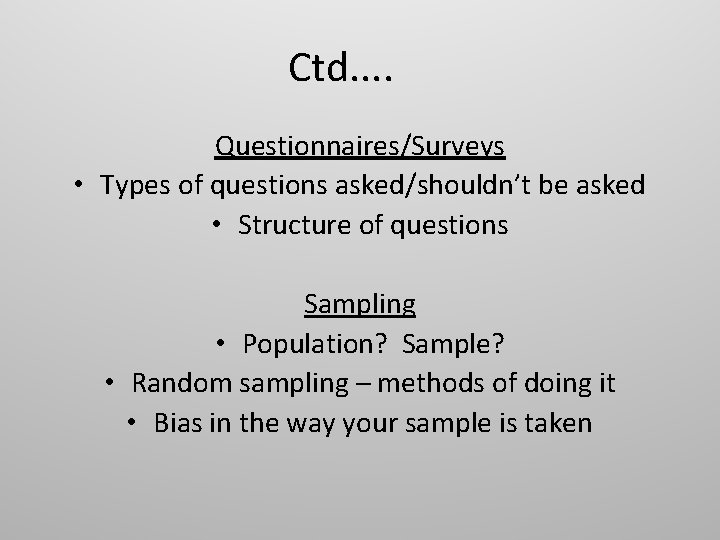
Ctd. . Questionnaires/Surveys • Types of questions asked/shouldn’t be asked • Structure of questions Sampling • Population? Sample? • Random sampling – methods of doing it • Bias in the way your sample is taken
Measurements of Location & Spread Different Terms Averages Mean, Mode, Median Which average to use and when Range and Inter Quartile Range Frequency Distribution Table/Mid interval Values Standard Deviation (using calculator)
Chapter 13
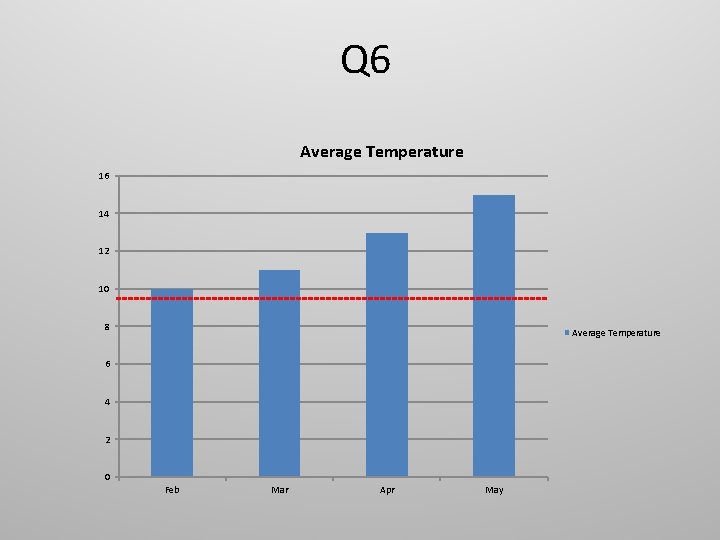
Q 6 Average Temperature 16 14 12 10 8 Average Temperature 6 4 2 0 Feb Mar Apr May
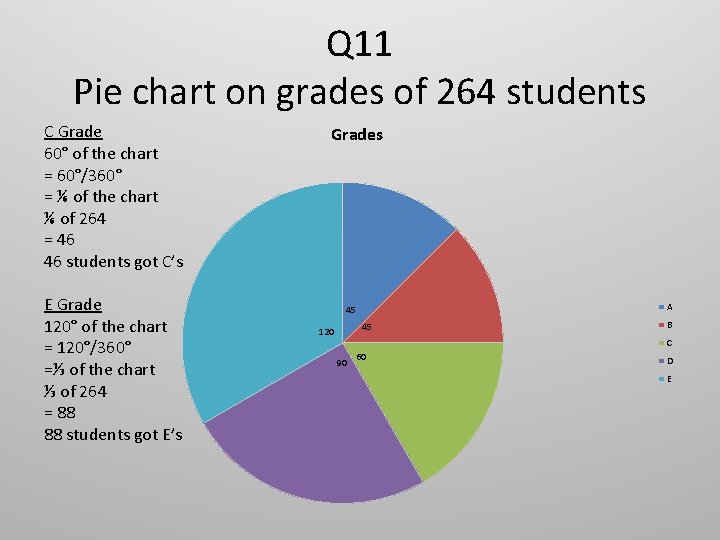
Q 11 Pie chart on grades of 264 students C Grade 60° of the chart = 60°/360° = ⅙ of the chart ⅙ of 264 = 46 46 students got C’s E Grade 120° of the chart = 120°/360° =⅓ of the chart ⅓ of 264 = 88 88 students got E’s Grades A 45 45 120 B C 90 60 D E
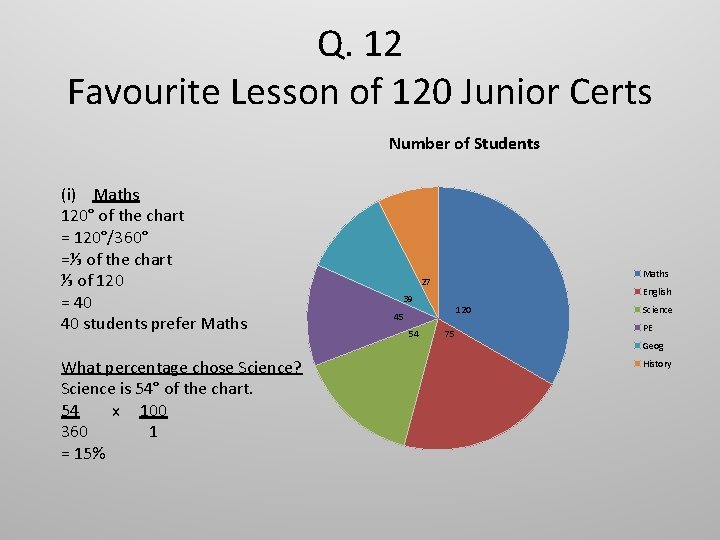
Q. 12 Favourite Lesson of 120 Junior Certs Number of Students (i) Maths 120° of the chart = 120°/360° =⅓ of the chart ⅓ of 120 = 40 40 students prefer Maths What percentage chose Science? Science is 54° of the chart. 54 x 100 360 1 = 15% Maths 27 English 39 120 45 54 75 Science PE Geog History
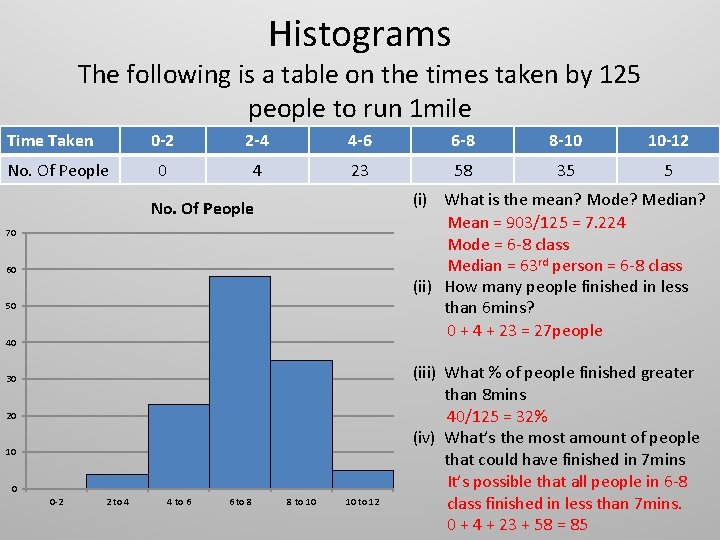
Histograms The following is a table on the times taken by 125 people to run 1 mile Time Taken No. Of People 0 -2 2 -4 4 -6 6 -8 8 -10 10 -12 0 4 23 58 35 5 (i) What is the mean? Mode? Median? Mean = 903/125 = 7. 224 Mode = 6 -8 class Median = 63 rd person = 6 -8 class (ii) How many people finished in less than 6 mins? 0 + 4 + 23 = 27 people No. Of People 70 60 50 40 30 20 10 0 0 -2 2 to 4 4 to 6 6 to 8 8 to 10 10 to 12 (iii) What % of people finished greater than 8 mins 40/125 = 32% (iv) What’s the most amount of people that could have finished in 7 mins It’s possible that all people in 6 -8 class finished in less than 7 mins. 0 + 4 + 23 + 58 = 85
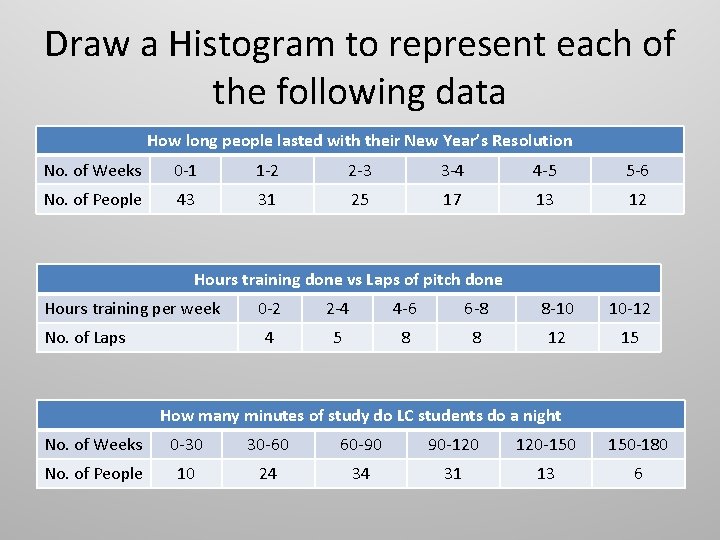
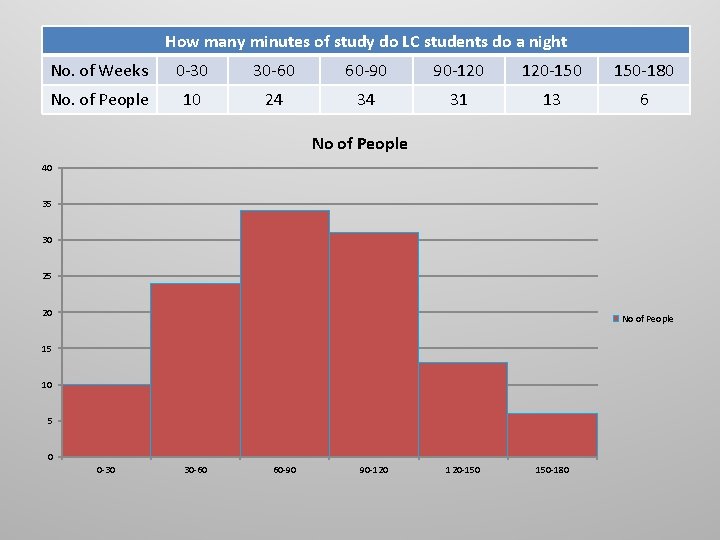
Draw a Histogram to represent each of the following data How long people lasted with their New Year’s Resolution No. of Weeks 0 -1 1 -2 2 -3 3 -4 4 -5 5 -6 No. of People 43 31 25 17 13 12 Hours training done vs Laps of pitch done Hours training per week No. of Laps 0 -2 2 -4 4 -6 6 -8 8 -10 10 -12 4 5 8 8 12 15 How many minutes of study do LC students do a night No. of Weeks 0 -30 30 -60 60 -90 90 -120 120 -150 150 -180 No. of People 10 24 34 31 13 6
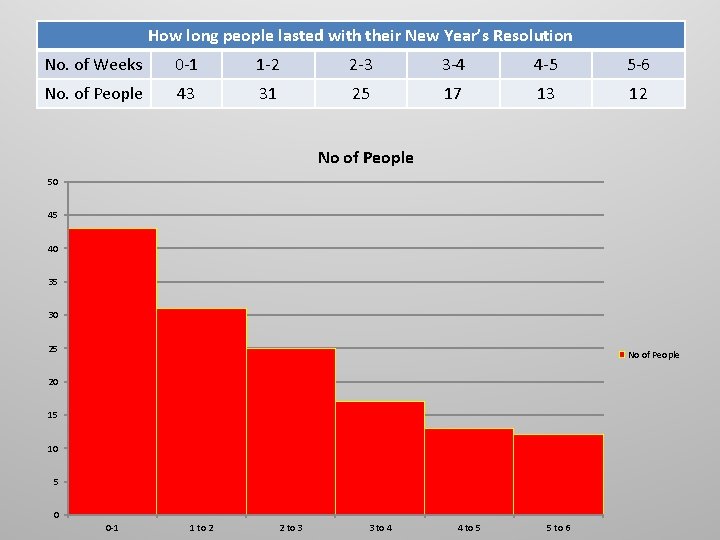
How long people lasted with their New Year’s Resolution No. of Weeks 0 -1 1 -2 2 -3 3 -4 4 -5 5 -6 No. of People 43 31 25 17 13 12 No of People 50 45 40 35 30 25 No of People 20 15 10 5 0 0 -1 1 to 2 2 to 3 3 to 4 4 to 5 5 to 6
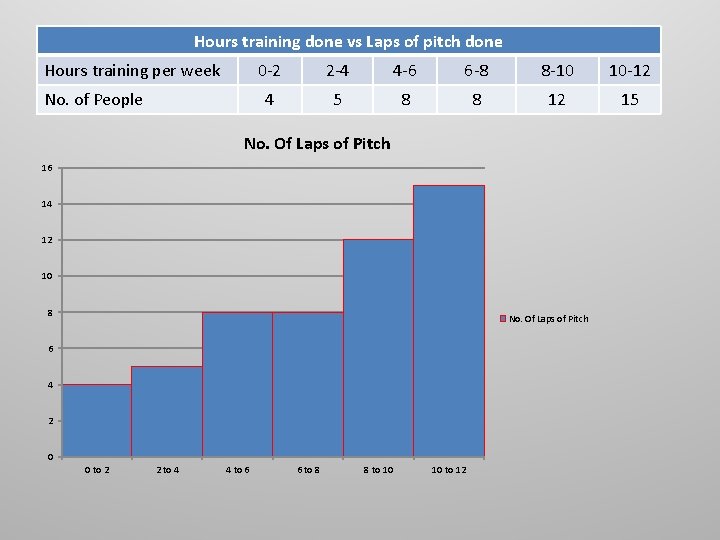
Hours training done vs Laps of pitch done Hours training per week No. of People 0 -2 2 -4 4 -6 6 -8 8 -10 10 -12 4 5 8 8 12 15 No. Of Laps of Pitch 16 14 12 10 8 No. Of Laps of Pitch 6 4 2 0 0 to 2 2 to 4 4 to 6 6 to 8 8 to 10 10 to 12
How many minutes of study do LC students do a night No. of Weeks 0 -30 30 -60 60 -90 90 -120 120 -150 150 -180 No. of People 10 24 34 31 13 6 No of People 40 35 30 25 20 No of People 15 10 5 0 0 -30 30 -60 60 -90 90 -120 120 -150 150 -180
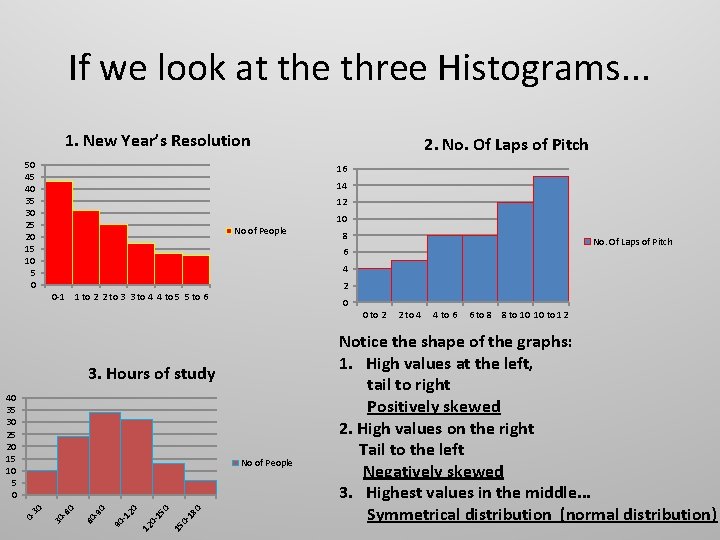
If we look at the three Histograms. . . 1. New Year’s Resolution 50 45 40 35 30 25 20 15 10 5 0 2. No. Of Laps of Pitch 16 14 12 No of People 10 8 No. Of Laps of Pitch 6 4 2 0 -1 1 to 2 2 to 3 3 to 4 4 to 5 5 to 6 0 0 to 2 3. Hours of study 40 35 30 25 20 15 10 5 0 0 - 18 0 0 15 15 12 0 - 20 -1 90 0 -9 60 0 -6 30 0 - 30 No of People 2 to 4 4 to 6 6 to 8 8 to 10 10 to 12 Notice the shape of the graphs: 1. High values at the left, tail to right Positively skewed 2. High values on the right Tail to the left Negatively skewed 3. Highest values in the middle. . . Symmetrical distribution (normal distribution)
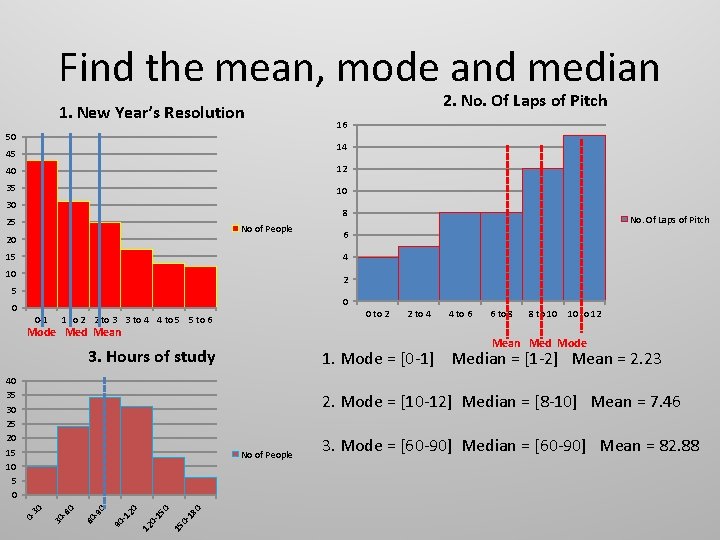
Find the mean, mode and median 1. New Year’s Resolution 50 2. No. Of Laps of Pitch 16 14 45 40 12 35 10 30 8 25 No of People 20 15 No. Of Laps of Pitch 6 4 10 2 5 0 0 0 -1 0 to 2 1 to 2 2 to 3 3 to 4 4 to 5 5 to 6 Mode Med Mean 4 to 6 6 to 8 8 to 10 10 to 12 Mean Med Mode 3. Hours of study 40 35 30 25 20 15 10 5 0 2 to 4 1. Mode = [0 -1] Median = [1 -2] Mean = 2. 23 2. Mode = [10 -12] Median = [8 -10] Mean = 7. 46 0 - 18 0 0 15 15 12 0 - 20 -1 90 0 -9 60 0 -6 30 0 - 30 No of People 3. Mode = [60 -90] Median = [60 -90] Mean = 82. 88
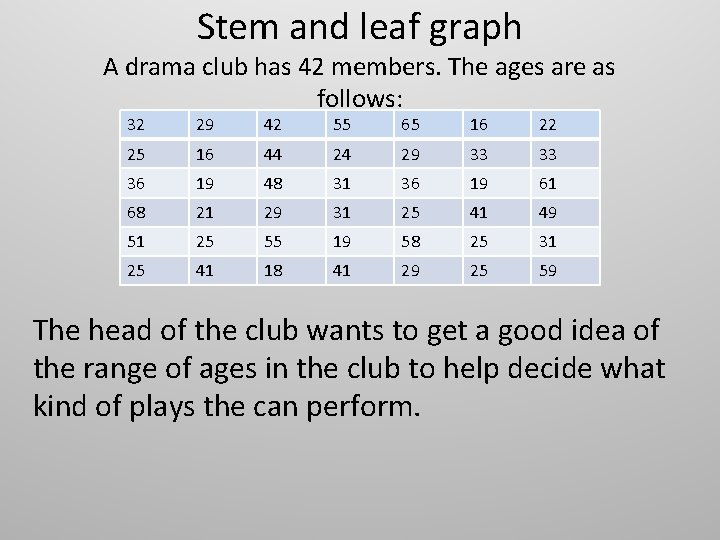
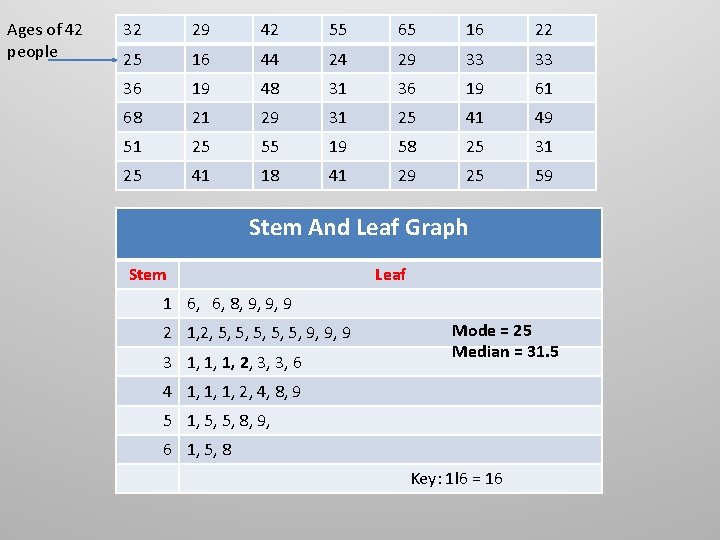
Stem and leaf graph A drama club has 42 members. The ages are as follows: 32 29 42 55 65 16 22 25 16 44 24 29 33 33 36 19 48 31 36 19 61 68 21 29 31 25 41 49 51 25 55 19 58 25 31 25 41 18 41 29 25 59 The head of the club wants to get a good idea of the range of ages in the club to help decide what kind of plays the can perform.
Ages of 42 people 32 29 42 55 65 16 22 25 16 44 24 29 33 33 36 19 48 31 36 19 61 68 21 29 31 25 41 49 51 25 55 19 58 25 31 25 41 18 41 29 25 59 Stem And Leaf Graph Stem Leaf 1 6, 6, 8, 9, 9 8 2 1, 2, 9, 2, 5, 4, 5, 9, 5, 1, 5, 9, 5, 9, 5 3 1, 2, 1, 3, 6, 3, 1, 16 Mode = 25 Median = 31. 5 4 1, 2, 1, 4, 1, 8, 2, 1, 4, 9, 8, 1, 9 1 5 1, 5, 5, 1, 5, 8, 9, 6 1, 5, 5, 1, 8 Key: 1 l 6 = 16 Key: = 16
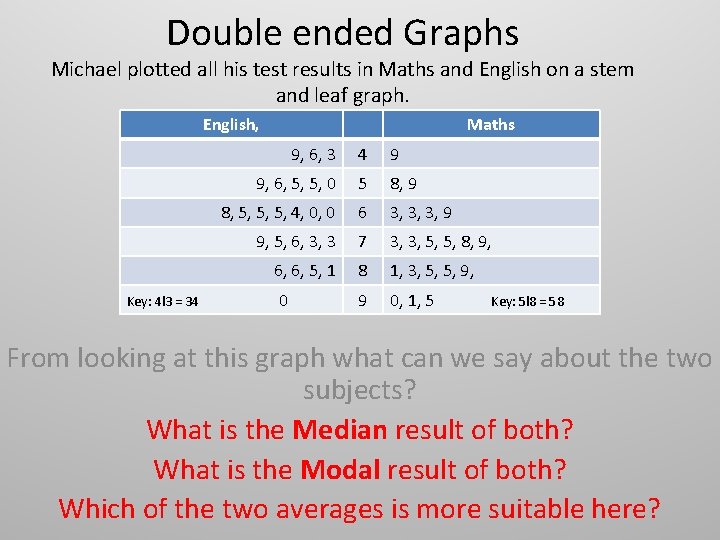
Double ended Graphs Michael plotted all his test results in Maths and English on a stem and leaf graph. English, Key: 4 l 3 = 34 Maths 9, 6, 3 4 9 9, 6, 5, 5, 0 5 8, 9 8, 5, 5, 5, 4, 0, 0 6 3, 3, 3, 9 9, 5, 6, 3, 3 7 3, 3, 5, 5, 8, 9, 6, 6, 5, 1 8 1, 3, 5, 5, 9, 0 9 0, 1, 5 Key: 5 l 8 = 58 From looking at this graph what can we say about the two subjects? What is the Median result of both? What is the Modal result of both? Which of the two averages is more suitable here?
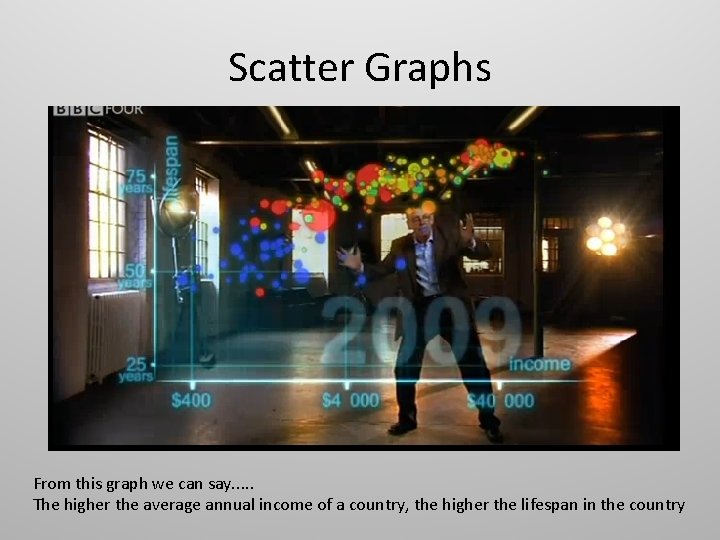
Scatter Graphs From this graph we can say. . . The higher the average annual income of a country, the higher the lifespan in the country
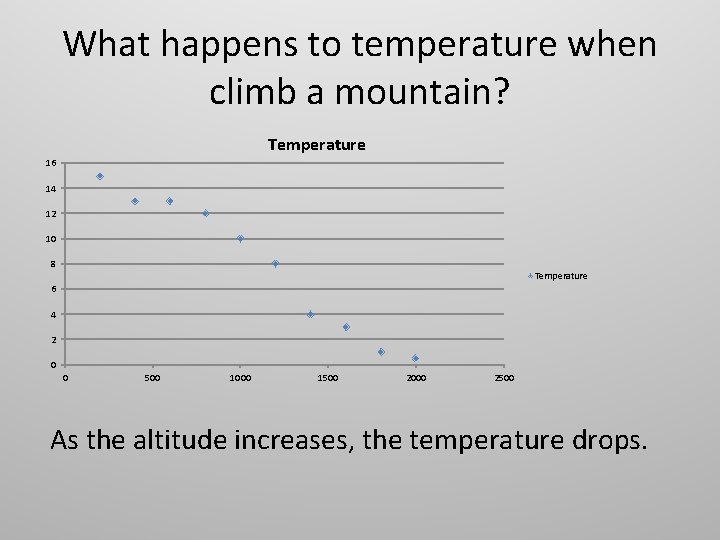
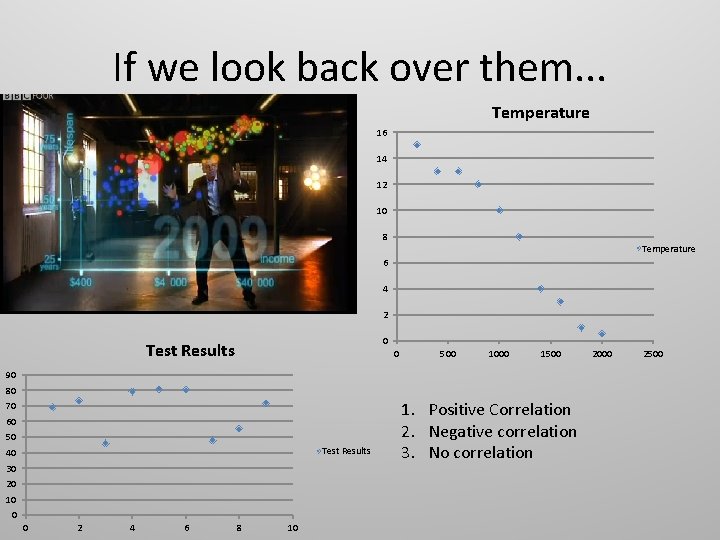
What happens to temperature when climb a mountain? Temperature 16 14 12 10 8 Temperature 6 4 2 0 0 500 1000 1500 2000 2500 As the altitude increases, the temperature drops.
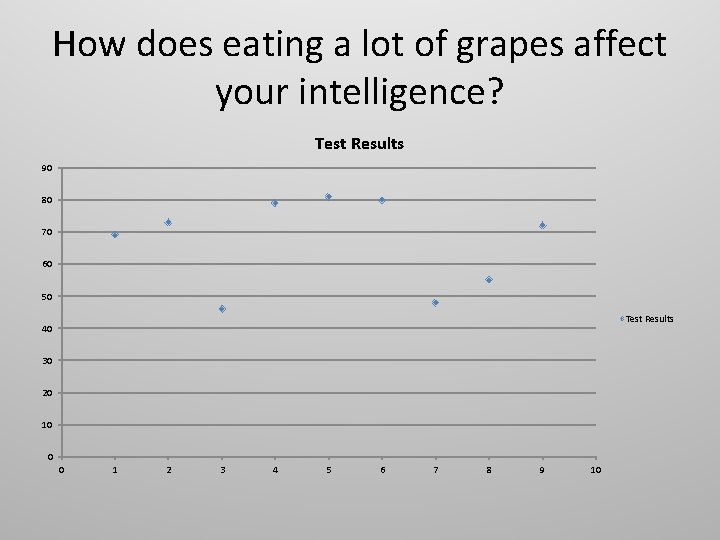
How does eating a lot of grapes affect your intelligence? Test Results 90 80 70 60 50 Test Results 40 30 20 10 0 0 1 2 3 4 5 6 7 8 9 10
If we look back over them. . . Temperature 16 14 12 10 8 Temperature 6 4 2 0 Test Results 0 500 1000 1500 90 80 70 60 50 Test Results 40 30 20 10 0 0 2 4 6 8 10 1. Positive Correlation 2. Negative correlation 3. No correlation 2000 2500
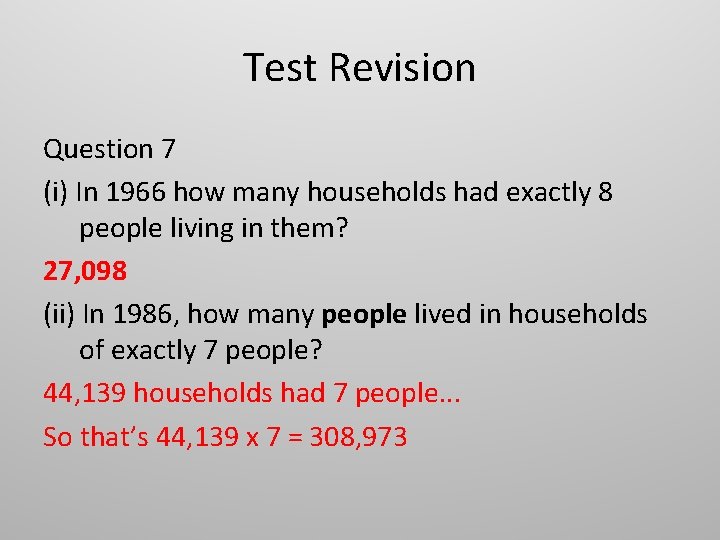
Test Revision Question 7 (i) In 1966 how many households had exactly 8 people living in them? 27, 098 (ii) In 1986, how many people lived in households of exactly 7 people? 44, 139 households had 7 people. . . So that’s 44, 139 x 7 = 308, 973
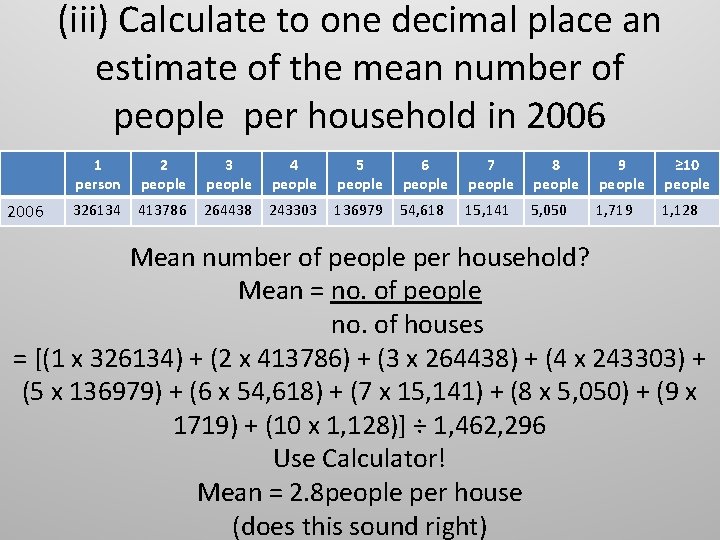
(iii) Calculate to one decimal place an estimate of the mean number of people per household in 2006 1 person 2 people 3 people 4 people 5 people 6 people 7 people 8 people 9 people ≥ 10 people 326134 413786 264438 243303 136979 54, 618 15, 141 5, 050 1, 719 1, 128 Mean number of people per household? Mean = no. of people no. of houses = [(1 x 326134) + (2 x 413786) + (3 x 264438) + (4 x 243303) + (5 x 136979) + (6 x 54, 618) + (7 x 15, 141) + (8 x 5, 050) + (9 x 1719) + (10 x 1, 128)] ÷ 1, 462, 296 Use Calculator! Mean = 2. 8 people per house (does this sound right)
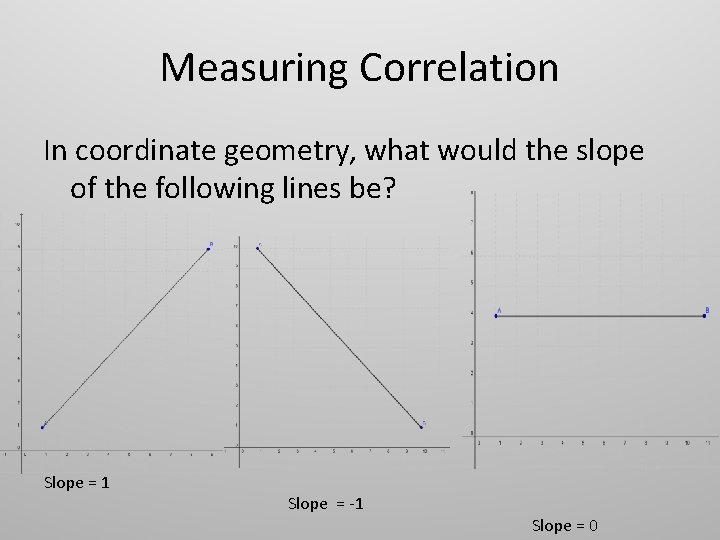
Measuring Correlation In coordinate geometry, what would the slope of the following lines be? Slope = 1 Slope = -1 Slope = 0
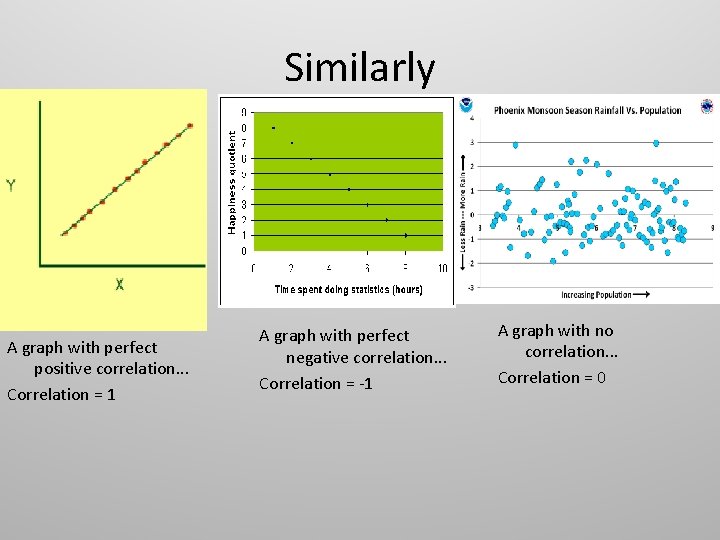
Similarly A graph with perfect positive correlation. . . Correlation = 1 A graph with perfect negative correlation. . . Correlation = -1 A graph with no correlation. . . Correlation = 0
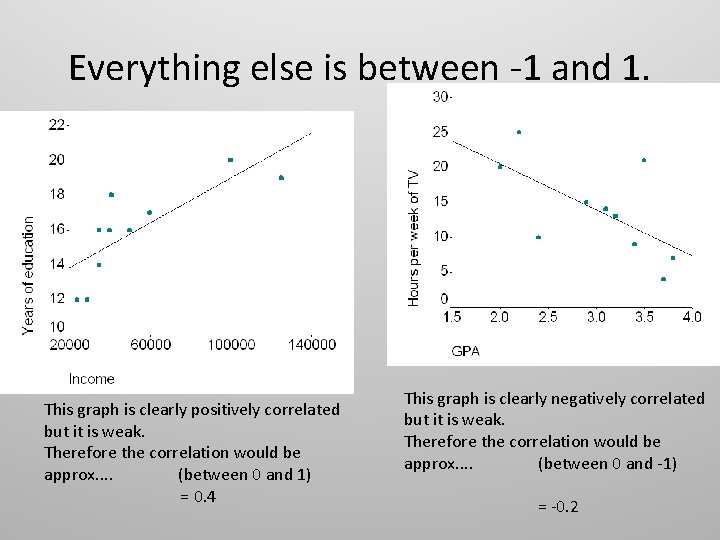
Everything else is between -1 and 1. This graph is clearly positively correlated but it is weak. Therefore the correlation would be approx. . (between 0 and 1) = 0. 4 This graph is clearly negatively correlated but it is weak. Therefore the correlation would be approx. . (between 0 and -1) = -0. 2