
Collecting and Recovering Evidence of Explosions Forensic Investigation
- Slides: 10
Collecting and Recovering Evidence of Explosions Forensic Investigation of Explosives May 7, 2015 Sanders 1: 47 PM
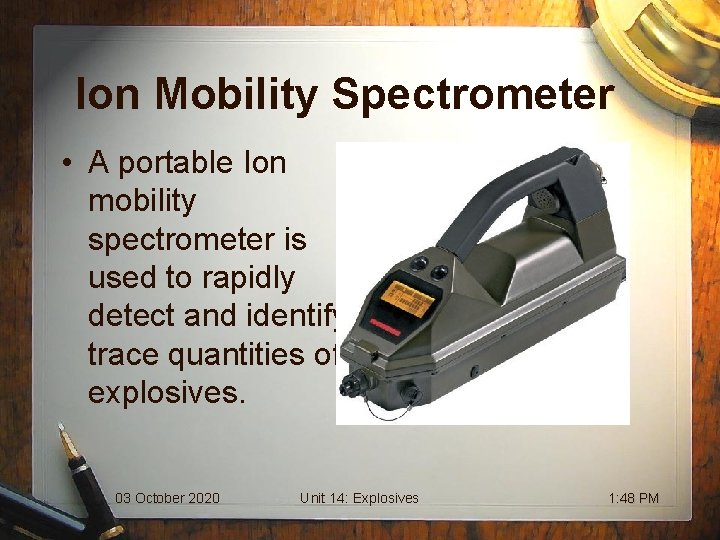
Ion Mobility Spectrometer • A portable Ion mobility spectrometer is used to rapidly detect and identify trace quantities of explosives. 03 October 2020 Unit 14: Explosives 1: 48 PM
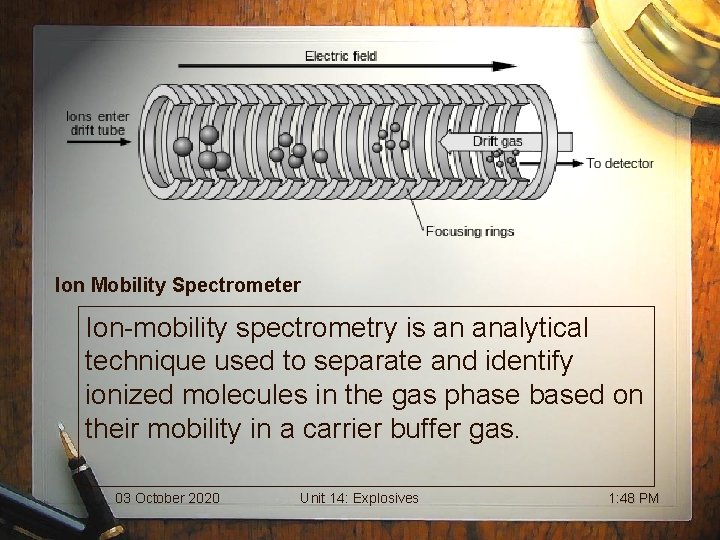
Ion Mobility Spectrometer Ion-mobility spectrometry is an analytical technique used to separate and identify ionized molecules in the gas phase based on their mobility in a carrier buffer gas. 03 October 2020 Unit 14: Explosives 1: 48 PM
Collection and Packaging • The entire bomb site must be systematically searched to recover any trace of a detonating mechanism or any other item that is foreign to the explosion site. 03 October 2020 Unit 14: Explosives 1: 48 PM
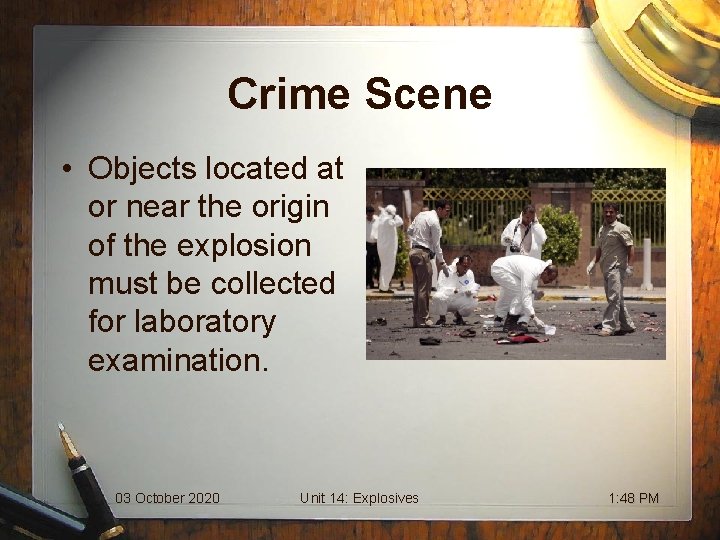
Crime Scene • Objects located at or near the origin of the explosion must be collected for laboratory examination. 03 October 2020 Unit 14: Explosives 1: 48 PM
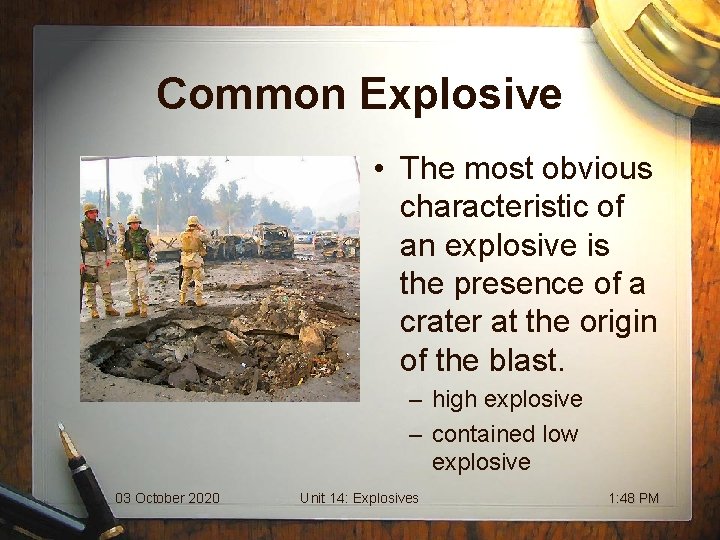
Common Explosive • The most obvious characteristic of an explosive is the presence of a crater at the origin of the blast. – high explosive – contained low explosive 03 October 2020 Unit 14: Explosives 1: 48 PM
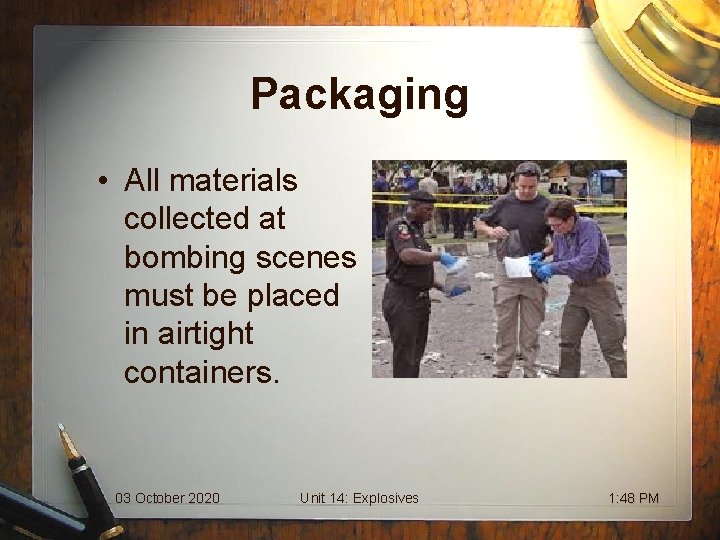
Packaging • All materials collected at bombing scenes must be placed in airtight containers. 03 October 2020 Unit 14: Explosives 1: 48 PM
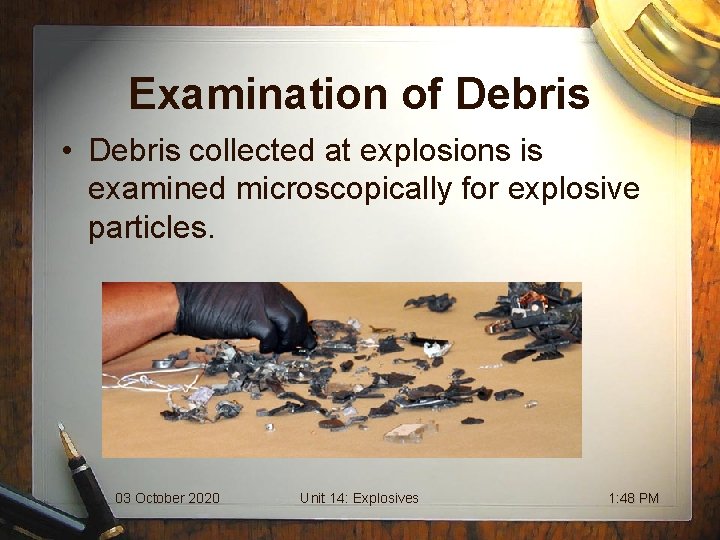
Examination of Debris • Debris collected at explosions is examined microscopically for explosive particles. 03 October 2020 Unit 14: Explosives 1: 48 PM
Sensitivity in Explosives • Recovered debris may be thoroughly rinsed with organic solvents and analyzed by testing procedures that include – – Color spot tests Thin layer chromatography Gas chromatography Mass spectrometry 03 October 2020 Unit 14: Explosives 1: 48 PM
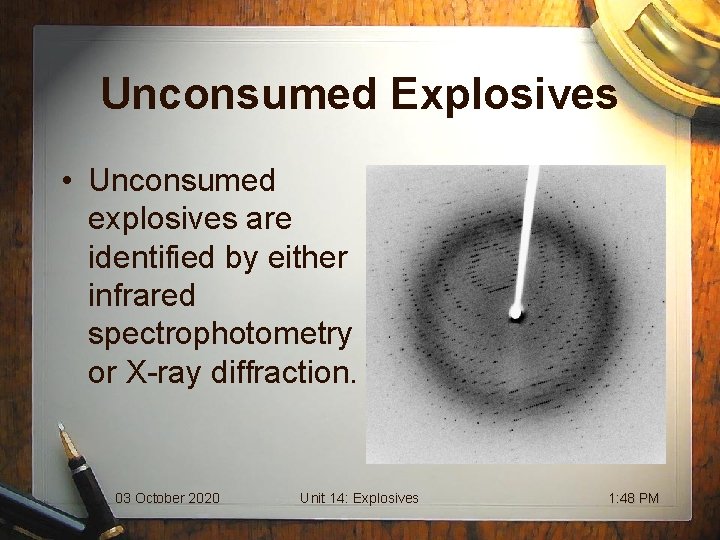
Unconsumed Explosives • Unconsumed explosives are identified by either infrared spectrophotometry or X-ray diffraction. 03 October 2020 Unit 14: Explosives 1: 48 PM