
Collateral First Aid Requirements Presented by This presentation
Collateral First Aid Requirements Presented by: This presentation was created by the N. C. Department of Labor for safety and health training.
Objectives At the end of this course, students will: l Recognize the difference between collateral duty and primary duty l Be aware of requirements for first aid availability l Be able to explain how collateral and primary first aid duty relates to the bloodborne pathogens standard This presentation was created by the N. C. Department of Labor for safety and health training.

Collateral Duty Vs. Primary Duty l Collateral duty: - Not your primary job assignment - You provide first aid, responding solely to injuries resulting from workplace incidents, generally at the location where the incident occurred. - Examples: teacher, camp counselor l Primary duty: - You are designated as a first aid provider and responsible to render first aid and medical assistance - Examples: emergency medical service personnel, lifeguard, plant nurse This presentation was created by the N. C. Department of Labor for safety and health training.
Medical Services and First Aid l General Industry – 29 CFR 1910. 151 l Construction – 29 CFR 1926. 50 Mancomm © NCDOL Photo Library This presentation was created by the N. C. Department of Labor for safety and health training.
Medical Services and First Aid 1910. 151 l General Industry - Employer shall ensure the ready availability of medical personnel for advice and consultation on matters of plant health - In the absence of an infirmary, clinic, or hospital in near proximity to the workplace which is used for the treatment of all injured employees, a person or persons shall be adequately trained to render first aid - When required to have a person adequately trained to render first aid then adequate first aid supplies shall be readily available This presentation was created by the N. C. Department of Labor for safety and health training.
Medical Services and First Aid 1926. 50 l Construction Industry - Provisions shall be made prior to commencement of the project for prompt medical attention in case of serious injury - Proper equipment for prompt transportation of the injured person to a physician or hospital, or a communication system for contacting necessary ambulance service, shall be provided This presentation was created by the N. C. Department of Labor for safety and health training.
Medical Services and First Aid 1926. 50 - In the absence of an infirmary, clinic, hospital, or physician, that is reasonably accessible in terms of time and distance to the worksite, which is available for the treatment of injured employees, a person who has a valid certificate in first-aid training that can be verified by documentary evidence, shall be available at the worksite to render first aid - First aid supplies shall be easily accessible when required This presentation was created by the N. C. Department of Labor for safety and health training.
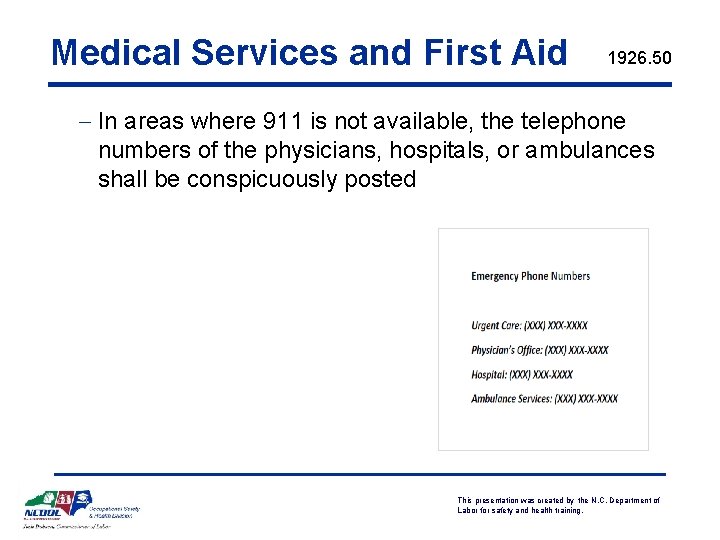
Medical Services and First Aid 1926. 50 - In areas where 911 is not available, the telephone numbers of the physicians, hospitals, or ambulances shall be conspicuously posted This presentation was created by the N. C. Department of Labor for safety and health training.
“In Near Proximity” “Reasonably Accessible” 1910. 151/1926. 50 l Interpretation letters - 1/16/2007 - 3/23/2007 l OSHA has long interpreted the term “in near proximity” and “reasonably accessible” to mean that emergency care must be available within no more than 3 -4 minutes from the workplace l OSHA does exercise discretion for particular cases - Possibility of serious work-related injuries is less likely » Up to 15 minutes may be reasonable This presentation was created by the N. C. Department of Labor for safety and health training.

Other Standards With First Aid Requirements l General Industry - 1910. 120 – HAZWOPER - 1910. 266 – Logging - 1910. 269 – Electrical Power Generation, Transmission and Distribution - 1910. 421 – Commercial Diving, Pre-dive Procedures l State-specific - 13 NCAC 7 F. 0605 – Communication Towers This presentation was created by the N. C. Department of Labor for safety and health training.
Bloodborne Pathogens (BBP) Standard l 1910. 1030 – Scope and Application » Applies to all occupational exposure to blood or other potentially infectious materials as defined by paragraph (b) l 13 NCAC 07 F. 0207 – Toxic and Hazardous Substances » Subpart Z – Toxic and Hazardous Substances – Incorporation of the existing standard for Bloodborne Pathogens, 29 CFR 1910. 1030, excluding subparagraph (e) – HIV and HBV Research Laboratories and Production Facilities, into the Safety & Health Regulations for Construction (29 CFR 1926) This presentation was created by the N. C. Department of Labor for safety and health training.
“Occupational Exposure” 1910. 1030, 13 NCAC 07 F. 0207 l General Industry – 1910. 1030 - Occupational Exposure means reasonably anticipated skin, eye, mucous membrane, or parenteral contact with blood or other potentially infectious materials that may result from the performance of an employee's duties l Construction – 13 NCAC 07 F. 0207 - Occupational Exposure means reasonably anticipated skin, eye, mucous membrane, or parenteral contact with blood or other potentially infectious materials that may result from the performance of collateral first aid duties by an employee in the areas of construction, alteration, or repair, including painting and decorating This presentation was created by the N. C. Department of Labor for safety and health training.
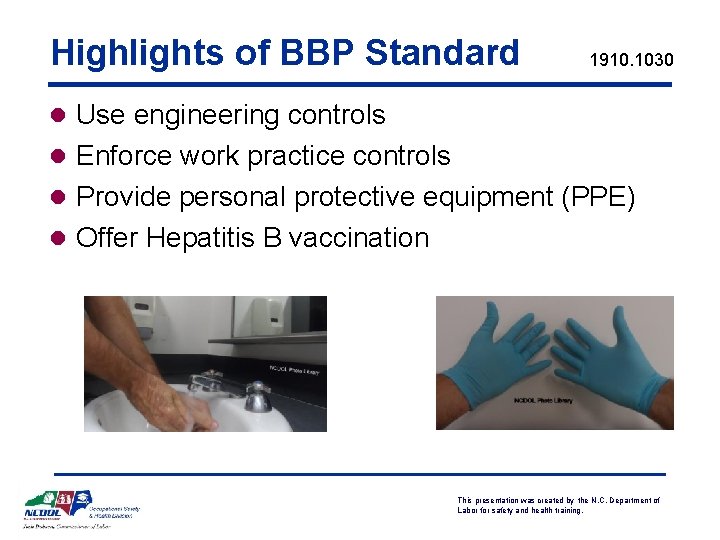
Highlights of BBP Standard 1910. 1030 l Use engineering controls l Enforce work practice controls l Provide personal protective equipment (PPE) l Offer Hepatitis B vaccination This presentation was created by the N. C. Department of Labor for safety and health training.
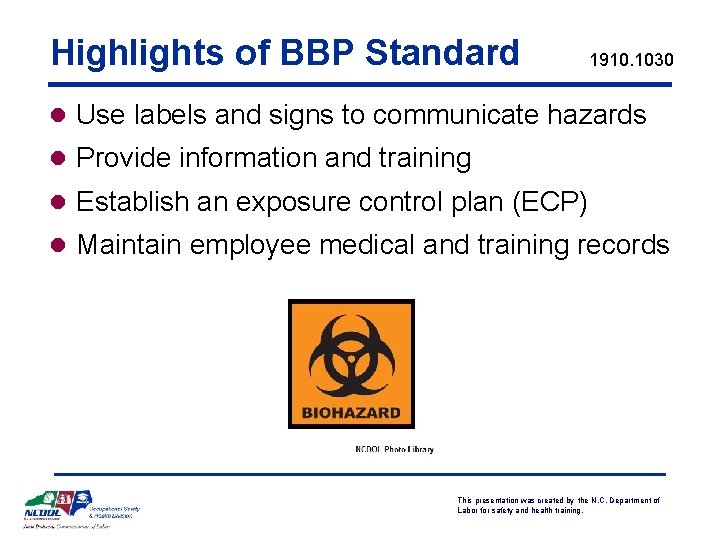
Highlights of BBP Standard 1910. 1030 l Use labels and signs to communicate hazards l Provide information and training l Establish an exposure control plan (ECP) l Maintain employee medical and training records This presentation was created by the N. C. Department of Labor for safety and health training.
Hepatitis B Vaccination 1910. 1030(f) l Hepatitis B vaccine, post-exposure evaluation and follow-up, including prophylaxis, shall be: - Available to employees at a reasonable time and place and without cost - Performed by or under the supervision of a licensed physician or healthcare professional - Prophylaxis will be provided when medically indicated, as recommended by the U. S. Public Health Service (USPHS) This presentation was created by the N. C. Department of Labor for safety and health training.
No Cost to the Employee 1910. 1030(f) l No out of pocket expense l Employer may not require employee to use his/her health care insurance to pay for series unless: - Employer pays all of the cost of health insurance, and - No cost to employee in form of deductibles, copayments, or other expenses This presentation was created by the N. C. Department of Labor for safety and health training.
Hepatitis B Vaccination 1910. 1030(f)(2)(i) l Hepatitis B vaccine shall be made available: - After employee has received required training - Within 10 days of initial assignment to all employees with occupational exposure - Ensures employees receive appropriate medical follow-up after each specific exposure incident This presentation was created by the N. C. Department of Labor for safety and health training.
Hepatitis B Vaccination 1910. 1030(f)(2)(i) l Exceptions - If the employee has previously completed the complete Hepatitis B vaccination series, or - Immunity is confirmed through antibody testing, or - The vaccine is contraindicated for medical reasons This presentation was created by the N. C. Department of Labor for safety and health training.
Hepatitis B Vaccination 1910. 1030(f)(2) l Participation in prescreening not prerequisite for receiving Hepatitis B vaccination l Provided even if employee declines but later wants vaccination l Employee must sign statement when declining Hepatitis B vaccination l Hepatitis B vaccination booster doses must be available to employees if recommended by the USPHS This presentation was created by the N. C. Department of Labor for safety and health training.
Hepatitis B Vaccine Delay Option l Exemption only for collateral duty - Vaccine series can be provided post-exposure » Hepatitis B vaccine series must be made available within 24 hours of first aid incident - The following conditions must be met for the exemption: » Primary job assignment is not rendering first aid or other medical assistance, and » Any first aid rendered is only as a collateral duty, responding solely to injuries resulting from workplace incidents, generally at the location where the incident occurred This presentation was created by the N. C. Department of Labor for safety and health training.
Hepatitis B Vaccine Delay Option » Employer’s ECP must specifically contain the following: • Provision for a reporting procedure that ensures that all first aid incidents involving the presence of blood or OPIM will be reported to the employer before the end of the work shift during which the incident occurred – Report must include names of all first aid providers who rendered assistance, regardless of whether PPE was used and must describe the first aid incident, including time and date – Description must include a determination of whether or not, in addition to the presence of blood or OPIM, an "exposure incident, ” as defined by the standard, occurred. This presentation was created by the N. C. Department of Labor for safety and health training.
Hepatitis B Vaccine Delay Option – This determination is necessary in order to ensure that the proper post-exposure evaluation, prophylaxis, and follow-up procedures required by paragraph (f)(3) – Post-exposure Evaluation and Follow-up – of the standard are made available immediately, whenever there has been an "exposure incident" as defined by the standard • A report that lists all such first aid incidents, that is readily available upon request, to all employees and to the Assistant Secretary • Provision for the bloodborne pathogens training program for designated first aiders to include the specifics of this reporting procedure This presentation was created by the N. C. Department of Labor for safety and health training.
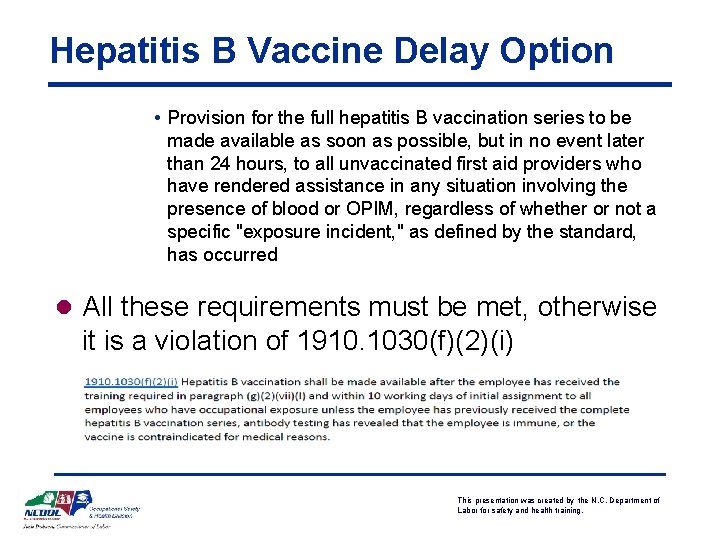
Hepatitis B Vaccine Delay Option • Provision for the full hepatitis B vaccination series to be made available as soon as possible, but in no event later than 24 hours, to all unvaccinated first aid providers who have rendered assistance in any situation involving the presence of blood or OPIM, regardless of whether or not a specific "exposure incident, " as defined by the standard, has occurred l All these requirements must be met, otherwise it is a violation of 1910. 1030(f)(2)(i) This presentation was created by the N. C. Department of Labor for safety and health training.
Resources l Bloodborne Pathogens Standard - 29 CFR 1910. 1030 l Compliance Directive - CPL 02 -02 -069 l Consultative Services - 919 -707 -7846 l Education, Training and Technical Assistance - 919 -707 -7876 l Web Sites - www. osha. gov - www. labor. nc. gov This presentation was created by the N. C. Department of Labor for safety and health training.
Summary In this course, we covered: l Difference between collateral duty and primary duty l Requirements for first aid availability l How collateral and primary first aid duty relates to the bloodborne pathogens standard This presentation was created by the N. C. Department of Labor for safety and health training.

Thank You For Attending! Final Questions? This presentation was created by the N. C. Department of Labor for safety and health training.
- Slides: 26