
Collaborative Research Development Seed Project for 20122013 Effective
Collaborative Research & Development (“Seed”) Project for 2012/2013 Effective Use of Learning and Teaching Resources to Cater for Learner Diversity in the Learning of English at Primary Level English Language Education Section Curriculum Development Institute Education Bureau
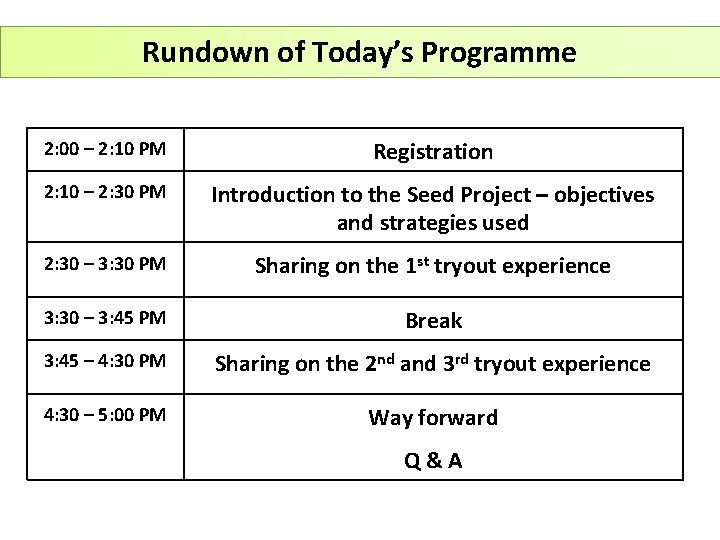
Rundown of Today’s Programme 2: 00 – 2: 10 PM Registration 2: 10 – 2: 30 PM Introduction to the Seed Project – objectives and strategies used 2: 30 – 3: 30 PM Sharing on the 1 st tryout experience 3: 30 – 3: 45 PM Break 3: 45 – 4: 30 PM Sharing on the 2 nd and 3 rd tryout experience 4: 30 – 5: 00 PM Way forward Q&A
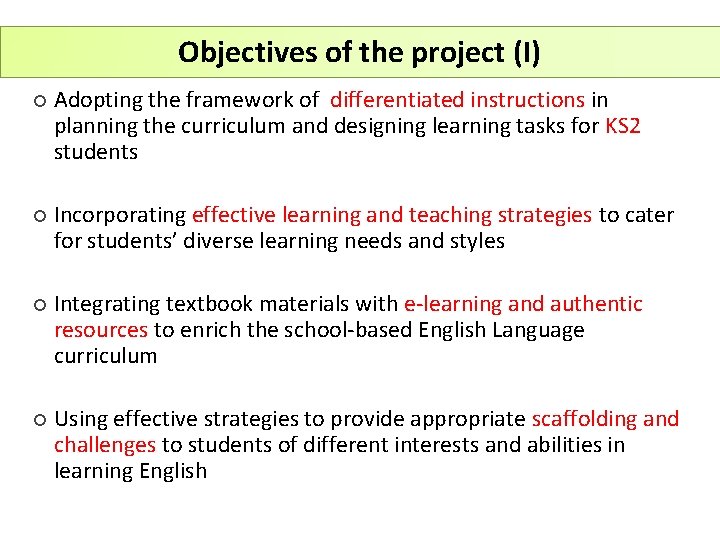
Objectives of the project (I) ¡ Adopting the framework of differentiated instructions in planning the curriculum and designing learning tasks for KS 2 students ¡ Incorporating effective learning and teaching strategies to cater for students’ diverse learning needs and styles ¡ Integrating textbook materials with e-learning and authentic resources to enrich the school-based English Language curriculum ¡ Using effective strategies to provide appropriate scaffolding and challenges to students of different interests and abilities in learning English
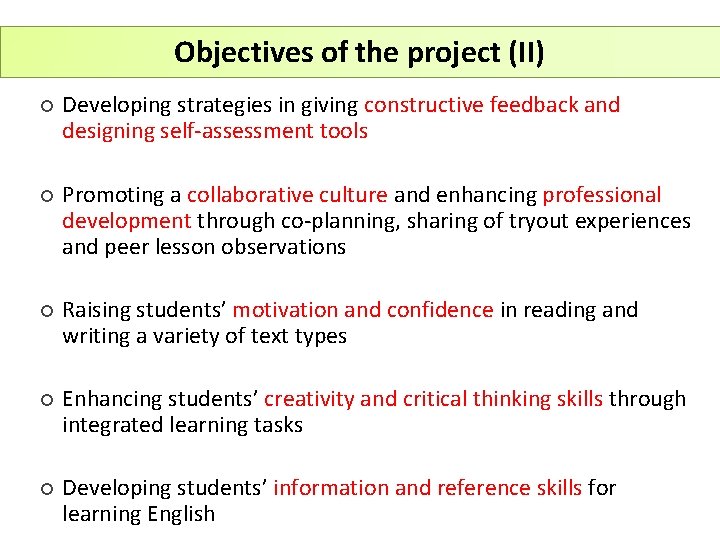
Objectives of the project (II) ¡ Developing strategies in giving constructive feedback and designing self-assessment tools ¡ Promoting a collaborative culture and enhancing professional development through co-planning, sharing of tryout experiences and peer lesson observations ¡ Raising students’ motivation and confidence in reading and writing a variety of text types ¡ Enhancing students’ creativity and critical thinking skills through integrated learning tasks ¡ Developing students’ information and reference skills for learning English
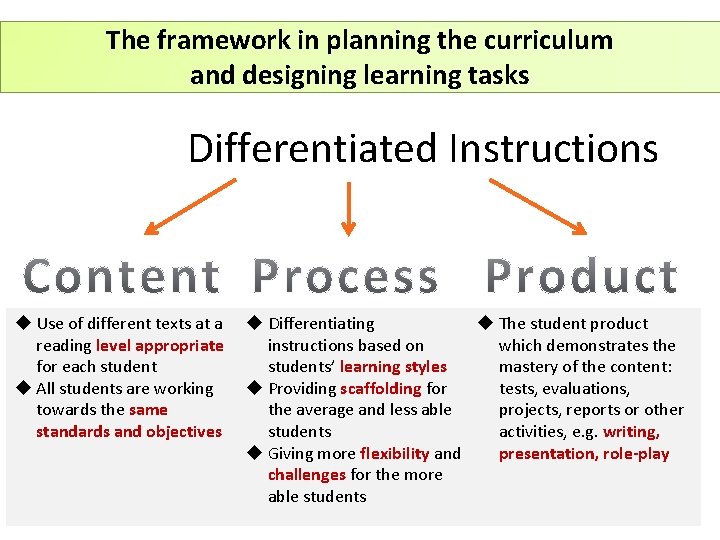
The framework in planning the curriculum and designing learning tasks Differentiated Instructions u Use of different texts at a reading level appropriate for each student u All students are working towards the same standards and objectives u Differentiating u The student product instructions based on which demonstrates the students’ learning styles mastery of the content: u Providing scaffolding for tests, evaluations, the average and less able projects, reports or other students activities, e. g. writing, u Giving more flexibility and presentation, role-play challenges for the more able students
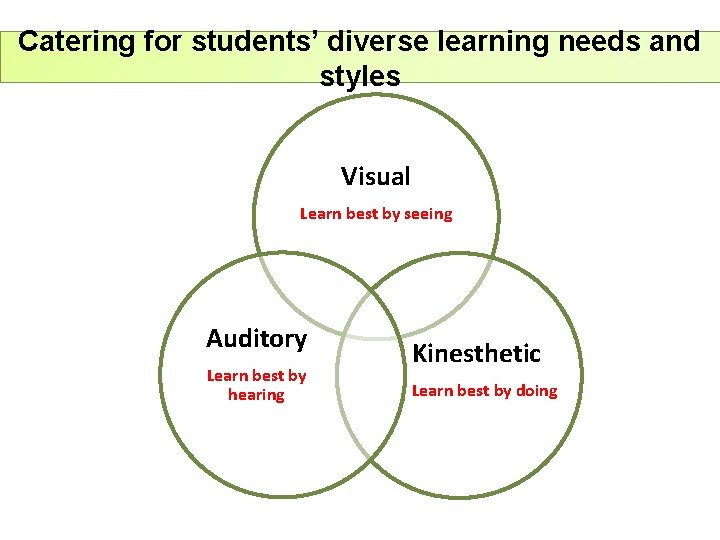
Catering for students’ diverse learning needs and styles Visual Learn best by seeing Auditory Learn best by hearing Kinesthetic Learn best by doing
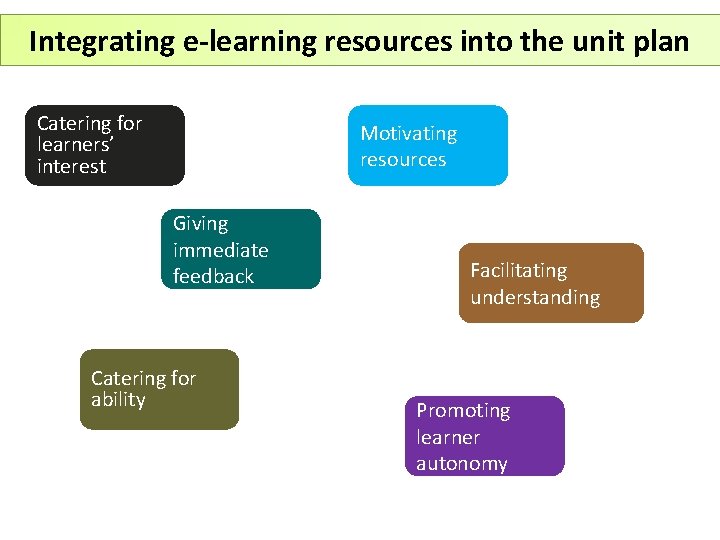
Integrating e-learning resources into the unit plan Catering for learners’ interest Motivating resources Giving immediate feedback Catering for ability Facilitating understanding Promoting learner autonomy
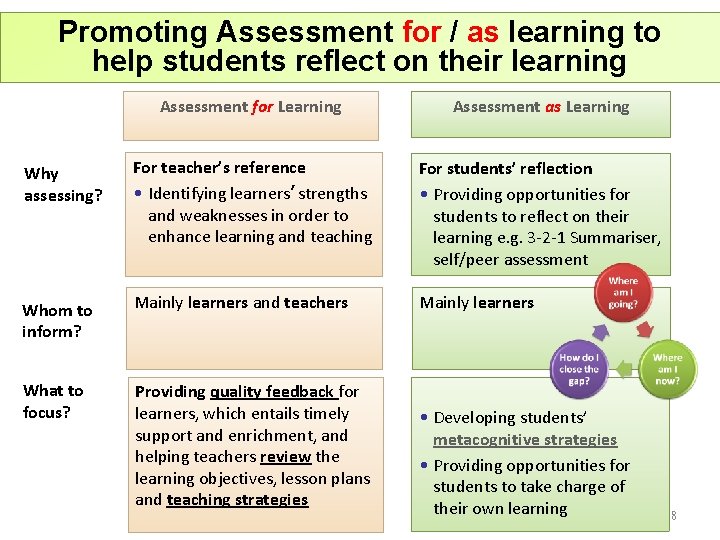
Promoting Assessment for / as learning to help students reflect on their learning Assessment for Learning Assessment as Learning Why assessing? For teacher’s reference • Identifying learners’ strengths and weaknesses in order to enhance learning and teaching For students’ reflection • Providing opportunities for students to reflect on their learning e. g. 3 -2 -1 Summariser, self/peer assessment Whom to inform? Mainly learners and teachers Mainly learners What to focus? Providing quality feedback for learners, which entails timely support and enrichment, and helping teachers review the learning objectives, lesson plans and teaching strategies • Developing students’ metacognitive strategies • Providing opportunities for students to take charge of their own learning 8
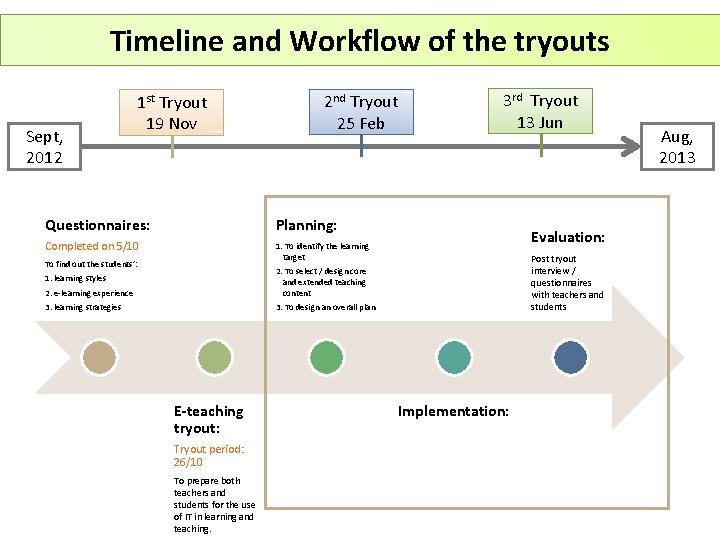
Timeline and Workflow of the tryouts Sept, 2012 1 st Tryout 19 Nov 2 nd Tryout 25 Feb Questionnaires: Planning: Completed on 5/10 1. To identify the learning target To find out the students’: 2. e-learning experience 2. To select / design core and extended teaching content 3. learning strategies 3. To design an overall plan 1. learning styles E-teaching tryout: Tryout period: 26/10 To prepare both teachers and students for the use of IT in learning and teaching. 3 rd Tryout 13 Jun Evaluation: Post tryout interview / questionnaires with teachers and students Implementation: Aug, 2013
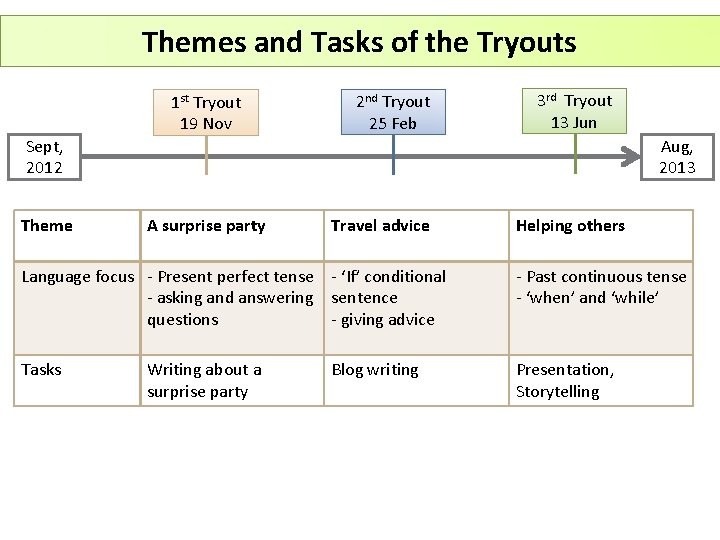
Themes and Tasks of the Tryouts 1 st Tryout 19 Nov 2 nd Tryout 25 Feb 3 rd Tryout 13 Jun Sept, 2012 Theme Aug, 2013 A surprise party Travel advice Language focus - Present perfect tense - ‘If’ conditional - asking and answering sentence questions - giving advice Tasks Writing about a surprise party Blog writing Helping others - Past continuous tense - ‘when’ and ‘while’ Presentation, Storytelling
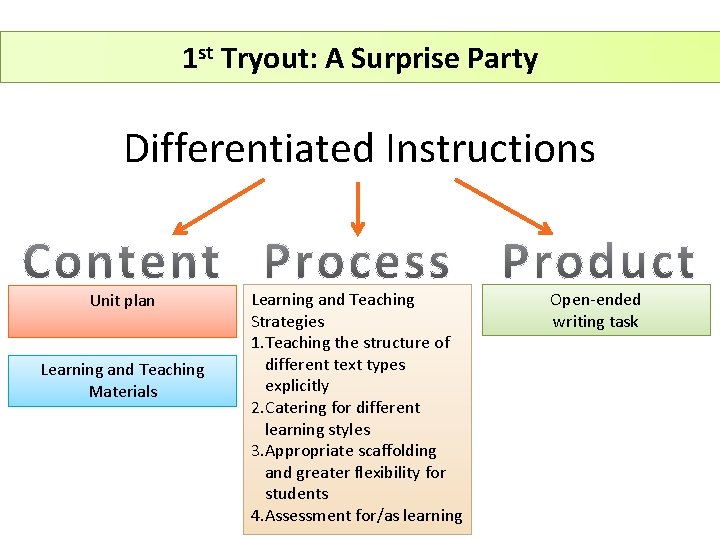
1 st Tryout: A Surprise Party Differentiated Instructions Unit plan Learning and Teaching Materials Learning and Teaching Strategies 1. Teaching the structure of different text types explicitly 2. Catering for different learning styles 3. Appropriate scaffolding and greater flexibility for students 4. Assessment for/as learning Open-ended writing task
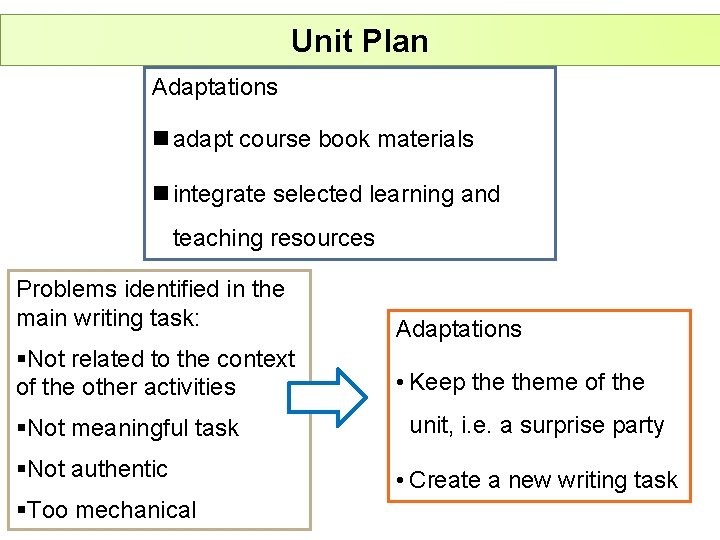
Unit Plan Adaptations n adapt course book materials n integrate selected learning and teaching resources Problems identified in the main writing task: Adaptations §Not related to the context of the other activities • Keep theme of the §Not meaningful task §Not authentic §Too mechanical unit, i. e. a surprise party • Create a new writing task
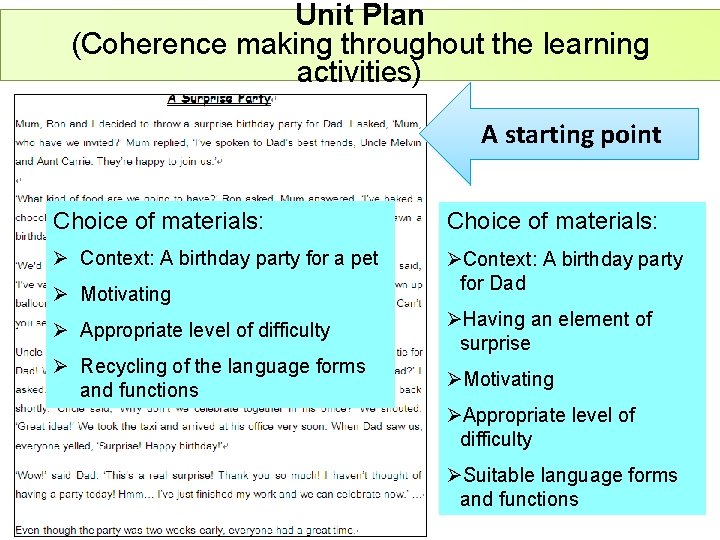
Unit Plan (Coherence making throughout the learning activities) A starting point Choice of materials: Ø Context: A birthday party for a pet ØContext: A birthday party for Dad Ø Motivating Ø Appropriate level of difficulty ØHaving an element of surprise Ø Recycling of the language forms and functions ØMotivating ØAppropriate level of difficulty ØSuitable language forms and functions
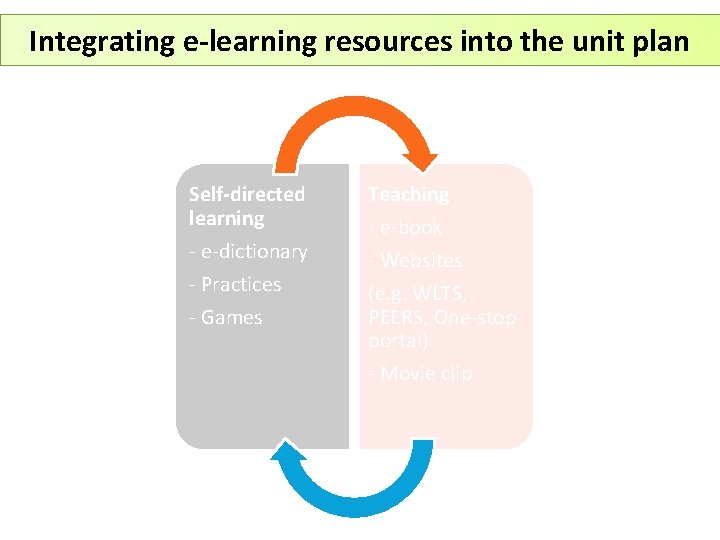
Integrating e-learning resources into the unit plan Self-directed learning - e-dictionary - Practices - Games Teaching - e-book - Websites (e. g. WLTS, PEERS, One-stop portal) - Movie clip
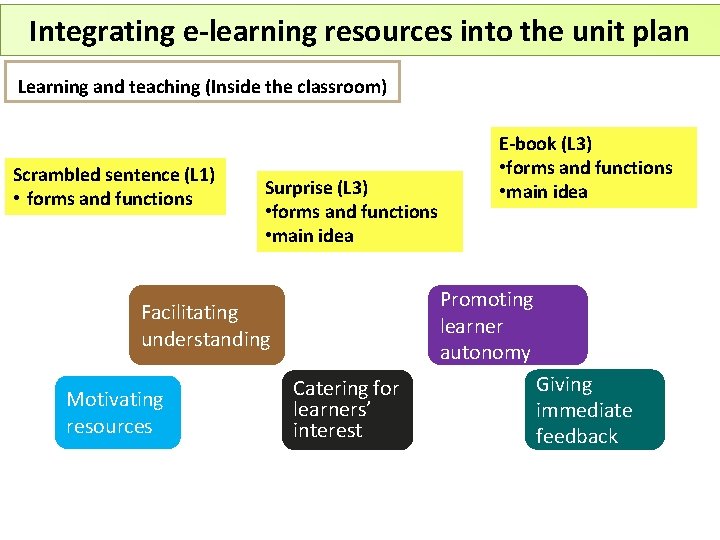
Integrating e-learning resources into the unit plan Learning and teaching (Inside the classroom) Scrambled sentence (L 1) • forms and functions Surprise (L 3) • forms and functions • main idea Promoting learner autonomy Facilitating understanding Motivating resources E-book (L 3) • forms and functions • main idea Catering for learners’ interest Giving immediate feedback
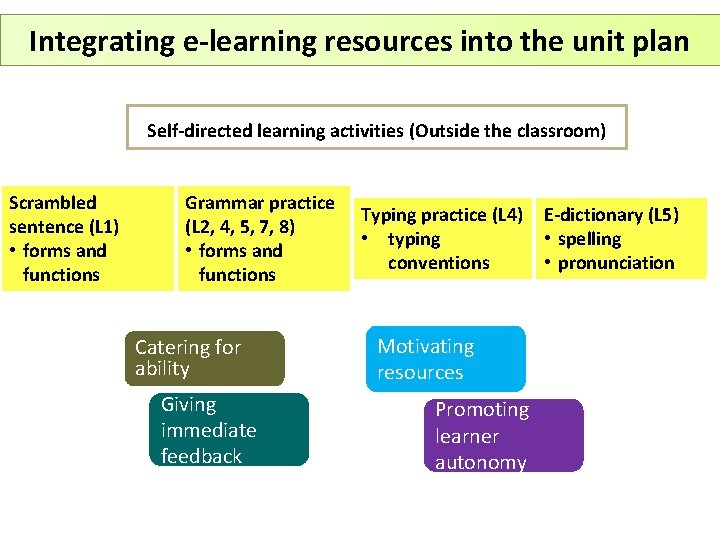
Integrating e-learning resources into the unit plan Self-directed learning activities (Outside the classroom) Scrambled sentence (L 1) • forms and functions Grammar practice (L 2, 4, 5, 7, 8) • forms and functions Catering for ability Giving immediate feedback Typing practice (L 4) • typing conventions Motivating resources Promoting learner autonomy E-dictionary (L 5) • spelling • pronunciation
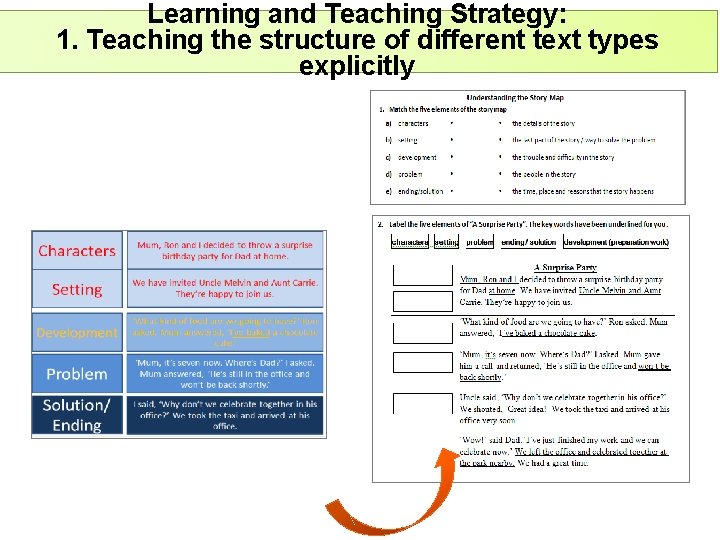
Learning and Teaching Strategy: 1. Teaching the structure of different text types explicitly Longman Express 5 A Unit 5
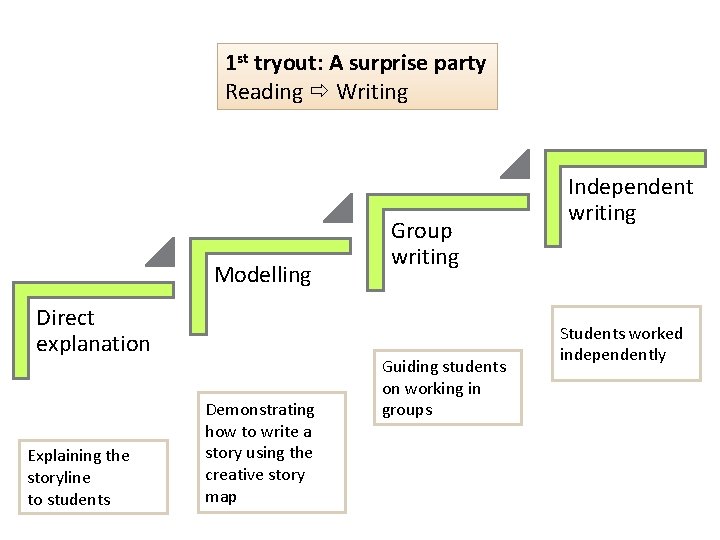
1 st tryout: A surprise party Reading Writing Modelling Direct explanation Explaining the storyline to students Demonstrating how to write a story using the creative story map Group writing Guiding students on working in groups Independent writing Students worked independently
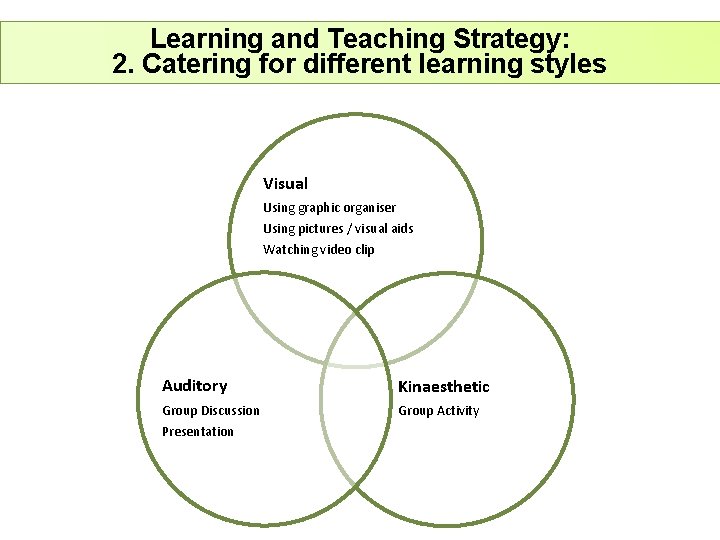
Learning and Teaching Strategy: 2. Catering for different learning styles Visual Using graphic organiser Using pictures / visual aids Watching video clip Auditory Kinaesthetic Group Discussion Group Activity Presentation
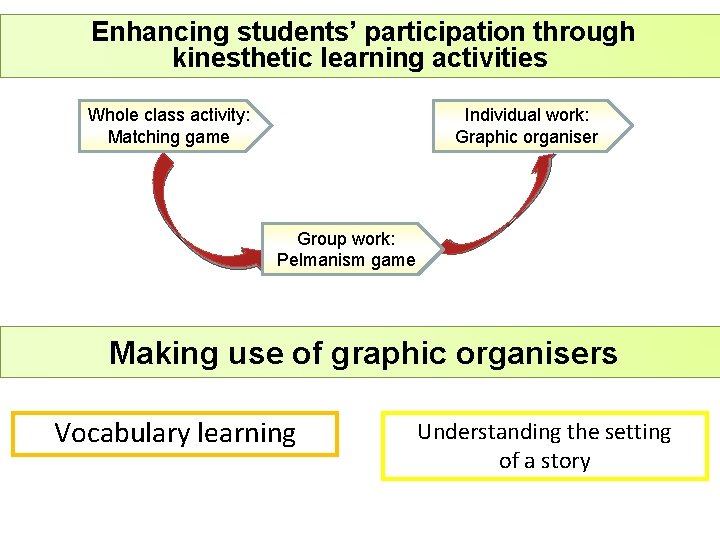
Enhancing students’ participation through kinesthetic learning activities Individual work: Graphic organiser Whole class activity: Matching game Group work: Pelmanism game Making use of graphic organisers Vocabulary learning Understanding the setting of a story
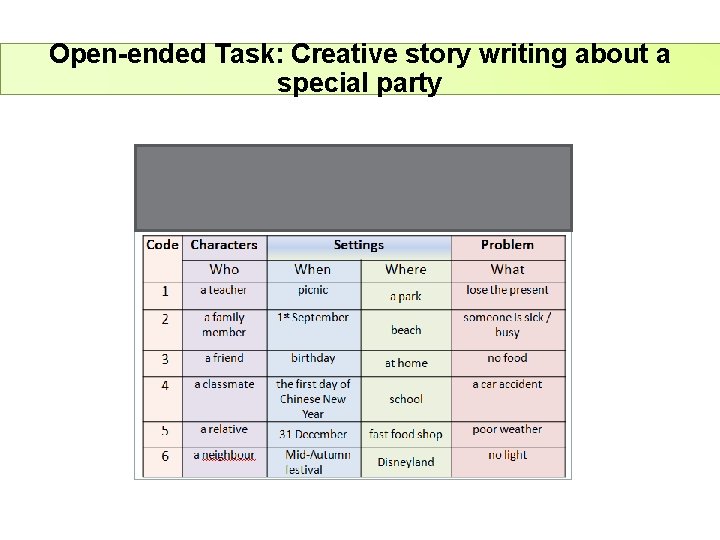
Open-ended Task: Creative story writing about a special party
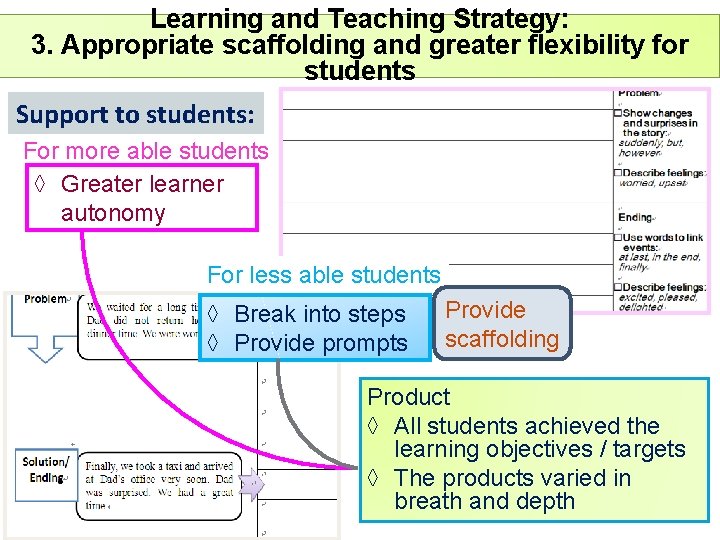
Learning and Teaching Strategy: 3. Appropriate scaffolding and greater flexibility for students Support to students: For more able students ◊ Greater learner autonomy For less able students ◊ Break into steps ◊ Provide prompts Provide scaffolding Product ◊ All students achieved the learning objectives / targets ◊ The products varied in breath and depth
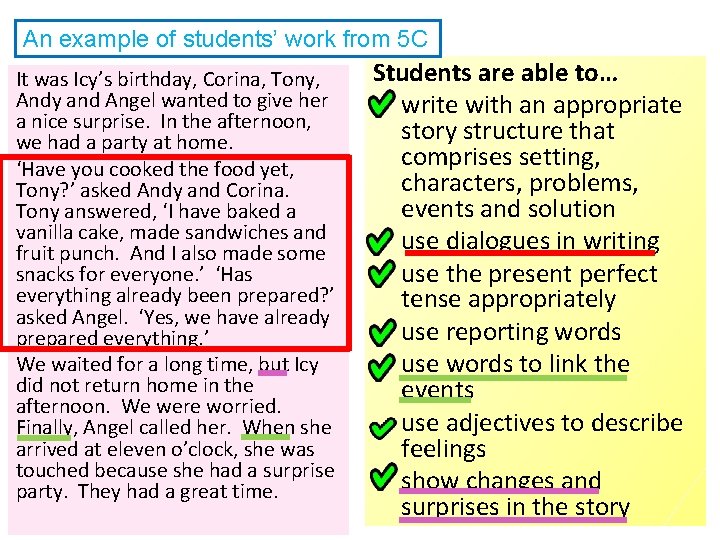
An example of students’ work from 5 C It was Icy’s birthday, Corina, Tony, Andy and Angel wanted to give her a nice surprise. In the afternoon, we had a party at home. ‘Have you cooked the food yet, Tony? ’ asked Andy and Corina. Tony answered, ‘I have baked a vanilla cake, made sandwiches and fruit punch. And I also made some snacks for everyone. ’ ‘Has everything already been prepared? ’ asked Angel. ‘Yes, we have already prepared everything. ’ We waited for a long time, but Icy did not return home in the afternoon. We were worried. Finally, Angel called her. When she arrived at eleven o’clock, she was touched because she had a surprise party. They had a great time. Students are able to… write with an appropriate story structure that comprises setting, characters, problems, events and solution use dialogues in writing use the present perfect tense appropriately use reporting words use words to link the events use adjectives to describe feelings show changes and surprises in the story
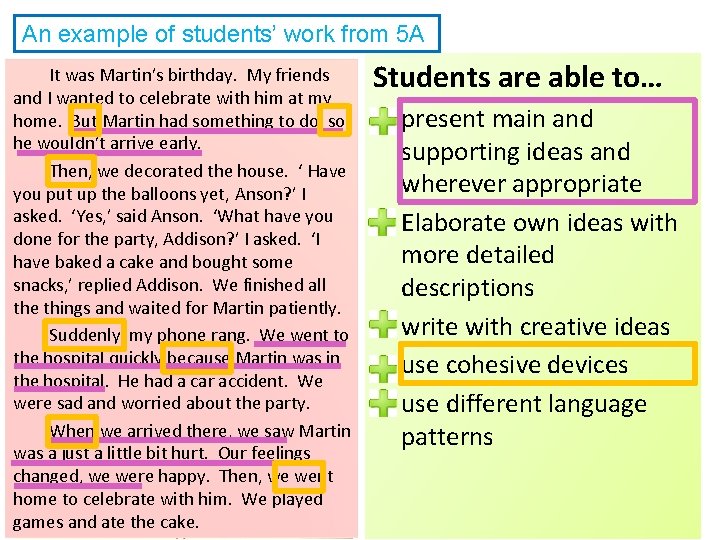
An example of students’ work from 5 A It was Martin’s birthday. My friends and I wanted to celebrate with him at my home. But Martin had something to do, so he wouldn’t arrive early. Then, we decorated the house. ‘ Have you put up the balloons yet, Anson? ’ I asked. ‘Yes, ’ said Anson. ‘What have you done for the party, Addison? ’ I asked. ‘I have baked a cake and bought some snacks, ’ replied Addison. We finished all the things and waited for Martin patiently. Suddenly, my phone rang. We went to the hospital quickly because Martin was in the hospital. He had a car accident. We were sad and worried about the party. When we arrived there, we saw Martin was a just a little bit hurt. Our feelings changed, we were happy. Then, we went home to celebrate with him. We played games and ate the cake. Students are able to… present main and supporting ideas and wherever appropriate Elaborate own ideas with more detailed descriptions write with creative ideas use cohesive devices use different language patterns
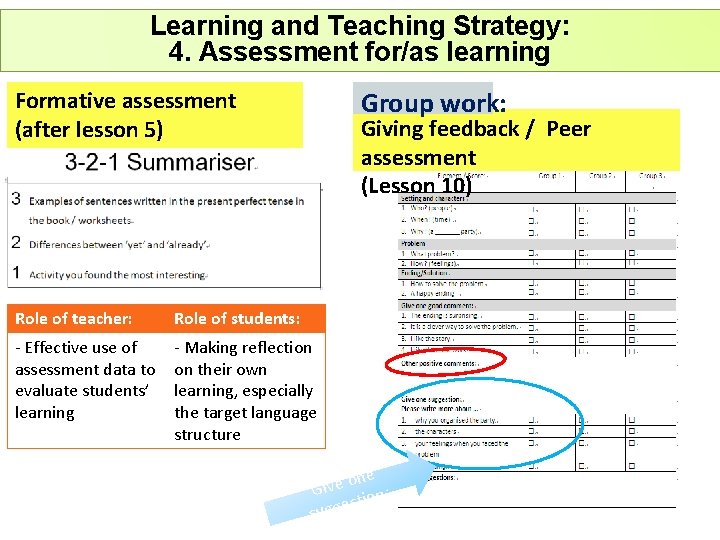
Learning and Teaching Strategy: 4. Assessment for/as learning Group work: Formative assessment (after lesson 5) Giving feedback / Peer assessment (Lesson 10) Role of teacher: Role of students: - Effective use of assessment data to evaluate students’ learning - Making reflection on their own learning, especially the target language structure one Give ion: est sugg
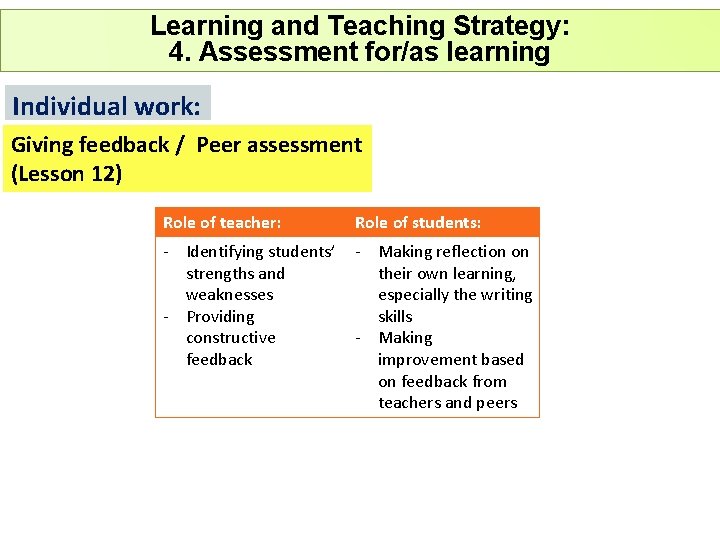
Learning and Teaching Strategy: 4. Assessment for/as learning Individual work: Giving feedback / Peer assessment (Lesson 12) Role of teacher: Role of students: - Identifying students’ strengths and weaknesses - Providing constructive feedback - Making reflection on their own learning, especially the writing skills - Making improvement based on feedback from teachers and peers
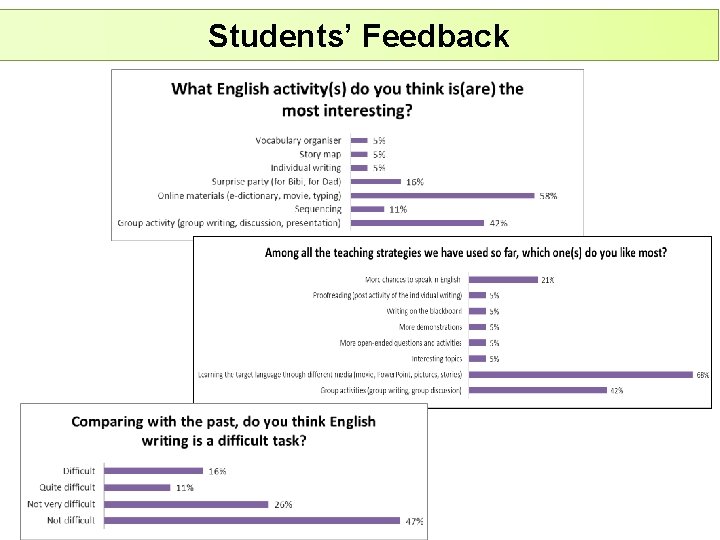
Students’ Feedback
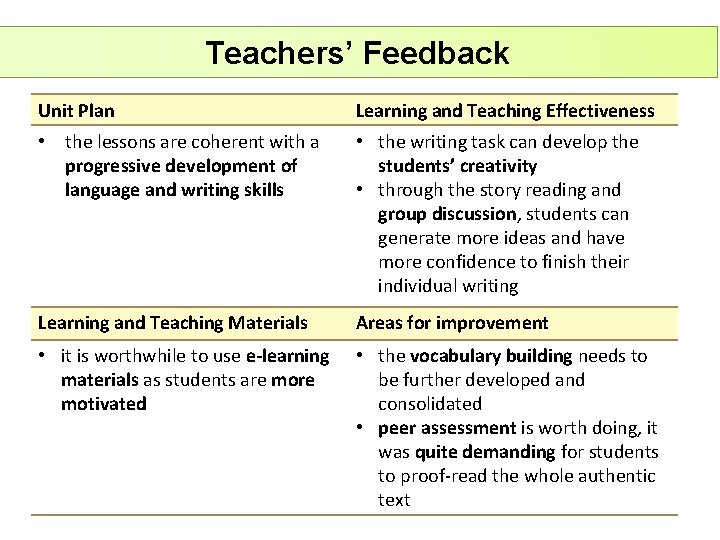
Teachers’ Feedback Unit Plan Learning and Teaching Effectiveness • the lessons are coherent with a progressive development of language and writing skills • the writing task can develop the students’ creativity • through the story reading and group discussion, students can generate more ideas and have more confidence to finish their individual writing Learning and Teaching Materials Areas for improvement • it is worthwhile to use e-learning materials as students are motivated • the vocabulary building needs to be further developed and consolidated • peer assessment is worth doing, it was quite demanding for students to proof-read the whole authentic text
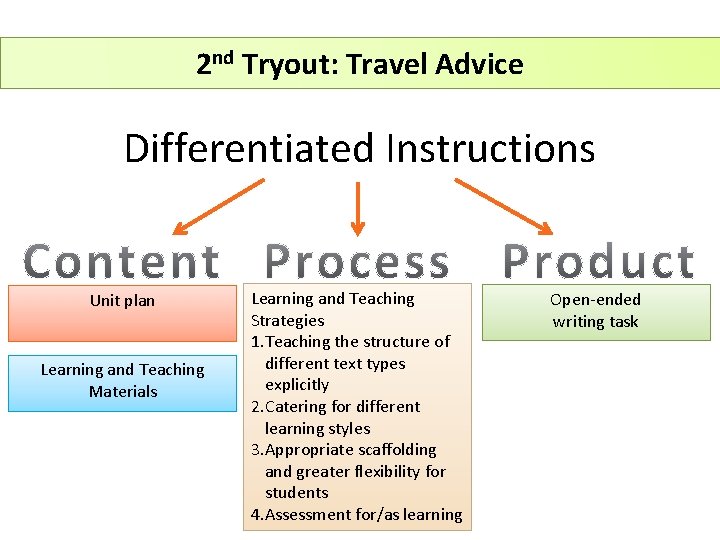
2 nd Tryout: Travel Advice Differentiated Instructions Unit plan Learning and Teaching Materials Learning and Teaching Strategies 1. Teaching the structure of different text types explicitly 2. Catering for different learning styles 3. Appropriate scaffolding and greater flexibility for students 4. Assessment for/as learning Open-ended writing task
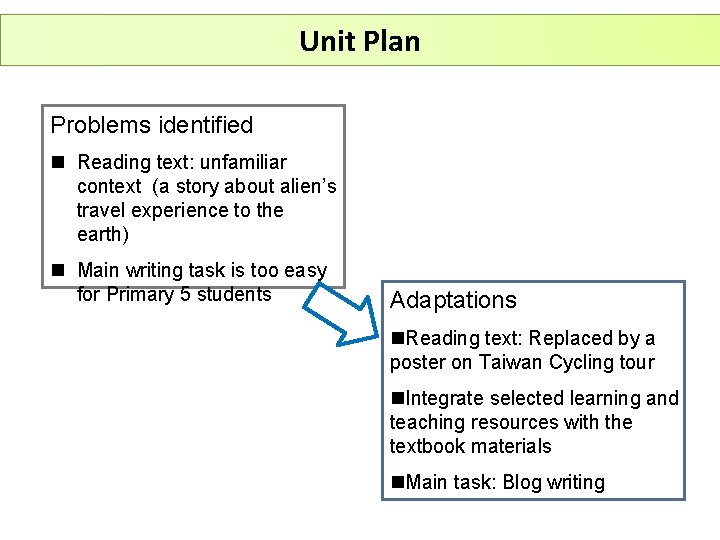
Unit Plan Problems identified n Reading text: unfamiliar context (a story about alien’s travel experience to the earth) n Main writing task is too easy for Primary 5 students Adaptations n. Reading text: Replaced by a poster on Taiwan Cycling tour n. Integrate selected learning and teaching resources with the textbook materials n. Main task: Blog writing
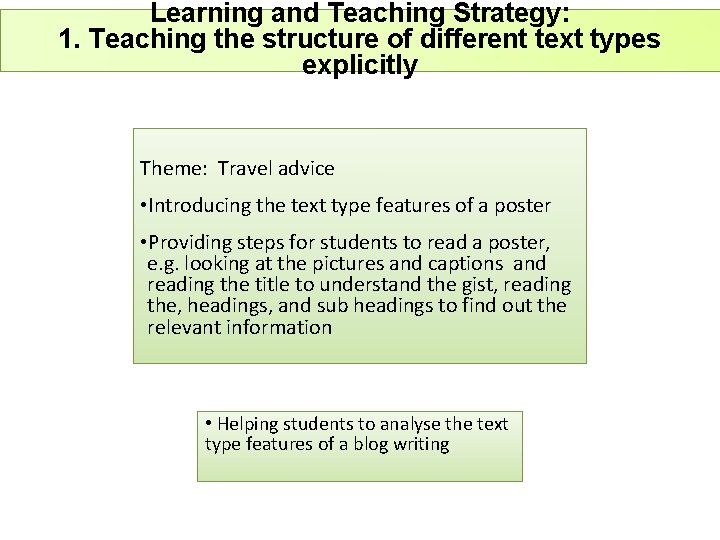
Learning and Teaching Strategy: 1. Teaching the structure of different text types explicitly Theme: Travel advice • Introducing the text type features of a poster • Providing steps for students to read a poster, e. g. looking at the pictures and captions and reading the title to understand the gist, reading the, headings, and sub headings to find out the relevant information • Helping students to analyse the text type features of a blog writing
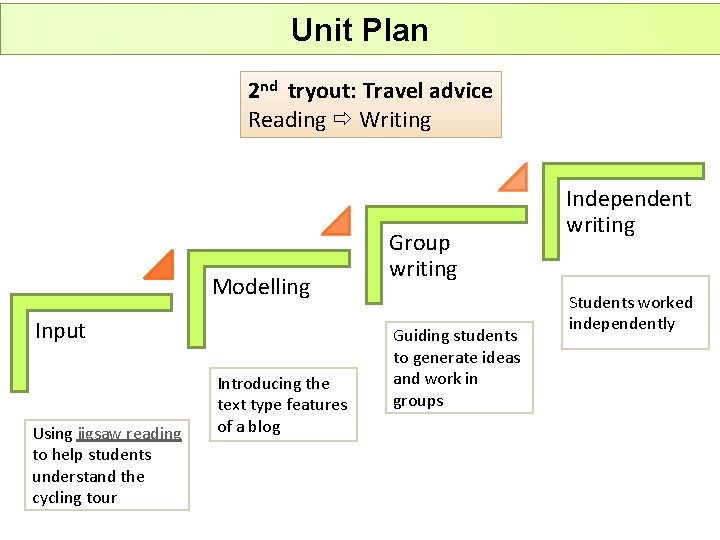
Unit Plan 2 nd tryout: Travel advice Reading Writing Modelling Input Using jigsaw reading to help students understand the cycling tour Introducing the text type features of a blog Group writing Guiding students to generate ideas and work in groups Independent writing Students worked independently
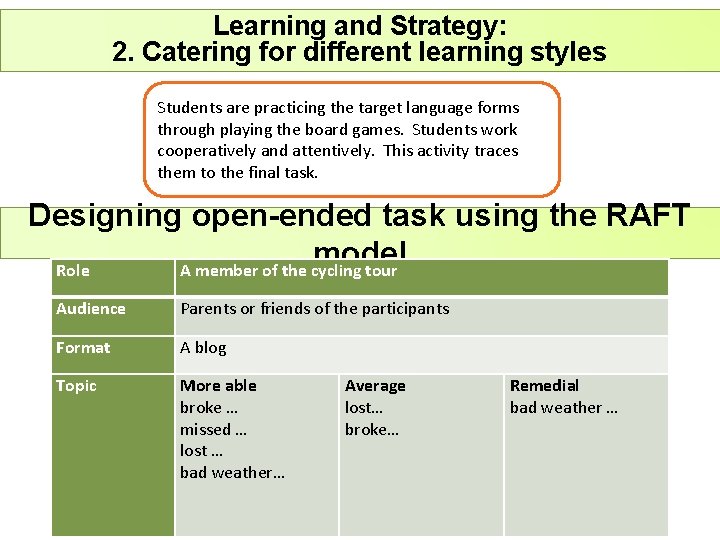
Learning and Strategy: 2. Catering for different learning styles Students are practicing the target language forms through playing the board games. Students work cooperatively and attentively. This activity traces them to the final task. Designing open-ended task using the RAFT model Role A member of the cycling tour Audience Parents or friends of the participants Format A blog Topic More able broke … missed … lost … bad weather… Average lost… broke… Remedial bad weather …
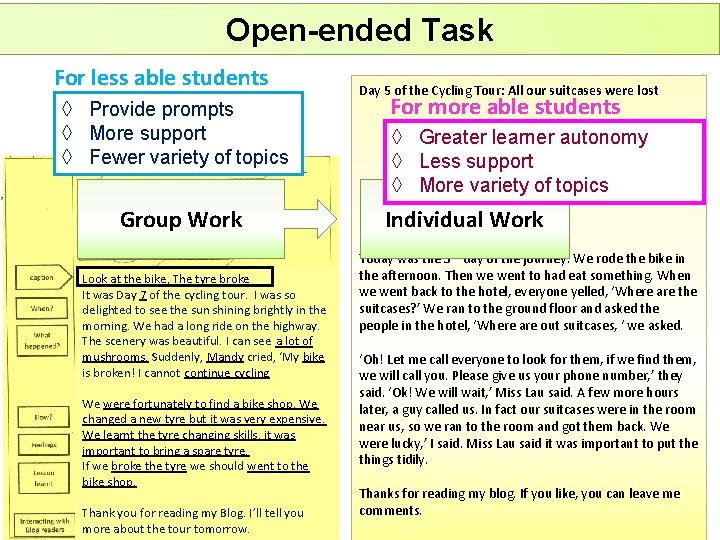
Open-ended Task For less able students ◊ Provide prompts ◊ More support ◊ Fewer variety of topics Group Work Look at the bike, The tyre broke It was Day 7 of the cycling tour. I was so delighted to see the sun shining brightly in the morning. We had a long ride on the highway. The scenery was beautiful. I can see a lot of mushrooms. Suddenly, Mandy cried, ‘My bike is broken! I cannot continue cycling. ’ We were fortunately to find a bike shop. We changed a new tyre but it was very expensive. We learnt the tyre changing skills. it was important to bring a spare tyre. If we broke the tyre we should went to the bike shop. Thank you for reading my Blog. I’ll tell you more about the tour tomorrow. Day 5 of the Cycling Tour: All our suitcases were lost For more able students ◊ Greater learner autonomy ◊ Less support ◊ More variety of topics Individual Work Oh no! Where are the suitcases? Today was the 5 th day of the journey. We rode the bike in the afternoon. Then we went to had eat something. When we went back to the hotel, everyone yelled, ‘Where are the suitcases? ’ We ran to the ground floor and asked the people in the hotel, ‘Where are out suitcases, ‘ we asked. ‘Oh! Let me call everyone to look for them, if we find them, we will call you. Please give us your phone number, ’ they said. ‘Ok! We will wait, ’ Miss Lau said. A few more hours later, a guy called us. In fact our suitcases were in the room near us, so we ran to the room and got them back. We were lucky, ’ I said. Miss Lau said it was important to put the things tidily. Thanks for reading my blog. If you like, you can leave me comments.
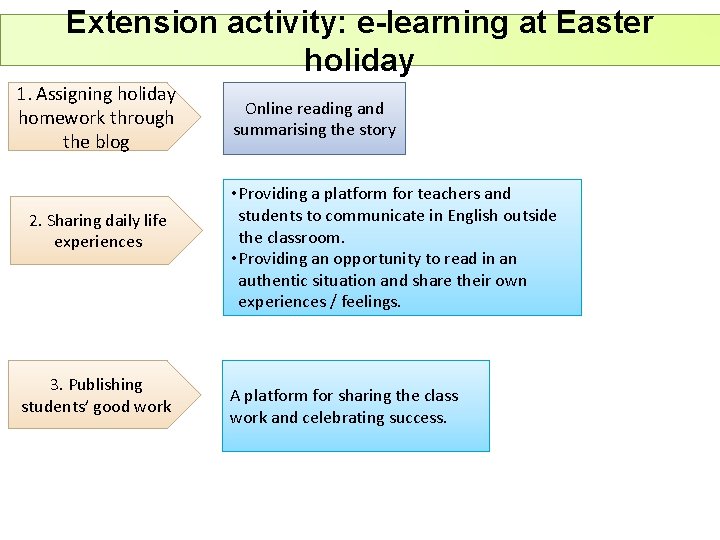
Extension activity: e-learning at Easter holiday 1. Assigning holiday homework through the blog 2. Sharing daily life experiences 3. Publishing students’ good work Online reading and summarising the story • Providing a platform for teachers and students to communicate in English outside the classroom. • Providing an opportunity to read in an authentic situation and share their own experiences / feelings. A platform for sharing the class work and celebrating success.
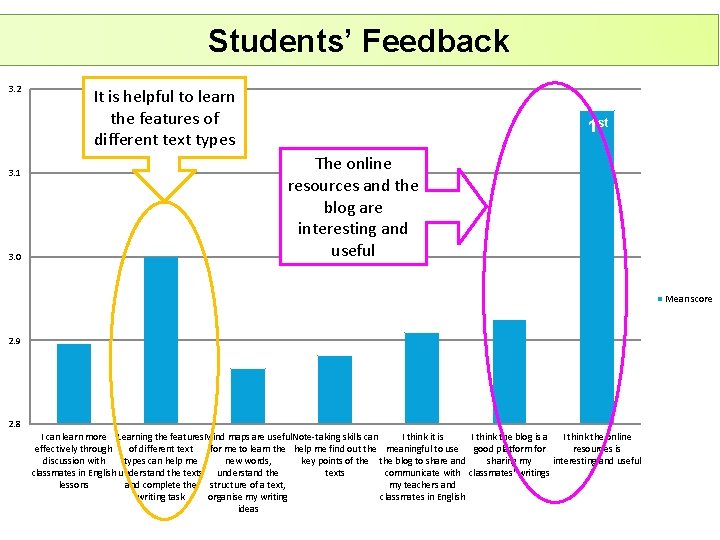
Students’ Feedback 3. 2 It is helpful to learn the features of different text types 3. 1 2 nd 3. 0 1 st The online resources and the blog are interesting and useful 3 rd 2. 9 2. 8 I can learn more Learning the features. Mind maps are useful. Note-taking skills can I think it is I think the blog is a I think the online effectively through of different text for me to learn the help me find out the meaningful to use good platform for resources is discussion with types can help me new words, key points of the blog to share and sharing my interesting and useful classmates in English understand the texts communicate with classmates' writings lessons and complete the structure of a text, my teachers and writing task organise my writing classmates in English ideas Mean score
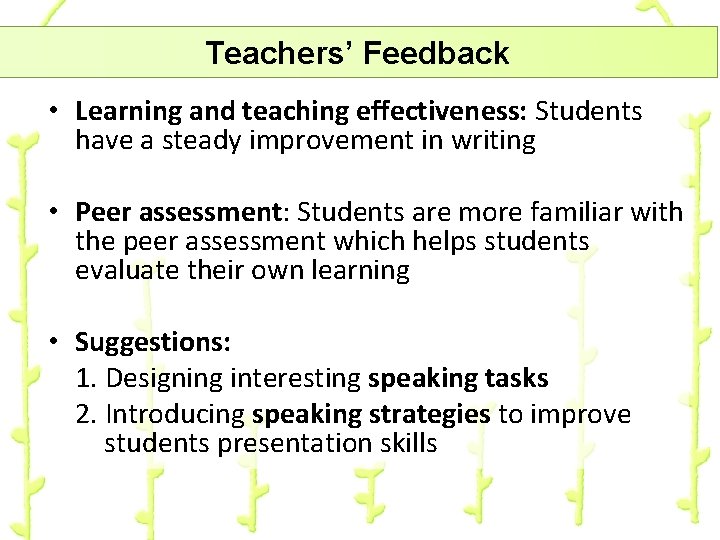
Teachers’ Feedback • Learning and teaching effectiveness: Students have a steady improvement in writing • Peer assessment: Students are more familiar with the peer assessment which helps students evaluate their own learning • Suggestions: 1. Designing interesting speaking tasks 2. Introducing speaking strategies to improve students presentation skills
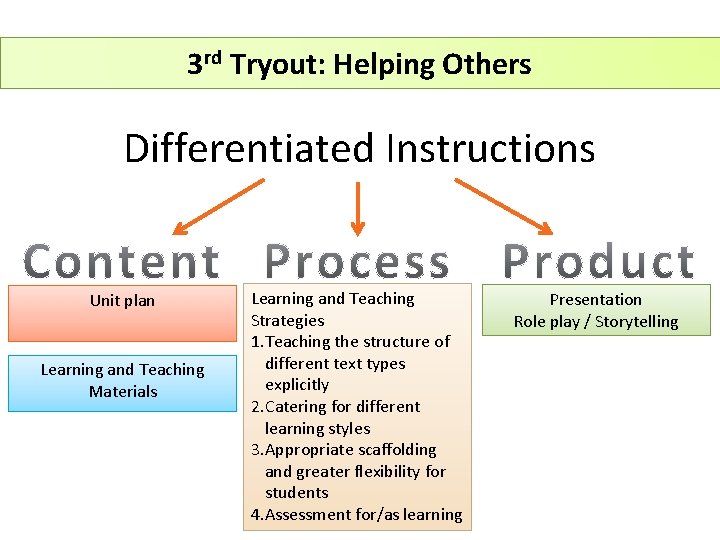
3 rd Tryout: Helping Others Differentiated Instructions Unit plan Learning and Teaching Materials Learning and Teaching Strategies 1. Teaching the structure of different text types explicitly 2. Catering for different learning styles 3. Appropriate scaffolding and greater flexibility for students 4. Assessment for/as learning Presentation Role play / Storytelling
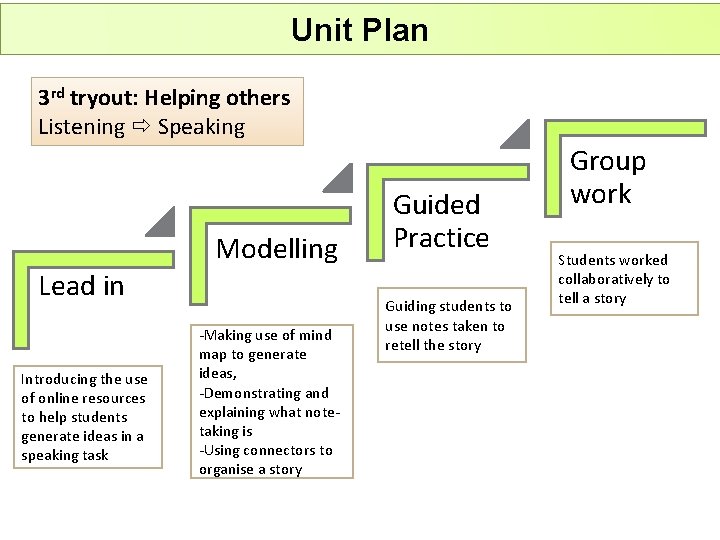
Unit Plan 3 rd tryout: Helping others Listening Speaking Lead in Introducing the use of online resources to help students generate ideas in a speaking task Modelling -Making use of mind map to generate ideas, -Demonstrating and explaining what notetaking is -Using connectors to organise a story Guided Practice Guiding students to use notes taken to retell the story Group work Students worked collaboratively to tell a story
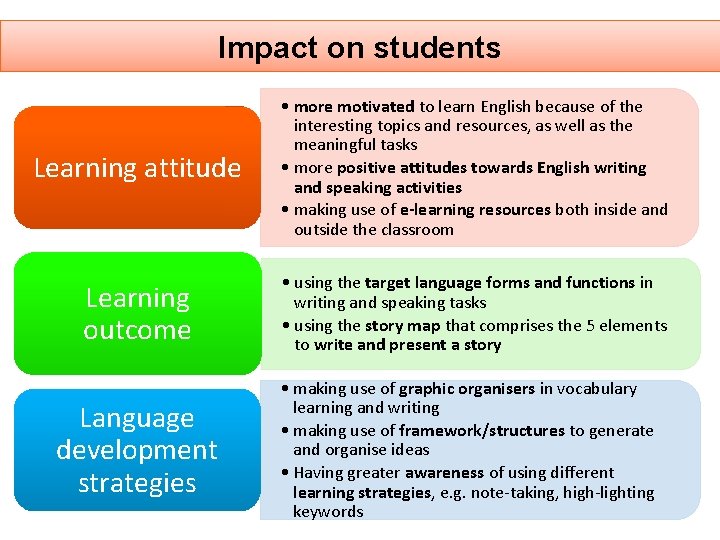
Impact on students Learning attitude • more motivated to learn English because of the interesting topics and resources, as well as the meaningful tasks • more positive attitudes towards English writing and speaking activities • making use of e-learning resources both inside and outside the classroom Learning outcome • using the target language forms and functions in writing and speaking tasks • using the story map that comprises the 5 elements to write and present a story Language development strategies • making use of graphic organisers in vocabulary learning and writing • making use of framework/structures to generate and organise ideas • Having greater awareness of using different learning strategies, e. g. note-taking, high-lighting keywords
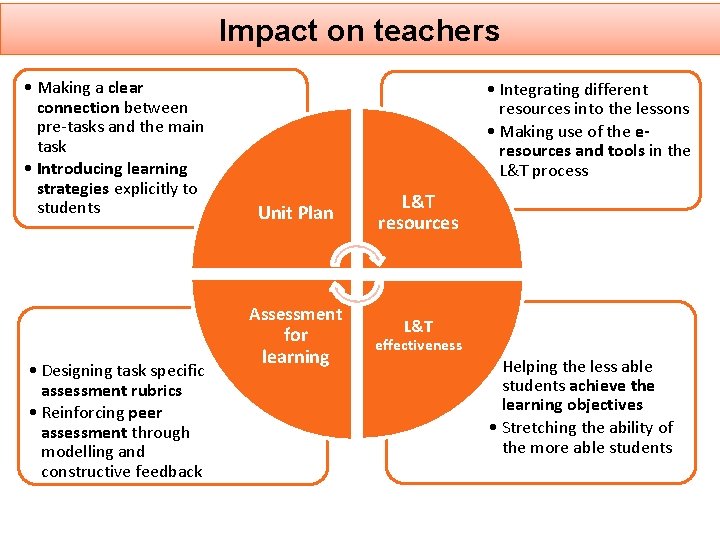
Impact on teachers • Making a clear connection between pre-tasks and the main task • Introducing learning strategies explicitly to students • Integrating different resources into the lessons • Making use of the eresources and tools in the L&T process Unit Plan Assessment • Designing task specific assessment rubrics • Reinforcing peer assessment through modelling and constructive feedback for learning L&T resources L&T effectiveness • Helping the less able students achieve the learning objectives • Stretching the ability of the more able students
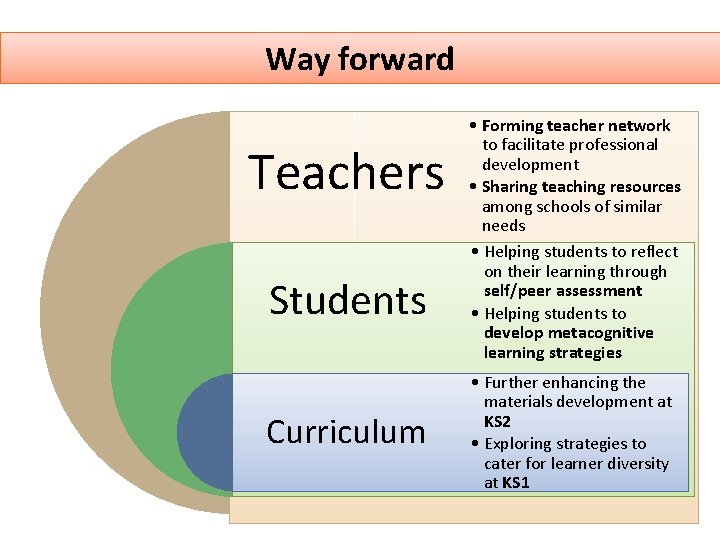
Way forward Teachers Students Curriculum • Forming teacher network to facilitate professional development • Sharing teaching resources among schools of similar needs • Helping students to reflect on their learning through self/peer assessment • Helping students to develop metacognitive learning strategies • Further enhancing the materials development at KS 2 • Exploring strategies to cater for learner diversity at KS 1
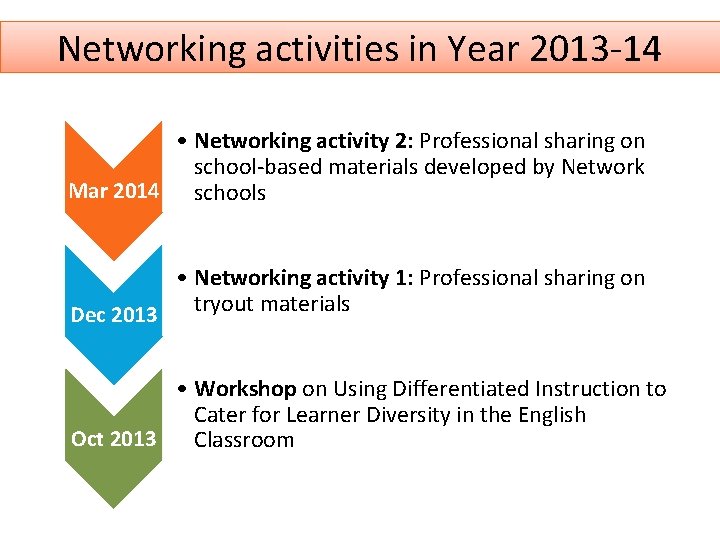
Networking activities in Year 2013 -14 • Networking activity 2: Professional sharing on school-based materials developed by Network Mar 2014 schools • Networking activity 1: Professional sharing on tryout materials Dec 2013 • Workshop on Using Differentiated Instruction to Cater for Learner Diversity in the English Oct 2013 Classroom
- Slides: 43