
Collaborative Qualitative Research A Consortium Approach to Exploring
Collaborative Qualitative Research: A Consortium Approach to Exploring the Complexity of Student Learning Outcome Practices Across Multiple Institutions Donna Harp Ziegenfuss, University of Utah donna. ziegenfuss@utah. edu Steve Borrelli, Washington State University sborrelli@wsu. edu 2014 ARL Library Assessment Conference | Seattle, WA | August 5, 2014
Agenda • Overview of a collaborative research project that focused on the role of the library in designing, implementing, assessing and disseminating student learning outcomes (SLOs) • Phase 1: Qualitative analysis and findings from the first part of the study collected from 20 Greater Western Library Alliance (GWLA) institutions • Phase 2: Taking the preliminary qualitative study findings to the Grounded Theory level
The Collaborative Research Project Survey data from 23 of 32 GWLA libraries responded • Questions on presence of student learning outcomes (SLOs) and if SLOs are assessed • Learned that there was a disconnect between having SLOs and assessing SLOs Interview data from 20 libraries • Questions on SLO practices at the library, department/program and institutional levels • Teams of paired interviewers interviewing one person at each institution • Seven librarian researchers doing qualitative research also working in teams
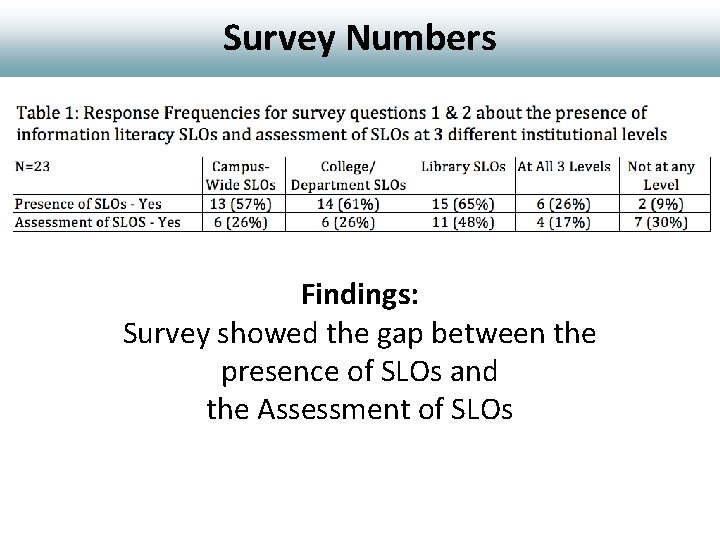
Survey Numbers Findings: Survey showed the gap between the presence of SLOs and the Assessment of SLOs
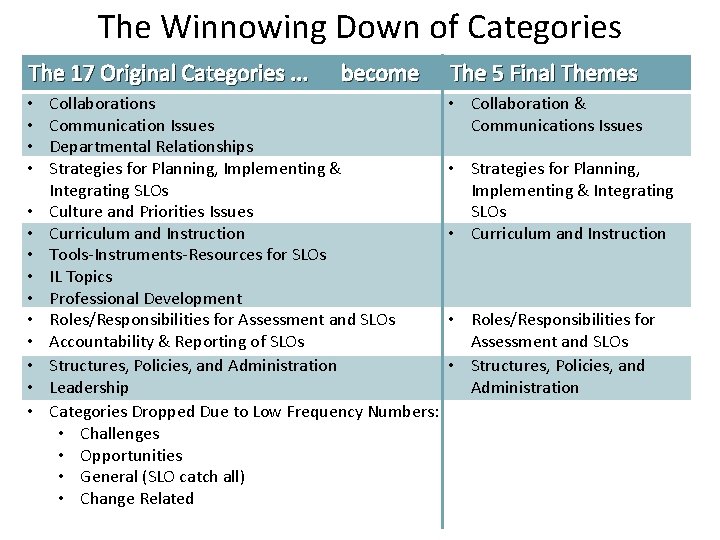
The Winnowing Down of Categories The 17 Original Categories. . . • • • • become Collaborations Communication Issues Departmental Relationships Strategies for Planning, Implementing & Integrating SLOs Culture and Priorities Issues Curriculum and Instruction Tools-Instruments-Resources for SLOs IL Topics Professional Development Roles/Responsibilities for Assessment and SLOs Accountability & Reporting of SLOs Structures, Policies, and Administration Leadership Categories Dropped Due to Low Frequency Numbers: • Challenges • Opportunities • General (SLO catch all) • Change Related The 5 Final Themes • Collaboration & Communications Issues • Strategies for Planning, Implementing & Integrating SLOs • Curriculum and Instruction • Roles/Responsibilities for Assessment and SLOs • Structures, Policies, and Administration
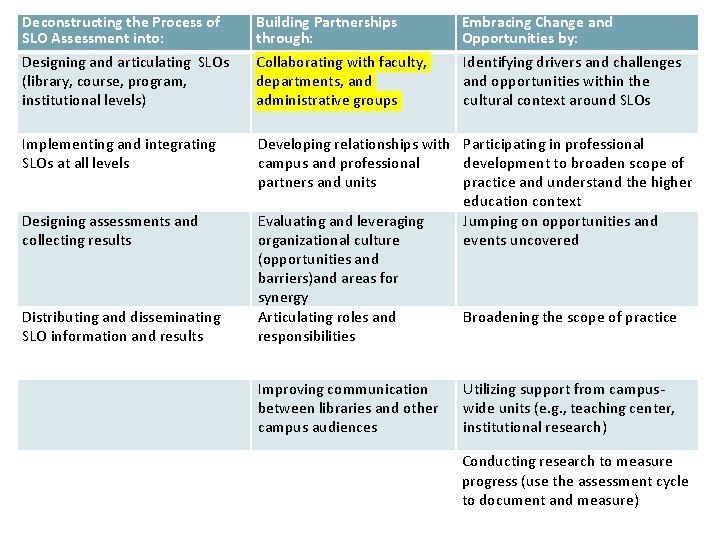
Deconstructing the Process of SLO Assessment into: Designing and articulating SLOs (library, course, program, institutional levels) Building Partnerships through: Collaborating with faculty, departments, and administrative groups Implementing and integrating SLOs at all levels Developing relationships with Participating in professional campus and professional development to broaden scope of partners and units practice and understand the higher education context Evaluating and leveraging Jumping on opportunities and organizational culture events uncovered (opportunities and barriers)and areas for synergy Articulating roles and Broadening the scope of practice responsibilities Designing assessments and collecting results Distributing and disseminating SLO information and results Improving communication between libraries and other campus audiences Embracing Change and Opportunities by: Identifying drivers and challenges and opportunities within the cultural context around SLOs Utilizing support from campuswide units (e. g. , teaching center, institutional research) Conducting research to measure progress (use the assessment cycle to document and measure)
https: //sites. google. com/a/gwla. org/greater-western-library-alliance/Committees/slo
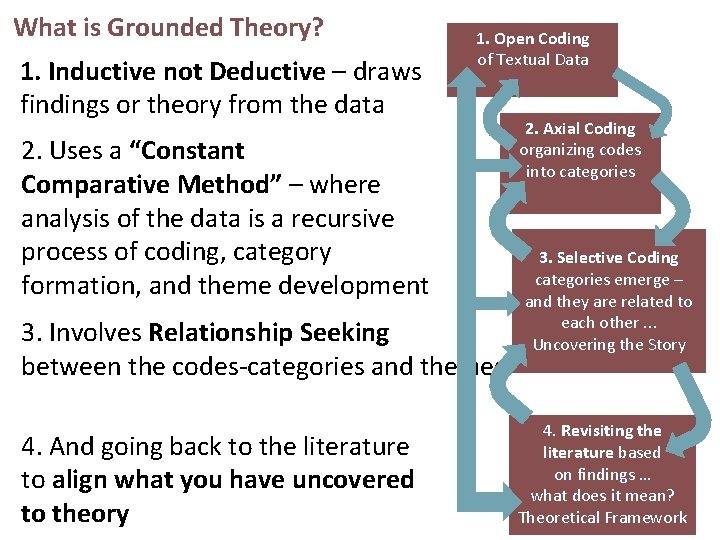
What is Grounded Theory? 1. Inductive not Deductive – draws findings or theory from the data 1. Open Coding of Textual Data 2. Uses a “Constant Comparative Method” – where analysis of the data is a recursive process of coding, category formation, and theme development 3. Involves Relationship Seeking between the codes-categories and themes 4. And going back to the literature to align what you have uncovered to theory 2. Axial Coding organizing codes into categories 3. Selective Coding categories emerge – and they are related to each other. . . Uncovering the Story 4. Revisiting the literature based on findings … what does it mean? Theoretical Framework
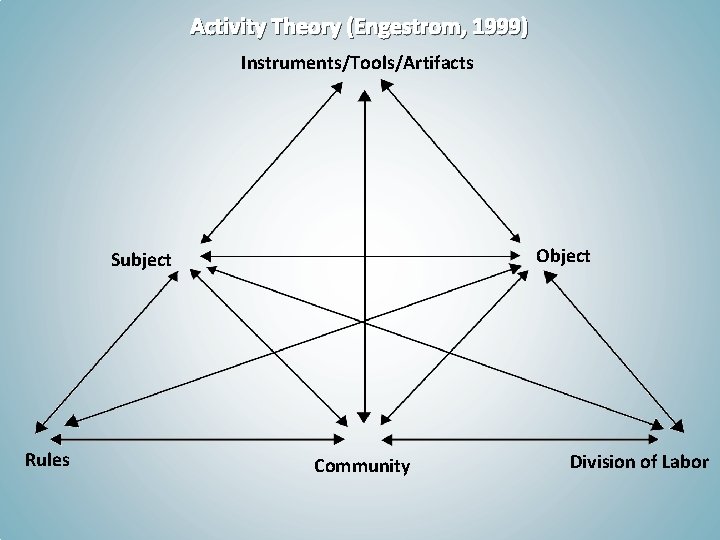
Activity Theory (Engestrom, 1999) Instruments/Tools/Artifacts Object Subject Rules Community Division of Labor
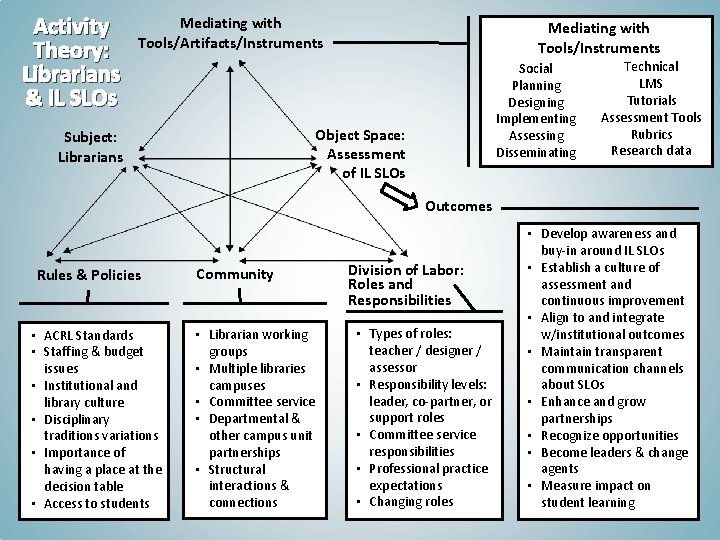
Activity Theory: Librarians & IL SLOs Mediating with Tools/Artifacts/Instruments Mediating with Tools/Instruments Social Planning Designing Implementing Assessing Disseminating Object Space: Assessment of IL SLOs Subject: Librarians Technical LMS Tutorials Assessment Tools Rubrics Research data Outcomes Rules & Policies • ACRL Standards • Staffing & budget issues • Institutional and library culture • Disciplinary traditions variations • Importance of having a place at the decision table • Access to students Community • Librarian working groups • Multiple libraries campuses • Committee service • Departmental & other campus unit partnerships • Structural interactions & connections Division of Labor: Roles and Responsibilities • Types of roles: teacher / designer / assessor • Responsibility levels: leader, co-partner, or support roles • Committee service responsibilities • Professional practice expectations • Changing roles • Develop awareness and buy-in around IL SLOs • Establish a culture of assessment and continuous improvement • Align to and integrate w/institutional outcomes • Maintain transparent communication channels about SLOs • Enhance and grow partnerships • Recognize opportunities • Become leaders & change agents • Measure impact on student learning
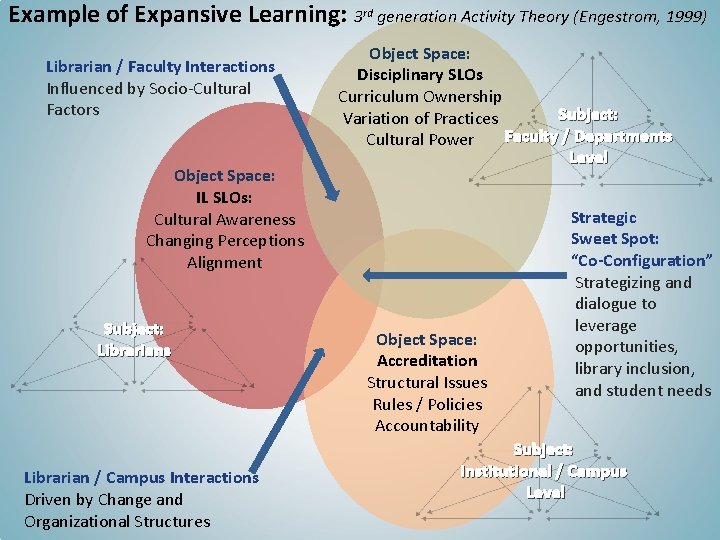
Example of Expansive Learning: 3 rd generation Activity Theory (Engestrom, 1999) Librarian / Faculty Interactions Influenced by Socio-Cultural Factors Object Space: IL SLOs: Cultural Awareness Changing Perceptions Alignment Subject: Librarians Librarian / Campus Interactions Driven by Change and Organizational Structures Object Space: Disciplinary SLOs Curriculum Ownership Subject: Variation of Practices Faculty / Departments Cultural Power Level AA Object Space: Accreditation Structural Issues Rules / Policies Accountability Strategic Sweet Spot: “Co-Configuration” Strategizing and dialogue to leverage opportunities, library inclusion, and student needs Subject: Institutional / Campus Level
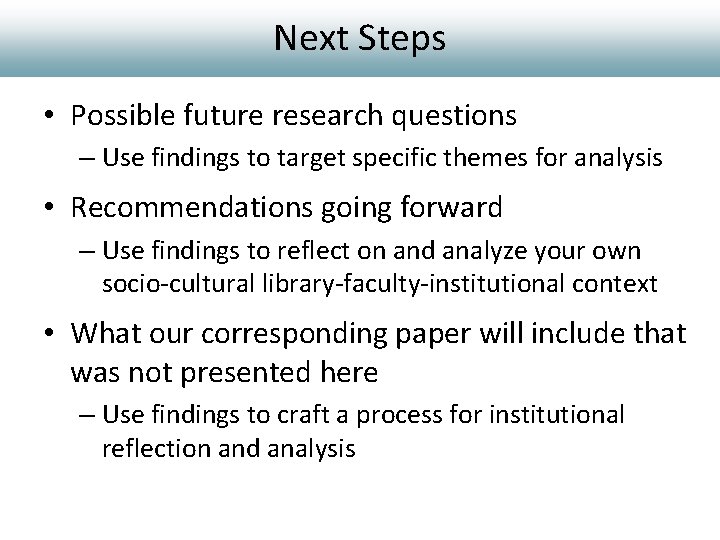
Next Steps • Possible future research questions – Use findings to target specific themes for analysis • Recommendations going forward – Use findings to reflect on and analyze your own socio-cultural library-faculty-institutional context • What our corresponding paper will include that was not presented here – Use findings to craft a process for institutional reflection and analysis
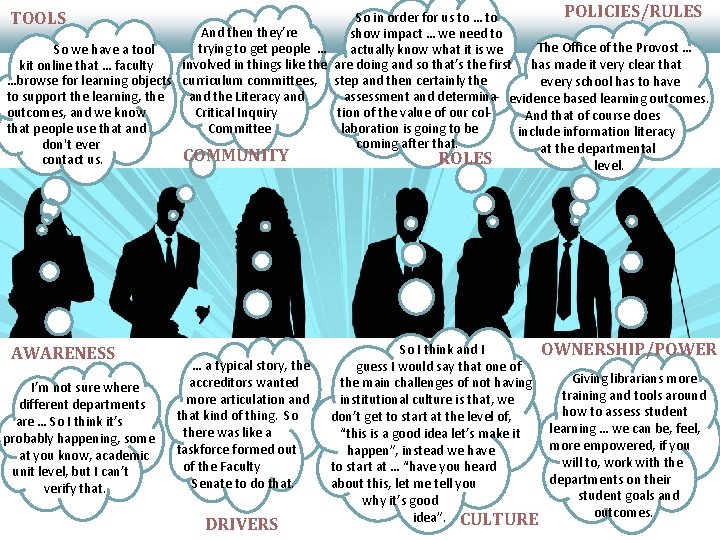
POLICIES/RULES So in order for us to … to And then they’re show impact … we need to The Office of the Provost … trying to get people … actually know what it is we So we have a tool involved in things like the are doing and so that’s the first has made it very clear that kit online that … faculty …browse for learning objects curriculum committees, step and then certainly the every school has to have assessment and determina- evidence based learning outcomes. and the Literacy and to support the learning, the tion of the value of our coloutcomes, and we know Critical Inquiry And that of course does laboration is going to be that people use that and Committee include information literacy coming after that. don't ever at the departmental COMMUNITY ROLES contact us. level. TOOLS Grass Roots Leaders in Higher Education: AWARENESS I’m not sure where different departments are … So I think it’s probably happening, some at you know, academic unit level, but I can’t verify that. … a typical story, the accreditors wanted more articulation and that kind of thing. So there was like a taskforce formed out of the Faculty Senate to do that. DRIVERS So I think and I OWNERSHIP/POWER guess I would say that one of Giving librarians more the main challenges of not having training and tools around institutional culture is that, we how to assess student don’t get to start at the level of, learning … we can be, feel, “this is a good idea let’s make it more empowered, if you happen”, instead we have will to, work with the to start at … “have you heard departments on their about this, let me tell you student goals and why it’s good outcomes. idea”. CULTURE
- Slides: 13