
Collaborative Potential of Virtual Communities Case Study of
Collaborative Potential of Virtual Communities: Case Study of „Connect“ Jasmina Božić Faculty of Humanities and Social Sciences University of Zagreb Ljubica Bakić-Tomić Faculty of Teacher Education University of Zagreb Armano Srbljinović Ministry of Defence – Institute for Research and Development of Defence Systems 12 th International Conference “Information Technology and Journalism”, Dubrovnik, May 21 -25, 2007
Collaborative Potential of Virtual Communities: Case Study of “Connect” Part I : Cooperation problem and virtual communities 12 th International Conference “Information Technology and Journalism”, Dubrovnik, May 21 -25, 2007
Collaborative Potential of Virtual Communities: Case Study of “Connect” Cooperation problem • Humans do not cooperate “of themselves”: The agreement of these creatures [social insects] is natural; that of men is by covenant only, which is artificial; and therefore it is no wonder if there be somewhat else required. Thomas Hobbes: “Leviathan” Your corn is ripe today; mine will be so tomorrow. 'Tis profitable for us both that I shou'd labour with you today, and that you shou'd aid me tomorrow. I have no kindness for you, and know that you have as little for me. I will not, therefore, take any pains on your account; and should I labour with you on my account, I know I shou'd be disappointed, and that I shou'd in vain depend upon your gratitude. Here then I leave you to labour alone: you treat me in the same manner. The seasons change; and both of us lose our harvests for want of mutual confidence and security. David Hume: “A Treatise of Human Nature” 12 th International Conference “Information Technology and Journalism”, Dubrovnik, May 21 -25, 2007
Collaborative Potential of Virtual Communities: Case Study of “Connect” Cooperation problem • Negative incentives / temptations to “free-ride” always exist: – Possibilities of short-term gains if merely private interests are followed – Everyone must give up a part of his/her personal freedom/comfort/gain/profit for the prosperity of all / “common good” • How to overcome negative incentives? – Knowledge and goodwill are often not enough • What “else” is required? 12 th International Conference “Information Technology and Journalism”, Dubrovnik, May 21 -25, 2007
Collaborative Potential of Virtual Communities: Case Study of “Connect” “Technologies of cooperation” • Social and/or technical arrangements facilitating cooperation • Lowering “costs of cooperation” to acceptable levels • Examples enabled by IT: – Wikipedia and other wiki-tools – electronic voting – e-reputation systems (e. Bay, Slashdot karma, …) 12 th International Conference “Information Technology and Journalism”, Dubrovnik, May 21 -25, 2007
Collaborative Potential of Virtual Communities: Case Study of “Connect” IT as a “cooperation amplifier” The most long-lasting social effects of technology always go beyond the quantitative efficiency of doing old things more quickly or more cheaply. The most profoundly transformative potential of connecting human social proclivities to the efficiency of information technologies is the chance to do new things together, the potential for cooperating on scales and in ways never before possible. Howard Rheingold: “Smart Mobs” The online world is home to some of the most participatory citizens we are ever likely to have. Jon Katz: “The Digital Citizen”, Wired, Dec. 1997 12 th International Conference “Information Technology and Journalism”, Dubrovnik, May 21 -25, 2007
Collaborative Potential of Virtual Communities: Case Study of “Connect” IT as a “cooperation attenuator” • Also provides many opportunities for reaping benefits/pleasures from the commons without contributing to its maintenance – Intentional destruction in most extreme cases • Examples from virtual communities: – – Spam e-mail messages Indulgence in ego trips and flame wars Spreading computer viruses Spreading patterns of deviant social behaviour: racism, hate, child pornography, … 12 th International Conference “Information Technology and Journalism”, Dubrovnik, May 21 -25, 2007
Collaborative Potential of Virtual Communities: Case Study of “Connect” IT as a “cooperation attenuator” The presence of flamers, bullies, bigots, charlatans, know-nothings, and nuts in online discourses poses a classic tragedy of the commons dilemma. If too many people take advantage of open access to seek other people’s attention, the excesses of the free riders drive away the people who make the conversation valuable. Howard Rheingold: “Smart Mobs” 12 th International Conference “Information Technology and Journalism”, Dubrovnik, May 21 -25, 2007
Collaborative Potential of Virtual Communities: Case Study of “Connect” Transforming “strategic setting” of on-line interactions ? • Goals: – Make cooperative social outcomes more frequent in human on-line interactions – Improve positive & suppress negative incentives for cooperation in virtual communities – Increase collaborative potential of virtual communities • Goals attainment: – Assessment of collaborative potential? – Set of guidelines? – Applicability in virtual communities? 12 th International Conference “Information Technology and Journalism”, Dubrovnik, May 21 -25, 2007

Collaborative Potential of Virtual Communities: Case Study of “Connect” Ostrom’s principles Elinor Ostrom, 1990, design principles of robust, long enduring, common-pool resource institutions: 1. 2. 3. 4. 5. 6. 7. 8. Clearly defined boundaries should be in place. Rules in use are well matched to local needs and conditions. Individuals affected by rules can usually participate in modifying the rules. The right of community members to devise their own rules is respected by external authorities. A system for self-monitoring members’ behaviour has been established. A graduated system of sanctions is available. Community members have access to low-cost conflict-resolution mechanisms. Nested enterprises – appropriation, provision, monitoring and sanctioning, conflict resolution, and other governance activities – are organized in a nested structure with multiple layers of activities. 12 th International Conference “Information Technology and Journalism”, Dubrovnik, May 21 -25, 2007
Collaborative Potential of Virtual Communities: Case Study of “Connect” Ostrom’s principles • • Discovered after empirical studies on common-pool resource governance In practice embodied in a rich variety of more specific rules No single set of specific rules is universally applicable Ostrom: Principles are helpful as a possible place to start an investigation, but they are in no way prescriptive. 12 th International Conference “Information Technology and Journalism”, Dubrovnik, May 21 -25, 2007
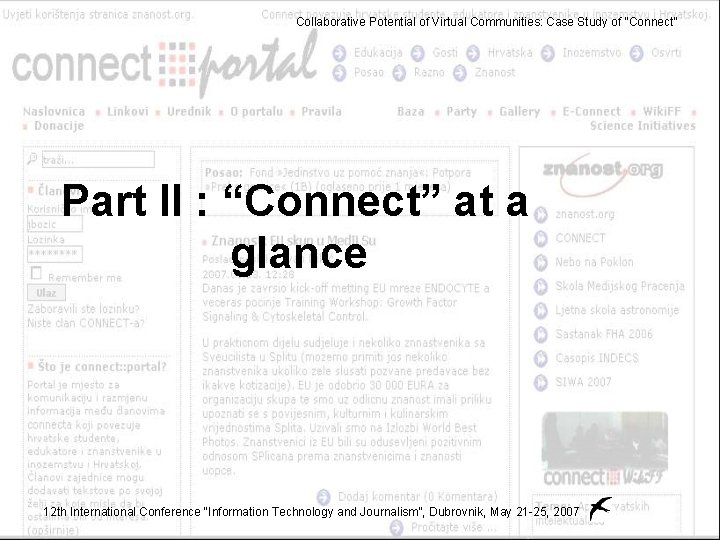
Collaborative Potential of Virtual Communities: Case Study of “Connect” Part II : “Connect” at a glance 12 th International Conference “Information Technology and Journalism”, Dubrovnik, May 21 -25, 2007
Collaborative Potential of Virtual Communities: Case Study of “Connect” • • • Envisioned as an informal “meeting place” of Croatian scientific community Started in 2004 Structured as an NGO programme consisting of several related on-line activities (“projects”) – – Portal, database, e-news and mailing lists, focus forums, science initiatives, on-line management of off-line activities A metaphor of “virtual city” (programme) consisting of “virtual squares” (projects) 12 th International Conference “Information Technology and Journalism”, Dubrovnik, May 21 -25, 2007
Collaborative Potential of Virtual Communities: Case Study of “Connect” • • A central virtual square A place where most on-line interactions among community members take place Discussions organised in thematic threads • – – – More than 2000 thematic threads by May 15, 2007 Members freely open new threads or post comments to existing threads Authorship of postings: • • – Public to community members Invisible to outsiders (except of the initial posting in a discussion thread) Additional private messages service for members 12 th International Conference “Information Technology and Journalism”, Dubrovnik, May 21 -25, 2007
Collaborative Potential of Virtual Communities: Case Study of “Connect” Connect: : Database • Members data – Name, affiliation, area of expertise, interests – Approx. 1150 members by May 15, 2007 Connect: : Party • Web-pages dedicated to off-line gatherings of community members – Organisation details, photo-galleries, … 12 th International Conference “Information Technology and Journalism”, Dubrovnik, May 21 -25, 2007
Collaborative Potential of Virtual Communities: Case Study of “Connect” E-Connect • • E-newsletters for all Connect members and for visitors Special-interest sub-communities with their own web-pages, professional discussion forums, newsletters, mailing lists – – Astro Connect: astrophysics HR in CH: Croatian young scientists in Switzerland Kognet: cognitive neuroscience Geo Connect: geo-science 12 th International Conference “Information Technology and Journalism”, Dubrovnik, May 21 -25, 2007
Collaborative Potential of Virtual Communities: Case Study of “Connect” • • Connect: : Wiki. FF = Wiki Focus Forum Web-pages for collaborative work focused on various topics of interest – Each member may contribute • 14 topics in total by May 15, 2007 • • • Started most recently Aim: encourage dialogue on science-related issues 2006 Video-conference “Setting up a World-Class Science Institute: Difficulties and Possibilities” 12 th International Conference “Information Technology and Journalism”, Dubrovnik, May 21 -25, 2007
Collaborative Potential of Virtual Communities: Case Study of “Connect” - main achievements • Importance for democratisation of Croatian scientific public sphere – • A member’s observation: Connect contributed to bringing many important science-related issues in Croatia from backdoors to public. Reinforcing feedback: portal <-> other media – – Portal discussions provide topics for media coverage Media coverage attracts new “Connect” members 12 th International Conference “Information Technology and Journalism”, Dubrovnik, May 21 -25, 2007
Collaborative Potential of Virtual Communities: Case Study of “Connect” Successful cooperation examples • Collaborative work on document proposals – 2 nd Congress of Croatian Scientists • Public interviews with prominent scientists and science officials (“guests”) – Over a certain period of “visit” each member may ask a question on-line, and a guest provides answers on-line – 6 “guest visits” by May 15, 2007 12 th International Conference “Information Technology and Journalism”, Dubrovnik, May 21 -25, 2007
Collaborative Potential of Virtual Communities: Case Study of “Connect” Successful cooperation examples • • Public nominations of officials in science and research Announcement of job opportunities in science and research – Increased visibility • Direct collaborative arrangements among members through message exchange – Less visible to public, nevertheless important 12 th International Conference “Information Technology and Journalism”, Dubrovnik, May 21 -25, 2007
Collaborative Potential of Virtual Communities: Case Study of “Connect” Cooperation breakdowns • Flame wars as the main problem – Not as frequent and intensive as in many other non-scientific portals – Nevertheless destructive consequences • • Focus on exchange of insults instead on problems Retreats from discussions Angry disputes continue through other media Other destructive tendencies not present 12 th International Conference “Information Technology and Journalism”, Dubrovnik, May 21 -25, 2007
Collaborative Potential of Virtual Communities: Case Study of “Connect” Part III: “Connect” - compliance to Ostrom’s principles 12 th International Conference “Information Technology and Journalism”, Dubrovnik, May 21 -25, 2007
Collaborative Potential of Virtual Communities: Case Study of “Connect” 1. Boundaries • • • Membership open to scientists, educators, students Also to professionals if they hold (at least) a bachelor’s degree Members not necessarily Croatian citizens, but have to be related to Croatia (place of education, work, living) 12 th International Conference “Information Technology and Journalism”, Dubrovnik, May 21 -25, 2007
Collaborative Potential of Virtual Communities: Case Study of “Connect” 1. Boundaries • Membership open to practitioners of sciences, social sciences, humanities – Only a fraction uses the opportunity • Members from sciences prevail – Bias towards issues primarily relevant to sciences – Self-selection establishes additional boundary 12 th International Conference “Information Technology and Journalism”, Dubrovnik, May 21 -25, 2007
Collaborative Potential of Virtual Communities: Case Study of “Connect” 2. Rules matched to local needs • Membership assumes acceptance of community’s rules – Clearly specified – General: registration, personal data reliability and protection, … – Not overly restrictive • Projects (Portal, Wiki. FF, …) – Additional more specific rules – Matched to project-specific needs – E-connect sub-communities: rules matched to their needs 12 th International Conference “Information Technology and Journalism”, Dubrovnik, May 21 -25, 2007
Collaborative Potential of Virtual Communities: Case Study of “Connect” 2. Rules matched to local needs • Connect: : Portal rules: – – – Technical rules - how to: format text, post, comment, rate, … Prohibitions: advertisement, partisanship and political marketing, defamation, copyright infringements Netiquette rules: • • • Specially emphasised Links to additional netiquette sources provided Advisory, but not mandatory status 12 th International Conference “Information Technology and Journalism”, Dubrovnik, May 21 -25, 2007
Collaborative Potential of Virtual Communities: Case Study of “Connect” 3. Participation in modifying the rules • • Rules open to discussion and revision Connect: : Portal rules are subject to comments as any other posting Members use this opportunity Intensions of changing the rules are publicly announced by the editor 12 th International Conference “Information Technology and Journalism”, Dubrovnik, May 21 -25, 2007
Collaborative Potential of Virtual Communities: Case Study of “Connect” 4. Respect of rights and rules by authorities • External authorities: – • No direct influence Internal authorities – Editor: – – The right to intervene in cases of severe rulebreaching Acts mainly as a benevolent, non-intrusive supervisor: • • Generally refrains from modifying or deleting postings Issues warnings to participants only when discussion erupts into a flame war 12 th International Conference “Information Technology and Journalism”, Dubrovnik, May 21 -25, 2007
Collaborative Potential of Virtual Communities: Case Study of “Connect” 5. Self-monitoring system • • • Rating postings in an “e-jury” manner Members can rate postings of discussions in which they do not participate Ratings: Insightful (+1) Informative (+1) Interesting (+1) • Neutral (0) Funny (0) Off topic (-1) Superfluous (-1) Improper (-1) Provocative (-1) Ratings are anonymous 12 th International Conference “Information Technology and Journalism”, Dubrovnik, May 21 -25, 2007
Collaborative Potential of Virtual Communities: Case Study of “Connect” 5. Self-monitoring system • Total rating of a posting: – Calculated only if at least 3 ratings are cast • • • Numerical part (magnitude) of total rating is a sum of all ratings Textual part of total rating is textual description of the most frequent rating of the same sign as the calculated sum Both total rating and the distribution of all ratings are public to members 12 th International Conference “Information Technology and Journalism”, Dubrovnik, May 21 -25, 2007
Collaborative Potential of Virtual Communities: Case Study of “Connect” 6. Sanctions • • Graduation of sanctions in 2 levels Level 1: Decentralised sanctions – Ratings cast by community members • Level 2: Centralised sanctions – Editor’s interventions in more serious cases 12 th International Conference “Information Technology and Journalism”, Dubrovnik, May 21 -25, 2007
Collaborative Potential of Virtual Communities: Case Study of “Connect” 6. Sanctions • Problems with ratings are subject of lengthy discussions among members: – Sample size: • – Usually small number of ratings are cast Sample quality: • • • Asymmetry between publicly signed postings and anonymous ratings Ratings may come from author’s “friends”/”enemies” and not represent “the silent majority” Publicity of ratings, on the other hand, would discourage negative ratings and diminish the sanctioning effect 12 th International Conference “Information Technology and Journalism”, Dubrovnik, May 21 -25, 2007
Collaborative Potential of Virtual Communities: Case Study of “Connect” 6. Sanctions – Problems (cont’d) • Observability and measurability of effects: – Ratings really have moderating effects? • – Ratings have excessively restrictive effects on discussions? • • • Hard to measure whether the frequency and intensity of flame wars declined since (and due to) the introduction of ratings Hard to measure whether the total amount of postings declined since (and due to) the introduction of ratings A broader dilemma: Freedom of public expression in postings vs. Freedom of anonymous expression of disagreement in ratings Meaningfulness of total rating: – – Need not be the most frequent of all ratings Postings with starkly different rating distributions may end with identical total rating 12 th International Conference “Information Technology and Journalism”, Dubrovnik, May 21 -25, 2007
Collaborative Potential of Virtual Communities: Case Study of “Connect” 7. Low-cost conflict-resolution • • Not implemented Remains a challenge for social computing practitioners to develop lowcost e-versions of various conflictresolution procedures – Ending flame wars in an “e-court”? “e-negotiation”, “e-mediation”, “e-arbitration”, …? 12 th International Conference “Information Technology and Journalism”, Dubrovnik, May 21 -25, 2007
Collaborative Potential of Virtual Communities: Case Study of “Connect” 8. Nested governance structure • • Most demanding requirement Cannot be fulfilled before the governance structure of considerable complexity exists “Connect” community still too small to afford multi-layered self-governance “E-connect” sub-community structure testifies that “Connect” is envisioned as a nested self-governing community 12 th International Conference “Information Technology and Journalism”, Dubrovnik, May 21 -25, 2007
Collaborative Potential of Virtual Communities: Case Study of “Connect” Part IV: Conclusions 12 th International Conference “Information Technology and Journalism”, Dubrovnik, May 21 -25, 2007
Collaborative Potential of Virtual Communities: Case Study of “Connect” Compliance to Ostrom’s principles • • • Principles 1. -4. implemented Principles 5. -6. implemented, but the effectiveness of their implementation is disputable Principles 7. -8. not implemented – Reasons: • • Principle 7. : technical prerequisites still do not exist Principle 8. : community still too small, develops towards nested self-government Room for improvement: principles 5. -8. How ? 12 th International Conference “Information Technology and Journalism”, Dubrovnik, May 21 -25, 2007
Collaborative Potential of Virtual Communities: Case Study of “Connect” Further work directions • Increase virtual communities sample size – • Compare several virtual communities as to their compliance and (non-)cooperative outcomes Increase guidelines sample size – – Ostrom’s set of principles only one among many Compare various sets of guidelines 12 th International Conference “Information Technology and Journalism”, Dubrovnik, May 21 -25, 2007
Collaborative Potential of Virtual Communities: Case Study of “Connect” Goals • Obtain further insights into factors influencing collaborative potential of virtual communities • Better explain successful/unsuccessful cooperation • Provide advice for social-software designers on promising directions of their further work • Further improve collaborative potential of virtual communities Use IT for further lowering costs of human cooperation 12 th International Conference “Information Technology and Journalism”, Dubrovnik, May 21 -25, 2007
Collaborative Potential of Virtual Communities: Case Study of “Connect” References: • • Axelrod, Robert (1984). The Evolution of Cooperation. New York, NY: Basic Books. Baase, Sara (2003). A Gift of Fire: Social, legal, and ethical issues for computers and the Internet. Upper Saddle River, NJ: Pearson Education, Inc. Connect virtual community web pages. http: //connect. znanost. org/ Hess, Charlotte and Elinor Ostrom (2006). An Overview of the Knowledge Commons. In: Charlotte Hess and Elinor Ostrom (eds. ) Understanding Knowledge as a Commons: From Theory to Practice. Cambridge, MA: The MIT Press. Katz, Jon (1997). The Digital Citizen. Wired 5. 12, Dec. 1997. Ostrom, Elinor (1990). Governing the Commons: The Evolution of Institutions for Collective Action. New York, NY: Cambridge University Press. Rheingold, Howard (2002). Smart Mobs: The Next Social Revolution. New York, NY: Basic Books. Schellenberg, James A. (1996). Conflict Resolution: Theory, Research and Practice. New York, NY: State University of New York Press. 12 th International Conference “Information Technology and Journalism”, Dubrovnik, May 21 -25, 2007
- Slides: 40