
Collaborative Learning of Hierarchical Task Networks from Demonstration
Collaborative Learning of Hierarchical Task Networks from Demonstration and Instruction Anahita Mohseni-Kabir, Sonia Chernova and Charles Rich Worcester Polytechnic Institute
Project Objectives and Contributions • Main Goal: Learning complex procedural tasks from human demonstration and instruction in the form of hierarchical task networks and applying it to car maintenance domain • Project Contributions: • Unified system that integrates hierarchical task networks (HTNs) and collaborative discourse theory into the learning from demonstration • Learning task model from a small number of demonstrations • Generalization techniques • Integration of mixed-initiative interaction into the learning process through question asking 2
Related Work • Collaborative Discourse Theory • Disco (ANSI/CEA-2018 standard) (Grosz and Sidner, 1986 and Rich et al. , 2001) • Learning from Demonstration • • • Mix Lf. D and planning (Nicolescu and Mataric, 2003) Integrate HTN and Lf. D (Rybski et al. , 2007) Learn from Instruction (Mohan and Laird, 2011) Learn the HTN from task’s traces (Garland et al. , 2001) Segmentation (Niekum et al. , 2012) Active learning (Cakmak and Thomaz, 2012) 3
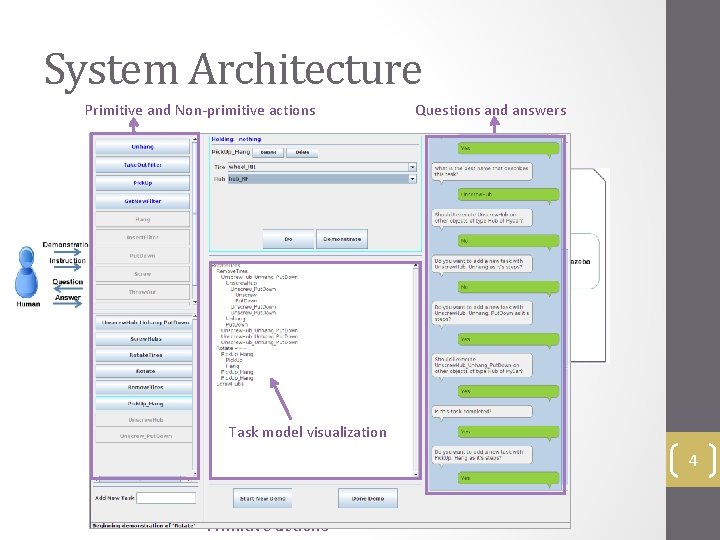
System Architecture Primitive and Non-primitive actions Questions and answers Task model visualization 4 Primitive actions
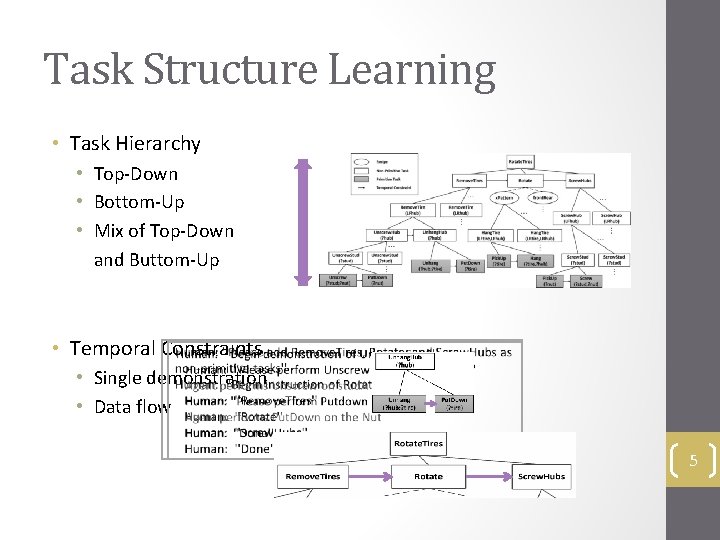
Task Structure Learning • Task Hierarchy • Top-Down • Bottom-Up • Mix of Top-Down and Buttom-Up • Temporal Constraints • Single demonstration • Data flow 5
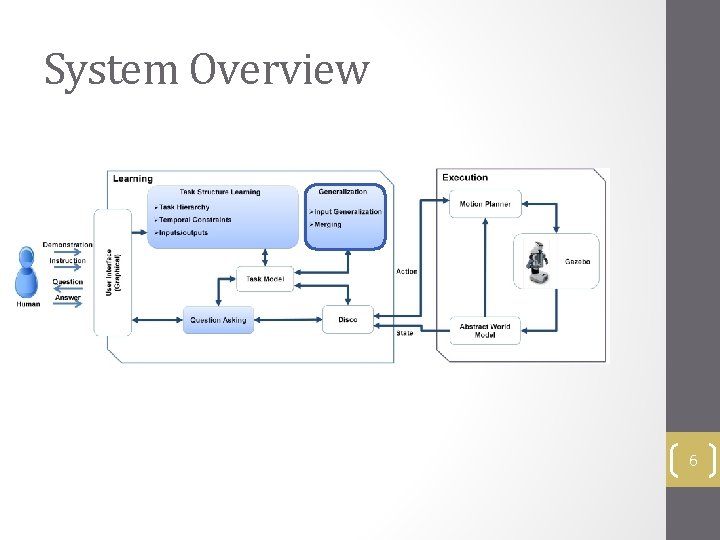
System Overview 6
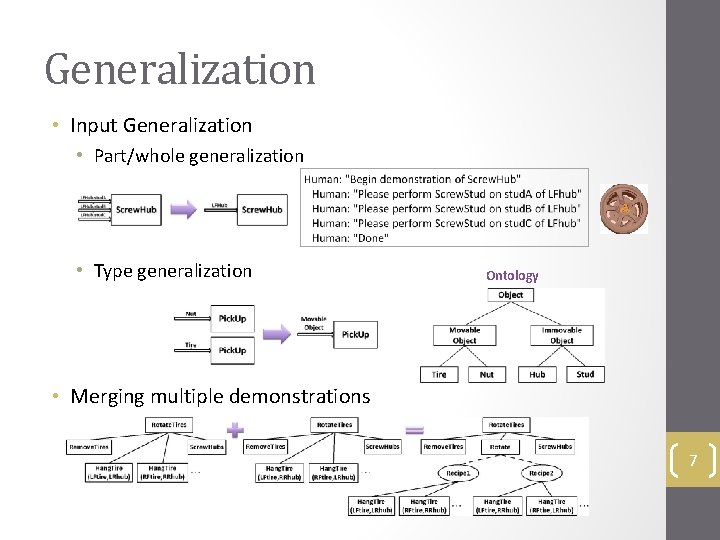
Generalization • Input Generalization • Part/whole generalization • Type generalization Ontology • Merging multiple demonstrations 7
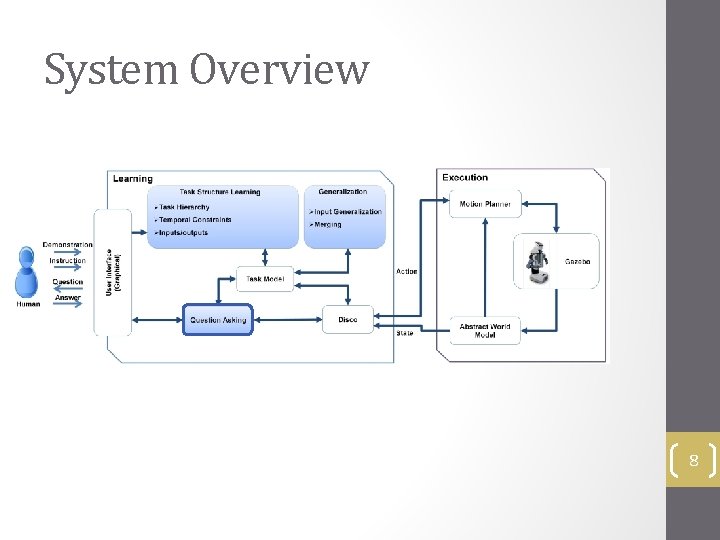
System Overview 8
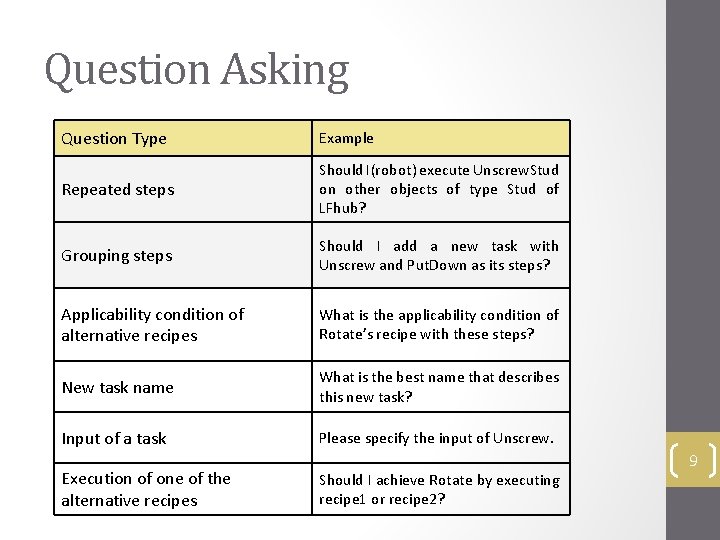
Question Asking Question Type Example Repeated steps Should I(robot) execute Unscrew. Stud on other objects of type Stud of LFhub? Grouping steps Should I add a new task with Unscrew and Put. Down as its steps? Applicability condition of alternative recipes What is the applicability condition of Rotate’s recipe with these steps? New task name What is the best name that describes this new task? Input of a task Please specify the input of Unscrew. Execution of one of the alternative recipes Should I achieve Rotate by executing recipe 1 or recipe 2? 9
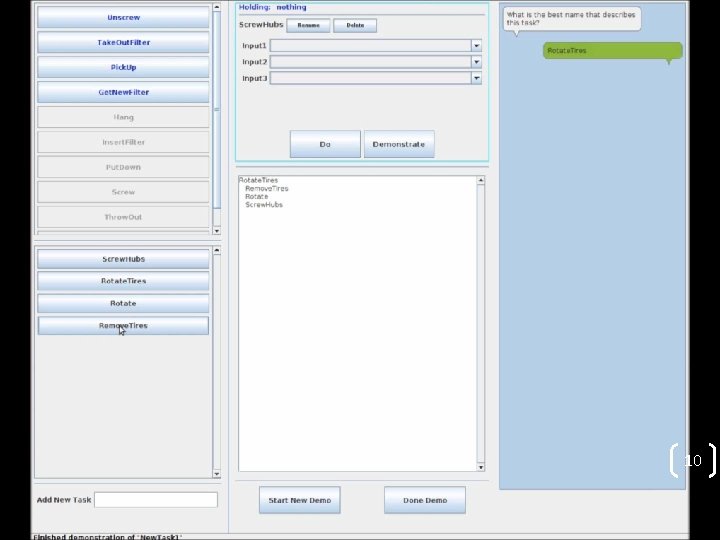
10
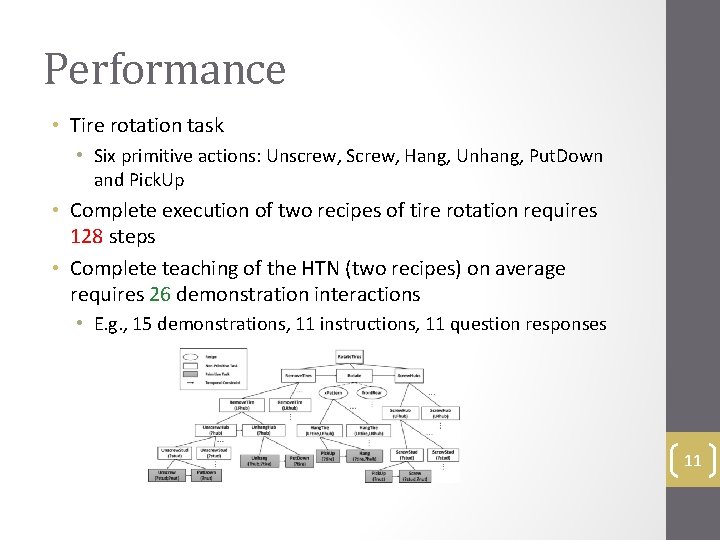
Performance • Tire rotation task • Six primitive actions: Unscrew, Screw, Hang, Unhang, Put. Down and Pick. Up • Complete execution of two recipes of tire rotation requires 128 steps • Complete teaching of the HTN (two recipes) on average requires 26 demonstration interactions • E. g. , 15 demonstrations, 11 instructions, 11 question responses 11
Conclusion and Future Work • Make the interaction as natural as possible by making the UI and robot look like a unified system • Do user study and use the real robot instead of the simulation • Learn applicability conditions and pre/postconditions of the tasks • Failure detection and recovery This work is supported in part by ONR contract N 00014 -13 -1 -0735, in collaboration with Dmitry Berenson, Jim Mainprice , Artem Gritsenko, and Daniel Miller. 12
References • Barbara J. Grosz and Candace L. Sidner. Attention, intentions, and the structure of discourse. Comput. Linguist. , 12(3): 175– 204, July 1986. • Charles Rich, Candace L Sidner, and Neal Lesh. Collagen: applying collaborative discourse theory to human-computer interaction. AI Magazine, 22 (4): 15, 2001. • Brenna D Argall, Sonia Chernova, Manuela Veloso, and Brett Browning. A survey of robot learning from demonstration. Robotics and Autonomous Systems, 57(5): 469– 483, 2009. • Paul E Rybski, Kevin Yoon, Jeremy Stolarz, and Manuela M Veloso. Interactive robot task training through dialog and demonstration. In ACM/IEEE Int. Conf. on Human-Robot Interaction, pages 49– 56, 2007. 13
References • Scott Niekum, Sarah Osentoski, George Konidaris, and Andrew G Barto. Learning and generalization of complex tasks from unstructured demonstrations. In IEEE/RSJ Int. Conf. on Intelligent Robots and Systems, pages 5239– 5246, 2012. • Maya Cakmak and Andrea L Thomaz. Designing robot learners that ask good questions. In ACM/IEEE International Conference on Human-Robot Interaction, pages 17– 24. ACM, 2012. • Monica N Nicolescu and Maja J Mataric. Natural methods for robot task learning: Instructive demonstrations, generalization and practice. In AAMAS, pages 241– 248, 2003. 14
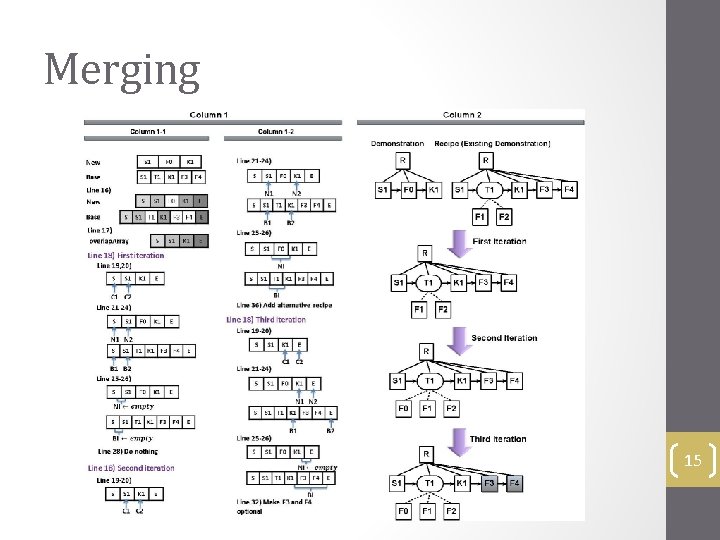
Merging 15
- Slides: 15