
Collaborative Learning and google Classroom By Falah Fakhri
Collaborative Learning and google Classroom By Falah Fakhri Post-doctoral Scholar falah. fakhri@utu. fi https: //www. researchgate. net/profile/Falah_Fakhri https: //falahfakhri. wordpress. com https: //twitter. com/FALAHFAKHRI https: //www. youtube. com/my_videos? o=U Department of Geography and Geology Friday 05/09/2014 Time 14: 15 – 15: 15 MAANTIETEEN JA GEOLOGIAN LAITOS
Overview § What would you like to say (do) first-year students in the first lecture? § Teaching and Learning Triangle § Blooms Taxonomy and Average of Retentions Rates § Collaborative Learning • What is Collaborative Learning? • What Are the Benefits of Collaborative Learning? • What Role Does the teacher play in Collaborative Learning? • Questions Asked in Collaborative Learning • Size of Groups • The Basic Collaborative Learning Techniques § Google Classroom MAANTIETEEN LAITOS
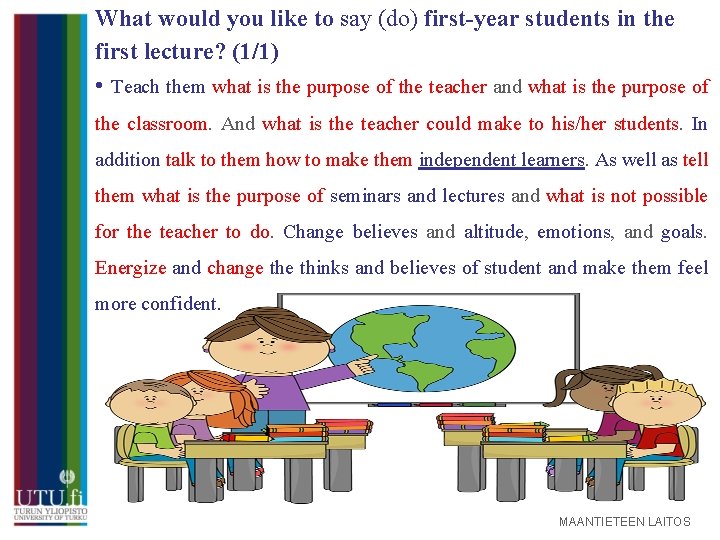
What would you like to say (do) first-year students in the first lecture? (1/1) • Teach them what is the purpose of the teacher and what is the purpose of the classroom. And what is the teacher could make to his/her students. In addition talk to them how to make them independent learners. As well as tell them what is the purpose of seminars and lectures and what is not possible for the teacher to do. Change believes and altitude, emotions, and goals. Energize and change thinks and believes of student and make them feel more confident. MAANTIETEEN LAITOS
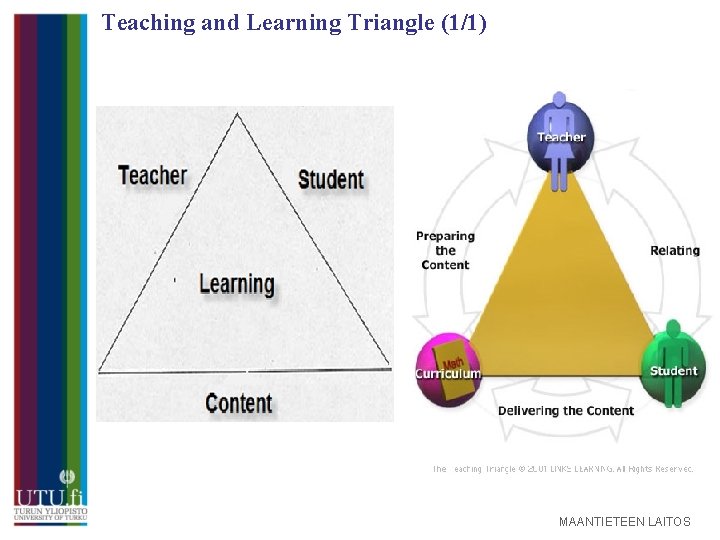
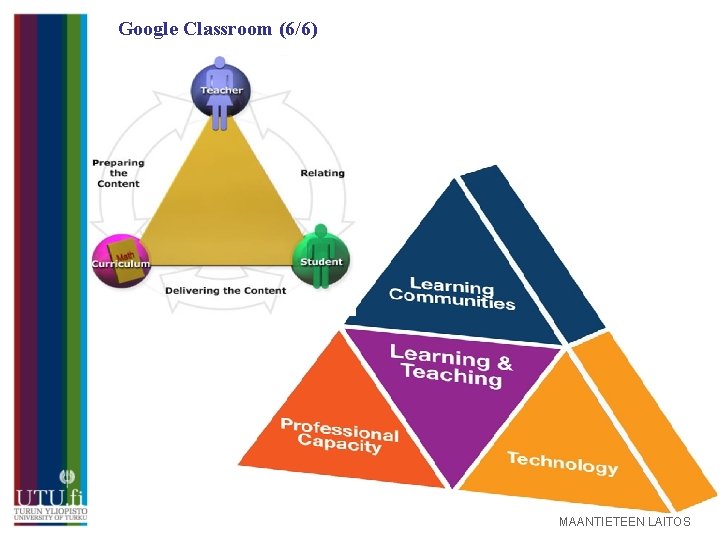
Teaching and Learning Triangle (1/1) MAANTIETEEN LAITOS
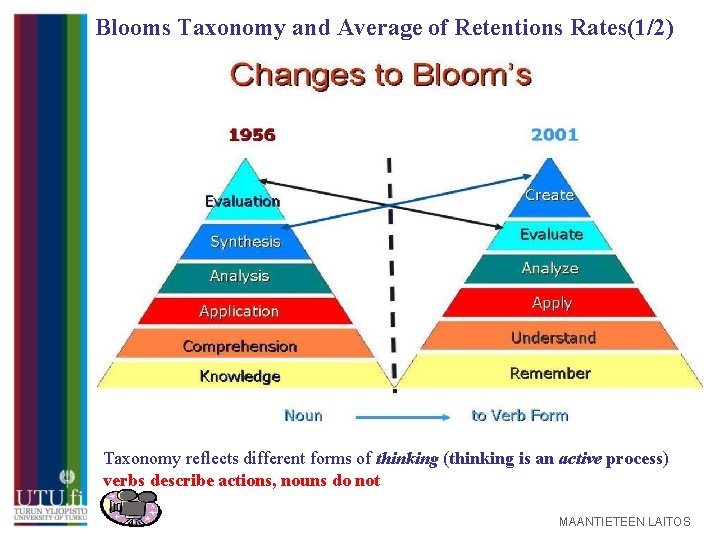
Blooms Taxonomy and Average of Retentions Rates(1/2) Taxonomy reflects different forms of thinking (thinking is an active process) verbs describe actions, nouns do not MAANTIETEEN LAITOS
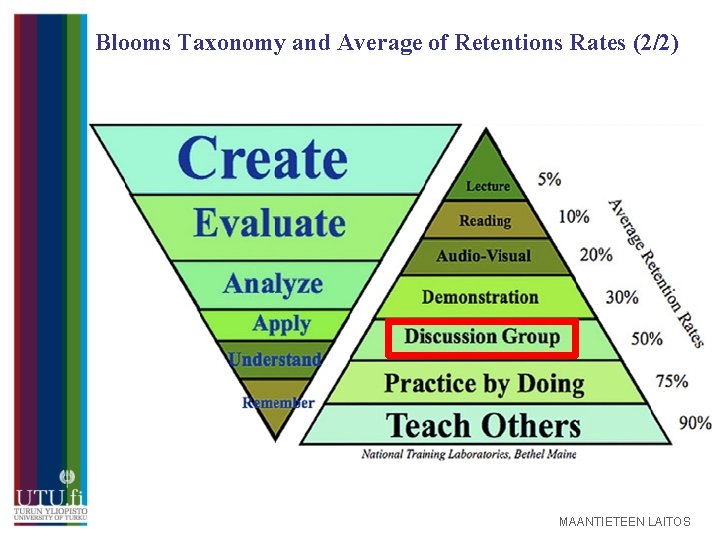
Blooms Taxonomy and Average of Retentions Rates (2/2) MAANTIETEEN LAITOS
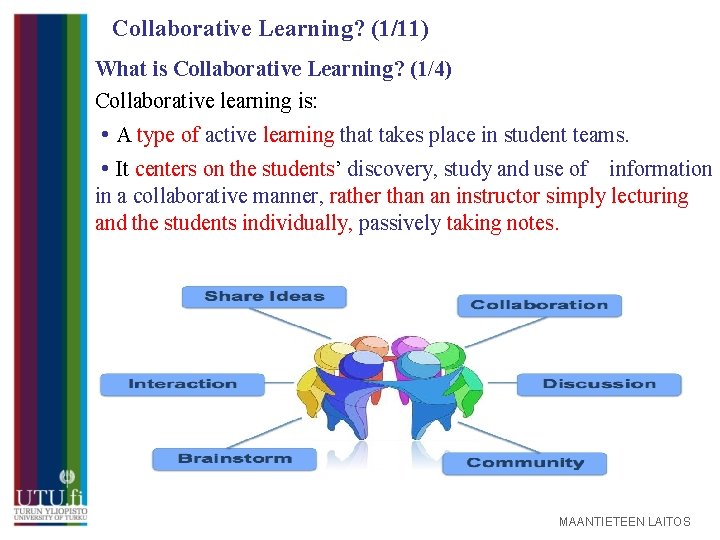
Collaborative Learning? (1/11) What is Collaborative Learning? (1/4) Collaborative learning is: • A type of active learning that takes place in student teams. • It centers on the students’ discovery, study and use of information in a collaborative manner, rather than an instructor simply lecturing and the students individually, passively taking notes. MAANTIETEEN LAITOS
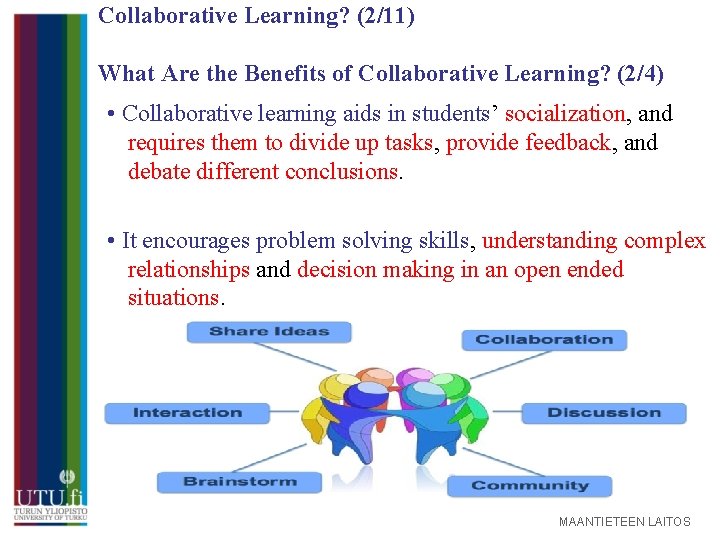
Collaborative Learning? (2/11) What Are the Benefits of Collaborative Learning? (2/4) • Collaborative learning aids in students’ socialization, and requires them to divide up tasks, provide feedback, and debate different conclusions. • It encourages problem solving skills, understanding complex relationships and decision making in an open ended situations. MAANTIETEEN LAITOS
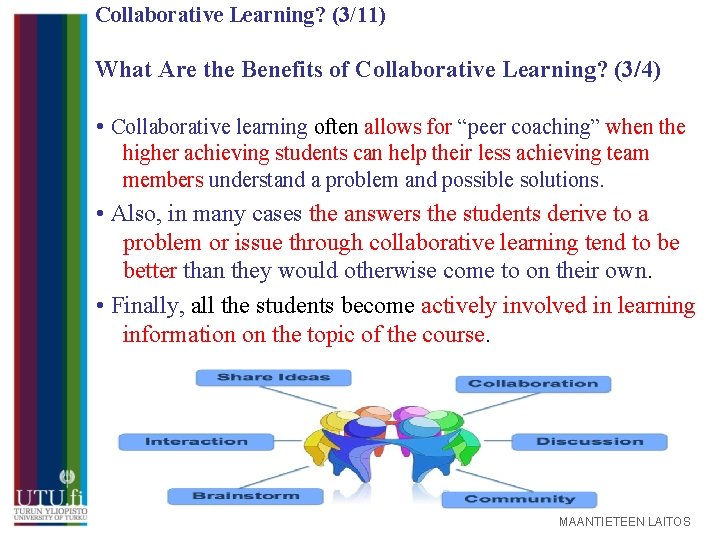
Collaborative Learning? (3/11) What Are the Benefits of Collaborative Learning? (3/4) • Collaborative learning often allows for “peer coaching” when the higher achieving students can help their less achieving team members understand a problem and possible solutions. • Also, in many cases the answers the students derive to a problem or issue through collaborative learning tend to be better than they would otherwise come to on their own. • Finally, all the students become actively involved in learning information on the topic of the course. MAANTIETEEN LAITOS
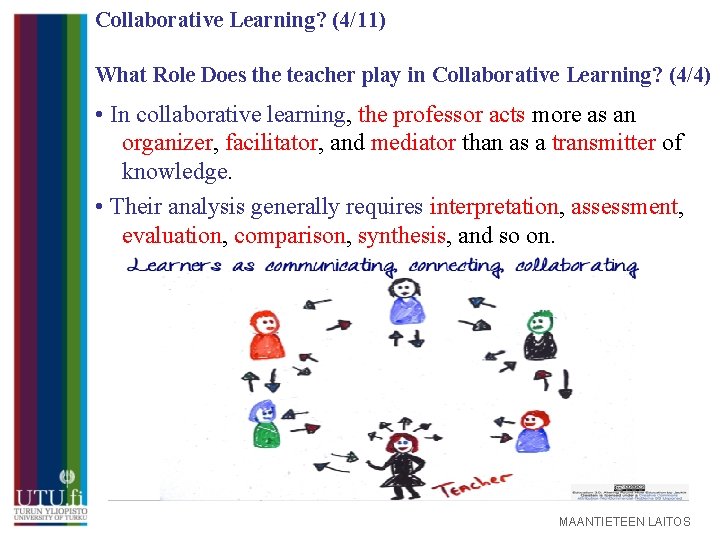
Collaborative Learning? (4/11) What Role Does the teacher play in Collaborative Learning? (4/4) • In collaborative learning, the professor acts more as an organizer, facilitator, and mediator than as a transmitter of knowledge. • Their analysis generally requires interpretation, assessment, evaluation, comparison, synthesis, and so on. MAANTIETEEN LAITOS
Collaborative Learning (5/11) Questions Asked in Collaborative Learning (1/2) These analytical questions are often used in collaborative learning: • What is the difference between. . . and. . . ? • How are. . . and. . . similar? • How would I use. . . to. . . ? • What is the main idea of. . . ? • What if. . . ? • How does. . . affect. . . ? • What is a new example of. . . ? • Explain why. . . ? • Explain how. . . ? • How does this relate to what I've learned before? • What conclusions can I draw about. . . ? MAANTIETEEN LAITOS
Collaborative Learning (6/11) Questions Asked in Collaborative Learning (2/2) These analytical questions are often used in collaborative learning: • What are the strengths and weaknesses of. . . ? • What is the best. . . and why? • What do you think causes _______ ? Why? • What is another way to look at _______ ? • What would happen if _______ ? • What are the implications of _______ ? • Why is _______ important? • How does _______ apply to everyday life? MAANTIETEEN LAITOS
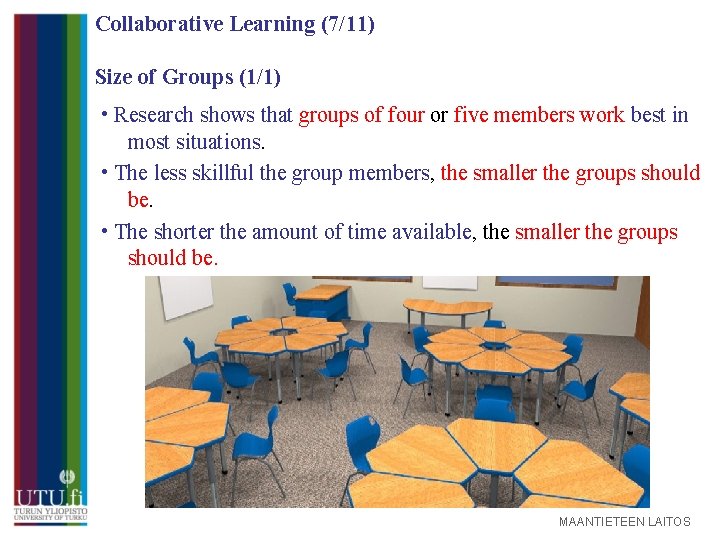
Collaborative Learning (7/11) Size of Groups (1/1) • Research shows that groups of four or five members work best in most situations. • The less skillful the group members, the smaller the groups should be. • The shorter the amount of time available, the smaller the groups should be. MAANTIETEEN LAITOS
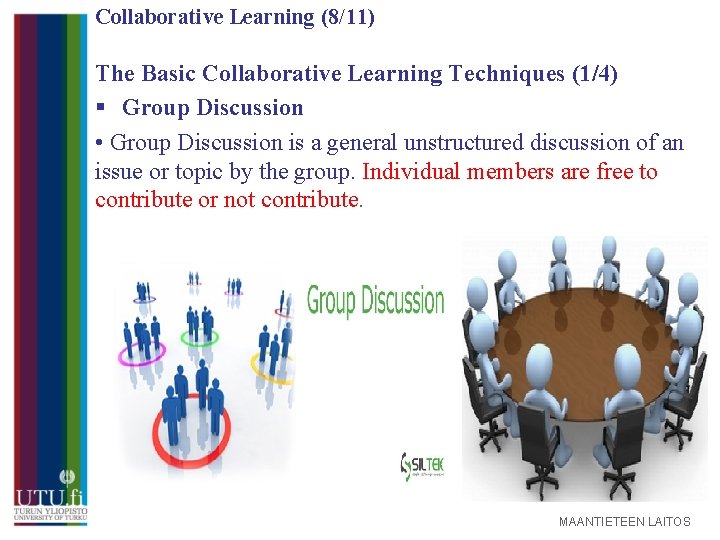
Collaborative Learning (8/11) The Basic Collaborative Learning Techniques (1/4) § Group Discussion • Group Discussion is a general unstructured discussion of an issue or topic by the group. Individual members are free to contribute or not contribute. MAANTIETEEN LAITOS
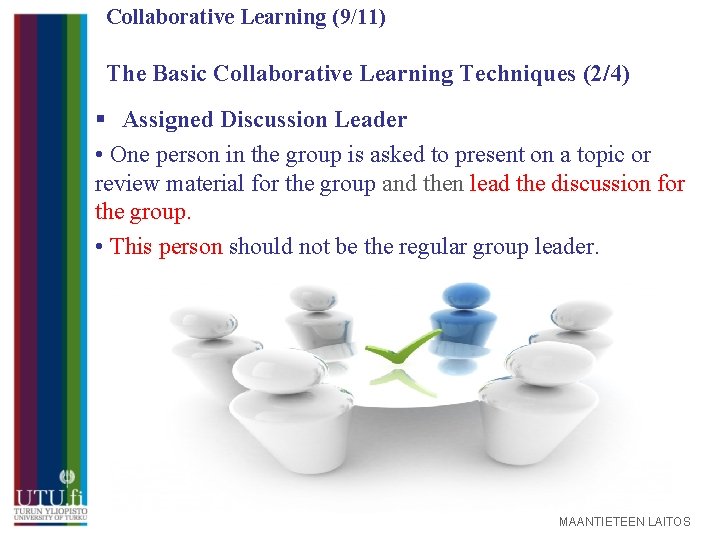
Collaborative Learning (9/11) The Basic Collaborative Learning Techniques (2/4) § Assigned Discussion Leader • One person in the group is asked to present on a topic or review material for the group and then lead the discussion for the group. • This person should not be the regular group leader. MAANTIETEEN LAITOS
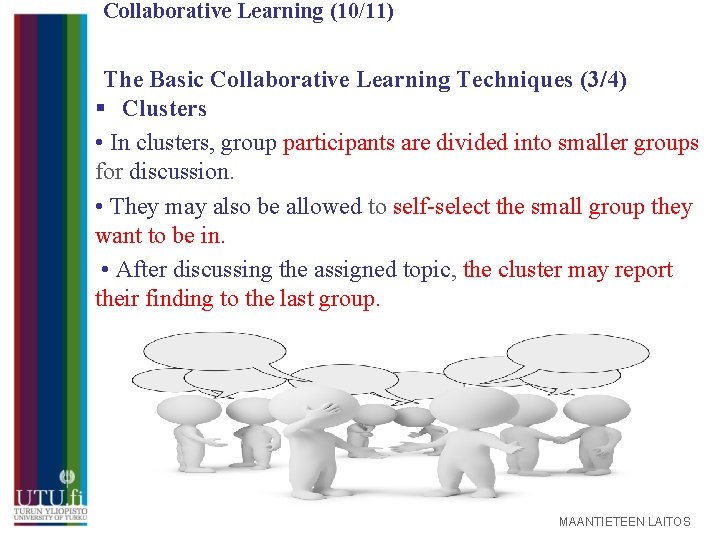
Collaborative Learning (10/11) The Basic Collaborative Learning Techniques (3/4) § Clusters • In clusters, group participants are divided into smaller groups for discussion. • They may also be allowed to self-select the small group they want to be in. • After discussing the assigned topic, the cluster may report their finding to the last group. MAANTIETEEN LAITOS
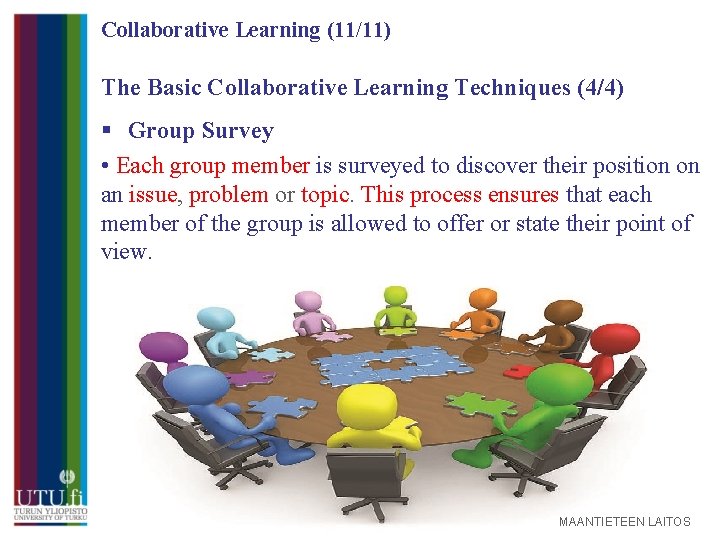
Collaborative Learning (11/11) The Basic Collaborative Learning Techniques (4/4) § Group Survey • Each group member is surveyed to discover their position on an issue, problem or topic. This process ensures that each member of the group is allowed to offer or state their point of view. MAANTIETEEN LAITOS
Google Classroom (1/6) MAANTIETEEN LAITOS
Google Classroom (2/6) Benefits for classes • Easy to set up Teachers can add students directly or share a code with their class to join. • Saves time The simple, paperless assignment workflow allows teachers to create, review, and grade assignments quickly, all in one place. • Improves organization Students can see all of their assignments on an assignments page, and all class materials are automatically filed into folders in Google Drive. • Enhances communication Classroom allows teachers to send announcements and start class discussions instantly. Students can share resources with each other or provide answers to questions on the stream. • Affordable and secure Like the rest of our Google Apps for Education services, Classroom contains no ads, never uses your content or student data for advertising purposes, and is free for schools. MAANTIETEEN LAITOS
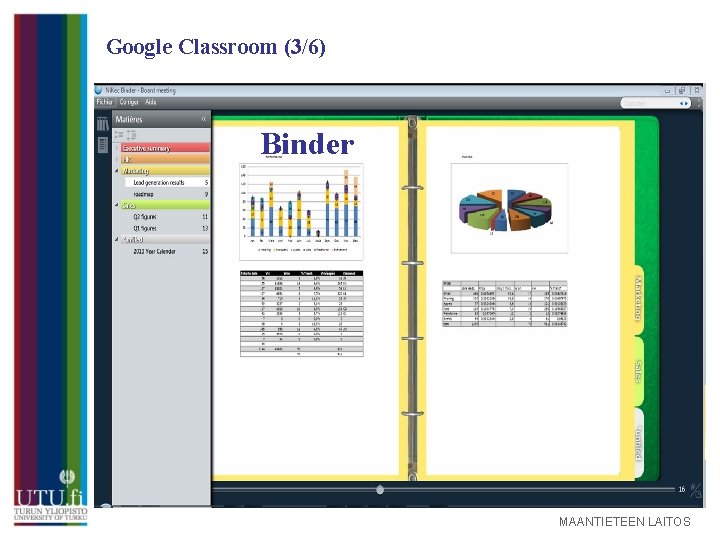
Google Classroom (3/6) Binder MAANTIETEEN LAITOS

Google Classroom (4/6) MAANTIETEEN LAITOS

Google Classroom (5/6) Turun Yliopisto moodle MAANTIETEEN LAITOS
Google Classroom (6/6) MAANTIETEEN LAITOS

MAANTIETEEN LAITOS
- Slides: 24