
Collaborative Filtering Nearest Neighbor Approach Jeff Howbert Introduction
Collaborative Filtering Nearest Neighbor Approach Jeff Howbert Introduction to Machine Learning Winter 2012 1
Bad news Netflix Prize data no longer available to public. l Just after contest ended in July 2009: – Plans for Netflix Prize 2 contest were announced – Contest data was made available for further public research at UC Irvine repository l But a few months later: – Netflix was being sued for supposed privacy breaches connected with contest data – FTC was investigating privacy concerns l By March 2010: – Netflix had settled the lawsuit privately – Withdrawn the contest data from public use – Cancelled Netflix Prize 2 Jeff Howbert Introduction to Machine Learning Winter 2012 2
Good news An older movie rating dataset from Group. Lens is still available, and perfectly suitable for the CSS 490 / 590 project. l l Consists of data collected through the Movie. Lens movie rating website. Comes in 3 sizes: – Movie. Lens 100 k – Movie. Lens 1 M – Movie. Lens 10 M http: //www. grouplens. org/node/12 http: //movielens. umn. edu/login Jeff Howbert Introduction to Machine Learning Winter 2012 3
Movie. Lens 100 k dataset properties l l l 943 users 1682 movies 100, 000 ratings 1 - 5 rating scale Rating matrix is 6. 3% occupied Ratings per user min = 20 l mean = 106 max = 737 Ratings per movie min = 1 Jeff Howbert mean = 59 Introduction to Machine Learning max = 583 Winter 2012 4
Recommender system definition DOMAIN: some field of activity where users buy, view, consume, or otherwise experience items PROCESS: 1. users provide ratings on items they have experienced 2. Take all < user, item, rating > data and build a predictive model 3. For a user who hasn’t experienced a particular item, use model to predict how well they will like it (i. e. predict rating) Jeff Howbert Introduction to Machine Learning Winter 2012 5
Types of recommender systems Predictions can be based on either: l content-based approach – explicit characteristics of users and items l collaborative filtering approach – implicit characteristics based on similarity of users’ preferences to those of other users Jeff Howbert Introduction to Machine Learning Winter 2012 6

Collaborative filtering algorithms l Jeff Howbert Common types: – Global effects – Nearest neighbor – Matrix factorization – Restricted Boltzmann machine – Clustering – Etc. Introduction to Machine Learning Winter 2012 7
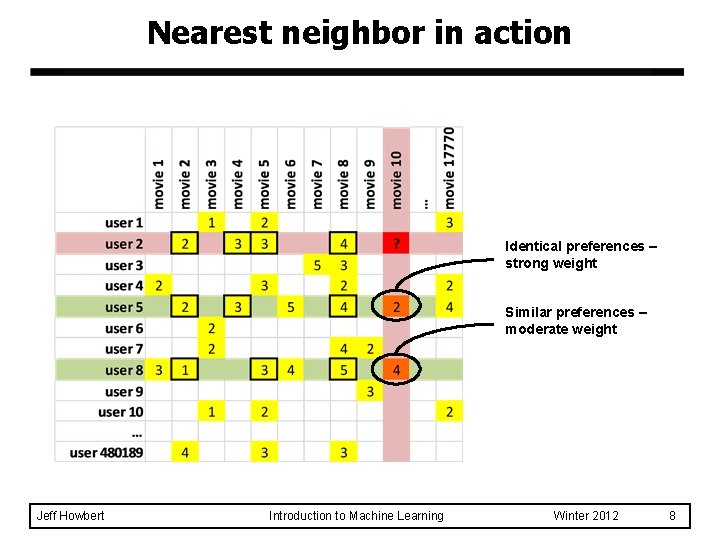
Nearest neighbor in action Identical preferences – strong weight Similar preferences – moderate weight Jeff Howbert Introduction to Machine Learning Winter 2012 8
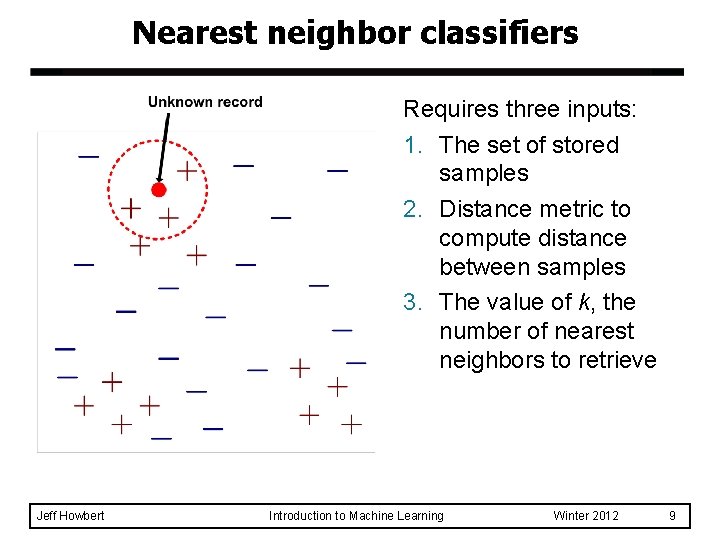
Nearest neighbor classifiers Requires three inputs: 1. The set of stored samples 2. Distance metric to compute distance between samples 3. The value of k, the number of nearest neighbors to retrieve Jeff Howbert Introduction to Machine Learning Winter 2012 9
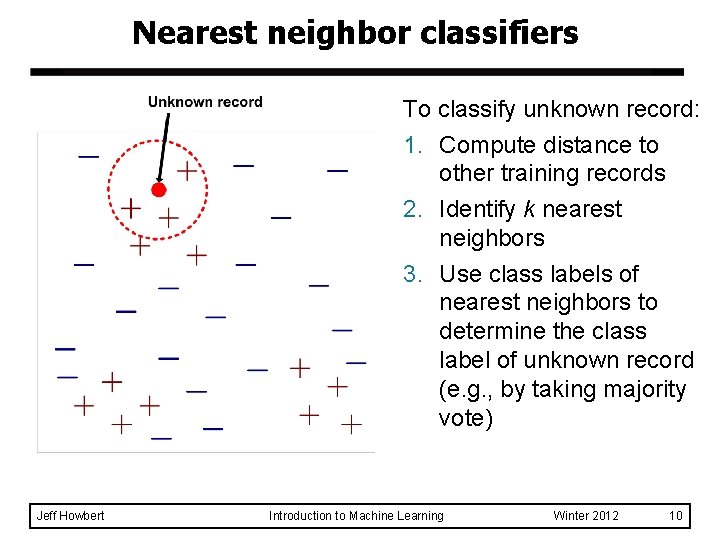
Nearest neighbor classifiers To classify unknown record: 1. Compute distance to other training records 2. Identify k nearest neighbors 3. Use class labels of nearest neighbors to determine the class label of unknown record (e. g. , by taking majority vote) Jeff Howbert Introduction to Machine Learning Winter 2012 10
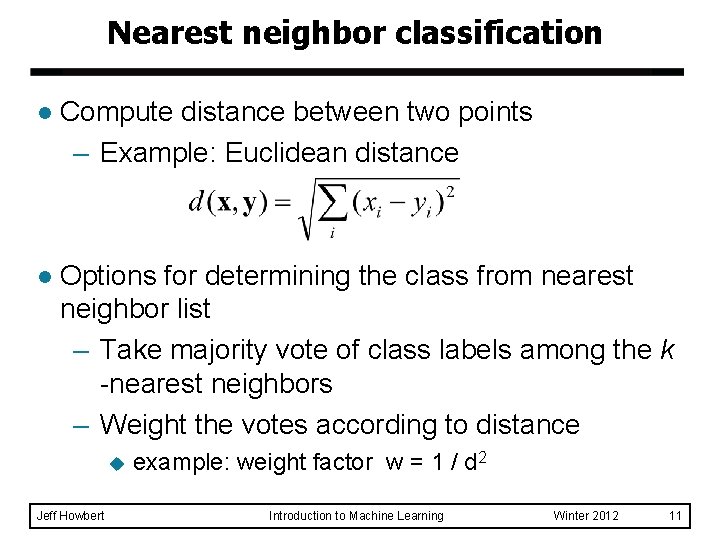
Nearest neighbor classification l Compute distance between two points – Example: Euclidean distance l Options for determining the class from nearest neighbor list – Take majority vote of class labels among the k -nearest neighbors – Weight the votes according to distance u Jeff Howbert example: weight factor w = 1 / d 2 Introduction to Machine Learning Winter 2012 11
Nearest neighbor in collaborative filtering l For our implementation in Project 2: – Actually a regression, not a classification. Prediction is a weighted combination of neighbor’s ratings (real number). u – We consider all neighbors, not the k-nearest subset of neighbors. Since we’re not ranking neighbors by distance, distance no longer relevant. u – Instead of distance, we calculate similarities that determine weightings of each neighbor’s rating. Jeff Howbert Introduction to Machine Learning Winter 2012 12
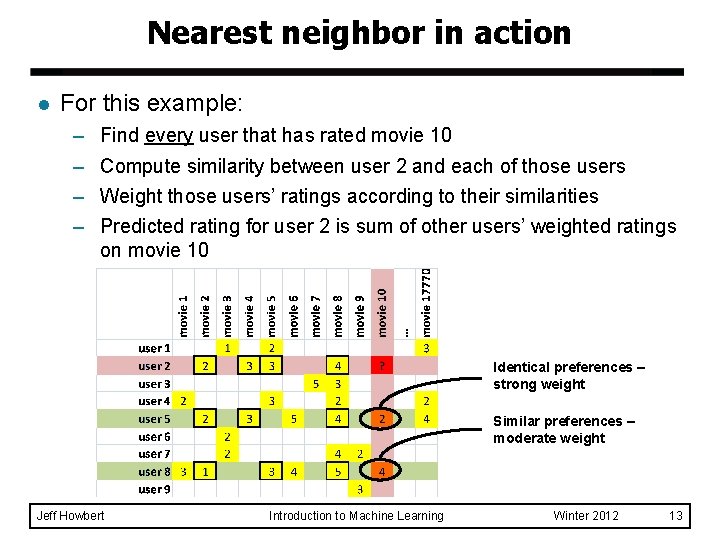
Nearest neighbor in action l For this example: – – Find every user that has rated movie 10 Compute similarity between user 2 and each of those users Weight those users’ ratings according to their similarities Predicted rating for user 2 is sum of other users’ weighted ratings on movie 10 Identical preferences – strong weight Similar preferences – moderate weight Jeff Howbert Introduction to Machine Learning Winter 2012 13
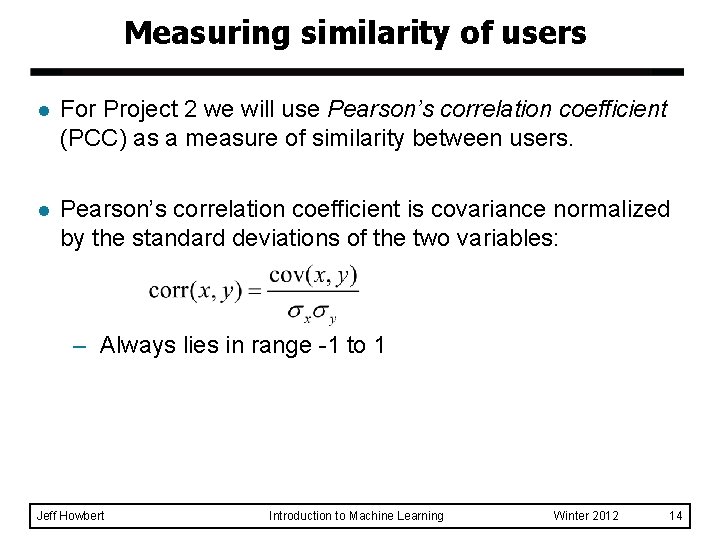
Measuring similarity of users l For Project 2 we will use Pearson’s correlation coefficient (PCC) as a measure of similarity between users. l Pearson’s correlation coefficient is covariance normalized by the standard deviations of the two variables: – Always lies in range -1 to 1 Jeff Howbert Introduction to Machine Learning Winter 2012 14
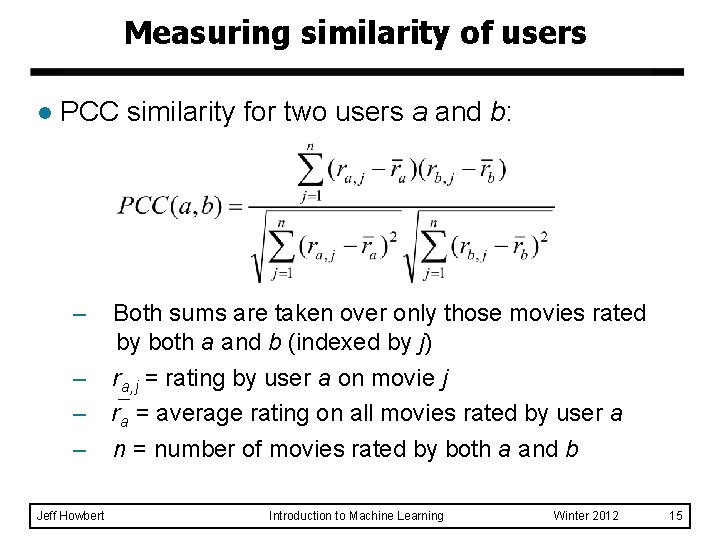
Measuring similarity of users l PCC similarity for two users a and b: – Both sums are taken over only those movies rated by both a and b (indexed by j) – ra, j = rating by user a on movie j – ra = average rating on all movies rated by user a – n = number of movies rated by both a and b Jeff Howbert Introduction to Machine Learning Winter 2012 15
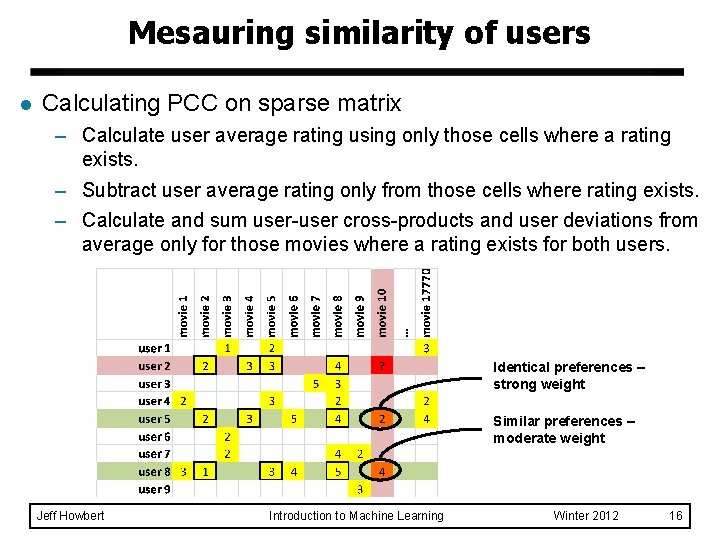
Mesauring similarity of users l Calculating PCC on sparse matrix – Calculate user average rating using only those cells where a rating exists. – Subtract user average rating only from those cells where rating exists. – Calculate and sum user-user cross-products and user deviations from average only for those movies where a rating exists for both users. Identical preferences – strong weight Similar preferences – moderate weight Jeff Howbert Introduction to Machine Learning Winter 2012 16
- Slides: 16