
Collaborative Filtering Meets Mobile Recommendation A Usercentered Approach

Collaborative Filtering Meets Mobile Recommendation: A User-centered Approach Vincent W. Zheng†, Bin Cao†, Yu Zheng‡, Xing Xie‡, Qiang Yang† †Hong Kong University of Science and Technology ‡Microsoft Research Asia This work was done when Vincent was doing internship in Microsoft Research Asia. 1

Introduction �User GPS trajectories accumulated on the Web 2

Motivation �Mobile Recommendation Travel experience: Some places are more popular than the others Big sale! Nice food! User activities: “Nice food!” --> Enjoy food there From Bing 3 D map 3
Goal �User-centric Recommendation �Location Recommendation � Question: I want to find nice food, where should I go? �Activity Recommendation � Question: I will visit the downtown, what can I do there? 4
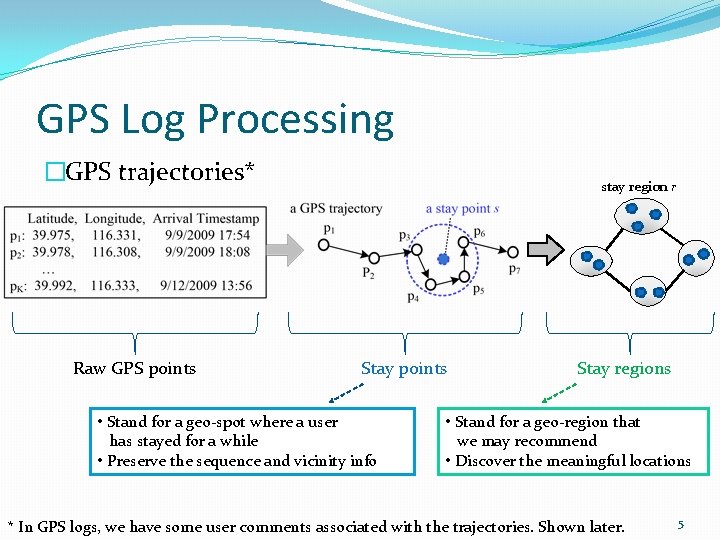
GPS Log Processing �GPS trajectories* Raw GPS points stay region r Stay points • Stand for a geo-spot where a user has stayed for a while • Preserve the sequence and vicinity info Stay regions • Stand for a geo-region that we may recommend • Discover the meaningful locations * In GPS logs, we have some user comments associated with the trajectories. Shown later. 5

Data Modeling �User -> Location -> Activity GPS: “ 39. 903, 116. 391, 14/9/2009 15: 25” Stay Region: “ 39. 910, 116. 400 (Forbidden City)” st n e e d s. N id ’ b r rd … Bi Fo … “User Vincent: We took a tour bus to see around along the forbidden city moat …” ty Ci Tourism Vincent +1 Alex … Activity: tourism 6

How to Do Recommendation? �If the tensor is full, then for each user: … B … ’ rd Bi Tourism Vincent Fo rb id d en … Alex Ci ty rd ’s N es t Zh on gg ua nc un Vincent es N s Location recommendation for Vincent Tourism: Forbidden City > Bird’s Nest > Zhongguancun Activity recommendation for Vincent Forbidden City: Tourism > Exhibition > Shopping Bi Tourism t … s. N ’ ird t es Shopping 2 1 6 Exhibition 4 3 2 Tourism 5 4 1 Unfortunately, in practice, the tensor is usually sparse! 7

Our Collaborative Filtering Solution �Regularized Tensor and Matrix Decomposition s tiv c A Users Locations ? Users e iti Activities Locations Features 8
Related Work �Few work done before � Either recommend some specific types of locations � � � Shops [Takeuchi & Sugimoto 2006] Restaurants [Horozov, et al. 2006] Travel hot spots [Zheng et al. 2009] � Or only recognize activity without location recommendation � � Outdoor activity recognition [Liao et al. 2005] Indoor activity recognition [Patterson et al. 2005] � Or do not explicitly model the users � Our previous solution [Zheng et al. 2010] � See next slide! 9

Our Previous Solution at WWW’ 10 �Collaborative Location and Activity Recommendation Tourism Exhibition Shopping 5 ? ? Bird’s Nest ? 1 ? Zhongguancun 1 ? 6 User not explicitly modeled! 1. Not modeling each single user’s Loc -Act history 2. = a sum compression of our tensor Activities Locations Features ? Activities Forbidden City 10
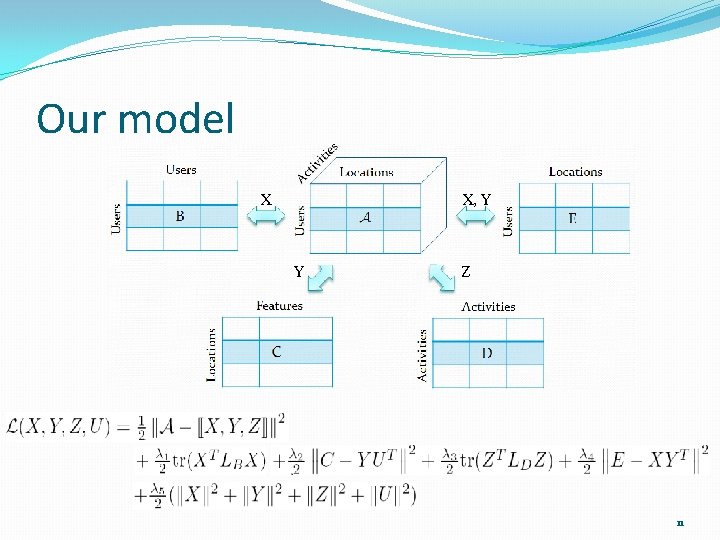
Our model X X, Y Y Z 11
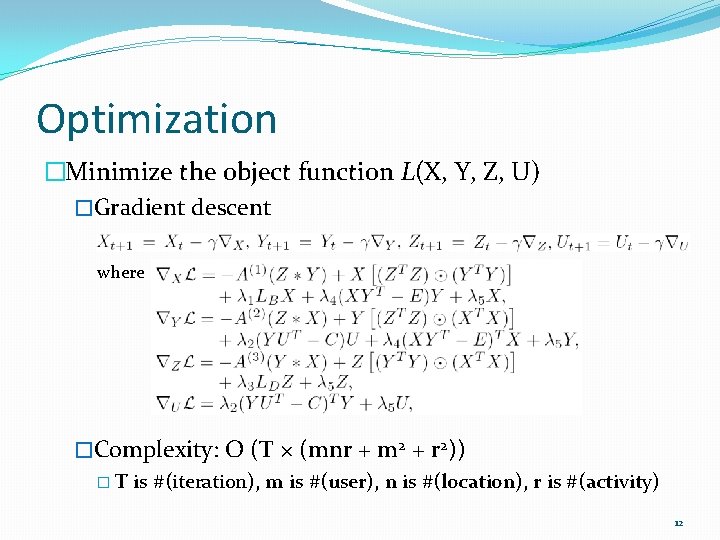
Optimization �Minimize the object function L(X, Y, Z, U) �Gradient descent where �Complexity: O (T × (mnr + m 2 + r 2)) � T is #(iteration), m is #(user), n is #(location), r is #(activity) 12
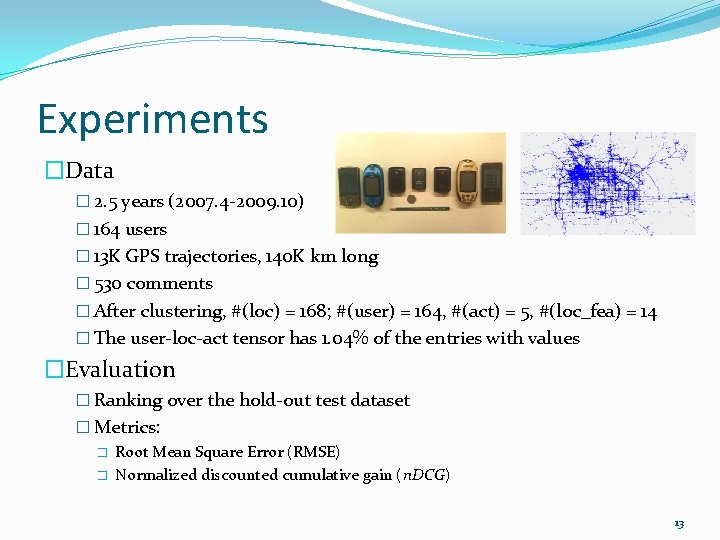
Experiments �Data � 2. 5 years (2007. 4 -2009. 10) � 164 users � 13 K GPS trajectories, 140 K km long � 530 comments � After clustering, #(loc) = 168; #(user) = 164, #(act) = 5, #(loc_fea) = 14 � The user-loc-act tensor has 1. 04% of the entries with values �Evaluation � Ranking over the hold-out test dataset � Metrics: � Root Mean Square Error (RMSE) � Normalized discounted cumulative gain (n. DCG) 13
![Baselines – Category I �Tensor -> Independent matrices [Herlocker et al. 1999] �Baseline 1:](http://slidetodoc.com/presentation_image_h2/dc60fae1b518060373555a870284a35a/image-14.jpg "Baselines – Category I �Tensor -> Independent matrices [Herlocker et al. 1999] �Baseline 1:")
Baselines – Category I �Tensor -> Independent matrices [Herlocker et al. 1999] �Baseline 1: UCF (user-based CF) � CF on each user-loc matrix + Top N similar users for weighted average �Baseline 2: LCF (location-based CF) � CF on each loc-act matrix + Top N similar locations for weighted average �Baseline 3: ACF (activity-based CF) CF on each loc-act matrix + Top N similar activities for weighted average t Ac User UCF Loc LCF ACF t Ac Loc … User Loc … � 14
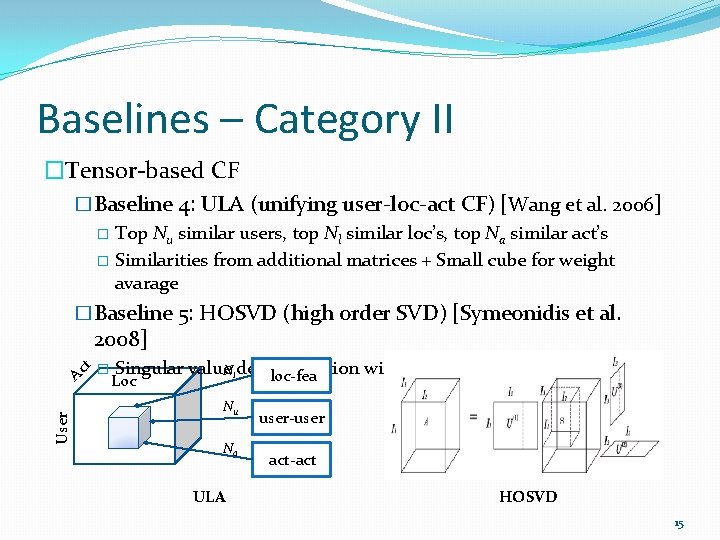
Baselines – Category II �Tensor-based CF �Baseline 4: ULA (unifying user-loc-act CF) [Wang et al. 2006] � Top Nu similar users, top Nl similar loc’s, top Na similar act’s � Similarities from additional matrices + Small cube for weight avarage �Baseline 5: HOSVD (high order SVD) [Symeonidis et al. 2008] User t Singular value with matrix unfolding Nl decomposition loc-fea Ac � Loc Nu Na ULA user-user act-act HOSVD 15
![Comparison with Baselines �Reported in “mean ± std” [Herlocker et al. 1999] [Wang et](http://slidetodoc.com/presentation_image_h2/dc60fae1b518060373555a870284a35a/image-16.jpg "Comparison with Baselines �Reported in “mean ± std” [Herlocker et al. 1999] [Wang et")
Comparison with Baselines �Reported in “mean ± std” [Herlocker et al. 1999] [Wang et al. 2006] [Symeonidis et al. 2008] 16
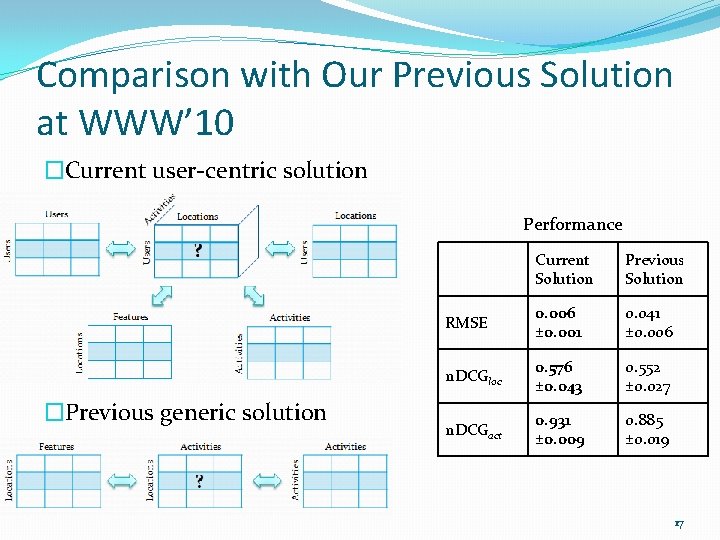
Comparison with Our Previous Solution at WWW’ 10 �Current user-centric solution Performance �Previous generic solution Current Solution Previous Solution RMSE 0. 006 ± 0. 001 0. 041 ± 0. 006 n. DCGloc 0. 576 ± 0. 043 0. 552 ± 0. 027 n. DCGact 0. 931 ± 0. 009 0. 885 ± 0. 019 17
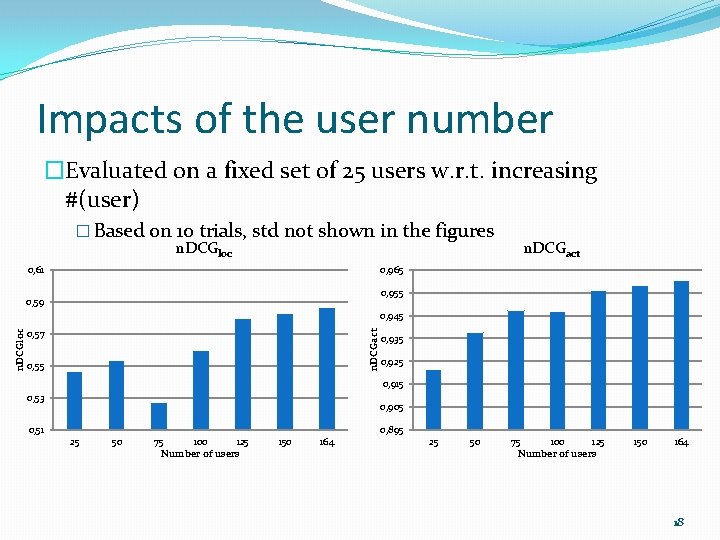
Impacts of the user number �Evaluated on a fixed set of 25 users w. r. t. increasing #(user) � Based on 10 trials, std not shown in the figures n. DCGloc 0, 61 n. DCGact 0, 965 0, 955 0, 59 0, 57 n. DCGact n. DCGloc 0, 945 0, 55 0, 935 0, 925 0, 915 0, 53 0, 905 0, 51 0, 895 25 50 75 100 125 Number of users 150 164 18
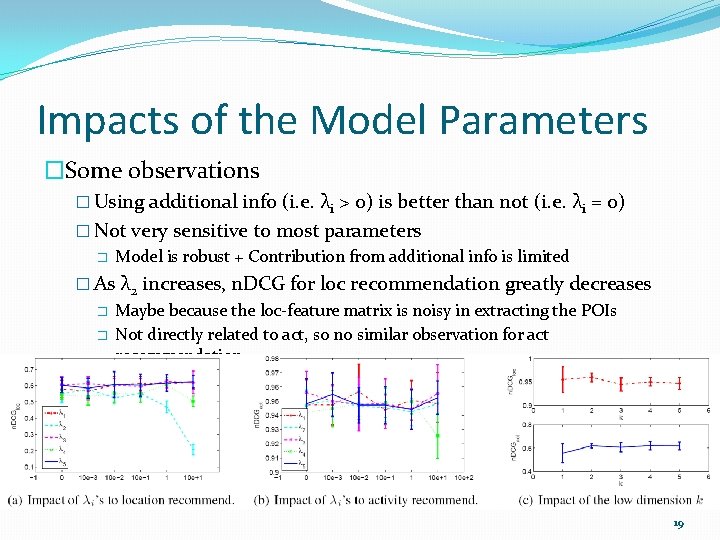
Impacts of the Model Parameters �Some observations � Using additional info (i. e. λi > 0) is better than not (i. e. λi = 0) � Not very sensitive to most parameters � Model is robust + Contribution from additional info is limited � As λ 2 increases, n. DCG for loc recommendation greatly decreases � Maybe because the loc-feature matrix is noisy in extracting the POIs � Not directly related to act, so no similar observation for act recommendation 19
Conclusion �We showed how to mine knowledge from GPS data to answer � If I want to do something, where should I go? � If I will visit some place, what can I do there? �We extended our previous work for user-centric recommendation � From “Location-Activity” to “User-Location-Activity” � From “Matrix + Matrices” to “Tensor + Matrices” �We evaluated our system on a large GPS dataset � 19% improvement on location recommendation � 22% improvement on activity recommendation over the simple memory-based CF baseline (i. e. UCF, LCF, ACF) �Future Work � Update the system online 20

Thanks! Questions? Vincent W. Zheng vincentz@cse. ust. hk http: //www. cse. ust. hk/~vincentz 21
- Slides: 21