
Collaborative documentation of intake and output Elise Howard
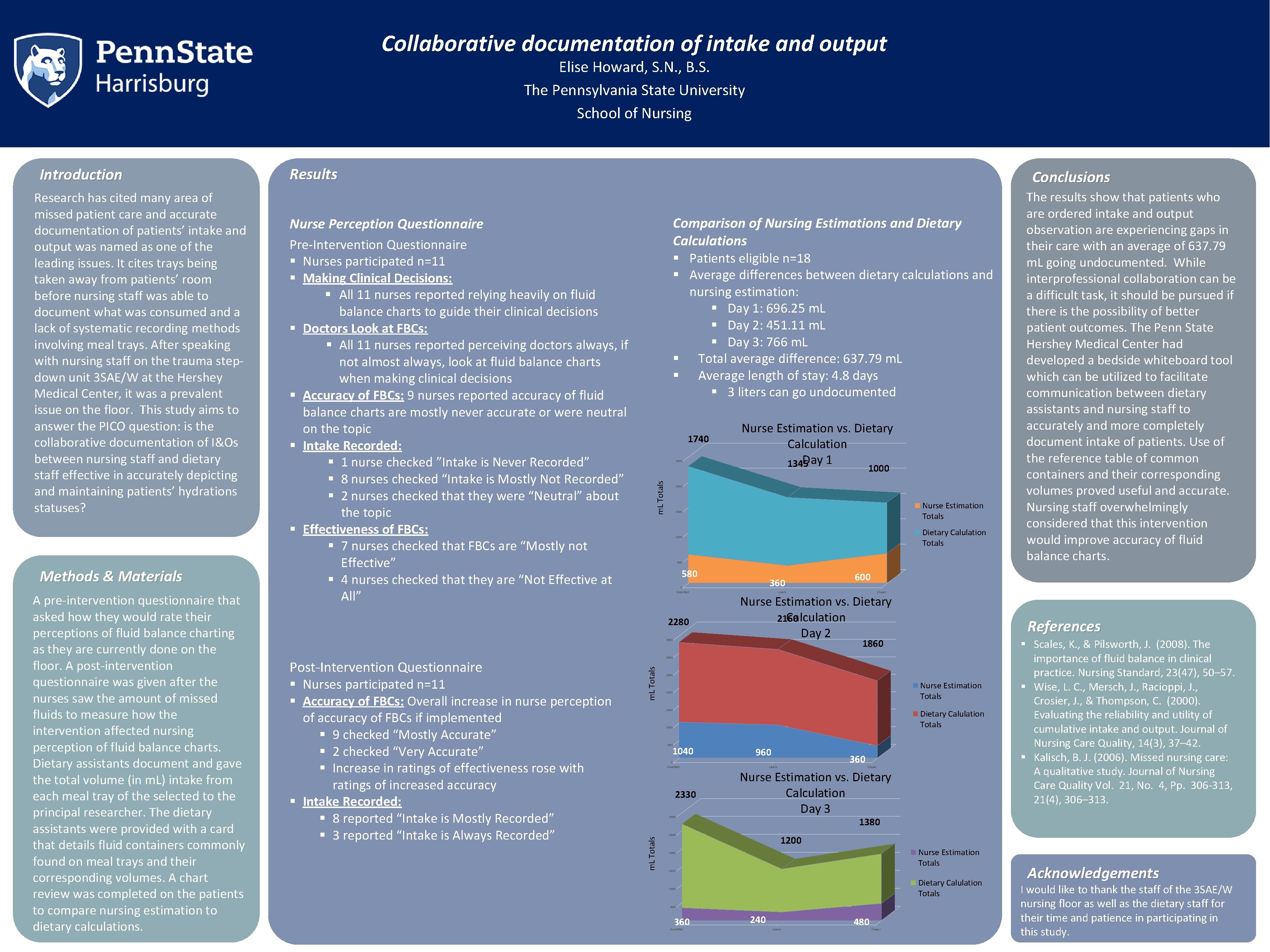
Collaborative documentation of intake and output Elise Howard, S. N. , B. S. The Pennsylvania State University School of Nursing Methods & Materials A pre-intervention questionnaire that asked how they would rate their perceptions of fluid balance charting as they are currently done on the floor. A post-intervention questionnaire was given after the nurses saw the amount of missed fluids to measure how the intervention affected nursing perception of fluid balance charts. Dietary assistants document and gave the total volume (in m. L) intake from each meal tray of the selected to the principal researcher. The dietary assistants were provided with a card that details fluid containers commonly found on meal trays and their corresponding volumes. A chart review was completed on the patients to compare nursing estimation to dietary calculations. Conclusions Comparison of Nursing Estimations and Dietary Calculations § Patients eligible n=18 § Average differences between dietary calculations and Nurse Perception Questionnaire nursing estimation: § Day 1: 696. 25 m. L § Day 2: 451. 11 m. L § Day 3: 766 m. L § Total average difference: 637. 79 m. L § Average length of stay: 4. 8 days § 3 liters can go undocumented 1740 2500 m. L Totals Pre-Intervention Questionnaire § Nurses participated n=11 § Making Clinical Decisions: § All 11 nurses reported relying heavily on fluid balance charts to guide their clinical decisions § Doctors Look at FBCs: § All 11 nurses reported perceiving doctors always, if not almost always, look at fluid balance charts when making clinical decisions § Accuracy of FBCs: 9 nurses reported accuracy of fluid balance charts are mostly never accurate or were neutral on the topic § Intake Recorded: § 1 nurse checked ”Intake is Never Recorded” § 8 nurses checked “Intake is Mostly Not Recorded” § 2 nurses checked that they were “Neutral” about the topic § Effectiveness of FBCs: § 7 nurses checked that FBCs are “Mostly not Effective” § 4 nurses checked that they are “Not Effective at All” 1500 Nurse Estimation Totals 1000 Dietary Calulation Totals 580 0 Breakfast 360 Lunch Dinner Nurse Estimation vs. Dietary Calculation 2160 Day 2 References 3000 2500 Nurse Estimation Totals 2000 1500 Dietary Calulation Totals 1000 500 1040 0 Breakfast 2330 3000 960 360 Lunch Dinner Nurse Estimation vs. Dietary Calculation Day 3 1200 Nurse Estimation Totals 2000 1500 Dietary Calulation Totals 1000 500 360 § Scales, K. , & Pilsworth, J. (2008). The importance of fluid balance in clinical practice. Nursing Standard, 23(47), 50– 57. § Wise, L. C. , Mersch, J. , Racioppi, J. , Crosier, J. , & Thompson, C. (2000). Evaluating the reliability and utility of cumulative intake and output. Journal of Nursing Care Quality, 14(3), 37– 42. § Kalisch, B. J. (2006). Missed nursing care: A qualitative study. Journal of Nursing Care Quality Vol. 21, No. 4, Pp. 306 -313, 21(4), 306– 313. 1380 2500 0 Breakfast The results show that patients who are ordered intake and output observation are experiencing gaps in their care with an average of 637. 79 m. L going undocumented. While interprofessional collaboration can be a difficult task, it should be pursued if there is the possibility of better patient outcomes. The Penn State Hershey Medical Center had developed a bedside whiteboard tool which can be utilized to facilitate communication between dietary assistants and nursing staff to accurately and more completely document intake of patients. Use of the reference table of common containers and their corresponding volumes proved useful and accurate. Nursing staff overwhelmingly considered that this intervention would improve accuracy of fluid balance charts. 600 1860 3500 of accuracy of FBCs if implemented § 9 checked “Mostly Accurate” § 2 checked “Very Accurate” § Increase in ratings of effectiveness rose with ratings of increased accuracy § Intake Recorded: § 8 reported “Intake is Mostly Recorded” § 3 reported “Intake is Always Recorded” 1000 2280 Post-Intervention Questionnaire § Nurses participated n=11 § Accuracy of FBCs: Overall increase in nurse perception Nurse Estimation vs. Dietary Calculation Day 1 1345 500 m. L Totals Research has cited many area of missed patient care and accurate documentation of patients’ intake and output was named as one of the leading issues. It cites trays being taken away from patients’ room before nursing staff was able to document what was consumed and a lack of systematic recording methods involving meal trays. After speaking with nursing staff on the trauma stepdown unit 3 SAE/W at the Hershey Medical Center, it was a prevalent issue on the floor. This study aims to answer the PICO question: is the collaborative documentation of I&Os between nursing staff and dietary staff effective in accurately depicting and maintaining patients’ hydrations statuses? Results m. L Totals Introduction 240 Lunch 480 Dinner Acknowledgements I would like to thank the staff of the 3 SAE/W nursing floor as well as the dietary staff for their time and patience in participating in this study.
- Slides: 1