
COLLABORATIVE CLASSIFIER AGENTS Studying the Impact of Learning

COLLABORATIVE CLASSIFIER AGENTS Studying the Impact of Learning in Distributed Document Classification Weimao Ke, Javed Mostafa, and Yueyu Fu {wke, jm, yufu}@indiana. edu Laboratory of Applied Informatics Research Indiana University, Bloomington
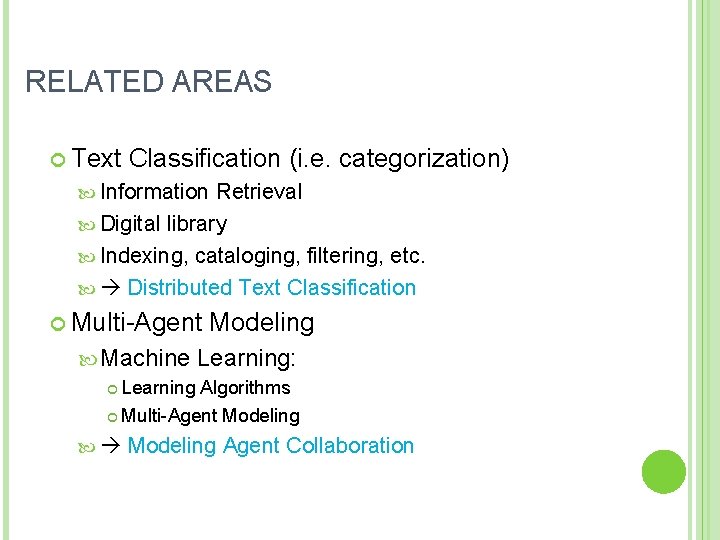
RELATED AREAS Text Classification (i. e. categorization) Information Retrieval Digital library Indexing, cataloging, filtering, etc. Distributed Text Classification Multi-Agent Modeling Machine Learning: Learning Algorithms Multi-Agent Modeling Agent Collaboration
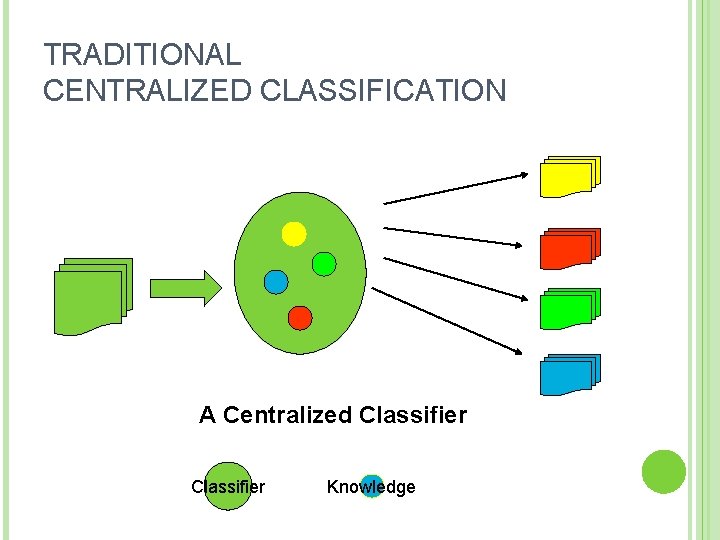
TRADITIONAL CENTRALIZED CLASSIFICATION A Centralized Classifier Knowledge

CENTRALIZED? Global repository is rarely realistic Scalability Intellectual … property restrictions ?

KNOWLEDGE DISTRIBUTION Arts History Distributed repositories Sciences Politics
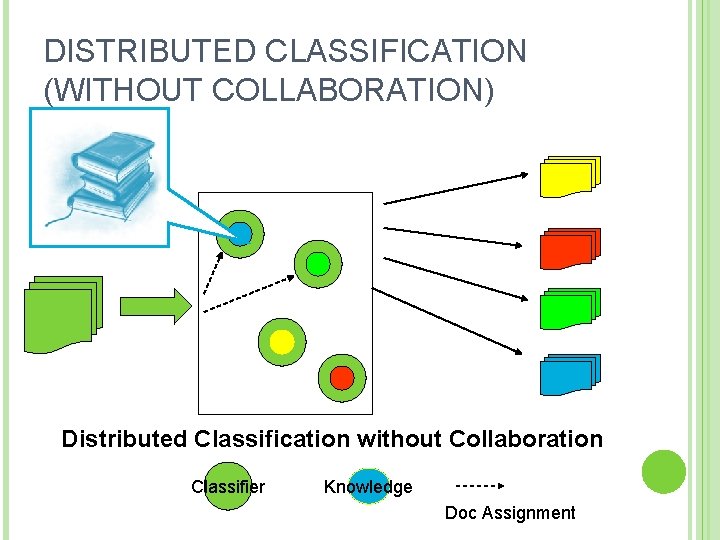
DISTRIBUTED CLASSIFICATION (WITHOUT COLLABORATION) Distributed Classification without Collaboration Classifier Knowledge Doc Assignment
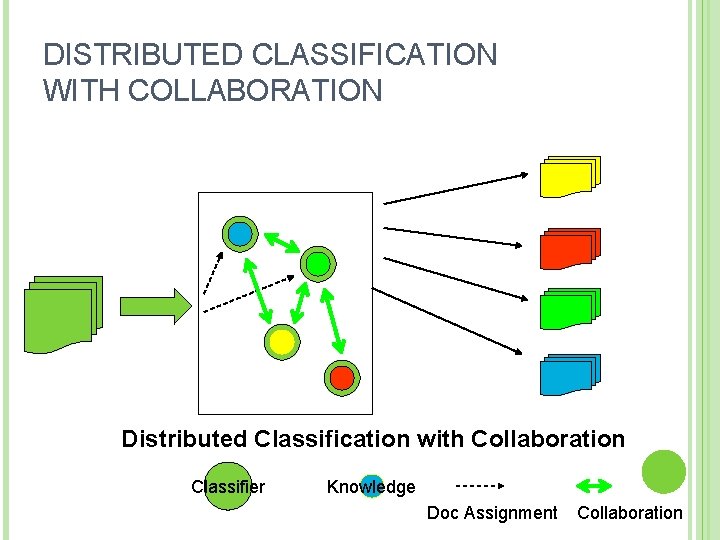
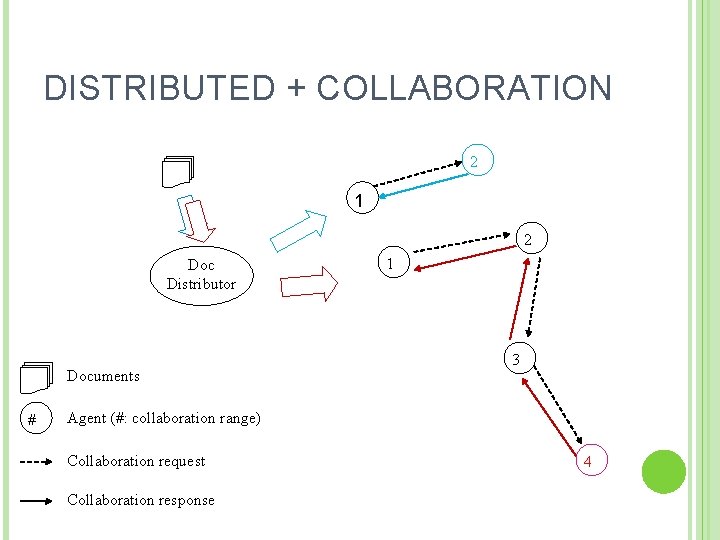
DISTRIBUTED CLASSIFICATION WITH COLLABORATION Distributed Classification with Collaboration Classifier Knowledge Doc Assignment Collaboration
RESEARCH QUESTIONS Motivation: Why distributed text classification? Knowledge is distributed No global knowledge repository e. g. individual digital libraries Advantages of distributed methods: fault tolerance, adaptability, flexibility, privacy, etc. Agents simulate distributed classifiers Problems/Questions Agents have to learn and collaborate. But how? Effectiveness and efficiency of agent collaboration?
DISTRIBUTED + COLLABORATION 2 1 2 Doc Distributor Documents # 1 3 Agent (#: collaboration range) Collaboration request Collaboration response 4
METHODOLOGY Compare � Traditional/centralized approach (upper-bound) � Distributed approach without collaboration (lower-bound) � Distributed approach with collaboration Two learning/collaboration algorithms: Algorithm 1: Pursuit Learning Algorithm 2: Nearest Centroid Learning Two parameters r: Exploration Rate g: Maximum Collaboration Range Evaluation Measure � Effectiveness: precision, recall, F measure � Efficiency: time for classification
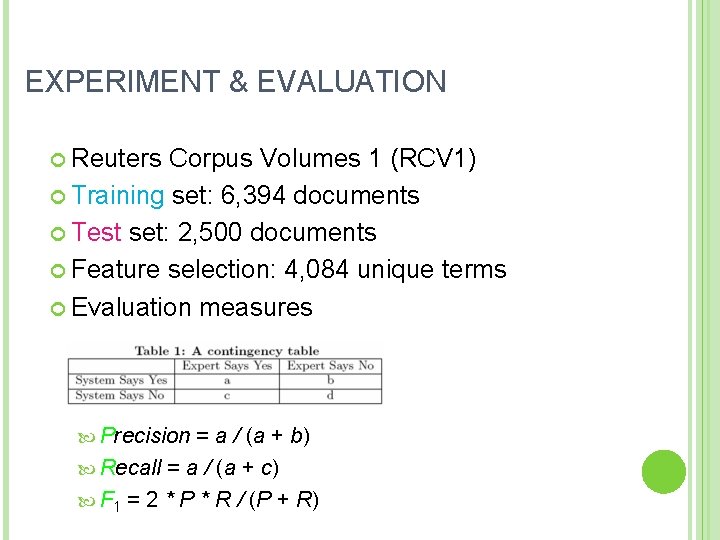
EXPERIMENT & EVALUATION Reuters Corpus Volumes 1 (RCV 1) Training set: 6, 394 documents Test set: 2, 500 documents Feature selection: 4, 084 unique terms Evaluation measures Precision = a / (a + b) Recall = a / (a + c) F 1 = 2 * P * R / (P + R)
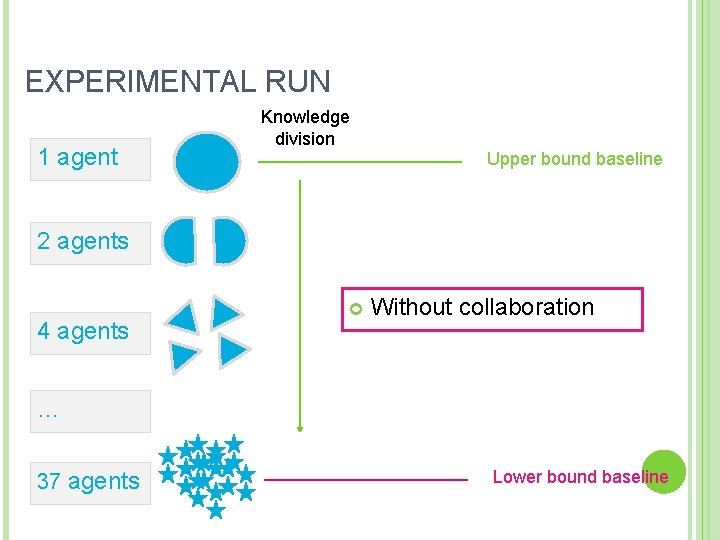
EXPERIMENTAL RUN 1 agent Knowledge division Upper bound baseline 2 agents 4 agents Without collaboration … 37 agents Lower bound baseline
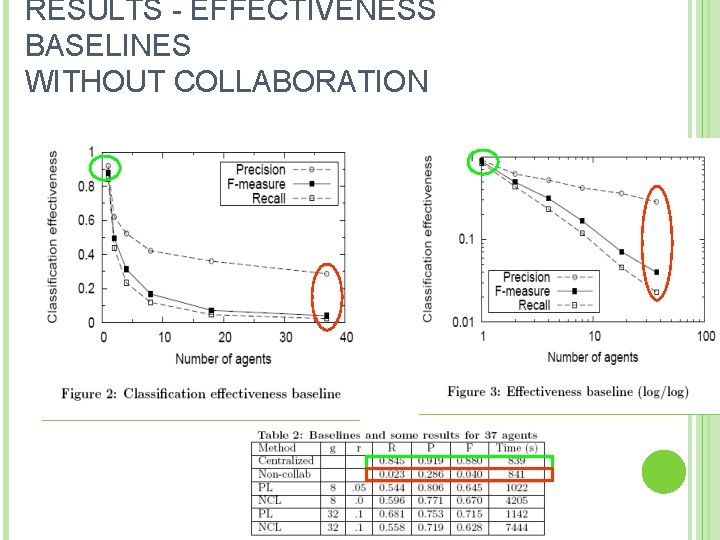
RESULTS - EFFECTIVENESS BASELINES WITHOUT COLLABORATION
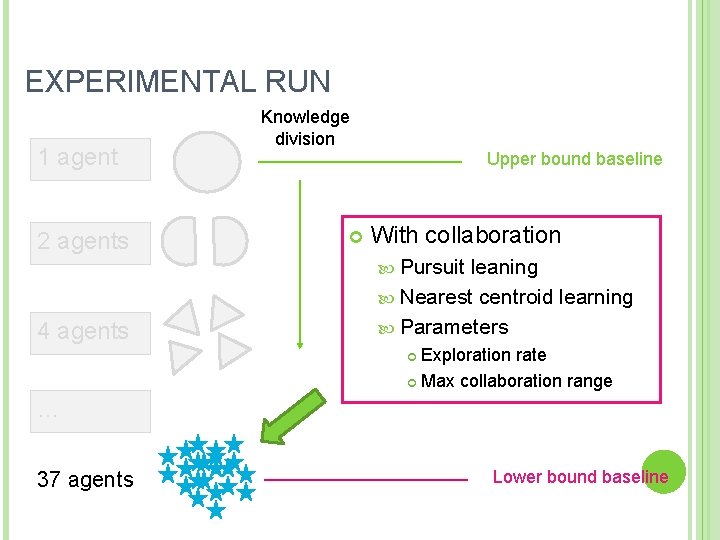
EXPERIMENTAL RUN 1 agent 2 agents Knowledge division Upper bound baseline With collaboration Pursuit 4 agents leaning Nearest centroid learning Parameters Exploration rate Max collaboration range … 37 agents Lower bound baseline
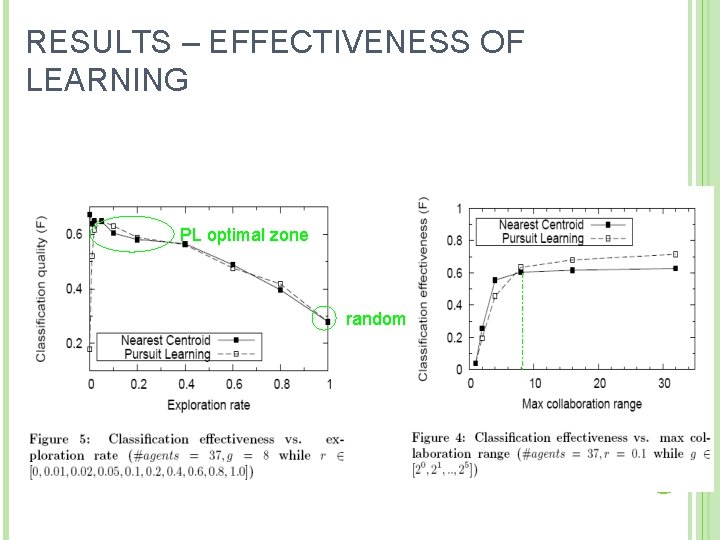
RESULTS – EFFECTIVENESS OF LEARNING PL optimal zone random
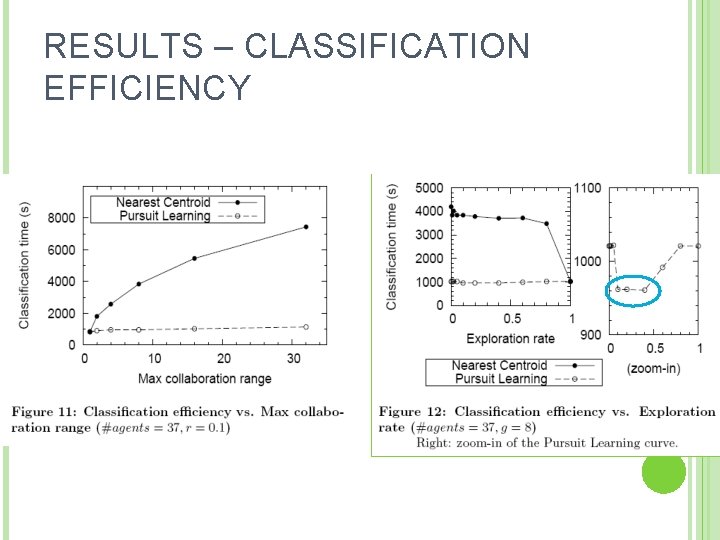
RESULTS – CLASSIFICATION EFFICIENCY
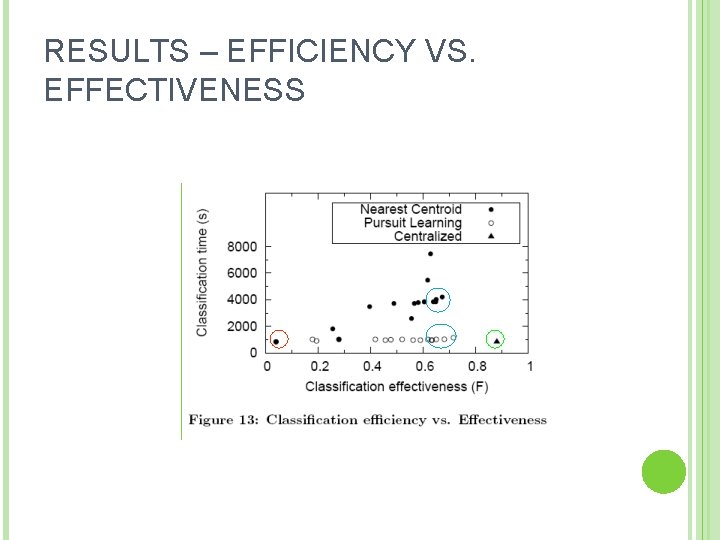
RESULTS – EFFICIENCY VS. EFFECTIVENESS
SUMMARY Classification effectiveness decreases dramatically when knowledge becomes increasingly distributed. Pursuit Learning � Efficient – without analyzing contents � Effective, although not content sensitive � “The Pursuit Learning approach did not depend on document content. By acquiring knowledge through reinforcements based on collaborations this algorithm was able to construct/build paths for documents to find relevant classifiers effectively and efficiently. ” Nearest Centroid Learning � Inefficient – analyzing content � Effective Future work � � � Other text collections Knowledge overlap among the agents Local neighborhood
- Slides: 18