
COLLABORATIVE AUTOETHNOGRAPHY Where do we start and how
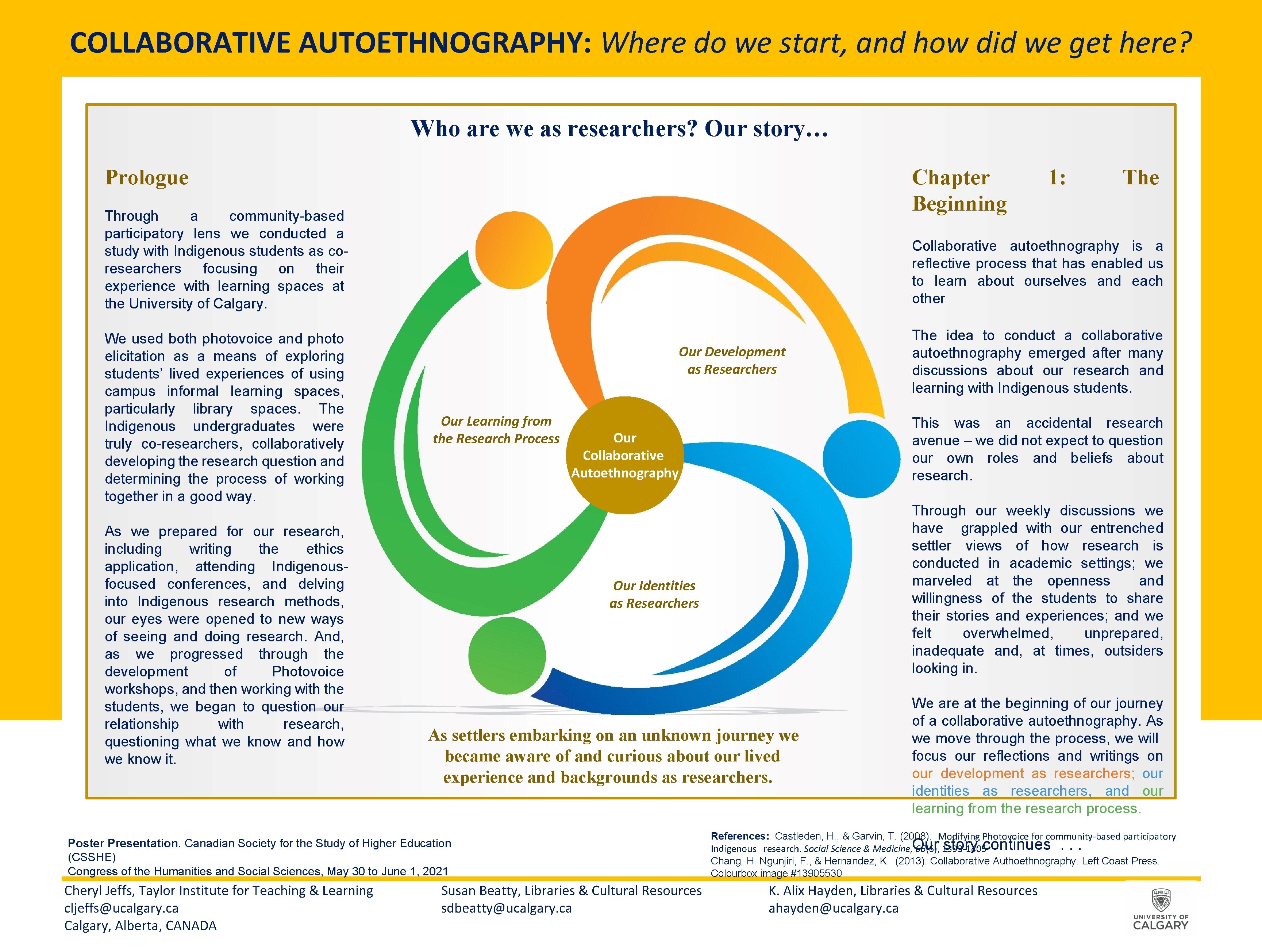
COLLABORATIVE AUTOETHNOGRAPHY: Where do we start, and how did we get here? Who are we as researchers? Our story… Prologue Chapter Beginning Through a community-based participatory lens we conducted a study with Indigenous students as coresearchers focusing on their experience with learning spaces at the University of Calgary. We used both photovoice and photo elicitation as a means of exploring students’ lived experiences of using campus informal learning spaces, particularly library spaces. The Indigenous undergraduates were truly co-researchers, collaboratively developing the research question and determining the process of working together in a good way. As we prepared for our research, including writing the ethics application, attending Indigenousfocused conferences, and delving into Indigenous research methods, our eyes were opened to new ways of seeing and doing research. And, as we progressed through the development of Photovoice workshops, and then working with the students, we began to question our relationship with research, questioning what we know and how we know it. The Collaborative autoethnography is a reflective process that has enabled us to learn about ourselves and each other Our Development as Researchers Our Learning from the Research Process Through our weekly discussions we have grappled with our entrenched settler views of how research is conducted in academic settings; we marveled at the openness and willingness of the students to share their stories and experiences; and we felt overwhelmed, unprepared, inadequate and, at times, outsiders looking in. Our Identities as Researchers As settlers embarking on an unknown journey we became aware of and curious about our lived experience and backgrounds as researchers. Susan Beatty, Libraries & Cultural Resources sdbeatty@ucalgary. ca The idea to conduct a collaborative autoethnography emerged after many discussions about our research and learning with Indigenous students. This was an accidental research avenue – we did not expect to question our own roles and beliefs about research. Our Collaborative Autoethnography Poster Presentation. Canadian Society for the Study of Higher Education (CSSHE) Congress of the Humanities and Social Sciences, May 30 to June 1, 2021 Cheryl Jeffs, Taylor Institute for Teaching & Learning cljeffs@ucalgary. ca Calgary, Alberta, CANADA 1: We are at the beginning of our journey of a collaborative autoethnography. As we move through the process, we will focus our reflections and writings on our development as researchers; our identities as researchers, and our learning from the research process. References: Castleden, H. , & Garvin, T. (2008). Modifying Photovoice for community-based participatory story continues. . . Indigenous research. Social Science & Medicine, Our 66(6), 1393 -1405 Chang, H. Ngunjiri, F. , & Hernandez, K. (2013). Collaborative Authoethnography. Left Coast Press. Colourbox image #13905530 K. Alix Hayden, Libraries & Cultural Resources ahayden@ucalgary. ca
- Slides: 1