
Collaborative Actions for Sustainable Tourism COAST Project UNEP
Collaborative Actions for Sustainable Tourism (COAST) Project UNEP Terminal Evaluation: Methodology and Process COAST Steering Committee Meeting 11 -13 June 2014 The Seychelles S. Heileman, External Evaluator, UNEP
Background UNEP (Implementing Agency) requires an INDEPENDENT terminal evaluation following completion of all projects: • To assess project performance with respect to relevance, effectiveness and efficiency • To determine actual and potential outcomes and impacts of the project, including their sustainability
Purpose 1. To provide evidence of results to meet accountability requirements 2. To promote learning, feedback and knowledge sharing through results and lessons learned among UNEP, GEF and their executing partners • Evaluate project achievements against the expected outputs, outcomes and impacts • Identify lessons of operational relevance for future project formulation and implementation.
Approach and methods • Independent evaluator • Under the overall responsibility and management of the UNEP Evaluation Office (Nairobi) • Participatory approach – Interviews with partners and key stakeholders • Desk review of documents • Country visits: Cameroon, Ghana, Kenya, Nigeria, Tanzania, Seychelles
Main evaluation criteria 1. Attainment of objectives and planned results 2. Sustainability (financial, socio-political, institutional and ecological) and catalytic role 3. Processes affecting attainment of project results 4. Complementarity with the UNEP strategies and programmes (Sub-criteria under each main criterion - TORs)
Evaluation ratings Evaluation criteria are rated on a 6 -point scale: 1. Highly Satisfactory 2. Satisfactory 3. Moderately Satisfactory 4. Moderately Unsatisfactory 5. Unsatisfactory 6. Highly Unsatisfactory Sustainability is rated from Highly Likely to Highly Unlikely
Review of Outcomes to Impacts (ROt. I) • Builds on the Theory of Change concept • Identifies the sequence of conditions and factors deemed necessary for project outcomes to yield impact, and assesses the current status of and future prospects for results and impacts. • UNEP defines ‘impact’ as changes in environmental benefits and how these affect human living conditions
Review of Outcomes to Impacts (ROt. I) • Analyzed in terms of the drivers and assumptions that underpin the processes for the transformation of outcomes to impacts via intermediate states • Drivers: External factors that if present are expected to contribute to realization of the intended impacts and can be influenced by the project, partners & stakeholders. • Assumptions: External factors that if present are expected to contribute to the realization of the intended impacts but are largely beyond the control of the project, partners & stakeholders
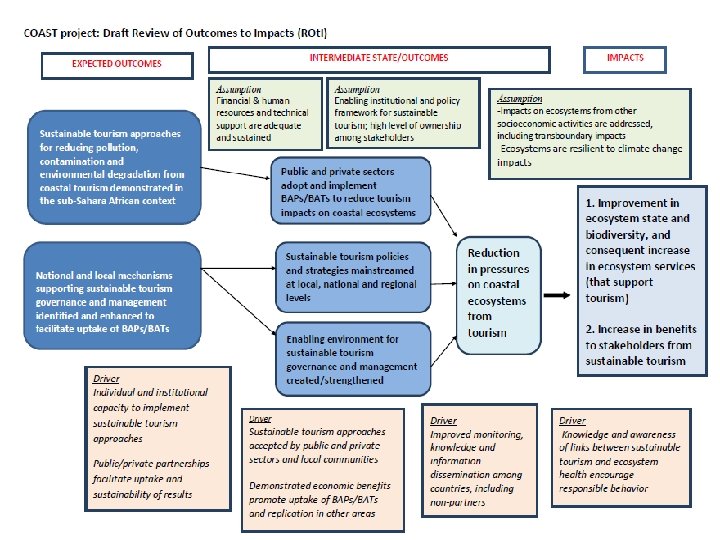
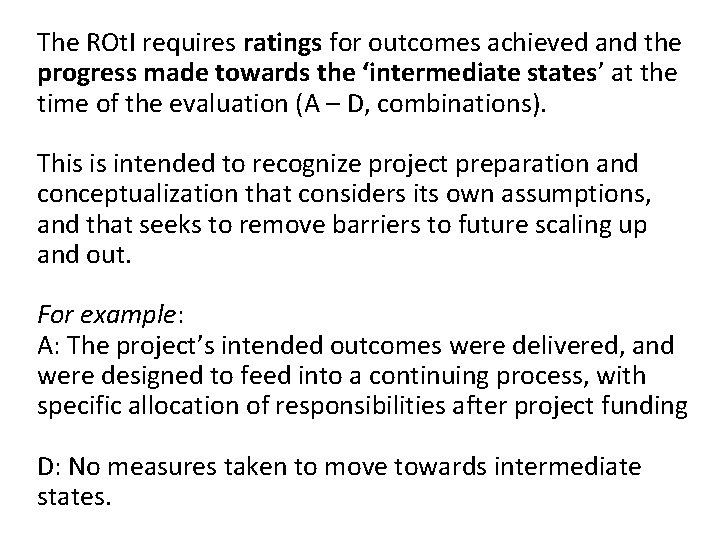
The ROt. I requires ratings for outcomes achieved and the progress made towards the ‘intermediate states’ at the time of the evaluation (A – D, combinations). This is intended to recognize project preparation and conceptualization that considers its own assumptions, and that seeks to remove barriers to future scaling up and out. For example: A: The project’s intended outcomes were delivered, and were designed to feed into a continuing process, with specific allocation of responsibilities after project funding D: No measures taken to move towards intermediate states.
• A project receiving an “AA” rating appears likely to deliver impacts • For a project receiving a “DD”, this would be very unlikely, due to low achievement of outcomes and limited likelihood of achieving the intermediate states needed for eventual impact
Next steps • Interviews with countries and partners • Site visits • Draft evaluation report prepared and submitted to UNEP Evaluation Office • Report circulated for comments to all partners • Comments addressed by evaluator (if rejected, evaluator must explain why) • Report finalized and submitted to UNEP

Thank you!
- Slides: 13