
Collaboration spider map A tool to help guide
Collaboration spider map A tool to help guide self-reflection prior to leading team collaboration
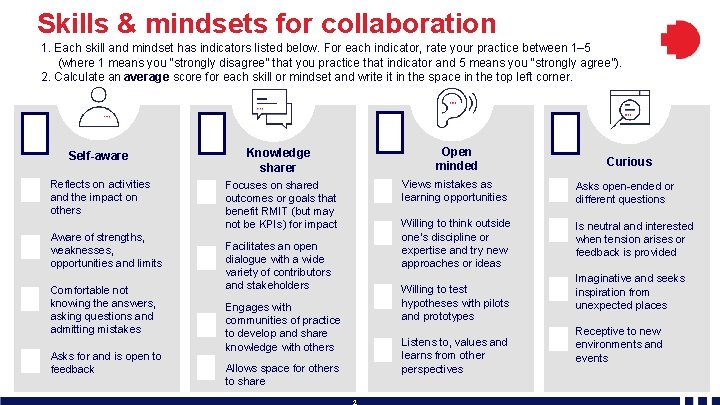
Skills & mindsets for collaboration 1. Each skill and mindset has indicators listed below. For each indicator, rate your practice between 1– 5 (where 1 means you “strongly disagree” that you practice that indicator and 5 means you “strongly agree”). 2. Calculate an average score for each skill or mindset and write it in the space in the top left corner. Self-aware Knowledge sharer Open minded Reflects on activities and the impact on others Focuses on shared outcomes or goals that benefit RMIT (but may not be KPIs) for impact Views mistakes as learning opportunities Asks open-ended or different questions Willing to think outside one’s discipline or expertise and try new approaches or ideas Is neutral and interested when tension arises or feedback is provided Aware of strengths, weaknesses, opportunities and limits Comfortable not knowing the answers, asking questions and admitting mistakes Asks for and is open to feedback Facilitates an open dialogue with a wide variety of contributors and stakeholders Willing to test hypotheses with pilots and prototypes Engages with communities of practice to develop and share knowledge with others Listens to, values and learns from other perspectives Allows space for others to share 2 Curious Imaginative and seeks inspiration from unexpected places Receptive to new environments and events
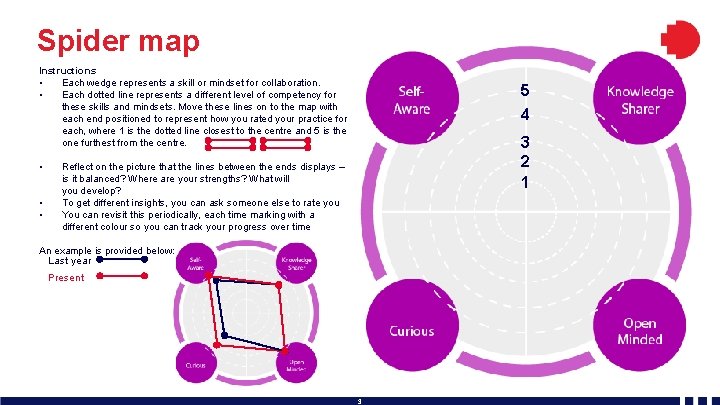
Spider map Instructions • Each wedge represents a skill or mindset for collaboration. • Each dotted line represents a different level of competency for these skills and mindsets. Move these lines on to the map with each end positioned to represent how you rated your practice for each, where 1 is the dotted line closest to the centre and 5 is the one furthest from the centre. • • • 5 4 3 2 1 Reflect on the picture that the lines between the ends displays – is it balanced? Where are your strengths? What will you develop? To get different insights, you can ask someone else to rate you You can revisit this periodically, each time marking with a different colour so you can track your progress over time An example is provided below: Last year Present 3
Reflection • Think of the worst leader that you have worked with – what traits did they have that made you feel this way? • Think of a someone that has inspired you – what quality or tactic did they use that you admired? Can you try this with your team? • What language can you use to influence the team? For instance using “could” and not “should”, or “yes and” rather than “yes but” Try incorporating 2 -5 minutes of self-reflection a day by finding time between tasks (the ‘third space’). For instance, what went well and what did you achieve? What did you learn? What might you change next time? 4
- Slides: 4